
Ever looked through an old jar of coins and wondered if you were holding a hidden treasure? For most people, it's just pocket change. But for a seasoned collector, the difference between a coin worth its face value and one worth a small fortune often boils down to two simple words: key date.
So, what exactly makes a coin a "key date"? Think of it like a limited-edition print from a famous artist. These are specific year-and-mint-mark combinations that were struck in much smaller numbers than their common counterparts, making them the rare, sought-after versions of an otherwise ordinary coin.
What Makes a Coin a Key Date
Imagine the U.S. Mint is a giant bakery. Most years, they're baking millions upon millions of coins—a massive batch of chocolate chip cookies for everyone. But every so often, due to economic downturns, historical events, or just low demand, they only produce a tiny batch.
Those small batches are the key dates. Their scarcity is the secret ingredient that makes them so valuable to collectors.
A coin’s date tells you when it was made, while a tiny letter called a mint mark tells you where. An "S" means it was struck in San Francisco, a "D" in Denver, and so on. A 1916 dime is pretty common, but a 1916-D Mercury Dime? That's a legendary key date. Only 264,000 were ever made in Denver that year, turning a simple dime into a collector's dream.
The Foundation of Coin Value
Grasping this simple concept is the first real step in evaluating any coin collection. It’s the reason one Lincoln cent is worth a penny, while another—the famous 1909-S VDB—can command over a thousand dollars. The value isn't just about age or metal content; it's locked into the story of its production.
A key date transforms a simple piece of currency into a historical artifact. It tells a story of a specific time and place, capturing a moment when circumstances made it rare from the very day it was struck.
This principle holds true for every coin series, from pennies to gold eagles. For anyone looking to sell an inherited collection, spotting these dates is absolutely critical to getting a fair price. Countless valuable coins go unnoticed simply because people overlook these small but vital details. This is especially true for older coins, and our guide on identifying valuable coins from 1964 and earlier dives deeper into this fascinating era.
When dealing with potentially valuable coins, it helps to know the lingo. Here’s a quick breakdown of the terms you'll hear.
Decoding Key Date Terminology
This table is a straightforward guide to the essential terms you'll encounter when discussing valuable coins.
| Term | Simple Definition | Why It Matters for Value |
|---|---|---|
| Key Date | The rarest, lowest-mintage coin in a series. | The "holy grail" for collectors; commands the highest prices. |
| Semi-Key Date | A coin with a relatively low mintage, but not the absolute lowest. | Still scarce and valuable, but more accessible than a key date. |
| Better Date | Any coin that is harder to find than a common date coin. | These coins carry a premium over their common counterparts. |
| Common Date | A coin produced in massive quantities, making it easy to find. | Value is typically based on metal content or face value. |
| Mint Mark | A small letter indicating the U.S. Mint facility where the coin was made. | Creates different versions of the same year's coin, some much rarer than others. |
Understanding these distinctions is the key to sorting a collection and recognizing where the real value lies. A pile of common date coins might just be worth its weight in silver, but a single key date can be worth more than the rest of the collection combined.
Why Selling Locally Matters
Once you think you've found a key date coin, the next step is getting it verified. Instead of trusting your valuables to the mail, you can save the hassle and sell locally for more than online shipments.
As experts in Gold and Jewelry Buying, we provide free, no-obligation evaluations at our Boise location. We use professional tools, including free Xray Scanning and Gold Testing, to confirm authenticity and composition right in front of you. This transparent process means you get a hassle-free offer you can trust. We even offer Price Matching to ensure you always get the highest payout in Boise.
Spotting Valuable Key Dates in Common U.S. Coins
You might be surprised to learn that some of the most valuable coins aren't rare gold pieces locked away in a museum. Many are hiding in plain sight—tucked away in old coffee cans, inherited change jars, and dusty piggy banks. The real secret is knowing exactly what you're looking for.
Certain everyday U.S. coins can be worth a small fortune simply because of their specific coin key dates. This one detail can turn ordinary pocket change into a genuine historical treasure. This guide will walk you through how to spot them.
This chart really puts the value difference into perspective. It shows just how dramatically a coin's status as a "key date" can make its value skyrocket compared to a more common coin from the same series.
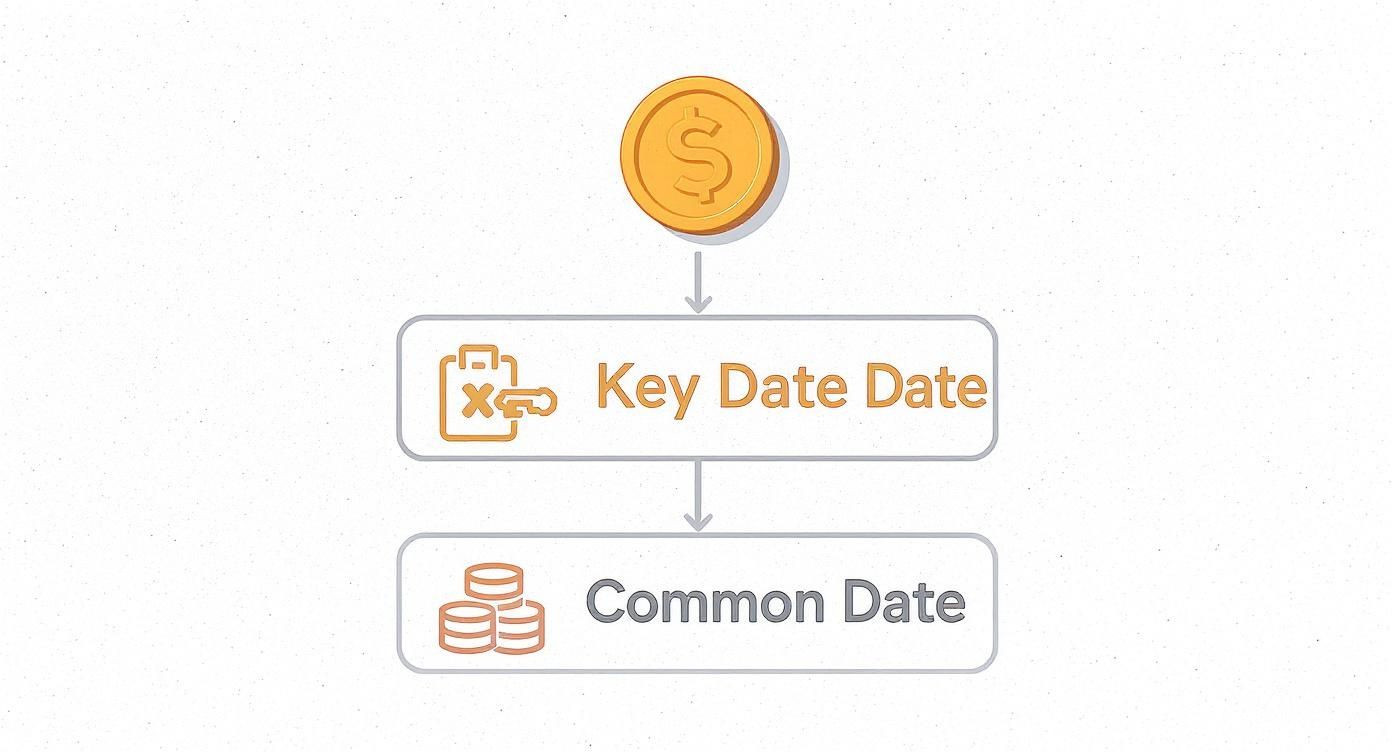
As you can see, the path to high value splits sharply. A common date coin is usually worth its face value or the value of its metal content. A key date, on the other hand, has a value driven by rarity, which gives it a much, much higher ceiling.
Lincoln Cents: The Collector's Starting Point
The Lincoln Cent is probably the most collected coin in American history. This popularity means its key dates are famous and always in high demand. While most "wheat pennies" (minted from 1909-1958) are only worth a few cents, a handful of rare date-and-mint combinations are worth hundreds, if not thousands, of dollars.
One of the most legendary key dates in all of American coin collecting is the 1909-S VDB Lincoln Cent. This coin, from the very first year of the Lincoln series, was unique for featuring the initials of its designer, Victor David Brenner (VDB), on the back. The San Francisco Mint struck a mere 484,000 of these, making it one of the absolute lowest mintages in the entire series. Because of that incredible rarity, even a well-circulated example can fetch several hundred dollars. An uncirculated one? We're talking thousands.
Here are a few other major key dates to hunt for in the Lincoln series:
- 1914-D: The Denver-minted cent from this year is the second-rarest in the series. It's consistently valuable no matter the condition.
- 1931-S: A Depression-era coin with a tiny mintage, making it a real prize for any collector.
- 1955 Doubled Die: This is a famous error coin where the date and lettering are so obviously doubled you can see it without a magnifying glass.
Spotting these coins takes a sharp eye and a little patience. The difference between a common 1914 penny and the valuable 1914-D is just a tiny "D" under the date, but that one letter can mean a massive jump in value.
Buffalo Nickels: A Glimpse of the Old West
The Buffalo Nickel (1913-1938) is another series beloved by collectors, and it has several key dates of its own. Condition is king with these coins. The date was one of the highest points on the design, so it tended to wear off very quickly. Any Buffalo Nickel with a full, clear date is automatically more desirable.
The most famous key date is the 1937-D Three-Legged Buffalo, an error coin created when a mint employee over-polished a die and accidentally removed the buffalo's front leg.
Other important dates to look for include:
- 1913-S Type 2: On this version, the "S" mint mark is on the reverse, just below the words "FIVE CENTS."
- 1916 Doubled Die Obverse: Just like the 1955 cent, this coin shows dramatic doubling on the date.
- 1926-S: A coin with a notoriously low mintage that's very tough to find in good shape.
Washington Quarters: Silver and Scarcity
Before 1965, Washington Quarters were made of 90% silver, which gives them a solid base value. But two specific key dates from the series' early years are valuable for their rarity alone, commanding prices far beyond their silver content.
The main key dates for the entire series are the 1932-D and the 1932-S. With mintages of only 436,800 and 408,000, respectively, these were struck in incredibly small numbers during the height of the Great Depression. Finding either one of these in any condition is a major score for a collector.
Mercury Dimes: Classic Design, Rare Dates
The Mercury Dime, minted from 1916 to 1945, is famous for its stunning design. Like the Washington Quarter, these coins are 90% silver, but a few dates are exceptionally rare. You can get a full breakdown by reading our guide on the value of a Mercury Dime.
The undisputed king of the series is the 1916-D. Only 264,000 were ever made. Even in heavily worn condition, this coin is worth a significant amount of money. Other dates to keep an eye out for are the 1921 and 1921-D, both produced in low numbers right after World War I.
If you believe you've found a key date coin, the next step is getting it verified. Here at our Boise store, we offer Gold and Jewelry Buying services with a total focus on transparency. We provide free Xray Scanning and Gold Testing to authenticate your items right in front of you. This process ensures you get a hassle-free offer and the highest payout in Boise, which we back with our Price Matching guarantee. Save the hassle and sell locally for more than online shipments can ever offer.
Uncovering High-Value Silver and Gold Coin Key Dates
While a key date can turn a humble penny into a collector's prize, the stakes get a whole lot higher when precious metals enter the equation. For silver and gold coins, a key date doesn’t just add a little extra value—it can multiply the coin's base metal worth exponentially. This powerful blend of rarity and precious metal content is where true investment-grade treasures are born.
Think about a standard one-ounce silver coin. Its value is pretty straightforward, tied directly to the daily spot price of silver. But what if that same coin happens to be a key date with a low mintage? Suddenly, its value isn't just about the metal anymore. It’s about scarcity and historical significance, which can launch its price far beyond what the silver itself is worth.

This dual-value system gives collectors and investors a unique safety net. The precious metal content sets a solid price floor, while the key date status offers incredible potential for appreciation. It’s the best of both worlds.
Morgan and Peace Silver Dollars
The Morgan Silver Dollar series, minted from 1878 to 1904 and again in 1921, is a perfect illustration of this principle in action. The 1893-S Morgan Dollar is the undisputed champion of the series. Struck during the Panic of 1893, a severe economic depression, only 100,000 were ever made. This rarity makes it wildly valuable, often fetching tens of thousands of dollars even in circulated condition. Then there's the 1895 Morgan, nicknamed the "King of the Morgan Dollars," which was only issued as a proof coin. With fewer than 900 believed to exist, it's another top-tier collectible.
The Peace Dollar, minted from 1921 to 1935, also has its share of heavy hitters:
- 1921: The very first year of issue featured a stunning high-relief design that proved difficult to strike properly. Finding a well-preserved example is a real challenge for collectors.
- 1928-P: With a tiny mintage of just 360,649, this is the key date of the series and a must-have for anyone serious about completing their collection.
- 1934-S: This San Francisco issue is notoriously hard to find in uncirculated condition, which drives its value way up.
Key Dates in American Gold Coinage
Gold coins represent the absolute pinnacle of coin collecting, where immense historical importance meets high intrinsic value. The Saint-Gaudens Double Eagle ($20 gold piece), minted from 1907 to 1933, is widely considered the most beautiful coin ever produced by the U.S. Mint.
While most of these coins are valued for their nearly one ounce of gold, certain dates are exceptionally rare. The 1927-D Double Eagle is the stuff of legend. Although over 180,000 were minted, the vast majority were melted down following the Gold Recall of 1933, leaving only a handful known to exist today. This makes it one of the most valuable coin key dates in the entire world. Understanding what makes a certified gold coin so sought-after can give you an even deeper appreciation for these historical artifacts.
Key date gold coins offer a unique blend of security and potential. Their gold content provides a solid baseline value, while their numismatic rarity offers the opportunity for significant long-term growth, protecting your investment from market fluctuations.
Your Local Boise Precious Metals Expert
Telling the difference between a common date and a rare one requires a trained eye and professional tools, especially with silver and gold. If you've inherited an old coin collection or are looking into Gold and Jewelry Buying, getting an expert opinion is absolutely critical. Here at our Boise location, we provide free Xray Scanning and Gold Testing to verify the authenticity and composition of your items without causing a scratch.
This transparent, scientific approach ensures you get a fair, hassle-free offer every single time. We even offer Price Matching to guarantee you get the highest payout in Boise. Why deal with the risk and uncertainty of shipping your valuables away? You can save the hassle and sell locally for more than online shipments, getting paid on the spot with complete peace of mind.
So, you’ve sifted through a jar of old change and think you might have a key date coin on your hands. That initial thrill of discovery is an amazing feeling, but it’s just the first step. The next part is what really counts: verification.
A coin’s entire value rests on two pillars: its authenticity and, just as crucially, its physical condition. A single, seemingly minor scratch or a well-intentioned but amateur cleaning can send the value of a rare coin plummeting.
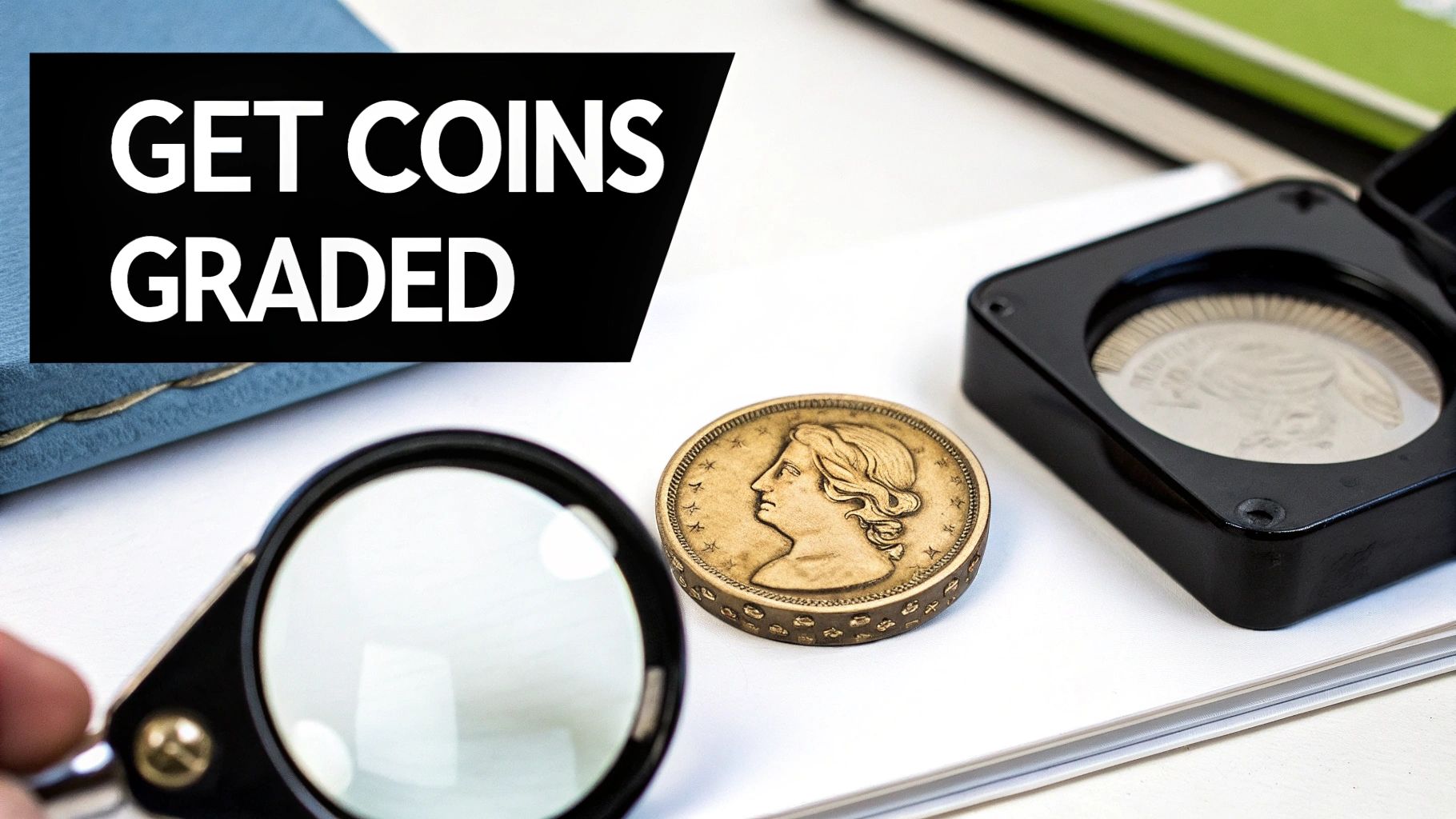
This is precisely why getting a proper, professional evaluation is so critical. Before you can even think about what your coin is worth, you need an unbiased, expert assessment of what you actually have.
How to Properly Evaluate Your Key Date Coins
The Basics of Coin Grading
Coin grading is simply the system used to describe a coin’s physical condition. While official grading is a complex science that takes years to master, you can learn the basics to get a ballpark idea of where your coin stands. The scale runs from Poor (heavily worn, barely identifiable) all the way up to Perfect Uncirculated (a flawless coin that looks like it just rolled off the press).
Here’s a quick rundown of what to look for:
- Good (G): The coin is very worn down, but you can still make out the main design and the date. The rims will probably be flattened into the rest of the coin.
- Fine (F): Most of the major design elements are clear, but you can see significant wear across the entire surface.
- Extremely Fine (XF): This coin only shows light wear on the highest points of the design, like the cheek on a portrait or the eagle’s feathers. Most of the original shine from the mint (its "luster") is gone.
- Uncirculated (UNC): There is absolutely no trace of wear. The coin still has its original mint luster, though it might have a few small dings or "contact marks" from being stored in a bag with other new coins.
The most important thing to understand is that even a small jump in grade—say, from Fine to Extremely Fine—can cause a massive leap in value for a key date. This is why a precise, professional assessment isn't just a suggestion; it's essential for getting the best price.
Below is a simple checklist to help you get started with a preliminary assessment.
Coin Condition and Grading Checklist
This table provides a simplified guide to help you make a basic assessment of your coin's condition before seeking a professional opinion.
| Grade Category | Key Visual Cues | Impact on Value |
|---|---|---|
| Poor/Fair | Date is barely legible; major design elements are worn flat. | Lowest value; typically only worth its metal content unless it's an extreme rarity. |
| Good (G) | Main design and date are visible, but heavily worn. Rims are flat. | Low-end collector value. A common date in this condition has little premium. |
| Fine (F) | Significant wear is visible, but major details are still clear. | Moderate value. A key date in Fine condition can still be quite valuable. |
| Extremely Fine (XF) | Light wear is present only on the highest points of the design. | High value. This is where prices for key dates really start to climb. |
| Uncirculated (UNC) | No signs of wear at all. Original mint luster is present. | Highest potential value, often increasing exponentially with each small step up in grade. |
| Red Flags | Unnatural shine, parallel scratches, mushy details near mint mark. | Any signs of cleaning or alteration can drastically reduce value, sometimes by 50% or more. |
Keep in mind, this is a starting point. Subtle differences the untrained eye might miss are what separate a good coin from a great one.
Spotting Red Flags and Alterations
Unfortunately, where there’s high value, there are often fakes. Counterfeiters have gotten crafty over the years. A common trick is to alter a common coin to mimic a rare one—for instance, carefully adding an "S" mint mark to a 1909 VDB Lincoln Cent to create a fake key date. Another is scraping a "3" on a Peace Dollar to look like an "8," turning a common coin into a fake 1928 key date.
The other major red flag is cleaning. It sounds completely backward, but you should never, ever clean a potentially valuable coin. Any kind of abrasive cleaning leaves behind tiny, unnatural scratches that permanently destroy the coin's original surface, or "patina." An experienced buyer can spot a cleaned coin from a mile away, and it can slash its value by 50% or more. For a deeper dive, our guide explains how to properly handle a silver dollar and why keeping chemicals far away is so important.
The Importance of Professional Verification
Trying to guess a coin's grade or authenticity based on a few online pictures is a recipe for disappointment. The only way to be certain is to have it examined in person by a professional who can spot the subtle details an untrained eye will always miss.
This is where having a trusted local expert changes the game. At our Boise location, we specialize in Gold and Jewelry Buying and offer a completely transparent, risk-free evaluation. We use advanced, non-destructive technology to give you solid answers without leaving so much as a fingerprint.
- Free Xray Scanning: Our X-ray fluorescence (XRF) scanner tells us the exact metallic makeup of your coin, confirming if it’s real gold, silver, or the correct alloy—all without leaving a mark.
- Free Gold Testing: For any gold coins, we perform additional verification to confirm its purity and authenticity.
- Expert Numismatic Assessment: Our team will carefully examine your coin for its grade, authenticity, and any signs of cleaning or alteration.
This entire process is 100% free, and we provide hassle-free offers with zero obligation to sell. We even offer Price Matching to guarantee you get the highest payout in Boise. Why go through the stress of mailing your valuables to some faceless online buyer? You can save the hassle and sell locally for more than online shipments, all while getting a confident, accurate assessment and immediate payment.
Getting the Highest Payout for Your Coins in Boise
https://www.youtube.com/embed/ryRi_l0RwC8
So, you've gone through your collection and identified a few potential coin key dates. That’s the exciting part. The next step is turning that rarity into real, tangible value, and where you choose to sell can make a monumental difference in your final payout.
It can be tempting to use online mail-in services. They seem convenient on the surface, but they come with significant risks. Packages get lost, and lowball offers arrive that you have little power to negotiate. Suddenly, convenience doesn't feel so convenient anymore.
This is exactly why selling to a trusted local expert here in Boise is the smartest, safest move you can make. It cuts out all the uncertainty. You get a transparent, face-to-face transaction, a firm, hassle-free offer, and immediate payment. It’s security from start to finish.
The Advantage of Selling Locally
When you choose a local buyer, you never lose control of your valuable assets. You can watch the entire evaluation process, ask all the questions you want, and make an informed decision without feeling rushed or pressured. That personal interaction builds trust and ensures you’re treated like a valued client, not just another number in a queue.
Our commitment is simple: provide the highest payout in Boise. And that's a promise we stand by. We’re able to do this by combining deep numismatic knowledge with a dedication to fair, transparent business. We want you to feel confident and respected every step of the way.
Selling locally isn't just about convenience—it's about security, transparency, and maximizing your return. You save yourself the hassle, avoid the risk, and ultimately get more for your collection than you would with an anonymous online shipment.
We get it. Every collection is unique, whether it’s a single rare coin passed down through generations or an entire estate you’re managing. That’s why we offer a personalized approach, tailored to your specific items.
Our Transparent and Free Evaluation Process
Knowledge is power, especially when you're selling valuable items. We believe in empowering our clients by making our evaluation process completely transparent. We offer a free, no-obligation assessment of your coins, jewelry, and precious metals right in front of you.
Here’s what our professional evaluation includes:
- Free Xray Scanning: We use state-of-the-art X-ray fluorescence (XRF) technology to analyze the exact metallic composition of your items. This method is non-destructive, incredibly accurate, and instantly confirms authenticity without ever leaving a mark.
- Free Gold Testing: For any gold items, we perform additional verification to confirm purity and genuineness. This ensures our offer is based on precise, scientific data, not guesswork.
- Expert Numismatic Review: Our specialists carefully examine each coin for its grade, condition, and any signs of cleaning or alteration, giving you a clear, honest picture of its true market value.
This thorough, hands-on approach is central to our Gold and Jewelry Buying services. You’ll leave our shop with a clear understanding of what you have and exactly what it’s worth. If you're looking specifically to sell gold coins, our detailed guide on where to sell gold coins in Boise offers even more valuable insights.
Our Commitment to the Best Price
We are so confident in our pricing that we back it up with a Price Matching guarantee. If you bring us a better written offer from another local buyer, we will match it. This promise ensures you always walk away with the highest possible payout for your treasures.
Don't settle for the stress and uncertainty of mailing your valuables away. Save the hassle and sell locally for more than online shipments can ever offer. Visit our Boise location for a professional, rewarding, and pressure-free experience that puts more money directly into your pocket.
Got Questions About Key Dates? We’ve Got Answers.
Jumping into the world of key date coins can feel a bit like learning a new language. As you start sorting through an old collection, you'll find the same questions popping up over and over. This section is all about giving you clear, straightforward answers to those common hurdles, helping you feel more confident in your journey.
Think of this as your go-to cheat sheet for those final, crucial questions that stand between you and understanding a coin's true value.
What's the Real Difference Between a "Key Date" and a "Semi-Key Date"?
That's a fantastic question, and it really gets to the heart of how collectors think. Let's use an analogy. Imagine you're collecting every baseball card for your favorite player.
The "key date" is their ultra-rare rookie card. It’s the single hardest one to find, the most expensive, and the crown jewel of the entire set. It's often the coin with the absolute lowest mintage numbers.
A "semi-key date" is more like a limited-edition card from a championship year. It’s still rare, valuable, and a real challenge to track down, but it’s not the number one toughest. It will always command a serious premium over common dates but is usually a little more attainable than the main key date. Both are absolutely essential for anyone trying to build a complete, high-value collection.
Where Do I Look for the Mint Mark on My Coin?
Knowing where to find the mint mark is one of the most important first steps. Its presence—or absence—can be the difference between a coin worth a few cents and one worth thousands of dollars. The location of this tiny letter changes depending on the coin's design and the era it was made.
Here are a few of the most common spots to get you started:
- Lincoln Cents: On "wheat pennies" (1909-1958), the mint mark is right on the front (obverse), just below the date.
- Morgan and Peace Dollars: For these big silver dollars, you’ll need to flip them over. The mint mark is on the reverse (back), usually tucked below the eagle or the word "ONE."
- Washington Quarters: On the classic silver quarters (made before 1965), the mint mark is on the reverse, underneath the wreath.
Common mint marks are "S" for San Francisco, "D" for Denver, and "P" for Philadelphia. One tricky detail: for much of its history, the Philadelphia mint didn't use a "P" mint mark at all. So, if your coin has no mark, it often means it was minted in Philadelphia.
A quick online search for your specific coin type and year will show you exactly where to look. This simple step is absolutely critical for an accurate ID.
Will Cleaning a Rare Coin Make It More Valuable?
This is easily the most important question for anyone new to handling old coins, and the answer is a firm, absolute NO. In the world of coin collecting (numismatics), cleaning a coin is one of the most destructive things you can possibly do. It permanently tanks its value.
Think of a coin's original surface, or "patina," as its unique historical fingerprint. This natural toning develops over many decades and is what serious collectors look for as proof of authenticity and originality. Any kind of cleaning—whether with a simple cloth, polish, or a chemical dip—creates microscopic scratches and strips away that delicate, original surface forever.
An expert can spot a cleaned coin from a mile away. That unnaturally bright shine or the presence of fine, parallel lines are dead giveaways. This irreversible damage can slash a coin's value by 50% or even more. The golden rule is simple: leave the coin exactly as you found it.
Why Is Selling Locally So Much Better Than Mailing My Coins Away?
When you’re dealing with valuable items, security and trust are everything. Selling your coins locally here in Boise gives you total control and, more importantly, peace of mind. You completely avoid the huge risks that come with shipping, like packages getting lost, damaged in transit, or being insured for the wrong amount. There's no anxious waiting by the mailbox or dealing with a faceless online company that might send you a lowball offer you can't really dispute.
At our Boise location, we specialize in Gold and Jewelry Buying with a process built on 100% transparency. You can sit with us and watch as we evaluate your items right in front of you.
We provide free, no-obligation Xray Scanning and Gold Testing to confirm authenticity without leaving a single mark. This scientific approach means our hassle-free offers are based on real data, not guesswork. Plus, with our Price Matching promise, you’re always guaranteed the highest payout in Boise. You save the hassle and sell locally for more than online shipments can ever offer, all while getting immediate payment and expert, friendly service.
At Carat 24 - Trusted Gold Experts, our commitment is to provide a secure, transparent, and rewarding experience for everyone looking to sell their coins, gold, or fine jewelry. Visit us to receive a professional evaluation and discover the true value of your collection.
Learn more about our services and get the highest payout at Carat 24 Boise
