
When you're trying to understand what makes a diamond truly special, it really comes down to two key factors beyond its cut: Clarity and Color. Think of Clarity as a diamond's unique fingerprint—the natural birthmarks it acquired while forming deep within the earth. Color, on the other hand, is all about its purity, or more accurately, its complete lack of color.
Getting a handle on both is the secret to choosing a stone that’s not just beautiful, but also a smart investment. For Gold and Jewelry Buying, understanding these qualities is the first step to securing the highest payout in Boise.
What Diamond Clarity and Color Really Mean
Before we get into the nitty-gritty of grading charts, let's break these ideas down.
Imagine a diamond with exceptional clarity. It has virtually no internal or external imperfections, which means light can travel through it without hitting any roadblocks. The result? Maximum sparkle. Now picture a diamond with a top-tier color grade. It's perfectly transparent, like a drop of pure spring water, allowing its natural fire and brilliance to explode without any hint of a yellow tint.
These two qualities are a team. They work together to create the visual appeal of a diamond and are major players in determining its price.
Why Grading Matters
For a long time, the diamond world felt a bit like the Wild West. There was no single, universal standard for quality, making it nearly impossible for everyday people to compare stones fairly. That all changed when the Gemological Institute of America (GIA) stepped in and created the grading system that is now the gold standard worldwide.
This system gives us a common language. It ensures that a “G” color or a “VS2” clarity grade means the exact same thing whether you're here in Boise or halfway across the globe. Whether you’re in the market for a new ring or thinking about selling a family heirloom, these grades are your guide to understanding a diamond’s true value.
Understanding the basics of clarity and color is your first step toward making a confident decision. It empowers you to know exactly what you're paying for or, if you're selling, what your jewelry is truly worth.
Clarity vs. Color At a Glance
To quickly summarize the difference, here's a simple breakdown of what each quality factor measures and how it affects a diamond's value.
| Attribute | What It Measures | Impact on Diamond | Grading Scale |
|---|---|---|---|
| Clarity | The presence of internal (inclusions) and external (blemishes) imperfections. | Affects the diamond's brilliance and sparkle by obstructing light. | Ranges from Flawless (FL) to Included (I3). |
| Color | The absence of color, specifically any yellowish or brownish tint. | Affects the diamond's overall appearance and brightness. | Ranges from D (Colorless) to Z (Light Color). |
Ultimately, both are critical, but they influence the diamond's beauty in very different ways.
Local Expertise for Boise Sellers
Knowing these fundamentals is especially important if you're considering selling diamond jewelry. To get the highest payout in Boise, you need a trusted expert who can accurately assess these grades on the spot. When you work with a local professional, you get benefits you just can’t find online. Save the hassle and sell locally for more than online shipments.
- Xray Scanning and Gold Testing for free: We use sophisticated tools to verify your item’s authenticity, and we do it at no cost to you.
- Hassle free offers: Forget the stress and risk of shipping your valuables. A local evaluation means you get a direct, transparent offer right then and there.
- Price Matching: Reputable Boise buyers will often match competitor prices, making sure you walk away with the best possible deal.
Understanding your diamond’s quality is the starting point. Our guide on how to tell if diamonds are real can give you even more tools. But nothing beats an expert, in-person appraisal to ensure you receive fair compensation for the true quality of your stone.
A Visual Tour of the GIA Clarity Scale
Think of a diamond's clarity not as a measure of perfection, but as its unique fingerprint. Those tiny characteristics inside are natural ‘birthmarks’ that formed deep within the earth billions of years ago. They’re what make every single diamond one-of-a-kind.
To help us understand this inner world, the Gemological Institute of America (GIA) developed a standardized scale. It’s not about finding a flawless stone, but about understanding how its internal features (inclusions) and external marks (blemishes) affect its overall look. For most of us, the goal is simple: find an ‘eye-clean’ diamond, where none of these characteristics are visible without a jeweler's loupe. That’s the sweet spot where incredible beauty and smart value meet.
The factors below are the foundation of a diamond's worth, and clarity is one of the most important pillars.
Let's walk through the GIA clarity scale together, grade by grade, to see what it all means in the real world.
Flawless and Internally Flawless Grades
Right at the top of the pyramid are the rarest and most sought-after grades. These are the legends of the diamond world.
- Flawless (FL): A Flawless diamond is perfect inside and out, showing no inclusions or blemishes even under powerful 10x magnification. They are the absolute pinnacle of purity.
- Internally Flawless (IF): An IF diamond has no internal inclusions but might have tiny, insignificant blemishes on the surface, visible only under 10x magnification. To the naked eye, it’s indistinguishable from a Flawless stone.
These grades are true investment pieces and collector's items. If you're looking to sell a certified FL or IF diamond, you have something exceptionally valuable. Getting it professionally verified is the key to securing the highest payout in Boise.
GIA Diamond Clarity Grades Explained
To make sense of it all, here's a quick breakdown of what each grade really means when you're buying or selling a diamond. This chart lays out the entire GIA clarity spectrum, from the rarest of the rare to the more common grades.
| Clarity Grade | Definition | Visual Appearance (to the naked eye) | Best For |
|---|---|---|---|
| Flawless (FL) | No inclusions or blemishes visible under 10x magnification. | Absolutely perfect. | Investment-grade collections and the highest-end jewelry. |
| Internally Flawless (IF) | No inclusions, only minor blemishes visible under 10x magnification. | Perfect. Indistinguishable from Flawless. | Collectors and those seeking top-tier, heirloom quality. |
| VVS1, VVS2 | Very, Very Slightly Included. Inclusions are extremely difficult for a skilled grader to see under 10x magnification. | Always "eye-clean." | High-end engagement rings where perfection is key. |
| VS1, VS2 | Very Slightly Included. Minor inclusions are visible with effort under 10x magnification. | Almost always "eye-clean." | The sweet spot for exceptional quality and great value in fine jewelry. |
| SI1, SI2 | Slightly Included. Inclusions are noticeable under 10x magnification. | Often "eye-clean," especially SI1. SI2 requires careful inspection. | Excellent value, offering an eye-clean look for a much lower price. |
| I1, I2, I3 | Included. Inclusions are obvious under 10x magnification and often visible without it. | Inclusions are typically visible and can impact sparkle. | Budget-conscious buyers; often used for smaller accent stones. |
Understanding this chart helps you pinpoint where the best value lies for your specific needs, whether you're buying an engagement ring or assessing a piece you'd like to sell.
VVS and VS: The Eye-Clean Champions
Stepping down from the flawless tier, we find the grades that deliver a visually perfect look without the breathtaking price tag. This is where most high-quality jewelry lives.
Very, Very Slightly Included (VVS1 and VVS2) diamonds have such tiny inclusions that even a trained gemologist has to hunt for them under a microscope. To you and me, they look completely perfect.
Very Slightly Included (VS1 and VS2) diamonds have minor inclusions that are still tough to spot with magnification. They are almost always eye-clean, representing a fantastic balance of quality and cost, which is why they're so popular.
SI and I Grades: Smart Value and Visible Characteristics
In the final categories, you have to be a bit more selective, but this is also where you can find incredible deals.
Slightly Included (SI1 and SI2) diamonds have inclusions that are easy to spot under magnification. An SI1 diamond is often the best value on the entire clarity scale because it's frequently eye-clean. An SI2, however, might have visible inclusions, so it’s a stone you’ll want to inspect in person.
Included (I1, I2, and I3) diamonds have obvious inclusions that are almost always visible to the naked eye. These inclusions can sometimes affect the diamond's brilliance and structural integrity.
The rarity of high-clarity diamonds is pretty staggering. Only about 20% of all mined diamonds are even considered gem-quality, and Flawless stones account for less than 1% of that. It’s no surprise that the vast majority of diamonds in engagement rings are in the VS and SI ranges—they deliver that gorgeous, eye-clean look without the collector-grade price.
If you want to sell a diamond, a professional appraisal is the only way to know its true clarity grade. Our guide on how to get jewelry appraised breaks down the entire process. A local expert can give you hassle free offers and provide Xray Scanning and Gold Testing for free on the spot. You can save the hassle and sell locally for more than online shipments, and we even offer Price Matching to guarantee you get the best value.
Navigating the Spectrum of Diamond Color
While clarity maps out a diamond’s internal world, color really defines its outward personality. It’s a common misconception that you're looking for a beautiful color in a diamond; what you're actually after is a stunning lack of color. The Gemological Institute of America (GIA) grades diamond color on a precise scale from D to Z, where D represents the absolute pinnacle of purity—a completely colorless stone that acts like a perfect prism for light.
As you move down the alphabet, subtle hints of yellow or brown begin to creep in. This isn't a flaw; it's a natural result of trace elements, like nitrogen, that were present when the diamond was forming deep within the earth millions of years ago. For most of us, the goal is to find a diamond that looks perfectly white to the naked eye, a feat that, thankfully, doesn't always require a flawless and pricey D grade.
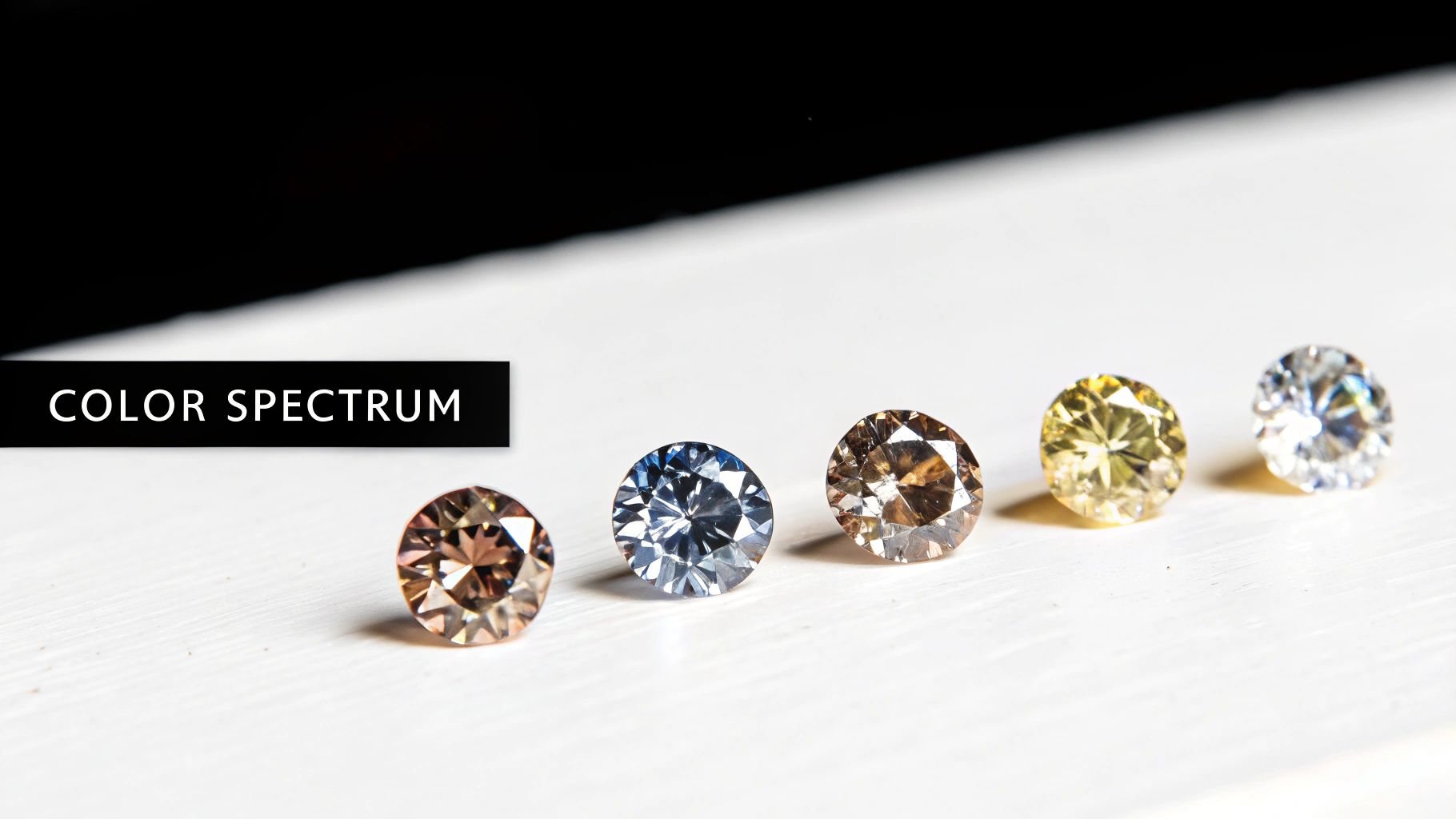
This image from the GIA vividly illustrates that progression from colorless to light yellow. It’s a foundational visual in the diamond world, used by both buyers and sellers to understand and communicate value.
Understanding the Color Grade Groups
The GIA scale isn't just a random list of letters. It’s intelligently organized into logical groups that give you a real-world sense of a diamond’s appearance and how it impacts both its beauty and price.
-
Colorless (D-F): These are the true elites, the rarest and most valuable grades. A diamond in this range is like a drop of crystal-clear water, showing absolutely no discernible color. A D grade is perfectly colorless, while E and F have minuscule traces of color that only a trained gemologist can spot under magnification.
-
Near Colorless (G-J): This is the sweet spot and by far the most popular range for engagement rings, and for good reason. Diamonds graded from G through J contain a very slight warmth that’s incredibly difficult for an untrained eye to detect once the stone is set in jewelry. They deliver a brilliant, white appearance at a much more accessible price point than the colorless grades.
-
Faint (K-M): When you get into the K-M range, you'll see a noticeable hint of warmth or a faint yellow tone. While this color is visible, some people genuinely appreciate its subtle, warm glow, especially when paired with vintage-inspired settings or yellow gold.
The GIA's color grading scale is the undisputed global standard. And while D color diamonds account for less than 1% of all gem-quality stones, the vast majority of savvy shoppers wisely choose stones in the G to J range. They get a diamond that appears colorless when set and delivers exceptional value for their money. You can get more great insights on this from Roman Malakov’s detailed color chart explanation.
The Secret Weapon: Metal Settings
Here’s a trick of the trade that can make your budget stretch significantly further. The color of your jewelry’s metal setting has a massive influence on how your diamond’s color is perceived. This is a game-changing tip whether you're buying a new piece or selling an old one.
A diamond with a slightly lower color grade, say a J or K, can look absolutely brilliant and white when it’s set in yellow or rose gold. The warm tone of the metal naturally complements the slight warmth in the diamond, creating a contrast that makes the stone appear much whiter than its grade suggests. This simple choice can save you thousands without sacrificing visual beauty.
Pro Tip: If your heart is set on platinum or white gold, it's best to stick with a higher color grade (G or H is a great choice). The cool, bright white of these metals can act like a spotlight, making any faint yellow in a lower-grade diamond more apparent.
What This Means For Boise Sellers
If you're thinking about selling your diamond jewelry, understanding this interplay between color and setting is critical for getting the highest payout in Boise. A true expert evaluation, like the one we provide at Carat 24, considers not just the diamond's certificate grade but also its setting and overall real-world appearance. We provide hassle free offers based on a complete and honest assessment.
With our free Xray Scanning and Gold Testing, we can instantly verify the quality of both your diamond and its precious metal setting. This transparent process ensures you know exactly what you have and understand its true value. Why risk sending your valuables through the mail when you can save the hassle and sell locally for more than online shipments? With our Price Matching guarantee, you can be absolutely confident you’re getting the best possible offer right here in Boise.
How Clarity and Color Drive Diamond Prices
Understanding the GIA scales is one thing. Connecting those grades to a diamond’s price tag is where the real magic happens—it's how you make truly smart decisions, whether you're buying or selling.
The relationship between a diamond's quality and its cost isn't a straight line; it's exponential. A single step up the grading ladder can trigger a huge price jump, often for a difference you couldn't spot without a jeweler's loupe.
For example, jumping from a VS2 to a VVS2 clarity grade can jack up the price by 20-30% or more. The same goes for color—an F color diamond costs significantly more than a G. But here’s the secret: to the naked eye, those diamonds would likely look identical. This is where we find the "sweet spot"—that perfect blend of grades that gives you a stunning, eye-clean diamond without the top-tier premium.
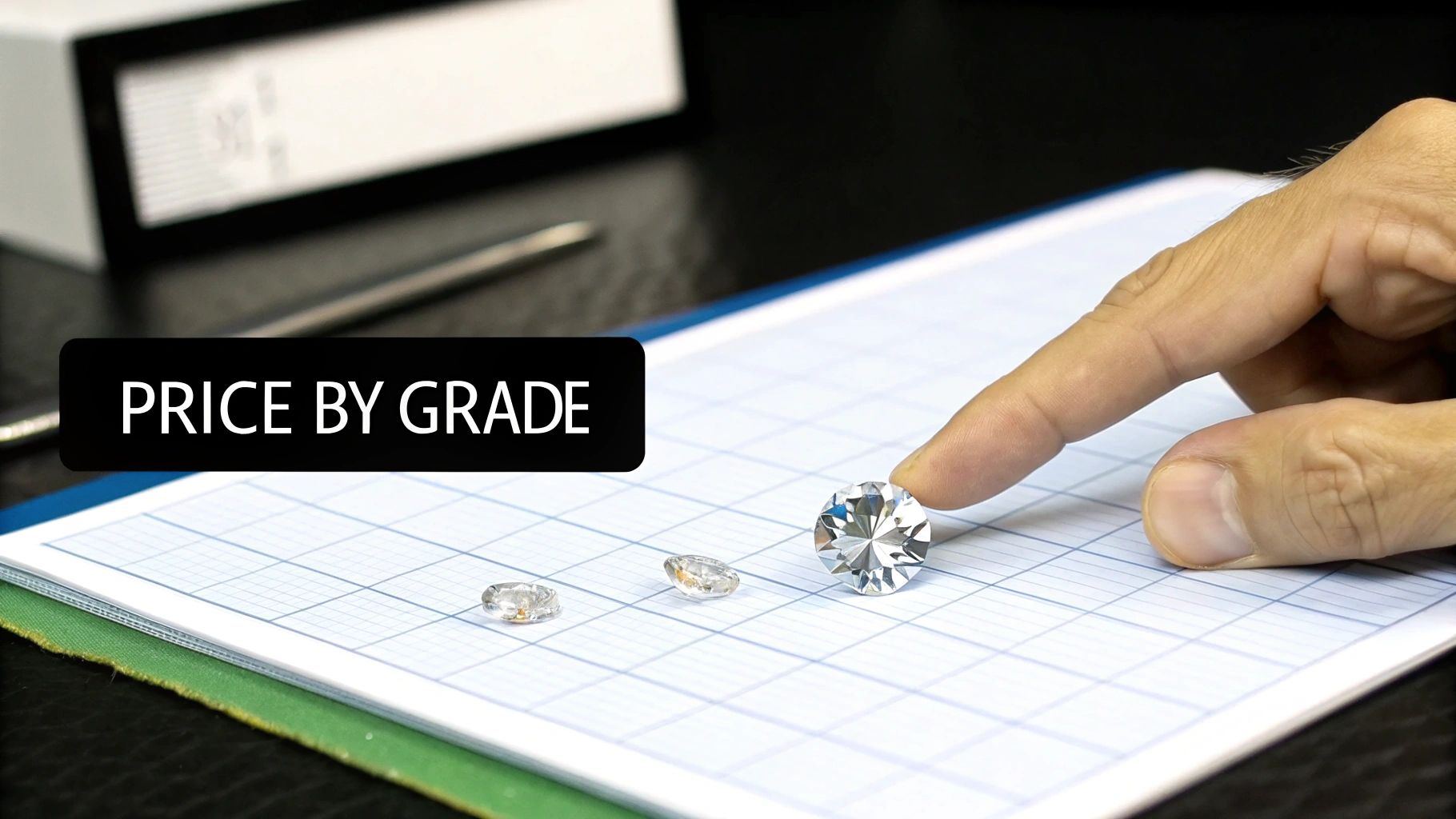
This knowledge is power. It lets you build a budget around what actually matters for visual beauty, not just what a piece of paper says.
Prioritizing the 4Cs for Maximum Value
When you're trying to get the most bang for your buck, it helps to think of the 4Cs (Cut, Color, Clarity, Carat) as a hierarchy. They all play a role, but their impact on a diamond's sparkle isn't equal. Ask any seasoned gemologist, and they'll almost always rank them in the same order.
-
Cut: This is, without a doubt, the king. A diamond's cut is 100% responsible for its brilliance, fire, and scintillation—that dazzling light show everyone craves. An excellent cut can make a diamond with slightly lower color or clarity grades look absolutely spectacular. On the flip side, a poor cut will make even a flawless, colorless diamond look dull and lifeless. Always, always prioritize the best cut you can afford.
-
Color: Coming in at a close second is color. The human eye is surprisingly good at detecting hints of yellow, much more so than spotting tiny inclusions. A diamond that appears crisp and white will almost always make a bigger visual impact than one with a slightly warmer tone.
-
Clarity: Clarity is third on the list, but with one major condition: the diamond must be "eye-clean." The tiny internal birthmarks in a VS2 or even a well-chosen SI1 diamond are invisible without magnification. Paying a premium for VVS or Flawless grades buys you perfection on paper, but often with no visible benefit.
This ranking is your roadmap to getting the most beauty and value out of any diamond.
Finding Your Diamond's Sweet Spot
The "sweet spot" is that perfect intersection where you get the most visual pop for your dollar. For most people, this means finding a diamond with:
- An Excellent cut
- A G-H color grade
- A VS2-SI1 clarity grade
This combination typically gives you a diamond that looks colorless and flawless to the naked eye but costs a whole lot less than one with top-of-the-line grades.
A savvy buyer focuses on what the eye can see, not just what the certificate reports. By choosing an eye-clean VS2 over a VVS1, you can often redirect those savings toward a larger carat weight or a better cut, making a much bigger impact on the diamond's overall beauty.
This same principle is vital when you're selling. The market value of your diamond is heavily dictated by where it lands on this value curve. Understanding your diamond’s true specs helps you set realistic expectations. For a deeper look, our guide on calculating a diamond's resale value breaks down how these factors translate into actual cash offers.
Get the Highest Payout in Boise
When it's time to sell your gold and jewelry, this knowledge becomes your greatest asset. To get the highest payout in Boise, you need to work with an expert who truly understands this value hierarchy. Online buyers often make lowball offers simply because they can't see the stone's true performance in person.
We provide hassle free offers based on a thorough, hands-on evaluation right here in our office. With Xray Scanning and Gold Testing for free, we verify every aspect of your jewelry on the spot. You can save the hassle and sell locally for more than online shipments. We even offer Price Matching to ensure you walk away confident you've received the best possible price for your valuables.
Your Guide to Buying and Selling in Boise
Now that you have a solid handle on diamond clarity and color, you're ready to make some smart decisions right here in Boise. Whether you're in the market to buy a new piece or considering selling one, having local expertise in your corner changes everything. It turns what can be a nerve-wracking process into a confident, rewarding experience.
Forget the risks and frustrating delays of those online mail-in services. When you work with a local expert for Gold and Jewelry Buying, you get total transparency and immediate results. The surest way to get the highest payout in Boise is to partner with a professional who evaluates your pieces with you, right there on the spot.
Why Selling Locally is the Smarter Choice
Choosing a local buyer means you’re in the driver's seat. You get to watch the entire process, ask questions as they come up, and receive instant, straightforward answers about your diamond's quality and real-world value. There’s simply no substitute for that level of personal service and security.
When you sell locally, you eliminate the uncertainty of shipping your precious items. You get a firm, hassle-free offer on the spot, backed by a professional evaluation you can trust.
This direct, face-to-face approach ensures you're treated like a valued client, not just another number in a queue. You get expert attention focused specifically on your items.
The Carat 24 Advantage
At Carat 24, our reputation is built on trust and transparency. We firmly believe an informed seller is an empowered seller. That’s why we offer a whole suite of complimentary services designed to show you the true, honest value of your jewelry—it’s how we guarantee you get the best possible offer.
- Xray Scanning and Gold Testing for free: We use advanced, non-invasive technology to pinpoint the purity of your precious metals and the quality of your gems. This service is always free, with absolutely no obligation.
- Hassle free offers: Our experts assess your items and give you a clear, competitive offer right away. You can make your decision with zero pressure from us.
- Price Matching: We are committed to giving you the best value in town. We will happily match competitor prices to ensure you always walk away with the highest payout.
- More Value Than Online Shipments: You can save the hassle and sell locally for more than online shipments. Our process is built to be efficient, secure, and put more money back in your pocket.
Making Your Decision with Confidence
Navigating the world of buying and selling diamonds and gold requires knowledge. For a deeper dive, be sure to check out our comprehensive guide on buying gold and diamonds in Boise. This resource is packed with extra tips for making the most of your investments.
Ultimately, your goal is to get fair market value with complete peace of mind. By choosing a trusted Boise expert, you’re not just making a transaction; you’re gaining a partner dedicated to making the process clear, fair, and profitable. Stop by for a free evaluation and see for yourself what a difference local, expert service makes.
A Few Final Questions
Navigating the world of diamonds always brings up a few common questions. Let's tackle some of the most frequent ones we hear from our clients right here in Boise. Getting clear, straightforward answers is the best way to feel confident in your decisions.
Which Clarity Grade Offers the Best Value?
Hands down, the sweet spot for value is almost always in the VS (Very Slightly Included) and SI1 (Slightly Included) grades. Diamonds in this range are what we call "eye-clean," meaning their tiny natural inclusions are completely invisible unless you're looking through a jeweler's loupe.
This is a huge advantage. You get a diamond that appears flawless to the naked eye without paying the massive premium that comes with truly flawless grades. Side-by-side, a beautiful SI1 and a flawless diamond can look identical, but their price tags will be worlds apart.
How Does My Ring's Metal Choice Affect Diamond Color?
The metal you choose for a setting has a massive impact on how your eye perceives the diamond's color. Think of platinum or white gold settings as a crisp white background—they'll make even the slightest hint of yellow stand out. For these metals, sticking with a colorless (D-F) or near-colorless (G-H) diamond is your best bet.
On the other hand, yellow or rose gold is much more forgiving. The warmth of the band naturally complements a diamond with a little more color (like an I, J, or even K grade), making it appear beautifully white in comparison. This is a brilliant strategy for saving a considerable amount of money while still getting a stunning look.
Is a GIA Report Really That Important?
Absolutely. A GIA report isn't just a piece of paper; it's the gold standard in the diamond industry. It represents an unbiased, consistent, and highly respected evaluation of your diamond's quality. For a buyer, it's your guarantee that you're getting exactly what you paid for.
For sellers, it’s undeniable proof of your diamond's characteristics and value. When you're trying to get the highest payout in Boise for your diamond jewelry, having that GIA report means you’ll get an offer based on a universally trusted assessment. It's a critical part of any professional Gold and Jewelry Buying process and ensures a fair transaction. Our guide on the best place to sell diamonds dives deeper into why this matters.
What's More Important, Clarity or Color?
This can be a matter of personal preference, but most experts—myself included—will tell you that color is typically more important than clarity, as long as the diamond is "eye-clean." The human eye is just more sensitive to a diamond's warmth or yellowish tint than it is to microscopic inclusions you can't see anyway.
The warmth of a lower-grade color can be more noticeable to the unaided eye than the minuscule inclusions of a VS or SI clarity diamond. However, the most critical factor for a diamond's beauty and sparkle is always its cut.
Understanding how these nuances work together is key. If you're selling, a local expert can assess how all these factors interact in your specific piece. We provide hassle free offers and perform Xray Scanning and Gold Testing for free to give you a complete, transparent picture of what you have. With our Price Matching guarantee, you can be sure you're getting the best deal. You can save the hassle and sell locally for more than online shipments, ensuring a secure and profitable experience.
At Carat 24 - Trusted Gold Experts, our goal is to empower you with the knowledge to make confident decisions about your fine jewelry. Whether you're buying, selling, or just curious, our team is here to provide expert guidance and transparent evaluations. Visit us to experience the difference local expertise makes. Learn more at https://carat24boise.com.
