

When you're looking at gold jewelry, the real story isn't just what you see on the surface—it's what the piece is made of through and through. The difference between gold filled and solid gold boils down to this: solid gold is a consistent gold alloy from the surface to the core, while gold filled jewelry has a substantial layer of solid gold mechanically fused to a less expensive base metal.
Getting a handle on this distinction is the first step to making smart decisions in Gold and Jewelry Buying, whether you're adding a new piece to your collection or selling an old one. This single difference in manufacturing affects everything from how the jewelry wears over time to its actual cash value.
Understanding the Core Difference
In the world of gold, what lies beneath is everything. The terms "solid gold" and "gold filled" aren't interchangeable; they describe two completely different ways of making jewelry. These methods directly impact a piece’s durability, its potential as an investment, and whether it’s the right fit for your lifestyle.
Composition and Gold Content
The most crucial distinction is the amount of actual gold in the item. To be legally labeled "gold filled," a piece must have a layer of gold that makes up at least 5% of its total weight. This is achieved by mechanically bonding that gold layer to a base metal core, usually brass. You'll often see a stamp like '14/20 GF', which means 14-karat gold makes up 1/20th (or 5%) of the item's weight.
Solid gold, on the other hand, is measured in karats out of 24. A 14k piece is 58.3% pure gold, and even a 10k piece is 41.7% pure gold, with the remainder being other alloys for strength. So, a 10-gram solid 14k gold ring contains 5.83 grams of pure gold. A 10-gram gold filled ring? It would only have 0.5 grams. To learn more, check out our insights on the nuances of jewelry composition and how it affects value.
Key Takeaway: Solid gold is an asset. Its value comes from its significant precious metal content. Gold filled jewelry can look great and last a long time, but it contains just a fraction of the gold and holds minimal intrinsic value.
This infographic gives you a quick visual of just how different the gold content is between a standard gold filled piece and 14k solid gold.
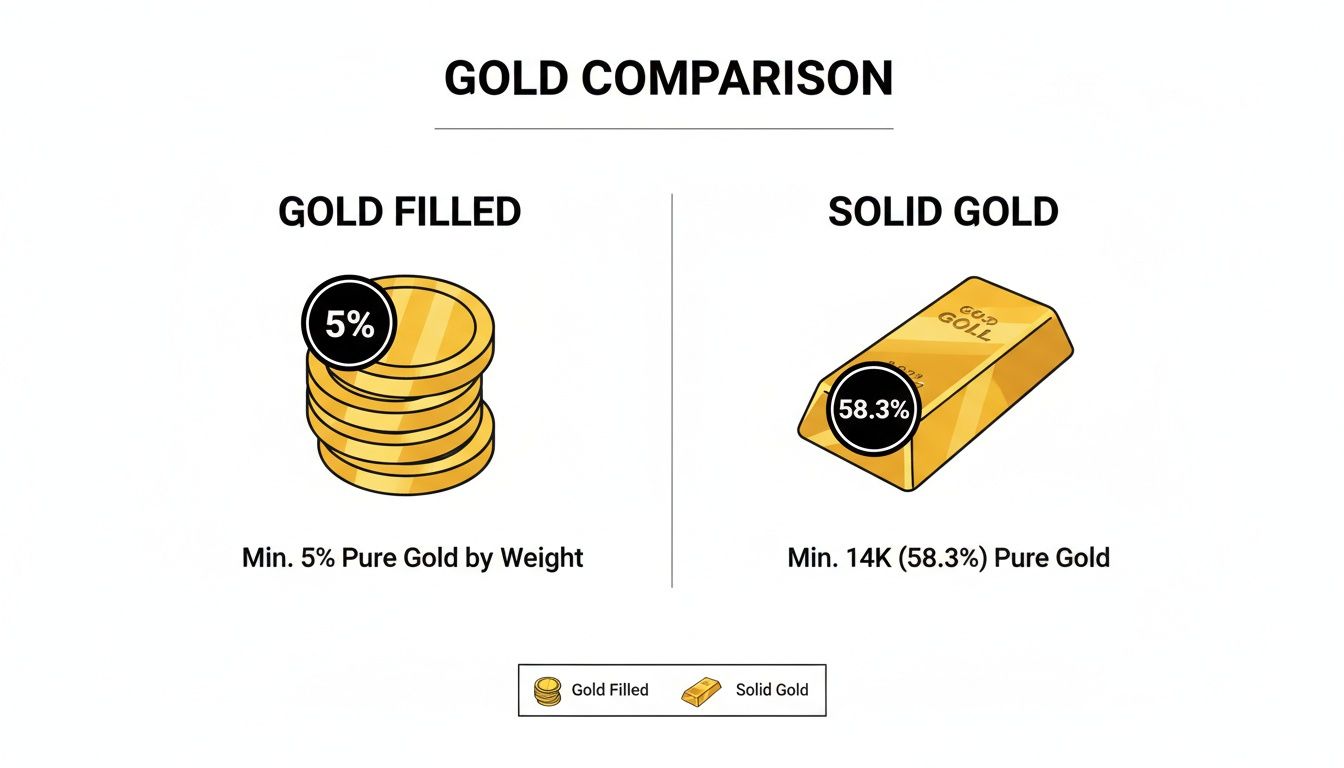
As you can see, even a lower-karat solid gold item has substantially more pure gold than its gold filled counterpart.
For a quick breakdown, here's how they stack up.
Quick Comparison Gold Filled vs Solid Gold
| Attribute | Gold Filled | Solid Gold |
|---|---|---|
| Gold Content | At least 5% gold by weight | Varies by karat (e.g., 58.3% for 14k) |
| Manufacturing | A thick gold layer is pressure-bonded to a base metal core | A consistent alloy of gold and other metals throughout |
| Resale Value | Very low to negligible scrap value | High resale value based on gold content and weight |
This difference is especially critical when you're looking to sell. Save the hassle and sell locally for more than online shipments. You can sell your gold locally and get a better price. We offer free Xray Scanning and Gold Testing with hassle free offers to determine your jewelry's true composition on the spot. This process ensures you get the highest payout in Boise, backed by our Price Matching guarantee.
How Gold Filled and Solid Gold Are Made
To really get the difference between gold filled and solid gold, you have to look at how they’re born. The way each is made is completely different, leading to two products with vastly different compositions, lifespans, and, of course, values. It’s these creation stories that explain why one is a true asset and the other is a top-tier, yet temporary, fashion accessory.
The Craft of Solid Gold Alloys
Think of solid gold jewelry like a baker’s recipe. Pure, 24-karat gold is just too soft for everyday life, so it gets mixed with other metals to give it strength and, in some cases, a whole new color.
The karat system is our guide here, measuring gold purity out of 24 parts. For instance, 14k gold is a blend of 58.3% pure gold with 41.7% other metals like copper, silver, or zinc. This alloying process is what makes solid gold tough enough to handle daily wear and tear.
The specific metals in that alloy "recipe" also dictate the final look of the gold:
- Yellow Gold keeps its classic, warm glow by being alloyed with a mix of silver and copper.
- White Gold gets its sleek, silvery-white look from mixing pure gold with white metals like palladium, nickel, or zinc. It's almost always finished with a rhodium plating for that extra bright shine and a bit more toughness.
- Rose Gold achieves its warm, pinkish hue by adding a higher percentage of copper into the mix.
Because the gold is an integral part of the metal from surface to core, solid gold jewelry has a completely uniform composition. There’s no layer to wear off. What you see is what you get, all the way through. This is why a solid gold piece can be polished, repaired, and resized over and over without ever losing its character.
The Mechanical Bonding of Gold Filled Jewelry
Making gold filled jewelry is a whole different ball game—it’s about mechanics, not chemistry. The process involves permanently bonding a thick sheet of solid karat gold to a core of a much less expensive base metal, which is usually jeweler's brass.
And this isn't just a simple coating. The process uses intense heat and pressure to literally fuse the gold layer to the brass core, creating a permanent mechanical bond. Legally, that gold layer has to make up at least 5% (or 1/20th) of the item's total weight. This substantial, durable layer is what puts gold filled items in a completely different league from thinly plated costume jewelry.
This manufacturing difference is absolutely critical when you're looking to sell. Our free Xray Scanning and Gold Testing right here in Boise can instantly tell if a piece is solid gold or gold filled, guaranteeing you get a transparent and fair offer on the spot.
That tough, bonded layer means gold filled jewelry can look great for years, even decades, with the right care. But eventually, that layer can wear down, exposing the base metal underneath. Since the core isn't gold, the piece has a finite lifespan and very little scrap value. It's a fantastic choice for beautiful, lasting fashion pieces at a great price, but it's not a financial asset like solid gold.
When it comes time to sell your real gold, you can save the hassle and sell locally for more than online shipments. We provide straightforward, hassle free offers and guarantee the highest payout in Boise, backing it up with our Price Matching promise for your solid gold.
Comparing Durability for Everyday Wear
When you're deciding between gold filled and solid gold, how a piece stands up to the rigors of daily life is a huge consideration. The way each is made directly shapes its lifespan, creating distinct pros and cons when faced with the real world.

Gold filled jewelry is impressively tough. That thick layer of solid gold is mechanically bonded to the core, so it easily handles daily activities without tarnishing or fading. This robust construction makes it a fantastic, practical choice for pieces you wear all the time, like necklaces and bracelets.
But that durability does have its limits. A well-cared-for gold filled piece can look great for 10 to 30 years, but eventually, that outer gold layer will wear thin. This happens fastest in high-friction spots, like the clasp on a bracelet or the back of a ring. Once the base metal peeks through, it's game over—the piece can’t really be repaired and will start to tarnish.
The Lifespan of Solid Gold
Solid gold, on the other hand, is in it for the long haul. It's built to last quite literally forever. Since the alloy is the same all the way through, there's no layer to wear off. Scratches? They can be polished out. Broken chain? A skilled jeweler can seamlessly repair it, making solid gold the clear winner for anything you want to become an heirloom.
Of course, the durability of solid gold depends on its karat. Higher karats like 18k (75% gold) are softer and more prone to scratching. Lower karats, especially 14k (58.3% gold), are mixed with stronger metals, making them much more resistant to the dings and dents of life. There's a reason 14k gold is the go-to for wedding bands and other pieces meant to be worn day in and day out.
Key Insight: The real difference in durability comes down to one thing: repairability. Solid gold can be restored indefinitely, holding its value for generations. Gold filled jewelry has a finite lifespan, making it more of a long-lasting fashion piece than a permanent investment.
Practical Scenarios Day to Day Use
Let’s put this into practice. Imagine wearing your favorite chain to the gym. Sweat and friction are hard on any jewelry, but both 14k solid gold and a quality gold filled piece will handle it just fine, resisting any tarnish from perspiration.
Now, think about daily chores. Bumping into countertops or coming into contact with household cleaners can cause damage. A solid gold ring might get a scratch that a jeweler can easily buff out. A similar impact on a gold filled ring could chip away at that outer layer, shortening its lifespan. If you want to get the most out of your pieces, you can read also our guide on how to clean gold filled jewelry.
Smart Gold and Jewelry Buying is all about matching the material to your lifestyle. Studies have shown gold filled jewelry holds up far better than standard gold plating, with 85% satisfaction from consumers on color retention after five years. Solid gold, while a bigger upfront investment, scores even higher at 95% satisfaction—a testament to its timeless resilience.
Understanding this difference is critical, especially if you ever plan to sell. You can save the hassle and sell locally for more than online shipments. At our Boise location, we offer free Xray Scanning and Gold Testing to confirm if your piece is solid gold. This ensures you get the highest payout in Boise, backed by our Price Matching guarantee and hassle free offers.
The Financial Difference In Cost and Resale Value
When it comes to Gold and Jewelry Buying, the biggest divide between gold filled and solid gold boils down to dollars and cents. The financial story behind each is really a tale of two completely different assets. One is a beautiful, durable fashion accessory, while the other is a tangible, wearable investment.
Getting this distinction right is the key to buying or selling a piece that actually fits your financial goals.
The initial price is the most obvious starting point. Solid gold carries a much higher price tag for one simple reason: it contains a whole lot more pure gold. Its price is directly tied to its weight, karat purity, and the daily fluctuations of the gold market. Think of a solid gold piece as a wearable form of a precious metal commodity.
Gold filled jewelry, on the other hand, gives you that luxurious look and feel for a fraction of the cost. Since its value comes from that durable but thin layer of gold bonded over a base metal, the manufacturing cost is significantly lower. This makes it a smart choice for anyone looking to build a versatile jewelry collection without a huge financial commitment.
Unpacking Resale Value
This is where the financial paths of gold filled and solid gold split dramatically. Resale value is the true test of a jewelry piece’s underlying worth, and the difference is night and day.
Solid gold is a genuine asset. Because its value is locked into its precious metal content, it can always be sold for its melt value—that’s the price a refinery will pay for the raw gold inside. This means a solid 14k gold chain from the 1980s holds real, liquid value today, and that value goes up as the market price of gold climbs. If you want to dig deeper into this, check out our guide on what your gold is worth and how that value is calculated.
Gold filled jewelry, however, has virtually no resale value. The amount of gold is just too small to be economically extracted, so its scrap value is next to nothing. Once a gold filled piece is no longer wearable, it can't be sold for its metal content. It’s a fashion item, designed for long-term wear, not for a financial return.
The Bottom Line: When you buy solid gold, you’re acquiring an asset that holds and often grows in value. When you buy gold filled, you’re purchasing a high-quality, long-lasting accessory whose value is in its style and durability, not its resale potential.
Here's a quick financial breakdown to put things in perspective.
Cost and Investment Potential
| Financial Aspect | Gold Filled Jewelry | Solid Gold Jewelry |
|---|---|---|
| Initial Cost | Low. 70-90% less than solid gold. | High. Based on gold weight, purity, and market price. |
| Primary Value | Aesthetic appeal and durability for everyday wear. | Intrinsic precious metal content and craftsmanship. |
| Resale Value | Negligible. Almost no scrap or secondhand market value. | High. Retains value based on its gold content (melt value). |
| Investment | A fashion purchase, not a financial investment. | A tangible asset that can appreciate with the gold market. |
As you can see, the decision isn't just about the initial price but what you expect from the piece in the long run.
A Real-World Financial Scenario
Let's make this even more concrete with some numbers. A solid 14k gold piece derives 58.3% of its value from pure gold, meaning it appreciates with market trends. In contrast, gold filled is legally required to be just 5% gold by weight, which gives it minimal scrap value but slashes the retail price by 70-90%.
For example, a solid 14k gold bracelet might run you $500, while its gold filled twin could cost just $50-$100. When it’s time to sell, a local buyer might offer you a significant percentage of the melt value for the 14k bracelet. The gold filled piece? Its resale value is practically zero.
This financial reality is especially important when you're selling unwanted or inherited jewelry. Many people unknowingly mix gold filled items in with their solid gold pieces, only to be disappointed by the final offer. To avoid this, getting a professional assessment is crucial. And remember: save the hassle and sell locally for more than online shipments.
At Carat24, we offer free, no-obligation Xray Scanning and Gold Testing right here in Boise to determine the exact composition of your items. Our transparent process guarantees you get hassle-free offers and the highest payout in Boise, backed by our Price Matching promise. Selling locally means you get paid more, you get paid faster, and you don’t have to risk sending your valuables through the mail.
How to Buy and Sell Your Gold Jewelry Wisely
Making smart choices in the world of gold—whether you're adding a new piece to your collection or parting with an old treasure—all comes down to knowing exactly what you’re looking at. The critical difference between gold filled and solid gold directly impacts not just what you pay, but the real value you get back when you sell. A little bit of knowledge goes a long way in making sure every transaction is a confident one.
When it comes to Gold and Jewelry Buying, your first move should be to play detective and look for the hallmarks. These tiny stamps are the secret language of jewelry, telling the story of a piece’s true composition.
Identifying What You Are Buying
For solid gold, the markings are pretty straightforward because they indicate purity. Keep an eye out for stamps like “14K,” “18K,” or their European equivalents, “585” (for 14K) and “750” (for 18K). These marks are a guarantee that the piece is a consistent gold alloy all the way through.
Gold filled items, on the other hand, have their own distinct language. You’ll usually find stamps that look like a fraction, such as “1/20 14K GF” or “14/20 GF.” This specific hallmark tells you that 14-karat gold makes up 1/20th, or 5%, of the item's total weight. Recognizing these stamps is the simplest way to tell the two apart and avoid overpaying for something that isn’t solid precious metal.
When in doubt, a professional evaluation is always your best bet. A quick look can be deceiving, but scientific testing gives a definitive answer.
This knowledge is even more important when you decide to sell. The value of your jewelry is locked in its materials, and any reputable buyer will always verify its composition.
Maximizing Your Return When Selling
If you're in the Boise area and thinking about selling your gold, understanding what you have is the only way to get a fair price. Solid gold pieces have significant intrinsic value based on their weight and purity. Gold filled items, while durable and beautiful, have almost no scrap value. That distinction is everything.
Many people are tempted by online mail-in services, hoping for an easy out, but this often ends in disappointment. You have to package your valuables, send them off into the unknown, and then just wait for an offer you have little power to negotiate. It’s a process filled with risk and uncertainty.
A much better approach is to save the hassle and sell locally for more than online shipments. Working with a trusted local expert means transparency, security, and immediate payment. At our Boise location, your peace of mind is our priority, and we make sure you get the best possible return.
We provide completely free Xray Scanning and Gold Testing with absolutely no obligation to sell. Our advanced technology pinpoints the exact composition of your items right in front of you, so there’s no guesswork involved. This allows us to make clear, hassle free offers based on precise data.
For a deeper dive into the different verification techniques, our guide on how to test gold purity offers some valuable insights. This knowledge helps you understand the entire process from start to finish.
We’re so confident in our pricing that we guarantee the highest payout in Boise. We also offer Price Matching, so you never have to second-guess your decision. By selling your gold locally, you don’t just get a better price—you get a secure, straightforward, and rewarding experience without the stress of mailing your precious items away.
Choosing The Right Gold For Your Lifestyle
So, how do you make the final call between gold filled and solid gold? It really boils down to your own life—what you need, what you can spend, and what you expect from the piece in the long run. The best choice is the one that just fits.
Think of it in terms of why you're buying: is this for fashion, for a memory, or for an investment? Once you frame it that way, the right answer usually becomes pretty clear.
Scenarios For Choosing Your Gold
Let's walk through a few real-world examples to highlight the difference between gold filled and solid gold and help guide your Gold and Jewelry Buying decision.
-
For the Style-Conscious Individual: Do you love wearing trendy pieces every day? If you want high-quality accessories that look amazing and can handle daily life, gold filled is a fantastic option. It gives you that luxe, solid gold look and durability without the hefty price tag, so you can build out a killer collection without breaking the bank.
-
For Commemorating a Major Life Event: When you’re marking a huge milestone—an anniversary, a graduation, the birth of a child—nothing beats the timeless value of solid gold. A solid gold piece isn’t just another accessory; it’s a future heirloom, something that carries both sentimental and real financial worth for generations to come.
-
For the Savvy Investor or Seller: If your goal is to own a tangible asset that holds its value (and often grows), then high-karat solid gold is the only way to go. Its worth is tied directly to its precious metal content. On the flip side, if you're looking to sell jewelry, understanding this is crucial to getting the best possible return on your item.
Solid gold is an asset that can be sold for its intrinsic value, while gold filled jewelry is a durable fashion accessory. Your primary goal—style, sentiment, or financial return—should be the deciding factor.
Making The Final Call
Ultimately, your lifestyle is the deciding factor. Are you looking for a piece that can take a beating day in and day out? Or are you searching for an investment to one day pass down?
Taking proper care of your jewelry is just as important, no matter what it's made of. For instance, knowing how to store gold jewelry the right way will keep it looking beautiful and preserve its value.
Whether you're buying a new treasure or selling an old one, clarity is everything. If you've got pieces you’re thinking about selling, don't leave their value up to guesswork. Save the hassle and sell locally for more than online shipments. We offer free Xray Scanning and Gold Testing right here in Boise to show you exactly what you have.
With our transparent, hassle free offers and a Price Matching guarantee, you can be confident you're getting the highest payout in Boise. Making an informed decision ensures you get the most value, every time.
Frequently Asked Questions
When you're trying to figure out the real difference between gold filled and solid gold, a few questions always come up. Here are some straightforward answers to the most common queries we hear from customers, designed to help you make a smart choice whether you're buying or selling.
Can You Wear Gold Filled Jewelry in Water?
While gold filled jewelry handles water much better than gold-plated pieces, it's not a good idea to make it a habit. Think of things like chlorinated pools, hot tubs, and saltwater—they can be pretty harsh and may slowly wear down that outer gold layer over time.
For the best, longest-lasting results, we always recommend taking off your gold filled pieces before you shower or go for a swim.
Is Gold Filled Jewelry Hypoallergenic?
For most people, yes. The outside layer is genuine karat gold, which rarely causes skin issues. Since the base metal core (typically jeweler's brass) doesn't make contact with your skin, reactions are uncommon.
However, if that gold layer eventually wears thin after years of heavy use, the exposed base metal might irritate someone with a severe allergy. If you have highly sensitive skin, solid gold is always the safest bet.
Key Consideration: The biggest difference between gold filled and solid gold really hits home when you think about resale value. Solid gold is a tangible asset with real, intrinsic worth. Gold filled jewelry, on the other hand, has almost no scrap value, which is a critical detail for anyone active in the Gold and Jewelry Buying market.
How Can I Tell if My Jewelry Is Solid Gold?
Professional Gold Testing is always the surest way to know, but a quick look for hallmarks is a great place to start. Solid gold pieces are usually stamped with their karat, like '14K' or '585'.
Gold filled items are marked differently, often with fractions like '1/20 14K GF'. If you're curious about spotting the signs, you can learn more about how to tell real gold from fake in our detailed guide.
For a 100% certain answer, bring your jewelry to a local expert. Here at our Boise shop, we offer free Xray Scanning to pinpoint your item’s exact composition. This guarantees you get a transparent, fair offer and the highest payout in Boise. Why deal with shipping your valuables online when you can sell locally for more? We even offer a Price Matching guarantee and provide hassle-free offers on the spot.
At Carat 24 - Trusted Gold Experts, our goal is to provide clarity and real value. Whether you’re looking to buy a new piece or sell an old one, our local expertise ensures you make the best decision every time. Stop by our Boise location for a free, no-obligation evaluation of your jewelry. https://carat24boise.com
