
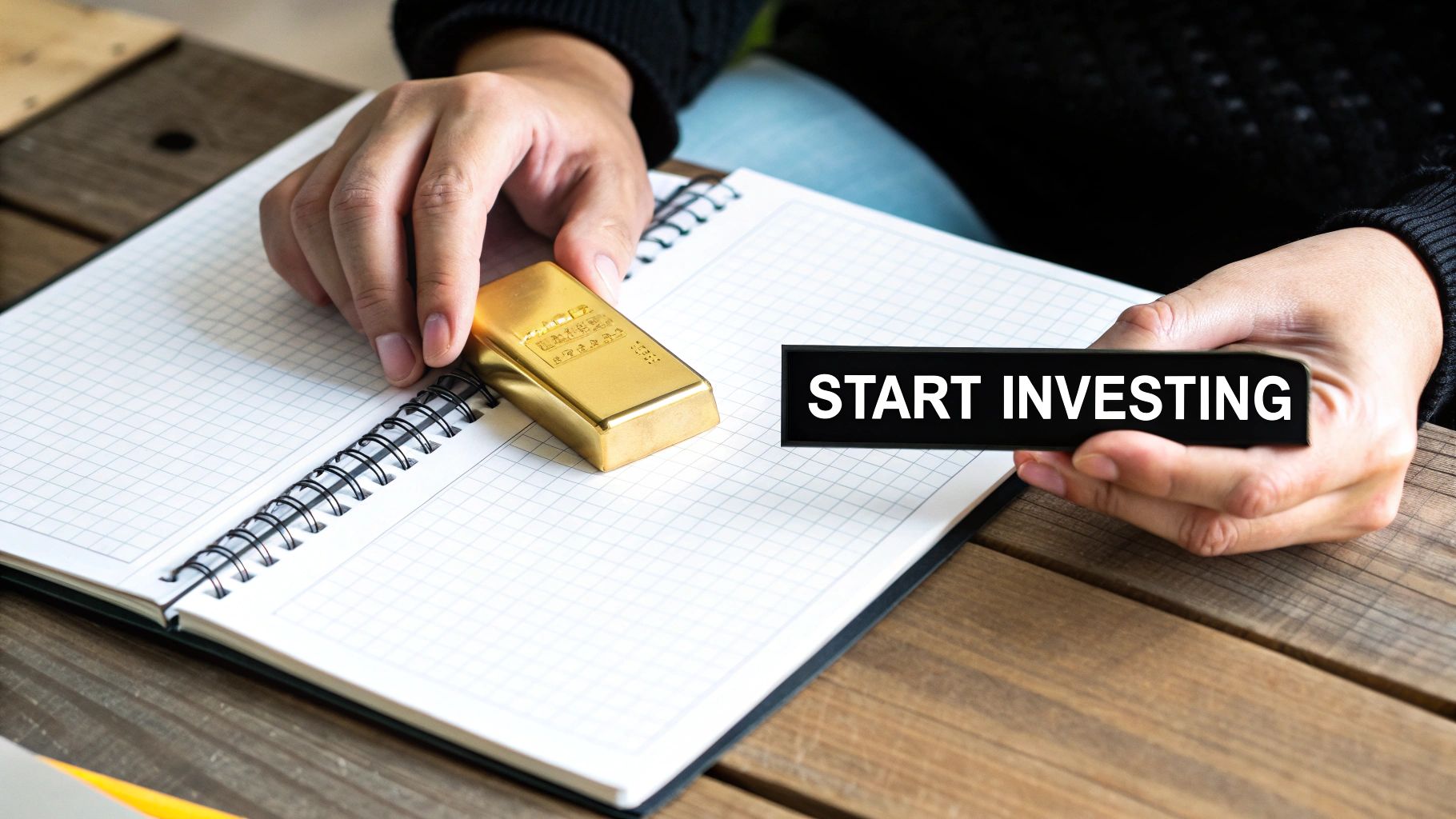
Dipping your toes into the world of gold investment can feel like a huge step, but it’s more straightforward than you might think. For centuries, people have turned to this precious metal not just as a symbol of wealth, but as a rock-solid financial tool.
Think of gold as a financial insurance policy. When the stock market gets choppy or inflation starts eating away at your savings, gold has a long history of holding its value. It’s a way to add some serious stability to your financial future.
This guide is designed to cut through the jargon and give you a clear, no-nonsense path forward. We'll walk you through everything from the different ways you can own gold—like bars, coins, and even jewelry—to the practical steps of making your first purchase or sale right here in Boise.
What You'll Learn in This Guide
Our goal is to give you the confidence to get started the right way. We'll build your understanding from the ground up, covering all the essentials you need to know.
Here's what we'll cover:
- The Core Benefits: We'll dig into exactly why gold is such a powerful tool for fighting inflation and diversifying your portfolio.
- Physical Gold Options: You'll learn the difference between bullion, coins, and jewelry, and figure out which one makes the most sense for you. Our guide to investing in gold bullion is a great place to start for a deeper dive.
- Local Gold and Jewelry Buying: Discover the secrets to buying and selling gold safely and for the best price, without ever leaving Boise.
Gold’s real job in your portfolio isn't about chasing huge, risky returns. It’s about providing stability and protecting what you've earned, especially when the economy gets shaky.
The Advantage of Working with a Local Expert
Sure, you can find plenty of online dealers, but nothing beats the trust and transparency you get from a local expert. When you save the hassle and sell locally for more than online shipments, you get instant peace of mind and cash in hand.
We provide hassle-free offers and even offer price matching to guarantee you get the highest payout in Boise.
Plus, our process is completely transparent. We offer free Xray scanning and gold testing on the spot, so you know exactly what your items are worth. Whether you're looking into gold and jewelry buying for the first time or you're ready to sell, partnering with a trusted local expert empowers you to make smart, confident decisions.
Why Gold Belongs in Your Investment Portfolio
When you’re putting together an investment strategy, it helps to think of it like building a house. You need a solid foundation, something that can hold up when the economic storms roll in. For centuries, that financial bedrock for savvy investors has been gold, offering real stability when other assets get shaky.
One of gold's most important jobs is acting as a hedge against inflation. Picture a seesaw. On one side, you have the value of the U.S. dollar; on the other, you have the price of gold. When inflation kicks in, the dollar's buying power drops, pushing its side of the seesaw down. Almost like clockwork, gold's side tends to rise, protecting your wealth from being quietly eaten away.
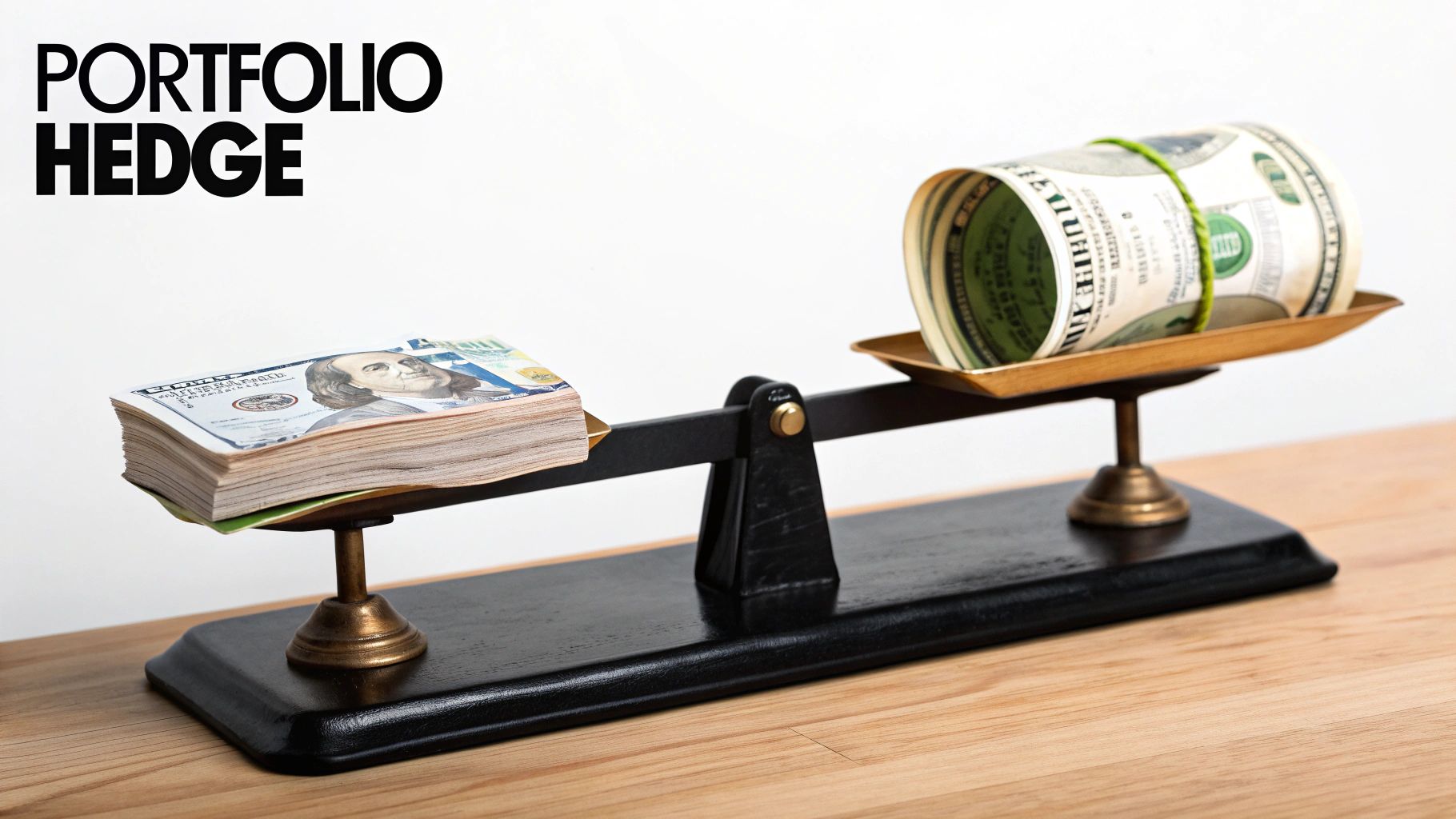
This simple, inverse relationship makes a gold investment for beginners one of the most intuitive ways to safeguard your savings over the long haul.
The Power of Diversification
Beyond fighting inflation, gold is the undisputed champion of diversification. Stocks and bonds often move in lockstep, reacting to the same economic news. Gold, on the other hand, frequently marches to the beat of its own drum. This independence is exactly what you want to lower your portfolio's overall risk.
During choppy markets or periods of geopolitical stress, you’ll see investors flock to gold as a "safe-haven" asset. This flight to safety can push gold prices up even as the stock market is tanking, providing a much-needed cushion for your other investments.
A well-diversified portfolio isn't about picking only winners; it's about ensuring that when some assets are down, others are up. Gold often provides that essential counterbalance, smoothing out the highs and lows.
Gold Performance in Real-World Scenarios
Think about a few common economic situations where gold really proves its worth:
- During a Recession: When the economy slows down and companies struggle, stocks often take a hit. Gold, however, tends to hold its value or even climb as people seek out security.
- Geopolitical Instability: Conflicts or trade disputes create a ton of uncertainty in financial markets. This anxiety almost always boosts demand for gold as a store of value that isn't tied to any one government's fortunes.
- Currency Devaluation: If the U.S. dollar weakens against other world currencies, the price of gold (which is priced in dollars) will almost always rise to compensate for that weakness.
This is why owning a tangible asset is so powerful. When you engage in gold and jewelry buying, you’re getting a physical item with intrinsic worth—value that exists completely independent of a company's earnings report or a government's latest policy decision.
A Foundation of Global Demand
A huge reason for gold's long-term stability is the steady, relentless demand from central banks all over the world. These massive institutions buy and hold tons of gold as part of their foreign reserves, which helps create a solid price floor for the metal. That institutional confidence provides a serious layer of security for individual investors like you and me.
In fact, gold has shown incredible resilience. Looking ahead, State Street Investment Management's 2026 outlook projects gold to consolidate in the $4,000–$4,500 range during 2026, largely supported by central banks continuing to buy around 190 tonnes per quarter.
Comparing Your Physical Gold Investment Options
When you're first getting into gold, one of the most exciting decisions is choosing what kind of gold you want to own. This isn't a one-size-fits-all choice. Think of it like deciding between a savings bond, a growth stock, or a collectible piece of art—each serves a different purpose.
For physical gold, the three most popular paths are gold bars, gold coins, and gold jewelry. Understanding the quirks of each one is the key to matching your purchase with your financial goals. Let's break them down so you can choose with confidence.
Gold Bullion Bars: Pure and Simple
Gold bars, often called bullion, are the most direct and efficient way to own gold. When you buy a gold bar, you're paying almost entirely for its weight and purity. Their value is tied directly to the live market price of gold, plus a small fee known as a premium, which covers manufacturing and distribution costs.
Because their design is so straightforward, bars typically have the lowest premiums compared to coins of the same weight. This makes them a fantastic, cost-effective choice for investors whose main goal is to accumulate as much physical gold as their budget allows. They are the workhorses of the gold investment world, focused purely on storing value.
Gold Coins: The Collector's Choice
Gold coins offer a fascinating blend of pure investment value and collectible appeal. These are official, government-minted pieces, like the famous American Eagle or Canadian Maple Leaf, and they even carry a legal tender face value (though their actual gold value is much, much higher). This official status makes them instantly recognizable and easy to trade anywhere in the world.
Coins often carry slightly higher premiums than bars because of the craftsmanship that goes into their detailed designs and minting. However, that extra cost comes with some unique advantages:
- High Liquidity: They are incredibly easy to buy and sell. Everyone recognizes them.
- Flexibility: Coins come in various sizes, from one-tenth of an ounce up to a full ounce and more, making them accessible for almost any budget. You can learn more about the specifics in our guide to buying Gold American Eagles.
- Numismatic Potential: Some coins, especially rare or historically significant ones, can gain value far beyond their gold content, adding another exciting layer to your investment.
When you're just starting out, 1-ounce coins are the most common entry point. If you're working with a smaller budget, fractional coins in denominations like 1/10 ounce or 1/4 ounce are a great way to get started without a large upfront commitment.
To help you visualize the differences, here’s a quick breakdown of how these physical gold types stack up for a beginner.
Comparing Physical Gold Investment Types For Beginners
| Investment Type | Best For | Pros | Cons |
|---|---|---|---|
| Gold Bars | Maximizing gold weight for your budget. | Lowest premiums over spot price; efficient for storing large values; simple and straightforward. | Can be harder to sell in smaller portions; less collectible appeal. |
| Gold Coins | Flexibility, liquidity, and collectible potential. | Easy to buy/sell; government-guaranteed purity; potential for numismatic value; available in small sizes. | Higher premiums than bars; value can be complex (mix of gold content and rarity). |
| Gold Jewelry | Enjoying your investment as a wearable asset. | Tangible and usable; can be acquired below market value (pre-owned); dual purpose as an asset and adornment. | High markups when buying new; resale value is often tied only to gold weight, not craftsmanship. |
Ultimately, the right choice depends on your personal goals—whether you prioritize pure value, liquidity and flexibility, or the joy of a wearable asset.
Gold Jewelry: The Wearable Asset
Finally, we have gold and jewelry buying, which lets you enjoy your investment in a tangible, beautiful form. Unlike bars and coins that usually sit in a safe, gold jewelry is an asset you can wear and appreciate every single day.
It's critical, however, to understand how jewelry is valued. The price of any piece is built on three main components:
- Intrinsic Gold Value: The base value of the gold itself, determined by its purity (karat) and weight.
- Craftsmanship: The skill and labor that went into the design and creation, which adds significant cost.
- Brand & Retail Markup: Designer names and the overhead of a retail store contribute heavily to the final price tag.
When you buy new jewelry, you pay for all three. When you sell, you often only get paid for the first one—the intrinsic gold content. This is precisely why buying pre-owned jewelry or working with a trusted local expert is a much smarter investment strategy.
By choosing wisely, you can acquire beautiful pieces for a price much closer to their actual gold value. When it comes time to sell, bringing your items to a local expert ensures you get a fair, transparent assessment. We offer free Xray Scanning and Gold Testing to determine the exact purity and value, providing hassle-free offers right on the spot.
Our price matching guarantee ensures you get the highest payout in Boise. You save the hassle and sell locally for more than online shipments, turning your wearable art back into liquid capital with complete transparency and peace of mind.
How to Buy and Sell Gold in Boise
Alright, you've done the homework and learned about the different kinds of gold. Now for the exciting part—making your first move. But this is often where people freeze up. For anyone here in Boise, the choice boils down to a simple question: do you deal with a faceless online company or a local expert you can meet in person?
The answer is pretty clear.
Why Selling Locally Just Makes Sense
Choosing a local partner for your gold and jewelry buying isn't just about convenience. It’s about security, transparency, and frankly, getting a better deal.
Think about those online mail-in services. They can feel like a total black box. You ship your valuables into the void, cross your fingers, and wait for an offer. The whole process is often plagued by delays, lowball offers, and the nagging worry that your items might get lost in transit.
When you save the hassle and sell locally for more than online shipments, you sidestep all that uncertainty. You get immediate service, a clear evaluation right in front of you, and payment on the spot. No waiting, no wondering.
Our Transparent, No-Pressure Process
We built our approach on trust and clarity. We believe you should feel confident and informed every step of the way, which is why we offer completely hassle-free offers. There’s zero pressure and no obligation—just an honest, straightforward valuation of what your gold is worth.
To make sure you get the absolute best value, we also stand by our price matching guarantee. We're committed to giving you the highest payout in Boise, and we will match any legitimate, written offer from a local competitor. It's our promise that you're walking away with the maximum value for your assets.
The real power of selling locally is control. You're in charge of the entire transaction, witnessing the evaluation firsthand and making decisions without pressure, which is something anonymous online services can never replicate.
Free Authentication Puts You in Control
When you're buying or selling gold, knowledge is your greatest asset. How can you be 100% sure about the purity and weight of your item? That’s where our professional authentication services come in, and we provide them completely free of charge.
We use state-of-the-art technology to give you a precise, scientific analysis of your gold. Here’s what our process includes:
- Free Xray Scanning: Our X-ray fluorescence (XRF) scanner provides a non-destructive analysis of your item’s exact metallic composition, confirming its purity down to the decimal point.
- Free Gold Testing: For extra verification, we use both traditional and advanced testing methods to guarantee complete accuracy.
This transparent evaluation means you know exactly what you have. It empowers you to make the best possible financial decision, whether you’re buying or selling. If you're looking to learn more about valuing different precious items, our guide on buying gold and diamonds is a great place to start.
This chart breaks down the simplest way to think about which form of gold fits your goals.
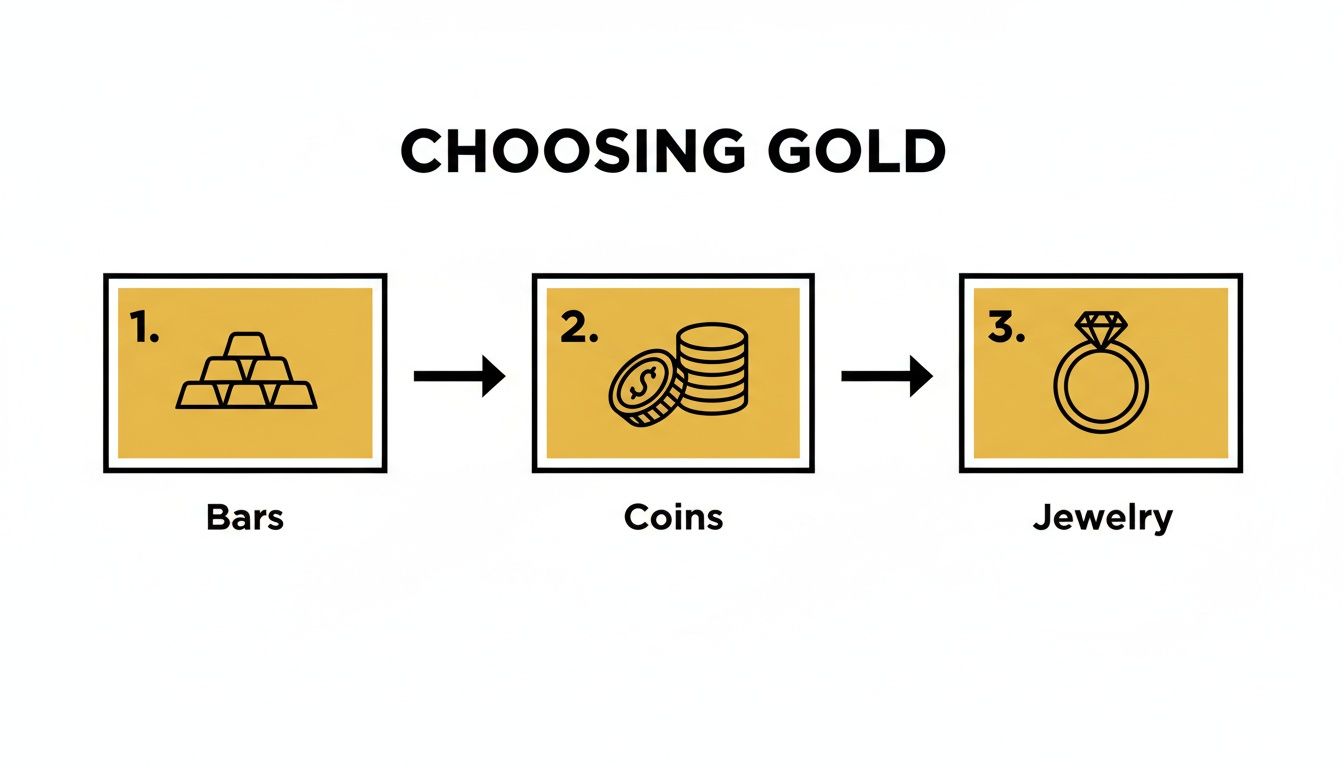
It’s a simple visual flow: bars are for pure weight, coins offer flexibility, and jewelry is a wearable asset. This helps guide beginners straight to the right choice for them.
Understanding What Drives Gold Prices
Investing in gold for the first time can feel like learning a new language. One of the first terms you'll hear is the "spot price" of gold. Think of this as the live, raw market price for one troy ounce of pure gold that's ready for immediate delivery. It’s that baseline number you see flashing across financial news networks.
But you'll notice that when you go to buy a physical item, like a coin or bar, you always pay a little more than the spot price. That extra bit is called a "premium." It's not a hidden fee; it's simply the cost of turning that raw gold into a beautiful, finished product—covering everything from manufacturing and distribution to the dealer's own operational costs. Getting a feel for this difference is crucial to knowing you're getting a fair deal.
The Key Forces Moving the Market
Gold’s price doesn’t move in a vacuum. It’s constantly reacting to a handful of powerful global economic forces. Once you grasp these core drivers, you can see the bigger picture beyond the daily ups and downs and better understand why gold is a long-term strategy for preserving wealth.
Here are three of the most significant factors:
- Interest Rates: When interest rates are low, gold tends to shine. Savings accounts and bonds offer minimal returns, so investors often look to gold. It doesn’t pay interest, but it does a fantastic job of holding its value.
- The U.S. Dollar: Gold is priced in U.S. dollars, which gives them a seesaw-like relationship. When the dollar weakens, it takes more dollars to buy an ounce of gold, and its price naturally rises.
- Global Economic Stability: In times of uncertainty—think recessions, political turmoil, or global crises—investors flock to gold as a "safe-haven" asset. This rush to safety drives up demand and, in turn, its price.
What the Experts Are Forecasting
To get a better sense of where the market might be heading, it helps to see what major financial institutions are predicting. These forecasts aren’t just guesses; they’re based on deep analysis of economic trends and global demand.
Right now, many of the big players have a bullish outlook on gold's future, seeing strong fundamentals that could support continued price growth. For instance, many Wall Street firms have raised their price targets significantly. Looking at in-depth analysis from firms like J.P. Morgan, Goldman Sachs, and Bank of America can give you valuable insight, especially if you're just starting your gold investment for beginners. You can learn more about what affects gold prices in our detailed guide.
Getting a handle on these market dynamics lets you react less to short-term noise. Instead of panicking over daily price swings, you can stay focused on gold’s real job in your portfolio—protecting and preserving your wealth over the long haul.
Central Banks and Long-Term Demand
One of the steadiest and most powerful players in the gold market is often overlooked by new investors: central banks. All around the world, governments purchase and hold massive quantities of gold to diversify their reserves and hedge against currency volatility.
This consistent, large-scale buying creates a strong and stable floor for gold prices, which is fantastic news for individual investors. This institutional confidence is a major reason behind many optimistic long-term forecasts.
According to J.P. Morgan Global Research, central bank buying is expected to stay high, fueling a positive outlook. They're projecting average prices could reach $5,055 per ounce by late 2026, with other institutions like Goldman Sachs and Morgan Stanley also targeting figures near the $5,000 mark.
Safeguarding Your Gold Investment
So, you’ve made the smart move and brought some physical gold into your portfolio. Excellent. But owning it is only half the battle—now you have to keep it safe. Protecting your tangible assets is a critical next step, and it’s about more than just preventing theft. It’s about preserving the condition and value of your investment for the long haul.
Think of it like owning a valuable piece of art. You wouldn't just lean it against a wall in the garage and hope for the best. The same principle applies here. Whether you have gold bars, collectible coins, or fine jewelry, securing it properly is a non-negotiable part of your strategy.
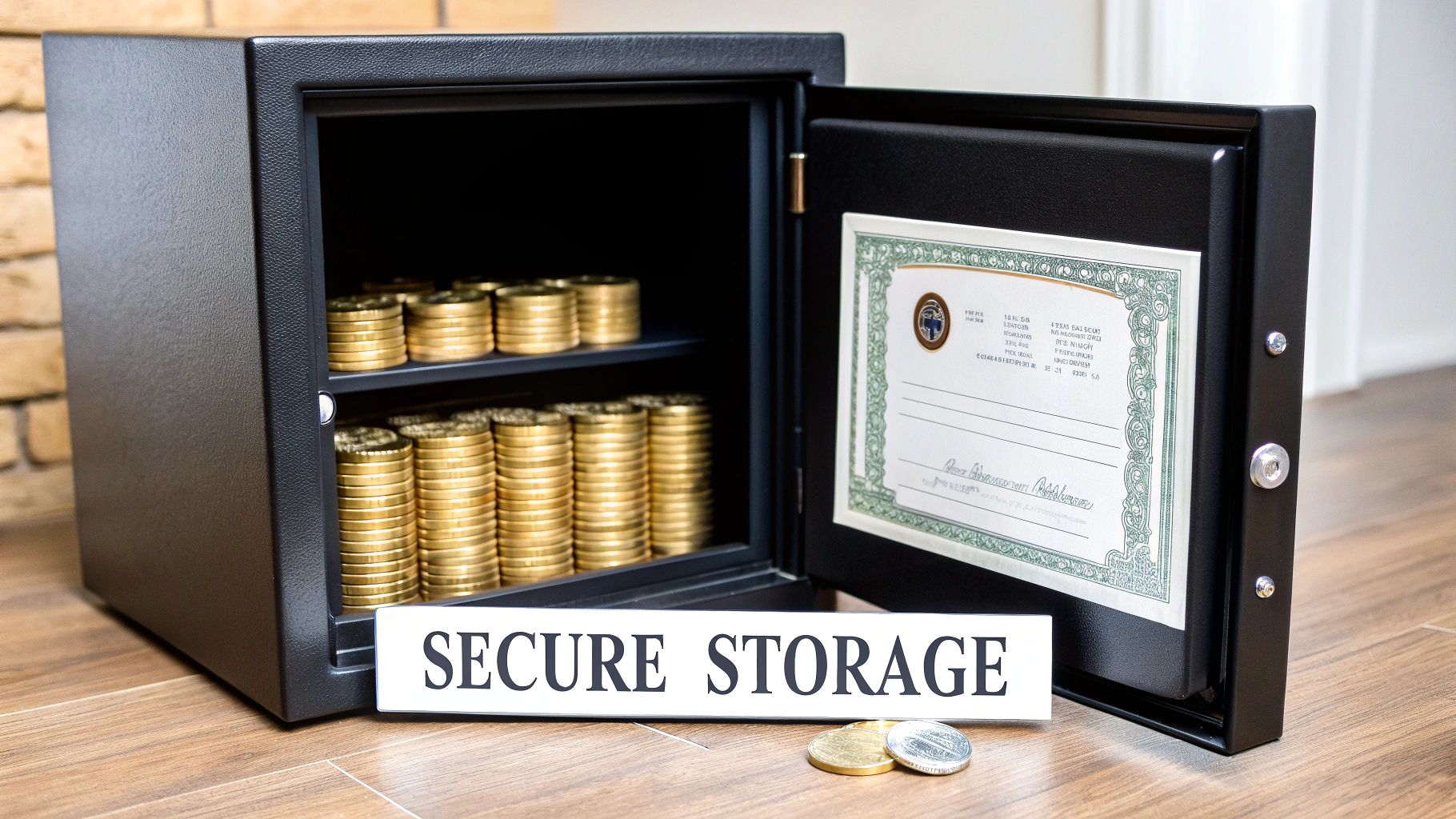
This is especially true for something like gold jewelry, where you’re not just protecting the metal but also the delicate craftsmanship and any gemstones it might feature.
Choosing Your Storage Method
When you're starting out, you have three main paths for storing physical gold. Each comes with its own trade-offs, and your choice will really come down to your personal comfort level, how much you've invested, and how quickly you might need to access it.
Here are the most common options people consider:
- High-Quality Home Safes: This is the go-to for anyone who wants direct, 24/7 access to their gold. The downside? It requires a serious upfront investment in a properly rated, securely installed safe, not to mention a comprehensive insurance policy to cover it.
- Bank Safe Deposit Boxes: This is a popular and relatively affordable choice. Your gold is tucked away securely off-site, but you can only get to it during bank hours. A big thing to remember is that the contents are typically not insured by the bank itself.
- Third-Party Depositories: Think of these as Fort Knox for the public. They are specialized, high-security vaults that will store and fully insure your precious metals for a fee. It's hands-down the most secure option and is ideal for larger holdings, but it's also the most expensive.
Practical Tips for Securing Gold at Home
If you decide to keep your gold at home, you have to make security your top priority. Simply stashing it under the mattress or in the back of a closet won't cut it. Real home storage is about creating multiple layers of protection that will deter anyone who shouldn't be there.
Honestly, your best defense is discretion—the fewer people who know you have gold at home, the better. You’ll also want to invest in a safe that is both fireproof and has a high burglary-protection rating. Most importantly, make sure it’s bolted securely to the floor so it can’t just be carried away.
Heads up: Your standard home insurance policy probably has a very low coverage limit for valuables like bullion, often just a few thousand dollars. You will need to purchase a separate, specialized insurance rider to fully protect your investment's value.
Preservation and Selling Your Assets
Proper storage isn’t just about security; it also plays a big role when you decide to sell. Keeping your coins in protective cases and your jewelry in soft-lined boxes prevents the kind of scratches and dings that can lower their value.
When you’re ready to turn your gold back into cash, working with a trusted local expert makes the entire process smooth and secure.
When you bring your items to us, you save the hassle and sell locally for more than online shipments. Our process includes free Xray Scanning and Gold Testing to verify authenticity and purity, which leads to our hassle-free offers. And with our price matching guarantee, you can be confident you’re getting the highest payout in Boise.
For more specific tips on jewelry care, our detailed guide on how to store gold jewelry is a great resource.
Got Questions About Gold? We Have Answers.
As you get closer to making your first move into gold, it's completely normal to have a few questions bubble up. Think of this as your personal FAQ, designed to give you clear, real-world answers to the things most beginners wonder about. Let's clear up any lingering doubts so you can move forward with confidence.
How Much of My Portfolio Should I Actually Put Into Gold?
This is probably the most common question we get. Most financial advisors will suggest putting somewhere between 5-10% of your total portfolio into gold. If you're just starting your gold investment for beginners journey, sticking to the lower end of that range—say, 5%—is a smart, conservative play.
This gives you a solid hedge against turbulence in the stock market without tying up too much of your capital in a single asset. Remember, gold isn't about getting rich quick; its real job is to preserve your wealth over the long haul. You can always adjust that percentage later as you get more comfortable and your financial goals evolve.
Is It Better to Buy Gold Coins or Gold Jewelry?
A fantastic question, and the answer really boils down to what you want to achieve.
Gold coins are pure investment tools. Their value is tied almost directly to the daily market price of gold, plus a small premium for the cost of minting them. They're recognized worldwide and incredibly easy to liquidate when you need to.
Gold and jewelry buying, on the other hand, is a different animal. Of course, it's a beautiful asset you can wear and enjoy. But the price you pay includes significant markups for the artist's labor and the retail brand's profit. When it's time to sell, the value is almost always based on the "melt value"—the raw worth of the gold content itself. For a pure investment, coins are the more efficient choice. For an asset that doubles as a personal treasure, jewelry is perfect.
How Do I Know the Gold I'm Buying Is Real?
Authentication is everything. This is the single biggest reason why working with a reputable, local expert here in Boise is so critical. You need to be extremely cautious about buying from private sellers online where you have zero ability to verify the item before your money is gone.
At a trusted local shop, the process should be completely transparent. We use a multi-step verification for every single piece that comes through our door. This includes checking weight and measurements against standards and using advanced tools like our free Xray scanning and gold testing. When you can watch the authentication happen right in front of you, you're not just buying gold—you're buying peace of mind.
Dealing with an established expert who has a physical location and a commitment to transparency is the simplest way to eliminate the risk of getting scammed. It’s just the smartest way to invest.
While you're focused on tangible assets, it's also a good idea for any new investor to get familiar with the bigger picture of investment safety. Learning about understanding general security fraud and investor protection can help safeguard your entire portfolio.
What Is the Easiest Way to Sell My Gold?
Hands down, the easiest and safest way to sell is to visit a trusted local buyer. This completely cuts out the guesswork and anxiety that comes with those mail-in services you see advertised. You save the hassle and sell locally for more than online shipments, and you never have to worry about your valuables getting lost in transit or mysteriously "undervalued" once they arrive.
We give you hassle-free offers right on the spot. Our process is quick, secure, and backed by a price matching guarantee to ensure you're getting the absolute highest payout in Boise. You walk in with your gold and walk out with cash in hand the very same day. It doesn't get simpler than that.
Ready to take that next step? Whether you're looking to buy your first piece of bullion or sell some old jewelry, the team at Carat 24 - Trusted Gold Experts is here to help with professional, transparent guidance. Stop by our Boise location today and see what a difference working with a local expert makes. Learn more at https://carat24boise.com.
