
It’s a question that sounds like the start of a riddle: "How much is a dime worth?" The obvious answer, of course, is ten cents. But if you’ve stumbled upon an old coffee can full of coins, that answer might only be scratching the surface.
Some dimes, hiding in plain sight in your pocket change or attic heirlooms, can be worth far more—sometimes even hundreds of dollars. It all depends on their age, the metal they're made of, and their story.
Your Dime Could Be Worth More Than Ten Cents
We're all guilty of it. We see a dime and immediately dismiss it as small change, barely worth picking up off the sidewalk. But that quick glance could be a costly mistake. That little silver coin has a secret life that goes way beyond its simple ten-cent spending power.
To really get what a dime is worth, you need to look at it from three different angles.
The Three Tiers of a Dime's Value
A dime’s real value isn't just about the number stamped on its face. It's a combination of different factors that all add up.
- Face Value: This one's easy. It's the ten cents the government says it's worth when you buy a candy bar. For any modern dime, this is its baseline value.
- Melt Value: Here's where it gets interesting. Dimes minted before 1965 were made of 90% silver. Their value is tied directly to the live market price of silver, which almost always makes them worth much more than a mere ten cents.
- Numismatic Value: This is the collector's value—the premium someone is willing to pay for a coin because of its rarity, historical importance, condition (or "grade"), or any cool minting errors. This is how a simple dime can suddenly be worth hundreds, or even thousands, of dollars.
Think about how much the value of money itself changes. Back in 1913, a single dime had the buying power of what would be roughly $3.20 today. This just goes to show that even "face value" isn't a fixed concept over time. You can play around with these numbers yourself using a U.S. inflation calculator.
A Quick Comparison
To put this in perspective, let’s look at a modern dime next to a common pre-1965 silver dime.
Dime Value at a Glance
| Dime Type | Face Value | Composition | Potential Melt Value |
|---|---|---|---|
| Modern Dime (1965-Present) | $0.10 | 91.67% Copper, 8.33% Nickel | $0.00 |
| Silver Dime (Pre-1965) | $0.10 | 90% Silver, 10% Copper | $1.50 - $2.50+ (varies with silver price) |
This table makes it crystal clear. While both are "dimes," one is just pocket change, and the other is a small piece of precious metal.
Turning Pocket Change Into Potential Profit
This guide will help you shift your mindset from someone who just spends dimes to a treasure hunter who can spot hidden value right in your hand.
For our friends and neighbors here in Boise, this knowledge is especially powerful. When you find valuable coins, you can bring them to a local expert specializing in Gold and Jewelry Buying. You can get the highest payout in Boise by working with professionals who give you straightforward, hassle-free offers.
Instead of the risk and headache of shipping your valuables off to some faceless company, you can get a professional evaluation right on the spot. Local buyers often provide free services like Xray Scanning and Gold Testing for free to figure out exactly what you have, ensuring you get a great price backed by Price Matching. Save the hassle and sell locally for more than online shipments.
If this sparks your interest, learning how to start a coin collecting hobby is a fantastic first step toward uncovering these hidden gems for yourself.
Unlocking the Value of Silver Dimes
When you're sorting through old coins, there's one magic number you need to remember for dimes: 1964. Any U.S. dime you find with that date or an earlier one isn't just pocket change. It's a completely different kind of asset.
Think of these older dimes less as currency and more as tiny, government-stamped pieces of silver. Before 1965, the U.S. minted dimes with a composition of 90% silver and 10% copper. This precious metal content gives them an inherent value that has nothing to do with the "ten cents" stamped on them.
Their real worth is tied directly to the daily ups and downs of the global silver market. It’s like owning a tiny share of a silver stock—its value fluctuates, but it's almost always way more than ten cents. That’s why checking the date is the first, most important step in your treasure hunt. A quick glance can be the difference between ten cents and a valuable piece of silver.
Calculating the Melt Value
So, how do you figure out this "melt value"? It's actually more straightforward than it sounds. The value comes down to the weight of the pure silver inside the coin.
Let's break it down. When silver is trading at, say, $25 per troy ounce, a single 90% silver dime (which contains about 0.07234 troy ounces of pure silver) has a melt value of roughly $1.81. That’s more than 18 times its face value!
Identifying the Silver Dime Trio
You're most likely to come across three main types of 90% silver dimes. Each has its own unique design and a rich history, making them favorites for both collectors and people who invest in silver.
- Barber Dimes (1892-1916): Named for their designer, Charles E. Barber, these coins feature a classic portrait of Lady Liberty wearing a cap and a laurel wreath.
- Mercury Dimes (1916-1945): This is one of the most iconic designs in U.S. coinage. Though its official name is the "Winged Liberty Head" dime, everyone calls it a Mercury dime because the image looks a lot like the Roman god.
- Roosevelt Dimes (1946-1964): It's the same Roosevelt design we use today, but with one crucial difference: the ones minted before 1965 are made of 90% silver.
Knowing these three designs instantly levels up your coin-hunting game. If you're curious to learn more, we have a detailed guide explaining what makes Mercury dimes so valuable.
For our fellow Boise residents, spotting these silver dimes is the first step toward a nice little payday. Instead of messing with the hassle and fees of shipping your coins off to an online buyer, you can sell them right here for a better price.
A trusted local expert who specializes in Gold and Jewelry Buying can give you hassle-free offers and the highest payout in Boise. Many places even offer complimentary services like Xray Scanning and Gold Testing for free and will Price Matching to make sure you're getting the absolute best value. Why not save the hassle and sell locally for more than online shipments?
The Collector Factor: When a Dime is Worth More Than Just Silver
While the silver in an old dime gives it a solid floor value, the real fun—and the serious money—starts when you look at it through a collector's eyes. This is the world of numismatics, where a coin's story, rarity, and unique quirks can make its value explode.
To a collector, a dime isn't just a piece of metal. It's a tiny piece of history, and they are willing to pay a huge premium for the best, rarest, or most unusual examples.
Three main things drive this "collector" value:
- Rarity: Simple supply and demand. How many were actually made?
- Condition: How well has it survived? A fresh, mint-condition coin is worlds apart from a worn-out one.
- Errors: Did something go wrong at the mint? These mistakes create fascinating—and often very valuable—varieties.
Rarity and the Power of the Mint Mark
Think of a mint mark as a coin's birthplace. For dimes, you'll see a "D" for Denver or an "S" for San Francisco. If there's no mint mark, it was usually made in Philadelphia.
Some years, one mint would produce way fewer dimes than the others. This imbalance created what collectors call a "key date"—a specific year and mint combination that's incredibly hard to find today.
The most famous example is the legendary 1916-D Mercury dime. That year, the Philadelphia mint churned out over 22 million dimes. The Denver mint? A tiny 264,000. That massive difference makes the 1916-D the holy grail for dime collectors. A regular 1916 dime is worth its silver, maybe a few bucks. A 1916-D in decent shape, however, can easily fetch over $1,000. If you find one in pristine, uncirculated condition, you're talking tens of thousands of dollars.
Condition Is Everything
In the coin world, condition is king. Experts use a grading scale that goes from "Good" (meaning pretty worn down but you can still tell what it is) all the way up to "Mint State" (looks like it just rolled off the press yesterday).
Two dimes from the exact same year and mint can have wildly different values based on their grade alone. A nearly invisible scratch or a bit of wear on the high points can knock hundreds, sometimes thousands, of dollars off a coin's price.
This is how a simple ten-cent piece can skyrocket in value. Key-date dimes like the 1916-D or rare error coins, like the famous 1942/1 overdate variety, have sold at auction for anywhere from a few hundred to tens of thousands of dollars. It all comes down to their condition. For more examples, check out these insights on valuable dimes at GainesvilleCoins.com.
For folks here in Boise wondering how much their dimes are worth, figuring out the condition is a critical first step. The best way to get a true assessment is to bring your coins to a local expert who offers Gold and Jewelry Buying services.
At a trusted Boise shop, you can often get Xray Scanning and Gold Testing for free to get a professional, no-pressure hassle-free offer. Why deal with the risk and cost of shipping your valuables? You can save the hassle and sell locally for more than online shipments. Look for a place that offers Price Matching to ensure you're getting the absolute highest payout in Boise.
How to Hunt for Valuable Dimes in Your Collection
Alright, you now understand the key difference between a dime's silver value and its collector value. Let's get down to the fun part: becoming a treasure hunter right in your own home. You don't need any fancy equipment for this—just your coins, a well-lit area, and maybe a magnifying glass to get a closer look.
I'll walk you through the exact steps we use to spot dimes that are worth a whole lot more than ten cents.
The very first thing you need to do is simple: check the date. Any U.S. dime you find with a date of 1964 or earlier is made of 90% silver. This single check is the quickest win in coin hunting and immediately separates a common clad dime from one with real precious metal value.
Once you’ve sorted out the silver coins, the next detail to zoom in on is the mint mark. This tiny letter, usually found on the back of the dime near the bottom, tells you which U.S. Mint facility struck the coin. That little letter is often the key that unlocks a dime's hidden collector value.
Your Treasure Map to Valuable Dimes
Think of this as your personal checklist for the hunt. These are some of the most sought-after dates, mint marks, and errors you’ll want to keep an eye out for across the three main silver dime series. This isn't an exhaustive list, but it covers the heavy hitters you're most likely to encounter.
To make it even easier, here's a quick reference table to guide your search.
Valuable Dime Checklist Key Dates and Errors
| Dime Series | Key Dates to Check | Common Errors |
|---|---|---|
| Barber Dimes (1892-1916) | 1895-O (a major key date), 1894-S, 1901-S | Look for repunched mint marks or date varieties. |
| Mercury Dimes (1916-1945) | 1916-D (the big one), 1921, 1921-D | The famous 1942/1 overdate is a classic error to find. |
| Roosevelt Dimes (1946-Present) | 1949-S, 1955 (all mints) for silver dimes. | Check for silver proofs after 1992 missing their "S" mint mark. |
Spotting one of these can feel like hitting the jackpot. While some are incredibly rare, others are just uncommon enough to make the search exciting.
This handy decision tree breaks down the core factors that build a dime's value, from its rarity and condition to those unique minting mistakes.
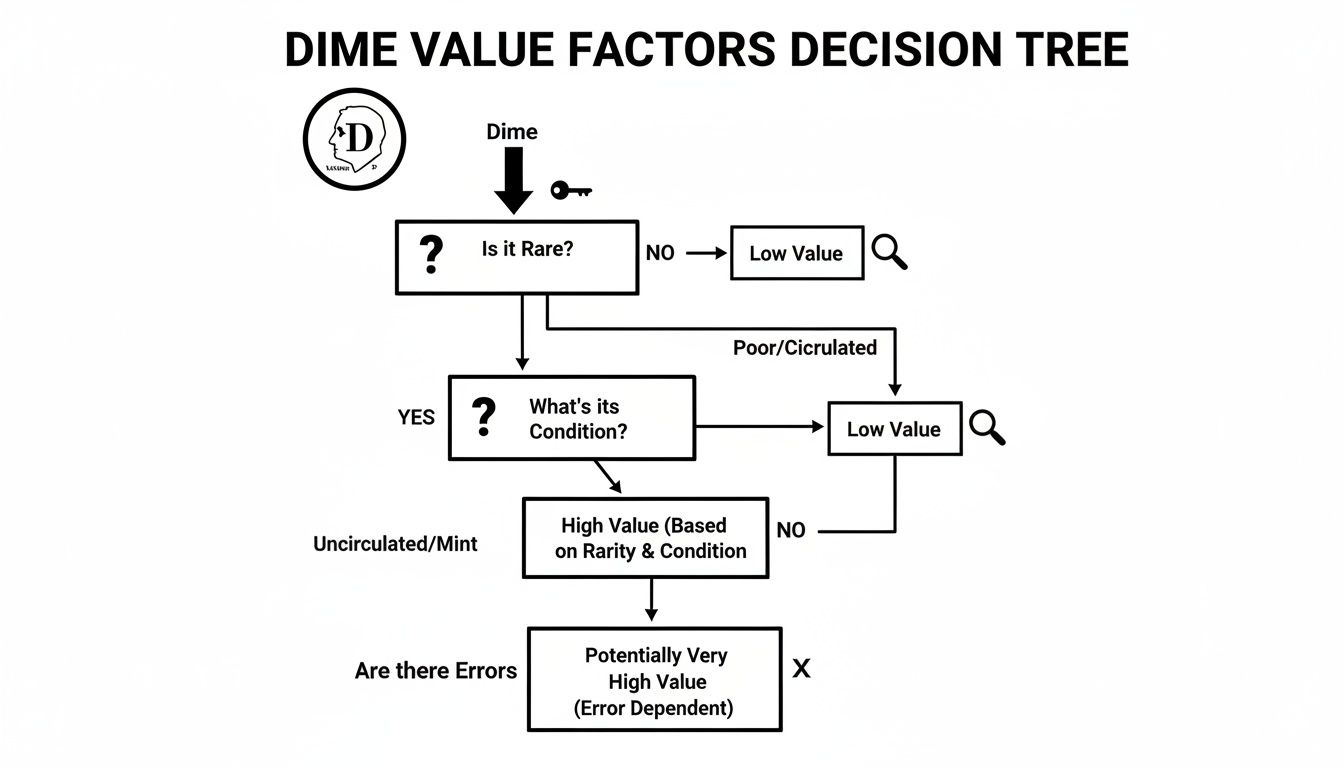
As you can see, a coin’s journey to becoming valuable isn't a straight line. It could be a rare mint mark, an exceptional state of preservation, or a one-of-a-kind minting flaw that sets it apart.
If you enjoy digging into these details, our guide to understanding coin key dates is a great next step. Mastering this knowledge is what separates a casual enthusiast from a serious collector who can spot the true gems.
Choosing the Right Way to Sell Your Coins
So, you’ve sorted through your change and found a dime that looks promising. The big question now is, "How do I actually get a fair price for this?" You have a few options, but they are definitely not all created equal. Navigating the world of coin selling can feel a little tricky, and it’s smart to be aware of potential pitfalls like surprise fees, shipping nightmares, and dishonest buyers.
The most common paths are online auctions, big coin shows, and your local coin dealers. Selling online can cast a wide net, but it comes with some serious downsides. You’re often looking at listing fees, final value fees, and payment processing fees that all take a cut. On top of that, you have the stress of packing a valuable item and shipping it off to a complete stranger. It can be a slow, uncertain process.
Coin shows are another option. They put you in a room with a lot of dealers at once, but that can be overwhelming. It's tough to know who to trust, and the high-pressure environment can leave you wondering if you really got the best deal.
The Advantage of Selling Locally
For most people, the simplest, safest, and smartest way to sell is by working with a trusted local expert. This approach completely cuts out the guesswork and risk that come with selling online. Instead of waiting for an auction to end or mailing your valuables across the country, you get an immediate, in-person evaluation and a cash offer right on the spot.
There's a real peace of mind that comes from selling locally. You're dealing face-to-face with a professional in your own community, building a level of trust that an anonymous online transaction just can't offer. This is a huge deal, especially if you're looking to sell more than just coins.
A reputable local buyer who specializes in Gold and Jewelry Buying can assess everything from your silver dimes to old gold rings in one quick visit. This one-stop approach saves you a ton of time and makes sure you get a fair, comprehensive offer for all your items at once.
Why Boise Residents Should Choose a Local Expert
If you're here in the Treasure Valley, the benefits of sticking with a local pro are even clearer. Why gamble with online hassles when you can get the highest payout in Boise right here at home? A trusted local shop will give you hassle-free offers without any of the pressure.
You also get access to professional tools that verify exactly what your items are worth. Look for a buyer who offers services like Xray Scanning and Gold Testing for free. This kind of technology confirms the precise metal content of your coins, jewelry, and bullion, which guarantees the offer you receive is both accurate and totally transparent.
A top-tier local buyer should also stand by their offers with Price Matching, giving you complete confidence that you're getting the best value possible. At the end of the day, you can save the hassle and sell locally for more than online shipments. If you're ready to learn more, our guide on how to sell collectible coins breaks down the process with more insider tips.
Why Selling Locally in Boise Is Your Smartest Move
If you're in Boise wondering "how much is a dime worth," the next logical question is where to sell it. While big online marketplaces seem tempting with their massive audience, they’re often a minefield of hidden fees, nerve-wracking shipping risks, and long waits to actually get paid.
Why jump through all those hoops? You can get the highest payout in Boise right here at home, with total confidence and zero stress.
Choosing a local expert for Gold and Jewelry Buying is about more than just convenience—it's about getting immediate, professional service. Forget about boxing up your valuables and just hoping they arrive safely. You can walk in, speak to a real person, and get a transparent, hassle-free offer right on the spot. It’s a straightforward process designed to give you security and the best possible value, no games involved.
The Boise Advantage: Service and Value
A top-tier local buyer has access to professional-grade technology that you just won't find with online mail-in services. Here, you can get things like Xray Scanning and Gold Testing for free, which are non-destructive ways to verify the exact composition of your coins and jewelry. This means the offer you get is based on hard data, not just a guess.
The best local experts will always stand behind their offers with Price Matching. This is your assurance that you aren't just getting a fair price—you're getting the best price in town. Period.
When you weigh the options, the choice becomes crystal clear. You can save the hassle and sell locally for more than online shipments. It doesn't matter if you have a single rare dime, a whole collection of silver coins, or other gold and jewelry—working with a trusted Boise professional is simply the smartest move.
Ready to take the next step? Our guide on how to sell silver coins is packed with even more tips for a successful sale. Trusting local expertise is the surest way to get the maximum return for your valuables.
Got questions? We've got answers. Here are a few of the most common things people ask when they're figuring out what their dimes are worth.
What's the Fastest Way to Spot a Silver Dime?
It all starts with the date. Flip it over and look for the year. If your dime is dated 1964 or earlier, you're holding 90% silver. That alone makes it worth more than ten cents.
For an immediate visual clue, just look at the edge of the coin. A modern, clad dime has a distinct copper-colored band sandwiched between two nickel layers. A silver dime, on the other hand, will have a solid, uniform silver stripe all the way around. No copper, no sandwich—just silver.
Should I Clean My Old Dimes?
In a word: no. Please, don't do it. Trying to polish or scrub an old coin is one of the fastest ways to destroy its value. Rubbing it with a cloth, using chemicals, or applying any kind of polish creates tiny, hairline scratches and strips away the natural toning (called patina) that collectors actually look for.
To a coin expert, a cleaned coin isn't a shiny coin—it's a damaged coin. You could accidentally wipe away hundreds of dollars in value with a single misguided attempt to "spruce it up."
If you're in the Boise area, there's no need to take that risk. Bringing your finds to a local expert who specializes in Gold and Jewelry Buying is the best way to go. You'll get a hassle-free offer on the spot, with zero pressure. Plus, you can get Xray Scanning and Gold Testing for free to see exactly what you have.
With Price Matching, you know you're getting the highest payout in Boise. Why deal with the risk and waiting of online sales when you can save the hassle and sell locally for more than online shipments?
Ready to see what your coins, gold, or old jewelry are really worth? Swing by Carat 24 - Trusted Gold Experts. We offer a professional, transparent experience with top-tier payouts. Visit us at our Boise store or check us out online to learn more.
