

So, you’ve got a piece of jewelry and you’re wondering if that stone is the real deal. Before you start thinking about the highest payout in Boise, it’s smart to run a few simple checks yourself. These at-home tests are a great starting point, a sort of first-pass screening before you bring it in for a professional look.
They don't require any fancy equipment and won't damage your stone. Think of it this way: a real diamond behaves in very specific ways when it comes to heat, light, and water. Most fakes just can't keep up.
The Fog Test: An Instant Clue
This is probably the quickest and easiest test you can do. Just hold the stone up to your mouth and breathe on it like you would to fog up a mirror.
A genuine diamond is an incredible conductor of heat, which means it won't hold onto the moisture from your breath. The fog will clear up almost instantly—we’re talking one or two seconds, max. An imposter like cubic zirconia or glass, on the other hand, will stay fogged up for a few seconds longer, usually three to five. It’s a surprisingly reliable first indicator.
The Water Test: A Matter of Density
Here’s another simple one. Grab a regular glass, fill it about three-quarters full with water, and gently drop the loose stone inside.
Real diamonds are incredibly dense. Because of this, a genuine diamond will sink straight to the bottom, no hesitation. Many common fakes, like glass or quartz, are less dense. They might float for a moment, suspend themselves in the middle, or just sink much more slowly. If your stone drops like a rock, it’s a good sign.
Keep in mind that some high-quality simulants, like cubic zirconia, are also quite dense and will sink. This is why it's best to combine multiple tests for a more rounded assessment before deciding to sell.
The Read-Through and Sparkle Tests
How a stone handles light is one of its most defining features. For the Read-Through Test, place the stone with its flat side (the table) down on a page of a book or newspaper.
If you have a real diamond, its incredible refractive properties will bend the light so sharply that you won’t be able to see the letters through it. It'll be a blur. If you can make out the words, or even just distorted black smudges, you're almost certainly looking at a fake.
Next, just look at how it sparkles under a normal lamp. A diamond’s sparkle is unique and has two key components:
- Brilliance: This is the powerful white light that reflects back to your eye. It should look crisp and bright.
- Fire: This is the rainbow of colors that flashes as you move the stone. A real diamond has a beautiful balance of both.
Many fakes, especially cubic zirconia, go overboard on the fire. They can throw off an exaggerated, almost disco-ball-like rainbow effect that looks a bit too flashy and artificial compared to a real diamond’s more subtle, elegant sparkle.
While these home tests are great for a preliminary check, they can't give you a definitive answer. To get a guaranteed hassle-free offer and find out the true value of your items, the next step should always involve an expert. You can save the hassle and sell locally for more than online shipments. At our Boise location, we offer free Xray Scanning and Gold Testing for free to give you the real story and back our offers with a price-matching guarantee.
So, you've tried a few of the at-home tests and you’re still not sure. Or maybe the tests suggest what you have isn't a diamond, and now you're wondering what it could be. It’s a common scenario, especially with inherited jewelry or pieces from an old collection.
Many materials can mimic a diamond's sparkle, but their physical properties always tell the real story. Knowing the most common fakes—Cubic Zirconia, Moissanite, and White Sapphire—is the next step in figuring out what you really have.
Let's break them down.
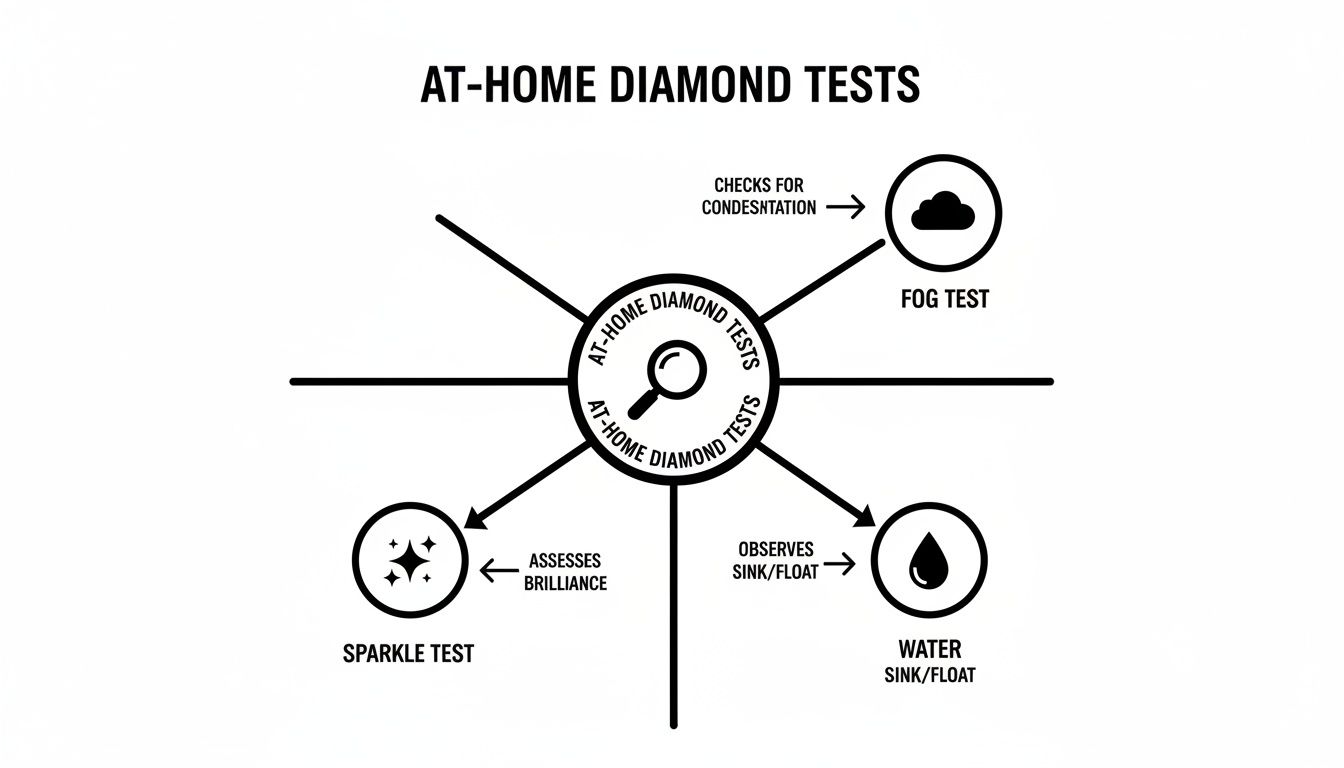
This quick visual guide shows how a real diamond's unique traits—like how it handles heat, its density, and the way it bends light—form the basis for these easy checks.
Cubic Zirconia: The Classic Imitation
If you have a diamond simulant, there’s a good chance it's Cubic Zirconia (CZ). It's the most widespread imitation out there because it's lab-created to be flawless and colorless. But its perfection is also its weakness.
- Hardness: A diamond is a 10 on the Mohs scale, the hardest material there is. A CZ is only about an 8. This means it scratches much more easily and will show wear and tear over time, especially along the sharp edges of its facets.
- Weight: This one is a big tell. CZ is about 75% denser than a diamond. If you have a loose stone that feels surprisingly heavy for its size, your suspicion should be high.
- Appearance: CZs often flash an over-the-top, rainbow-colored fire that just looks a bit too flashy compared to a genuine diamond's balanced sparkle. It lacks that crisp, white brilliance you expect from the real deal.
Moissanite: The Convincing Competitor
Moissanite is a whole different ballgame. It's a seriously convincing fake that can fool even seasoned eyes without the right equipment. It’s incredibly hard (a 9.25 on the Mohs scale) and its thermal conductivity is so similar to a diamond's that it can actually pass some older, basic diamond testers.
So, what's the giveaway? Its fire is on another level. Moissanite is "doubly refractive," meaning it splits light into two separate rays. This creates a dazzling, almost chaotic rainbow sparkle often called the "disco ball effect." A diamond's fire is much more controlled and balanced.
If you look closely at a Moissanite from an angle, you might even see the facets appear doubled or blurry through the stone—a dead giveaway of double refraction.
White Sapphire, Glass, and Other Stand-Ins
White Sapphire is another contender you might run into. It’s a natural gemstone and quite durable at a 9 on the Mohs scale, but it just doesn't have a diamond's life or sparkle. It often looks a bit milky or cloudy, with more of a soft, silvery glow than a sharp, brilliant fire.
And then there's good old-fashioned glass. As a low-cost fake, it's pretty easy to spot. It's soft (around 5.5 on the Mohs scale), so it will be covered in scratches. A glass stone looks dull and lifeless, and you can often spot tiny bubbles or other imperfections trapped inside.
| Diamond vs. Common Simulants: A Quick Comparison Guide |
| :--- | :--- | :--- | :--- | :--- | :--- |
| Characteristic | Diamond | Moissanite | Cubic Zirconia (CZ) | White Sapphire | Glass |
| Hardness (Mohs) | 10 | 9.25 | 8-8.5 | 9 | 5.5 - 7 |
| Brilliance (Sparkle) | Intense, balanced white & colored light | Exceptional, fiery, "disco ball" effect | Strong, but more rainbow flashes than white brilliance | Muted, silvery sparkle; often looks cloudy | Dull, minimal sparkle |
| Refraction | Singly refractive | Doubly refractive (doubled facets visible) | Singly refractive | Singly refractive | Singly refractive |
| Weight | Standard density | Slightly lighter than diamond | ~75% heavier than diamond | Heavier than diamond | Varies, but often feels light |
| Heat Conductivity | Excellent (dissipates fog instantly) | Very good (can fool some testers) | Poor (fogs up easily) | Poor (fogs up) | Poor (fogs up) |
The small details that separate a real diamond from these look-alikes often come down to their internal structure and quality. If you want to learn more about what gemologists look for inside a stone, check out our diamond clarity and color guide for a deeper dive.
At the end of the day, the only way to be 100% certain is to have it professionally tested. It’s a quick and painless process that gives you a definitive answer.
When to Bring in the Experts: Professional Diamond Testing
While the at-home tests are a fantastic starting point, they can only take you so far. High-quality fakes, especially moissanite, are designed to fool the naked eye and can often pass the simpler checks. To get a definitive answer and a true valuation, you have to move beyond guesswork and into the world of professional gemological tools.
Understanding how we, as experts in Gold and Jewelry Buying, test diamonds gives you transparency and confidence in the authentication process. It's precisely this level of accuracy that allows us to provide the highest payout in Boise for your items—we don't guess, we verify with industry-standard equipment for every single evaluation.
The first tool an expert will grab is surprisingly simple, yet incredibly powerful.
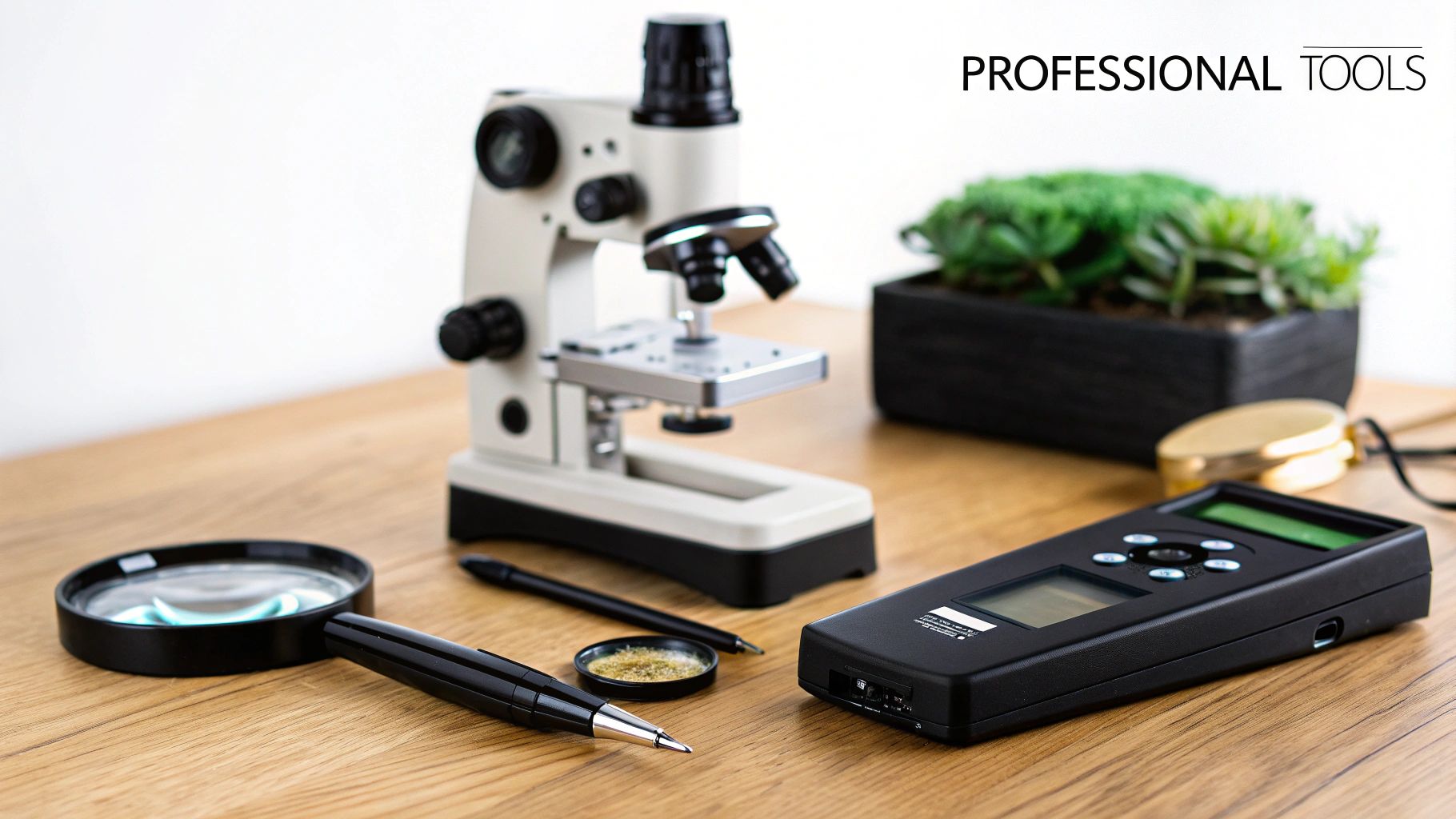
A Closer Look with a Jeweler's Loupe
A jeweler's loupe is essentially a small, high-powered magnifying glass, usually with 10x magnification. It’s our first line of defense, and for a very good reason. Under that lens, the hidden story of a stone starts to come into focus.
A trained eye looks for tiny internal characteristics known as inclusions. These are nature's fingerprints—miniscule crystals, feathers, or cloudy spots that were trapped inside the diamond as it formed deep within the Earth. Most fakes, like cubic zirconia, are lab-made to be perfect, so a complete absence of any inclusions can actually be a red flag. On the other hand, a cheap glass imitation might reveal tiny air bubbles, a dead giveaway of its origin.
A loupe also tells us a lot about the quality of the cut. The facet edges on a real diamond are incredibly sharp and precise. Fakes often have rounded or worn-looking junctions between facets, a tell-tale sign of softer material.
Diamond Testers: Thermal and Electrical Probes
This is where technology really shines. A professional diamond tester is a handheld device with a small, spring-loaded tip that measures how a stone responds to heat and electricity. Diamonds are exceptional thermal conductors, meaning they pull heat away from the probe's tip at a specific, rapid rate.
Older testers often had trouble telling diamonds and moissanite apart because moissanite is also a good thermal conductor. Here's the catch: moissanite is electrically conductive, while diamonds are not. Modern combination testers check both properties at once, making it simple to distinguish between the two. This is a non-negotiable step in any professional Gold and Jewelry Buying evaluation.
The tech has come a long way. Early testers could spot about 95% of fakes but sometimes failed on rare Type IIa diamonds. As of 2024, the game has changed. With lab-grown diamonds now making up 17% of the engagement ring market, modern testers can accurately identify both natural and lab-created stones. For perspective, 1980s-era testers were fooled by moissanite up to 30% of the time; today's advanced models have near-zero false positives.
High-Powered Microscopes and Advanced Scanning
For the final, definitive analysis, we turn to high-powered gemological microscopes and advanced scanning tech. Under 30x or 40x magnification, a gemologist can spot details that are completely invisible even with a loupe. This includes things like tiny laser inscriptions etched on a diamond's girdle or subtle growth patterns that distinguish a natural diamond from one grown in a lab.
Here in Boise, we take it a step further. We offer free Xray scanning and Gold Testing for free on-site. Using an X-ray fluorescence (XRF) scanner, we can determine the exact elemental makeup of the metal setting without leaving a single scratch. This instantly confirms if you have 14k gold, platinum, or another alloy, ensuring a comprehensive and accurate evaluation.
Knowing about these tools helps you understand the meticulous detail that goes into a professional appraisal. It's a transparent, precise process designed to give you a hassle free offer with total confidence.
If you're curious about what a full evaluation looks like from start to finish, our guide on how to get jewelry appraised walks you through the entire process. You can save the hassle and sell locally for more than online shipments, especially knowing our price matching guarantee ensures you get the absolute best value right here at home.
The Modern Challenge of Lab-Grown Diamonds
In recent years, the conversation around identifying fake diamonds has gotten a lot more complicated. It’s no longer just about spotting glass or cubic zirconia. The real challenge now comes from lab-grown diamonds.
Here’s the thing: lab-grown diamonds aren’t “fakes” in the traditional sense. They are chemically, physically, and optically identical to diamonds pulled from the earth.
This means all those simple at-home tests—like breathing on the stone or checking its sparkle—are completely useless for telling them apart. A lab-grown diamond will pass every single one of those tests because, materially speaking, it is a real diamond. The only difference is its origin story: one was formed deep in the earth over billions of years, and the other was created in a high-tech lab.
For anyone involved in Gold and Jewelry Buying, this distinction is absolutely critical. While they are both real diamonds, their market values are worlds apart, which directly impacts the payout you receive.
Why Origin Matters for Value
Understanding the difference between a natural and a lab-grown diamond is crucial for any fair evaluation. Natural diamonds are a finite resource, and their rarity is a massive part of what gives them value.
Lab-grown diamonds, on the other hand, can be produced in large quantities, leading to a much lower price point. It's not about one being "better" than the other, but simply a matter of supply, demand, and market perception. When you want to sell a piece, knowing its origin is essential to getting an accurate and honest offer. This is where professional expertise becomes non-negotiable, as only advanced equipment can make the final determination.
A common misconception is that lab-grown diamonds are somehow inferior. In reality, they are often just as beautiful and durable as natural stones. The primary difference is their history and resale value, which is a key factor in any appraisal.
Uncovering the Truth with Advanced Spectroscopy
So, if they look and feel the same, how can an expert possibly tell the difference? The answer is technology that sees what the human eye can't. We use advanced spectroscopic tools, like Fourier Transform Infrared (FT-IR) spectroscopy, to get a look at the diamond's atomic structure.
This incredible method works by identifying the presence and arrangement of nitrogen atoms within the diamond's crystal lattice. It’s the key to everything.
This allows us to use the official diamond typing system, which categorizes stones with incredible precision. Here's a quick breakdown:
- Type I diamonds contain nitrogen and make up 98% of all mined gems.
- Type II diamonds have very low nitrogen and represent only 1-2% of natural diamonds.
Synthetics have surged from a tiny 1% market share in 2015 to 16% by 2024. An FT-IR scan can spot the subtle indicators of synthetic origin with over 95% confidence. This is vital, as misidentified stones can lose 80-90% of their value. For example, 75% of Type IIa diamonds are untreated naturals worth twice as much as their synthetic counterparts.
This level of scientific analysis ensures we never make an offer based on guesswork. It’s a core part of the process that allows us to confidently provide the highest payout in Boise. Knowing every last detail about your stone is what makes for an honest jewelry appraisal near me.
Your Assurance of an Accurate Offer
Ultimately, identifying a lab-grown diamond requires specialized equipment and a trained eye. It’s the perfect example of why you should save the hassle and sell locally for more than online shipments. When you ship your jewelry to some unknown online buyer, you have zero visibility into their testing methods and no way to ensure a transparent evaluation.
Here in Boise, we provide Xray Scanning and Gold Testing for free, right in front of you. This commitment to a transparent, scientific approach means you get hassle free offers you can trust, backed by our price matching guarantee. Knowing the true origin of your diamond ensures you get paid its true value. Every single time.
Why a Professional Evaluation Is Your Safest Bet

After trying the at-home tests and seeing how tricky modern fakes can be, you start to realize something important. The only way to know for sure what you have is to let a professional take a look. DIY tests are great for spotting obvious fakes, but they just can't compete with high-quality synthetics or even other natural gems that mimic a diamond's sparkle. This is where a trained eye and the right technology make all the difference.
Shipping your valuables off to a faceless online buyer is a huge gamble. The second that package is out of your hands, you've lost control. It creates a ton of stress and leaves you wondering if you're getting a fair shake. Why put yourself through that? You can save the hassle and sell locally for more than online shipments, all while getting a transparent and secure experience.
Transparency and Trust: The Local Advantage
When you bring your jewelry to a local expert, you’re part of the conversation. You get to ask questions, see the tests being performed, and hear a clear, face-to-face explanation of what we find. That kind of open dialogue is the bedrock of a trustworthy Gold and Jewelry Buying experience—something a mail-in service just can't replicate.
We believe in total transparency, which is why we do all our evaluations right in front of you. This immediate, in-person approach doesn't just give you peace of mind; it leads to hassle-free offers without the long waits or hidden fees you often see with online buyers.
The core benefit of a local evaluation is accountability. When you work with a trusted member of the Boise community, you can be confident that the appraisal is fair, accurate, and conducted with integrity.
To truly protect your investment, it's vital to verify an item's authenticity before it ever becomes an issue. You can learn more about how pre-authentication can prevent financial loss.
Our Rigorous 8-Step Authentication Process
To guarantee accuracy and deliver the highest payout in Boise, we've perfected a meticulous 8-step authentication process. It’s a powerful combination of a gemologist's trained eye and advanced technology, leaving absolutely no room for error. It’s how we can confidently stand behind every single offer we make.
Here's a look at our process:
- Detailed Visual Inspection: We start with a close-up look under magnification, checking the piece's condition, craftsmanship, and any identifying marks.
- Precise Measurements and Weight: We record the exact dimensions and carat weight—critical data points for an accurate valuation.
- Advanced Spectroscopic Analysis: This is where the magic happens. Our equipment, including free X-ray scanning, analyzes the stone's chemical makeup to tell the difference between natural diamonds, lab-grown diamonds, and simulants.
- Microscopic Examination: We hunt for tiny inclusions and growth patterns that tell the story of a stone's origin.
- Thermal and Electrical Conductivity Tests: These quick electronic tests are the definitive way to separate a diamond from moissanite, one of its most convincing impostors.
- UV Fluorescence Check: We observe how the stone reacts under ultraviolet light, as different diamonds can show unique fluorescent colors.
- Setting and Metal Purity Analysis: Our free Gold Testing confirms the purity of the metal setting, whether it's 14k, 18k, or platinum.
- Final Valuation and Offer: Using all the data we've gathered, we present a transparent, fair market offer backed by our Price Matching guarantee.
This scientific, hands-on approach is more crucial today than ever before. For instance, FT-IR spectroscopy—a key tool in our arsenal—has been a cornerstone of gem authentication for decades. It instantly classifies diamonds by their nitrogen content, separating common types from rarer ones. A modern analyzer can run this test in under 30 seconds with 99% accuracy. With lab-grown diamonds now making up 17% of the global supply, this technology is essential for protecting our clients and ensuring you get paid the correct value.
Ultimately, a professional evaluation isn't just about finding out if a diamond is real. It's about understanding its complete story and its true worth. For more tips on getting the most for your items, check out our guide on finding the best place to sell diamonds.
Answering Your Top Questions About Diamond Testing
When you're thinking about selling a diamond, questions are a good thing. It means you're being careful. Whether you’ve inherited an heirloom ring or are simply curious about a piece you’ve owned for years, getting straight answers is the first step toward making a smart decision. We've pulled together the most common questions we hear from folks right here in our Boise shop to help you feel more confident.
Our goal is to pull back the curtain on how to detect fake diamonds and give you the clarity you need. Knowing these key details will put you in a much better position before you bring your gold and jewelry in for a professional look.
Can a Real Diamond Get Scratched?
It’s incredibly tough, but yes, it can happen. A diamond is the hardest natural material we know of, earning a perfect 10 on the Mohs scale of hardness. In day-to-day life, that means the only thing that can really put a scratch on its surface is another diamond.
However, a diamond isn't indestructible. A sharp, direct hit along one of its "cleavage planes"—think of it like the grain in a piece of wood—can cause it to chip or even fracture. If you're looking at a stone and see obvious surface scratches, you're almost certainly dealing with a softer simulant like glass or cubic zirconia. We strongly recommend you never try a "scratch test" yourself. You could easily damage a valuable gemstone, whether it's a real diamond or another precious stone like a white sapphire.
Is a Lab-Grown Diamond Considered Fake?
Absolutely not. This is one of the biggest points of confusion in the jewelry world today. A lab-grown diamond is a real diamond, not a fake. It has the exact same chemical makeup, crystal structure, and optical properties as a diamond that came out of the ground.
"Fake" diamonds are actually simulants—materials made to look like a diamond but are completely different chemically. Think cubic zirconia (CZ), moissanite, or glass. While lab-grown diamonds are real, their origin story is different, and that does impact their market value and how much they can be resold for. We use specialized equipment to tell them apart from natural diamonds so we can give you a fair and accurate offer based on what you have. If you want to dive deeper into how this affects pricing, our guide on using a diamond resale value calculator breaks it down.
Why Sell My Diamonds Locally in Boise Instead of Mailing Them?
Selling your diamonds to a local expert offers huge advantages in security, transparency, and often, value. When you save the hassle and sell locally for more than online shipments, you completely avoid the risk of your jewelry getting lost, stolen, or damaged in the mail. There’s no nail-biting wait or uncertainty.
Even better, you get to be part of the process. You can watch us work, ask questions, and get a hassle free offer on the spot with our free Xray scanning and Gold Testing for free. That face-to-face interaction builds trust. Because we have lower overhead than big online operations and a reputation to uphold right here in Boise, we can often provide the highest payout in Boise. Our price matching policy is your guarantee that you’re getting the best possible value without the gamble of sending your heirlooms off to a stranger.
Selling your valuables should feel secure and rewarding. When you choose a trusted local buyer, you stay in control and get the peace of mind that only comes from a transparent, face-to-face transaction.
What Is Your 8-Step Authentication Process?
Our 8-step authentication process is our promise of accuracy and fairness. It’s a thorough, systematic approach that combines a trained gemologist’s eye with advanced technology to assess every detail of your jewelry. This rigorous method ensures we identify every stone and metal with total confidence, which allows us to make the strongest possible offer.
The process involves a meticulous visual inspection, precise measurements, checking for laser inscriptions, running advanced spectroscopic analysis (like XRF scanning) to map out material composition, performing thermal and electrical conductivity tests, and using UV light to check for fluorescence. This kind of detailed evaluation is how we can confidently stand behind every offer we make. For more on spotting fakes in general, you can find some great resources with further insights on identifying fake items.
When you're ready to learn the true value of your jewelry, visit us at Carat 24 - Trusted Gold Experts. We provide a transparent, professional, and rewarding experience, ensuring you get the best value for your items right here in Boise. Stop by or learn more at https://carat24boise.com.
