
So, you've got some gold you're thinking about selling. Before you do anything else, the first step is figuring out what it's really worth, and that all comes down to purity. It's a simple concept: the more pure gold in your item, the more valuable it is.
Understanding Gold Purity and What It Means for You
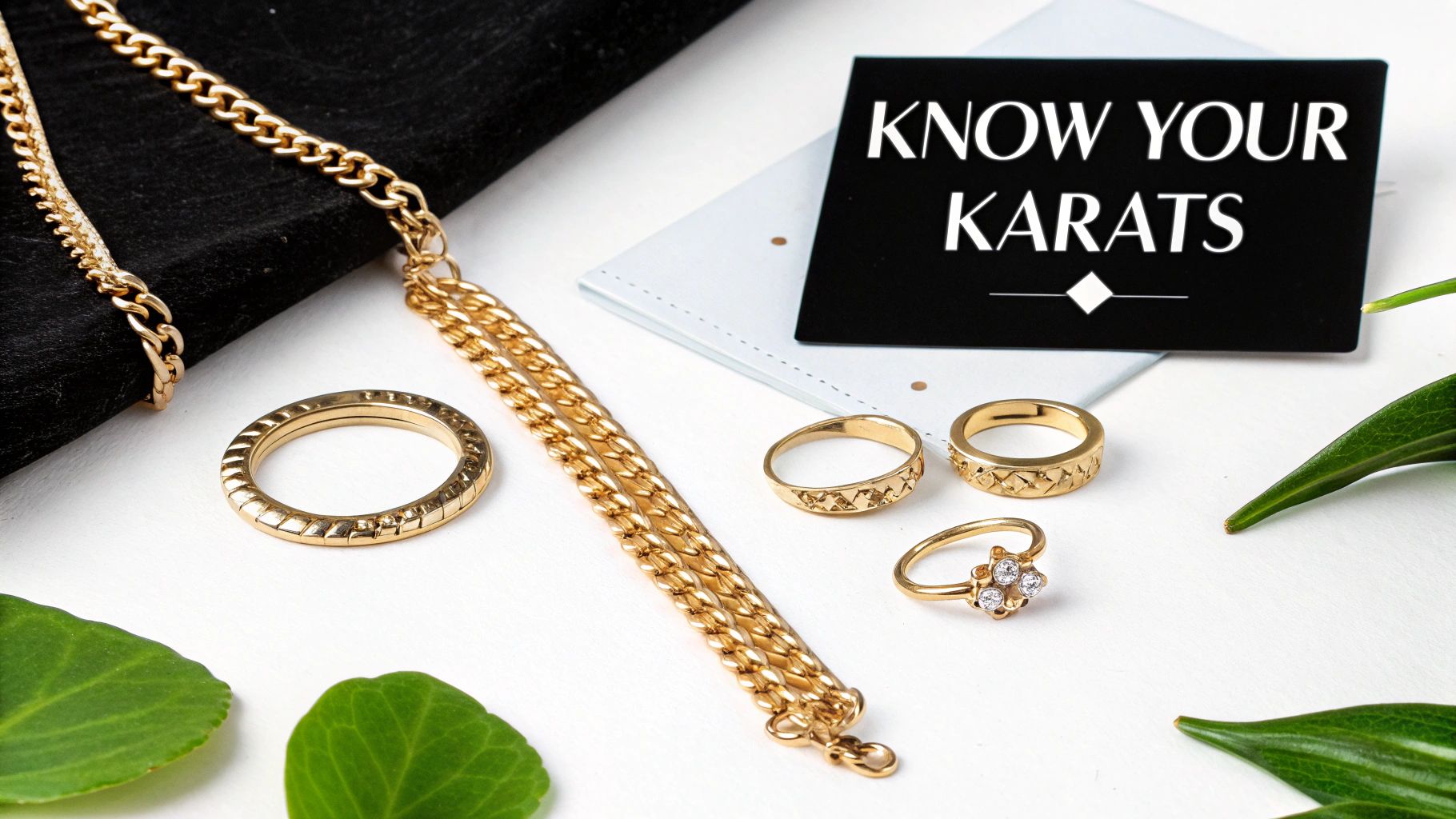
Let's get one thing straight: most gold jewelry isn't 100% pure gold. Pure gold, or 24-karat (24k) gold, is actually quite soft and not very practical for everyday wear. To make it more durable, jewelers mix it with other metals like copper, silver, or zinc. This mixture is called an alloy, and the karat system tells us exactly how much pure gold is in that mix.
Think of the karat system as a scale out of 24 parts. For instance, an 18-karat piece is made of 18 parts pure gold and 6 parts other metals. Do the math, and that comes out to 75% pure gold. A 14-karat piece? That's 14 parts pure gold to 10 parts other metals, or about 58.3% pure.
Karat vs Fineness
You might also see a three-digit number stamped on your jewelry instead of a "k" mark. This is its "fineness," which is just a more precise way of stating purity in parts per thousand. A stamp that reads "750" means the item is 750 parts pure gold out of 1,000—the exact same thing as 18k gold (75%).
Knowing these markings is your first clue to an item's value and helps you set realistic expectations before getting a professional appraisal. Different countries and time periods have their own unique ways of marking jewelry. If you're curious, you can learn a lot about these conventions by exploring guides on specific types, like this one on what is Italian gold.
Knowing the difference between 14k and 18k isn't just trivia—it directly translates to the payout you'll receive. Higher purity means a higher value.
Gold Karat and Fineness Conversion Chart
This chart is a handy little reference to quickly translate the markings on your jewelry into actual gold content. It's a great tool to have bookmarked.
| Karat (K) | Millesimal Fineness | Pure Gold Percentage (%) |
|---|---|---|
| 24K | 999 | 99.9% |
| 22K | 916 or 917 | 91.6% or 91.7% |
| 18K | 750 | 75.0% |
| 14K | 583 or 585 | 58.3% or 58.5% |
| 10K | 417 | 41.7% |
Having this knowledge puts you in a much stronger position. But remember, stamps can be worn down, faked, or just plain wrong. The only way to know for sure is through professional testing.
If you want to get the highest payout in Boise, save the hassle and sell locally for more than online shipments. We make it easy with hassle-free offers, Price Matching, and Gold Testing for free with Xray Scanning to instantly confirm your gold’s true worth.
Your First Step: A Thorough Visual Inspection
Before you jump into any complex tests, just take a good, hard look at your gold piece. More often than not, the most valuable clues about its purity are stamped right onto the item, hiding in plain sight. A careful visual inspection is always the best place to start.
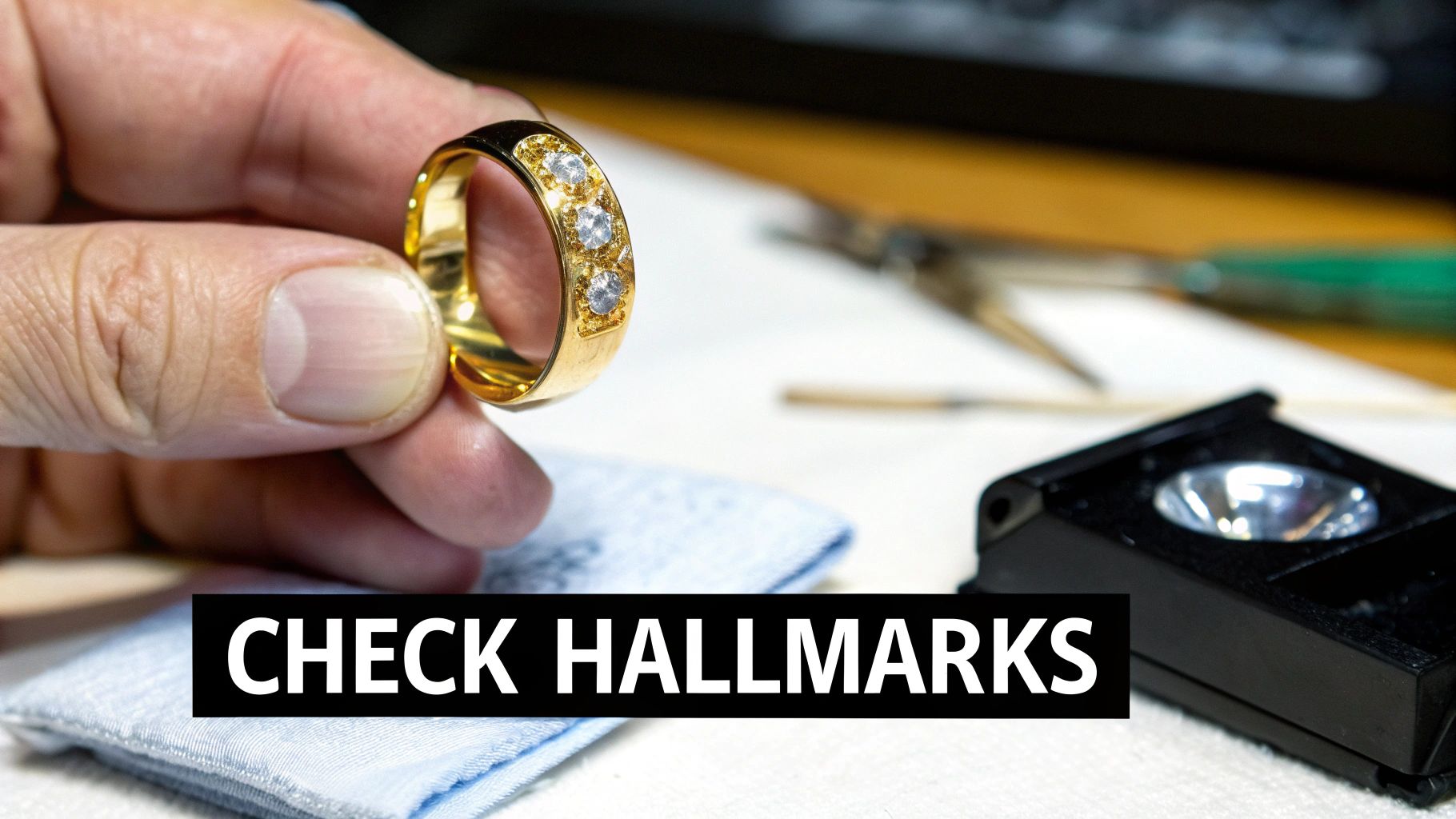
If you have a magnifying glass or a jeweler's loupe, grab it. These markings can be incredibly small and often get worn down over years of use. You're searching for a hallmark—a tiny stamp that certifies the gold's content. On a ring, it's usually on the inner band. For a necklace, check near the clasp, and for earrings, look on the post or backing.
Decoding the Markings
These little stamps tell a very specific story. They typically come in two main flavors: the karat system (like "14K" or "18K") that most Americans are familiar with, or the millesimal fineness system, which uses numbers (like "585" for 14K or "750" for 18K). It's easy to confuse these with a maker's mark, which is just the logo or initials of the company that made it and says nothing about purity.
Different parts of the world also have their own stamping conventions. If you're curious about symbols from other countries, our guide to understanding Chinese gold jewelry markings is a great resource. Learning to spot these subtle differences is a big part of a good visual check.
A genuine purity stamp is a strong clue, but it's not a foolproof guarantee. And if there's no mark at all? It doesn't automatically mean the item is fake. It could just be very old, custom-made, or from a country where stamping wasn't required.
Spotting Potential Red Flags
Your inspection isn't just about finding marks—it's also about looking for signs that an item isn't solid gold. Discoloration is a huge red flag. Check the spots that get the most wear and tear, like the edges of a pendant or the inside of a ring's band.
If you see another color—often a tell-tale green, black, or even reddish tone—peeking through where the top layer has rubbed off, you're almost certainly looking at a gold-plated piece.
Also, keep an eye out for specific initials that are meant to look official but actually tell you the item isn't solid gold.
Common Plating Marks to Watch For:
- GP: Gold Plated
- GF: Gold Filled
- HGE: Heavy Gold Electroplate
- RGP: Rolled Gold Plate
Finding any of these stamps confirms the piece has only a thin outer layer of gold covering a less valuable base metal. While this visual check is an essential first move, the only way to be 100% certain of your gold's purity is with professional testing.
For anyone in the Boise area, you can skip the guesswork entirely. We offer Gold Testing for free with on-the-spot Xray Scanning and straightforward, hassle-free offers for all Gold and Jewelry Buying. With our Price Matching promise, you know you're getting the highest payout in Boise, period.
Simple At-Home Tests for a Preliminary Check
Once you've given your piece a good visual inspection, it's time to try a few simple, non-destructive tests you can do right at home. Think of these as a first-pass screening. They won’t give you a definitive answer on purity, but they are fantastic for quickly weeding out the most obvious fakes.
These methods don't require fancy equipment and can save you a trip if your item isn't the real deal. They help you gather more information before deciding to get a professional opinion.
The Magnet Test: A Quick Check
This is the easiest test of them all. Real gold isn't magnetic, so it shouldn't react when you bring a strong magnet close. It’s a lightning-fast way to identify items made from or containing iron or steel, which are common metals used in counterfeit jewelry.
Just grab a strong magnet—a neodymium magnet from a hardware store works best—and hold it right up against your item.
If you feel any pull or the piece snaps to the magnet, it’s not solid gold. It’s almost certainly a base metal that’s been gold-plated.
But don't get a false sense of security. While the magnet test is great at spotting fakes containing ferrous metals, it won't catch everything. Counterfeits made from non-magnetic metals like copper, aluminum, or certain stainless steels will pass this test with flying colors. So, if your item doesn't stick, it just means it's not magnetic—it doesn't automatically confirm it's genuine gold.
The Ceramic Scratch Test
Another popular at-home method is the ceramic scratch test. You'll need an unglazed ceramic plate or tile for this one. Find a small, inconspicuous spot on your gold item and gently rub it across the ceramic surface. You only need to apply enough pressure to leave a faint streak.
- A golden-yellow streak is a good sign. It suggests the item is likely real gold.
- A black or dark-colored streak means it's not gold and is probably a base metal.
A word of caution: this test is slightly abrasive and can leave a small scratch. Always perform it on a hidden area of the piece you’re testing, like the inside of a ring or near a clasp. It's a step up from the magnet test but still falls short of providing a truly accurate analysis. For a deeper dive into different screening methods, check out our comprehensive guide on gold and silver testing.
At-home tests are great preliminary steps, but they are not substitutes for professional evaluation. They can help you identify clear fakes but cannot accurately determine the karat value of genuine gold.
Ultimately, these home-based techniques are useful for an initial assessment, but they can't provide the certainty you need when you're ready to sell. Knowing the exact purity is critical to getting a fair price.
For our neighbors here in Boise, we take all the guesswork out of it. We offer hassle-free, no-obligation offers based on precise, professional Gold Testing for free. Using our advanced Xray Scanning technology, we can tell you your item's exact composition in seconds. This ensures you get the highest payout in Boise. And with our Price Matching guarantee, you can sell with total confidence.
Exploring Traditional Gold Testing Techniques
Once you’ve done the simple at-home checks, you might be curious about the more classic methods jewelers have relied on for centuries. These traditional techniques, like the acid test and the density test, take a bit more effort and come with some risks, but they can give you a much better idea of what you’re holding.
Think of these as the old-school field methods. They’re what professionals often use for a quick assessment before pulling out the high-tech equipment. While they seem more involved, they’re grounded in straightforward science—chemistry for the acid test and physics for the density test, based on principles that go all the way back to Archimedes.
This flowchart gives a good overview of the initial, non-destructive steps you can take before moving on to these more hands-on methods.
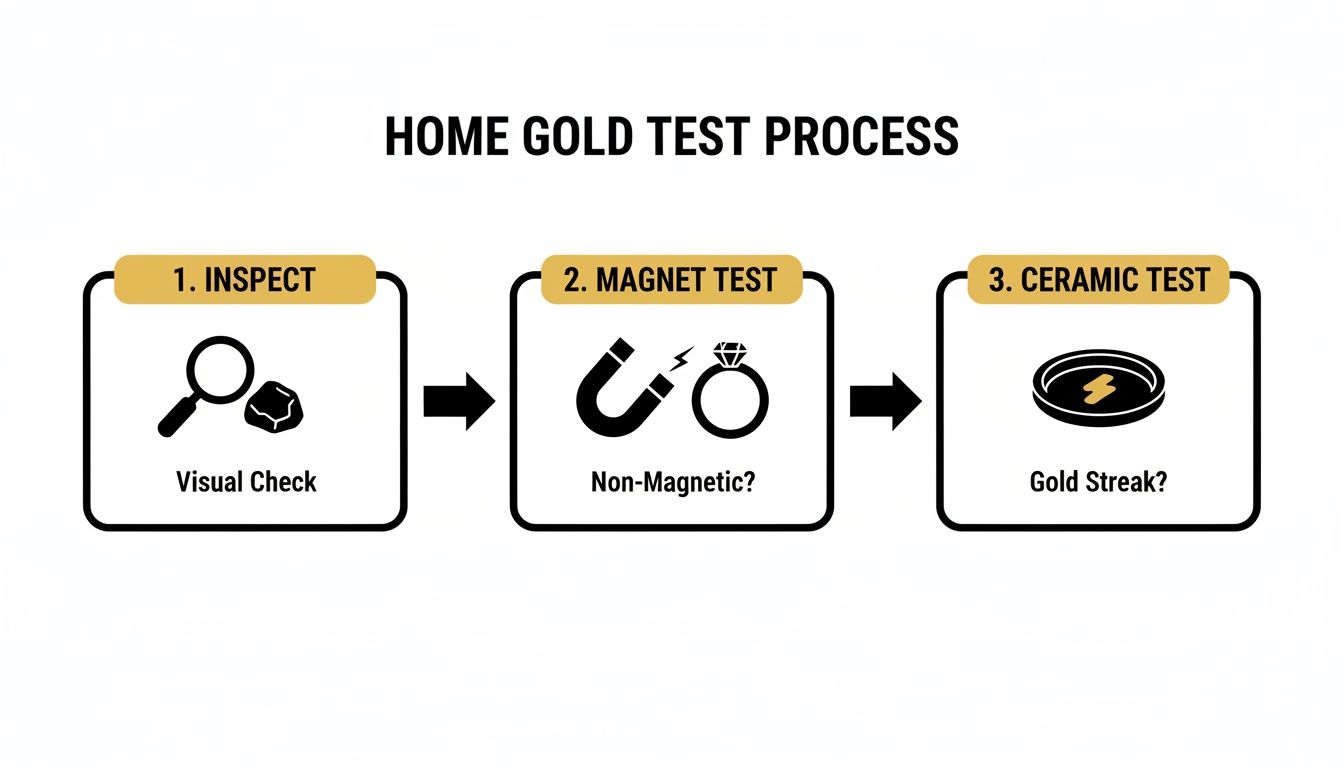
Starting with the easiest tests first is a logical way to weed out the obvious fakes.
The Acid and Touchstone Method
The acid test, often called the touchstone test, is probably one of the oldest and most trusted ways to check gold purity. It's a pretty straightforward process: you gently rub the gold item on a special black touchstone, which leaves a small, visible streak of the metal. Then, you apply a drop of nitric acid that's been specifically calibrated for a certain karat level right onto that streak.
The acid's reaction tells you everything you need to know. If the streak vanishes, the gold is a lower karat than what the acid is rated for. If it stays put, the gold is at least that karat, or possibly higher. For instance, 24k gold is highly resistant to nitric acid, so its streak will remain bright and unchanged. You repeat this with stronger acids until the streak disappears, which helps you narrow down the exact karat.
Important Safety Note: This test involves powerful acids that can cause serious chemical burns and will damage your jewelry if applied directly. It should only be done by someone with the right training and safety gear.
The Density Test
Another time-tested technique is the density test, which calculates an item's density using water displacement. This is a great non-destructive option that hinges on a simple fact: pure gold has a very specific density of 19.32 grams per cubic centimeter (g/cm³).
The method involves weighing your item normally, then weighing it again while it’s fully submerged in water. The difference between those two weights allows you to calculate its volume, and from there, its density. Learn more about how gold's density is a key to verifying its purity on sellgold.be.
These traditional methods are still incredibly useful as complementary techniques. The density test is a cheap, safe way to spot fakes, while the touchstone test gives a quick estimate of the karat. But even these can be fooled by sophisticated fakes.
For absolute certainty and to ensure you get the highest payout in Boise, nothing beats professional analysis. We invite you to skip the hassle and potential damage. We provide Gold Testing for free using advanced Xray Scanning for instant, precise results and hassle-free offers. Plus, our Price Matching guarantee ensures you always get the best deal.
The Professional Standard for Accurate Gold Testing

While the at-home tests we've discussed can give you some good clues, they just can't deliver the concrete accuracy you need when real money is on the line. To know the exact composition of your gold, professionals rely on advanced technology that moves way beyond simple estimates.
Getting a handle on these industry-standard methods is crucial. It shows you why a professional evaluation is the only way to be certain of your gold’s true value. For anyone serious about selling, getting a definitive analysis isn't just a smart move—it’s absolutely essential for a fair payout.
X-Ray Fluorescence: The Modern Gold Standard
Walk into any reputable gold buyer's shop today, and this is the technology you'll likely see: X-Ray Fluorescence (XRF) analysis. An XRF scanner is a sophisticated piece of equipment that gives a fast, completely non-destructive, and incredibly precise breakdown of an item's elemental makeup.
So how does it work? The machine bathes your jewelry in safe, low-level X-rays. The atoms in the metal get excited and emit their own unique energy signatures, which the scanner instantly reads. Within seconds, it can tell you every single metal present and its exact percentage. This is how you find out if a piece is 14k, 18k, or something else entirely, all with scientific certainty.
Key Benefits of XRF Gold Testing:
- Completely Non-Destructive: Your jewelry is analyzed without a single scratch, scuff, or mark.
- Incredibly Fast: You get a precise reading of the gold content in less than a minute.
- Highly Accurate: The technology provides a detailed report of every alloy in the piece.
For sellers, the speed and accuracy of XRF are a total game-changer. There’s no ambiguity and zero guesswork. You get a clear, data-driven valuation that ensures you are paid for the exact amount of gold you have.
Fire Assay: The Historic Benchmark
While XRF is the go-to tool for everyday Gold and Jewelry Buying, the original, historic gold standard for purity testing is the Fire Assay. This is a highly specialized and destructive method used by mints, refineries, and official assay offices when absolute, unquestionable precision is required.
The process involves taking a small sample of the gold and melting it at extreme temperatures, which chemically separates the pure gold from all other alloys. With a history tracing back to 1380 BCE, fire assay is still the reference method for determining gold purity. Its ability to produce results accurate to within fractions of a percent is why governments and major refineries still rely on it as the final word. You can dive deeper into the science behind this and other methods in this comprehensive guide from the GIA.
For Boise locals, there's no need to guess or mail your valuables away. You can save the hassle and sell locally for more than online shipments. We offer Gold Testing for free using state-of-the-art Xray Scanning technology, giving you hassle-free offers right on the spot. And with our Price Matching guarantee, you know you're getting the highest payout in Boise.
To learn more about what a professional evaluation involves, check out our guide on how to get jewelry appraised.
Get the Highest Payout for Your Gold in Boise
You've done your homework. You know the difference between a simple magnet test and a professional analysis, and you have a good idea of what your gold might be worth. Now for the most important part: turning that knowledge into a fair and honest payout.
While those at-home tests are great for getting a ballpark idea, they just don't offer the certainty you need to sell with confidence. This is where a trusted, local professional becomes your biggest ally—especially when you compare it to the gamble of using a mail-in service.
For anyone in or around Boise, selling your gold locally offers real, immediate benefits. Forget the stress of shipping your valuables across the country. You can save the hassle and sell locally for more than online shipments. Shipping jewelry opens you up to risks of loss, damage, and sneaky insurance loopholes, not to mention the painfully long waiting periods and lowball offers that are all too common with faceless online buyers.
Why a Local Expert Matters
Choosing a local expert for Gold and Jewelry Buying is about transparency and getting genuine, personal service. Instead of dropping your prized possessions in a mailbox and just hoping for the best, you get to be there for the entire evaluation. That direct interaction builds trust and ensures you know exactly how your items are being valued, every step of the way.
The biggest advantage of selling locally is getting a professional, on-the-spot evaluation and an immediate, no-obligation offer. There's no waiting for a check to arrive or dealing with those surprise "revised" offers after your items have already left your hands.
We make the whole process straightforward and rewarding. Our commitment starts by offering Gold Testing for free using advanced Xray Scanning (XRF) technology. This is a completely non-destructive method that gives you a precise, scientific breakdown of your gold's purity in seconds. No guesswork, just facts.
Right after the free analysis, we provide hassle-free offers on the spot. We believe in being upfront with our pricing and are confident we provide the highest payout in Boise. To prove it, we offer Price Matching, making sure you always get the best possible value for your gold and jewelry without ever having to leave town. You can get more great insights by reading our guide on the best place to sell gold.
Ultimately, knowing your gold’s purity is only half the battle. The other half is finding a buyer who respects you and the true value of your items. By choosing a local expert, you're choosing security, speed, and a much better financial outcome.
Ready to discover what your gold is really worth? Visit Carat 24 - Trusted Gold Experts in Boise for a free, no-obligation XRF scan and an immediate, top-dollar offer. Stop by today at https://carat24boise.com.
