

Chinese gold jewelry marks are like secret stamps tucked into your rings, necklaces, and bracelets. They tell you exactly how pure the metal is—and often who made it. Spotting a 999, 750, or 585 imprint can be the difference between a fair deal and leaving money on the table.
At Carat 24 in Boise, we specialize in Gold and Jewelry Buying, offering the highest payout in Boise. Enjoy Xray Scanning and Gold Testing for free, along with Hassle free offers and Price Matching. Save the hassle and sell locally for more than online shipments.
Understanding Chinese Gold Jewelry Marks
Think of these tiny hallmarks as the goldsmith’s signature. When you spot one, you’re looking at a guarantee of metal purity and origin.
They save you time and money by letting you identify higher-karat pieces at a glance. No more guessing games when you’re negotiating or appraising.
Below is a quick reference to these marks and their karat equivalents:
Common Chinese Gold Purity Marks
| Mark | Karat | Meaning |
|---|---|---|
| 999 | 24K | 99.9% Pure Gold |
| 750 | 18K | 75.0% Pure Gold |
| 585 | 14K | 58.5% Pure Gold |
Even if you’re new to gold, this chart is your shortcut to understanding what lives behind each stamp.
Reading Purity Marks
Most marks hide in plain sight—on clasps, inside rings, or the back of pendants. A little polish and a 10× jeweler’s loupe will usually reveal the imprint.
Watch for:
- Clean, sharp edges on the stamp
- Chinese characters like “足” (meaning sufficient gold) alongside purity numbers
- Signs of smudging or uneven engraving—red flags for counterfeits
“A clear hallmark is your strongest bargaining chip when selling gold locally.”
— Carat 24 Boise
Practical Authentication Steps
Before you head to a buyer, run through these quick checks:
- Clean the piece gently with a soft cloth to reveal any hidden marks.
- Examine under magnification and note the purity number and symbols.
- Compare against the purity table above.
- For a scientific check, bring your jewelry to Carat 24 in Boise for free X-ray scanning and on-the-spot gold testing.
At Carat 24, we offer:
- Instant, no-obligation offers
- Price matching with any local competitor
- The highest payout in Boise for authenticated, marked pieces
- A simple, local selling experience—no shipping required
Tips For Selling Gold Locally
When you walk into a shop, confidence goes a long way. Be prepared with:
- Photo ID and any certificates
- A clean piece with visible hallmarks
- A working knowledge of the purity codes
- Our guide on the difference between gold-filled and solid gold for extra insight
Benefits Of Recognizing Purity Marks
By mastering these stamps, you’ll:
- Speed up the appraisal process
- Avoid lowball quotes by proving authenticity
- Negotiate like a seasoned pro
- Skip unnecessary third-party testing and shipping
In the world of gold, a little know-how goes a long way. Decode the marks, and you’ll sell smarter—every single time.
Evolution Of Chinese Gold Jewelry Marks
From the workshops of ancient emperors to today’s precise stamps, Chinese gold jewelry marks weave a rich narrative.
Imagine stepping into the Shang Dynasty (1600 – 1046 BCE). Artisans hammered gold into paper-thin leaves, foils, and flakes—tiny marvels that adorned masks and crown pieces. Those golden accents did more than catch the light; they spoke of power and divine favor. Learn more about these dynastic innovations from Orimodern
Fast forward to the Han Dynasty (206 BCE – 220 CE). As the Silk Road stretched over 10,000 km, traders brought silver, turquoise, and agate, and designs exploded by 300%. Simple hammer marks gave way to symbols denoting 90–95% purity—roughly our 22–24 K standard. Archaeologists have uncovered over 500 Han gold artifacts, and 70% carry those early dragon stamps signaling imperial approval.
“Early dragon stamps served as ancient quality badges, certifying both purity and imperial favor.”
Early Symbols And Imperial Badges
Dragon seals were the era’s logos. Today, collectors pay up to 40% more for pieces with verified dynastic marks.
- Dragon motifs blended metal fineness and royal endorsement
- Dots or short lines marked basic purity checks
- These early badges set the stage for later standardized hallmarks
Transition Through Dynasties
Each ruling house added its flourish. During the Tang and Song eras, floral motifs and character seals gained popularity. By Ming and Qing, numeric fineness marks like 999, 750, and 585 sat alongside elaborate ideograms, marrying clarity with artistic flair.
This timeline infographic charts three key purity milestones, showing how stamps sharpened over the centuries:
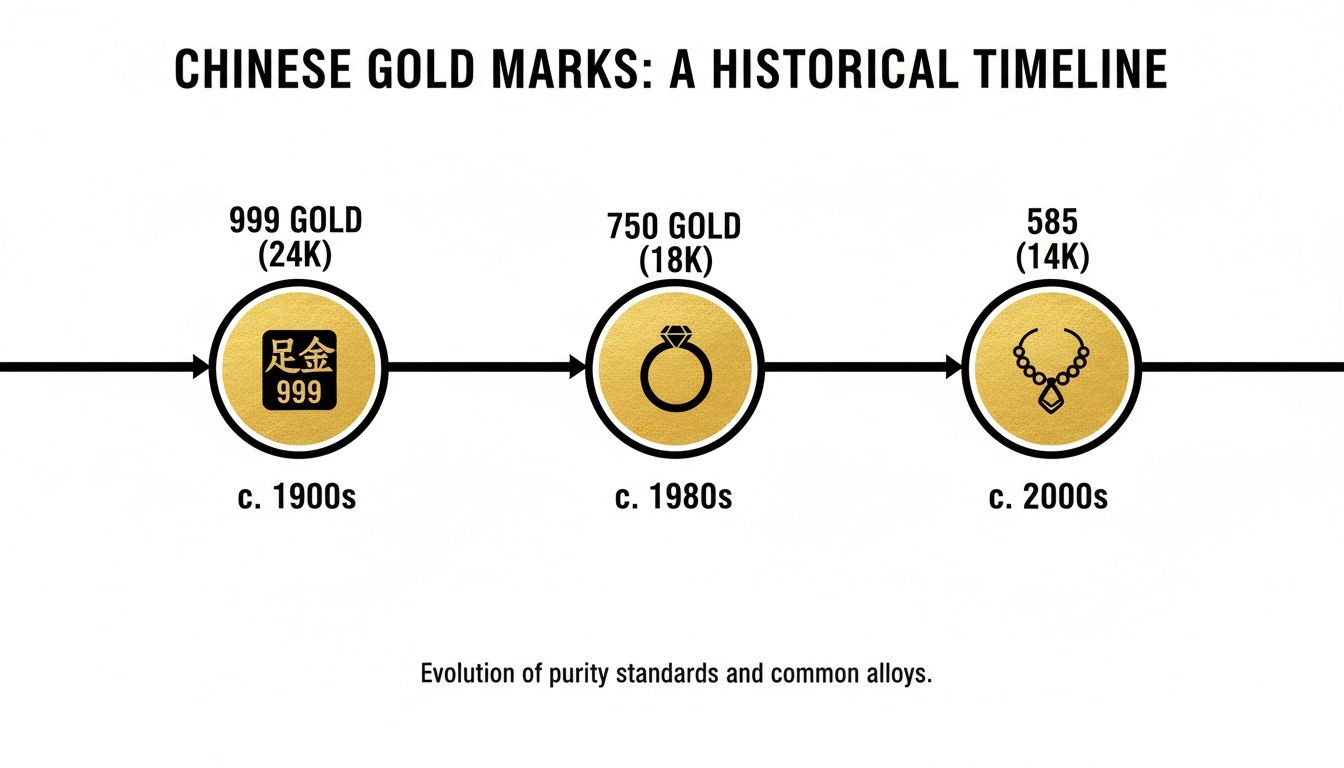
You’ll see the evolution from vague foil prints to the crisp 999 mark on modern 24K treasures—each change building trust.
Modern Hallmarks And Local Selling
Today’s hallmarks owe their roots to those dynastic seals, but with modern precision. Bring your marked pieces to Carat 24 – Trusted Gold Experts and enjoy:
- Free Xray Scanning and Gold Testing for free
- Price matching with any local offer
- Hassle free offers—no shipping required
- Highest payout in Boise for authenticated, marked items
Curious about other traditions? Explore our Guide to Italian Gold.
Armed with this history, you’ll spot authenticity cues at a glance and negotiate with confidence.
Global Impact Of Historical Marks
Trusted purity marks still move markets. In 2023, global gold jewelry exports jumped 25% to $15 billion, and auction houses reward dynastic-stamped pieces with premiums up to 40%—a modern echo of ancient quality seals.
Key Purity Marks And Their Meanings
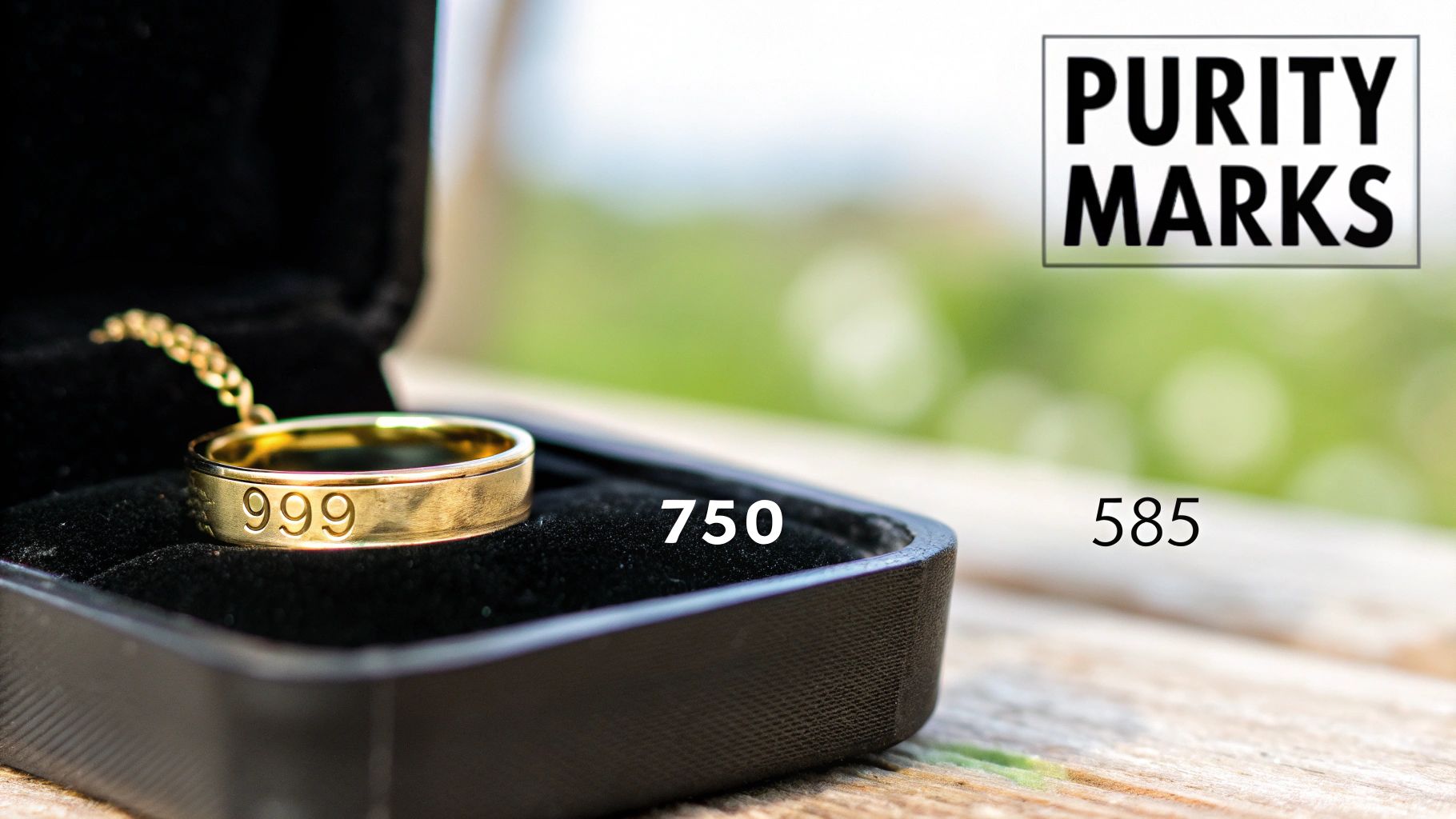
Gold stamps on Chinese jewelry are more than decoration. They tell you exactly what you’re holding.
Seeing 999, 750, or 585 gives instant clarity on purity and performance.
Translate Marks Into Karats
Turn a number into a karat with a quick glance:
- 999 = 24K (99.9% pure gold)
- 750 = 18K (75.0% gold content)
- 585 = 14K (58.5% gold content)
Higher karats shine with that rich, yellow glow. Lower karats offer extra strength against everyday knocks.
“Think of purity marks as a recipe guide that lets you taste quality before investing.”
Comparing Domestic And Export Standards
China’s rules changed in 2002, stamping most 24K items as 999. Beyond the mainland, Hong Kong shops often pair 750 or 585 with Chinese characters.
| Mark | Domestic Rule | Export Usage |
|---|---|---|
| 999 | 99.9% pure (2002 law) | 95%+ of 24K exports |
| 750 | 75.0% pure | Common in Hong Kong and EU |
| 585 | 58.5% pure | Popular in North America and UK |
If you’re selling to a local buyer like Carat 24, this table gives you the edge at the negotiating table.
Historical Leap In Hallmarking
Before the 1842 Treaty of Nanking, most Chinese gold went unmarked—up to 90% slipped through without stamps. By 1900, Western demand pushed hallmarks onto 60% of exported pieces.
Fast forward to GB/T 18043-2019: assay labs test over 10,000 items per year, keeping counterfeits down to about 4%.
Hallmarking grew from a trust-builder to a consumer cornerstone.
Global buyers reward marked jewelry with roughly 35% higher resale values. A 2023 Christie’s sale of a Qing-marked gold piece even reached $1.8 million, a 50% premium over unmarked peers.
Learn more about this hallmarks revolution on Chinese export silver history (http://chinese-export-silver.com/SW0CY).
How Purity Influences Value
Purity drives price. A 999 piece sits on the top shelf, much like organic produce. A 585 item trades lower but stands up better to daily wear.
Real-world rates at Carat 24:
- 24K gold: around $58 per gram
- 18K gold: near $45 per gram
- 14K gold: about $35 per gram
Keep in mind, online platforms can shave 10–15% off returns through fees and shipping.
Selling locally can boost your net by 10% over online shipments.
For step-by-step guidance on testing your own pieces, see how to test gold purity.
Regional Variations And Price Examples
Just as dialects shift across regions, so do purity stamps:
- Mainland shops mark “足金999” on most 24K pieces.
- In Hong Kong, you’ll spot “999足金”, plus the occasional “750” or “585” in traditional characters.
Local price checks:
- Shenzhen pawn shops: 999 trades at about ¥370 per gram (≈$57/g).
- Hong Kong Victoria Market: 750 rings in at HK$390 per gram (≈$50/g).
- Online auctions peg 24K near $60 per gram, though final bids drop by roughly $6/g after fees.
Regional tastes shape stamp prevalence and pricing power.
Best Mark For Local Sellers
Pure elegance or everyday strength? Your choice matters.
- Bring your stamped jewelry to Carat 24 for free X-ray scanning and on-the-spot testing.
- Tap into Boise’s highest payout, guaranteed Price Matching, and Hassle free offers.
Identifying Maker And Assay Marks On Chinese Gold Jewelry
Decoding workshop stamps is like reading an artist’s signature.
Each tiny imprint on a gold piece reveals more than a name. It points to a specific craftsman and often hints at regional techniques handed down across generations.
- Liú (刘) stamp marks items from Guangzhou’s Liu workshop.
- Chén (陈) signature flags jewelry from Shanghai ateliers.
- Serial or lot numbers tie pieces to particular production runs, offering clues for historians and collectors alike.
These marks are your first ticket to pinpointing a maker’s story. Next on the list: assay marks that verify metal purity under official oversight.
Decoding Assay Office Symbols
Assay marks usually nestle beside purity numbers as simple icons. They work like regulatory badges, proving a piece passed inspection.
| Icon | Office | Typical Location |
|---|---|---|
| □ Square Seal | Beijing Assay | Inside Ring Band |
| 🌸 Lotus Motif | Guangzhou Assay | Pendant Clasp |
| 🌾 Wheat Icon | Shanghai Assay | Bracelet Links |
Cross-check oddities—like a chip on that square seal—against a reputable hallmark guide to spot potential tampering.
Imperial Symbols And Their Stories
Beyond fineness checks, Chinese gold carries imperial whispers. Over centuries, dragons, phoenixes, and other mythical creatures signaled rank and occasion.
- Five-clawed dragons reserved for emperors.
- Phoenix emblems adorned empresses’ ceremonial pieces.
- Lotus or cloud shapes often framed purity stamps for aesthetic balance.
A Ming Dynasty dragon ring with a flawless five-claw seal commanded a 40% premium at auction. Rare motifs still drive collector fervor and push market values skyward.
During the Zhou era, gold accounted for 15-20% of elite jewelry, trading alongside jade. Fast forward to 1920, and a U.S. Stamp Act demanding “CHINA” on imports slashed fake jewelry by 25%. Today, pieces stamped 999.9 fineness form 85% of Chinese gold, capturing 40% of the Asia-Pacific’s $120 billion gold market.
Real World Applications
Knowing these marks transforms how you evaluate gold—whether at a local shop or an international auction house. For anyone looking to sell, a clear maker’s or assay mark becomes a powerful negotiation tool.
Bring your stamped pieces to Carat 24 in Boise and you’ll skip shipping headaches, enjoy free X-ray scanning, and see on-the-spot gold testing. You can even tap into Price Matching for the best payout.
- Free X-ray scanning reveals internal structures without a scratch.
- Instant on-site gold testing confirms purity with razor-sharp accuracy.
- Price Matching ensures you receive competitive offers.
- Local selling saves on shipping costs and eliminates delays.
Curious about professional valuations? Check out our detailed guide on how to get jewelry appraised.
Next Steps To Authenticate
Before you head to market or store, work through this quick checklist:
- Gently polish your piece and use a jeweler’s loupe to highlight stamps.
- Record the maker’s character, symbol, or serial code.
- Match assay icons against the table above or museum catalogs.
- Verify purity marks like 足金999 against national standards.
- If anything feels off, seek Carat 24’s expert appraisal on-site.
Following these steps sharpens your confidence and shields you from surprises. When you’re ready, head over to Carat 24 in Boise with your authenticated, stamped gold. You’ll leave with instant payment and the peace of mind that every mark has been properly deciphered.
With these insights, reading Chinese gold marks isn’t a chore—it’s an invitation to uncover history, protect your investment, and strike a fair deal.
Authenticating Chinese Gold Jewelry for Sellers
Selling your marked Chinese gold pieces doesn’t have to feel like wandering through a maze. At Carat 24, we handle local gold and jewelry buying every day, delivering expert appraisals and a guaranteed price match that puts cash in your pocket—fast.
We even offer free on-the-spot X-ray scanning and gold testing to confirm purity before you leave. No shipping, no waiting, no surprises. Just honest numbers and an instant offer in Boise.
Preparing Your Jewelry For Authentication
First things first: clean each item with a soft cloth or mild jewelry cleaner. Think of it like brushing away dust on an old photograph—suddenly those tiny hallmarks and stamps pop into view.
Next, gather your paperwork:
- Photo ID
- Purchase receipts or certificates
- A loupe for inspecting micro-stamps
Having everything ready means we can dive right into the appraisal. Our Price Matching pledge ensures local offers rival any online quote.
Expert Takeaway: Sellers enjoy 10% higher net returns when they skip shipping and deal face-to-face.
On-The-Spot Testing Process
Here’s how our eight-step workflow unfolds—like following a recipe for the perfect dish:
- Inspect hallmarks under 10× magnification
- Run a Xray Scanning and Gold Testing for free to peek at the metal’s core
- Perform instant gold testing for purity levels
- Review your tailored offer
No needles, no damage, and no hidden fees. Once testing wraps up in minutes, you walk away with a clear, competitive bid.
Maximizing Your Return
Armed with test results, you’re ready to negotiate like a pro. Start by highlighting our Xray Scanning and Gold Testing for free. Then confirm the Price Matching clause before sealing the deal.
Quick comparison:
| Method | Shipping Fees | Wait Time | Net Return |
|---|---|---|---|
| Local Sale | $0 | Minutes | 10%+ higher |
| Online Sale | Varies | Days–Weeks | -10–15% fees |
Don’t forget these tips:
- Verify assay symbols to back up maker credibility
- Spot purity marks like 999, 750, 585
- Bring multiple pieces to spark competitive bids
Pro Tip: Bundling several items can boost offers by up to 15%.
Streamlining Paperwork And Sale
Think of your documents like a well-organized toolbox. Create a simple folder with receipts, certificates, and clear photos of each hallmark. Label everything by purity and maker mark for quick reference.
When you arrive:
- Hand over your folder
- Let our experts review and match offers
- Collect instant payment
If you’re working through a larger collection, book your free X-ray scan in advance. Drop-ins are welcome, but appointments speed up the process.
By the end, you’ll have:
- A certified fineness report
- Confidence in every penny you receive
- More cash in hand than any online platform
Ready to sell with zero guesswork? Visit Carat 24 at 3780 W. State St., Boise for free X-ray scanning, gold testing, and Boise’s highest local payouts. For details, head to carat24boise.com.
Avoiding Fake Marks And Common Pitfalls
When you’re eyeing Chinese gold jewelry, learning to spot counterfeit stamps is your first line of defense. A tiny wobble in a character or an off-color patina can save you from overpaying.
Real hallmarks carry consistent depth and crisp detail—anything less should raise an eyebrow.
Spotting Uneven Stamp Depth
Uneven stamp depth happens when a fake die isn’t pressed evenly. Authentic Chinese gold marks are carved or cast with uniform depth across every stroke.
Look for these telltale signs under magnification:
- Inconsistent Stroke Width: Wobbly engraving means the tool slipped.
- Ridges Or Chips: Tiny metal fragments around the edges betray a rough press.
- Mismatched Patina: Darker or lighter tarnish around the stamp indicates aftermarket work.
“A faulty dragon stamp taught me to look beyond the shine,” recalls a veteran gem appraiser.
Hands On Tests
A handful of basic tools can instantly separate the real from the fake. Grab a loupe, a magnet, and an alloy spot test kit to run through these four quick checks:
- Loupe Inspection: True hallmarks have razor-sharp edges and steady depth.
- Magnet Test: Pure gold isn’t magnetic—any pull is a red flag.
- Alloy Spot Test: A drop of acid on a discreet spot reveals plating or base metals.
- Patina Examination: Natural aging leaves a balanced patina; new stamps often look “too clean.”
Pro Tip: A consistent patina around the hallmark usually means minimal tampering.
Cross Referencing With Trusted Guides
No single trick catches every forgery. Always compare your findings against reliable hallmark references before selling or buying.
For a deeper dive into counterfeit detection, check out our guide on how to identify fake gold.
Recommended resources:
- Museum catalogs with high-resolution hallmark photos
- Official assay office databases
- Industry standard reference books on Chinese jewelry marks
Comparing Real And Fake Marks
Training both your eyes and fingertips makes fake stamps obvious in seconds. Genuine hallmarks sit flush and smooth, while forgeries feel raised or uneven.
| Feature | Real Stamp | Fake Stamp |
|---|---|---|
| Depth | Uniform and smooth | Varies; choppy & uneven |
| Color Tone | Matches gold hue | Slightly dull or too bright |
| Character Precision | Sharp strokes | Blurred or smudged edges |
- Feel along the surface for dips or peaks.
- Keep a printed hallmark chart on hand for instant side-by-side checks.
Selling With Confidence
When you’re ready to turn your gold into cash, bring your authenticated pieces to Carat 24. Their free X-ray scanning and eight-step fineness test leave no doubt.
You’ll also benefit from Price Matching and zero hidden fees—right in Boise. Face-to-face deals mean instant payment and no shipping headaches.
Advanced Counterfeit Indicators
Seasoned forgers sometimes sand down stamp edges to fake wear. That unnatural smoothness is a dead giveaway.
Watch for these subtle signs:
- Uneven Wear Patterns: Genuine age wears down high points, not just around the stamp.
- Hidden Abrasions: Use a soft brush under side lighting to expose filed areas.
- Color Shifts: A faint silver or gray tint near the hallmark often signals base-metal plating.
By combining these advanced cues with your basic tests, you’ll achieve near-perfect detection.
Ready to verify your Chinese gold jewelry stamps accurately? Visit Carat 24 for Boise’s highest payout, free testing, and hassle-free offers.
FAQ
Navigating Chinese gold jewelry marks can feel like decoding a secret language. Below, you’ll find straightforward answers to the questions we hear most often. Whether you’re hunting for a bargain or preparing to sell, these tips will give you the confidence to read any hallmark like a pro.
What Do Different Purity Numbers Mean On Chinese Gold Jewelry Marks?
When you spot numbers like 999, 750, or 585, think of them as gold’s “report card” in parts per thousand. In practical terms, they equal 24K, 18K, and 14K. Spotting these codes takes just a glance—but it tells you everything about a piece’s value.
How Can I Read Maker Marks And Translate Characters?
Jewelry workshops often stamp tiny ideograms, transliterated characters, or seals into their creations. With a handy reference chart, you can match a flourish or symbol to a specific artisan, region, or era—connecting today’s jewelry to centuries-old craft traditions.
“Mastering maker marks connects you with artisans across centuries.”
Selling Your Gold Locally
What Steps Should I Take Before Selling To A Local Buyer?
Before you head out, give each piece a gentle clean and inspect it with a loupe to find hidden purity stamps. Gather any receipts, certificates, or previous appraisals you have for added leverage.
Once you’re set, bring your gold down to Carat 24 for:
- Free X-ray scanning to verify purity
- On-the-spot gold testing
- Hassle free offers with price matching and Boise’s highest payout
Helpful tips:
- Polish with a soft cloth or mild cleaner to reveal faint hallmarks
- Use a purity chart to confirm what each number denotes
- Bring valid photo ID and supporting documents for a smooth transaction
Regulatory Standards In Hallmarking
How Do Modern Regulations Ensure Mark Authenticity?
China’s GB/T 18043-2019 standard mandates fineness testing and visible purity stamps on 95% of all 24K pieces. Meanwhile, local assay centers and Hong Kong exports carry additional character marks for extra verification. Thanks to these safeguards, counterfeit hallmarks appear in under 4% of audited lots.
“Clear hallmarks backed by regulation give buyers confidence and sellers leverage.”
Maximize Your Local Return
Ready to get the best deal in town? Here’s how to make sure you walk away with top dollar:
- Highlight both purity and maker marks for stronger offers
- Remind appraisers of our Xray Scanning and Gold Testing for free and gold testing services
- Double-check that you’re getting Boise’s highest payout, plus Price Matching
Bringing these checks and local insights together means more money in your pocket. With Carat 24’s no-cost testing and expert guidance, you’ll sell quickly and confidently.
Experience fast selling with Carat 24 – Trusted Gold Experts
