
You've found a tube of Silver Maple Leafs in a drawer, inherited a small collection, or decided it's time to turn silver into cash. Before you visit a buyer, work out what the coins contain, gather anything that helps verify what they are, and compare the actual offers rather than relying on a dealer's retail price.
The key is to separate melt value, which follows the silver market, from any collector premium a particular issue might command. That gives you a sensible range to evaluate, while careful documentation and a clear testing process help keep an offer from being reduced for reasons no one can explain.
Work Out Your Coins' Value Before You Sell
Melt value per coin = live silver spot price per troy ounce.
| Spot price per oz | Melt value per coin | Offer per coin (90–97%) | Offer for 10 coins |
|---|---|---|---|
| $25 | $25 | $22.50–$24.25 | $225–$242.50 |
| $30 | $30 | $27–$29.10 | $270–$291 |
| $35 | $35 | $31.50–$33.95 | $315–$339.50 |
| $40 | $40 | $36–$38.80 | $360–$388 |
Illustrative planning ranges, not quotes. The offer band assumes a 3–10% discount from melt; actual offers depend on the market, the coin, and the buyer.
The standard Silver Maple Leaf bullion coin contains 1 troy ounce, or 31.11 grams, of 99.99% pure silver. The Royal Canadian Mint has issued the series since 1988, and the standard coin carries a C$5 face value. That face value isn't a resale benchmark: the coin's metal content is its main economic value, so the price usually tracks silver spot, dealer premiums, condition, and demand, as the Royal Canadian Mint's Silver Maple Leaf specifications explain.
Calculate a useful planning range
- Look up spot on the day you plan to sell. Use a reputable live market quote and note the time. Last week's price or a dealer's retail listing won't tell you what a buyer will pay today.
- Multiply spot by your coin count. If spot is $35 per ounce and you have 10 standard bullion coins, the melt value is $350. A 90–97% planning band would be $315–$339.50 before any documented collector value or condition adjustment.
- Treat the band as a comparison tool, not a promise. Dealers buy below their selling price to cover business costs and resale risk. Retail premiums over spot are what buyers may pay when purchasing; they aren't a reliable measure of what a dealer will offer you.
- Adjust only for identifiable differences. A limited issue or special finish may attract collector interest, while cleaning, damage, or uncertain authenticity can reduce an offer. Regular bullion Silver Maple Leafs have no fixed mintage, so don't assume a standard coin is rare just because it's an older date.
Practical rule: A quote far above melt needs a clear, verifiable explanation of the collector premium. The useful number is the written offer you can accept on the day you sell.
For more context on the factors that can move a coin's resale value, see this guide to silver coin values.
Check Authenticity and Condition Before You Sell
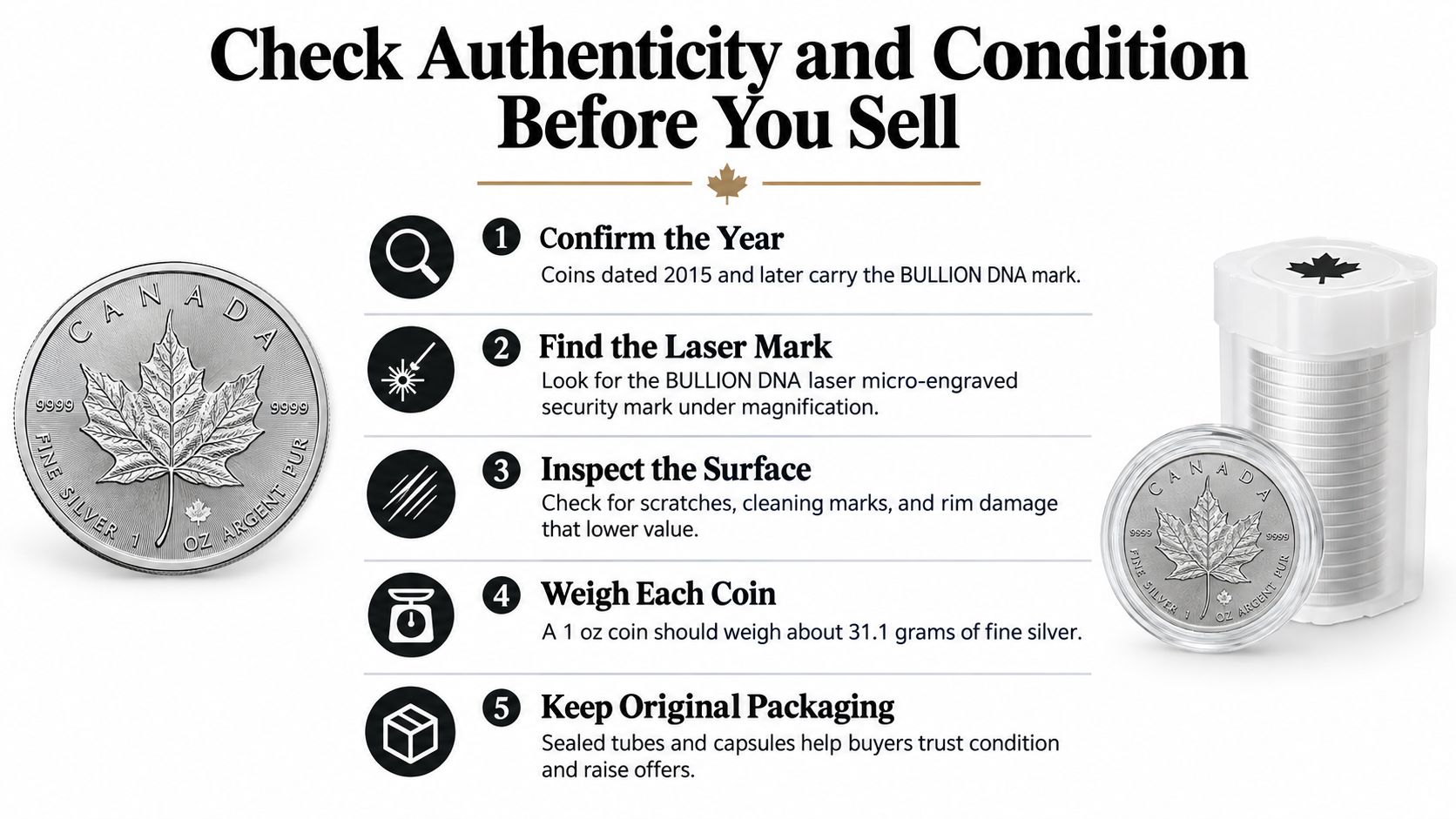
A buyer who can't verify a coin may discount it or decline it. Make the identification process easier before you walk in, but don't mistake a home check for professional authentication.
| Coin profile | Key check | Supporting check | Likely effect on offer |
|---|---|---|---|
| 2015 and later | BULLION DNA micro-engraved mark with issue year under magnification | Radial lines and textured leaf on newer issues | Strongest verification; standard offer |
| Before 2015 | Weight of 31.11 g, 38 mm diameter, serrated edge | Professional testing; no BULLION DNA mark | Offer may carry a verification discount |
| Cleaned, scratched or altered | Surface marks, polishing traces, weight or size off | Photos of both sides before any handling | Lower offer or rejection until verified |
The Mint says Silver Maple Leafs dated 2015 and later use BULLION DNA technology, including a laser-micro-engraved mark whose centre carries the issue year, along with security features such as radial lines and a textured maple leaf. Inspect the mark under magnification. Earlier coins don't have that feature, so a professional may rely more on weight, dimensions, edge, die details, and testing, as described in the Royal Canadian Mint's bullion coin information.
Prepare the coins without damaging them
- Photograph both sides. Use even light and keep the images clear enough to show the date, surface, and any visible marks.
- Record the date and packaging. Note whether a coin is in a mint tube, capsule, or special presentation packaging.
- Don't clean or polish the coins. Cleaning can leave surface marks and remove evidence a buyer needs to assess condition.
- Separate damaged examples. Keep scratched, dented, or altered-looking coins apart from clean coins so one condition issue doesn't blur the evaluation of the rest.
- Use home tools only to flag concerns. A scale, calipers, and magnet can help you notice an anomaly, but they don't prove a coin is genuine. Professional verification matters, especially for older coins or pieces with unusual features.
Proof coins, privy-mark issues, and special packaging may be evaluated differently from standard bullion. Tell the buyer what you have rather than assuming every Maple Leaf is interchangeable. If the buyer proposes a deduction, ask for the reason in writing and the test method used. A coin certificate and authenticity guide can also help you understand what documentation does, and doesn't, establish.
Paperwork to Gather Before You Walk In
A clear inventory helps a buyer price each item rather than treating a mixed lot as generic bullion. Use the same descriptions when comparing offers, so differences in the quoted range reflect the buyer's terms, not missing details.
Bring:
- Original packaging, including mint tubes, boxes, and capsules. It can help identify a special issue and support a buyer's assessment.
- Purchase receipts, if available. Keep them with your ownership and transaction records, as they may help establish your cost basis for tax reporting.
- A written inventory listing each coin's year, weight, finish, packaging, and any visible mark or damage.
- Estate documents, if you're selling on someone else's behalf. Bring documents showing your authority to sell and government photo ID. Ask the buyer beforehand what they require.
The Silver Maple Leaf series includes collector products as well as standard bullion, and their values can differ. The Royal Canadian Mint identifies the Ultra High Relief series as beginning in 2022. Its 2026 Ultra High Relief issue has a stated mintage of 11,000. Limited issues and special finishes may be valued differently from standard bullion, so record details such as year, weight, finish, plating, privy mark, packaging, and mintage when available. Those details help a buyer distinguish a potential collector item from a coin priced mainly for its silver content.
Before you walk in, make a one-page inventory and attach your photos. Give each buyer the same list. If you have a limited issue or special finish, identify it clearly so the offer accounts for the actual coin rather than an incomplete description.
Selling Locally Versus Shipping Your Coins Online
For a small or mid-sized lot, compare the local offer with what you would keep after shipping and insurance. An online bid can be higher before costs, but a very large lot may still attract enough competing offers to make shipping worthwhile. The choice comes down to net value, timing, and the risk of sending coins away.
| Factor | Local Boise dealer | Online or mail-in |
|---|---|---|
| Payment timing | Same visit, cash or agreed method | After shipment arrives and is checked |
| Shipping and insurance cost | None | Paid by seller, plus declared-value coverage |
| Coin testing | Ask about the buyer's testing methods | Photos or mailed testing, often with a delay |
| Price matching | Ask whether a competing written quote can be matched | Ask before shipping; don't assume a match |
| Transit risk | None during sale | Seller bears risk until coins are received |
| Best fit | Small to mid-sized lots and time-sensitive sales | Very large lots after comparing multiple bids |
At Carat 24, 3780 W. State St., Boise, ask about its testing methods and whether it will consider a competing written quote. Compare any offer with the live spot quote, then check the net amount after fees or shipping. This guide to local coin and silver dealers can help you decide what to ask before choosing a buyer.
Compare the total, not just the headline offer
For 20 coins with silver spot at $35 per ounce, the melt value is $700. A local offer at 95% of melt comes to $665. An online offer at 97% comes to $679, but after $25 for insured shipping, the net is $654, below the local offer. These figures are a hypothetical comparison, not a prediction of current prices or available quotes.
A large lot may draw multiple bids from buyers you cannot reach locally. Still, a headline percentage leaves out shipping, insurance, payment timing, and the chance that the buyer changes the offer after inspection. Before shipping, ask how a lower post-inspection offer is handled and whether you can decline it and have the coins returned.
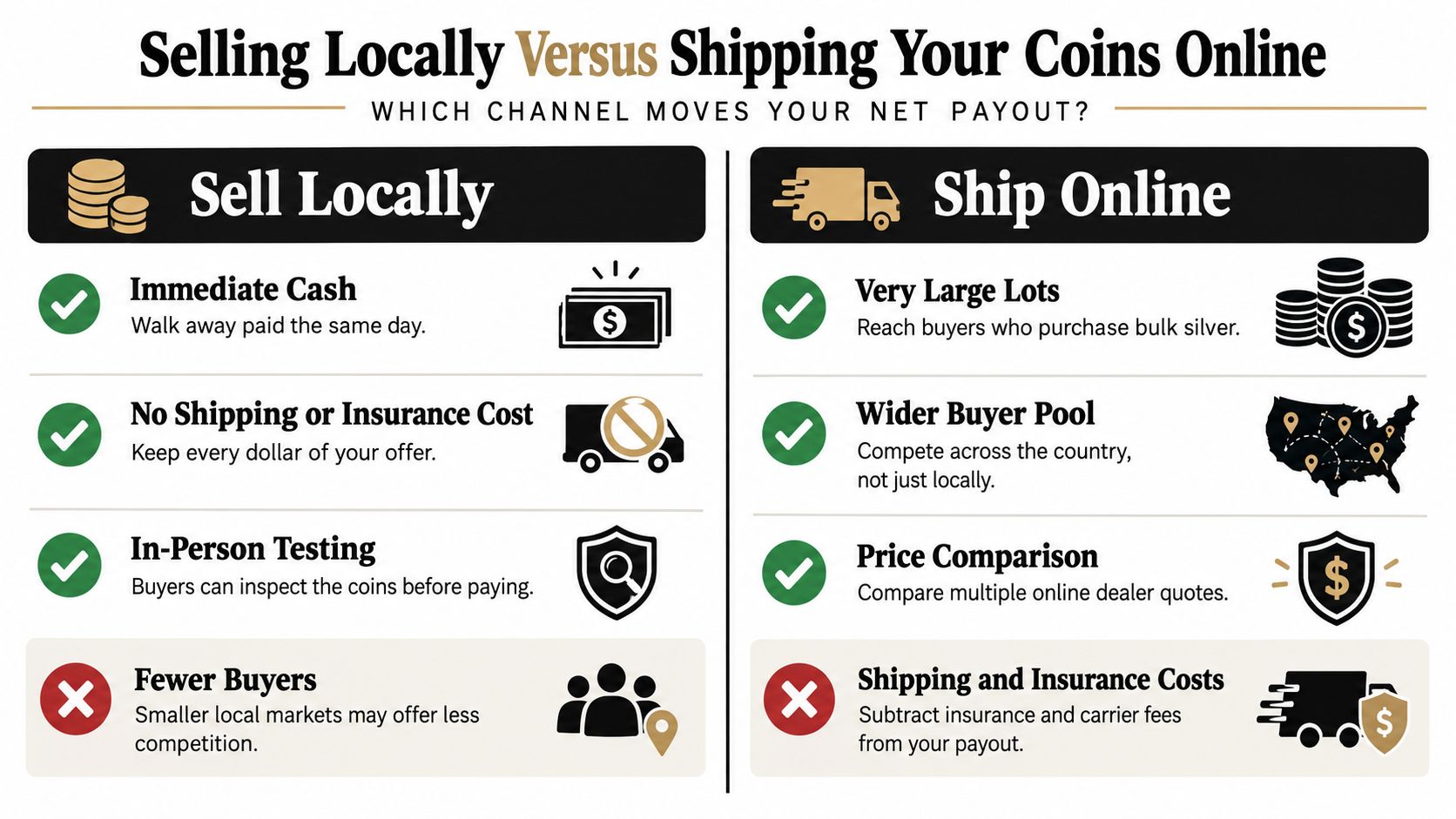
For a sale involving hundreds of coins, collect at least one online quote and one local quote, then compare the net totals. For a smaller lot, a nearby buyer lets you ask questions and see how the coins are tested, without paying to ship them. Either way, calculate the likely take-home amount before accepting an offer.
How to Negotiate Your Offer Step by Step
A buyer's offer is easier to judge when you arrive with a realistic range based on the spot price, your coin count, and any potential collector value. Keep that range in mind as the buyer checks the coins, and ask how each finding changes the total.
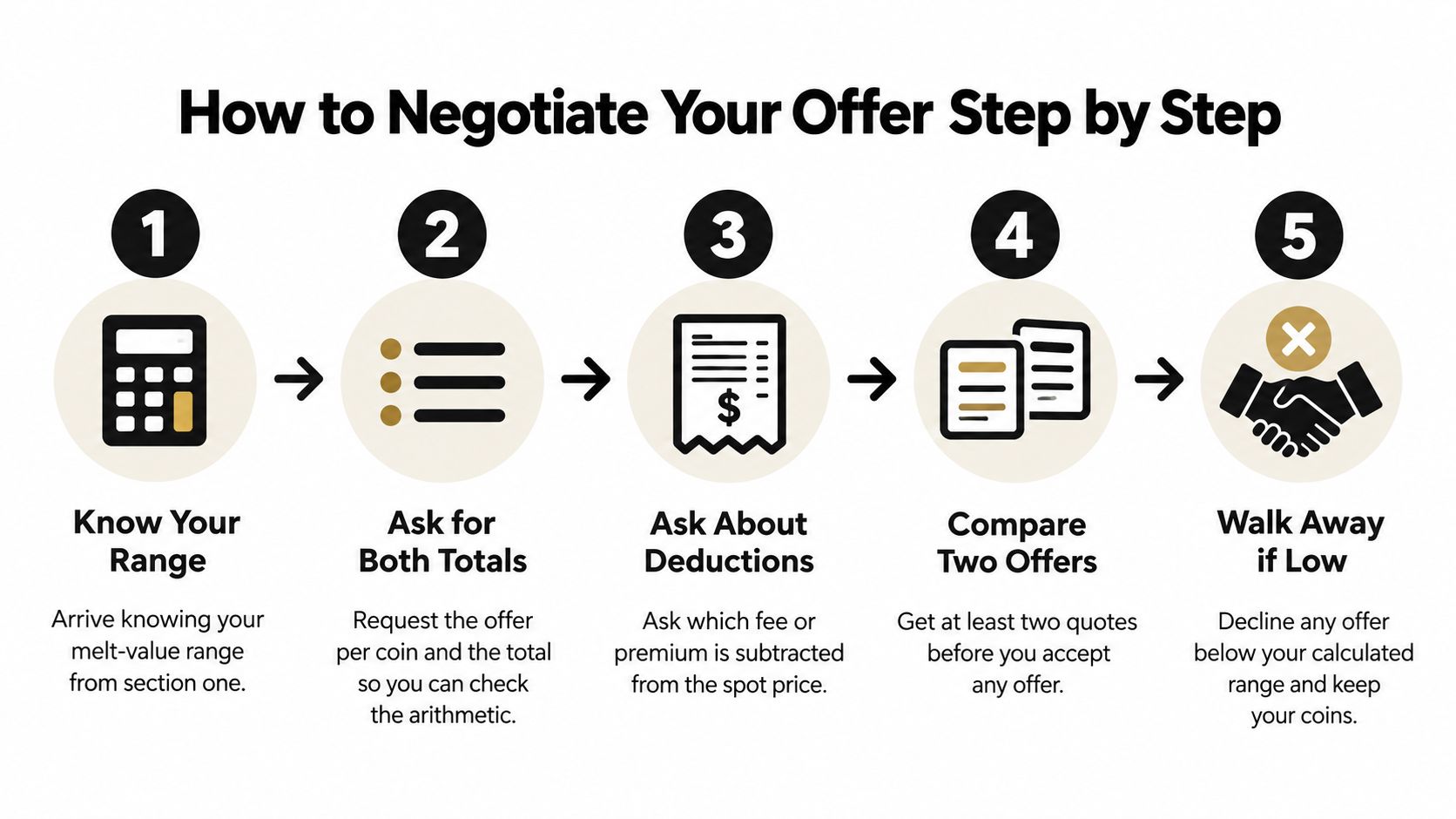
- Arrive with a range. Bring your coin count and current spot calculation. Treat it as a comparison point, not a guaranteed payout. A buyer may price standard bullion differently from a coin with collector appeal.
- Ask for the per-coin offer and the total. Check the multiplication yourself. If the buyer quotes a mixed lot, request separate line items for standard bullion and any coin being considered as a collectible. A guide to numismatic coins can help explain why collector value may differ from metal value.
- Ask how the buyer tested the coins. X-ray fluorescence (XRF) can help identify metal content and alloy composition, but it does not by itself establish every aspect of authenticity. Results depend on instrument calibration, sample condition, and testing protocol. Ask which method the buyer uses and how the result affects the offer. If a test leads to a deduction, ask the buyer to explain the finding and show how it changes the calculation.
- Show a higher local quote. Present the written quote and ask whether the buyer can match it. Check that both offers cover the same coins and use comparable terms.
- Request an itemized explanation. Ask for each discount, fee, or collector valuation in writing. If a coin receives a lower offer, ask what feature caused the reduction. This makes it easier to compare the buyer's calculation with your expected range.
- Decide once the arithmetic is clear. If the quote is unexplained or falls outside your range, ask for clarification before agreeing. Keep the coins until you have accepted the total.
- Keep the receipt. Make sure it lists the transaction and items sold. If gold or jewelry is in the same bag, ask whether the buyer can assess it alongside the coins through a Gold and Jewelry Buying service.
Here's a short video to help you prepare for the sale:
A fair offer is one you can verify against the coins and the buyer's itemized calculation.
Shipping Safely and Keeping Tax Records
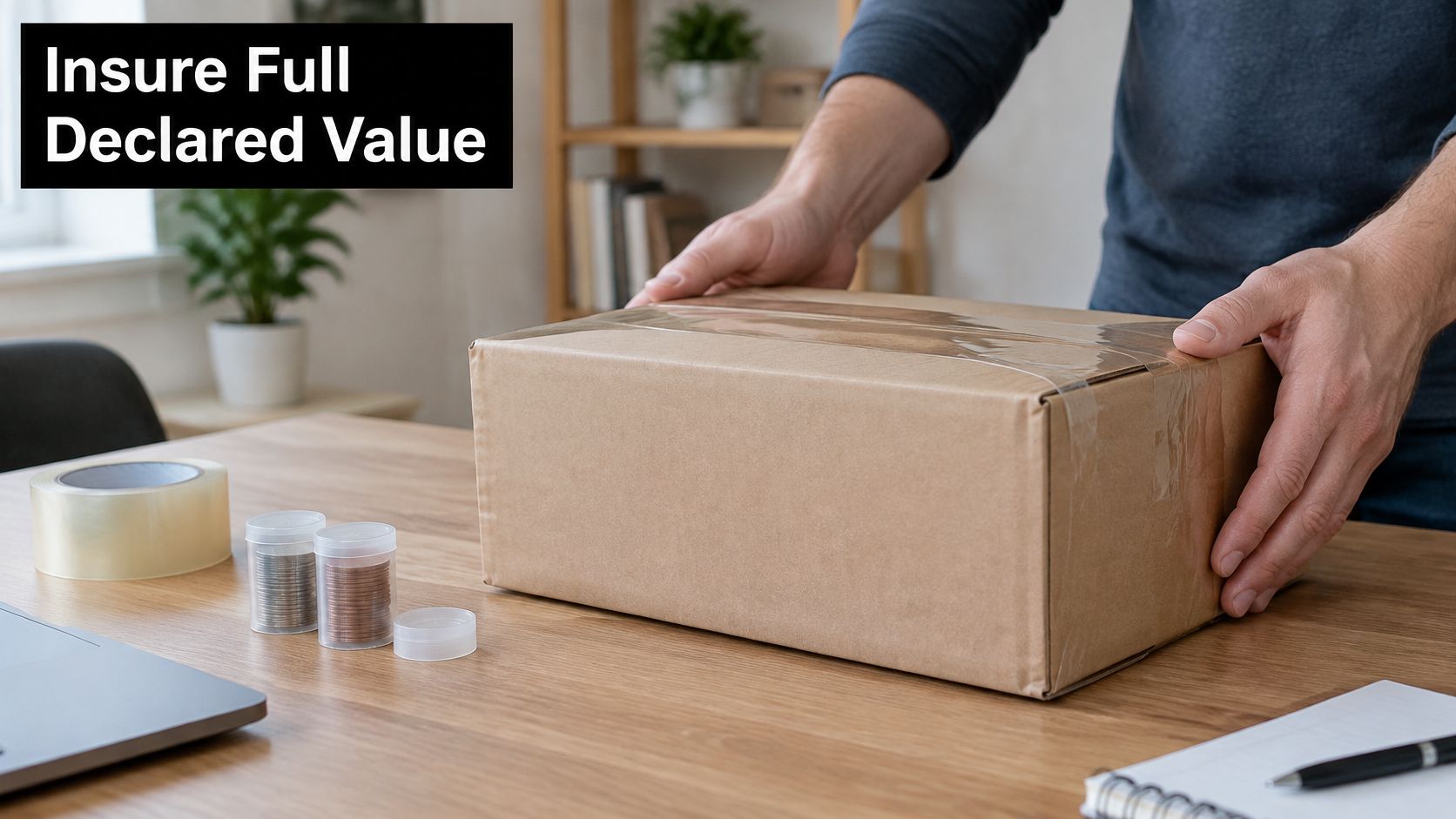
Don't ship your coins until the buyer confirms the offer and terms in writing. If you choose a mail-in sale, use a tracked carrier with signature required, declare the full value, and buy coverage for that declared value. Pack coins in a rigid, padded container, place each coin in its own sleeve or capsule, and include a photographed inventory.
For an in-person sale, meet at a known business during business hours. Don't take coins to an unfamiliar location, and don't leave without a receipt documenting what you sold and the agreed amount.
Tax treatment depends on where you live and your circumstances. In the United States, bullion coins, including foreign coins such as Silver Maple Leafs, may be treated as collectibles for capital-gains purposes, and short-term gains may be taxed as ordinary income. Canadian sellers may face capital-gains treatment or business-income treatment if they trade frequently. Confirm your situation with a tax professional rather than relying on a general rule.
Keep purchase receipts, sale receipts, any dealer tax forms, and a spreadsheet recording the date, quantity, year, and price for each transaction. A consistent record makes it easier to document what you bought and sold. This guide to selling silver bullion offers additional practical points to consider before completing a sale.
Confirm the Offer Before You Hand Over Your Coins
A high quote is useful only if it applies to your coins, reflects the day's market, and comes with clear terms. The Federal Trade Commission's guidance on shopping recommends comparing quality, price, and service, reviewing return policies, and checking that precious-metal markings accurately describe the item.
Watch for these red flags:
- No test method, or a result the buyer will not explain.
- A quote that ignores today's spot price without a clear reason.
- An offer far above melt with no collector explanation. Ask what supports the premium.
- An unexplained deduction that is missing from the itemized offer.
- Pressure to decide immediately, before the inspection is complete.
- An upfront payment or fee request before you receive a clear offer.
- No written offer or no stated return policy for a mail-in transaction.
Before you agree, gather your inventory, receipts, and packaging. Check the day's spot price, then count your coins by year and weigh them. This gives you a basis for comparing the buyer's offer with your expected melt range.
- Visit Carat 24 at 3780 W. State St., Boise, where each item goes through its 8-step authentication process.
- Compare the written offer with your melt range, and ask whether the buyer can match a higher local quote.
- Sign only when the total is clear and every deduction has been explained.
Carat 24 buys and sells gold, silver, bullion, and numismatic collectibles, with local expertise to guide sellers considering a Boise sale. Gather your coins and inventory, then visit Carat 24 - Trusted Gold Experts to discuss the offer and compare its written terms with your expected range.
