
A jar of old change turns up in the garage, and suddenly every coin looks like it might be worth keeping. The useful first question isn't “Which one is rare?” It's “What do you want this collection to do?” A coin that teaches you how to read dates may be a better first buy than a prestigious rarity, while a seller may care more about documentation and a clear offer than a coin's headline auction price.
The best coins to collect fit your goal, budget, and likely selling costs. Rarity matters, but so do condition, authenticity, buyer demand, records, and taxes. Start with a type you can understand, then check the details before you spend.
Quick Picks for Every Collecting Goal
If you're sorting through a jar, set aside coins with unusual dates, mint marks, designs, or condition. Then decide whether you're learning, collecting for history, buying metal, or preparing an estate collection. These starting points keep the choice tied to a purpose.
| Goal | Start with | Why it fits | Main risk |
|---|---|---|---|
| Learning the hobby | Lincoln wheat cents | Cheap, common and useful for learning dates and mint marks | Most are low value, so the lesson is the point |
| Silver on a budget | 1964-and-earlier dimes, quarters and half dollars | Silver content gives them a metal-value component | Price follows the silver market |
| Metal exposure | American Silver Eagle or American Gold Eagle | Recognized bullion coins with a metal value and a dealer premium | The premium sits above metal value |
| Numismatic upside | 1909-S VDB cent and Morgan dollar key dates | Rarity and collector demand can make them desirable | Value hinges on exact grade and authentication |
| Legacy and estates | Certified gold, silver and proof sets | Documentation makes the pieces easier to explain to heirs | Purchase records help establish cost basis |
| World coins and history | British Sovereign and Mexican gold 50 peso | Established series appeal to collectors | Collector price can exceed gold content |
A wheat cent is a practical first study coin: compare its date and mint mark, then look at how wear changes the design. If you'd rather begin with silver, older U.S. coins can introduce you to the difference between a coin's metal value and its collector value. Bullion coins offer a different lesson: a recognized coin can still sell for more than its metal content because a dealer premium is added.
For a key date, slow down before buying. The 1909-S VDB Lincoln cent is a celebrated example, but its mintage alone doesn't tell you how many survive or what a particular grade should cost. Estate sellers should likewise keep certified pieces and their paperwork together rather than treating a mixed box of coins as one lot.
Start with the goal, then set the budget, then choose the coin. That order makes it easier to judge whether a premium, a grade, or a piece of paperwork is worth paying for.
What Makes a Coin Worth Collecting
Think of a coin's desirability like a house sale. Location, condition, paperwork, and the number of interested buyers all shape the final price. Coins have the same four pillars: rarity, condition, provenance, and demand. A weakness in one can offset strength in another.
Rarity begins with mintage
Mintage tells you how many pieces were struck, not how many exist today or how easy they are to buy. The 1909-S VDB Lincoln cent had 484,000 struck, but many were saved when new because it was a first-year issue. That means its surviving supply is larger than the original mintage alone might suggest. The U.S. Mint's long history also makes production records a starting point, not a complete census of every surviving coin.
For a better view, compare three measures: original mintage, estimated surviving population, and certified population. The PCGS population-report guide explains why each measure offers a different view of availability. A grading service counts coins it has examined, not every coin in existence; raw coins, coins submitted elsewhere, and repeat submissions can all affect the picture. Check the certified count at the grade you plan to buy, rather than relying only on the total population.
Condition can change the price dramatically
Collectors use a Sheldon-derived 1-to-70 scale. For business-strike coins, MS-60 through MS-70 describe coins without circulation wear. Marks, luster, strike quality, and eye appeal separate grades, and even coins with the same numeric grade can look different in hand.
This creates condition rarity. A coin might be easy to find in circulated grades but scarce at MS-65 or higher, so the price can rise sharply as condition improves. Compare examples at the grade you can afford, and don't assume the highest label automatically means the most attractive coin.
Paperwork and buyers complete the picture
Provenance is the documented history of a coin's ownership. Certification, purchase records, and prior auction appearances can help a buyer assess authenticity and confidence, although paperwork doesn't guarantee a particular price. Demand matters too: a rare coin with few interested buyers may be harder to sell than a more familiar issue.
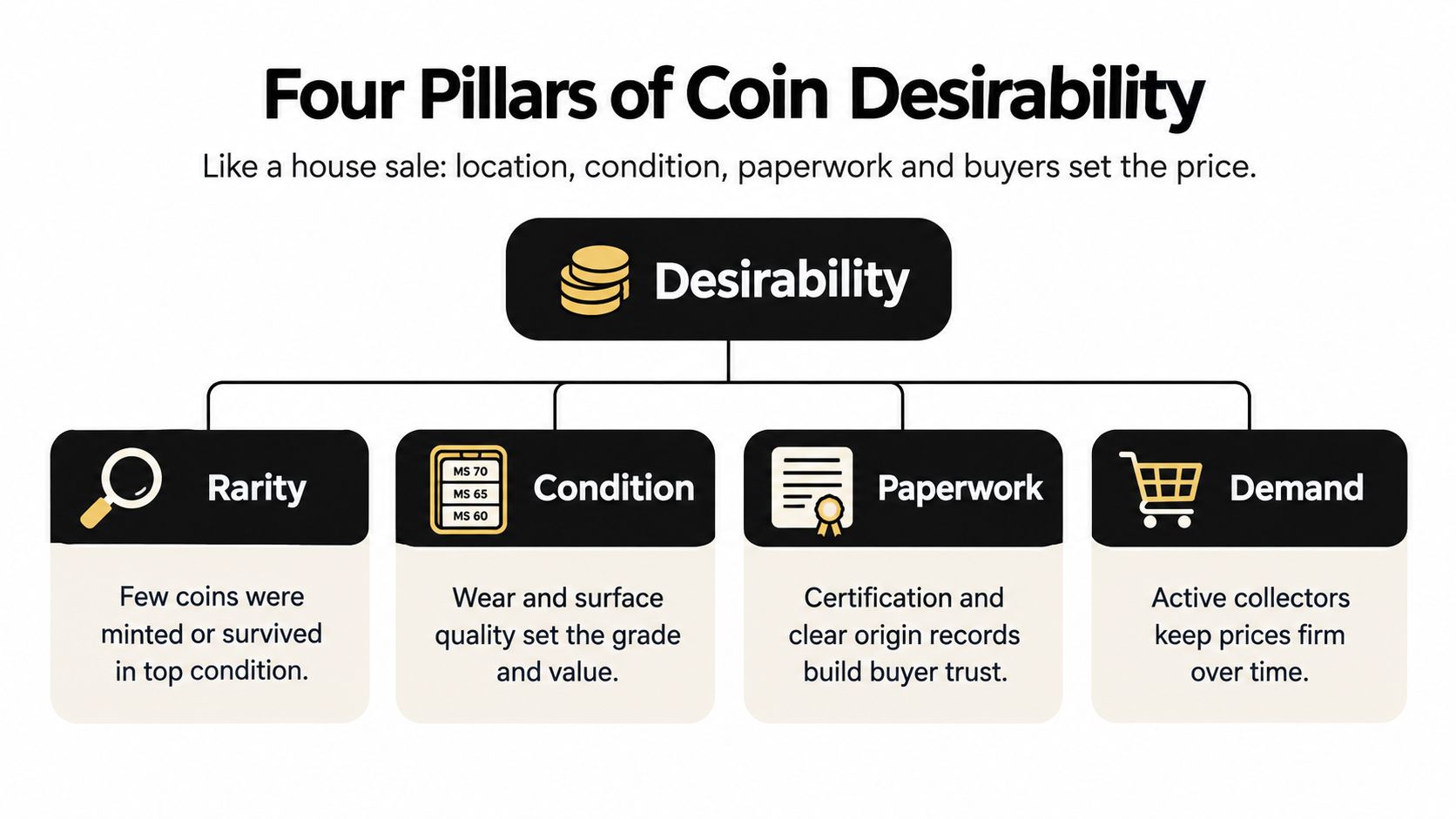
A simple test helps: look for strength in at least three pillars before you commit. If a coin is scarce but poorly documented, difficult to authenticate, or unlikely to attract buyers, its rarity may not translate into a useful purchase.
Classic U.S. Coins and Key Dates Worth Hunting
| Series | Metal | Key date or variety |
|---|---|---|
| Lincoln wheat cent | Copper | 1909-S VDB |
| Buffalo nickel | Copper-nickel | 1937-D three-legged variety |
| Mercury dime | Silver | 1916-D |
| Walking Liberty half dollar | Silver | 1921 |
| Morgan dollar | Silver | 1893-S |
| Peace dollar | Silver | 1921 high-relief issue |
| War nickel | Silver alloy | Reverse mint-mark variety |
| Kennedy half dollar | Silver | 1964 issue; type record set at auction |
A type set chooses one coin from each design. A date-and-mint set works more like a scavenger hunt: the same series can contain ordinary issues and a few dates that change the search completely. Use the table as a hunt list, then compare only like with like. A worn common-date Morgan dollar tells you little about what an 1893-S in a higher grade should bring.
The 1909-S VDB cent shows why a famous name still needs a careful price check. Its low mintage explains the attention, but that figure does not price the coin in your hand. Examine authenticity, grade, surfaces and recent sales for the same date and variety. The 1893-S Morgan dollar works the same way: scarcity matters, while condition and buyer interest determine how that scarcity translates into an offer.
Rank each target by the likely net result rather than the fame of its label. A key date with clear attribution, an active buyer pool and an inexpensive resale route can be the better choice when a more prestigious coin is harder to document or place. Before paying a premium, record what you bought and what you paid so the after-tax result of a later sale can be measured alongside dealer spread or auction costs.
Auction results show the upper end of the market rather than a predictable resale price. Heritage Auctions' 2018 results reported U.S. rare-coin auction sales of $187,825,708 in 2018, up 11% from $169,101,766 in 2017, including a $2.64 million sale of an 1804 Draped Bust dollar and a $108,000 1964 Kennedy half dollar that set a type record at the time.
Those results describe particular coins under active competition. To estimate one you own, match the date, mint mark, grade and variety first. For additional candidates, this guide to coin key dates can provide a research list, but each coin still needs its own comparison before you buy or sell.
Bullion, Commemoratives and World Coins Compared
Bullion is priced mainly by metal content plus a premium. A collectible coin is more like a painting: condition, history, and buyer interest help set the price. That distinction matters when you compare an investment purchase with a coin you want to own for its design or story.
| Coin | Metal and content | Collector or investor angle |
|---|---|---|
| American Silver Eagle | .999 fine silver, one troy ounce | Direct metal exposure; proof and reverse-proof versions interest collectors |
| American Gold Eagle | 22-karat gold; one troy ounce total weight | Recognized bullion coin; dealer premium sits above gold value |
| Canadian Maple Leaf | .9999 fine gold | High-purity option with broad recognition |
| South African Krugerrand | 22-karat gold | Long-traded bullion coin with a broad buyer base |
| British Sovereign | 22-karat gold, 7.98 grams | Historic series; collector price can exceed gold content |
| U.S. commemorative silver dollars | Silver content varies by issue | Limited mintages; often priced above metal value |
A bullion buyer should compare the premium between similar coins, not just the metal price. If your priority is metal exposure, a widely recognized coin with a reasonable premium may suit you better than an attractive proof with a larger collector markup. Premiums can widen when demand rises, so get a current offer before assuming a coin will resell at the price you paid.
Commemoratives and world coins serve a different purpose. A U.S. commemorative silver dollar may interest you because of its subject and limited mintage, while a British Sovereign or Mexican gold 50 peso may fit a collection centered on world history. In either case, check whether the asking price reflects metal, collector interest, or both. This guide to foreign coins that contain silver can help you explore international issues, but verify the specific coin's composition before buying.
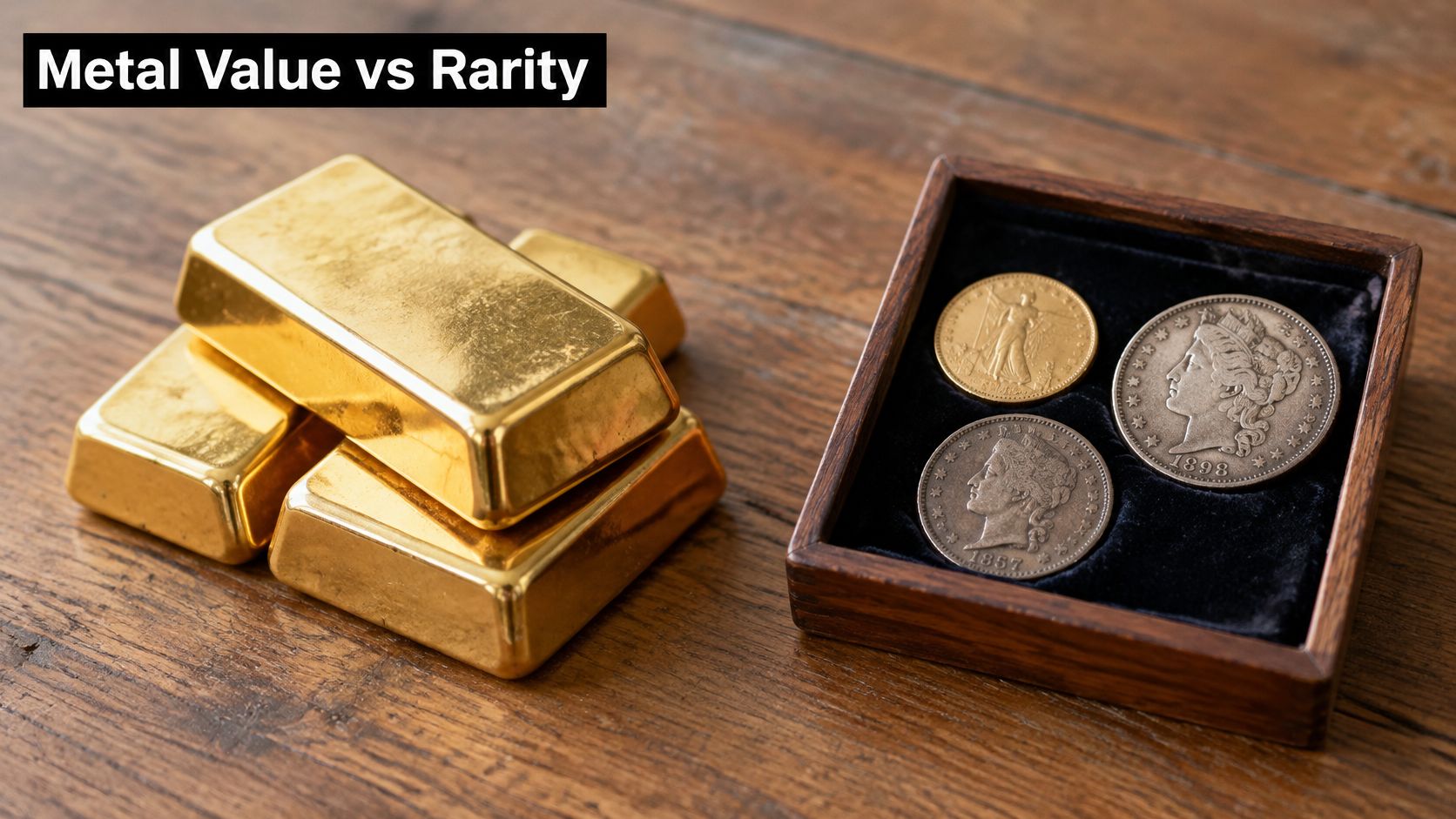
The practical rule is straightforward: buy bullion for metal exposure and keep premiums in view; buy numismatic coins for grade, history, and collector demand. Don't pay a collectible premium unless you understand what feature you're paying for and who might want the coin later.
Proof Sets and Error Coins for Specialists
Proof sets and mint errors attract collectors who enjoy close inspection, but neither category is automatically scarce just because it looks unusual. Proof coins are made for collectors, often with polished fields and sharply defined details. Modern proof quantities are tracked more precisely than some early proof production, when quantities could be made as needed and not always included in year-end totals. Check a reliable reference before treating an old proof as rare.
Error coins require a different kind of caution. A genuine mint error can occur when something goes wrong during production, but damage after a coin leaves the mint isn't an error. A scratch, a flattened edge, or a coin altered with tools may look dramatic without being a collectible mint mistake. Compare the coin with verified examples of the specific variety and ask a qualified dealer or grading service when the price justifies that extra step.
Some errors are widely discussed because they're visually distinctive. The 1943 copper-alloy cent is a notable authentication target, and a 1955 doubled die Lincoln cent is recognized for doubling on lettering and the date. Less dramatic errors, such as off-center strikes or die cracks, can be easier to encounter, but their value still depends on the exact feature and condition.
Counterfeiting and alteration are the central risks. A coin can be plated, filed, glued, or modified to imitate a valuable variety. Don't buy an error coin based only on a seller's description or a blurry photograph. First compare the details and surfaces with a reliable reference, then ask for authentication if you're considering a significant purchase. Collectors exploring proof-set pricing can use this U.S. proof-set value guide as a starting point, while checking the exact issue and condition independently.
How to Authenticate and Grade a Coin Before You Buy
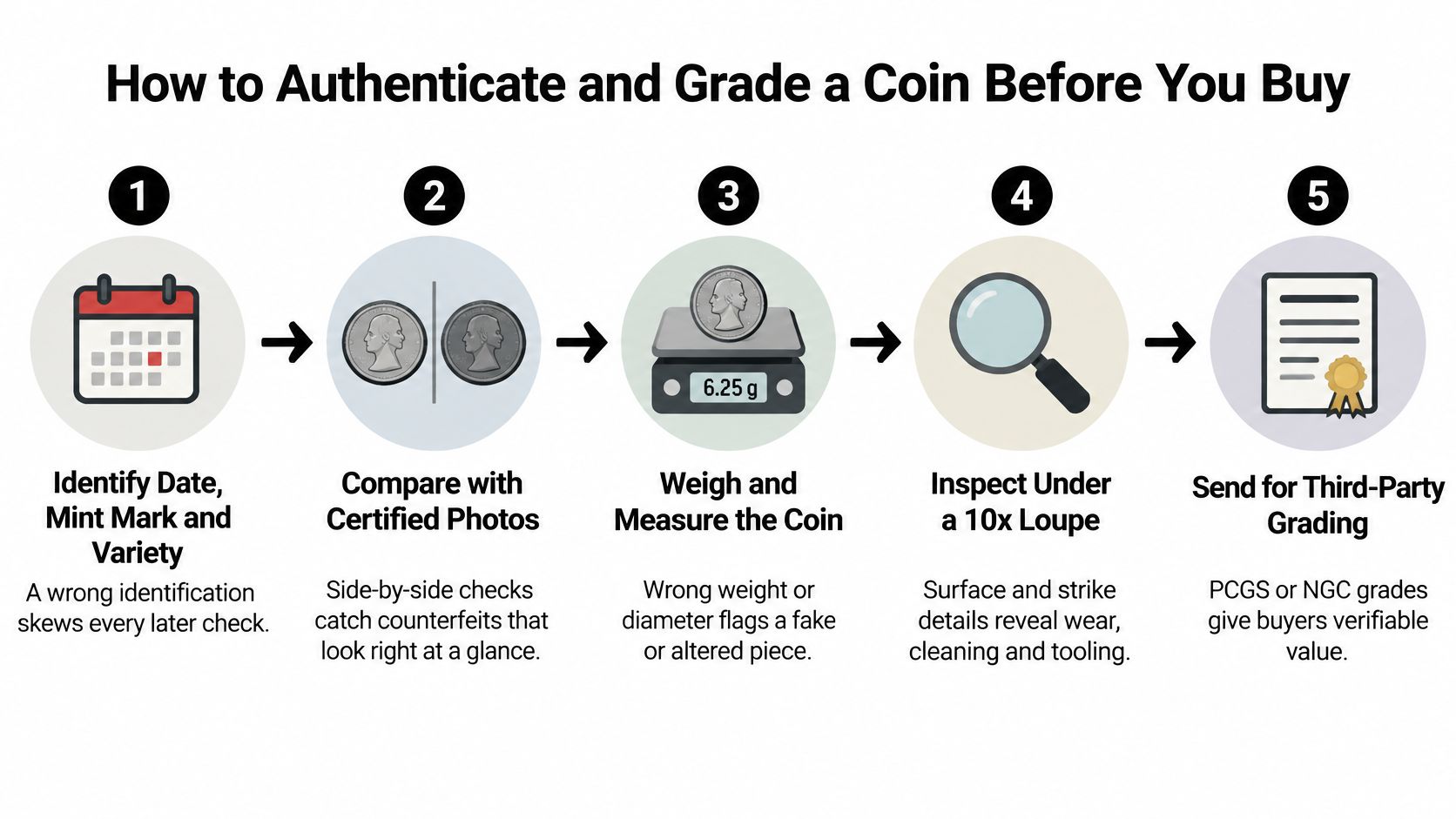
A seller slides a coin across the counter and quotes a key-date price. Before that price means anything, you need to confirm what the coin is, what condition it is in, and whether anyone independent has verified either claim. Work through these checks in order, and pause if the coin's identity or surfaces don't match the seller's description.
- Identify the date, mint mark, and variety. Use a current reference to confirm exactly what you're looking at. A wrong identification skews every later comparison, including population checks and price research.
- Compare with certified photographs. Find images of the same date and variety at a similar grade. Compare design details, lettering, mint-mark position, and surfaces; a quick glance misses the differences that separate a genuine piece from an altered one.
- Inspect under magnification. Use a loupe to look for cleaning lines, scratches, rim damage, spotting, and signs of tooling. Tilt the coin under good light; unnatural hairlines or dull, disturbed surfaces can signal cleaning or alteration.
- Check the population at your target grade. Read the grading service's report for the grade you plan to pay for, not only the total count. Population reports don't count every ungraded coin and may include resubmissions, so treat them as benchmarks rather than exact census figures.
- Consider third-party grading for expensive coins. PCGS and NGC are recognized grading services, and certification gives future buyers a consistent reference for authenticity and grade. That consistency matters at resale: a certified coin is easier to document and easier to liquidate than a raw coin, which has no certified grade, so don't treat a seller's estimate as a formal grade. For more on the process, see this overview of a coin grading service.
For gold jewelry, check that the karat mark appears alongside the manufacturer's name or registered trademark. The FTC's jewelry guidance says not to buy a gold piece lacking that accompanying trademark, because it identifies the party responsible for the quality claim.
Gold testing is a separate issue from coin grading. X-ray fluorescence, or XRF, examines jewelry without damaging it, and the Bureau of Indian Standards' testing guidance describes it as a preliminary surface test that returns alloy-composition data in approximately 2–5 seconds per sample, with readings that may vary by up to ±5 parts per thousand and may not represent average purity. Fire assay is destructive but more accurate, so reserve it for cases where a definitive result is necessary or a result is disputed.
Carat 24 says it uses an 8-step authentication process for the items it evaluates.
Storing, Documenting and Tax-Checking Your Collection
Good storage protects surfaces; good records protect your ability to explain what you own and what you paid.
Keep coins safe and handle them carefully
- Choose inert holders: Use PVC-free flips, archival 2x2 holders, or coin albums designed for storage. Avoid soft plastics and adhesives that can contact the coin.
- Use a stable location: Keep the collection away from damp basements, hot attics, and areas with large changes in humidity.
- Handle by the edges: Hold a coin by its rim, or wear clean cotton or nitrile gloves when appropriate. Don't clean a coin to make it look brighter; cleaning can leave marks that reduce its appeal.
Keep a record for each coin or lot
Save receipts, purchase dates, seller names, prices paid, grading reports, and clear photographs. Store the records with a description of the coin, including its date, mint mark, variety, and certification number if it has one. That file can help you compare offers later and establish the coin's cost basis.
Consider the tax outcome before selling
The IRS treats coins as collectibles. Under the IRS guidance on selling, buying, and owning collectibles, gains on coins held for more than one year can be subject to a maximum 28% collectibles capital-gains rate; gains on holdings kept for one year or less are generally taxed at ordinary-income rates. Gains from selling collection items are taxable, while losses on personal-use hobby collectibles generally can't be deducted.
That difference can change which coin makes sense to buy or sell. A prestigious coin with a wide buy-sell spread, uncertain grade, and weak resale demand may produce a worse after-tax result than a more straightforward piece with clear pricing and records.
Estate sellers should gather purchase records and appraisals where available. An heir's basis can differ from the original owner's cost, so ask a tax professional how to document inherited pieces and whether an appraisal is appropriate. Tax treatment depends on individual circumstances; confirm your situation with a qualified tax adviser.
Start Your Collection and Choose Where to Sell
A practical first collection starts with an exit plan: pick coins you can grade, document, and sell while keeping as much as possible after spreads, selling costs, and any tax due.
- Choose one collecting goal from the quick-pick table.
- Set a budget and decide whether you're buying for grade, metal content, or history.
- Buy from a dealer who documents the coin and clearly describes its condition.
- Record the purchase promptly, including the price, date, and seller.
- Before selling, collect at least two written offers so you can compare terms as well as price.
Local selling can avoid some of the work and uncertainty of shipping a valuable coin, bullion piece, or jewelry item. The USPS insurance information describes optional insurance for mailed items up to $5,000, with the fee based on declared value. Even with insurance, mailing can mean extra packaging, declarations, and waiting, so count those costs when you compare a local offer with a shipped sale.
A sound buyer comparison covers quality, price, service, and refund or return terms in writing. For simple gold jewelry, compare the item's gram weight with the current gold price, and make sure important claims are documented on the receipt. When evaluating a local buyer, ask how the offer is calculated and whether the buyer will explain the test results. Judge the offer by clear math and terms you can keep.
For estate liquidation, use a clear sequence: collect records and grading reports; sort the property into coins, bullion, and jewelry; have jewelry tested and check its marks; then compare written offers and their terms. If you're preparing to sell rarities, this guide to how to sell collectible coins can help you prepare questions before requesting an offer.
Carat 24 buys gold, silver, bullion, numismatic coins, and jewelry at 3780 W. State St., Boise, Idaho.
If you've found coins, bullion, or jewelry in a collection or estate, organize the pieces and bring along any receipts, grading reports, or appraisals. Visit Carat 24 - Trusted Gold Experts for a local evaluation and a written offer you can compare before deciding whether to sell.
