
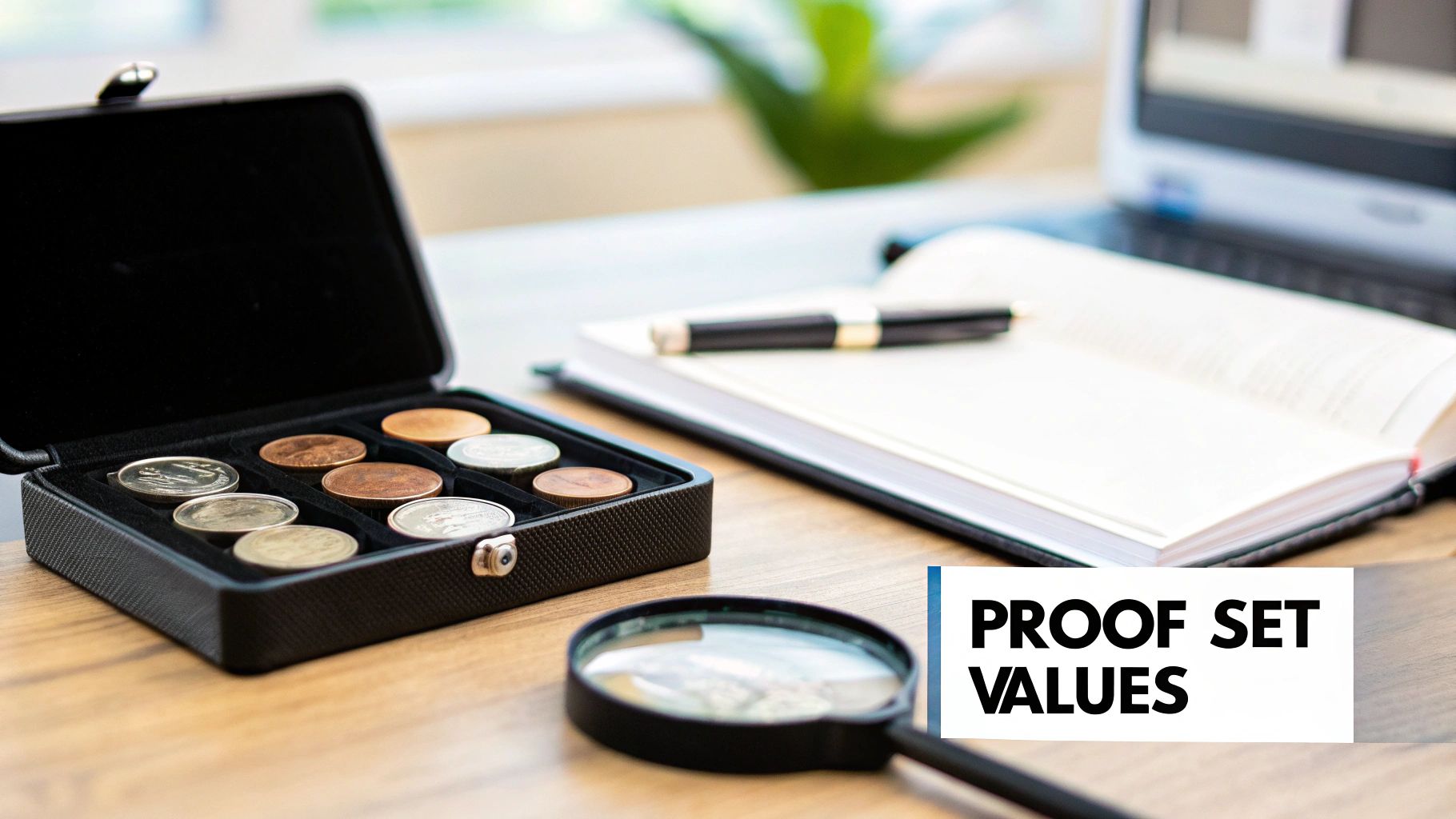
When you stumble upon a pristine box of U.S. coins from an inheritance or tucked away in an attic, you might wonder if you're holding a hidden gem. Those shiny, specially packaged coins are likely United States Proof Sets, and their values can swing wildly from just a few dollars to thousands.
This guide will walk you through exactly what drives their worth, helping you understand the story behind the coins.
A Quick Guide to Proof Set Values
Think of it this way: not all proof sets are created equal. Some are like rare, first-edition books, while others are more like common paperbacks. The value isn't just about the face value of the coins inside; it's a story told through their history, scarcity, condition, and even the original packaging.
To really get a feel for their potential, you need to understand the basic principles of valuation, like knowing what is fair market value is and how that concept applies to collectibles like coins. It’s a combination of rarity, metal content, and collector demand.
Key Eras of U.S. Proof Sets and Their Value Drivers
The first step in figuring out what you have is to identify the era it comes from. The U.S. Mint's production has gone through distinct phases, and each one has a major impact on what a set is worth today.
Here's a quick breakdown of the major periods and what makes them tick in the market.
Key Eras of U.S. Proof Sets and Their Value Drivers
| Era | Key Value Drivers | General Value Range |
|---|---|---|
|
Classic Silver Era (1936–1964) |
90% silver content, very low mintage numbers, high collector demand, condition is critical. | $100s to $1000s+ |
|
Special Mint Sets (1965–1967) |
Unique satin-like finish (not true proofs), transitional period, moderate scarcity. | $10 to $50 |
|
Modern Clad Era (1968–Present) |
Mass production means low base value. The key is finding special silver editions or sets in perfect condition. | $5 to $50 (most common sets) |
As you can see, a set's date is your biggest clue. An early set from the Classic Silver Era (1936–1964) is where the real money often is, thanks to its 90% silver content and incredibly low production numbers compared to today. Conversely, most sets from the Modern Clad Era (1968–Present) were made by the millions, so their value is much closer to face value unless they are special silver issues. The Special Mint Sets (1965–1967) are a unique middle ground, created when proof production was paused.
Understanding these distinctions is the first step in unlocking your collection’s potential. To dig deeper into how rarity and historical significance affect coin prices, you might be interested in our guide on what are numismatic coins: https://carat24boise.com/blogs/news/what-are-numismatic-coins.
And if you decide to sell, remember you don't always have to ship your collection away. Selling locally can save you hassle and often gets you a better price. Here in Boise, reputable gold and jewelry buyers offer free X-ray scanning and gold testing, providing transparent, hassle-free offers and even price matching to ensure you get the highest possible payout.
What Makes a Proof Set Different and Valuable
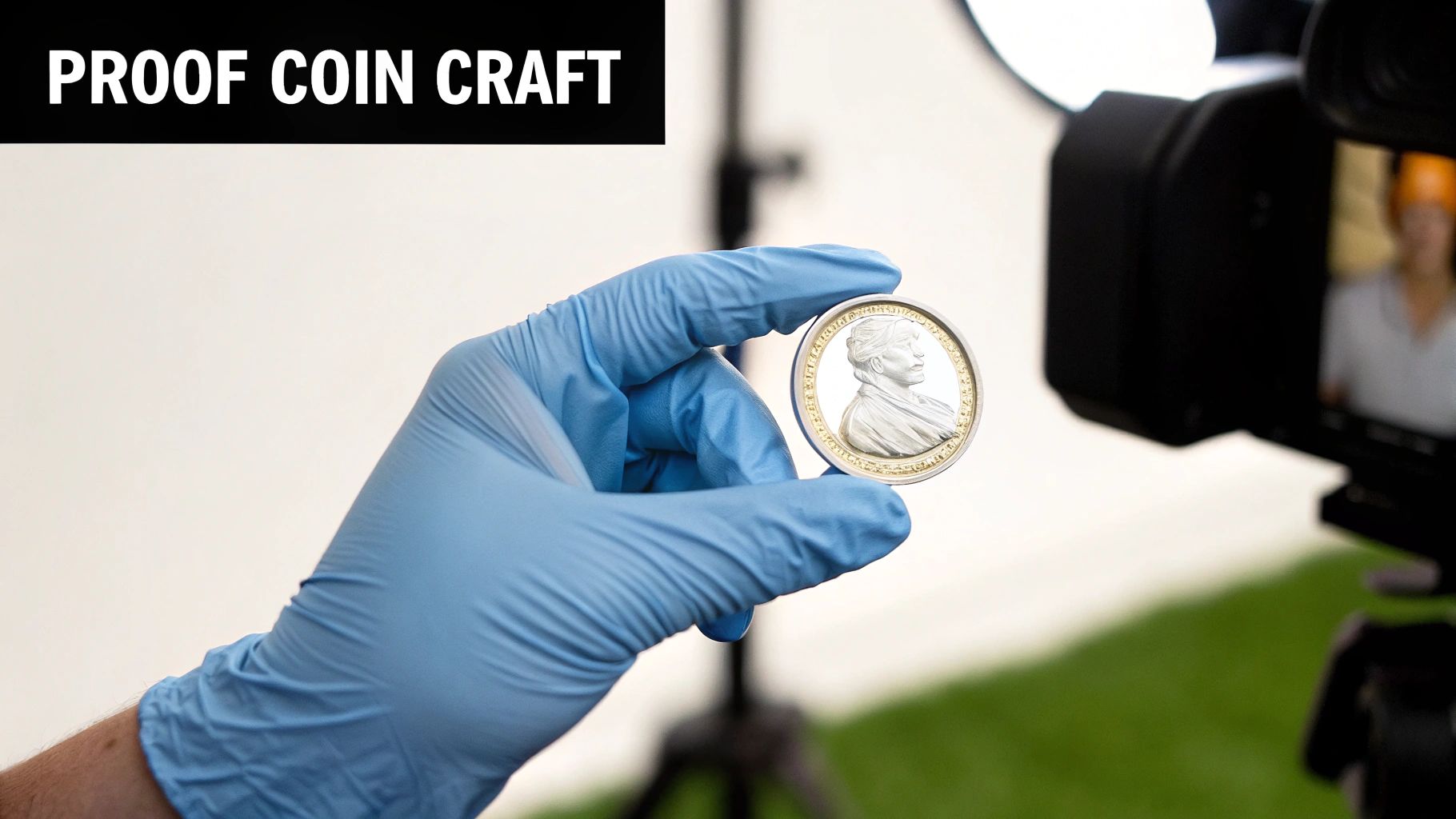
Before you can really get a handle on the value of a U.S. proof set, you have to understand what makes a "proof" coin special in the first place. Think of it this way: a regular quarter you get as change is like a mass-produced poster, made to be used and passed around. A proof coin, on the other hand, is more like a signed, limited-edition giclée print—crafted with incredible care for people who appreciate the art form.
This isn't just a cosmetic difference; it's the whole reason they're valuable. A standard coin for circulation gets struck just once. A proof coin gets a much more deliberate and gentle treatment, turning a simple metal disc into a collector's prize. Getting a feel for these fundamentals is the first step, and this detailed What is a Proof Coin? A Collector's Guide is a great place to start.
The Art of the Proof Coin
The secret behind a proof coin's jaw-dropping appearance is all in how it's made. The U.S. Mint starts with specially prepared coin blanks, known as planchets, that are buffed and polished until they gleam. The dies used to stamp the designs onto these blanks are also meticulously polished and often get special treatments to create that signature look.
This is where the magic really happens. That polished blank is struck multiple times, forcing the metal into every last crevice of the die's design. The result is razor-sharp detail and two distinct features that define a true proof coin:
- Mirror-Like Fields: The flat, background surfaces of the coin are so incredibly smooth they reflect light like a mirror.
- Frosted Devices: The raised parts of the design—like the president's portrait or the lettering—have a contrasting, soft, frosted texture.
This stunning visual pop between the reflective background and the matte design is what collectors call a "cameo" effect. It's the hallmark of a top-quality proof coin and a massive driver of its appeal. Sets with a deep, crisp cameo almost always fetch higher prices.
The cameo effect isn’t just a pretty feature; it’s a direct signal of the pristine condition of the dies and the precision of the minting process. A powerful cameo tells a collector that this coin was likely one of the very first ones struck from a brand-new set of dies.
A Legacy of Scarcity
The U.S. Mint kicked off the tradition of issuing annual proof sets in 1936, a major turning point after more inconsistent production in the 19th century. Those early sets, from 1936 to 1942, are especially hard to find because so few were made. For example, a 1937 Proof Set in its original packaging can be valued around $3,150 today.
Knowing these key dates and low-mintage years is crucial for spotting the really valuable sets. Certain years simply had tiny production runs, making them far rarer and more desirable. You can learn more about how to identify these important years in our article covering coin key dates.
Whether you're looking at an old silver set or a modern one, the value always comes down to that winning combination: superior quality, limited numbers, and historical significance. When you're ready to find out what your own collection is worth, remember that selling locally can save you the stress and risk of shipping your valuables. Here in Boise, we offer hassle-free offers for your gold and jewelry, providing free X-ray scanning and gold testing to ensure you get the highest payout with our price match guarantee.
The Five Factors That Drive Proof Set Values
Figuring out what a U.S. proof set is worth is a bit like being a detective. You’re not just looking at a handful of shiny coins; you’re piecing together clues from their history, how they were made, and how they’ve been treated over the years. It all boils down to five key factors that work together to determine if a set is worth a few bucks or a small fortune.
If you can get a handle on these five elements, you’ll be in a great position to accurately assess your own collection. Each factor tells a piece of the story, and together, they paint the full picture of your proof set's true market value.
1. Mintage and Rarity
The oldest rule in collecting is simple supply and demand. The fewer sets the U.S. Mint produced in a particular year, the more valuable they tend to become over time. This is the single biggest reason why the really early proof sets command such high prices.
Take the 1936 Proof Set, for example. The Mint only produced a tiny run of 3,837 sets. That incredible rarity makes it a holy grail for serious collectors, often pushing its value into the thousands. Now, compare that to a set from the 1980s, where mintages often soared past 3 million. It's easy to see why the older set is worth exponentially more.
2. Precious Metal Content
The very metal a coin is made from gives it a solid, baseline value. This is especially true for any set produced before 1965, back when our dimes, quarters, and half dollars were all struck from 90% silver. That silver content creates what we call a "melt value"—a price floor that the set is very unlikely to fall below.
This built-in value acts as a safety net for both collectors and sellers. Even if the numismatic demand for a particular set goes up or down, the silver inside ensures it always holds real, tangible worth. When you’re thinking about selling, a local expert can verify this for you. Here in Boise, reputable gold and jewelry buying experts offer free X-ray scanning and gold testing to give you a transparent, hassle-free offer based on the actual metal content.
The change from silver to clad coinage in 1965 is one of the most important dividing lines in U.S. proof set history. A 1964 set is packed with 90% silver, while a 1968 set is mostly copper-nickel. This one difference can create a value gap of hundreds of dollars between sets that otherwise look almost identical.
It's also smart to keep an eye on the daily fluctuations of precious metals. To get a better feel for how the pros determine current value, it's worth reading up on the spot price for gold and silver.
3. Condition and Grading
For a serious collector, condition is everything. A proof set’s value is directly tied to how perfectly its delicate, mirror-like surfaces have been preserved. Professional grading services use a 70-point scale where PR70 represents a flawless, perfect coin.
A couple of key terms can have a massive impact on value:
- Cameo (CAM): This indicates a nice, frosty contrast between the raised design and the mirrored background field.
- Deep Cameo (DCAM) or Ultra Cameo (UCAM): This describes a coin with a stunning, almost black-and-white contrast. Earning this designation can easily double or even triple a coin's value.
For instance, a standard 1960 Proof Set might sell for around $35. But if the coins inside that same set are graded as Deep Cameo, the value can rocket past $200.
4. Original Government Packaging
That plastic case or cardboard holder isn't just a box—it's part of the set's history and its primary line of defense. Collectors place a huge premium on sets that are still sealed in their Original Government Packaging (OGP).
Breaking a set out of its original lens or flat-pack can instantly torpedo its value. The OGP is what protects the coins from fingerprints, environmental damage, and scratches. A set in its pristine, unopened packaging is always more desirable than loose coins or one that's been moved to a different holder. Just think of it like a vintage action figure—it’s always worth more in its original, unopened box.
5. Rare Errors and Varieties
Last but not least, we have the most exciting factor: the hunt for rare errors. Every once in a while, a mistake during the minting process creates an anomaly that can turn an ordinary set into an extraordinary treasure. They aren’t common, but finding one is what every collector dreams of.
One of the most famous examples is the 1970-S "No S" Roosevelt Dime. A small number of proof sets were accidentally released containing a dime that was missing its "S" mint mark. A normal 1970-S Proof Set is worth about $10. Find one with that error dime, however, and you're looking at a value of over $1,500.
When you decide it’s time to sell, bringing your collection to a trusted local buyer can make all the difference. You can save the hassle and sell locally for more than online shipments, completely avoiding the risks and costs of insurance and postage. Look for a buyer in Boise who offers the highest payout for gold and jewelry buying and provides price matching to ensure you're getting the best possible deal for your collections.
Classic Silver vs Modern Clad Proof Sets
To really wrap your head around U.S. proof set values, you have to understand the massive shift that happened in 1965. That single year is the dividing line between two completely different eras of collecting: the classic silver period and the modern clad period. One is all about precious metal and scarcity, while the other is defined by mass production and special editions.
Think of it like comparing a vintage, hand-built muscle car to a modern sedan right off the assembly line. Both are cars, sure, but their materials, rarity, and what makes them valuable are worlds apart. The classic sets are the rare, powerful machines collectors dream about, while the modern ones are far more common, with just a few high-performance models sprinkled in.
The Classic Silver Era: A Collector's Dream
The years from 1936 to 1964 represent the golden age for proof set collectors. Every dime, quarter, and half-dollar tucked into these sets was struck from 90% silver. This precious metal gives them a solid floor value—they can’t really ever be worth less than the silver they’re made of.
But the silver content is just the beginning of the story. The real magic from this era comes down to incredibly low production numbers. The U.S. Mint just didn't make that many of them, which makes them genuinely scarce today. It’s this powerful one-two punch of real silver value and true rarity that sends their prices into the hundreds, and sometimes thousands, of dollars.
A great example is the 1955 Proof Set. The Mint only produced about 378,000 of them. Its silver provides a nice base value, but its rarity is what pushes the market price through the roof. That’s the simple formula that makes this classic era so exciting for collectors and investors.
The Modern Clad Era: Navigating High Mintages
Everything changed starting in 1968 (after a short break where the Mint issued "Special Mint Sets"). The U.S. Mint switched to a copper-nickel clad composition for dimes and quarters, stripping them of their silver. At the same time, production numbers went through the roof, often hitting several million sets per year.
This means that most standard-issue clad proof sets from 1968 onward are worth something much closer to their original issue price. There are simply too many of them out there for the value to climb much. But this era isn't a total wash—you just have to know where the hidden gems are.
Finding Hidden Gems in the Modern Era
While the basic clad sets won't make you rich, the U.S. Mint eventually started releasing special editions that got collectors excited again and created new opportunities for value.
Here are the key modern sets to keep an eye out for:
- Silver Proof Sets (1992-Present): The Mint brought back 90% silver dimes, quarters, and half-dollars in 1992. These "Silver Premier" sets were made in much smaller numbers than their clad twins and are always worth more.
- Prestige Proof Sets (1983-1997): These were premium sets that included the standard proof coins plus a special commemorative, usually a silver dollar. Their unique contents and lower mintages make them far more desirable.
- Special Series Sets: The 50 State Quarters program created a collecting frenzy. The silver proof versions of these sets are especially sought-after by people trying to build a top-quality collection.
Modern sets exploded in variety after the 1990s, especially as the Mint capitalized on the hype from series like the State Quarters. For instance, the standard 1995-S proof set had a mintage of 2,010,384 and sells for around $13 today. Compare that to the 1995-S Silver Proof Set—only 549,878 were made, and its silver content and rarity push its value to about $72.
Whether you're holding classic silver sets or modern clad ones, knowing what they're made of is the first step to figuring out their worth. To get a better feel for why that silver matters so much, dive into our detailed guide on pre-1965 silver quarters.
How to Get the Highest Payout for Your Proof Sets
You've learned to spot the differences between the eras and what really drives a proof set's value. Now comes the best part: turning that knowledge into cash. When it's time to sell your United States proof sets, the goal is simple—get the best possible price without all the headaches. While online marketplaces might look tempting, they often hide a minefield of risks and unexpected costs.
Shipping a valuable and sometimes delicate collection can be a nerve-wracking experience. You're suddenly dealing with careful packaging, insurance costs, and the nagging worry of a package getting lost or damaged. It's why so many seasoned collectors save the hassle and sell locally for more than online shipments.
This timeline breaks down the major shifts in coin composition that directly influence your sets' base value.
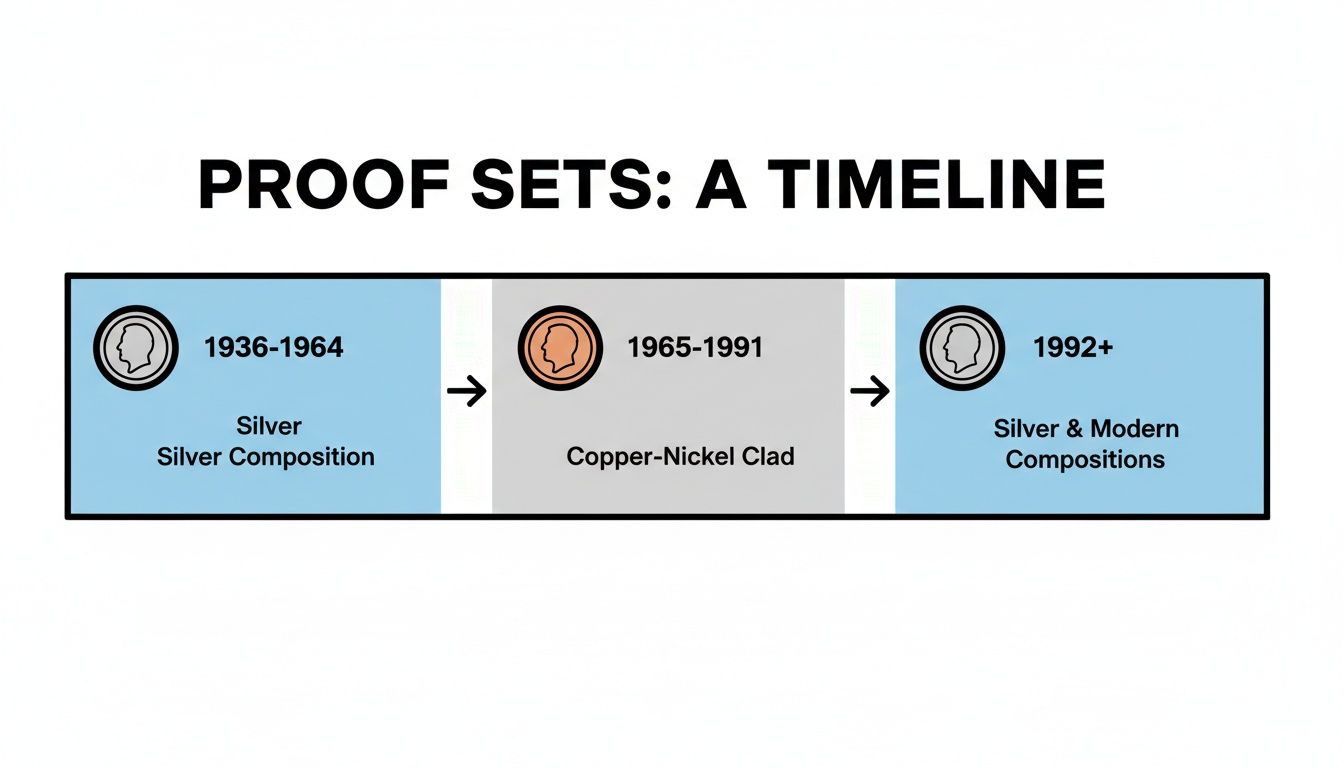
As you can see, there's a clear reason why the pre-1964 silver sets and the modern silver sets from 1992 onward often carry a higher intrinsic value than the clad sets sandwiched in between.
Your Step-by-Step Guide to Selling Locally
Selling your collection right here in Boise doesn't need to be complicated. A few straightforward steps can make the whole process smooth and transparent, putting the most money back in your pocket. It really boils down to good preparation and finding a buyer you can trust.
A reputable local expert won't just evaluate your proof sets—they'll also be set up for gold and jewelry buying, which lets you handle everything in one secure and convenient stop.
Here’s the best way to approach it:
-
Organize Your Collection First: Get your sets grouped together by year. If you still have original receipts or any paperwork, keep those with the matching sets. This bit of organization makes the appraisal process much faster and more efficient for everyone involved.
-
Do Not Clean the Coins: This is the absolute golden rule. "Cleaning" coins, even with a soft cloth, leaves behind tiny scratches on their mirrored proof surfaces and can strip away the natural toning that many collectors prize. Cleaning your coins will absolutely tank their value.
-
Research Reputable Local Buyers: Look for a trusted expert in Boise with a physical storefront and solid reviews from the community. A true professional will offer a transparent process and be happy to walk you through how they arrived at their offer.
A trustworthy buyer will never pressure you into a sale. They should provide a clear, no-obligation offer and give you the time and information needed to make a decision you feel good about. That commitment to a hassle-free experience is the hallmark of a real professional.
Finding a Buyer Who Offers Transparency and Value
When you're checking out potential buyers, prioritize the ones who offer comprehensive services that guarantee a fair and honest evaluation. The best local experts do more than just give your collection a quick look; they use technology to confirm the exact composition of your items, making sure you get paid for every bit of value.
Look for a Boise buyer who provides these key services:
- Free X-ray Scanning and Gold Testing: This is a game-changer. It scientifically verifies the precious metal content in your coins and any other jewelry you might be selling. This takes all the guesswork out of the equation and ensures your offer is based on hard data.
- Hassle-Free Offers: The appraisal should be straightforward, with zero obligation to sell. You should walk away with a clear offer and a full explanation of how it was calculated.
- Price Matching: A buyer who is confident in their pricing will often provide price matching. This is your guarantee that you're receiving the highest payout in Boise for your valuables.
By choosing a local expert, you're not just getting a better price—you're getting peace of mind. To dive deeper into the selling journey, feel free to check out our detailed guide on how to sell collectible coins. It will help you walk into any appraisal feeling prepared and confident.
Of course. Here is the rewritten section, crafted to sound like it was written by an experienced human expert.
Your Top Questions About Proof Set Values
As you spend more time with your collection, you'll find that the same questions tend to pop up. Getting solid answers is the key to making smart moves, whether you plan on holding your sets for the long haul or you're thinking about selling.
Let's dive into some of the most common questions we hear about United States proof set values. We'll clear up the confusion around everything from silver content to packaging so you can feel confident about what you have in your hands.
Are All U.S. Proof Sets Made of Silver?
No, and this is probably the single most important thing to know when figuring out value. It's a common misconception. While those classic sets from 1936 to 1964 were packed with 90% silver coins, the game changed after that.
Most sets made between 1965 and 1991 are just a copper-nickel clad composition. The U.S. Mint did bring back 90% silver proof sets in 1992, and now they're sold right alongside the standard clad versions. Knowing if your modern set is silver or clad is the first step, as it sets the entire foundation for its value.
Does Removing Coins from Their Original Packaging Decrease Value?
Yes, absolutely. Ripping open that original government packaging is one of the fastest ways to tank a proof set's value. A huge part of a proof set's worth is tied directly to its preservation in the Original Government Packaging (OGP).
Breaking the seal or popping the coins out can instantly slash their value by 20% to 50%, sometimes even more.
Think of the OGP as the coin's time capsule. It's the first line of defense, authenticating the set and protecting those delicate, mirror-like surfaces from fingerprints, scratches, and the elements. For maximum value, always keep your proof sets sealed in their original holders.
Proof set values can swing wildly based on rarity and condition, with early gems and special editions leading the pack. While a modern 2022-S Proof Set might trade for around $49, scarce silver editions like the 2001-S Silver set command about $84—a premium of over 460% compared to its clad counterpart. You can discover more insights about how market trends affect proof set prices on Greysheet.com.
How Can I Get My Proof Sets Appraised for Free?
Many trusted local coin and jewelry buyers, especially in the Boise area, offer free verbal appraisals to help you get a handle on your collection's worth. Look for a reputable buyer that provides complimentary services like X-ray scanning and precious metal testing for a transparent, no-pressure evaluation.
This lets you get an accurate assessment of what you own without any cost or obligation to sell. A true professional will give you a hassle-free offer and all the information you need to make a confident decision. This is especially true when you find a local business that also specializes in gold and jewelry buying, offering a one-stop solution for all your valuables.
When you're ready to learn the true worth of your collection, visit Carat 24 - Trusted Gold Experts. We provide the highest payout in Boise with free evaluations, X-ray scanning, and a price match guarantee, ensuring you save the hassle and sell locally for more. Get your hassle-free offer today at https://carat24boise.com.
