

That old silver dime tucked away in a drawer might be more than just ten cents; it’s a small piece of American history with a value that can definitely surprise you.
A common, heavily worn 1920 dime is always worth at least its silver content. But a pristine version from a rarer mint? That can fetch a significant sum from collectors. When it comes down to it, three core factors work together to determine its ultimate worth.
Your 1920 Mercury Dime Value at a Glance
So, what transforms a simple 1920 dime from pocket change into a valuable collectible? It's a combination of where it was made, the life it has lived, and the metal it's made from.

As the chart shows, a coin's journey from raw metal to a collector's prize is shaped by its origin (mint mark), its life story (condition), and its intrinsic material worth (silver price). Each element plays a crucial role.
Key Value Drivers Explained
Getting a handle on these elements is the first step toward figuring out what your specific coin is worth. Each one tells a part of the coin's story and adds to its final appraisal value.
- Mint Mark: Look for a tiny letter on the back of the coin. This reveals where it was made. Some mints produced far fewer coins than others, making their dimes rarer and more desirable to collectors.
- Condition (Grade): This is all about wear and tear. A coin with sharp, crisp, and clear details is graded higher and is worth significantly more than one that’s been smoothed down from years of circulation.
- Silver Melt Value: This is the baseline. Every 1920 Mercury Dime contains 90% silver, giving it a foundational value that goes up and down with the daily price of precious metals.
For a deeper dive into how these factors apply across the entire series, you can learn more about the general value of Mercury Dimes in our detailed guide.
Let's take a look at some real-world numbers. The table below gives you a solid idea of what to expect for a 1920 Mercury dime based on its mint mark and overall condition.
Estimated 1920 Mercury Dime Value by Mint Mark and Condition
| Mint Mark (Location) | Circulated Value (Good - Fine) | Uncirculated Value (MS-60 to MS-63) | Gem Uncirculated Value (MS-65+) |
|---|---|---|---|
| No Mint Mark (Philadelphia) | $3 - $6 | $45 - $80 | $175+ |
| "D" (Denver) | $4 - $10 | $80 - $160 | $300+ |
| "S" (San Francisco) | $3 - $8 | $70 - $140 | $275+ |
As you can see, even a heavily circulated coin is worth many times its face value. But the real money comes in when you find a high-grade, uncirculated specimen, especially from the Denver or San Francisco mints. The value jumps exponentially.
How Mint Marks Determine Your Dime's Rarity
To really understand what your 1920 Mercury dime might be worth, you’ll need to play detective for a moment. The single most important clue is a tiny letter—or maybe no letter at all—on the back of the coin. That's the mint mark, and it tells you exactly which U.S. Mint facility struck your dime over a century ago.
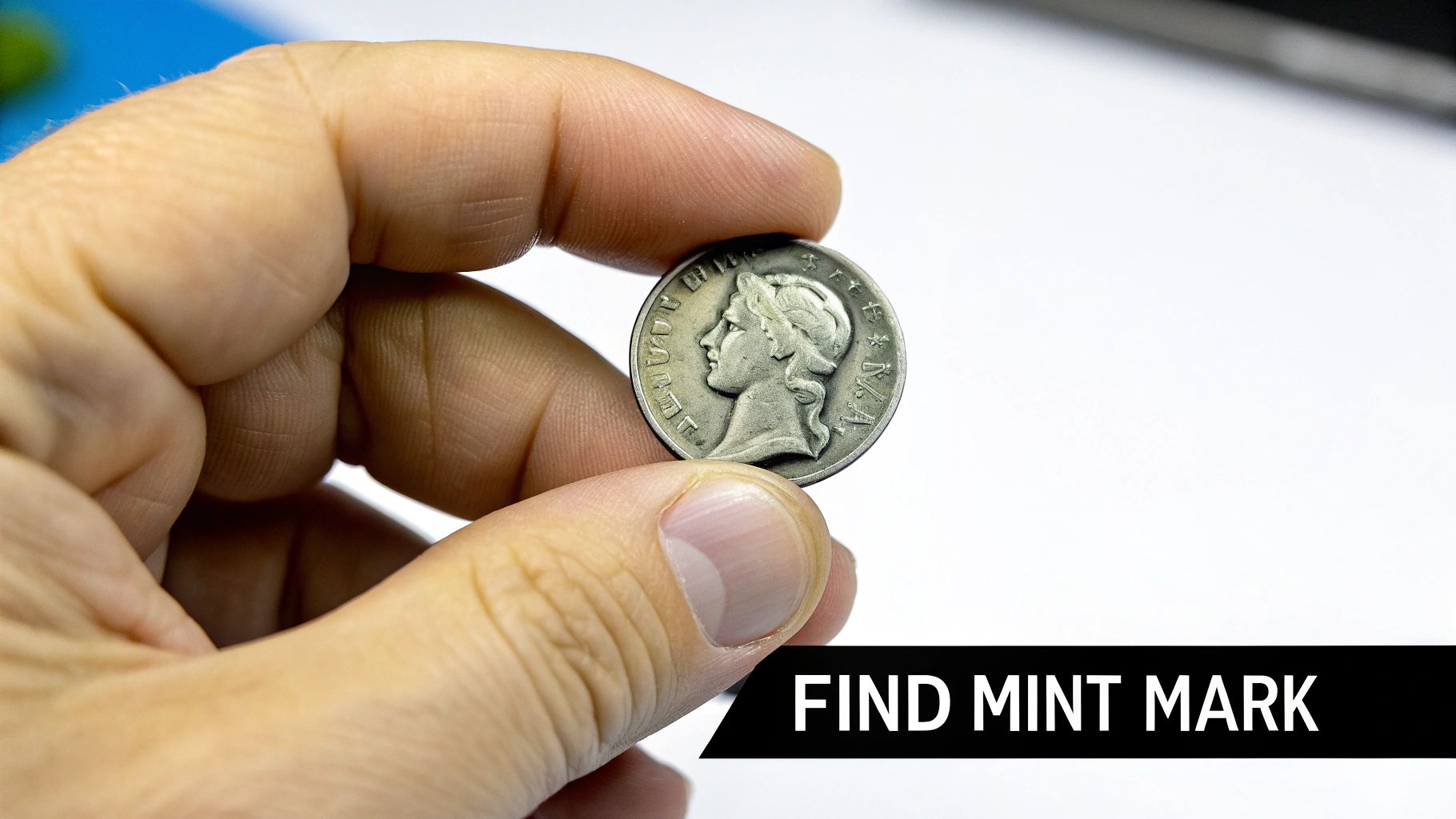
Flip your dime to the reverse side and look near the bottom. To the left of the fasces—that bundle of rods with an axe head—you might spot a small initial. This one letter is the key to unlocking the coin's backstory and is a massive factor in its value.
The Three Varieties of the 1920 Dime
Back in 1920, three different mints were responsible for producing these beautiful silver dimes, and each one left its own calling card. Knowing which one you have is critical because their production numbers were wildly different.
- No Mint Mark (Philadelphia): If you can’t find a letter, your dime was made at the main U.S. Mint in Philadelphia. They handled the bulk of the work, churning out over 59 million 1920 dimes. This makes them the most common by far.
- "D" Mint Mark (Denver): A small "D" means your coin hails from Denver, Colorado. The Denver Mint produced just over 19 million, making these significantly harder to find than their Philadelphia cousins.
- "S" Mint Mark (San Francisco): An "S" tells you it was minted in San Francisco. This facility had the lowest output for the year, making these dimes the scarcest of the three.
The mint mark fundamentally changes a coin's story. It goes from being a generic piece of silver to a specific historical artifact. A 1920-S dime isn't just a 1920 dime; it's one of only 13,820,000 coins struck in San Francisco that year. That gives it a distinct identity and much stronger collector appeal.
The 1920-S Mercury Dime from the San Francisco Mint holds a special place for collectors. It nicely bridges the gap between common coins and the truly rare ones. Because of its lower mintage and the San Francisco Mint's reputation for high-quality strikes, its value tends to climb much faster as the coin's condition improves.
This idea of scarcity being tied to a mint mark isn't just for the 1920 dime; it's a core principle in all of coin collecting. For a deeper dive, take a look at our guide on how to identify important coin key dates. Finding the mint mark is your first big win, but it's just one piece of the puzzle.
Why a Coin's Condition Can Multiply Its Value
Have you ever wondered how two seemingly identical 1920 Mercury dimes, struck from the same mint, can have wildly different values? One might be worth a few dollars, while the other could command hundreds. The secret isn't in the silver content—it's all about the coin's condition, or what we in the collecting world call its "grade."
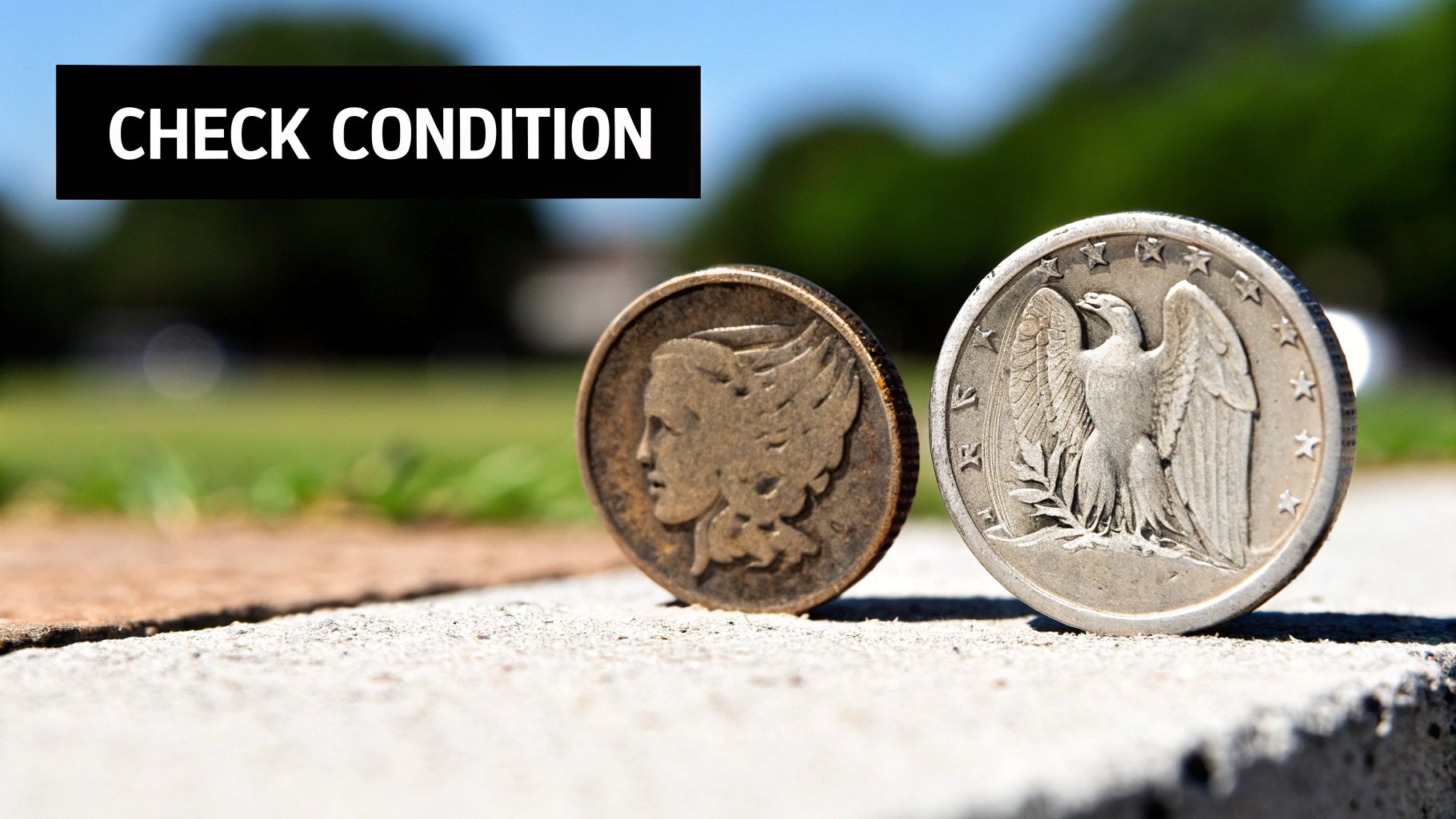
Think of a coin that’s been passed around in pockets and cash registers for years. All that handling slowly wears down the delicate details the artist intended. A pristine, sharply detailed coin is a rare survivor, and that's exactly what collectors are willing to pay a premium for.
From Worn Pocket Change to a Perfect Specimen
You don't need to be a professional grader to get a feel for a coin's condition. It really just comes down to looking closely at the details. A higher grade means a clearer, sharper "picture" on the coin. Here’s a quick rundown of what to look for on a 1920 Mercury dime:
- Good (G-4): At this stage, the coin has seen a lot of life. The main designs are there, but the fine details are mostly gone. The feathers in Liberty’s cap and the lines on the fasces (the bundle of rods on the back) are worn smooth. You can read the date, but it's flat.
- Fine (F-12): Now we're starting to see a bit more detail emerge. You can make out some separation in the wing feathers and a few of the vertical lines on the fasces. Liberty’s hair and cheekbone, however, are still heavily worn down.
- Extremely Fine (EF-40): This is a nice-looking coin. Most of the details are crisp and clear, from the feathers in the wing to the individual strands of Liberty's hair. Only the very highest points of the design show any real signs of wear.
- Uncirculated (MS-60+): This coin looks like it just left the mint yesterday. It has no wear from circulation, boasts its original shine (or "mint luster"), and every single detail is razor-sharp.
The price jump between these grades is dramatic. Based on current market data, a 1920 Mercury Dime in Good condition is worth about $3. That value climbs to $3.50 in Fine, $8 in Extremely Fine, and hits $15 or more for a basic Uncirculated coin.
"Full Bands": The Detail That Changes Everything
Beyond the standard grades, there’s one special detail that can make the value of a 1920 Mercury dime explode: the Full Bands (FB) designation. This refers to the three horizontal bands holding the fasces together on the reverse side of the coin.
A coin only gets the "Full Bands" label if the strike was so perfect and powerful that all three bands are completely separate and fully rounded. Even a brand-new, uncirculated coin will lack this feature if it came from a weak strike, resulting in mushy, merged bands.
Achieving a perfect strike was rare, which makes a 1920 dime with the FB designation a true prize for serious collectors. An otherwise identical Uncirculated coin can easily be worth ten times more just because it has those three perfect little lines. It's the ultimate seal of quality for a Mercury dime.
Before you sell, it's always smart to get a professional opinion. Here at Carat 24, we specialize in Gold and Jewelry Buying, and our experts will happily assess your coins for free. We use safe, non-invasive Xray Scanning and Gold Testing for free to confirm authenticity and condition without ever harming your items, guaranteeing you get the highest payout in Boise. We make fair, hassle-free offers and even price match, so you can sell with confidence right here at home.
Understanding Your Dime's Silver Melt Value
Beyond its historical charm and appeal to collectors, every single 1920 Mercury Dime holds a guaranteed base value, all thanks to the precious metal it's made of. You can think of this as the coin's ultimate safety net; its worth can never drop below the value of its silver content. In the coin world, we call this the "melt value."
Each one of these dimes was struck from a mix of 90% silver and 10% copper. This specific composition ensures that even a heavily worn or damaged coin—one that might not catch the eye of a serious numismatist—still possesses real, tangible worth based on the silver market.
Calculating Your Dime's Base Worth
Figuring out this base value is actually pretty straightforward. A 1920 Mercury Dime contains precisely 0.0723 troy ounces of pure silver. To find its current melt value, you just multiply that number by the daily market price of silver, which is often called the "spot price."
Let's run a quick example. If the spot price of silver is sitting at $30 per troy ounce, the melt value of your dime would be:
0.0723 oz. x $30/oz. = $2.17
This simple calculation gives you a solid floor for any appraisal. If you're curious about how precious metal prices are determined, you can learn more in our guide on the spot price for gold and silver.
The melt value is the absolute floor. It’s the minimum you should ever expect for your coin, no matter its condition. Any value above this is what we call its numismatic, or collectible, premium.
When you're ready to see what your collection is truly worth, selling locally is often your best bet. Save the hassle and sell locally for more than online shipments. Here at Carat 24, we specialize in Gold and Jewelry Buying and offer the highest payout in Boise.
We provide free Xray Scanning and Gold Testing to accurately assess your items on the spot and give you a hassle-free offer. We even price match to ensure you can skip the stress and sell locally for more.
A Collector's Guide to Each 1920 Mint Variety
Alright, now that we’ve walked through the key factors like grading and silver content, let's put that knowledge into action. We'll break down each of the three 1920 Mercury Dime varieties one by one. Understanding the unique story behind the coins from Philadelphia, Denver, and San Francisco is crucial for getting a real sense of your coin's potential worth and rarity.
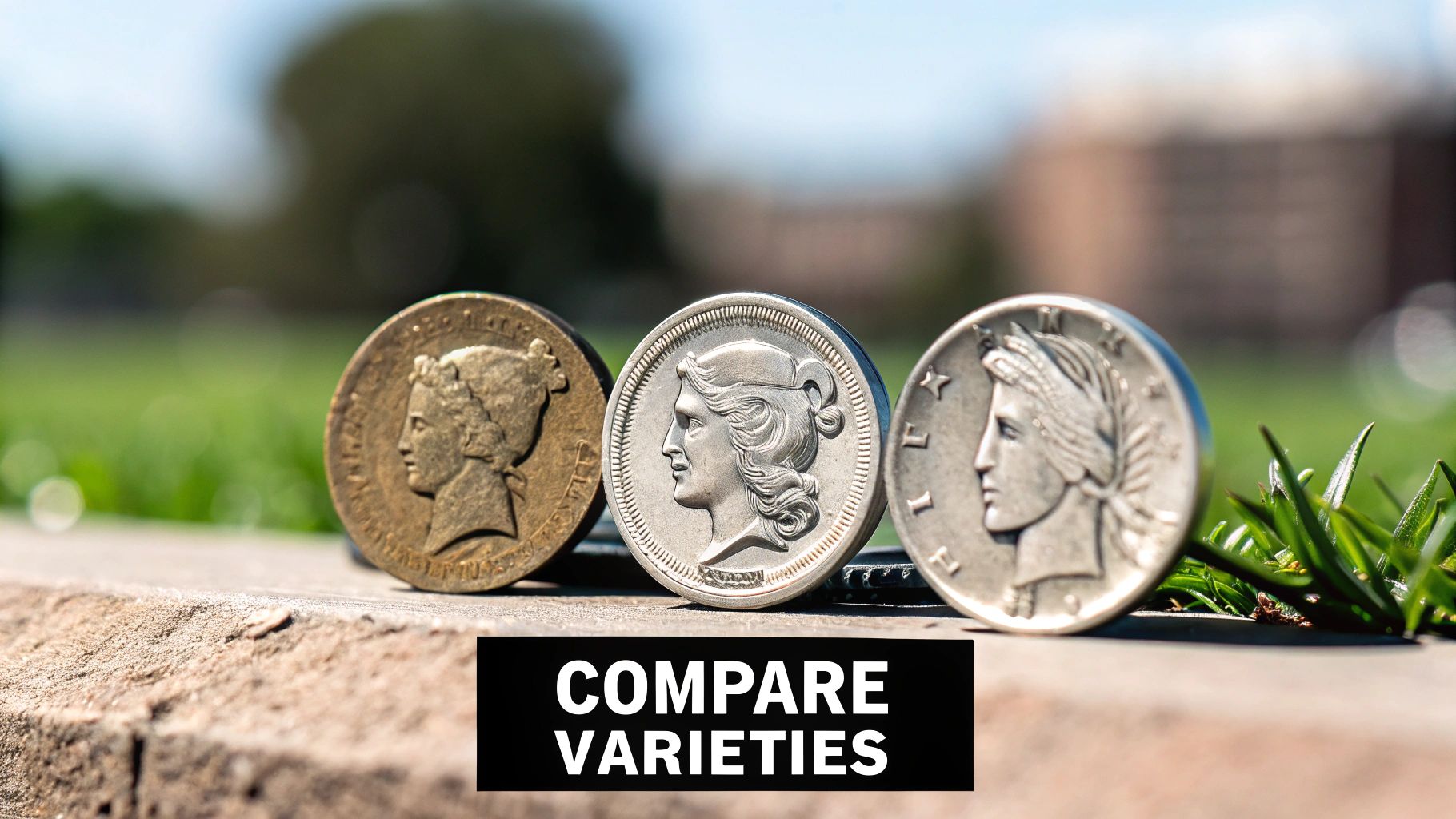
Each mint had different production numbers and even varied in the quality of their strikes. This created unique collecting profiles for what is otherwise the same coin design. Pinpointing which one you're holding is the final piece of the puzzle before getting it professionally looked at.
The Common King: 1920 Philadelphia (No Mint Mark)
The Philadelphia Mint was the workhorse of the U.S. Mint system, and 1920 was no exception. They churned out a staggering 59,030,000 of these dimes. You'll know it's from Philly because it has no mint mark, and they are, by far, the most common version you'll come across.
Because there are so many of them, the value for a well-circulated 1920 (P) dime is mostly tied to its silver content. But don't write them off just yet! The story completely changes once you get into the higher, uncirculated grades. A pristine example with a crisp, sharp strike can still fetch a respectable premium from collectors trying to build a top-tier set.
The Deceptive Denver: 1920-D
The 1920-D Mercury Dime from the Denver Mint is a fascinating one. At first glance, its mintage of 19,171,000 coins seems pretty high, making it far more common than the San Francisco issue. But here's the catch: the Denver Mint had a reputation for inconsistent strike quality that year.
This means finding a well-struck 1920-D, especially one with coveted Full Bands, is a whole lot harder than the production numbers might suggest. As a result, the value of a 1920-D can skyrocket in higher grades, often blowing past its rarer San Francisco sibling when in gem condition.
The Scarce Survivor: 1920-S
With the lowest mintage of the year at just 13,820,000 coins, the 1920-S Mercury Dime from San Francisco is the scarcest of the bunch. This built-in rarity gives it a higher base value across all grades compared to the dime from Philly. The San Francisco mint also tended to produce coins with strong, clear details, which makes well-preserved examples especially attractive to collectors.
For collectors, the 1920-S is a key target. Its lower mintage and solid strike quality create a perfect storm of scarcity and eye appeal, making it a prized possession in any condition.
No matter which 1920 dime you have, the only way to know its true market value is to have it professionally evaluated. You can save the hassle and sell locally for more than online shipments by visiting us at the shop. We specialize in Gold and Jewelry Buying and are committed to offering the highest payout in Boise.
Our experts provide free Xray Scanning and Gold Testing for hassle-free offers, and we'll even price match to ensure you get the absolute best deal. Beyond just this one coin, learning good coin collection management strategies will help you preserve and organize all your valuable pieces for the future.
Get the Highest Payout for Your Coins in Boise
Once you have a good idea of what your 1920 Mercury dime might be worth, the next big question is: where do you sell it? It’s tempting to look at online marketplaces or mail-in services. They seem easy, right? But that convenience can come at a cost.
You’re suddenly dealing with shipping risks, insurance costs, and then the long wait for your money. Worst of all, you're often at the mercy of a faceless buyer who might throw out a lowball offer, knowing you've already gone through the trouble of sending your coin in.
Why put yourself through that headache? Selling your coin to a trusted local expert is a much cleaner, safer, and often more profitable experience. When you cut out the middlemen and their hidden fees, you can often sell locally for more than online shipments.
Your Trusted Boise Coin and Jewelry Experts
Here at Carat 24, we specialize in Gold and Jewelry Buying, and we’ve built our reputation in Boise by giving people a reliable place to sell their valuables. We get it—every coin has a story and a real value. Our entire process is built around trust and making sure you see exactly what we see.
We offer completely free, hassle-free offers with zero pressure to sell. To give you total peace of mind, we use state-of-the-art, non-damaging Xray Scanning and Gold Testing for free. This isn't some backroom acid test; it's advanced technology that lets us verify your coin's exact makeup and authenticity without leaving a single scratch.
Our promise is simple: we provide the highest payout in Boise for your coins, gold, and jewelry. We're so confident in our offers that we have a Price Matching guarantee, ensuring you always walk away with the best possible price for your items.
Getting the most for your collectibles, whether they're coins or other fine items, really comes down to understanding the market and working with buyers who have a solid reputation. The same principles apply across the board, a point driven home in this excellent guide on how to sell luxury watches for maximum value. The core strategies for getting a top-dollar payout are universal.
Before you decide, we also recommend checking out our expert guide on how to sell silver coins for more tips on making the process smooth and profitable. Come visit us today and see what a professional, transparent, and rewarding selling experience feels like.
Got Questions About Your 1920 Mercury Dime?
Even with a century of history behind it, the 1920 Mercury dime still sparks a lot of questions. If you're holding one in your hand, you're probably wondering about a few key things. Let's clear up some of the most common curiosities.
How Can I Tell If My 1920 Mercury Dime Is Real?
You can start with a few simple at-home checks. A genuine 1920 Mercury dime is made of 90% silver, weighs 2.5 grams, and won't stick to a magnet. The details on Liberty's portrait and the lettering should also look crisp and consistent for its age.
But for a 100% guarantee, an expert eye is your best bet. Here at our Boise shop, we offer free, non-destructive Xray Scanning and Gold Testing. It’s a surefire way to verify your coin's composition without causing any damage.
Is It Worth Getting My 1920 Dime Professionally Graded?
Honestly, for most circulated 1920 dimes, the answer is probably no. The cost of sending a coin to a top-tier service like PCGS or NGC can easily be more than the coin is worth. Grading is usually reserved for pristine, uncirculated coins—especially those that look like they might qualify for the valuable Full Bands (FB) designation.
A much smarter first move is to get a professional appraisal. We provide hassle-free offers and can tell you right away if spending money on grading makes any financial sense for your specific coin.
Getting an expert opinion locally can save you hundreds in unnecessary grading fees. A trusted buyer can quickly assess a coin's potential and tell you if it's a candidate for certification.
What Makes the "Full Bands" Designation So Valuable?
On the back of the dime, you'll see a bundle of rods (a "fasces") held together by three horizontal bands. The "Full Bands" or "FB" designation is only given to a coin where those bands were struck so perfectly that you can see a clear, complete separation between all three.
This sounds simple, but it’s incredibly rare. Many Mercury dimes, even ones that never saw a day in circulation, came from weak strikes that left the bands looking mushy or merged together. Finding an example with that perfect, razor-sharp detail is what collectors dream of, and they're willing to pay a massive premium for that sign of a flawless strike.
Ready to uncover the true value of your coins and jewelry? At Carat 24 - Trusted Gold Experts, we specialize in Gold and Jewelry Buying, and we are committed to providing the highest payout in Boise. Save the hassle and sell locally for more than online shipments. Visit us for a free, transparent evaluation with a Price Matching guarantee. Find out more at https://carat24boise.com.
