
That old quarter jingling in your pocket or sitting in a forgotten jar could be worth a whole lot more than just 25 cents. The secret is in the date. If it was minted in 1964 or earlier, you're holding a piece of history made from 90% silver, tying its value directly to the precious metals market. Any quarter you find with a date after 1964 is a standard copper-nickel blend, worth only its face value.
The Hidden Treasure in Your Spare Change
It’s easy to forget, but for decades, the coins we handled every day were made of precious metals. This created a direct link between our currency and tangible wealth. By the early 1960s, though, silver prices were climbing so high that the metal inside a quarter was actually worth more than the coin itself. This simple economic reality forced a major shift in U.S. coinage.
The Coinage Act of 1965 officially pulled silver from our circulating dimes and quarters. In an instant, this transformed all pre-1965 silver quarters from everyday money into miniature silver bars. Today, their value isn't based on what they can buy at the store, but on their intrinsic silver content.
Why Are Silver Quarters So Hard to Find?
You might be thinking, "If so many were made, why don't I find them in my change?" The answer is simple: people who knew their real worth pulled them from circulation almost as soon as the new copper-nickel coins appeared.
This is a classic example of Gresham's Law, an economic principle stating that "bad money drives out good." The less valuable copper-nickel coins kept circulating, while the valuable silver ones vanished into private collections and hoards.
The U.S. Mint produced around 3.77 billion silver Washington quarters between 1932 and 1964, but they have become incredibly rare in daily transactions. Your odds of finding one in circulation are now less than 5%, because they were systematically plucked out decades ago.
This scarcity is exactly what makes finding one so exciting. Whether you're a seasoned investor or just starting out, understanding this history is the first step. For those new to this fascinating world, it helps to get the basics down first. You can explore our guide on how to start your coin collecting hobby to build a solid foundation.
Selling Your Silver Quarters in Boise
If you happen to uncover a stash of these silver coins, you're sitting on a valuable asset. The best way to get their full value is to work with a trusted local expert right here in Boise. Save the hassle and sell locally for more than online shipments. A local specialist offers a secure, straightforward, and personal process.
At a reputable Gold and Jewelry Buying shop, you should expect:
- Hassle-free offers based on a transparent, professional evaluation.
- Free X-ray scanning and gold testing to confirm the authenticity of all your items.
- A guarantee of the highest payout in Boise, often with a price matching promise.
Selling locally means you avoid the headaches and often get a better price than mail-in services can offer. This guide will walk you through everything else you need to know about identifying and valuing your pre-1965 silver quarters.
Why Pre-1965 Quarters Are Worth Looking For
To really get why pre-1965 silver quarters are special, you have to completely ignore the "25 cents" stamped on them. Think of the face value as just the packaging. The real prize is what's inside: the coin's 90% silver composition. That’s the entire game-changer, separating a regular quarter from a tangible piece of precious metal.
Unlike the copper and nickel quarters we use today, a pre-1965 coin’s value is directly wired to the daily silver market. Its worth goes up and down with the global price of silver, making it a real, hold-in-your-hand asset. This is exactly why collectors and investors hunt for them—they aren’t just holding onto pocket change, but a small, measurable piece of a valuable commodity.
The Power of Intrinsic Value
The key concept here is intrinsic value—what the metal in the coin is actually worth. After 1964, the intrinsic value of a U.S. quarter basically dropped to zero. But for a silver quarter, the metal itself is worth many, many times its 25-cent face value.
This is where the term "junk silver" comes from. It sounds a little harsh, but in the industry, it's just a simple way to classify common-date silver coins that don't have any special collector rarity. Their value is based almost entirely on their silver content, which makes them a super popular and easy way for everyday people to start investing in precious metals.
Every one of these old pre-1965 quarters holds about 0.1808 troy ounces of pure silver. This all changed with the Coinage Act of 1965, when the government had to switch metals because the silver inside the coins was becoming worth more than the coins themselves.
Bullion vs. Numismatic Value: Knowing the Difference
While most pre-1965 quarters are valued for their silver (bullion), a small handful have a whole other layer of value: numismatic value. This is the fancy term for collector value. It applies to coins that are rare because of low mintage numbers, minting errors, or being in exceptionally pristine condition. These special coins are what collectors dream of finding and can be worth far more than their weight in silver.
Certain years and mint marks are incredibly hard to find, turning what looks like a standard silver quarter into a serious collector's item. Learning to spot these can make a huge difference in what you get paid. You can check out our guide on important coin key dates to see which ones to keep an eye out for.
If you think you've stumbled upon some of these rarer coins, the next move is to talk to a local expert. Forget the hassle and risk of shipping them off somewhere. When you sell locally in Boise, you can often get a better price. A trusted Gold and Jewelry Buying shop will give you hassle-free offers and uses technology like X-ray scanning and free gold testing to know exactly what you have. Find a buyer that offers Price Matching to guarantee you get the highest payout in Boise. It saves you the runaround and ensures you walk away with the true value for your silver treasures.
How to Spot a Silver Quarter in Seconds
You don’t need to be a seasoned coin expert to find treasure hiding in plain sight. With a few simple tricks, you can sift through a jar of change and instantly pick out the valuable silver quarters. Forget the fancy tools and magnifying glasses for a moment; these three methods are all you need to confidently identify pre-1965 silver quarters.
Each technique is dead simple, reliable, and can be done just about anywhere. By checking the date, glancing at the edge, and even listening to the coin’s ring, you'll be able to tell a common clad quarter from a valuable silver one in no time.
The Foolproof Date Check
The first and most obvious giveaway is the date stamped right on the coin. This is the easiest test of all.
Just look at the year on the front (the "obverse") of the Washington quarter. If that date is 1964 or earlier, you're holding a coin made of 90% silver. If the date is 1965 or any year after, it's just a standard copper-nickel clad quarter with no precious metal value.
A common point of confusion is whether 1965 quarters might contain some silver during the transition. The answer is a hard no. The U.S. Mint made a clean break; any quarter dated 1965 or newer is guaranteed to be a non-silver coin.
The Revealing Edge Test
But what if the date is worn down or unreadable? The next method is just as reliable and takes only a second. Grab any quarter made after 1964 for a quick comparison and look at both coins from the side.
- Silver Quarter Edge: A pre-1965 silver quarter has a solid, uniform silver or grayish-white stripe running along its entire edge. No other colors, just solid silver.
- Clad Quarter Edge: A modern clad quarter shows a distinct, layered look. You’ll see a reddish-brown copper stripe sandwiched between two nickel-silver layers.
This visual difference is unmistakable once you see it. That copper core in modern quarters is a dead giveaway, while the solid silver edge confirms you've found the real deal.
The Distinctive Sound Test
For a final, satisfying confirmation, you can use your ears. For centuries, people who handle precious metals have used the "ping test" because silver coins produce a sound that is strikingly different from their clad cousins.
Balance a coin on the tip of your finger and gently tap it with another coin. A pre-1965 silver quarter will sing with a high-pitched, resonant, almost bell-like "ping" that rings for a second or two. By contrast, a modern clad quarter just makes a dull, lower-pitched "thud" with almost no ring at all. The difference is surprisingly clear.
Silver Quarter Identification Cheat Sheet
To make it even easier, here’s a quick reference guide to help you spot the difference at a glance.
| Feature | Pre-1965 Silver Quarter | Post-1964 Clad Quarter |
|---|---|---|
| Date | 1964 or earlier | 1965 or later |
| Edge Appearance | Solid silver or grayish-white stripe, no layers | Obvious copper stripe between two silver-colored layers |
| Sound When Tapped | High-pitched, bell-like "ping" that rings | Dull, low-pitched "thud" with no ring |
| Composition | 90% Silver, 10% Copper | 91.67% Copper, 8.33% Nickel |
Keep this cheat sheet in mind, and you'll be spotting silver quarters like a pro in no time.
Once you’ve separated out your silver quarters, the next step is understanding their full potential. While these identification tips are straightforward, you can find a more detailed walkthrough for discovering treasure among older coins in our specialized guide.
If you believe you have a collection of pre-1965 silver quarters and you're in Idaho, the best way to realize their full value is to bring them to a trusted specialist. A professional Gold and Jewelry Buying expert in Boise can provide a transparent and accurate assessment. You can save the hassle and sell locally for more than online shipments. Look for a buyer who offers free X-ray scanning and gold testing, providing hassle-free offers and a price matching guarantee to ensure you get the highest payout in Boise.
Calculating the Real Value of Your Quarters
So, you’ve sorted through your change and found some pre-1965 silver quarters. Now for the exciting part: finding out what they're actually worth. The value of these old coins isn't just a simple number; it splits into two different paths, and knowing which path your coin is on makes all the difference. You're looking at either melt value or numismatic value—and if you’re really lucky, you might have a coin that’s a star in both categories.
Most of the silver quarters you’ll come across are what we call "common date." Their value is tied directly to the precious metal they're made of. This is their melt value, or bullion value. Think of it as the coin’s raw, intrinsic worth. It’s the value of the silver, plain and simple.
Understanding Melt Value
Figuring out the melt value is surprisingly easy. You don't need any fancy equipment, just a little bit of math. The calculation hinges on the current market price of silver, which, as you know, changes daily.
Here’s the basic formula:
(Current Silver Spot Price) x 0.1808 x (Number of Quarters)
Each of these 90% silver quarters contains about 0.1808 troy ounces of pure silver. Just multiply that fixed amount by today's silver price, and you’ll have a solid estimate of your coin's base value. To stay on top of the numbers, you can check the daily spot price for silver and gold to keep your calculations sharp.
Beyond Bullion: The Hunt for Numismatic Value
While most silver quarters get their value from their silver content, a special few are worth far more to collectors. This is what's known as numismatic value. It’s a value based on rarity, condition, historical importance, and collector demand. A tiny detail, like a specific date or a small letter called a "mint mark," can transform a coin worth a few bucks into one worth hundreds, or even thousands.
The Washington quarter series is a perfect example. The U.S. Mint cranked out over 41 billion Washington quarters between 1932 and 1998, but only those struck up to 1964 have that precious silver content. Among them, the king is the 1932-S. With a mintage of only 408,000 coins, it's a true collector's prize.
This quick visual guide can help you figure out which path to go down with your quarters.
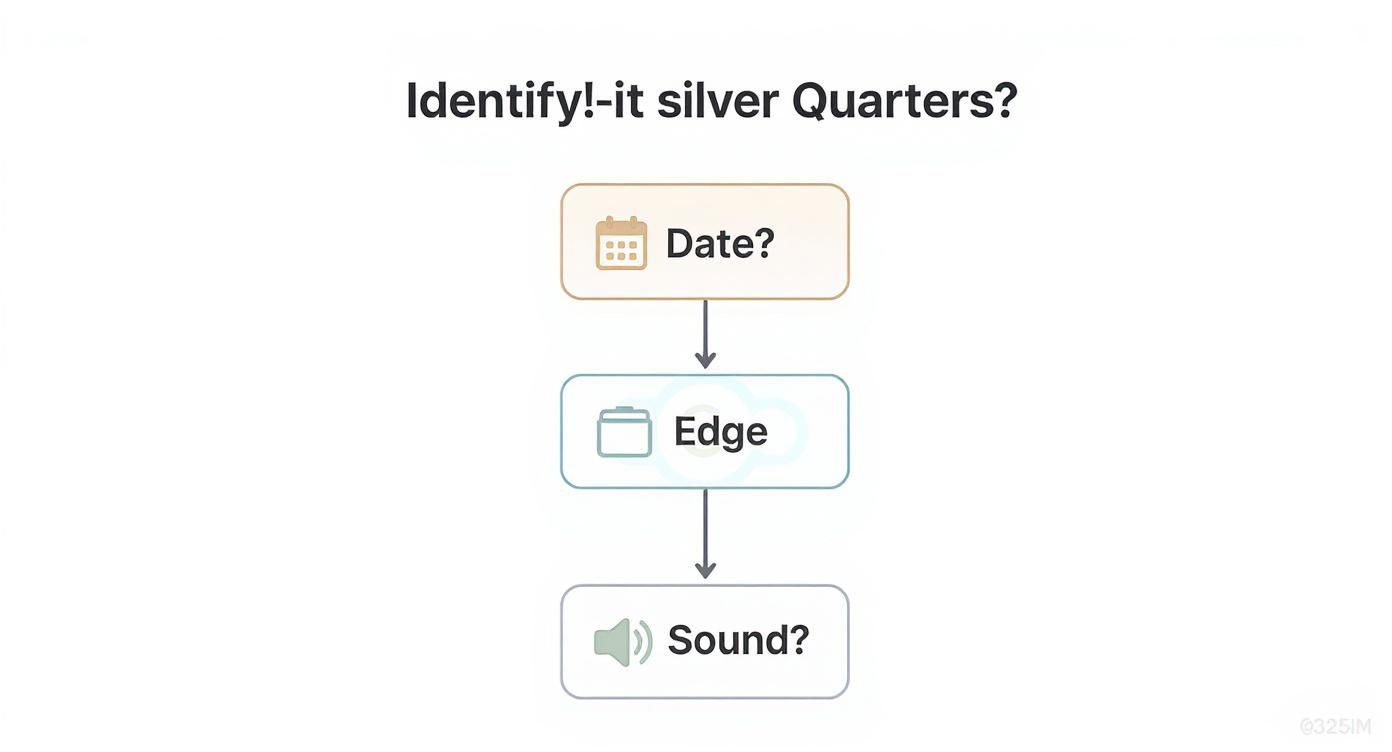
As you can see, checking the date, edge, and sound is just where the story begins. From there, you're either calculating melt value or diving into the world of collectibles.
Getting a Professional Appraisal in Boise
Telling the difference between a common silver coin and a rare collector's item can be tough for the untrained eye. This is where leaning on a professional really pays off. Instead of trying to guess, you can get a straight answer from someone you trust locally.
When you bring your coins to a specialist, you get more than just a price—you get certainty. An expert can instantly recognize key dates, mint marks, and subtle grading details that online calculators and guides might miss.
For the best and most accurate valuation, consider seeing a Gold and Jewelry Buying expert right here in Boise. You can save the hassle and sell locally for more than online shipments. A reputable buyer will give you a transparent evaluation, often with services like free X-ray scanning and gold testing to confirm exactly what you have. Look for someone who provides hassle-free offers and is willing to price match, ensuring you get the absolute highest payout in Boise for your silver treasures.
Getting the Highest Payout for Your Silver in Boise
So, you’ve sorted through your change and found a stash of silver quarters. That’s the fun part. The next step is turning that silver into cash, and how you go about it makes all the difference in what you walk away with.
Your choice of a buyer is just as important as finding the coins in the first place. Many people's first instinct is a pawn shop or one of those online mail-in services. While they seem convenient, they often come with real drawbacks. Pawn shops are generalists, not coin specialists, and their offers usually reflect that. As for online buyers? You’re dealing with the hassle and risk of shipping your valuables, long waits for payment, and a serious lack of transparency.
The Advantage of Selling Locally
There's a much better way, especially here in Boise. When you save the hassle and sell locally for more than online shipments, you're not just getting a better price—you're getting peace of mind.
The process is direct and personal. You get to speak face-to-face with an expert, ask questions, and see your coins evaluated right in front of you. It completely removes the guesswork and anxiety of sending your silver off to some unknown warehouse.
A dedicated Gold and Jewelry Buying specialist lives and breathes this stuff. They know the market inside and out and understand the subtle differences between simple melt value and a coin's numismatic premium. This is the kind of expertise that ensures you get a fair offer for your pre 1965 silver quarters, something a jack-of-all-trades buyer simply can't provide.
The key to a successful sale is finding a buyer who combines expertise with transparency. A reputable establishment should be willing to explain their valuation process step-by-step, ensuring you feel confident and informed throughout the entire transaction.
What to Look for in a Boise Buyer
To lock in the highest payout in Boise, you need to find a buyer who has built their reputation on trust and top-notch service. They aren't all the same. Here are the key things that signal you're dealing with a true professional.
- Free X-ray Scanning and Gold Testing: A serious buyer will use modern tech like an X-ray fluorescence (XRF) scanner to know exactly what's in your items without damaging them. This scientific precision guarantees you a fair assessment, and it should always be free.
- Hassle-Free Offers: The whole experience should be straightforward and low-pressure. An expert will look at your coins, explain what they see, and give you a clear, no-obligation offer. You should have all the time you need to decide.
- Price Matching Guarantee: A buyer who knows their pricing is competitive will gladly match or beat a legitimate written offer from someone else. This is their way of proving they're giving you the best deal in town.
Finding a buyer with these credentials makes selling your silver easy and profitable instead of stressful. If you want to dig deeper into the strategy of selling collectibles, our guide on how to sell collectible coins is a great next step.
Your Final Step to a Secure Transaction
At the end of the day, you want to work with someone who values your business and respects what you're selling. A local Boise expert provides a secure, professional setting for your transaction.
You walk in with your coins and walk out with payment. No shipping labels, no insurance headaches, no waiting by the mailbox for a check that might never come.
By choosing a local specialist in Gold and Jewelry Buying, you put their expertise to work for you. They have the trained eye to spot any quarters that might be worth more to a collector than they are melted down, ensuring no value gets left on the table. This mix of convenience, security, and expert valuation is why selling locally is the smartest move for Boise residents looking to get the maximum return for their silver treasures.
Safely Storing Your Silver Coin Collection
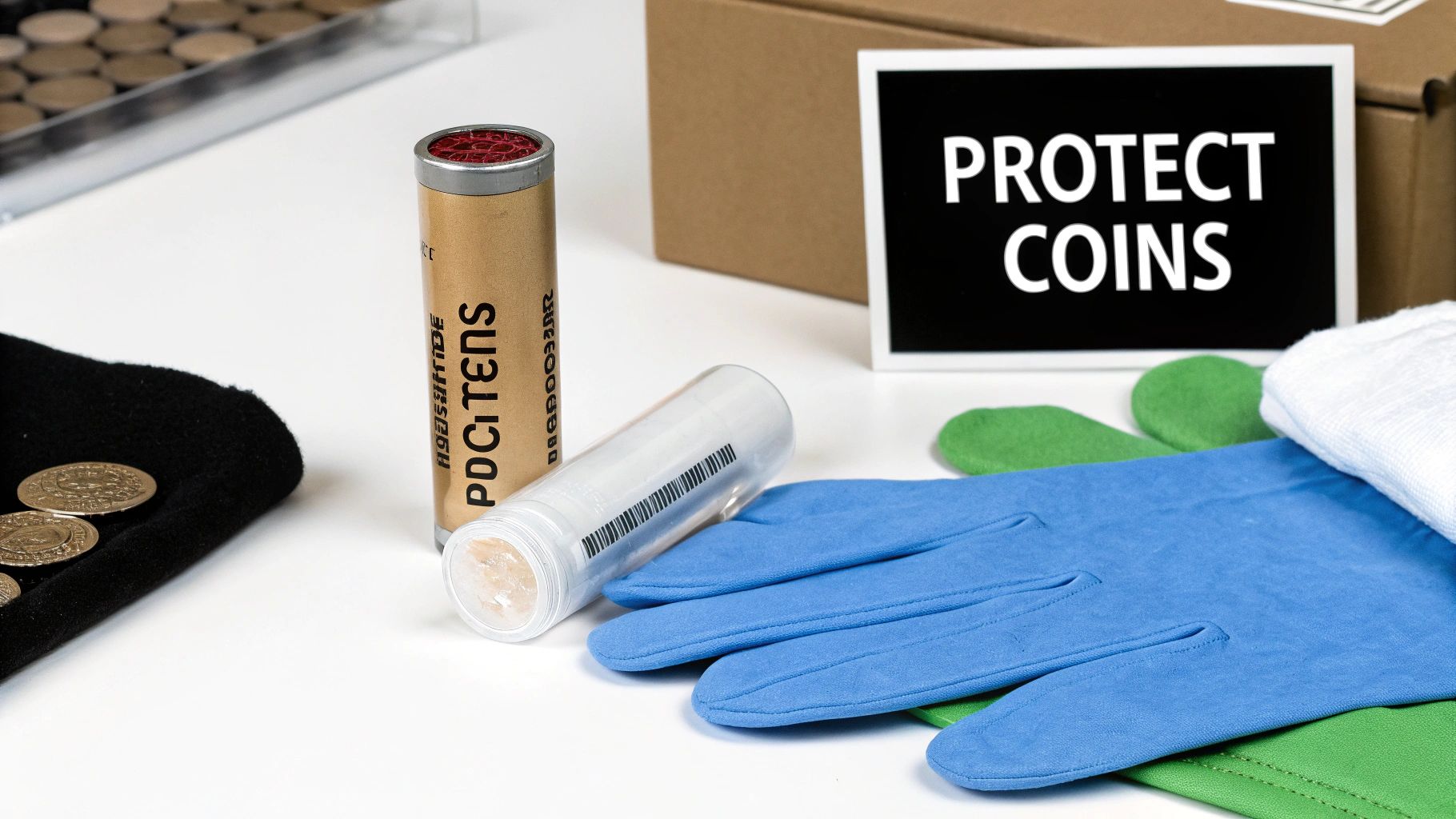
So, you've gone through the work of finding and evaluating your pre-1965 silver quarters. Now what? Maybe you see them as a long-term investment or just a fascinating link to the past. Either way, protecting their condition is absolutely critical to preserving their value. The good news is that proper storage isn't complicated or expensive, but it makes a world of difference.
The single biggest rule in coin collecting is tattooed on the brain of every seasoned numismatist: never, ever clean your coins. I know it's tempting to polish them up, but cleaning strips away the natural patina—the aged surface that collectors value—and leaves microscopic scratches. That one simple act can instantly gut a coin's numismatic worth, turning a potential collector's piece into something worth only its weight in silver.
Handling and Basic Protection
Your first line of defense is simply how you touch them. The oils and dirt on your fingertips can cause permanent blemishes over time. Get in the habit of holding your silver quarters by their edges, pinched between your thumb and forefinger. Never touch the face or the reverse.
For day-to-day storage, a few affordable options work wonders:
- Acid-Free Flips: These are the little 2x2 cardboard holders with clear plastic windows. They're perfect for individual coins, protecting them from scratches while letting you see both sides.
- Coin Tubes: If you've got a whole roll or a stack of silver quarters, plastic tubes are your best bet. They keep the coins neatly stacked and prevent them from rattling against each other.
Creating the Right Environment
Where you keep your coins is just as important as what you keep them in. Silver is reactive, and things like humidity and airborne chemicals can cause ugly toning or even corrosion.
Your goal is to create a stable environment. A cool, dry place is best—think a closet or a safe, not a damp basement or a sweltering attic. Big temperature swings can cause condensation, which is a coin’s worst enemy.
Taking these simple steps ensures your silver quarters will stay in great shape for years to come. This protects their potential value, whether you plan to pass them down as a family heirloom or eventually sell them.
And if you ever do decide to sell your collection, having well-preserved coins makes everything easier. When that time comes, remember to save the hassle and sell locally for more than online shipments. A trusted Gold and Jewelry Buying expert right here in Boise offers hassle-free offers. They use tools like free X-ray scanning and gold testing to show you exactly what your items are worth. Always look for a local buyer that offers price matching to guarantee you get the highest payout in Boise.
Got Questions? We’ve Got Answers.
As you get more familiar with pre-1965 quarters, a few common questions always seem to pop up. Let's tackle them head-on so you can move forward with confidence, whether you're holding onto your coins or thinking about selling.
Are All 1964 Quarters Made of Silver?
Yes, they absolutely are. Every single quarter stamped with the date 1964 is made of 90% silver and 10% copper.
The government drew a very clear line in the sand with the Coinage Act of 1965. There was no gray area or transition period. If your quarter says 1964, it's silver. If it says 1965 or anything later, it’s the copper-nickel clad version you find in your pocket today. This makes the date check your most foolproof tool.
How Much Is a Full Roll of Silver Quarters Worth?
A standard roll of quarters has 40 coins, for a face value of $10. But a roll of pre-1965 silver quarters is a whole different ballgame. Its real value is tied directly to the silver market.
Each of those quarters contains about 0.1808 troy ounces of pure silver. So, a full roll gives you roughly 7.23 troy ounces of silver (that's 40 x 0.1808 oz). To figure out its worth, you just multiply that number by the current spot price of silver. Keep in mind, this value changes daily along with the metals market.
Should I Sell My Quarters for Melt Value or to a Collector?
This is probably the most critical question you'll face, and the answer hinges entirely on what specific coins you're holding.
For the overwhelming majority of old silver quarters, their value is locked into their silver content. These are often called "common date" coins, and you're essentially selling a commodity. But for a small handful of key dates or coins in pristine condition, their value to a collector can soar far beyond their weight in silver.
Telling the difference can be nearly impossible without a trained eye. That’s why a professional appraisal is your safest bet. It ensures you don't accidentally let a rare, valuable coin go for its melt price. An expert can sort the common from the collectible in minutes.
If you’re in the Boise area, the best approach is to talk to a trusted local specialist. A local Gold and Jewelry Buying expert provides a secure, straightforward setting for this. You can save the hassle and sell locally for more than online shipments. Reputable buyers offer free X-ray scanning and gold testing to give you hassle-free offers. And to make sure you're getting top dollar, find a buyer who offers Price Matching to guarantee the highest payout in Boise.
At Carat 24 - Trusted Gold Experts, we offer transparent evaluations for your precious metals and coins. Visit us in Boise to receive a professional appraisal and a competitive, no-obligation offer for your silver quarters. Learn more about our services at https://carat24boise.com.
