
You found a Rolex in a drawer after a parent died, or you're staring at a listing that looks cheap next to the boutique price. The seller says the serial checks out. You still don't know whether the watch is original, whether the number on the tag is fair, or whether mailing it away is a mistake.
That pause is the right one. A pre-owned luxury watch can be a pleasure to wear and still keep some of what you paid. It is not a reliable investment, and a matching serial is not the whole story. Treat it the way you'd treat a used car. The badge matters, but so do the miles, the service book, and whether the parts still belong together.
What Counts as a Pre-Owned Luxury Watch
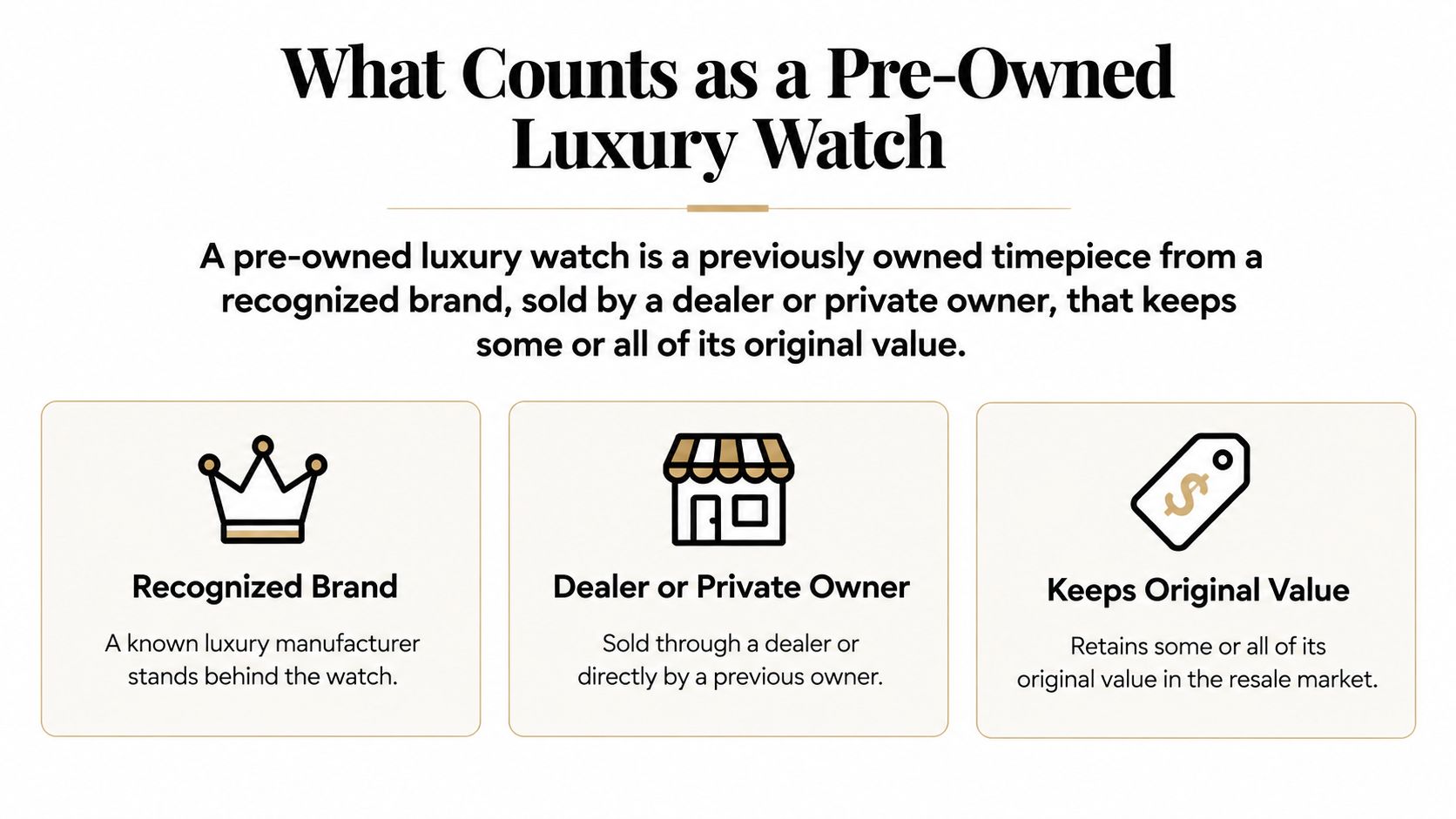
A pre-owned luxury watch is a previously owned timepiece from a recognized brand, sold by a dealer or private owner. Its price may hold, rise, or fall, depending on the model, condition, originality, and demand.
A new watch is like a new car from a dealership. A pre-owned watch is like a used car from a known make: its age and condition matter, and its badge alone does not set its value. A vintage watch is an older, often discontinued model, valued in part for its age and originality.
| Category | Typical age and condition | Paperwork usually | Typical buyer |
|---|---|---|---|
| New from authorised boutique | Current production, unworn | Full set with warranty | Buyers who want a current model and full warranty |
| Recent pre-owned | Recent references, worn or used | Box and papers vary | Buyers wanting retail savings on modern specifications |
| Vintage | Usually 20 or more years old, often discontinued | Often incomplete | Collectors who value age and originality |
Recent pre-owned models offer a way to look for modern specifications below retail, though paperwork may be complete or missing. Vintage watches call for a different lens: age and originality can matter more than a fresh polish.
Why the category is mainstream
Pre-owned watches are part of a growing market. A Polaris Market Research forecast estimated the global pre-owned luxury-watch market at about USD 11.94 billion in 2023 and USD 13.30 billion in 2024, projecting USD 32.05 billion by 2032. The forecast estimated an 11.6% compound annual growth rate from 2024 through 2032. These are industry estimates covering the United States, Europe, and Asia, not a government series.
Automatic watches made up about 69.5% of the global pre-owned luxury watch market in 2024, according to Market.us. That figure describes market value, not the share of listings. If a particular listing is quartz, check its description rather than assuming every luxury watch is automatic.
First checks on any listing
Before judging a watch from its photos, note four details:
- Brand and reference number: The reference identifies the model, much like a car's trim level.
- Serial number: Check whether it matches the case and papers, not only a number typed into the listing.
- Papers: Note whether the box, warranty card, or service records are included or clearly stated as missing.
- Return policy: Find out who accepts a return and how long you have if the watch does not match its description.
If the seller will not provide the reference, walk away. Without it, you cannot make a sound comparison.
Why Buying Used Makes Sense and Where It Falls Short
Used can be the smarter buy, and it can also be the expensive lesson. Hold both ideas at once.
What you gain
- A lower price than retail for the same reference, so your money buys the watch rather than the new-car premium.
- Discontinued models you can't order at a boutique anymore.
- A documented service history on some pieces, which is the closest thing to a Carfax for a watch.
Where it falls short
- No full manufacturer warranty on many pre-owned pieces. You may be buying the seller's short return window, or nothing.
- Wear that needs paid service. Dried oil and tired gaskets don't show up in a pretty photo.
- Undisclosed repairs and parts swaps. A genuine case with the wrong dial is still the wrong watch.
- A wide gap between the asking price and what you net after negotiation, service, insurance, and selling fees.
Buying used is now ordinary
Between 2020 and 2024, interest shifted from collectors-only to everyday buyers. Deloitte's 2024 Swiss Watch Industry Insights, drawn from surveys of more than 6,000 consumers from August 2020 through September 2024, found that the share likely to buy a pre-owned watch in the next year had doubled. Indifference toward pre-owned watches had nearly halved. The surveys covered Switzerland plus China, France, Germany, Hong Kong, India, Italy, Japan, Singapore, the United Arab Emirates, the United Kingdom, and the United States. Deloitte also noted that pre-owned growth still outpaced the primary market and could match it within ten years. That's a projection, not a promise.
It still isn't a savings account
High-end secondary prices are not a straight line up. The ChronoPulse watch index reported that high-end secondary-market prices fell an average of 3% in Q1 2025 and sat 23.9% below the March 2022 peak, even while the market was still up 24.5% over five years.
Practical rule: "Investment quality" belongs to a specific reference, not to a whole brand. Rarity, originality, documentation, condition, and current demand decide what you get back.
A common steel sports watch can lose money while a scarce, original piece holds up. Estate sellers get hurt when they price from 2022 peak asking prices instead of today's likely net.
Would you still enjoy wearing this watch if its resale value fell by 20%? If the answer is no, you're speculating. If the answer is yes, you're buying a pleasure with residual value. That's the honest frame.
How to Authenticate a Pre-Owned Watch Step by Step
A watch can arrive with a genuine serial number and still contain the wrong dial, hands, or movement. Like a used car, it needs a whole-vehicle inspection: one matching identifier cannot confirm that every part belongs. Box and papers can also come from a different watch, so check the piece itself and its records together.
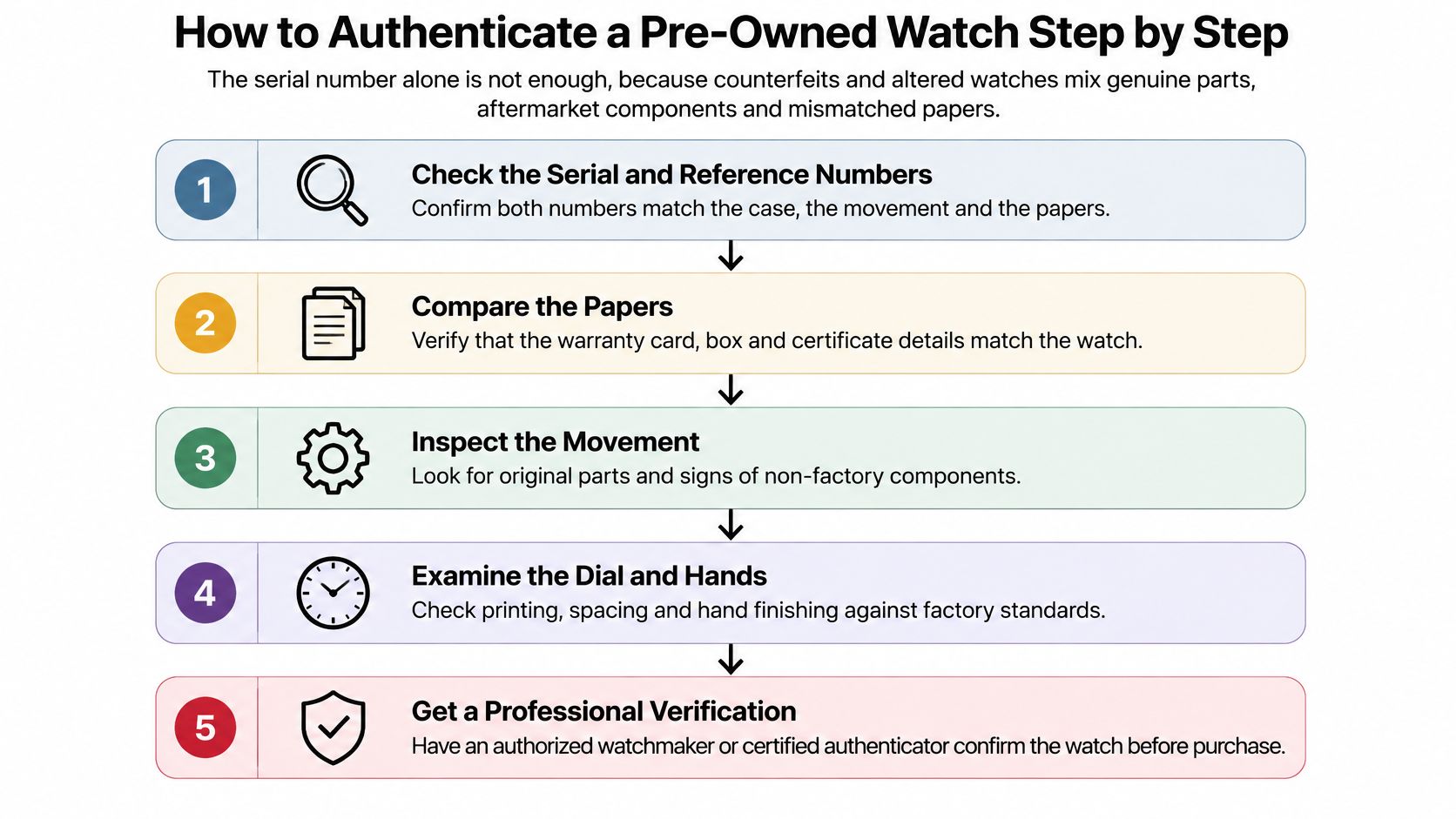
Work through these checks in order. Each one answers a different question about identity, originality, or condition.
- Match the reference, serial, and papers to the watch. The reference identifies the model; the serial should agree with the case and, where applicable, the movement. A printed card is one clue, not proof. Have the case opened by a qualified watchmaker when checking the movement engraving.
- Inspect the dial, hands, and indexes under magnification. Look for crisp printing, even spacing, and lume that appears consistent across the hands and markers. A photo may hide blurred lettering or a replacement hand whose lume differs from the rest.
- Check the bracelet, clasp, and links. Matching end links do not confirm that the entire bracelet is original. Stretch, mixed date codes, or a clasp made for another reference can affect both value and fit.
- Compare the case, crown, and caseback with examples of the same reference. Polishing can soften edges and lettering. A case that looks unusually sharp for its age may have been replaced, so ask about its history rather than treating sharpness as proof of originality.
- Confirm the movement caliber and inspect for signs of tampering. Scratched screw slots, a re-engraved caseback, or a caliber that does not match the model call for further investigation. Many watches need to be opened for this check. Looking through the crystal cannot reveal the movement in a solid-back case.
- Ask for a multi-position timing check. Compare the result with the specification for that watch in the next section. An unstable or poor rate can point to magnetism, old oil, worn pivots, beat error, or overdue service. It does not establish that the watch is counterfeit; a genuine movement can run poorly if it needs care.
- Check that the box and papers belong to this watch. Compare dates, reference, and serial details. A set assembled from separate watches can misrepresent the piece. A watch described candidly without its box is easier to assess than paperwork that does not match.
- Arrange an independent inspection before paying, and keep written notes. Use this watch authentication checklist to record what you checked and what remains uncertain. That record can help you ask the seller specific questions.
What you can see, and what you can't
Dial printing, hand shape, bracelet fit, and visible case damage are things you can assess visually. Internal finishing, correct movement parts, serial history, and brand-service records require more than a quick look. For a higher-value piece, arrange an in-person bench inspection and ask what the inspection covers.
Get the seller's responsibility for undisclosed alterations in writing before you pay. Brand paperwork may help, but it does not replace examining the watch itself. Authentication reduces uncertainty; it cannot promise that the watch will retain its value or avoid future service costs. A pre-owned watch is best bought for the pleasure of wearing it, with any resale value treated as a possible benefit rather than a guarantee.
Timing Accuracy and Fair Value Explained
A used watch is a pleasure purchase with some value left in it, not a dependable investment. Its timing specification gives you one way to judge how it runs, while its likely resale value depends on different factors. Like a used car, condition and maintenance matter more than a single number on a page.
| Standard | Allowed average rate | Testing basis | Apply it to |
|---|---|---|---|
| COSC chronometer | -4 to +6 seconds per day | 15-day ISO 3159 test, 5 positions, 3 temperatures | Any watch advertised as COSC-certified |
| Omega Master Chronometer, over 26 mm | 0 to +5 seconds per day | COSC plus eight METAS tests | Omega movements over 26 mm |
| Omega Master Chronometer, over 20 mm to 26 mm | 0 to +6 seconds per day | COSC plus eight METAS tests | Omega movements over 20 mm up to 26 mm |
| Omega Master Chronometer, up to 20 mm | 0 to +7 seconds per day | COSC plus eight METAS tests | Omega movements up to 20 mm |
Read the row that fits
COSC tests the uncased movement for 15 days under ISO 3159, in five positions and at three temperatures: 8°C, 23°C, and 38°C. The chronometer standard's average daily rate is -4 to +6 seconds per day. Testing also checks positional consistency, temperature response, and rate recovery. A single dial-up reading on a timing machine cannot establish that a watch passed the full test.
Omega's Master Chronometer specifications vary by movement size: 0 to +5 seconds per day over 26 mm, 0 to +6 from over 20 mm up to 26 mm, and 0 to +7 up to 20 mm. These watches first meet COSC requirements, then undergo eight METAS tests. A Master Chronometer running at +8 seconds per day falls outside its Omega rate range and COSC's -4 to +6 range as well.
Record the caliber, movement diameter, claimed certification, amplitude, beat error, and rates in dial-up, dial-down, crown-up, and crown-down positions. Compare the results with the row that matches the watch. Step 6 of the authentication check uses the same comparison. A poor result may point to service needs or magnetism rather than fraud, but a watch running outside its claimed standard still needs an explanation.
Asking price is not what you keep
Rarity, originality of parts, service history, box and papers, condition, and current buyer interest all affect an offer. The asking price starts a discussion. Your likely net is what remains after negotiation, authentication, servicing, insurance, and selling fees.
An insurance appraisal estimates replacement cost for a new item. A resale offer estimates what a buyer will pay for the used watch today. Those figures answer different questions, so they may be far apart.
This explanation of jewelry appraisal versus a resale offer describes why brand, condition, materials, authenticity, and demand affect resale. If you are pricing an inherited watch, an old forum screenshot or insurance schedule may not reflect what a buyer would offer now. Ask for a current written offer tied to the watch's reference. For a Rolex, begin with its reference and condition, then use this guide to what a Rolex is worth to understand the factors behind a valuation.
Red Flags That Should Stop a Deal
You meet a seller who says another buyer is on the way, but won't let you have the watch inspected. That pressure is a warning, not proof of fraud. Pause the deal until you can check the details without being rushed.
Seller
- Refuses inspection: You can't examine the watch or have a watchmaker inspect it.
- Pushes urgency: The seller pressures you to pay before you finish checking the watch.
- Blocks a second opinion: They won't share movement photos or give you time to consult someone.
- Offers no clear return policy: Ask what happens if the watch proves different from its description.
Price
- Far below the going price for that reference: Ask for a specific reason, such as missing papers or service due.
- Unusually cheap for a popular or discontinued model: A low price needs a credible explanation.
- Payment leaves no record: Cash without a receipt or a wire to a stranger can make it difficult to resolve a dispute.
Watch
- Serial and reference details conflict with the case, movement, or each other. A Rolex serial number lookup can help check one detail, but it cannot authenticate the whole watch.
- Dial text or lume looks wrong: Soft printing, unusual spacing, or hands that don't match deserve a closer look.
- Bracelet links are mixed or the clasp doesn't belong with that reference.
- The case appears heavily polished: Soft lettering may indicate that metal has been removed.
- The crown or caseback looks replaced or re-engraved.
Paperwork
- Papers don't match the serial.
- Warranty cards are undated or appear altered.
- The seller can't explain the documents or the watch's history.
One concern calls for a question. Several unresolved concerns are a good reason to walk away. Before paying, get the seller's responsibility in writing if the watch turns out not to have its original movement. A promise you can keep is more useful than a shrug.
Service Intervals and Resale Habits That Protect Value
A watch may still keep time while its seals or lubricants need attention. Oil can dry, gaskets can harden, and an old quartz battery can leak. Keep a service schedule instead of waiting until you plan to sell.
| Service item | Typical interval | Why it matters |
|---|---|---|
| Full mechanical service | Every 5 to 7 years | Replaces lubricants and gaskets and restores timing |
| Crown and gasket check | Every 2 to 3 years, or after water exposure | Helps keep moisture out of the case |
| Quartz battery replacement | Every 2 to 3 years | Reduces the risk of leakage damaging the movement |
| Bracelet and clasp inspection | Once a year | Finds worn links and loose pins early |
A full service can restore timing and seals, and the invoice gives a later buyer a record of the work. Ask the service shop for a quote, since cost depends on the brand and caliber. A vintage movement with scarce parts may cost more to service than a current three-hand watch.
Habits that keep the residual
- Keep the box, papers, tags, and any links you removed. Replacing missing pieces later can be difficult.
- Store the watch dry and away from magnets. Speakers, magnetic phone cases, and handbag clasps can affect a watch.
- Wind a mechanical watch on a steady rhythm if you wear it, so its oils circulate.
- Skip aggressive polishing. It can soften edges and fade engravings, reducing originality.
- Photograph every angle before you sell, including the caseback, clasp codes, and dial.
- Keep every service receipt with the watch, where a future buyer can find it.
A replacement dial or fresh set of hands can make a watch look newer, while reducing its originality and collector value. A clear service record is more useful than a glossy refinish. Buyers interested in collectible Rolex watches often value original parts, so keep records of any replacements or repairs. A pre-owned watch can be a pleasure to own with residual value, but service history and careful handling do not guarantee an investment return.
Choose a Trusted Local Seller in Boise Before You Sell
You bring a pre-owned watch to a Boise shop, hear an offer, and decide whether to accept. That is different from mailing it to an online buyer, where the final offer comes after the parcel arrives and is inspected. A local visit lets you keep the decision in your hands, though it does not guarantee a higher price.
| Factor | Sell locally in Boise | Sell online by shipping |
|---|---|---|
| Transit risk | You hand over the item in person | A parcel can be lost, damaged, or delayed |
| Offer timing | You can receive a written offer during the visit | The offer follows delivery and inspection |
| Comparing offers | Use the written offer to compare with another buyer | Shipping and insurance costs affect your net |
Carat 24 - Trusted Gold Experts, at 3780 W. State St. in Boise, buys gold, jewelry, and pre-owned watches. The shop offers free X-ray scanning and gold testing, written offers, and price matching. Ask what terms apply to a competing offer and what the evaluation covers. For a broader comparison of selling options, see this guide to where to sell luxury watches.
What the metal test actually tells you
X-ray fluorescence (XRF) measures the surface composition of precious metals without cutting or melting an item. Portable XRF instruments can provide a reading in a few seconds, expressed as a percentage, karat, or parts per million. For a seller, the practical point is that a quick scan can help identify the metal composition at the counter.
A surface reading does not guarantee the average purity throughout a piece. The Bureau of Indian Standards advises recognized assaying centers to test each piece by XRF and add a fire assay when a formal purity report is required. Ask whether a counter reading meets your needs or whether you require a formal report.
A watch's value also depends on more than its metal. Like a used car, it is a pleasure purchase first, with possible residual value later. Authentication should consider the whole watch, including its movement, case, dial, and components, rather than relying on a serial number alone. A local seller can explain what was examined and how that affects the offer.
Buyers may make different offers. Guidance for Idaho gold sellers recommends checking the current spot price and getting written quotes from two or three buyers. A written offer gives you a clear comparison point, whether you are considering an in-person sale or weighing the uncertainty of shipping.
- Bring the watch and its box, papers, and service records. Bring any gold or jewelry you want tested, too.
- Ask for the offer in writing. Compare it with another buyer's quote.
- Take time to decide. If you want a price match, ask which written competing offers qualify before accepting.
Frequently Asked Questions
Is a missing box or papers a dealbreaker? Usually not. They can affect resale value and the amount you receive, much like missing service records on a used car. Check the watch itself, including its movement and case, rather than relying on its accessories.
Does a pre-owned watch come with a warranty? Some do, but many do not. Get the return terms and any warranty in writing before you pay.
Should I service a watch before selling it? Consider service if it is due or the watch runs poorly. A recent, documented service can support your asking price. Paying for service just to freshen up the watch may not be recovered in the sale.
Is COSC certification the same as Master Chronometer? No. They use different tolerances. Check the watch's reference against the appropriate row in the timing table, rather than applying one timing limit to every watch.
Does a replacement dial or hands hurt value? Usually. A replacement part may make the watch look newer, but it reduces originality, which collectors may value.
How often should a pre-owned mechanical watch be serviced? The general guidance is a full service every 5 to 7 years, with a crown and gasket check every 2 to 3 years, or sooner after water exposure. Follow the watch's condition and service history, too.
For Boise buyers and sellers, Carat 24 - Trusted Gold Experts offers in-person gold testing and written offers. Bring the watch, box, papers, and service records so the offer can account for the complete piece. A pre-owned watch is best treated as something to enjoy, with possible resale value, not as a dependable investment.
