

Your grandmother's garnet ring is sitting on the kitchen table beside an old appraisal. You remember it on her hand, but the setting feels dated, and you can't picture wearing it yourself. Before asking what a new setting costs, ask a harder question: should this piece change at all?
Heirloom jewelry redesign can make inherited jewelry useful again. It can also erase the workmanship, marks, or family details that made the original worth keeping. A sound decision starts with what must survive, not with a sketch of what comes next.
Choosing Between Preserving, Redesigning and Selling
Preserve a wearable, historically meaningful piece if redesign would make it unrecognizable; consider redesign or sale when the materials matter more than the original form. That's a decision test, not a substitute for examining the ring.
Before repair, resizing, or redesign, identify the hallmarks, maker attribution, construction method, provenance, gemstone originality, and condition. Some inherited jewelry deserves preservation because its original form carries collectible or historical value, as this guidance on options for inherited jewelry explains.
Preserve, redesign or sell by situation
| Situation | Best Path | Why | Watch For |
|---|---|---|---|
| Signed maker, designer or antique piece | Preserve as is or sell intact | Original form may be worth more than its parts | Get an attribution check before any work |
| Plain gold ring, intact, no tie to its setting | Redesign | Metal and stones may be reused in a modern setting | Confirm karat mark and maker's mark first |
| Good stones, broken or worn original mount | Reset stones in a new mount | Keeps the gem and replaces damaged metal | Stone risk class decides whether it can move |
| Piece no one will wear, stones of good quality | Sell or trade in | Cash may serve the family better than an unused object | Compare a written local offer with shipping costs |
| Family wants to wear it but original must stay recoverable | Detachable or reversible design | Leaves the original usable later | Allow for added work and a secure bail or clasp |
The difference between dated and unimportant matters. A ring can look unfashionable while retaining distinctive construction or a documented connection to its maker. Don't authorize polishing away a mark or dismantling a setting before someone has assessed those details.
Equally, you don't have to preserve every component just because it belonged to someone you loved. If the family connection rests in the garnet, a safer, more wearable home for that stone may respect the memory better than leaving the ring untouched.
Try a reversible change first
Ask whether a detachable pendant bail, removable attachment, or temporary restyle could meet your needs. If loose family stones are available, using those while keeping the original mounting intact may avoid an unnecessary sacrifice.
Practical rule: Decide what you're unwilling to lose before discussing what you'd like to add.
Reversibility needs a written explanation. Ask which original parts remain untouched, which attachments can be removed, and whether undoing the work would leave visible changes. “We can put it back” isn't precise enough for a family object.
How to Assess an Heirloom Before Any Cutting
A grandmother's ring lands on the bench, and the question that matters comes before design or price: should the piece be altered at all? A signed period mounting or a documented maker can be worth more intact than anything you would build from the parts, and cutting erases that option permanently. General guidance on resetting, resizing, and restoring heirloom rings makes the same point: record everything before anyone removes material.
The first task is straightforward. Document the piece before handling changes its condition.
Establish what the piece is worth untouched
Have the ring appraised before design talk starts. Maker's marks, signatures, original period construction, and provenance can push a piece into collectible territory, where intact condition drives the price and any alteration lowers it.
Ask which number the appraisal gives you. Insurance replacement value estimates what a comparable piece costs to buy at retail. An estate sale or a private buyer typically returns less, sometimes far less. Families who confuse the two figures authorize work based on money that was never there. This guide to getting jewelry appraised explains how to prepare for that appointment. Keep the condition record separate from assumptions about what a buyer might pay.
Build the intake record
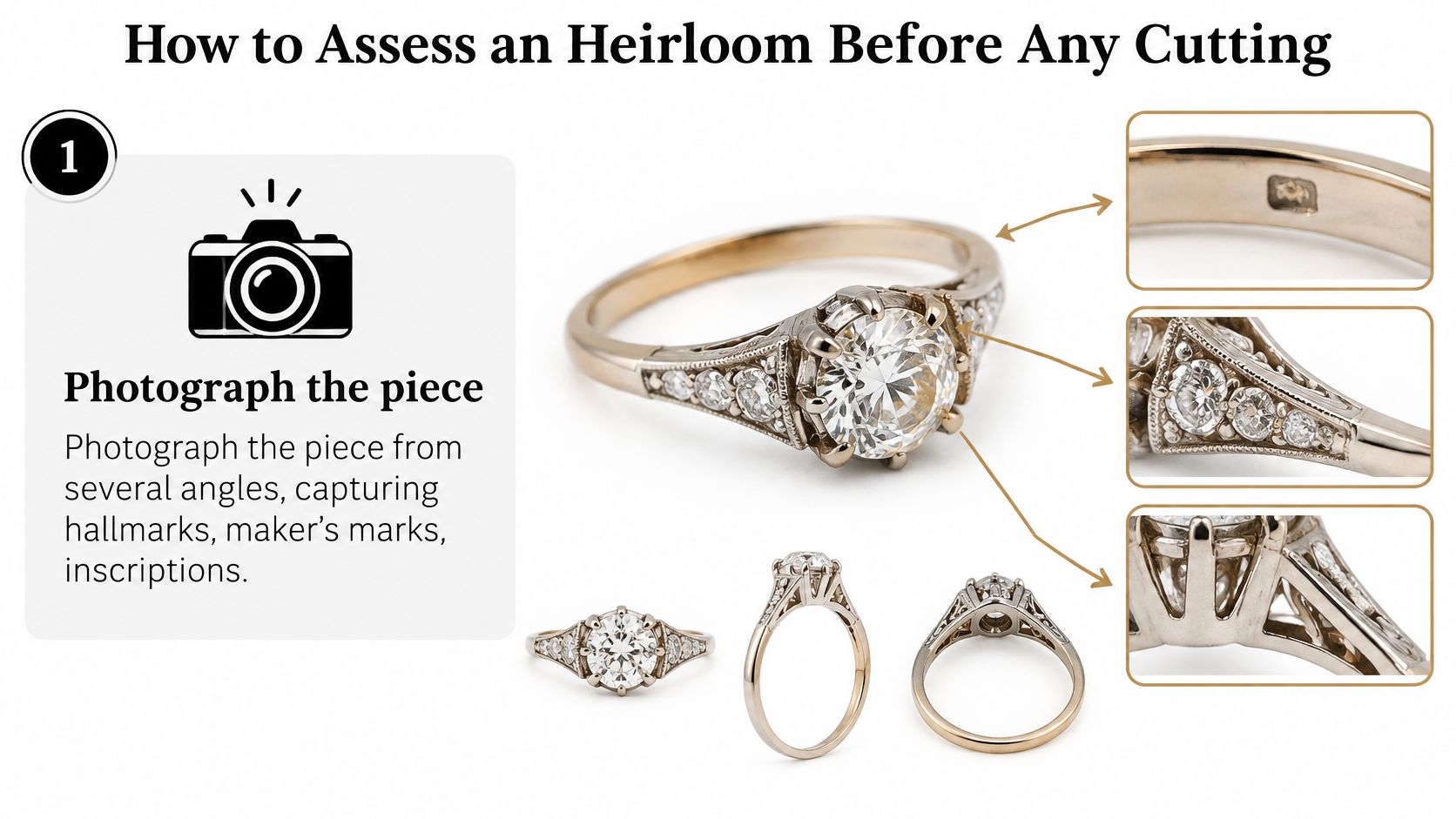
- Photograph the piece. Capture several angles, hallmarks, maker's marks, inscriptions, serial numbers, and repair seams. These images preserve evidence that work might obscure.
- Write down its identity. Record dimensions, metal marks, provenance, and known repairs together. Add family history, but separate remembered stories from receipts or other documentation.
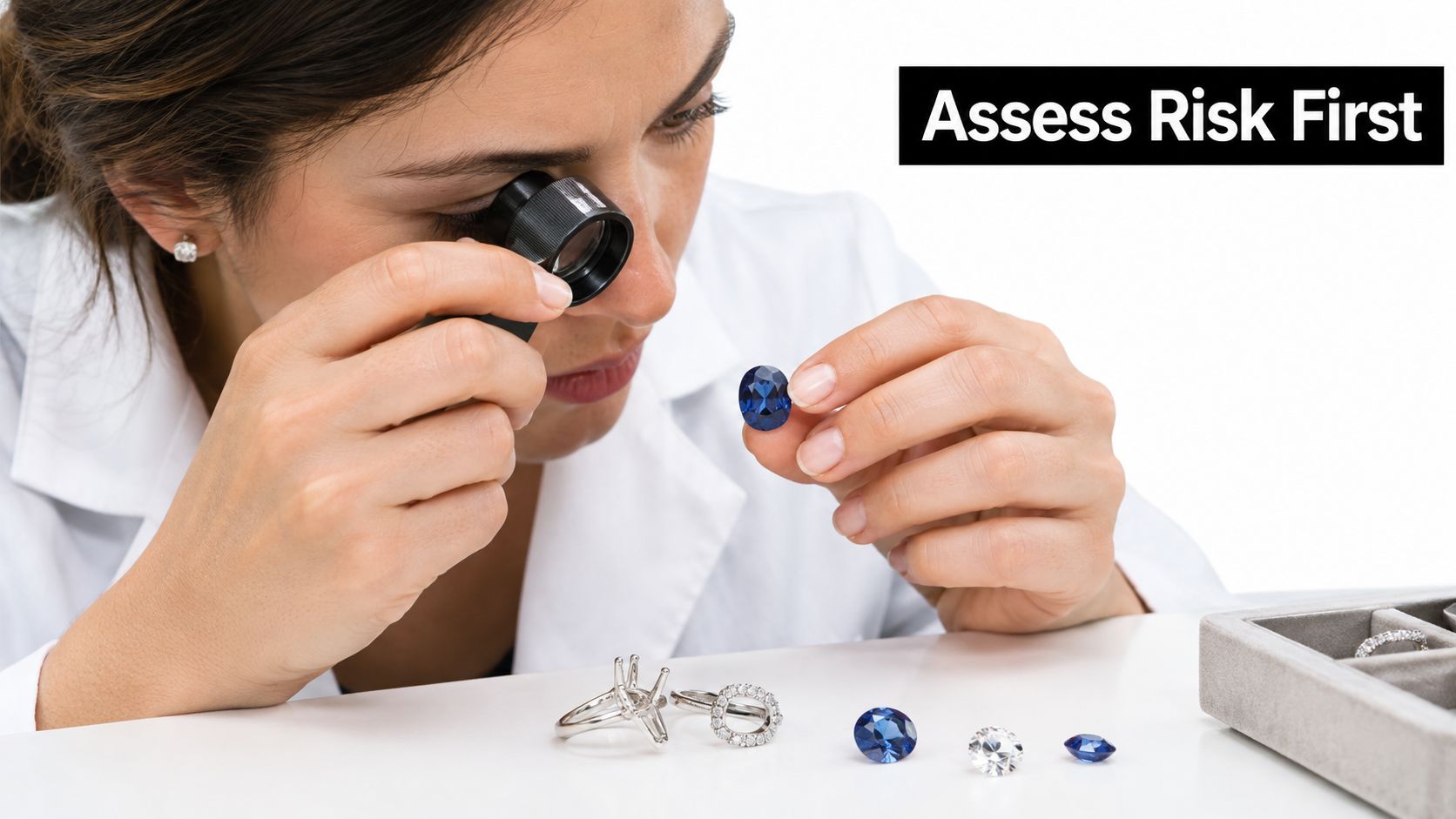
- Inspect every gemstone under magnification. The jeweler should map chips, abrasions, surface-reaching fractures, possible treatments, and cleavage-sensitive orientations. A beautiful face-up view does not prove a stone is safe to remove.
- Choose restoration, resetting, or redesign. Make this decision after inspection, not before it. The condition report may rule out the design you initially wanted.
- Review a dimensioned drawing. Examine a wax or digital prototype when one is available. Confirm the proportions and how the finished piece will sit rather than approving only a decorative illustration.
- Authorize irreversible work in writing. Approval should come before cutting, melting, or moving stones. State which components will be retained, returned, altered, or credited toward the project.
- Document the finished setting. Keep completion photographs, an itemized work record, and updated care instructions. The finished file should explain what changed and what remains original.
This order matters because disassembly can expose damage nobody saw coming. Cutting removes metal permanently, hides identifying marks, and can make the original mounting unrecoverable.
Choose an anchor, not a preservation wish list
Select one primary feature to protect: the center stone, an engraving, a distinctive proportion, or a family symbol. Trying to retain every worn component produces a design that is neither secure nor comfortable.
Ask what "reusing your gold" means in the estimate. Will the actual metal remain in the finished piece, be alloyed, or receive a credit toward different metal? Those outcomes are not emotionally interchangeable, even when the financial treatment seems reasonable.
Understand the limits of a scan
X-ray fluorescence, or XRF, screens surface composition rather than proving what the whole object is made of. This explanation of XRF gold testing describes how the method works and where it falls short: coatings, accumulated grime, curved surfaces, and plated areas can all distort a reading.
A free scan is useful screening. Weigh it alongside hallmarks and construction, and never treat it as permission to melt an heirloom.
Matching a New Setting to Each Gemstone's Risk
Classify the proposed work as low, conditional, or unacceptable risk before applying heat, pressure, vibration, or cleaning chemicals. These classes describe the stone and the procedure together. They aren't permanent labels attached to every example of a gemstone.
Magnification is where a practical setting decision begins.
Gemstone risk class and setting rules
The following screening rules reflect stone-specific risks in heirloom redesign. The final classification requires examination of the actual stone.
| Gemstone | Risk Class | Suitable Setting | Cleaning Rule |
|---|---|---|---|
| Diamond | Low to conditional; surface feathers can spread under pressure | Prong or bezel after fracture mapping | Approve cleaning individually; protect fractures and fillings |
| Sapphire | Low to conditional | Prongs with a checked girdle; consider a bezel if chipped | Gentle cleaning; no heat on fracture-filled stones |
| Emerald | Conditional; heat or aggressive cleaning may be unacceptable with oil or resin | Deep bezel or another protective design, if setting pressure is acceptable | No ultrasonic, steam, or solvents |
| Opal | Conditional; vulnerable to thermal shock | Protective bezel where feasible, with controlled handling | No steam; avoid sudden temperature changes |
| Pearl | Conditional; soft and vulnerable to ultrasonic cleaning | Assess a pin or wire design without damaging stress | Soft-cloth care; no ultrasonic |
| Any fracture-filled or treated stone | Reheating may be unacceptable | Reset only after assessing treatment stability and removal risk | Written treatment-specific, no-heat protocol |
Diamonds and sapphires generally tolerate routine bench work better than fragile or treated materials. That doesn't make every inherited diamond safe: prong pressure can worsen a surface-reaching feather, while heat can permanently damage a fracture-filled gem.
Emerald treatments require particular caution. Oil or resin can be altered by heat, solvents, steam, or ultrasonic cleaning. A design that demands those procedures may need to change, even if the finished sketch looks ideal.
A protective setting is useful only if the stone can safely survive being placed in it.
A deep bezel can shelter vulnerable edges, but it isn't an automatic solution. Setting pressure still matters. Exposed prongs may be inappropriate around a chipped girdle or vulnerable cleavage orientation; this guide to a bezel diamond engagement ring offers additional design context.
Let the object suggest the redesign
Not every redesign needs a newly made ring. Rapaport's account of the conversion jewelry market describes stick pins and small brooches becoming pendants, and watch fob chains becoming necklaces or double-wrap bracelets.
Those examples suggest a useful approach: change the function before replacing the whole object. A family chain might need a carefully considered clasp arrangement rather than complete reconstruction.
For an additional visual reference, watch the video below.
Measure the stone precisely and fit the setting to those dimensions, not to the nearest catalog description. There's no reliable industry-wide failure rate for heirloom stone removal or resetting. Ask for a stone-specific assessment and informed consent acknowledging that hidden damage may appear or worsen during removal.
Cost, Value and Timeline Estimates for Redesign
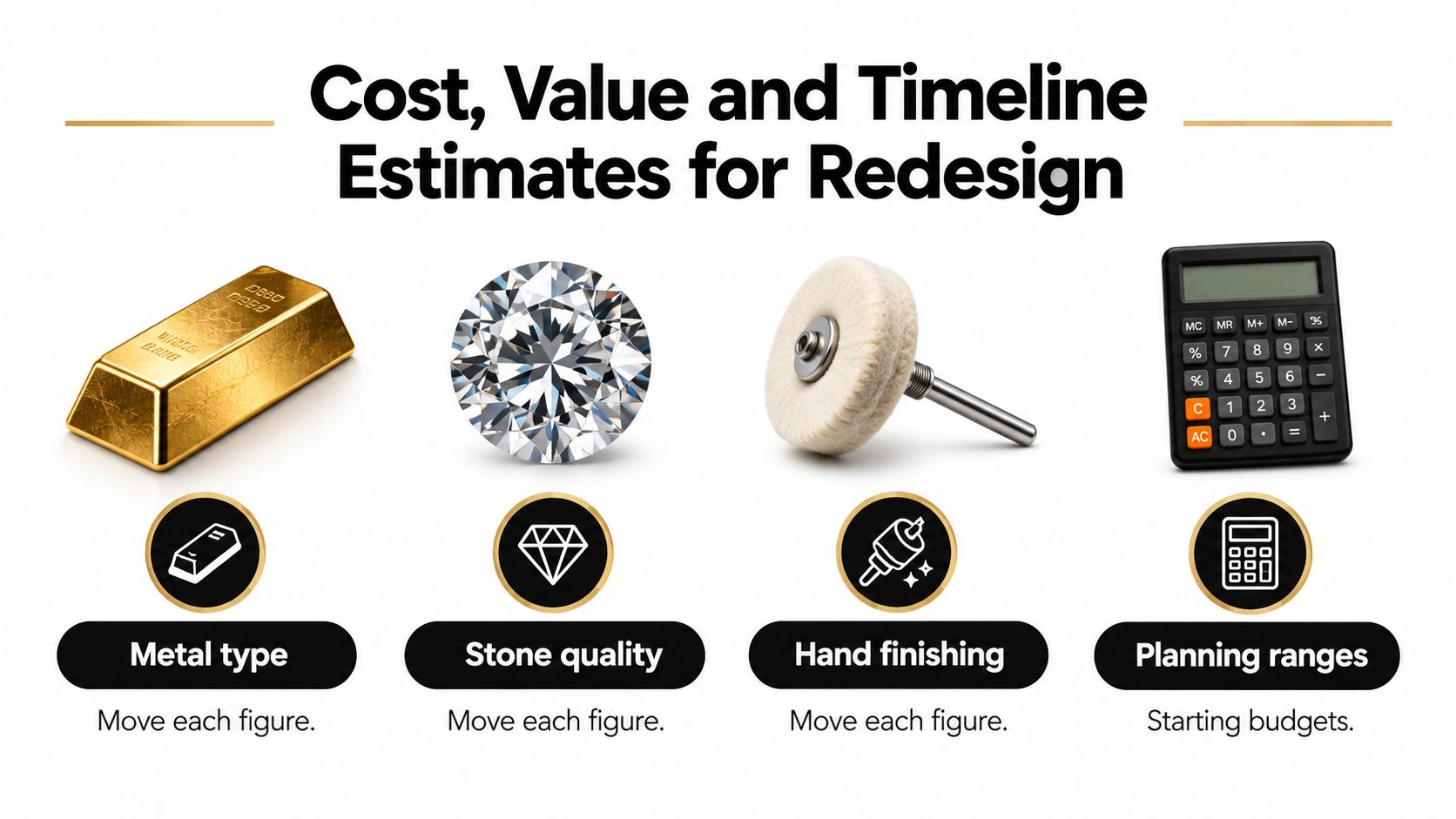
A written, item-specific quote is more useful than an unsupported price range. Metal choice, stone condition, added materials, prototype work, and hand finishing all belong in the discussion. Without a current Boise quote, neither a dollar figure nor a promised completion window should be treated as dependable.
Typical redesign costs and timelines
| Redesign Job | Typical Cost (USD) | Typical Timeline | Main Cost Driver |
|---|---|---|---|
| Ring resize, plain band | Written quote required | Confirm after inspection | Metal type and size change |
| Stone reset in existing mount | Written quote required | Depends on mount and stone assessment | Number of stones and prong work |
| Pendant or brooch conversion | Written quote required | Confirm after design approval | Added metal, bail and chain |
| Watch fob chain to bracelet | Written quote required | Depends on required alterations | Clasp, length and links needed |
| New custom setting for existing stone | Item-specific custom quote | Include prototype and approval stages | Design time, prototype and metal choice |
| Full redesign with new stones and metal | Itemized custom quote | Confirm sourcing and production stages | Stone quality, gold weight and hand finishing |
| Assessment and drawing before work | Confirm consultation and design fees | Ask when findings and drawings are due | Photos, magnification and prototype |
Use these categories to compare estimates, not just their totals. A lower quote may omit the chain, prototype, appraisal, or work needed after a stone is removed.
The budget factors below are qualitative, not measured cost comparisons.
Ask for a schedule that identifies inspection, design approval, material sourcing, bench work, and final review. Agree on what happens if a hidden defect changes the scope, rather than assuming the original completion date still applies. This jewelry repair cost guide can help frame the questions to bring to an estimate.
Separate replacement value from money you can receive
An insurance appraisal estimates retail replacement cost, not necessarily resale proceeds or estate value. An appraisal is also a time-specific assessment, so an old document can mislead a family deciding whether to sell, as this explanation of inherited jewelry valuation makes clear.
Use a deliberate sequence:
- Value the original. Establish what exists before its identity changes.
- Separate the redesign charges. Request labor, new materials, retained stones, and any material credits as distinct entries.
- Appraise the finished item. Make sure its description reflects the completed work.
- Confirm insurance treatment. Ask whether coverage follows the original item, the redesign, or scheduled components, and whether antique or sentimental value receives any recognition.
Value check: A higher replacement appraisal doesn't prove that redesign created a better investment.
For a Boise family dividing an estate, that distinction is essential. Don't assign one heir a replacement-value figure while another receives actual sale proceeds and assume the amounts represent equivalent cash.
Selling Heirloom Gold and Jewelry Locally in Boise
A family brings in a heavy gold bracelet that no one wears. Before anyone prices it as scrap, have the piece identified: karat, weight, maker's marks, stones, condition, and any sign of period workmanship. A signed mounting or antique clasp can carry value that disappears once it is cut, melted, or reset.
If nobody will wear it and no redesign plan has real support, sell it as a transaction. Keep the original appraisal for identification, then judge offers against likely sale proceeds and estate division needs, using the valuation distinction already covered.
Compare the complete transaction
Ask each buyer to put the same terms in writing:
- Net payment after every deduction.
- Weight, karat, and test method behind the offer.
- Construction: solid, hollow, alloyed, plated, or set with stones that must be removed.
- Payment timing and decline terms, including whether the piece is returned intact.
Gold plating differs from solid-karat gold. The FTC's jewelry guidance on gold descriptions separates gold throughout an alloy from a surface layer that can wear away, and prohibits misleading claims about gold content.
A local buyer such as Carat 24 can weigh and test the piece in front of you, but treat that number as one quote. Compare any shop's written offer against at least one competing quote before accepting.
Check local offers against shipment proceeds
A mail-in offer can look higher until shipping, insurance, platform fees, and return risk come out of it. A local offer can look lower until you count faster payment and no parcel leaving your hands. Compare net dollars, time to payment, and what happens if you say no.
Before you accept, get another local quote and prepare the collection with this guide to selling estate jewelry. Selling fits when the piece has no wearer, no collectible premium to protect, and no redesign outcome the family would keep.
Caring for a Redesigned Heirloom Piece
Care should follow the most vulnerable component, not the strongest one. A redesigned piece may combine materials with different cleaning limits, so keep the jeweler's written instructions close at hand.
Daily care
- Clean only as approved. Where suitable, use warm water, mild soap, and a soft brush, then dry with a lint-free cloth. Don't apply that routine automatically to treated or fragile gems.
- Follow cleaning exclusions. Keep vulnerable stones out of ultrasonic cleaners and steam, following the protocol established during assessment.
- Remove rings for demanding tasks. Take them off before gardening, sports, or work that could knock or stress the setting.
- Separate stored pieces. Use individual soft pouches or lined compartments. This guide to storing gold jewelry provides practical storage ideas.
Checks and records
- Agree on an inspection schedule. Ask the setter when the first follow-up and later checks should occur, based on the actual design.
- Respond to a knock. Stop wearing a piece that has taken an impact or feels different, and have the setting checked.
- Watch plated components. If plating wears, discuss replating or replacement rather than assuming polishing will restore it.
- Keep the project file. Store before-and-after photos, the itemized work record, appraisal, and care instructions together.
Add a short family note explaining why the redesign happened and which feature was preserved. The next owner shouldn't have to guess whether a new mounting contains an inherited stone or why the original engraving mattered.
Choosing a Boise Jeweler and Booking Your Assessment
Choose someone who can explain why a procedure is appropriate, rather than just promise that it can be done. A careful assessment may end with a recommendation to leave the piece intact. That's a useful result, even if you arrived expecting a redesign.
Bring your questions before the heirloom leaves your hands.
Ask how identity and responsibility are recorded
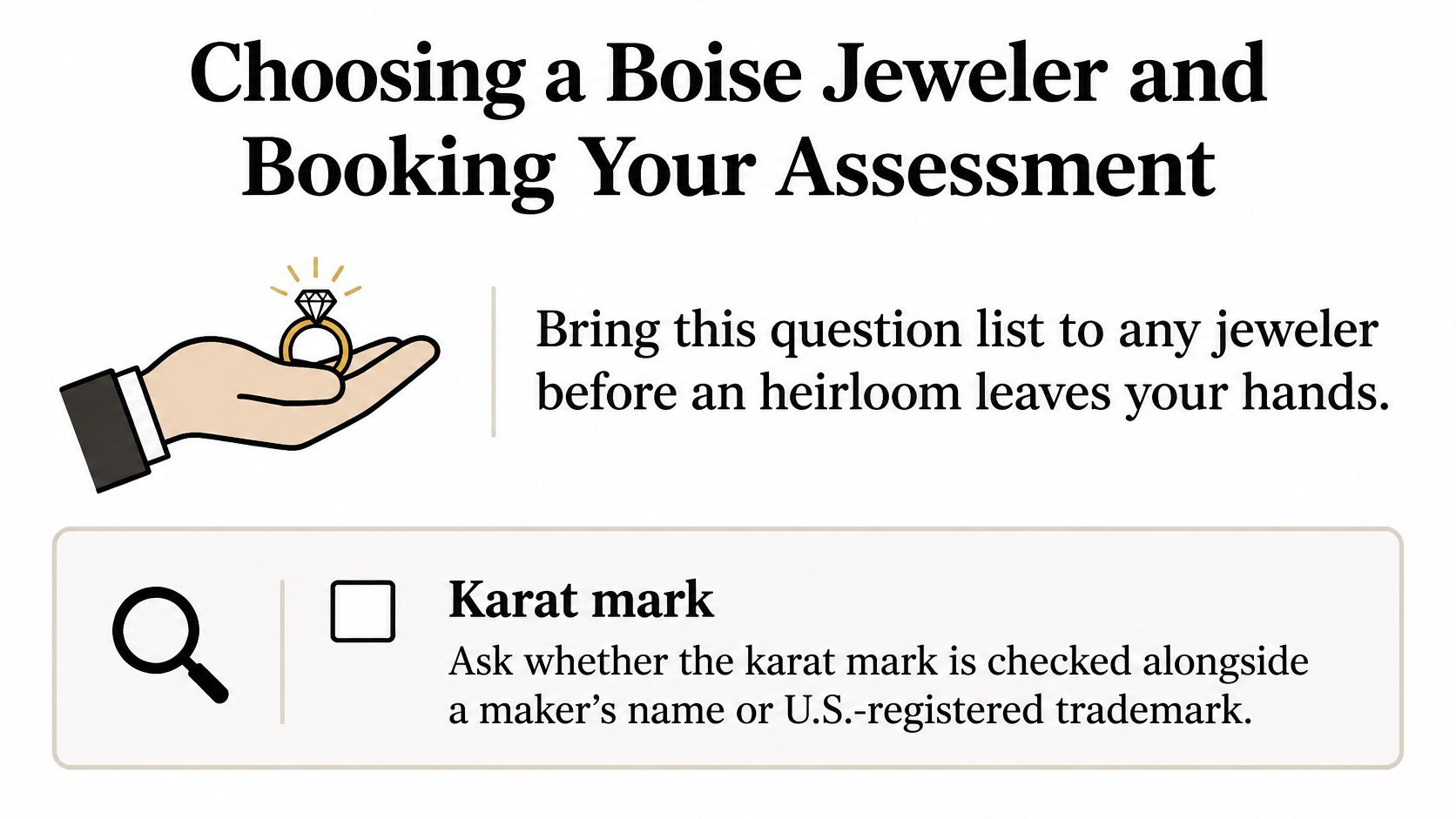
The FTC's guidance on gold jewelry markings explains that 24K represents 24 parts gold, while 14K contains 14 parts gold and 10 parts other metal. It also advises buyers to look for a maker's name or U.S.-registered trademark near the karat mark. A karat stamp alone doesn't identify who stands behind the claim.
Use these questions at the counter:
- Marks and testing. Will you check the maker's identification alongside the karat mark, and explain magnification and XRF findings?
- Fees and construction. Are the scan and gold test free, and how will you identify solid, hollow, alloyed, or plated construction?
- Design approval. Does the estimate include a dimensioned drawing, wax model, or digital prototype?
- Risk and consent. Who authorizes stone removal, and what happens if a hidden crack appears?
- Returned components. Who keeps the original mounting, removed metal, and unused stones?
- Records and timing. Will I receive intake photographs, an itemized estimate, and a stated schedule?
A paper file is acceptable if it's complete. For shops comparing recordkeeping systems, BenchKey's jewelry repair software is one resource to review; the customer's priority remains receiving an accessible record of the agreed work.
Prepare for the appointment this week
Carat 24, at 3780 W. State St., Boise, is one local option to verify. Its stated services include free X-ray scans and gold testing, an 8-step authentication process, buying offers, and price matching. Confirm which services apply to your particular assessment and whether any proposed redesign work requires a separate consultation.
Before booking:
- Gather the evidence. Bring photographs, receipts, prior appraisals, and a repair history.
- Name the anchor. Write down the feature you want preserved and whether your goal is daily wear, occasional wear, or inheritance.
- Request written terms. Compare the proposed work or sale offer with alternatives before authorizing irreversible changes.
Leave the appointment knowing what the piece is, what remains uncertain, and what you've agreed to. No stone should move merely because a design conversation went well.
Carat 24 - Trusted Gold Experts offers free X-ray scanning and gold testing to help you evaluate inherited jewelry before deciding whether to preserve, redesign, or sell. Bring your heirloom and its records to Carat 24 - Trusted Gold Experts, and request a written assessment or buying offer before committing to the next step.
