

You're standing in a Boise house that's been lived in for thirty years. The closets are full, the jewelry box is tangled, and your brother in Oregon is asking on the phone what's been sold and for how much. You don't need a same day cleanout. You need a calm order of operations, who has authority first, documentation second, and the right buyer for each kind of item third.
Why Boise Families Need an Estate Liquidation Service
Maybe your mother is moving to assisted living off State Street. Maybe your spouse has died and you're the executor, or your dad's house in the North End needs to be cleared before it can be listed. In each case, you're not really facing a garage sale problem. You're facing decades of belongings that have to be sorted fairly, valued accurately, and sold in a way other family members can later review.
A good estate liquidation service handles that inventory, valuation, and sale of personal property in an organized way. But don't treat it as one method for everything in the house. That's where families lose money and start arguments.
Volume Is Not the Same as Value
Furniture, kitchen goods, linens, and tools create the volume. They take trucks, labor, and time. Jewelry, gold, silver, bullion, watches, and luxury handbags create the risk. A small pouch can be worth more than a room of furniture, and it's the easiest thing to underprice when it's tossed into a general lot.
I've seen this pattern repeatedly. A daughter clears the house quickly to help, sells a box of mixed jewelry for a flat amount, and months later a sibling asks what happened to Mom's diamond ring. There's no photo, no weight, no written offer. Nobody meant harm, but nobody can prove what was there.
Practical rule: Slow down for anything small, shiny, branded, or boxed. Speed is fine for sofas. It's expensive for gold.
You're not alone in facing this. The 2020 Census count of 55.8 million people aged 65 and older, representing 16.8% of the population explains why downsizing and estate transitions are now routine family work. At the same time, Federal Reserve research on roughly 2 million households receiving an inheritance or substantial gift in an average year shows many estates are modest in cash but still full of personal property that must be handled carefully.
The Four Jobs Before Anything Sells
Do these before you post a sale date:
- Confirm who can sell: Identify the executor or personal representative, because an heir's good intentions aren't legal authority.
- Set aside sentimental pieces: Let family claim keepsakes in writing before strangers walk through the house.
- Document high value items separately: Photograph jewelry, watches, coins, and handbags apart from household lots.
- Match the channel to the asset: Don't force fine jewelry through the same path as patio furniture.
If you're unsure where legal authority starts, Miles Hansford Law Firm's probate guidance is a useful plain language starting point for executors settling an estate. Read it before you promise items to relatives or accept a cleanout bid.
You're the right reader for this approach if you want a sequence you can defend to family, not just an empty house by Friday.
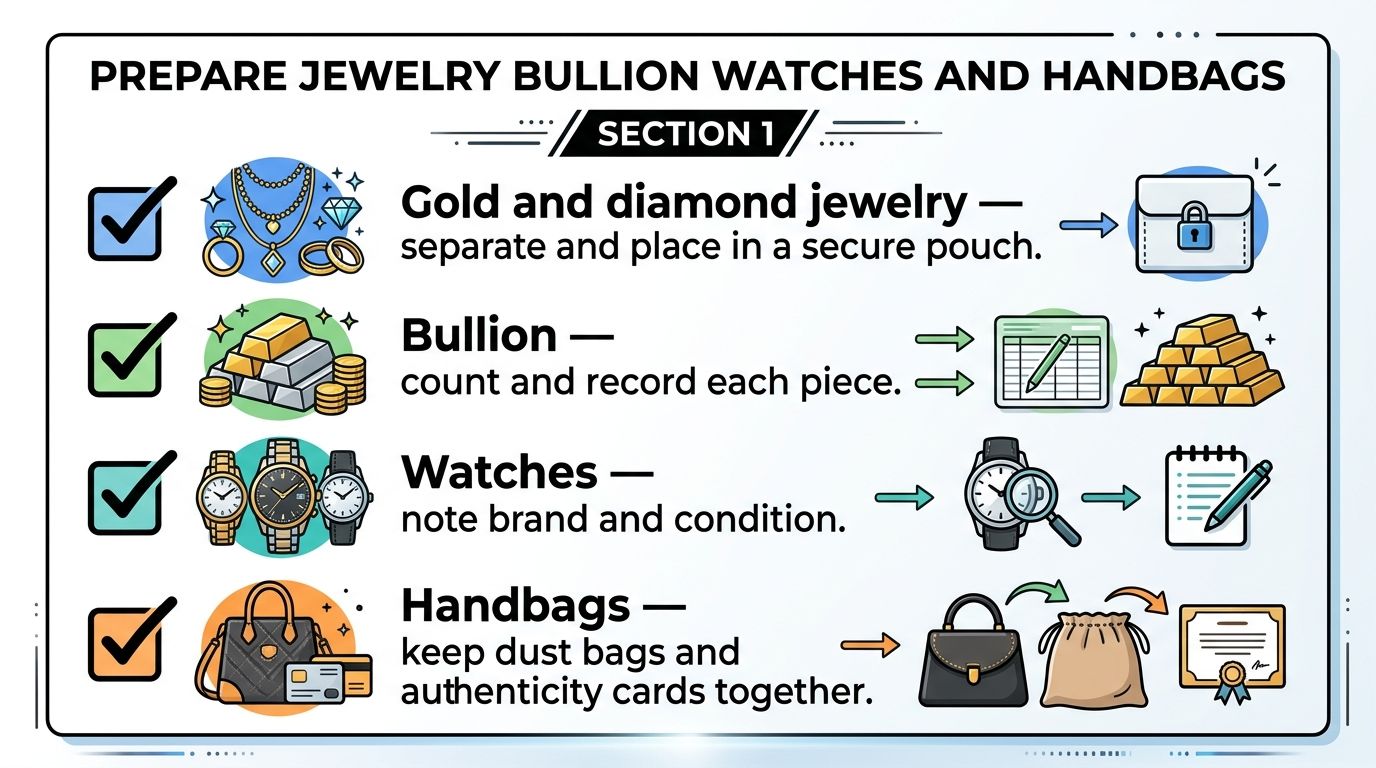
Prepare Jewelry Bullion Watches and Handbags
Start room by room, and pull valuables out of the general pile as you go. Don't wait until the estate company arrives and everything's already boxed by room. By then, a gold bracelet is sitting under costume jewelry and nobody remembers which dresser it came from.
Work with a table, good light, small zip pouches, labels, and your phone camera. If you're an executor, keep a simple log as you sort. Families who want a stronger system can use asset records for executors and trustees as a model for how an inventory should be organized.
Sort These Categories Separately
Gather each group into its own labeled container:
- Gold and diamond jewelry: Rings, chains, bracelets, earrings, broken pieces, and single earrings go together, even if they look unfashionable.
- Silver and bullion: Count coins and bars piece by piece, and write down denominations or markings you can read.
- Numismatic pieces: Keep coins in their holders or albums, don't clean them, and don't polish anything to make it look better.
- Watches: Note the brand, whether it runs, and keep boxes, links, and papers with the watch.
- Handbags: Keep dust bags, authenticity cards, receipts, and straps with the bag they belong to.
Photograph each piece front and back, then photograph any marks, clasps, serial numbers, and damage. Note where you found it and anything you know about who owned it. That provenance note takes thirty seconds now and saves arguments later.
For a focused walkthrough on inherited pieces, see this guide on how to sell estate jewelry without bundling it into a household lot.
Read Karat Marks but Don't Trust Looks Alone
A yellow color doesn't tell you purity. The FTC explanation that 24-karat gold is pure gold, 18-karat contains 18 parts gold and six parts other metals, and 14-karat contains 14 parts gold and 10 parts other metals gives you the language to ask better questions. Look also for a trademark or registered business mark near the karat stamp, because that mark helps identify who's accountable for the claim.
Don't write your own price list from stamps and internet listings. Your job is to produce a labeled, photographed set of pieces that a buyer can test in front of you.
That's where Xray Scanning and Gold Testing for free matters for Gold and Jewelry Buying. X-ray fluorescence scanning gives a fast, nondestructive estimate of composition, but you should understand its limits. Technical guidance on XRF accuracy of roughly 2 to 5 parts per thousand on sufficiently flat, large surfaces also warns that curved jewelry, plating, and chemical treatments can distort results because the scan mainly reads a thin outer layer. A careful buyer explains that limit, retests odd readings, and examines suspicious plated pieces further instead of treating one scan as magic.
When you finish, you shouldn't have a guessed value. You should have pouches, photos, notes, and boxes ready for an in person evaluation.
Compare Auction Direct Sale and Consignment
Before signing a sale agreement, confirm who has authority to approve it and how each valuable item will be documented. Then choose the channel by category. A company offering to take everything, from the lawn mower to the Rolex, in one agreement may be asking you to trade the value of your best pieces for convenience.
Retail price is a poor guide to liquidation proceeds. Jewelry included in a general household sale can draw little attention beside furniture and everyday goods. A separate assessment gives gold, stones, brand, and resale condition room to affect the offer. Keep the item list and written offer with the estate records.
Which Sale Channel Fits the Item
| Asset | Better first channel | Main risk | What to verify |
|---|---|---|---|
| Ordinary furniture and household goods | Estate sale or online auction | Low bids and unsold lots | Labor, hauling, and disposal fees |
| Gold, silver, and bullion | Direct local sale after testing | Understated karat or weight | Karat, weight, deductions, written offer |
| Fine diamond jewelry | Direct sale or consignment | Scrap pricing for a resale piece | Whether offer reflects stones and workmanship |
| Luxury watches and handbags | Specialist direct sale or consignment | Authentication disputes | Brand, serial number, papers, condition |
| Clothing and low demand goods | Donation, recycling, or bundled sale | Fees consuming proceeds | Minimum price and unsold item terms |
Auction can suit furniture, tools, collectibles with a broad bidder pool, and rare pieces that may draw competition. You give up control over the final price, pay commission, and risk having some lots go unsold. Ask who covers handling and what happens to unsold items.
Direct sale gives you a clear offer and a faster decision. For gold and bullion, it can be a straightforward option when testing, weight, deductions, and payment are documented. Compare the written terms, not just the headline price.
Consignment may fit a distinctive ring, watch, or handbag when time is available and the item merits retail presentation. Confirm who insures it, how long it will be listed, what fees apply, and what happens if it does not sell. If you're considering that route for a ring, review how engagement ring consignment terms differ from a direct offer before signing.
Where a Local Gold Buyer Changes the Math
Carat 24 at 3780 W. State St. in Boise buys and sells gold, silver, bullion, numismatic collectibles, fine jewelry, luxury handbags, and watches, including Louis Vuitton and Rolex. The business describes an eight-step authentication process. Ask the buyer to explain the steps and record the results for the estate file.
Request a local offer based on visible testing. Xray Scanning and Gold Testing for free, Price Matching against a verifiable competing quote, and an aim for the highest payout in Boise matter only if the buyer shows the karat, weight, and deductions in writing. Ask to see each figure before you decide.
My recommendation is direct. Let an estate company handle household volume if that suits the family. Keep jewelry, bullion, watches, and handbags separate until each has been assessed and offered on its own terms.
Set the Timeline Fees and Paperwork
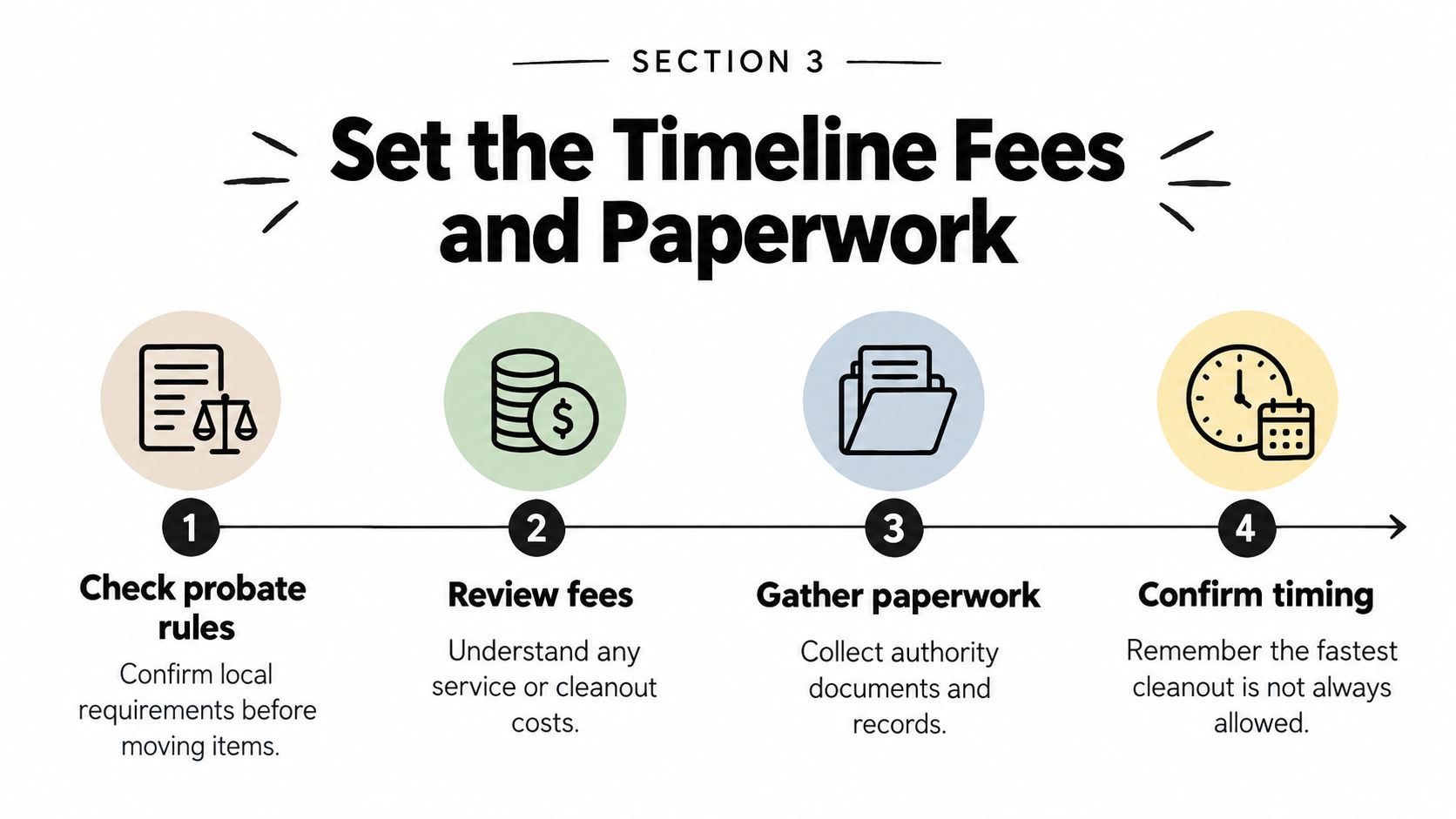
Permission comes before pricing. Probate rules vary by jurisdiction, and the fastest cleanout isn't always allowed. If debts, taxes, or beneficiary rights are unresolved, selling early can create a bigger problem than waiting.
Start by confirming the will, the executor, and who the legal owner of the property is. For a helpful overview of how probate generally requires identifying and safeguarding assets, valuing them, paying valid debts and administration costs, and distributing only the remainder, see this probate process overview for settling an estate. Don't treat any general timeline as universal for your family.
Build a File an Executor Can Defend
Use this sequence and keep it boring. Boring paperwork is what protects you.
- Write the scope: State what's being sold, what's being kept, and who's authorized to approve sales.
- Set the valuation date: Record the date that matters for the estate, not just the day you got around to sorting.
- Photograph room by room: Capture condition, dimensions, serial numbers, and provenance notes for important items.
- Separate categories: Keep ordinary goods apart from jewelry, bullion, watches, and handbags from the start.
- Research comparable sales: Use evidence near the valuation date instead of retail replacement cost or a dealer's unsupported quote.
- Keep the audit trail: Save sources, assumptions, limitations, invoices, and final disposition results in one folder.
That record matters for taxes as well as family peace. Under IRS guidance that inherited property generally receives a basis equal to fair market value at the decedent's date of death, date specific documentation affects later tax reporting and beneficiary allocations. A photo with a date and a written valuation note is worth far more than a memory.
If pricing household lots feels murky, this estate sale pricing guide for setting defensible asking prices can help you separate asking price from expected recovery.
Ask About Every Fee in Plain Language
Get these costs in writing before work begins:
- Commission: What percentage, and is it charged on gross proceeds or after other costs?
- Transport and storage: Who pays to move, store, photograph, and insure items?
- Labor and cleanout: Is hauling included, or billed after the sale?
- Unsold lots: Do you pay again to donate, recycle, or dispose of what's left?
Learn to spot the difference between a disclosed service fee and a quiet deduction buried in a purchase price. Both may be legitimate, but only one is transparent.
If the house itself will be sold after liquidation, sequencing matters there too. The discipline in these seven steps to selling Chicagoland homes is a useful reminder to order pricing, preparation, and paperwork before you rush to market, even though your property is here in Boise.
Hold unusual or high value sales until the personal representative approves them. A short delay with documents beats a fast sale you have to explain for years.
Protect the Sale from Pressure and Unfair Offers
The riskiest person in an estate sale isn't always a stranger. It can be a rushed relative who wants the house empty, a helpful neighbor who starts carrying boxes to his truck, or one family member who controls access, pricing, and payment with nobody watching. Good intentions don't remove conflicts of interest.
Watch how a careful review should feel in practice, with paperwork on the table and no one rushing a signature.

Protections for Older Sellers and Remote Heirs
If you're selling after a death, or you're a daughter in another state trying to oversee things by phone, insist on these safeguards:
- Plain English explanations: Ask for a written summary you can reread at home, not just a verbal pitch.
- Extra decision time: A legitimate offer survives an overnight conversation with family.
- Two person counting: Count coins, chains, and loose stones with another adult present.
- Itemized photos: Every valuable in the offer should match a photo in your inventory.
- Disclosed testing: The buyer should explain how karat, weight, and authenticity were checked.
- Written approval: Remote heirs should approve major sales in writing and receive payment records.
Don't move money because someone unexpected asked you to. Guidance noting the FTC reported in 2025 that scams targeting retirees were increasingly aimed at life savings advises independently verifying the organization involved. Hang up, look up the business yourself, and call the number you found.
This short video is worth watching before you agree to any in home pickup or mail in offer.
Test Any Price Match Claim
Price Matching only helps if you're comparing the same thing. Ask whether both quotes use the same karat, the same weight, the same deductions and fees, and whether the price is for scrap value or for finished jewelry that can be resold. The FTC advice to compare prices and quality among multiple retailers and check reputation with the Better Business Bureau or a state attorney general applies just as well when you're the seller.
A local evaluation lets you watch the test, ask questions, and take your pieces home if you don't like the number. Mailing valuables means packaging, tracking, and confirming insurance before you've been paid. To vet a buyer before you visit, use this checklist for reputable gold buyers and the questions to ask first.
Keep a short refusal list on your fridge. No cash only pressure. No unsigned offer. No sale of sentimental pieces that haven't been set aside and agreed on by family.
Take the Next Step with a Local Buyer
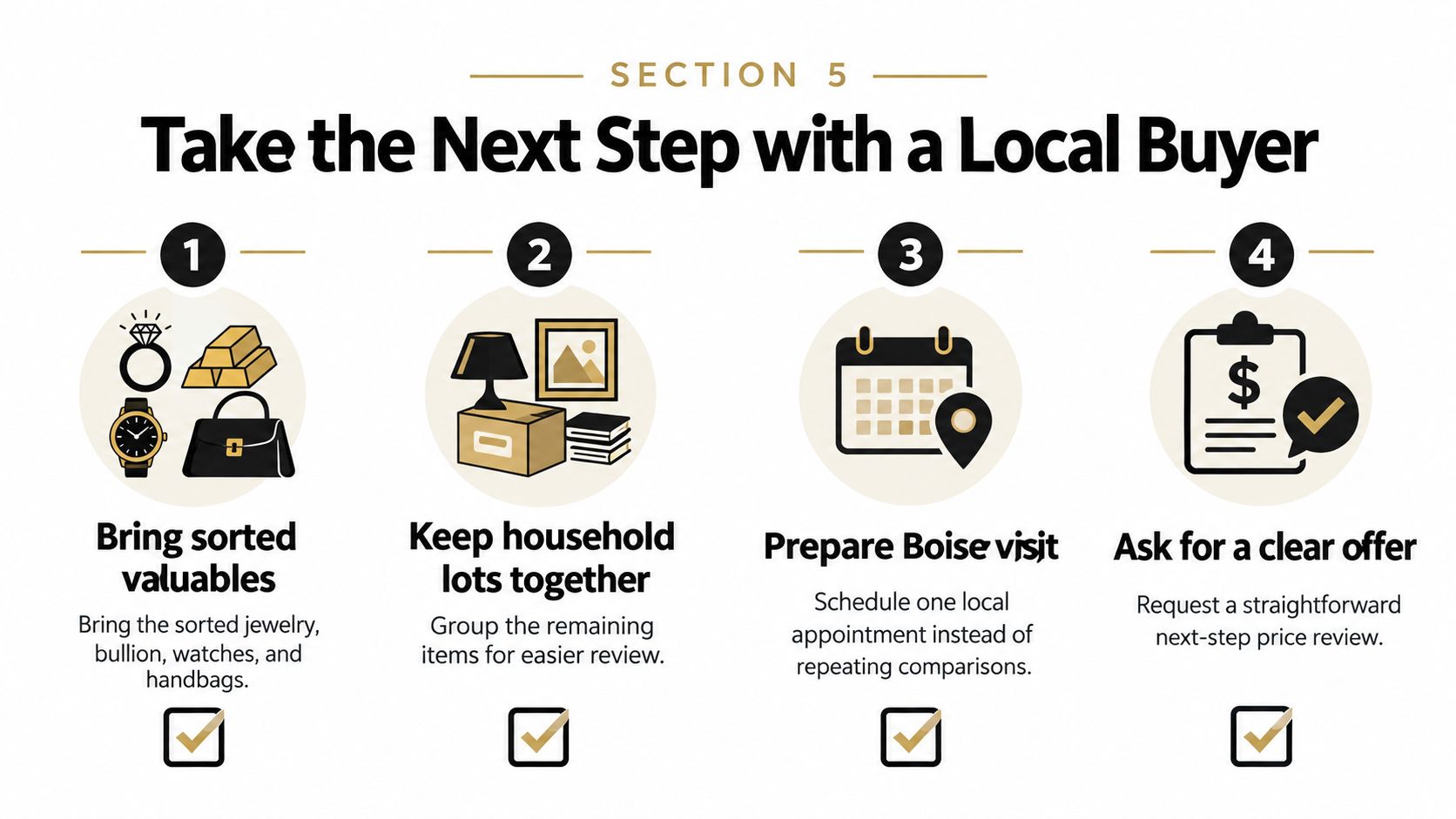
Turn all of that preparation into one visit. Don't drive around Boise getting verbal numbers you'll forget by dinner. Bring your sorted items, your notes, and your questions to one place, get a written offer, and then decide with family.
Save the hassle and sell locally for more than online shipments is not just a slogan when you count the full cost of mailing. In one consumer review reporting a FedEx shipment may be insured up to $5,000, with additional coverage available up to $100,000 through that service, the seller still has to package, ship, track, and verify coverage before payment. A Boise counter removes those steps and lets you inspect the testing yourself.
Your Boise Visit Checklist
Bring these items and ask these questions:
- Sorted valuables: Jewelry, bullion, watches, and handbags in labeled pouches, with household lots kept separate at home.
- Identification and authority: Your ID, plus executor or personal representative papers if you're selling for an estate.
- Boxes and papers: Watch boxes, extra links, receipts, authenticity cards, and prior appraisals if you have them.
- A competing quote if you have one: Bring it in writing so price matching can be judged on karat, weight, fees, and deductions.
At Carat 24, 3780 W. State St., Boise, ask to see the Xray Scanning and Gold Testing for free and ask the team to walk you through the eight-step authentication process for any piece being bought or sold. That's not small talk. It's how you learn whether you're being offered scrap value, resale value, or numismatic value.
Request the offer in writing with weight, karat, deductions, and whether Price Matching was applied. If the goal is the highest payout in Boise, the proof is that written breakdown compared against a verifiable quote, not a promise made at the door. For background before you go, read about local gold and silver dealers and what an in person evaluation should include.
A fair local offer gives you three real choices: accept it, negotiate it with evidence, or walk away with your items and your paperwork intact.
That's the outcome you're after. Not a rushed cleanout, not a box mailed to strangers, and not a family argument next Thanksgiving. A documented, hassle free offer you understood while your jewelry was still in front of you.
Bring your sorted estate jewelry, bullion, watches, and handbags to Carat 24 for Gold and Jewelry Buying with free X-ray scanning and gold testing, a clear written offer, and price matching on a verifiable competing quote. Visit Carat 24 - Trusted Gold Experts to plan your in person Boise evaluation and decide on your timeline, with no pressure to sell the same day.
