
You've got coins you didn't buy, a price you can't verify, and someone online telling you to mail them across the country. Pause there. A coin grading service can help, but it isn't always the right first step, and it can cost you money you never get back. This guide is written from the seller's side of the counter. You'll learn what a grade proves, what it doesn't, and when a local Boise offer beats shipping your coins away.
The Coin Jar on Your Kitchen Table
A Boise widow in her seventies clears her husband's desk and finds a coffee can of silver dollars, a few gold pieces in paper envelopes, and a notebook with dates but no prices. Her kids don't collect. She doesn't want to learn numismatics. She wants to know three things. Are these real, are any of them scarce, and how does she sell them without getting shortchanged?
That's the situation most sellers walk in with. It isn't a collector's question about completing a set. It's an estate question, a Gold and Jewelry Buying question, and often a timing question. Bills, probate, and dividing things fairly among heirs don't wait well for slow mail-in processes.
The Real Decision in Front of You
You have three realistic paths, and they serve different purposes.
- Mail coins to a third-party grading service: Best for a small number of scarce, high-value, or disputed coins where the exact grade could change the selling price.
- Pay an independent appraiser: Useful for estate division, insurance, or paperwork where you need a written opinion that isn't tied to a buy offer.
- Visit a local buyer in person: Best when you want metal content tested, condition assessed, and a same-day offer while your coins never leave your sight.
Grading can add clarity. It also costs fees, shipping, and waiting time, and it doesn't guarantee a higher payout. For a jar of common circulated coins, those costs can eat the entire margin. For one key-date coin in sharp condition, skipping grading could leave serious money on the table.
Don't grade everything. Grade the few coins where condition is the argument, and get the rest tested and priced locally.
Start by sorting, not spending. Separate gold from silver, slabbed coins from loose ones, and anything that looks cleaned, bent, or holed. Photograph both sides. Write down dates and mintmarks exactly as they appear. Don't clean anything, don't rub it, and don't try to make it shiny. You'll make a better decision once you understand what that number on a holder means.
How the Sheldon Scale Turns a Coin into a Number
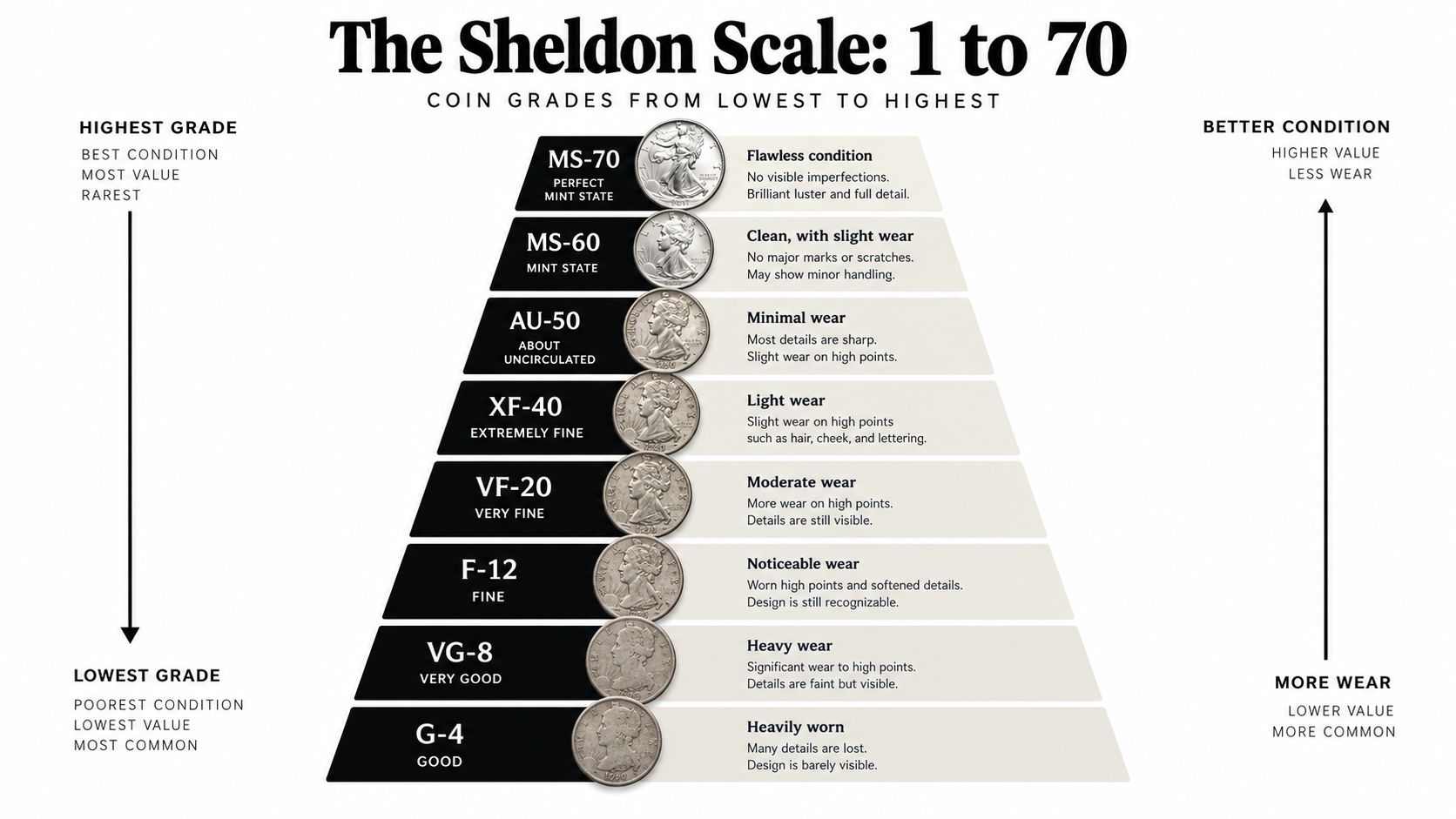
Professional grading turns physical preservation into a standardized 1 to 70 scale derived from the Sheldon system, with the American Numismatic Association framework separating circulated grades from Mint State grades MS-60 through MS-70. Think of it as a condition language, not a price tag. Buyers and sellers in different states can argue about value, but they're at least arguing about the same described coin.
Circulated Coins Have Lost Metal
Circulation wears the highest points first. Hair detail flattens, lettering softens, rims take hits, and original mint shine disappears. The common circulated labels run from Good, Fine, and Very Fine, up through Extremely Fine and About Uncirculated. An About Uncirculated coin can look nearly new to an untrained eye, but slight wear on the high points keeps it out of Mint State.
That distinction matters because many sellers describe any shiny old coin as uncirculated. It may have been polished, or it may have sat in a drawer after light use. If you're unsure how finishes differ, read about the difference between proof and uncirculated coins before you repeat a seller's description as fact.
Mint State Is About Marks, Not Age
MS-60 through MS-70 means no circulation wear. Within that range, graders separate coins by contact marks, scratches, luster, strike sharpness, toning, and overall eye appeal. An MS-60 can be dull and baggy. An MS-65 should have cleaner fields and stronger luster. MS-70 is effectively flawless.
This is exactly what sellers care about. Two coins with the same date and mintmark can sit in very different price brackets if one is MS-64 and the other is MS-65. That one-point gap is where a coin grading service earns its fee, because a buyer at a distance will pay more readily when independent graders have confirmed the higher condition. For a common circulated piece, that gap usually doesn't exist.
- Wear decides circulated versus Mint State: Look at the highest design points first.
- Marks decide the Mint State number: Cleaner surfaces and stronger luster support higher grades.
- Grade doesn't decide rarity: A common coin in high grade and a scarce coin in low grade are different market problems.
Read a holder that way and you'll stop treating the number as magic. It's a structured opinion about preservation. Price still depends on scarcity, demand, metal, and who's buying.
What a Grading Service Actually Does to Your Coin
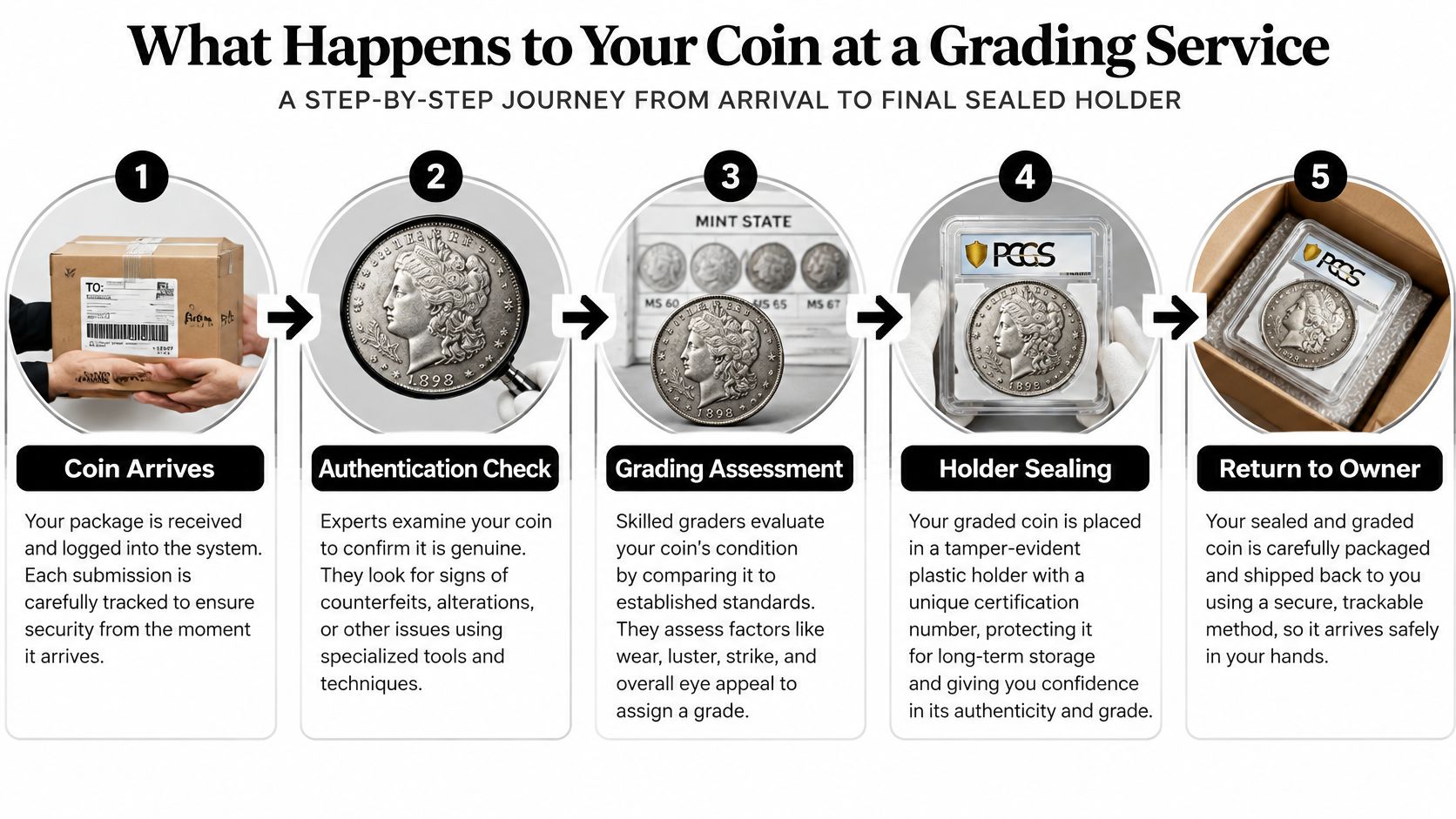
A reputable coin grading service does three jobs. It checks whether the coin is genuine, assigns a grade using standardized criteria, and seals the coin in a labeled, tamper-evident holder tied to a certification record. That system became standardized through the Sheldon scale proposed in 1948 and large-scale third-party certification beginning with PCGS on February 3, 1986, followed by NGC in 1987.
From Intake to Sealed Holder
- Intake and identification: Staff log the submission, confirm the count, and match each coin to your form by date, denomination, and mintmark.
- Authentication: Specialists check weight, design details, edge, and other diagnostics to rule out counterfeits and alterations.
- Grading assessment: Graders examine high-point wear, remaining luster, strike quality, contact marks, scratches, toning, and rim condition under strong light and magnification.
- Encapsulation: The coin is sealed with a label showing its identification and assigned grade, creating a stable record for future buyers.
- Return: The holder comes back to you, and the certification can be checked against the service's record.
That holder protects the coin the way proper framing original movie posters protects paper collectibles from handling damage. In both cases, preservation and clear identification make resale easier, but neither one creates value the underlying item doesn't have. If you already own slabbed coins, understanding what a coin certificate of authenticity does and does not document will keep you from confusing paperwork with a guaranteed price.
What Graders Are Really Judging
They aren't guessing what your coin will sell for next month. They're judging observable condition at the moment of inspection. A weak strike can lower the grade even without wear. Cleaning or damage can prevent a straight grade altogether and result in a qualified description instead.
Practical rule: If a coin has been cleaned, tooled, bent, or heavily scratched, ask about that problem before you pay for a submission. A problem qualifier often disappoints sellers who expected a clean number.
That's also why your own pre-screen matters. Handle coins by the edges, inspect them under diffuse light, and record anything odd. Don't try to fix surfaces. A grader will see it, and so will a serious buyer.
Costs, Turnaround, and When Grading Actually Pays Off
Grading is a business decision. You're paying fees, shipping, and insurance, and you're giving up access to the coin while it travels and waits in a queue. Ask whether the likely price improvement is large enough to beat those costs. If it isn't, don't submit.
Scale alone tells you certification isn't just for museum pieces, since PCGS reported certifying its 45 millionth item in 2025, representing more than $41.7 billion in combined value. It also tells you you're entering an industrial process. Your coin will be handled through tiers built around declared value, submission type, and speed.
Typical Coin Grading Service Tiers and Use Cases
| Tier | Typical turnaround | Best fit for |
|---|---|---|
| Economy | Slowest queue | Lower-value coins where timing doesn't matter |
| Standard | Middle queue | Scarce coins where an independent grade could affect offers |
| Express or higher-value service | Fastest queue | High-value, disputed, or counterfeit-prone pieces needing quicker handling |
Exact fees and timelines change by service and declared value, so confirm the current schedule in writing before you ship. Don't rely on an old forum post or a dealer's memory. Include membership requirements, return shipping, and insurance in your math, not just the headline grading fee.
Run the Break-Even Test
Ask three questions before you pay.
- Is the coin scarce enough that grade changes demand: A common date with huge surviving numbers may not reward certification.
- Is there a meaningful price step near the likely grade: The MS-64 versus MS-65 boundary is the classic example.
- Can the coin get a straight grade: Cleaning, alteration, rim damage, or scratches can wipe out the expected benefit.
If you answer no to the first two, a local test and offer will usually serve you better. If you answer yes, grading can make the coin easier to sell to distant buyers and auction bidders who can't inspect it in hand.
My recommendation is blunt. Submit selectively. One or two strong candidates may justify the process. A whole inherited box almost never does, at least not before someone knowledgeable sorts it in person.
Why a Graded Coin Is Not Automatically Worth More
A slab doesn't create a buyer. It describes condition. Sellers who forget that distinction overpay for submissions, overprice inherited coins, and then sit on inventory nobody wants at their number.
The Federal Trade Commission states that grading is not an exact science and a certificate represents only the grading service's opinion. The same guidance warns that sellers may inflate grades, use less-reputable services, or place lower-grade coins in holders labeled with higher grades. Read that twice if you're handling an estate. A holder is evidence, not proof of value.
Five Different Things People Confuse
- Authenticity: Is the coin genuine?
- Condition: How well is it preserved on the 1 to 70 scale?
- Market value: What have similar coins traded for?
- Liquidity: How quickly can you find a buyer at a fair price?
- Asking price: What a seller hopes to get, which may have little to do with recent transactions.
An authentic coin can still be overpriced. A high-grade common coin can still be slow to sell. A rare coin in modest condition can still draw strong bids because collectors need it. Grading helps most with the first two items. It doesn't settle the last three.
A certificate is not an independent valuation, and it is not an investment guarantee.
So verify the certification number and match it to the exact coin in the holder. Compare recent completed transactions, not advertised prices. Then get an independent second opinion before you accept or reject an offer, especially if the person praising the grade is also the person trying to sell you the coin or buy it cheaply.
For heirs, this is the central safeguard. You may not know what your relative paid, whether the service was reputable, or whether the original purchase price was inflated. Don't anchor on old receipts. Anchor on authentication, current demand, and competing bids you can verify today.
Submitting Coins Safely and Avoiding Conflicts of Interest
The question isn't only which grading company has the best reputation. It's who benefits if the grade or value is overstated. The FTC advises checking whether a grading service is independent from the dealer, while Minnesota's Attorney General warns about dealer-affiliated grading promotions, and both support in-person examination and a second opinion.
If You Mail Coins, Protect the Paper Trail
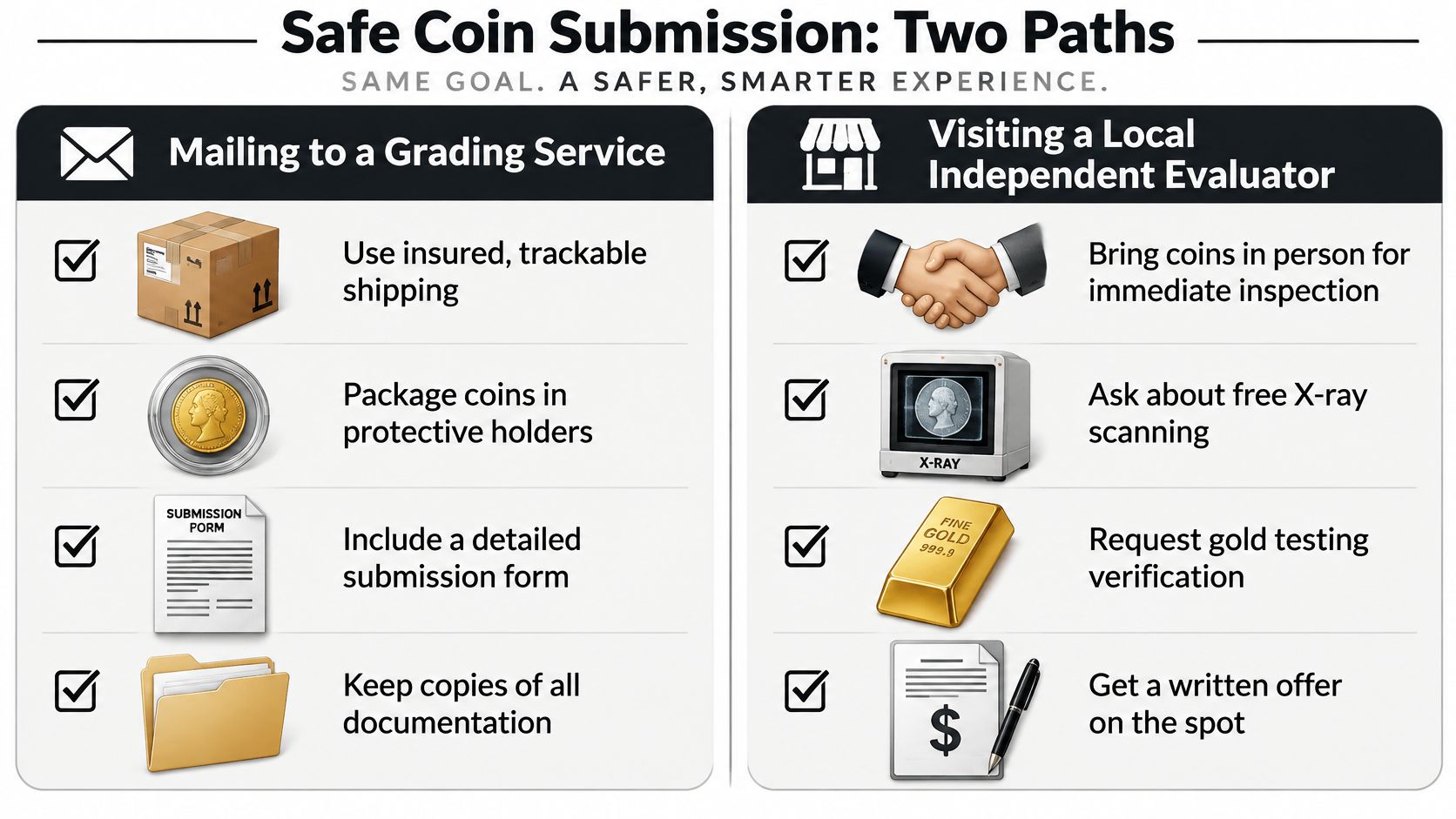
- Inventory everything: Record date, mintmark, denomination, and any visible damage, then photograph both sides.
- Package defensively: Use protective holders, padding, and a sturdy box that doesn't announce valuables inside.
- Ship insured and trackable: Keep the submission form, payment record, tracking number, and delivery confirmation together.
- Clarify control: Know who submits the coin, who pays the fee, and whether the fee is gone if the coin misses your hoped-for grade.
That last point catches people. Grading fees buy an opinion and encapsulation where eligible. They don't buy the grade you want. Also check whether a quoted number you're hearing is a retail estimate, an auction expectation, or an immediate cash offer. Those are not interchangeable.
Before any submission, resist the urge to improve appearance. Guidance on how to clean a silver dollar is useful mainly because it shows how easily cleaning damages collector value. Leave toning and original surfaces alone.
The Conflict Test
Ask the evaluator two direct questions. Are you affiliated with the grading service you're recommending, and are you also the buyer? If the answer to either is yes, get another opinion.
Direct third-party submission fits high-value or disputed pieces. Independent appraisal fits estate division and documentation. A transparent local buy offer fits when speed and certainty matter more than chasing an auction result. Pick the channel that matches your purpose, not the channel that earns someone else a fee.
A Local Boise Option for Hassle-Free Authentication and the Highest Payout
For many Boise sellers, the smarter first step isn't a mailbox. It's a counter where you can watch the testing happen. Shipping precious metals to an online buyer adds packaging, transit, tracking, insurance, receipt confirmation, and waiting for inspection before payment, while a local sale lets you stay present while items are weighed and tested.
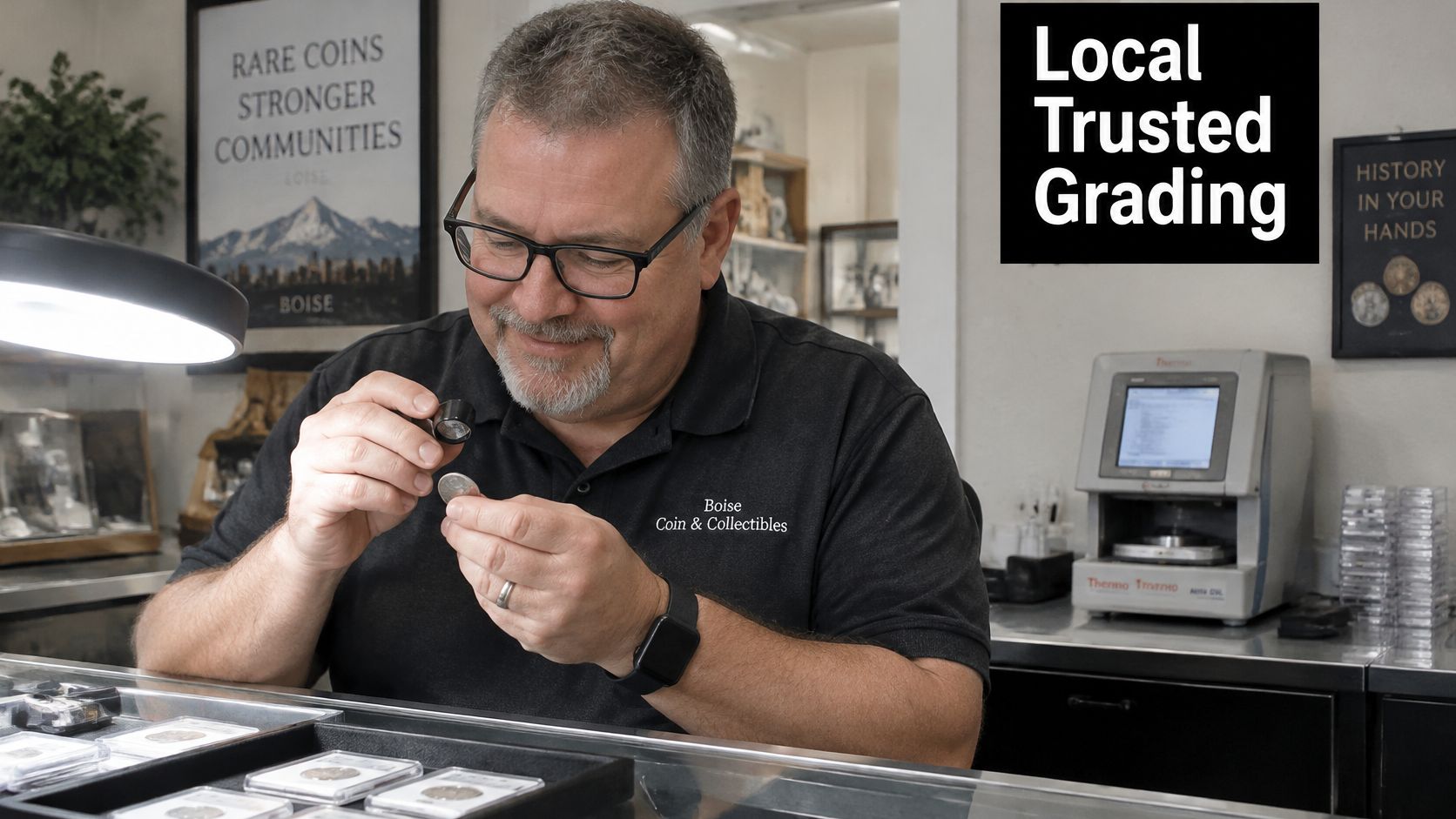
At Carat 24, 3780 W. State St. in Boise, sellers can ask about Xray Scanning and Gold Testing for free, hassle free offers, and Price Matching as part of Gold and Jewelry Buying. The pitch is the highest payout in Boise, and the practical advantage is simple. Save the hassle and sell locally for more than online shipments by comparing a written in-person bid against what you'd net after shipping, insurance, delays, and a possible revised offer after inspection.
Treat those promises the way you'd treat any business claim. Confirm them in writing. Ask what's tested for free, which competing offers qualify for matching, and whether the bid can change after final inspection. A transparent buyer should explain how karat, weight, condition, and current metal benchmarks produced the number.
This short video shows the kind of in-person evaluation to expect before you agree to anything.
If your coins include better dates or collector pieces, also compare how rare coin buyers evaluate scarcity and demand beyond metal weight. That conversation is easier face to face, coin by coin, with no package sitting in another state.
Your Decision Checklist Before You Let Go of the Coin
Use this the same week you sort the collection. Don't let the coins sit while you go back and forth for months.
Before You Choose a Path
- Sort and photograph: Separate gold, silver, slabbed, and damaged pieces. Record dates and mintmarks.
- Do not clean: Original surfaces matter more than shine.
- Spot the grading candidates: Flag scarce, high-grade, disputed, or counterfeit-prone coins only.
- Verify existing slabs: Match the certification number to the exact coin and check the service's reputation and independence.
- Compare real bids: Use completed market activity and written offers, not asking prices or old purchase receipts.
- Confirm terms in writing: Testing, price matching, fees, shipping, insurance, and whether an offer is final.
If you need a refresher on identifying dates and separating common pieces from better ones, review how to value old coins before your visit. Bring your notes and photos with the coins.
Grade the exceptional few. Test and price the rest locally. Never mail first and think later.
The right answer depends on the coin, your timeline, and your tolerance for shipping risk. A scarce piece near a valuable grade boundary may belong at PCGS or NGC. A typical inherited mix of coins, gold jewelry, and silver usually belongs on a local counter first, where free testing and a clear offer tell you whether further grading would even pay.
Bring your coins, gold, and estate jewelry to Carat 24 - Trusted Gold Experts at 3780 W. State St. in Boise for free X-ray scanning and gold testing, price matching, and a hassle-free in-person offer before you risk mailing anything away. You'll see the testing, hear how the number was reached, and can decide on the spot whether selling locally or grading a select coin makes more sense.
