
You're standing at a counter in Boise with two phones open, one showing a ring marked way down online and the other showing a photo your partner sent months ago. The sale tag says you're saving a fortune. Your gut says don't blow this.
Both instincts are right to pay attention to. A diamond engagement ring on sale can be a smart buy, but only if you judge it against documented value, not against a crossed-out price someone invented for marketing.
What a Sale Price Actually Means for an Engagement Ring
I watch this play out weekly. A buyer finds a ring, sees the was and now sticker, feels the rush, and almost buys before asking a single question about the stone. Then we slow down, pull the paperwork, and sometimes the deal holds up. Sometimes that bargain was never a bargain at all.
Start with a real benchmark. The Knot's 2024 study put average engagement ring spending at $5,200, down from $5,500 in 2023 and $5,800 in 2022, with 64% of buyers spending less than $6,000 according to Rapaport's summary of The Knot's 2024 Jewelry and Engagement Study. That tells you most buyers aren't spending what the old salary rules claimed.
Engagement-Ring Spending Benchmarks to Compare a Sale Against
| Group | Average Spend | Year |
|---|---|---|
| All buyers | $5,200 | 2024 |
| All buyers | $5,500 | 2023 |
| All buyers | $5,800 | 2022 |
| Gen Z | $3,800 | 2024 |
| Millennials | $5,800 | 2024 |
| Generation X | $5,500 | 2024 |
Use that table correctly. If a sale ring lands near $3,800, that doesn't prove it's fairly priced, it only tells you it sits near a common budget. You still need to verify carat weight, cut, color, clarity, grading report, setting metal, and natural versus laboratory-grown origin.
Remember, this tradition is younger than sellers imply. Only about 10% of American brides received diamond engagement rings in 1940, rising to approximately 80% by 1980 after decades of coordinated marketing as traced in Al Jazeera's history of the diamond engagement ring. That cultural premium is baked into retail prices, which is why discounts can look dramatic without being meaningful.
Practical rule: If a seller can't explain the price without pointing at the discount percentage, walk away.
Run every discounted ring through four filters before you care about the tag. First, grading-report verification. Second, natural versus lab-grown origin. Third, cut quality over carat weight. Fourth, total cost of ownership, including sizing, repairs, insurance, and resale.
Pre-owned options deserve the same discipline, not looser standards. If you're open to estate pieces, read up on how consignment engagement rings work before you shop, because condition and documentation drive value there too.
The Four Quality Filters to Run Before the Price Tag
Most buyers start with carat because it's the number they can brag about. That's backwards. Start with cut, because cut controls whether the diamond sparkles or sits there looking glassy and tired.
The visual below lays out the order I want you to use at the counter.
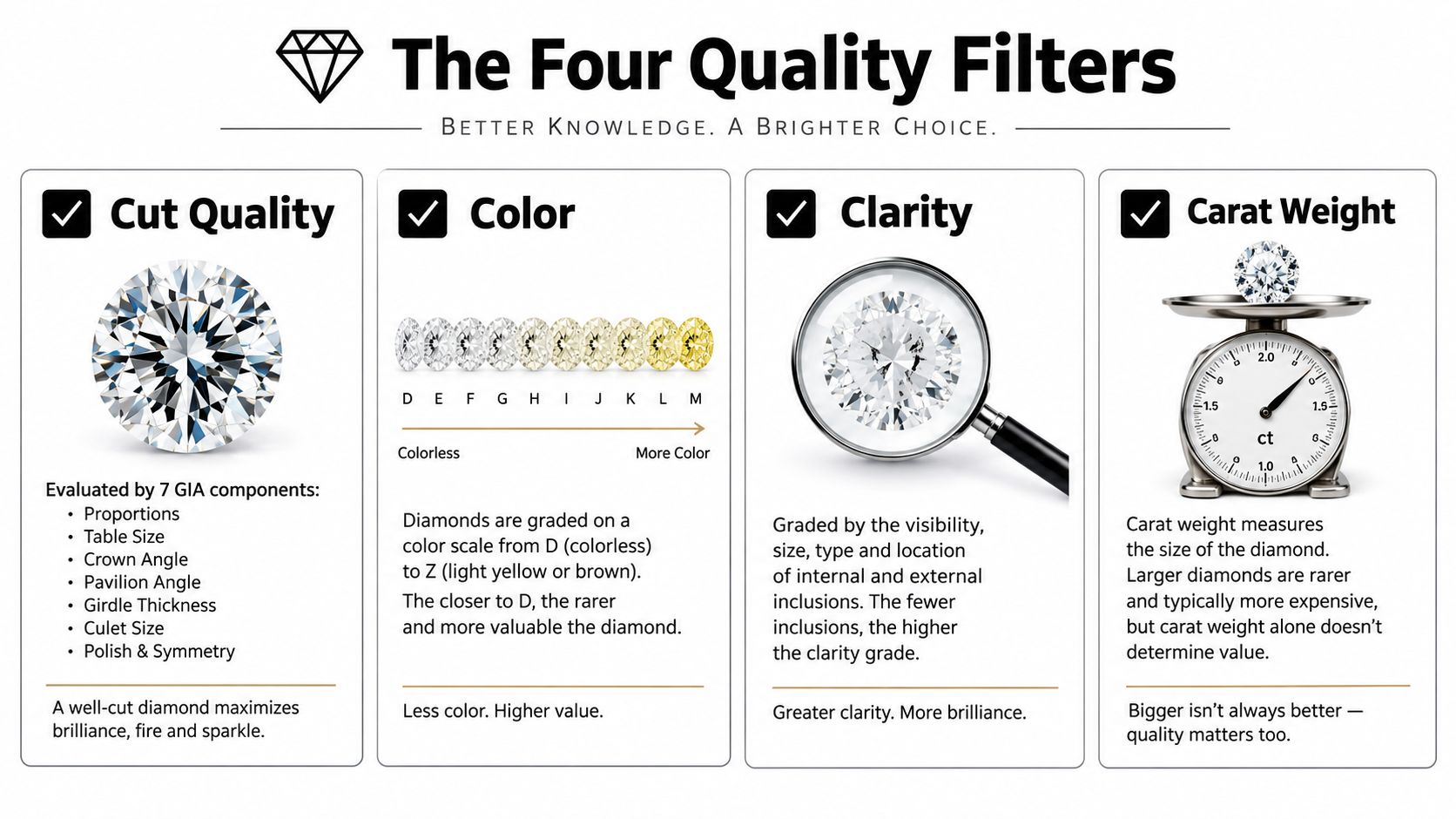
Filter One Cut Quality
GIA evaluates seven components for cut, brightness, fire, scintillation, weight ratio, durability, polish, and symmetry, on a scale from Excellent to Poor under GIA's diamond cut grading system. That system was built from computerized analysis of more than 1 million modeled proportion sets and more than 70,000 human observations involving nearly 2,300 diamonds, using the same cut source just cited. For a standard round brilliant, prioritize Excellent cut and check polish and symmetry grades separately.
Then look at the ring under neutral lighting, not just showroom spotlights designed to make everything flash. Check girdle thickness and exposed edges where chips happen. A weak cut is my first disqualifier on a round stone, no matter how steep the markdown looks.
Filters Two and Three Color and Clarity
GIA grades color on the D-to-Z scale and clarity from Flawless to Included based on characteristics at 10× magnification as explained in GIA's guide to understanding diamond grading reports. Don't pay extra for a tiny color or clarity bump your partner will never see while accepting poor proportions she will see every day.
Also, eye-clean is not a laboratory grade. It's a sales phrase. Demand the actual clarity grade on paper, and use this diamond clarity and color guide to translate grades into what you'll notice face up.
- Color trap: Paying up for near-colorless grades in a yellow gold setting that masks tint anyway.
- Clarity trap: Assuming no visible inclusion under store lights means a strong clarity grade.
- Shape trap: Applying round-brilliant cut benchmarks to fancy shapes, where that specific GIA scale doesn't apply the same way.
Filter Four Carat Weight
Carat is weight, not visual size. One carat equals 0.2 grams, and face-up dimensions depend on shape, depth, and proportions, per the GIA report guide cited above. A deep, poorly proportioned stone can weigh more and look smaller than a well-cut lighter stone.
Natural Diamonds vs. Lab-Grown and How That Changes a Sale
Origin is the biggest reason two similar-looking rings carry wildly different prices. If you don't pin down origin first, you're not comparison shopping. You're guessing.
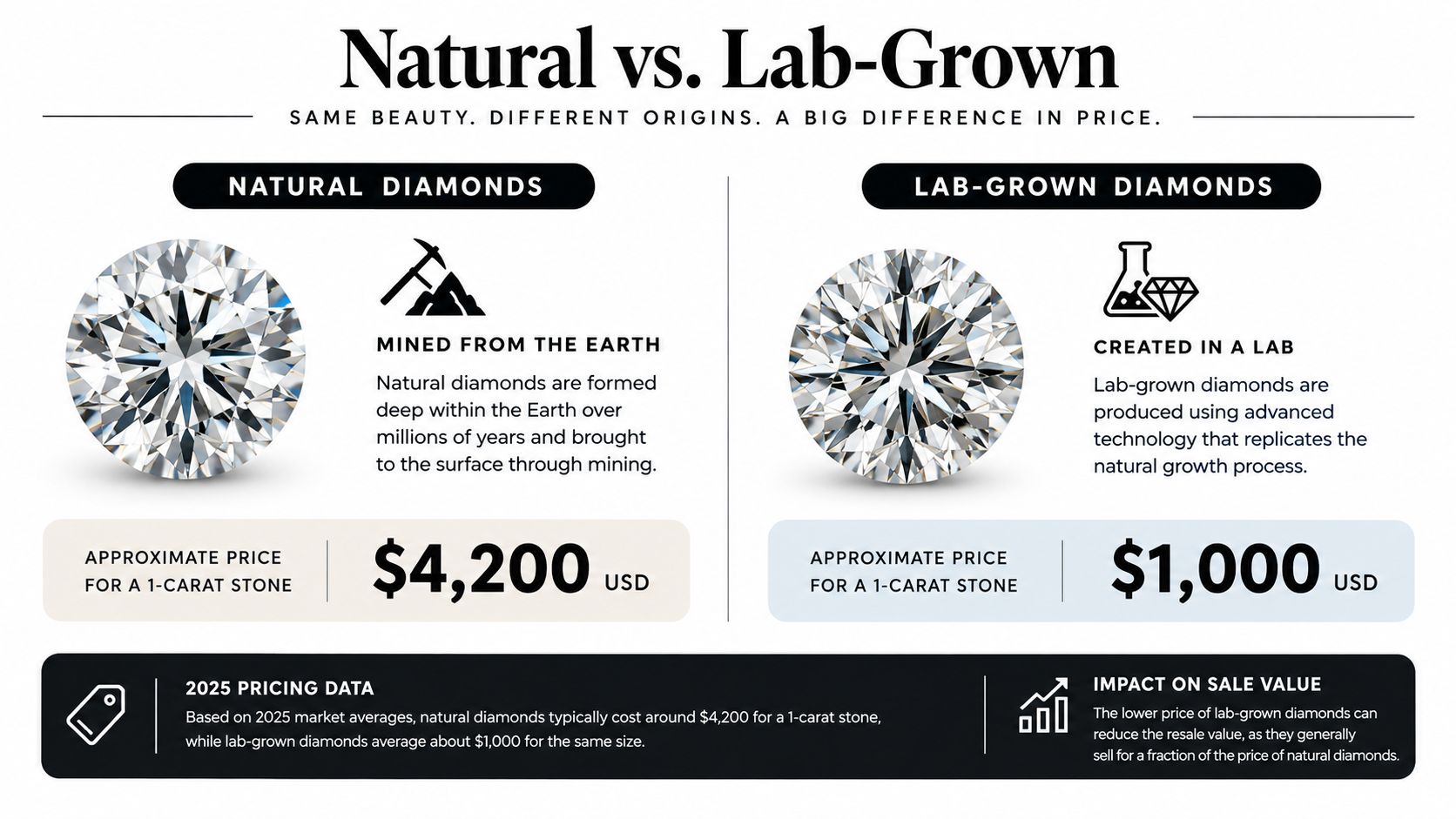
Recent 2025 market data put a 1-carat lab-grown diamond at $1,000 or less versus about $4,200 for a 1-carat natural diamond in the 2025 lab-grown versus natural diamond market report. The same reporting shows the average lab-grown center stone grew from 1.31 carats in 2019 to 2.45 carats in 2025, using that same market report. Bigger stones got cheaper because supply changed, not because every retailer suddenly got generous.
This chart shows why a large sale ring can be affordable without being underpriced.
How to Choose Without the Sales Pitch
Lab-grown diamonds are diamonds with a different origin and different market economics. They're not fake, and they're not automatically the smarter buy either. Decide what you're paying for.
- Maximum size on a budget: Lab-grown usually wins on face-up size per dollar.
- Rarity and mined origin: Natural is the honest fit if that matters to you both.
- Resale expectations: Don't assume a low purchase price means strong future resale. Buy lab-grown for wear and value now, not as an investment story.
- Heirloom thinking: Some families care about mined origin. Talk about it before you buy, not after the proposal.
Disclosure isn't optional. The FTC says laboratory-grown diamonds must be identified clearly and conspicuously as not mined, immediately before or equally prominently with the word diamond under FTC guidance on advertising diamonds and gemstones. Vague words like created or certified on a tag don't replace that disclosure.
A low price explained by lab-grown origin is honest. A low price explained only by a mystery markdown is marketing.
Compare like for like, same shape, same grades, same report type. If you're still torn between origins and other stones entirely, review these diamond engagement ring alternatives with your partner before money changes hands.
Paperwork, Authentication, and the Free Checks That Catch Fakes
Don't trust a tag. Trust documents you can verify and metal you can test while you watch.
GIA notes that quality differences can be subtle enough that even a trained jeweler may not identify them without laboratory verification, which is why buyers should request an independent grading report documenting the 4Cs and confirming natural or laboratory-grown origin and treatments in GIA's diamond buyer's guide. That report is your baseline for every price conversation.
Here's the storefront and counter where Boise buyers can run those checks in person instead of mailing a ring somewhere and hoping.
Your Document-First Checklist
- Get the report number: Match it to the diamond's laser inscription if one is present.
- Verify it independently: Confirm the number through GIA's secure Report Check database, as recommended in the GIA buyer's guide cited above.
- Confirm origin and treatments: The report should state natural or laboratory-grown and disclose detected treatments.
- Match measurements to the stone: Carat, color, clarity, and cut on paper must correspond to the physical diamond.
- Grade the setting separately: Check metal purity, prong security, wear, and prior repairs.
Federal rules back you up here. The FTC Jewelry Guides require truthful representation of type, grade, quality, metallic content, weight, cut, color, treatments, origin, price, and value under the FTC Jewelry Guides for consumers. That means a simulant like cubic zirconia can't be dressed up to imply it's a mined diamond, and gold content claims must be verifiable.
In Boise, use that advantage locally. Ask for Xray Scanning and Gold Testing for free, watch the authentication happen, and get written condition notes before you pay. This is core Gold and Jewelry Buying work, testing karat or fineness and stone identity on the spot, not after shipping.
If you want the basics before you come in, learn how to tell if diamonds are real, then still get the in-person verification. Home tests don't replace a report check and proper testing.
Timing the Buy and Negotiating Without the Awkwardness
Yes, timing helps. No, it doesn't rescue a bad stone. Buy the right ring during a sale window, don't buy the wrong ring because a sale window is closing.
Post-Valentine's, late spring, and holiday periods are the windows I tell friends to watch, because retailers compete harder and older inventory gets priced to move. Shop early in those windows for selection, not on the last desperate day.
The timeline below shows the sequence that keeps you in control.
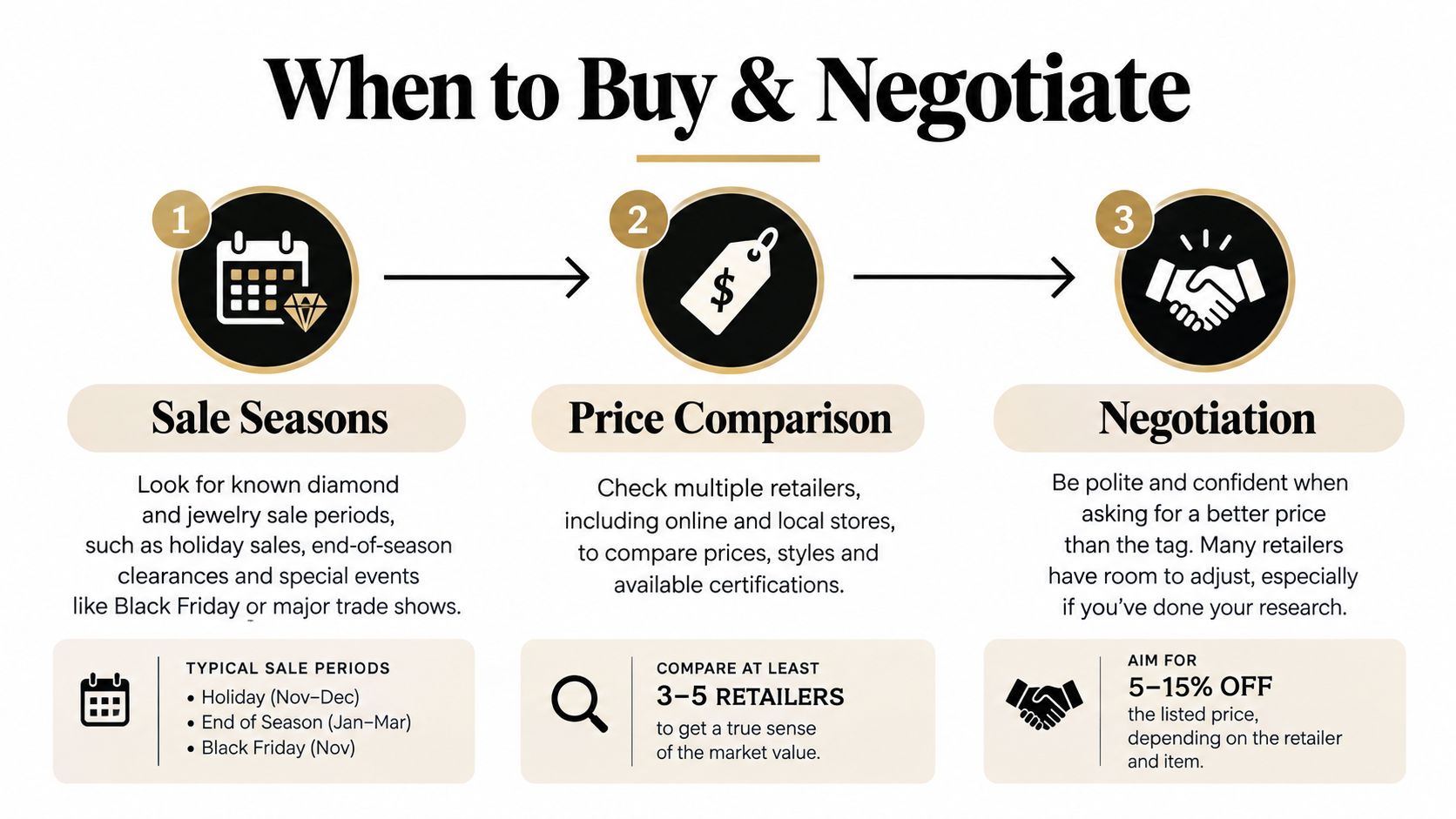
Ask for Price Matching Like an Adult
Price matching isn't automatic under federal law, and the FTC advises checking whether a seller has a price-matching policy and contacting the seller to request a match in FTC guidance on online shopping and price matching. Policies may cover a competitor's price or the seller's own online price, per that same FTC guidance.
Use this script. Show a current, verifiable offer for a comparable ring, same origin, grades, report, metal, and return terms. Then ask directly whether they'll match it. That's not awkward, that's business.
- Bring proof: A live listing or written quote, not a screenshot from months ago.
- Match the whole deal: Ask whether certification, condition, shipping, and returns affect eligibility.
- Negotiate extras if price is firm: Sizing, appraisal paperwork, or warranty terms can matter as much as a small discount.
Watch this walkthrough before you negotiate so you know what a clean, documented transaction should look like.
Buying locally also removes shipping insurance, signature handoffs, and return uncertainty from the equation. You inspect the actual ring, ask questions face to face, and leave with paperwork in hand.
Financing, Appraisals, Insurance, and Long-Term Value
The sale price is only the first bill. Budget the whole ownership picture or the deal you celebrated will annoy you for years.
Paying Without Overpaying
If you're financing, compare total cost, not monthly payment. Store promotions can look painless while interest eats your discount. If you're weighing options, this resource on choosing between loan and card helps you compare structures before you commit at the counter.
My candid advice is simple. Don't finance a larger stone to impress people who won't help you make the payments. A well-cut ring you own outright beats a bigger ring that stresses your first year of marriage.
Appraisal and Insurance Come Next
Get an independent appraisal for insurance and future resale documentation. Keep the grading report, receipt, appraisal, and clear photos together so a claim or resale conversation starts with evidence, not memory. Learn how to get jewelry appraised before you schedule one, so you know what a useful appraisal should contain.
For resale thinking, GIA defines fair market value as an appraiser's opinion of what a willing buyer would pay a willing seller, considering quality, market availability, local desirability, and current fashion for mounted stones in GIA's guidance on selling gemstones and jewelry. Retail price and fair market value are not the same number. Accept that now and you'll make cleaner decisions later.
Insure the ring for replacement with a like-quality stone, and price resale from fair market value. Confusing those two numbers causes most disappointment I see.
Resale and Gold and Jewelry Buying in Boise
Circumstances change. Rings get inherited, upgraded, or sold, and that's normal life, not failure. When that day comes, save the hassle and sell locally for more than online shipments by getting an in-person offer where testing happens in front of you.
Look for hassle free offers, clear explanations of metal weight and stone value, and a buyer aiming to be the highest payout in Boise on documented pieces. Consignment can work, but payment typically waits until the item sells and the jeweler keeps a commission, per the GIA selling guidance cited above. A direct local buyer can pay without that wait.
Your One-Page Buying Plan and the Carat 24 Advantage
Photograph this plan and bring it into any store. If a seller resists any step, that resistance is your answer.
- Set your benchmark: Know current average spending, then judge specs, not stickers.
- Lead with cut: For round brilliants, prioritize Excellent cut, then check polish and symmetry.
- Pin down origin: Natural or lab-grown, disclosed clearly, priced against true comparables.
- Verify documents: Report number, inscription match, Report Check confirmation, treatment disclosure.
- Test the setting: Metal purity, prongs, wear, and repair history graded separately from the stone.
- Price the whole ownership: Sizing, repairs, appraisal, insurance, and realistic resale.
- Ask about price matching: Bring a current comparable offer and ask directly.
At 3780 W. State St. in Boise, Carat 24 builds that plan into the counter experience with an 8-step authentication process, Xray Scanning and Gold Testing for free, and price matching on verified comparable offers. Trade-ins let you put an older piece toward the right ring instead of letting it sit in a drawer. For sellers, that same Gold and Jewelry Buying setup means hassle free offers without mailing jewelry across the country and waiting.
A smart sale isn't a percentage off. It's a documented diamond, in a sound setting, at fair market value, with verification you watched happen. That's the standard. Don't lower it because a tag is red.
Bring any diamond engagement ring on sale you're considering, or jewelry you may want to sell or trade, to Carat 24 - Trusted Gold Experts at 3780 W. State St. in Boise for free X-ray scanning and gold testing, an 8-step authentication review, price matching on verified comparable offers, and a hassle-free local offer aimed at the highest payout in Boise. You'll see the testing, review the paperwork with our team, and leave knowing exactly what the piece is and what it's worth before you decide.
