
You're holding a ring from a drawer, a chain with a broken clasp, or a bracelet you inherited, and you don't know if it's worth real money or almost nothing. You'd rather check Solid Gold Jewelry Reddit threads at midnight than walk into a shop unprepared. That's smart. Don't sell blind.
The Question Behind Every Solid Gold Jewelry Reddit Post
A typical post goes like this. Someone photographs a yellow ring next to a coin for scale, says a grandparent left it behind, and asks three things at once. Is it real, what's it worth, and will a buyer rip me off?
The replies split fast. One person swears by a magnet. Another says check the stamp. A third warns never to mail gold anywhere. They're all partly right, and none of them can see weight, purity, or condition from a blurry photo.
What You're Really Asking
Strip away the anecdotes and you're asking seven practical questions.
- Purity basics: What does 14K or 18K mean in gold content?
- Construction: Is your piece solid through and through, or plated over something cheaper?
- Which value applies: Are you looking at melt value, resale value as jewelry, or a piece you should keep?
- Testing: Which home tests tell you anything useful, and which ones waste your time?
- Red flags: What pressure tactics or vague answers should end a conversation?
- Shipping risk: Should you mail it to an online buyer or sell face to face?
- Preparation: What should you bring to a Boise shop so you get a clear, written number?
Don't ask strangers to price gold from a photo. Get the karat, weight, and construction confirmed in person first.
My recommendation is simple. Use Reddit to learn the vocabulary and spot bad advice, then verify the metal before you negotiate. A stamp is a claim, not proof. A price per gram means nothing until you know what the grams contain.
If you remember one distinction, remember this. Solid describes construction, karat describes purity. Confusing those two words causes most bad buying and selling decisions in these threads, from overpaying for a plated chain to melting a signed piece that deserved a resale appraisal first.
What Solid Gold Actually Means
Think of karat like coffee strength. Pure gold is the strongest brew, and jewelers dilute it with harder metals so a ring survives daily wear instead of bending like soft wire.
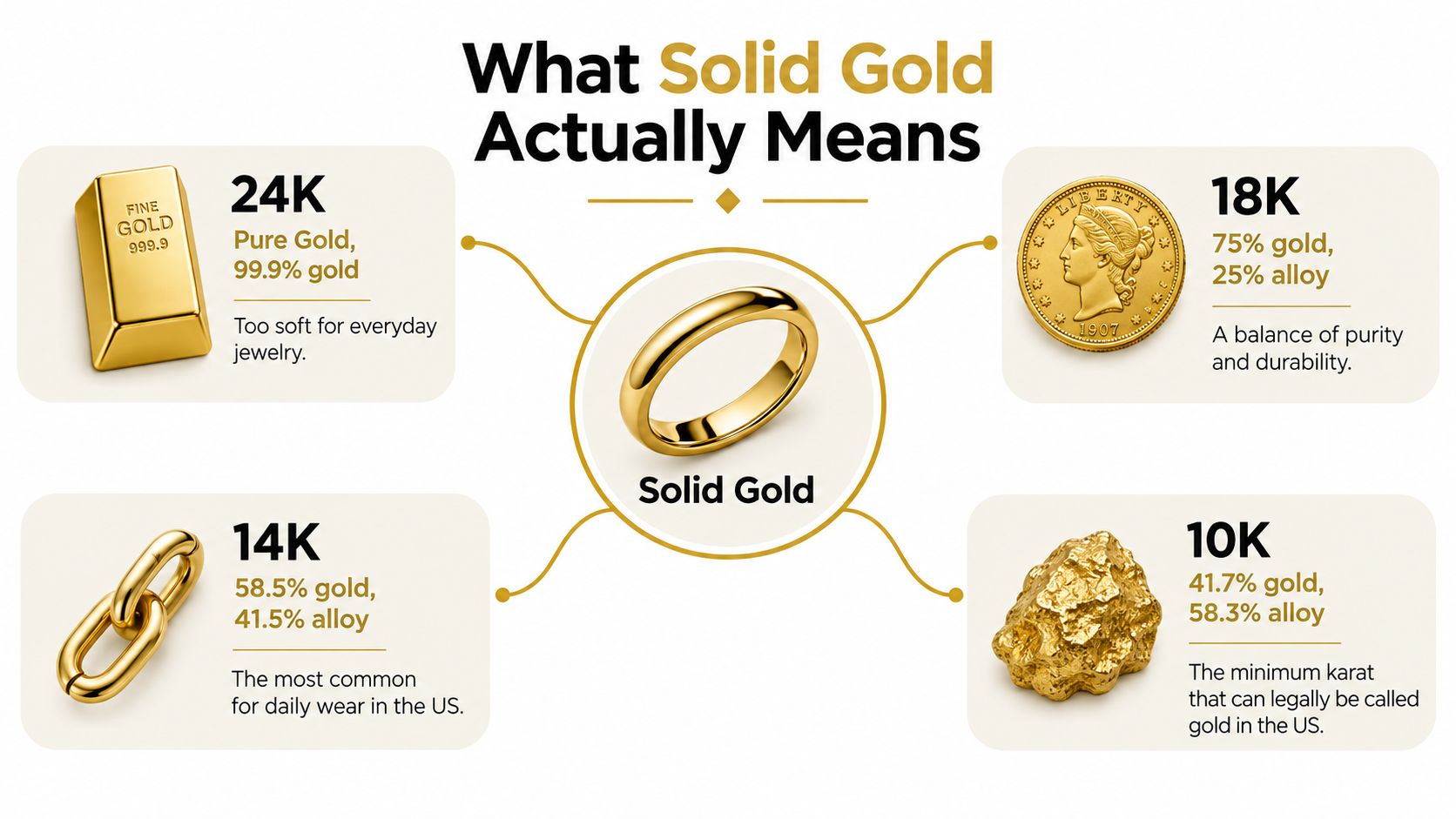
The U.S. Federal Trade Commission explains the math in its FTC guidance on buying platinum, gold and silver jewelry. 24K is approximately 100% gold, 18K is about 75% gold, and 14K is roughly 58.3% gold, with the remainder made up of alloy metals. U.S. federal guidance allows an item to be marked and described as gold only when it's at least 10 karat, provided the karat designation appears with the word gold.
Why Solid Doesn't Mean Pure
A solid 14K ring is gold alloy all the way through. It isn't plated, and it isn't hollow costume jewelry. It also isn't pure gold, and it contains substantially less gold by weight than an otherwise identical 18K piece.
That's not a defect. Pure 24K gold is soft, so manufacturers alloy it for durability. For a wedding band you wear every day, a lower karat can be the practical choice. For resale, higher purity in the same weight means more gold content to price.
- Check two marks: Look for the karat quality mark and the manufacturer's name or registered trademark.
- Treat a missing mark as uncertainty: It doesn't prove a piece is fake, but it removes a traceable accountability point.
- Ask what the alloy means for value: Weight alone doesn't set the offer. Purity changes the calculation.
If you're comparing construction on a small charm before you buy, this breakdown of solid gold vs plated horseshoe charm options is a useful plain-English example of why the core metal matters. Apply the same logic to rings and chains. What's inside matters more than the shine outside.
Solid Gold Versus Gold Plated and Gold Filled
Plated, filled, and solid are not interchangeable labels for the same thing. Treating them as equal is how buyers overpay and sellers walk into a shop expecting a gold price for base metal.
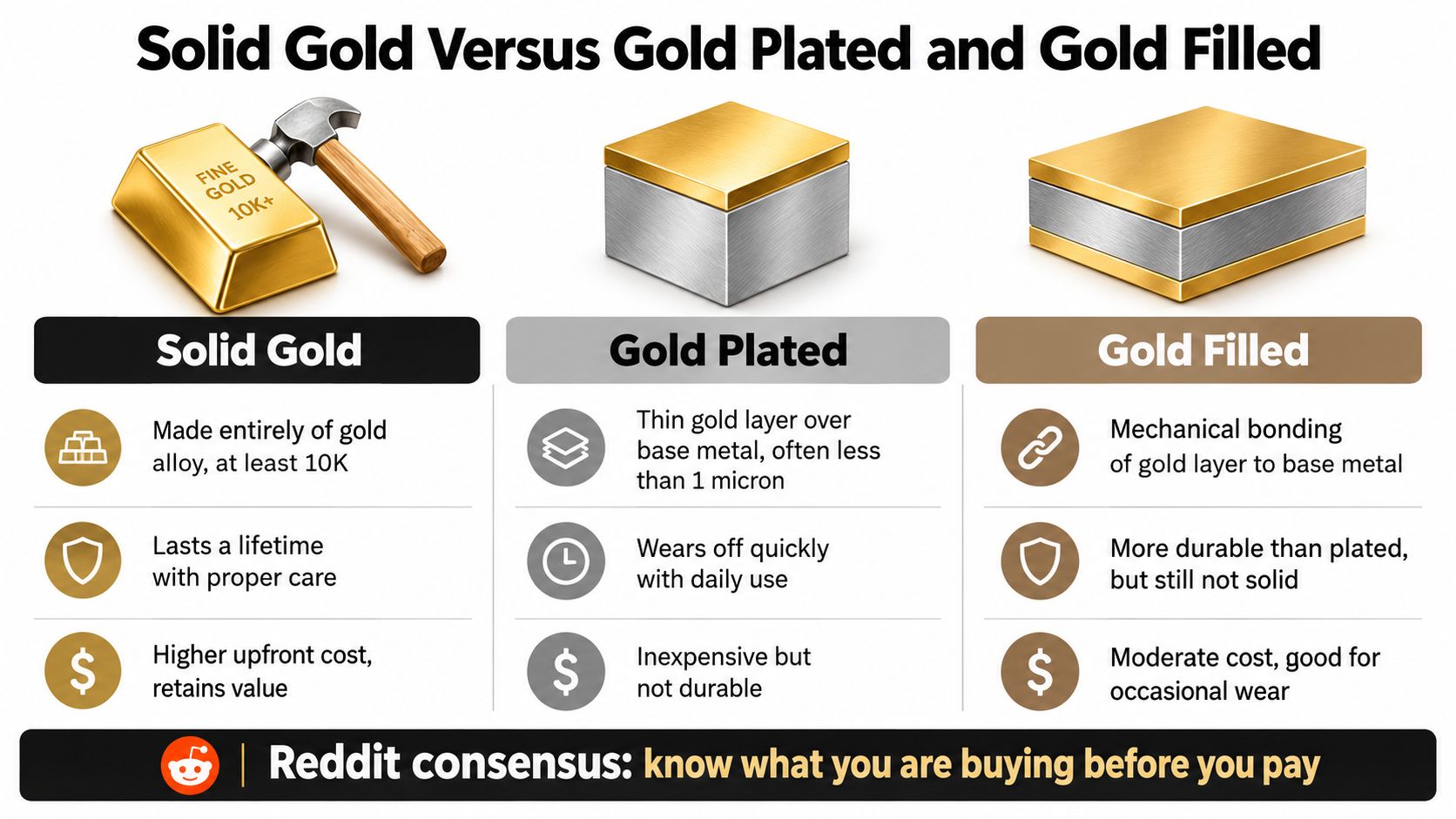
Solid gold is gold alloy throughout the piece. Gold plated jewelry has a thin gold layer over a base metal. Gold filled jewelry has a gold layer mechanically bonded to a base metal core, and it's generally more substantial than ordinary plating, but it still isn't solid.
Why the Counter Offer Changes
A plated chain can look convincing, feel heavy, and pass a casual magnet check because the base metal underneath may not react the way you expect. None of that creates meaningful gold content. When gold is only on the surface, an honest buyer prices the piece accordingly and tells you the category before quoting.
Our detailed guide to the difference between gold filled and solid gold walks through that construction gap in more depth. Read it before you list anything online as solid. Mislabeling invites returns, disputes, and accusations you don't need.
For a visual walkthrough of how these layers differ, watch this short explainer before you test a piece at home.
If you're shopping rather than selling, construction should drive the budget. People who find thoughtful jewelry gifts for daily wear should favor solid pieces for longevity, while occasional-wear fashion pieces can justify a lower-cost construction. Don't pay solid prices for a surface finish.
Melt Value Resale Value and Sentimental Value
Reddit argues about selling inherited gold because people use the word value to mean three different things. Separate them before you decide.
Melt value is what the recoverable metal is worth based on weight and purity. Resale value is what a wearable, branded, signed, or collectible piece can bring as a finished item. Sentimental value is personal, and no scale can measure it.
Three Values That Drive Different Decisions
| Value Type | What It Measures | Typical Buyer |
|---|---|---|
| Melt value | Gold content by weight and karat | Gold buyer or refiner |
| Resale value | Design, brand, condition and demand as jewelry | Retailer, collector or estate buyer |
| Sentimental value | Family history and personal attachment | No buyer, you keep or gift it |
Market context explains why this distinction matters now. The World Gold Council reported that global gold jewelry consumption fell to 1,542.3 metric tonnes in 2025, an 18% decline from 2024, yet demand value rose 18% to a record US$172 billion. Fewer pieces changed hands, but each purchase represented more money. Weight and purity still anchor the asset, while design, workmanship, condition, and brand shape the retail outcome.
Take two inherited items. A damaged, unsigned 14K bracelet with a stretched clasp is usually a melt conversation. A signed vintage watch or a well-kept branded piece deserves a resale evaluation first, because melting it can destroy value a collector would pay for.
Decision rule: Get the melt number and the resale opinion separately. If a buyer only gives you one number without explaining which value it represents, ask.
If you want the math before a visit, start with our guide on what your gold is worth and bring your questions with the piece. Don't melt a family item on a rushed day. You can always sell later. You can't unmelt it.
How Reddit Users Test Gold at Home and at the Counter
Home tests can rule out some obvious fakes. They can't confirm karat with the precision a sale requires. Rank them accordingly.
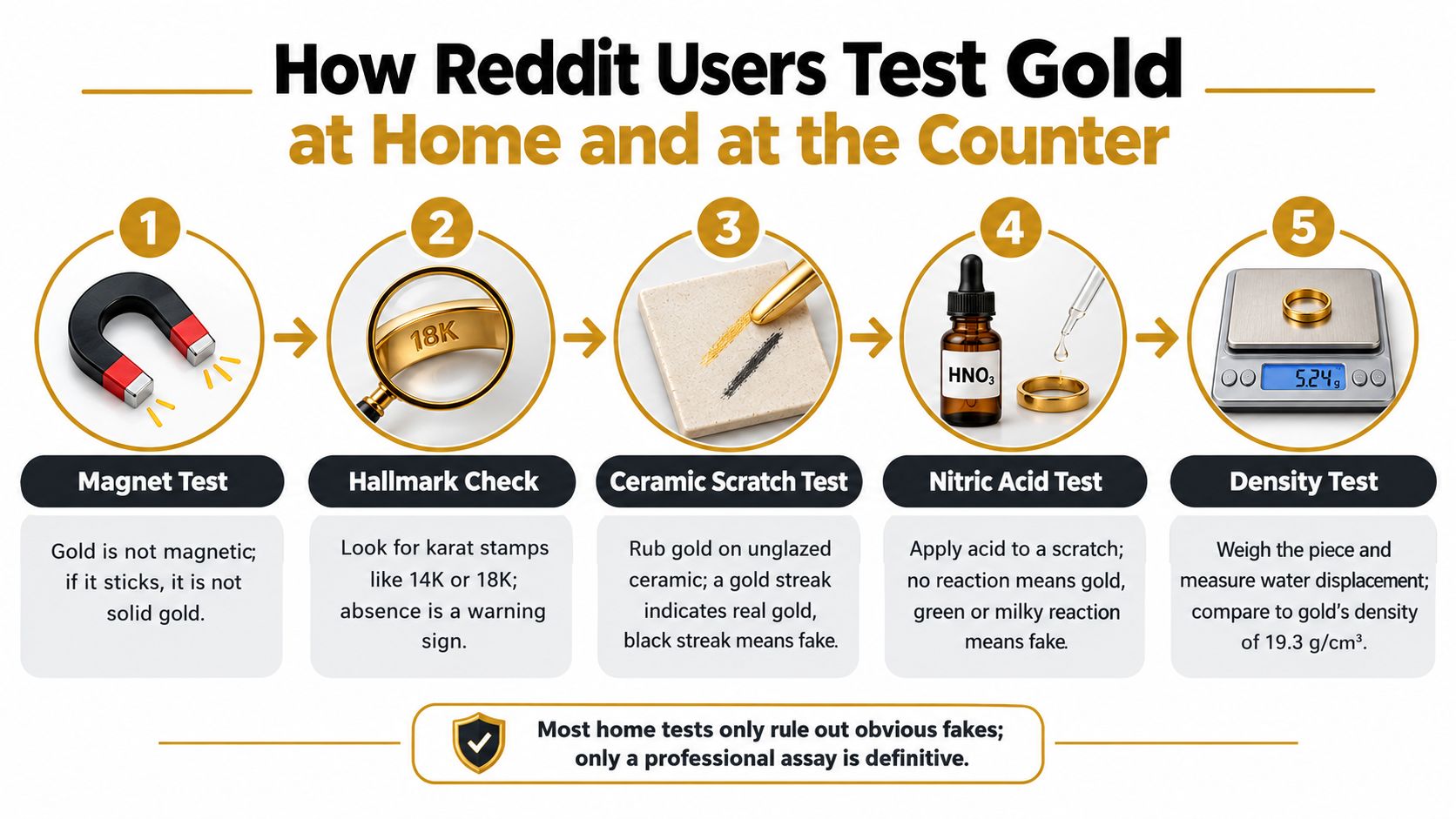
Start with observation. Look for karat and maker marks with magnification, check wear spots for a different colored metal showing through, and note whether a magnet pulls strongly. Those steps cost nothing and sometimes end the mystery.
What Each Test Can and Cannot Prove
- Magnet test: A strong pull is a warning sign, but no pull doesn't prove solid gold.
- Hallmark check: A stamp supports a claim. Stamps can be missing, worn, or wrong.
- Acid scratch test: A professional can learn from the reaction on a testing stone, but a beginner can damage a piece and misread the result.
- Density and weight checks: Useful as supporting information, not as a standalone verdict on a set stone or hollow item.
At the counter, ask for X-ray fluorescence testing, called XRF. Bruker states that portable XRF jewelry analyzers deliver gold concentration and full alloy chemistry in roughly 2 to 5 seconds per sample, within a few tenths of a percent of fire assay under appropriate conditions. It's non-destructive, fast, and shows results in percentages or karats.
XRF has a limit you should know. It primarily measures near-surface material, so plating or an inhomogeneous sample can affect a reading. A good buyer combines XRF with weight, visual inspection, and other checks instead of waving one scan like magic.
Our step-by-step overview of how to test gold purity explains where each method fits. My advice is blunt. Don't acid-test grandma's ring at your kitchen table to save a trip. Get it scanned where you can watch.
Red Flags Buyers and Sellers Should Watch For
The same complaints repeat across threads because the same tactics work on rushed people. Slow down when you see them.
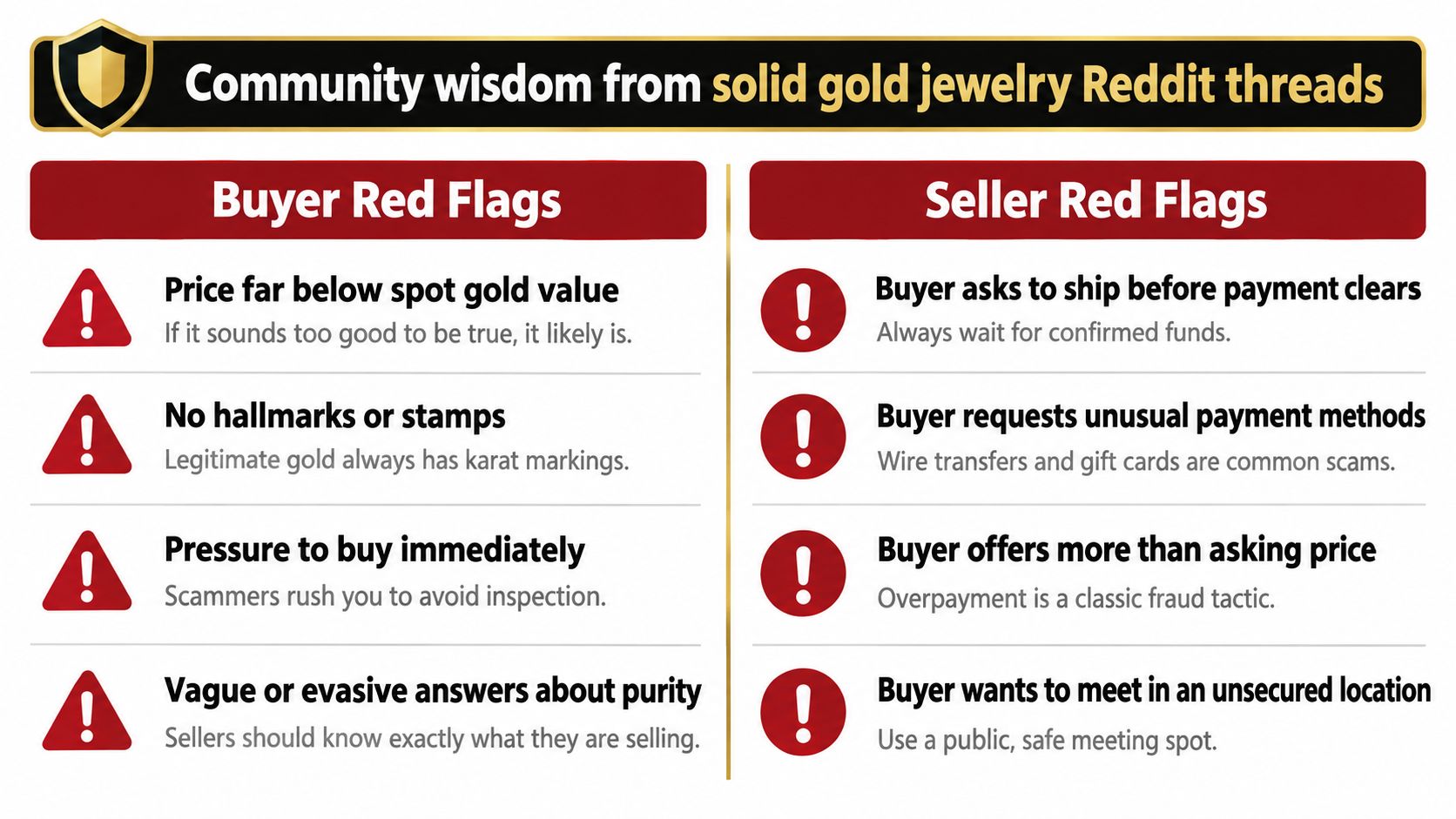
Flags That Should Pause a Deal
- Pressure to ship before testing: You lose control of the piece before purity is established. Say you need testing and a written offer first.
- Vague karat language: Gold tone, gold color, and layered gold aren't karat claims. Ask for the exact construction and stamp.
- No weight in the listing or offer: Without weight and purity, you can't compare numbers. Ask for both in writing.
- Refusal to allow competing quotes: A confident buyer expects comparison shopping. Walk if you're rushed.
- Payment app only with no paperwork: You need identification of the parties and a record of the item and price.
- Missing maker information on a high-priced piece: It weakens traceability and resale confidence.
Comparison isn't rude. It's responsible. FTC consumer guidance recommends comparing prices and quality at several retailers while checking karat marks and seller identification, with price matching mechanics documented in writing. A documented competing offer should identify the same item, the competitor, and whether fees are included. A screenshot of an unrelated online listing isn't comparable.
For visual warning signs on the metal itself, review our guide on how to identify fake gold before you meet a private buyer. If answers get evasive when you ask about testing, weight, or paperwork, end the conversation. Good buyers explain. Bad actors hurry you.
Shipping Gold Versus Selling Locally
Mail-in buyers sell convenience. They don't remove risk. They move the risk into packing, transit, insurance limits, and a waiting period where your jewelry is out of your hands.
Check the carrier rules before you seal a box. USPS states that it insures mailpieces up to $5,000 in indemnity with fees based on declared value, and International Priority Mail Express prohibits platinum, gold, silver, precious stones, jewelry and watches altogether. If your piece is worth more than the coverage you arrange, a loss becomes your problem to document and dispute.
Compare the Two Paths Honestly
Shipping can make sense for a low-value, clearly identified item when you understand the terms, photograph everything, and accept the timeline. It makes less sense for an inherited set, a signed piece, or anything you haven't tested. You'll negotiate by phone after the buyer already holds your gold.
A local sale changes the deal. You watch the test, see the scale, hear whether the offer is melt or resale based, and you can decline and take the piece home. There's no declared-value form, no transit gap, and no argument about what arrived in a damaged box.
Keep possession until you understand the offer. Once jewelry leaves in a mailer, your options narrow fast.
Save the hassle and sell locally for more than online shipments when the piece is valuable, untested, or emotionally difficult to part with. Our local guide to the best place to sell gold breaks down what to look for in a shop. Convenience is worth something. It isn't worth surrendering verification.
Selling Solid Gold in Boise With Carat 24
If you're in the Boise area, bring the piece in and settle the questions Reddit can't settle from photos. Carat 24 is at 3780 W. State St. in Boise, Idaho, and specializes in Gold and Jewelry Buying alongside silver, bullion, numismatic coins, signed jewelry, Rolex and other luxury watches, and luxury handbags.
Bring the jewelry, any boxes or paperwork you have, prior appraisals if they exist, and a competing written offer if you've already shopped around. Don't clean aggressively or try to polish out marks before a visit. Original condition gives the buyer better information, especially on vintage or signed items.
What Happens at the Counter
Each item goes through a rigorous 8-step authentication process. You get Xray Scanning and Gold Testing for free, so you see purity data instead of guessing from a stamp. Staff weigh the piece, assess construction and condition, and separate metal value from any resale premium for brand, design, stones, or collectibility.
Ask direct questions while that happens.
- Purity result: What karat did the scan show, and does it match the stamp?
- Basis of the offer: Is this priced for melt, resale as jewelry, or both?
- Stone handling: Are stones included, returned, or valued separately?
- Written terms: Can you take the offer details with you and decide without pressure?
Hassle free offers should mean exactly that. The number is explained, the testing happens in front of you, and you can say no. Carat 24 aims for the highest payout in Boise and offers Price Matching on documented, comparable local offers, so bring proof of the competing price and ask how the match applies to your specific item. That written mechanic matters more than a vague promise over the phone.
Trade-ins deserve a look too. The World Gold Council reported that about 40 to 45% of jewelry purchases in Q1 2025 involved exchanging old jewelry for new. An unworn chain can become credit toward something you'll wear instead of sitting in a drawer while you debate mailing it away.
My closing recommendation for Boise sellers is practical. Don't pay to test what a local expert will scan free. Don't ship an unidentified estate piece before you know its karat and weight. Bring it in, watch the process, compare the written offer, and decide at your pace.
Bring your solid gold rings, chains, estate jewelry, coins, or luxury watch to Carat 24 for free X-ray scanning, clear testing, and a documented offer you can compare before you decide. Visit Carat 24 - Trusted Gold Experts to plan your visit to 3780 W. State St. in Boise and turn Reddit guesswork into verified numbers.
