

You're sorting through a drawer, a safety-deposit box, or a family collection and find a gold coin marked $5, $10, or $20. The face value looks clear, but it doesn't tell you how much gold the coin contains or what a buyer might pay for it.
Start with the coin's fine-gold content: the weight of pure gold inside it. That figure depends on the coin's total weight and its fineness, or gold purity. Its date, condition, and collector appeal matter too. Two coins with the same denomination can have different gold content, and two coins with the same gold content can still sell for different amounts.
Knowing the gold content of US coins helps you estimate melt value, ask better questions during an appraisal, and avoid accepting a figure based only on the number stamped on the coin. The practical approach is straightforward: identify the coin, verify its specifications, calculate its fine-gold weight, then consider any numismatic premium before deciding where to sell.
Why Gold Content Is the First Number to Know
The denomination on a coin is a historical face value, not a current price tag. A gold coin marked $20 isn't necessarily worth $20, and it isn't automatically worth more than another coin marked $10. What matters first for its metal value is how much pure gold it contains.
That's why the first questions at the coin-room bench are practical. What is the coin's date and type? What does it weigh? What is its fineness? Once you know those details, you can estimate its melt value. Then you can ask whether its condition, scarcity, or appeal to collectors could make it worth more than the metal alone.
An old U.S. coin may be made of a gold alloy rather than pure gold. As a result, weighing the entire coin doesn't tell you the exact amount of gold in it. A coin's denomination doesn't settle that question either. Its actual specifications do.
Melt value is a starting point
Melt value is an estimate based on the coin's fine-gold weight and the current gold price. It's a useful baseline, but it isn't necessarily the final sale value. A collectible coin in desirable condition may attract a premium, while a worn or common coin may trade closer to its metal value.
At the bench: Don't clean or polish an old coin before having it examined. Its condition can matter to collectors, and cleaning may affect that assessment.
A careful buyer should be able to explain how the coin was identified and how its gold content was determined. By the time you're ready to compare offers, you'll want to understand the difference between total coin weight, fine-gold weight, and collector value. That's the difference between guessing from the number on the front and evaluating the coin on its merits.
Fineness and Troy Ounces Explained Without the Jargon
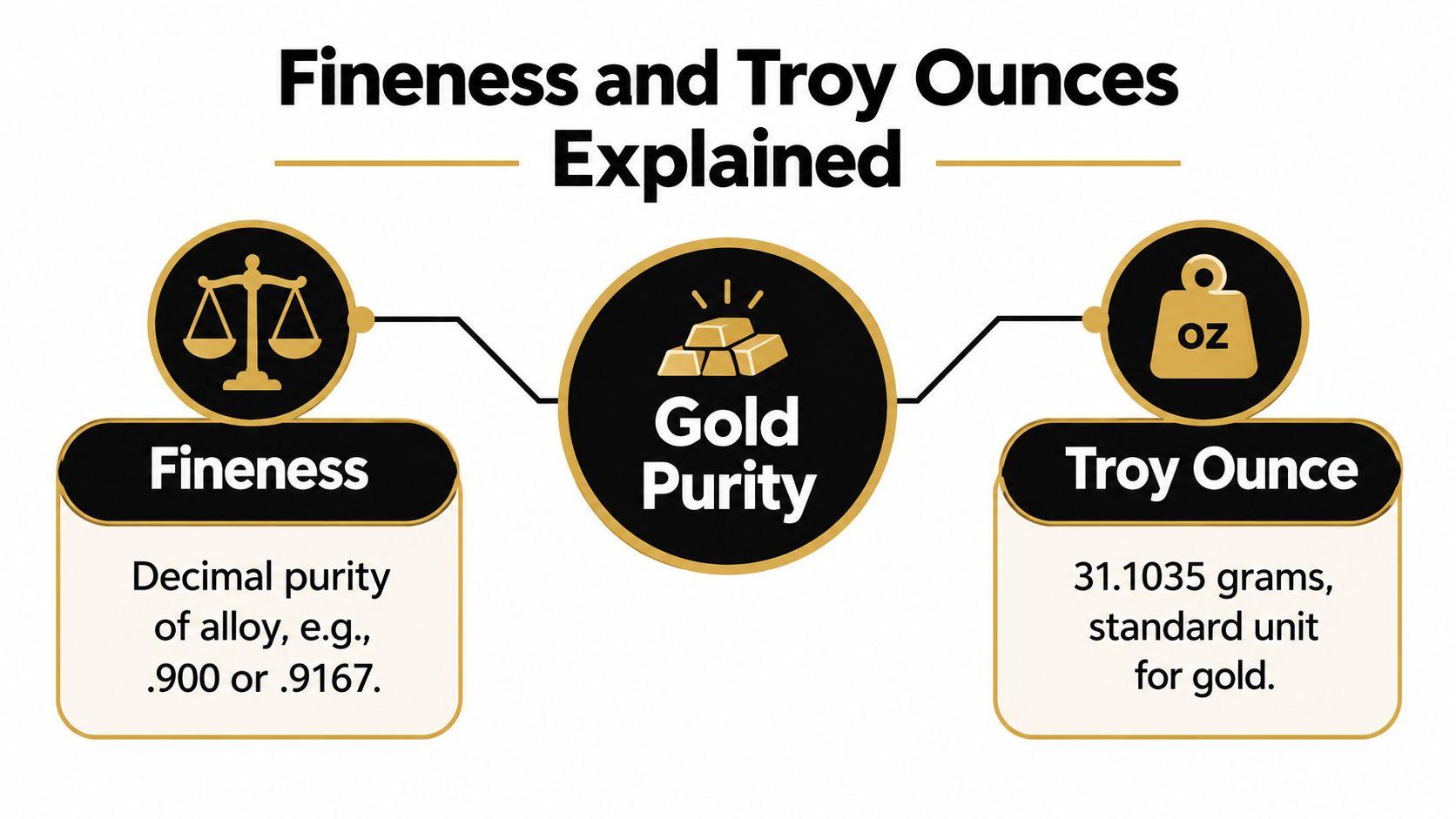
Fineness describes the proportion of gold in a metal alloy. The cocoa percentage on a chocolate bar works the same way: it tells you how much of the whole is the ingredient you're measuring. A fineness of .900 means 90% of the coin's weight is gold; the rest is other metals.
Early U.S. gold coins were alloys, and the recipe changed more than once. The Coinage Act of 1792 set the first standard at .9167, or about 91.67% gold. The standard shifted to .8992 in 1834, then settled at .900 in 1837, as recorded in U.S. Mint production histories. That .900 standard is the one you'll meet most often: a $20 double eagle struck after 1837 is .900 fine, so a 33.436-gram coin holds about 30.09 grams of pure gold.
The second term is troy ounce, the standard unit for precious metals. One troy ounce equals 31.1035 grams, so an ordinary kitchen scale's ounce reading measures the wrong unit. For a plain-language comparison of the two units, see why troy ounces matter for gold. This guide to what a troy ounce means defines the unit in everyday terms.
From gross weight to pure gold
To estimate the pure gold in a coin, multiply its total weight by its fineness. The total weight is often called gross weight. The result is the coin's fine-gold weight, the figure that feeds a melt-value estimate.
The math fits on one line. 10 grams × .900 = 9 grams of pure gold, and the leftover gram is alloy. Across the counter in Boise, a buyer runs that same multiplication before quoting you a price. Knowing it before you walk in lets you check the offer instead of taking it on faith.
Classic US Gold Coins and the 90% Standard
A seller walks into a Boise coin shop with an envelope from a grandparent's estate: a $20 gold piece, a $10 piece, and two smaller coins marked $5 and $2.50. Those four face values are the classic U.S. gold denominations, known as the $20 double eagle, $10 eagle, $5 half eagle, and $2.50 quarter eagle. The denomination stamps the coin's type, and the type tells you how much gold you're holding.
The United States began striking gold coins in 1795, three years after the Coinage Act of 1792 set up the framework for federal coinage. Specifications shifted over the early decades, then settled at .900 fine in 1837, as noted earlier. That single standard makes the classic family easy to work with: every coin is nine parts gold to one part alloy, so the fine-gold content scales directly with the denomination.
| Denomination | Gross weight | Fineness | Fine-gold weight |
|---|---|---|---|
| $20 double eagle | 33.436 g | .900 | 30.09 g |
| $10 eagle | 16.718 g | .900 | 15.05 g |
The half eagle and quarter eagle carry the same .900 alloy at proportionally smaller weights, roughly one-half and one-quarter of the eagle's gold content. That proportional structure is why dealers can quote classic U.S. gold quickly. Once the denomination is identified, the expected weight is already known.
You can run that check yourself. A buyer weighing your $10 eagle expects the scale to read near 16.7 grams. A coin that comes in noticeably light may have lost metal to wear or damage, which trims the melt figure before collector value even enters the conversation.
Why date and condition matter
Identical gold content does not mean identical offers. Federal gold-coin production for circulation ended in 1933 during the Great Depression, when measures to stabilize the monetary system restricted private ownership of many gold coins and bullion. Ownership rules changed again in 1974, but the Mint never returned gold to everyday circulating coinage.
Two double eagles can sit side by side with the same 30.09 grams of fine gold and sell for different amounts. Date and mint mark place the coin in its mintage history, and condition decides whether a buyer prices it as bullion or as a collectible. For an inherited coin, record the date and any mint mark first, then have the weight verified on a calibrated scale.
Practical rule: A $20 double eagle's face value says nothing about its resale value. Confirm the coin's identity, weight, fineness, date, and condition before weighing any offer.
Modern US Gold Coins Explained
A seller walks into a Boise coin shop with a $50 American Gold Eagle, watches it land on the scale at 33.931 grams, and asks why a "one-ounce" coin weighs more than an ounce. The answer sits in the gap between fine-gold weight and total coin weight. The stated size describes the pure gold inside the coin. The scale reads the whole alloy.
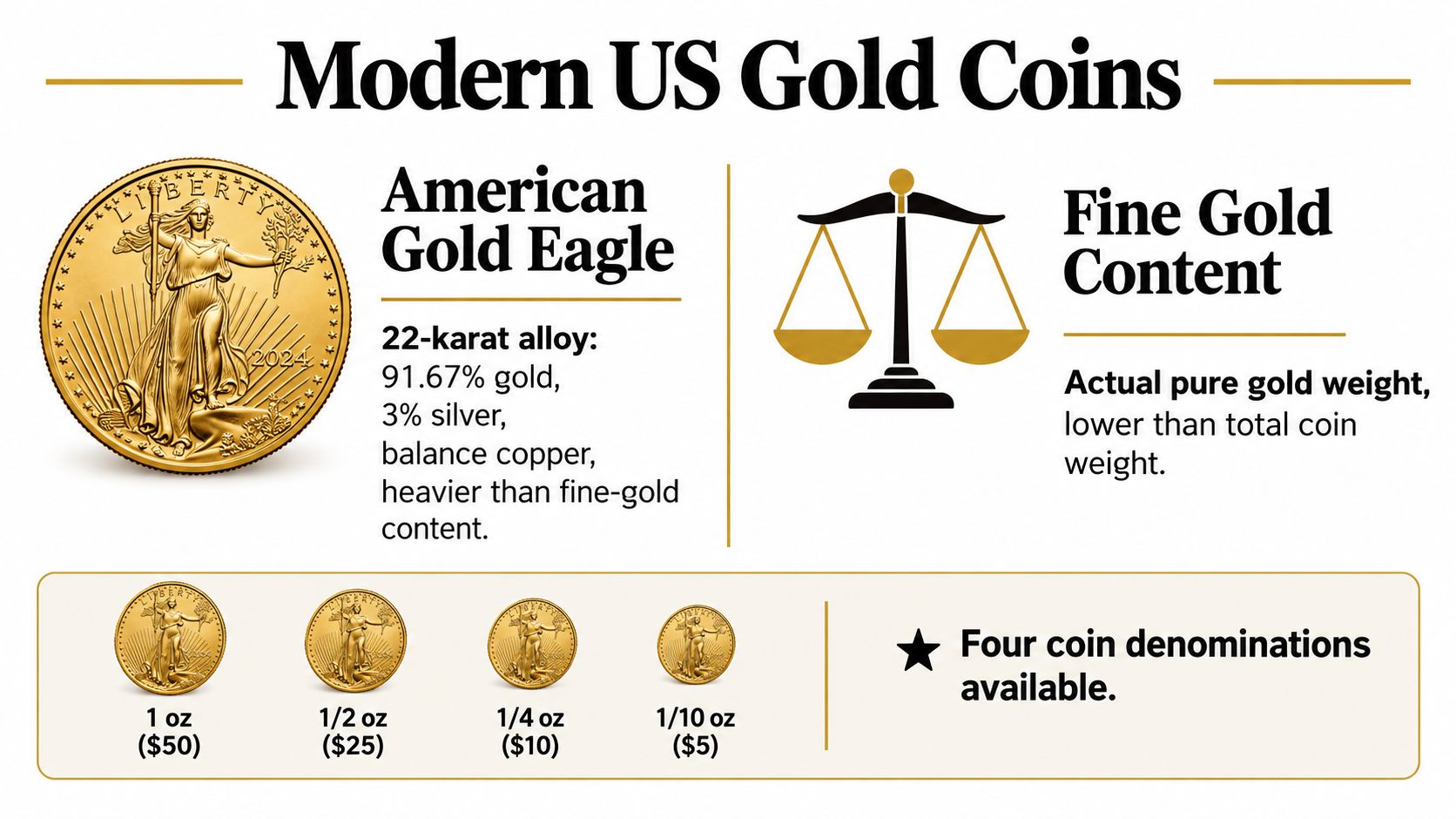
The Eagle is a 22-karat alloy containing 91.67% gold, 3% silver, and the balance copper. That blend is harder than pure gold, which helps it resist scratching and deformation during handling, according to the U.S. Mint's bullion coin program specifications.
The federal specifications cover four denominations, and the fine-gold amount is what the stated size refers to. Gross weight includes the alloy metals.
| Face denomination | Fine-gold content | Gross weight |
|---|---|---|
| $50 | 1 troy ounce | 33.931 grams |
| $25 | 1/2 troy ounce | 16.966 grams |
| $10 | 1/4 troy ounce | 8.483 grams |
| $5 | 1/10 troy ounce | 3.393 grams |
Those denominations and fine-gold amounts are set by federal statute. A one-ounce Eagle weighs 1.0909 troy ounces, or 33.931 grams, in total because its alloy carries metals besides gold. The one-ounce label means one troy ounce of fine gold.
Commemorative coins use their own specifications
A modern commemorative can follow a different legal specification from an American Gold Eagle, even at the same face value. The 2010 Star-Spangled Banner $5 commemorative was required to weigh 8.359 grams and contain 90% gold, under the terms of its federal authorizing law. That is the same $5 denomination as the tenth-ounce Eagle, with a different weight and a different fineness.
A coin's name or face value cannot stand in for its legal composition. When you bring modern gold across a Boise counter, arriving with the correct specification for each coin means the offer starts from the right fine-gold weight, and a buyer who skips that step is easier to spot.
The Mint's alloy choice also explains why Eagles carry no stated purity on the coin itself: the 22-karat composition is a legal specification, not an inscription.
How to Calculate Melt Value Step by Step
You can estimate a coin's melt value by finding its fine-gold weight and applying the current gold price. The calculation has three parts: confirm the total weight, multiply by fineness, then convert the result to troy ounces if your gold price is quoted per troy ounce.
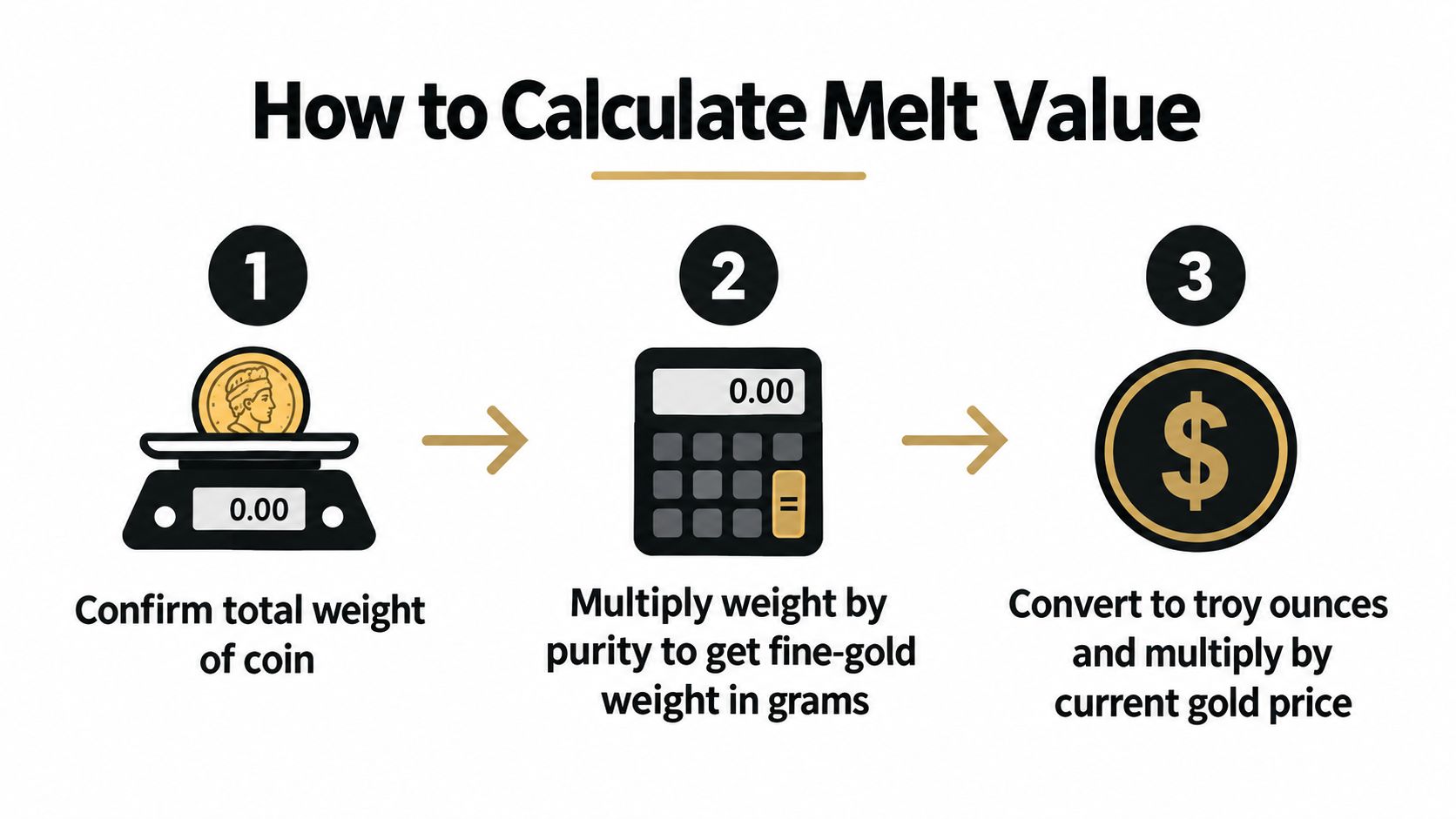
- Confirm the coin and its weight. Use the correct specifications for the exact coin, or have its weight checked on a suitable scale. Don't assume that the face value or the coin's appearance establishes its weight.
- Multiply by fineness. For the Star-Spangled Banner commemorative, the calculation is 8.359 grams × .90 = 7.5231 grams of fine gold. The federal specification works out to approximately 0.2419 troy ounce of gold.
- Apply the current gold price. Convert the fine-gold weight into troy ounces, then multiply by the current spot price per troy ounce. For a guide to the price benchmark used in this calculation, see what gold spot price means.
Check whether collector value changes the result
For a one-ounce American Gold Eagle, the specification is 33.931 grams total and one troy ounce of fine gold. Its gold content is already stated in troy ounces, so you don't need to treat its alloy weight as though it were all pure gold.
Melt value is a baseline, not a guaranteed offer and not always the coin's full market value. A rare date, desirable mint mark, strong condition, or collector demand can create a numismatic premium. Ask the buyer to distinguish the metal calculation from any collector assessment, so you can see how each part contributes to the offer.
Why Denomination Is Not the Same as Value
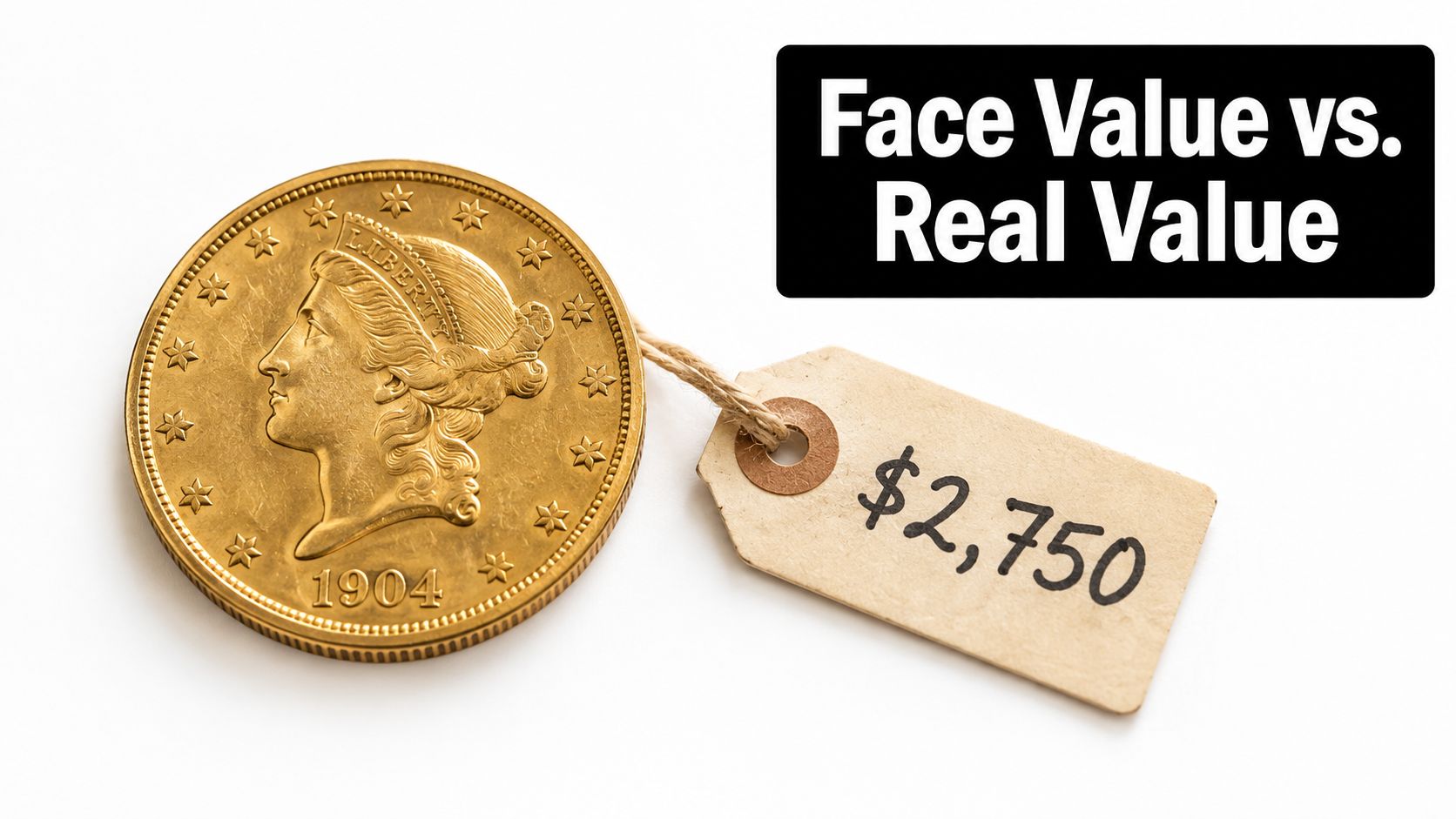
Once you can calculate a coin's fine-gold weight, the denomination printed on it becomes far less useful for pricing. A modern $5 Eagle and a classic $5 half eagle share the same legal denomination, but they are different coins with different gold specifications. Face value works like a size label across different sizing systems: the same mark does not guarantee the same underlying measurement.
Federal statute specifies the gold weights for the $50, $25, $10, and $5 American Gold Eagles. Those denominations identify each version within the series; they do not establish today's resale price. Before comparing offers, identify the exact coin, calculate its fine-gold content, and then consider date, mint mark, condition, and collector demand separately.
At a Boise counter, that separation can directly affect your selling decision. Ask the buyer to show the coin's metal calculation first, then explain any additional amount tied to collector interest. A local appraisal gives you the chance to question each part of the offer before accepting it, rather than relying on one unexplained quote from a mail-in buyer.
What heirs should record
For an inherited collection, keep records that connect each coin to the basis used for its valuation. Inherited property generally receives a basis tied to fair market value at the decedent's death, and collectibles can receive different federal tax treatment from other assets. Because the outcome depends on the circumstances, obtain qualified tax advice instead of relying on a buyer's estimate.
A useful record includes:
- Coin identity: denomination, date, and mint mark.
- Metal details: fineness and fine-gold weight, when established.
- Condition: a written description or professional assessment.
- Valuation: date-of-death fair market value and the basis for the estimate.
- Collector premium: any numismatic amount identified separately from melt value.
Two coins with identical gold content can still receive different offers because condition, scarcity, or demand differs. Understanding what makes a coin numismatic helps keep that distinction clear: bullion value comes from the metal, while numismatic value comes from collector interest.
Authentication Tips and Why Free X-Ray Scanning Matters
A coin's appearance is only one part of authentication. A buyer can begin by examining its design, wear, and edge, then compare its weight and dimensions with the specifications for that coin. Those checks help identify pieces that deserve a closer look, but no single visual impression settles the question of composition.
X-ray fluorescence (XRF) is a nondestructive method for analyzing elemental composition. It can help determine karat or fineness without melting, cutting, or otherwise damaging the coin. Its reading primarily reflects the surface layer, however, so plating or hidden subsurface features may not be reliably identified by an XRF scan alone. The technical overview of nondestructive gold testing explains why XRF is best treated as a rapid screening method.
A useful test result answers a question. It doesn't replace the rest of the examination.
What a careful examination can include
An experienced buyer may combine surface analysis with other checks, especially if the coin is unusually valuable or authenticity is disputed. That may involve comparing the piece's dimensions and weight with known specifications and using an additional assessment method where appropriate. The goal is to verify both the coin's identity and the composition behind the offer.
For a first-time seller, the process should be understandable. Ask what the XRF reading shows, what it can't establish, and whether the buyer recommends another method. You can also review how gold purity testing works before bringing in a coin.
Carat 24 - Trusted Gold Experts offers free X-ray scanning and gold testing for coins. A clear explanation of the scan and any follow-up check helps you understand what's being valued, while nondestructive testing avoids the need to damage a coin just to assess its metal.
Selling Locally in Boise Beats Shipping Online
An online quote isn't necessarily the amount you'll keep. Shipping, handling, packaging, insurance, taxes, and other fees can affect the final total, and mailing a coin also means waiting for delivery and inspection. The Federal Trade Commission advises shoppers to compare the full cost and check whether a seller offers price matching. It also makes sense to confirm any price-match terms in writing, as explained in the FTC's online shopping guidance.
A local, in-person appraisal lets you watch the coin being examined and ask questions before accepting an offer. You can compare the proposed melt-value calculation with the coin's potential collector value instead of relying on a mail-in process that separates you from the item. If you're deciding between local and online options, this guide to where to sell gold coins can help you prepare.
What to bring and what to ask
Carat 24 is located at 3780 W. State St. in Boise, Idaho. The business buys gold, silver, bullion, and numismatic collectibles, and offers free X-ray scanning, free gold testing, hassle-free offers, and price matching. Its staff can examine a coin's authenticity, weight, gold content, condition, and possible collector premium. Ask how the offer was calculated and whether any price match applies to the specific item and terms.
Before you go, gather the coins without cleaning them and make a simple note of what you know. This helps the appraisal stay focused on the pieces rather than on trying to reconstruct their history at the counter.
- Bring identification and any documentation or packaging that came with the coins.
- Group coins by type if you can, and keep unusual or potentially collectible pieces separate.
- Note dates and mint marks so the buyer can identify each coin accurately.
- Ask for the melt-value breakdown in writing, including how the buyer assessed any collector premium.
- Compare the final net offer, not just an online headline quote, and confirm price-match terms before agreeing.
Selling locally won't guarantee a higher offer in every case, but it can spare you shipping expenses and delays while giving you a chance to discuss the coin face to face. For Boise sellers weighing mail-in quotes against an in-person appraisal, free testing and a clear offer make the comparison more concrete.
Visit Carat 24 - Trusted Gold Experts in Boise for free X-ray scanning, gold testing, and a clear explanation of your coin's melt and collector value. Bring your coins in for a hassle-free offer, ask about price matching, and compare the local payout with the full cost of shipping them online.
