
You're holding a watch you inherited, bought second hand, or found in a drawer, and you're asking the right question. Is it real, is it original, and what should you do before you buy, sell, or insure it? Don't trust weight, shine, papers, or a smooth sweep on their own. Good watch authentication checks the whole object, piece by piece, and separates identity from originality, condition, and value.
Why Watch Authentication Matters Before You Buy or Sell
A client brings in a clean looking Rolex with a box and a confident story. The movement runs, the bracelet feels solid, and the seller swears it's unworn. That's exactly where people lose money. Appearance and a running movement prove almost nothing today.
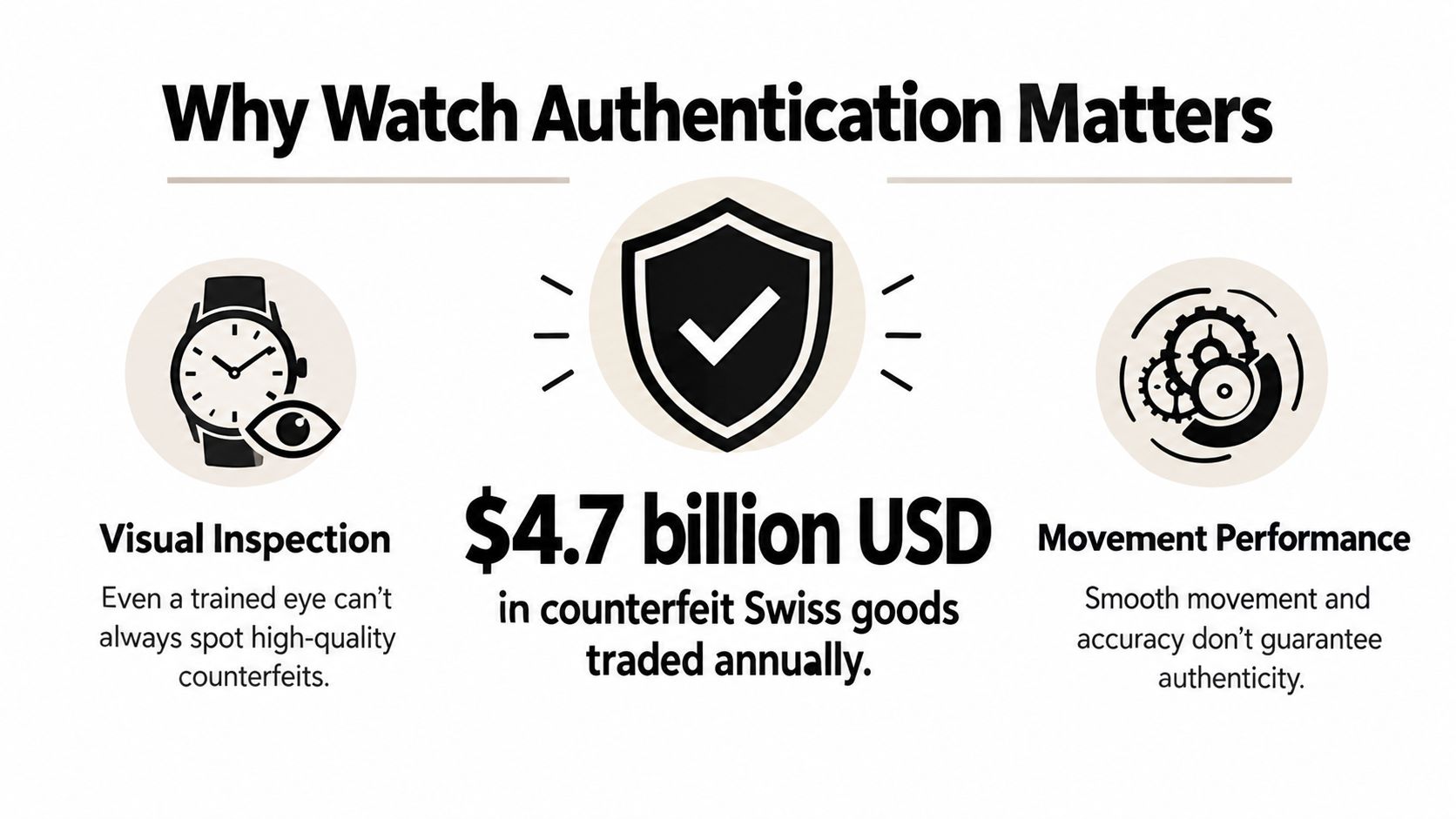
The scale explains why. The OECD estimated counterfeit goods infringing Swiss trademarks reached USD 4.7 billion in 2021, equal to 1.3% of Switzerland's total exports. Watches were the most targeted category in that same analysis. They accounted for 87% of worldwide customs seizures involving counterfeit goods infringing Swiss intellectual property rights during 2020 to 2021, per the same OECD figures.
What a Defensible Check Actually Covers
Start with the basics and work inward. Record reference, serial, configuration, accessories, and provenance before you touch anything. Then inspect case geometry, engravings, dial printing, hands, lume, bracelet, and clasp under magnification.
Next, compare dimensions, weight, finishing, and component architecture with manufacturer specifications for that exact reference and era. Look for signs of modification or replacement, not just a wrong logo. A watch can have correct branding and still carry a swapped dial, wrong hands, or a movement that doesn't belong in that case.
Practical rule: If a conclusion rests on one clue, you don't have a conclusion. You have a guess.
Why Sellers Need This Too
Authentication isn't only buyer protection. If you're selling, clear findings let you price fairly, disclose service parts, and avoid a return or dispute after payment. Our guidance on where to sell luxury watches in Boise starts from that same principle, document first, negotiate second.
Do it in order. Photograph identifiers, inspect non-invasively, test performance, and open the case only when evidence warrants it. Skipping straight to price is the most expensive mistake in any pre-owned transaction.
Hands-On Checks You Can Run at the Kitchen Table
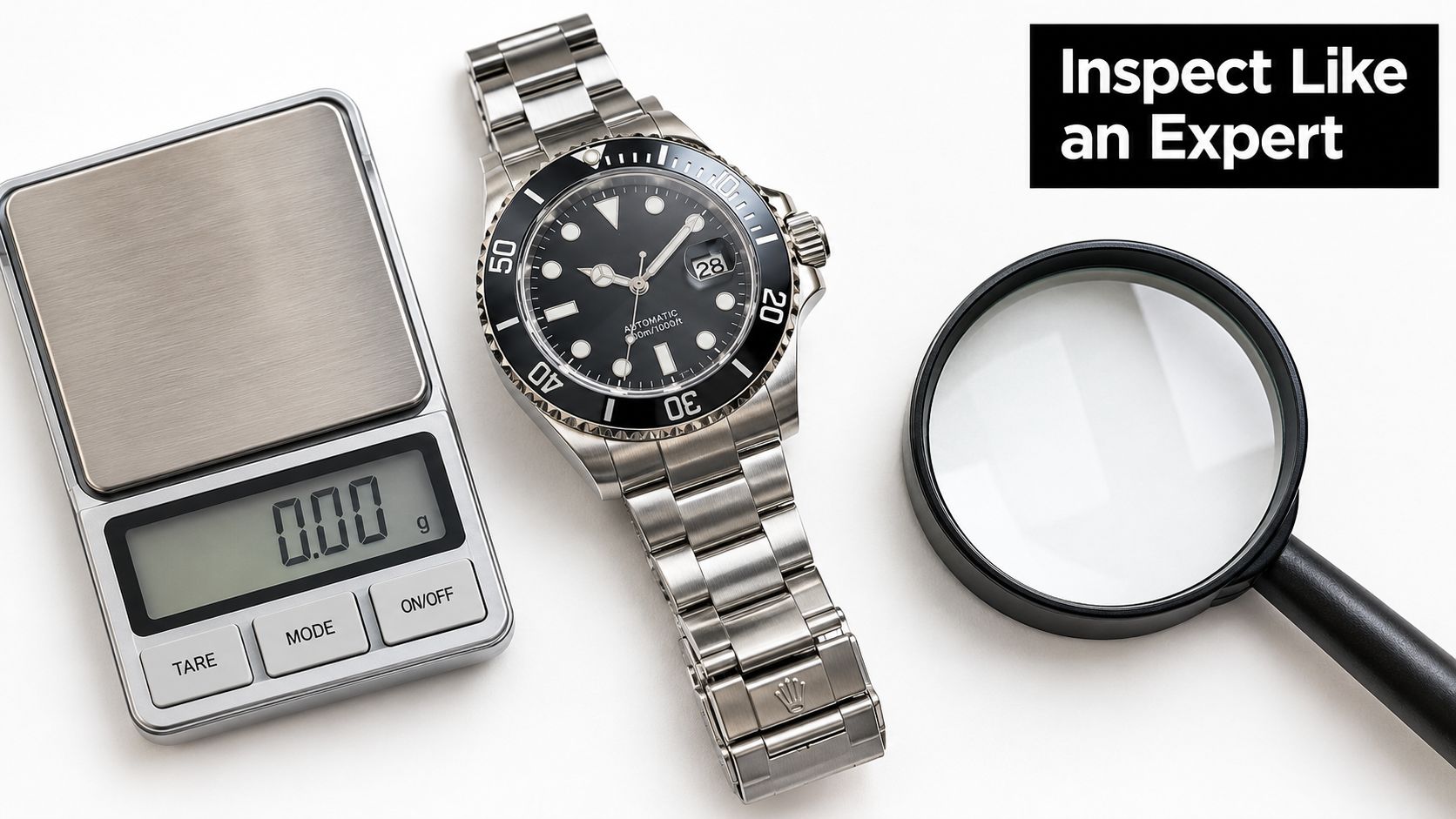
You don't need a bench to catch the obvious problems. You need good light, a loupe, a small jewelry scale, and fifteen quiet minutes. Work slowly and write down what you see.
The risk isn't rare. The Federation of the Swiss Watch Industry states tens of millions of fake Swiss watches are offered annually, while legitimate Swiss production is approximately 30 million watches per year. The federation also puts fake watches at about 9% of customs seizures, second only to textiles, according to that same source. Assume exposure, then verify.
Start With Touch and Magnification
- Weigh it against the correct specification: Compare the full watch, bracelet included, with the published weight for that reference and material. A counterfeit often feels too light, though added weight alone doesn't prove a real watch.
- Inspect engraving under magnification: Check the rehaut, case, clasp, and case back for crisp, evenly spaced characters. Soft edges, uneven depth, or misaligned letters should stop you.
- Rotate the dial in natural light: Look for printing bleed, crooked applied indexes, misaligned hands, and lume that varies in color or fill. Legitimate dials stay clean at angles where fakes smear.
- Run a fingertip over the bracelet: End links, clasp edges, and link joints should feel finished, not sharp or rattly. Excess play and rough milling are useful warnings.
The same habit of comparing stitching, tags, fonts, and materials shows up in other categories. If you want a parallel example outside watches, how to spot fake jerseys is a useful reminder that counterfeiters copy the headline logo and miss the small construction details.
Don't overvalue the seconds hand. A smooth sweep doesn't authenticate anything because counterfeiters can fit high beat or cloned movements. Note the behavior, then move on to physical consistency, case shape, crown action, and finishing. If two or more basic checks conflict, stop calling it a kitchen table question.
Reading Serials, Papers, and Provenance Like a Detective
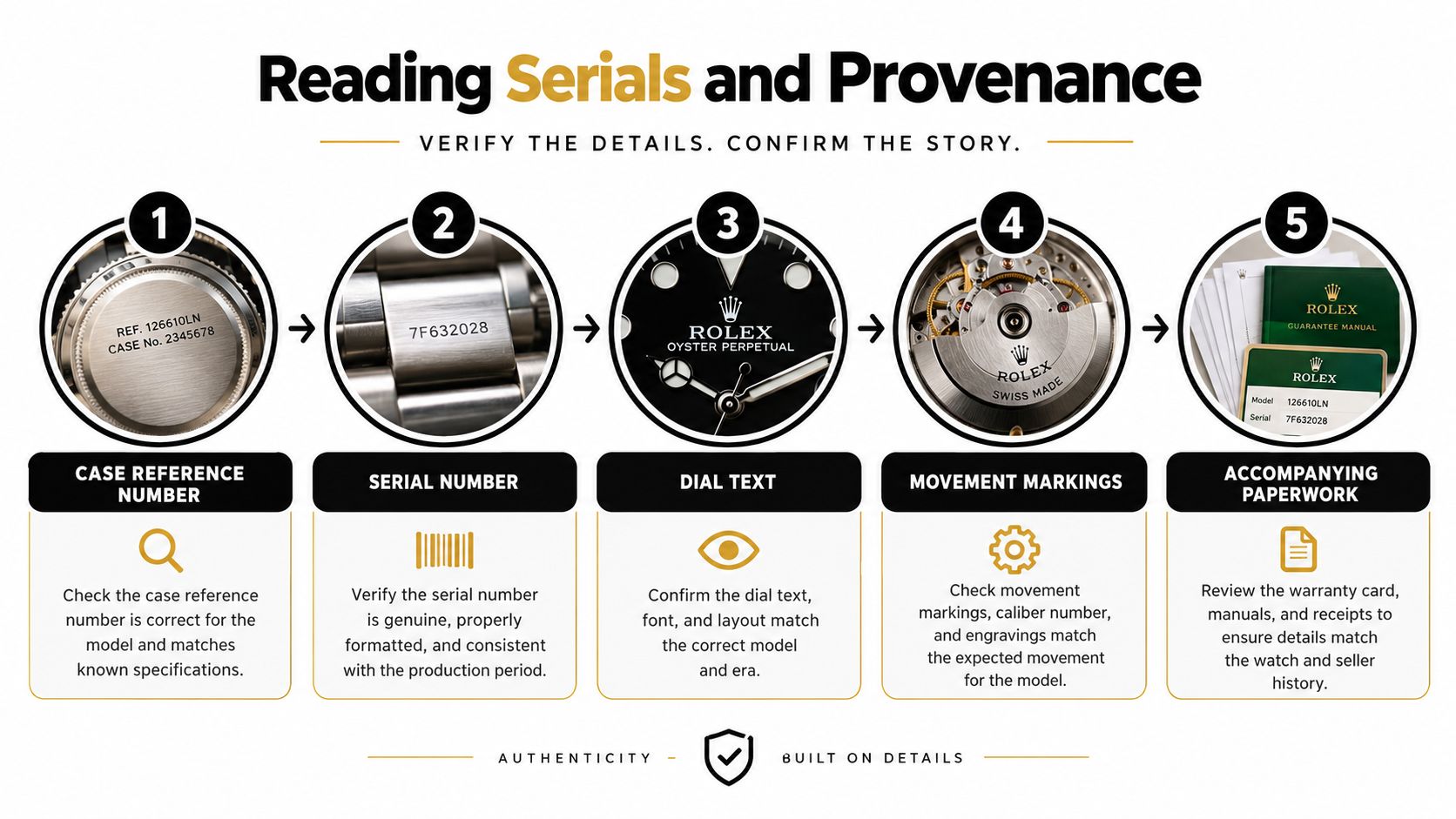
Paperwork helps, but it doesn't authenticate a watch by itself. Papers can be copied, boxes can be married to the wrong watch, and a serial can be reproduced. What matters is consistency between the documents and the physical object in your hand.
Start by photographing every identifier. Note the case reference, serial number, dial text, bracelet code, clasp markings, and movement markings if they're visible without opening the case. Then ask a simple question for each one. Does this detail fit the claimed model, material, and production period?
Cross Checks That Catch Real Problems
A serial range that fits one era paired with dial text from another is a problem, even if both look genuine separately. The same goes for a warranty card font that doesn't match the period, a reference that never came in that metal, or a bracelet code that postdates the watch by years without a service explanation. Don't excuse mismatches because the seller sounds sincere.
For Rolex specifically, use a structured Rolex serial number lookup guide to place the number in context before you judge the papers. Then reconcile case numbers, movement numbers, and documents together. If paperwork conflicts with physical evidence, trust the physical evidence and investigate further.
The short video below is useful for seeing how identifiers are handled during an inspection rather than treating serials as magic passwords.
Precious metal claims need their own check. Portable X-ray fluorescence, or XRF, testing can analyze gold, silver, and platinum without cutting or scratching, returning concentration and alloy data in approximately two to five seconds. Bruker's description puts accuracy within a few tenths of a percent of fire assay, per that same source.
Use XRF correctly. It's surface oriented, so it supports a metal claim but doesn't prove the entire watch is genuine, original, or correctly documented. Pair alloy screening with magnetism checks where appropriate, keep photos of stamps and hallmarks, and record what you tested. That's how you build an evidence chain, not a pile of reassuring paperwork.
What a Timegrapher and Movement Tests Really Tell You
A timegrapher gives you evidence. It does not give you a verdict. Treat timing, magnetism, and water resistance as supporting layers that must agree with the caliber, case, and service history.
For certified mechanical chronometers, ISO 3159 and COSC testing evaluate rate over 15 days across multiple positions and temperatures, with a commonly cited tolerance of -4/+6 seconds per day. That's a certification standard, not a quick counterfeit test. A competent replica movement can pass a short timing check, and a genuine watch that needs service can fail one.
A Bench Protocol You Can Defend
Fully wind the watch first. Then measure rate, amplitude, and beat error in at least six positions, let it stabilize, and repeat the run. Compare the results with the expected specification for that caliber, including correct lift angle assumptions.
Large positional swings can point to a wrong movement, damaged escapement, magnetization, contamination, or poor prior servicing. They don't tell you which one without inspection. Record instrument settings, positions, and results so another watchmaker can reproduce your findings.
A watch that keeps good time for five minutes on a machine hasn't proven its identity. It's proven it keeps good time for five minutes.
Magnetism and Water Resistance Need Context
Magnetism results also need the right benchmark. ISO 764 related testing uses a 4,800 A/m magnetic field in three exposures, based on the verified testing description provided for this topic. METAS Master Chronometer testing targets resistance above 1.5 tesla, or 15,000 gauss, and includes multiple watch level tests, per that same verified description.
Those are different standards, so don't compare them casually. A magnetized genuine watch may run fast, and demagnetizing it may improve rate without changing authenticity. Test, interpret, and document the standard you used.
Water resistance is the most abused result of all. Use calibrated dry pressure equipment before any immersion, inspect gaskets, and explain that opening a case can change water resistance. ISO 2281 style procedures include low depth immersion, crown and pusher loading, and rated pressure overpressure testing, based on the verified testing description for this topic.
A pressure test pass is not authenticity evidence. It tells you the seals held under test conditions that day. If a seller uses a pressure pass to shut down questions about movement architecture or component originality, walk away.
Beyond Real or Fake The Originality Problem
Stop asking only whether a watch is real. That binary question misses the issue that costs collectors and estate sellers the most money. A genuine model can still be materially non-original.
A refinished dial, aftermarket bezel, service period hands, replacement bracelet, or exchanged movement changes collectability, resale expectations, and insurability. The watch may be authentic as a model while no longer matching its factory configuration. Those are separate findings, and a good report should say so clearly.
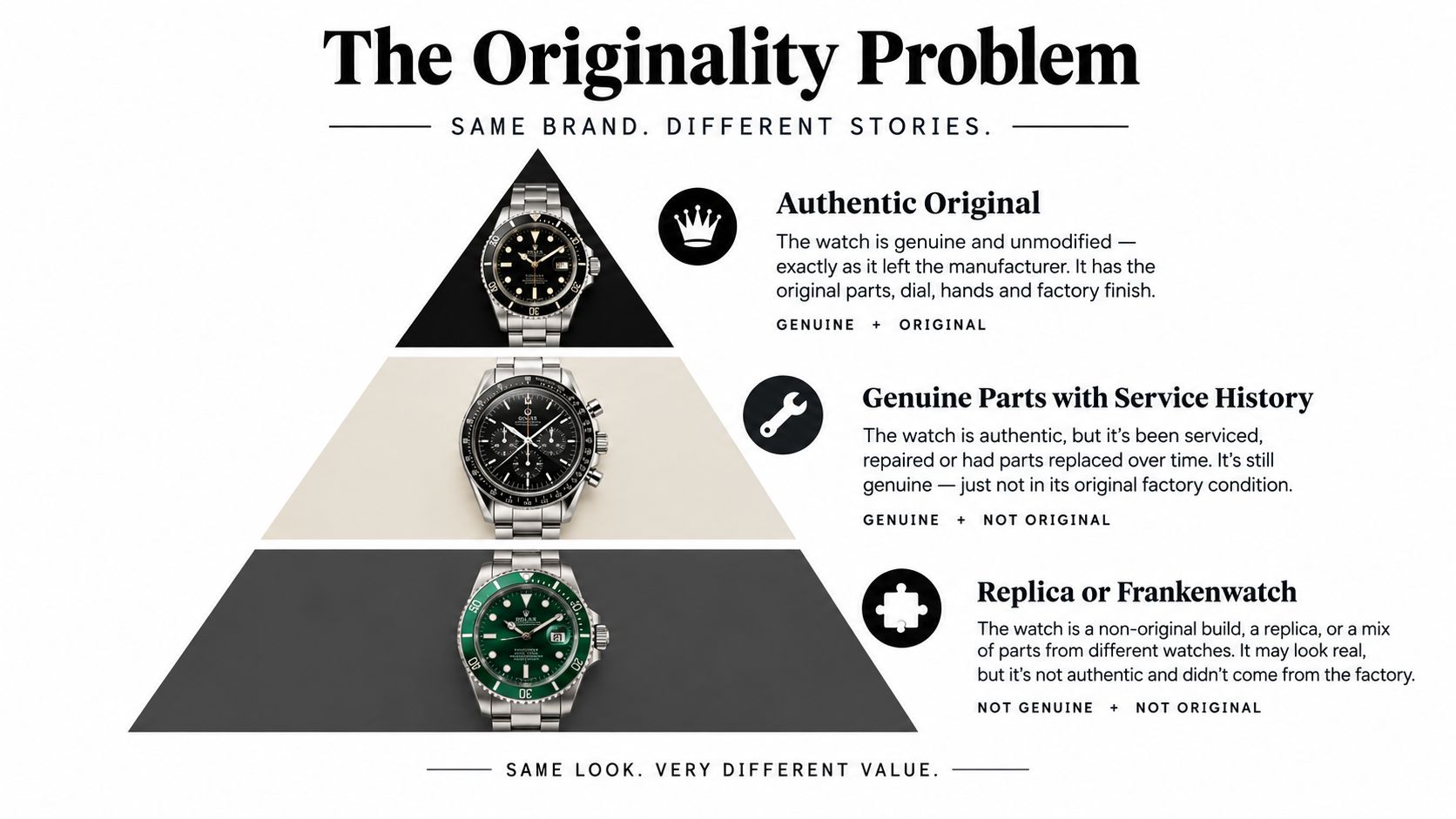
The broader market shows why this matters. Bezel reported rejecting 34% of watches submitted for sale in 2025, up from 29% in 2024 and 23% in 2023. That rejection rate covers misrepresentation and condition, not merely counterfeits, according to that same report. In plain terms, many rejected watches aren't fake. They're misdescribed.
What Usually Helps and What Hurts
- Documented factory service parts: Often acceptable, especially when disclosed, because buyers can judge the change with records.
- Refinished or incorrect dials: Usually damaging for vintage value, because dial originality drives collector demand.
- Aftermarket bezels and bracelets: Must be disclosed and priced as non-original, even if they look attractive.
- Exchanged movements: Serious concern unless numbers, caliber, and service history reconcile cleanly.
Use a proper Rolex reference number guide to confirm which dial, bezel, bracelet, and movement configurations belong to the reference before you call a part correct. Don't rely on memory or sales listings, because listings repeat other sellers' mistakes.
Before an appraisal, photograph the dial, hands, bezel, bracelet codes, clasp, case profile, and every document you have. Write down known service history and separate what you know from what you were told. The right output is five conclusions, identity, originality, condition, provenance, and market value, not one yes or no stamp.
When to Bring in an Expert and What to Expect
Bring in an expert when money, uncertainty, or originality is on the line. Kitchen table checks are screening tools. They aren't a substitute for movement identification, controlled opening, or stolen watch and serial consistency checks.
One large specialist provides a useful operational warning. WatchPro reported that business found approximately 80% of examined watches required thorough testing, compared with about 20% historically, and roughly one in ten Rolex watches offered to it were identified as fake. Treat that as a company reported benchmark, not a universal market rate. It still tells you sophistication has moved the baseline.
Self-Check Versus Professional Authentication
| Scenario | Self-Check Sufficient | Professional Authentication Recommended |
|---|---|---|
| Low value fashion watch for personal wear | Yes, basic visual screening | Not usually |
| Pre-owned luxury purchase | No, screening only | Yes, before payment |
| Estate watch with missing papers | No | Yes, document identifiers and originality |
| Precious metal case or bracelet | No | Yes, add alloy testing |
| Serial, dial, or movement mismatch | No | Yes, stop and investigate |
A professional should photograph identifiers before opening, record instrument settings, preserve removed seals, and open the case only when visual or performance evidence warrants it. The movement should be identified by caliber specific architecture and finishing, not by rotor decoration alone. Authentication should stay separate from valuation so a desirable reference doesn't bias the conclusion.
Costs and timelines vary by brand, complication, and whether archives or parts research are needed, so get the scope in writing before work begins. Don't accept a verbal thumbs up for a major purchase. If you're comparing older pieces, our notes on vintage Rolex watch dealers explain why provenance and originality support matter more than a confident sales pitch.
Red flag check: Refusal to allow inspection, pressure to pay today, mismatched serials, vague service history, and a price justified only by box and papers.
A trustworthy report names the tests performed, lists identifiers, states uncertainty, and separates authenticity from originality and value. If you can't show that report to a buyer, insurer, or executor, it isn't enough.
Authenticating Watches in Boise With Carat 24
For Boise buyers and sellers, local evaluation solves a practical problem. You can watch the testing, ask questions in person, and avoid shipping a valuable watch before you know what you have. That matters for Gold and Jewelry Buying, estate pieces, and luxury watches where originality affects the offer.
Carat 24 uses a rigorous 8-step authentication process at 3780 W. State St. in Boise. The workflow covers materials, craftsmanship, hardware, serial numbers, packaging, and available paperwork, with reference and serial verification against certified websites and databases. Authentication stays separate from the offer, so the findings come first.
What Happens During a Walk-In Evaluation
Bring the watch, box, papers, service receipts, extra links, and any prior appraisal. Don't clean, polish, or open the case before your visit. On site Xray Scanning and Gold Testing for free helps verify precious metal content without damaging the piece, alongside weight, dimension, and component checks. You'll get hassle free offers based on documented findings, not pressure.
Compare offers correctly. The FTC advises consumers to shop around and compare quality, price, and service, and the relevant figure for a Boise seller is the net amount after shipping, insurance, packaging, waiting time, and return risk, based on that FTC guidance. Save the hassle and sell locally for more than online shipments when the net local offer wins. With Price Matching on a verified competitor offer for the same item, you can test any claim about the highest payout in Boise with documents in hand. If you're browsing first, start with our guide to choosing a second hand watch shop, then bring the actual watch in for a decision you can defend.
Bring your watch, gold, or estate jewelry to Carat 24 - Trusted Gold Experts for documented authentication, free X-ray scanning and gold testing, and a clear local offer with price matching on verified competing offers. Visit us in Boise before you ship anything online, and you'll know what's genuine, what's original, and what it's worth before you decide.
