
There's no standard U.S. circulating $2 gold coin, so a “21 2 dollar gold piece” is more likely a $2.50 quarter eagle, a foreign coin, or a misidentified silver dollar or token. The safest first step is free, on-site identification in Boise before anyone quotes a price.
You may be looking at a coin you inherited, found in a jewelry box, or saw described online as a “$2 gold piece.” The description alone doesn't establish what it is or what it's worth. At Carat 24 on West State Street, an appraiser can inspect the coin and test its composition before discussing an offer. That matters because a gold-colored surface doesn't prove the item contains gold, and a coin's collectible value can depend on details that a quick melt calculation misses.
Why the 21 2 Dollar Gold Piece Question Starts with Identification
A Boise seller searching “21 2 dollar gold piece value” may be dealing with a date, a mistaken denomination, or a coin that is not gold. The phrase can point to a $2.50 quarter eagle, a 1921 silver dollar, a foreign coin, a token, jewelry, or a replica. Identify the object before looking for a price.
Inspect the coin itself. Record its date and inscriptions, including any country name, denomination, or mint mark. Note its weight, diameter, and edge, too. These details help an appraiser distinguish a U.S. gold coin from a silver dollar or a gold-colored imitation.
Practical rule: Identify the object first. A price estimate for the wrong coin isn't useful.
The 1921 dollar is a common source of confusion. A 1921 Morgan dollar is a one-dollar silver coin, not a gold piece. It measures 38.10 mm, weighs 26.73 g, and contains 90% silver and 10% copper, with approximately 0.7734 troy oz of silver (PCGS' 1921 Morgan dollar specifications). A gold-colored coating or a “gold” label does not change the coin's composition.
Don't calculate a gold value from an assumed weight. First establish what the piece is and what metal it contains. At Carat 24's West State Street location in Boise, ask for free, no-obligation identification and a free XRF scan before considering an offer. Have the coin checked in person, with its features and composition verified, rather than relying on an online description.
Understanding the Quarter Eagle and Other Gold Denominations
The quarter eagle is a $2.50 gold coin, not a $2 coin. It's the most likely U.S. gold denomination behind a description like “two-dollar gold piece,” especially when someone remembers the coin as a small, low-denomination gold coin. U.S. historical gold coinage used a distinct set of denominations, and the quarter eagle sits between the gold dollar and the $3 piece.
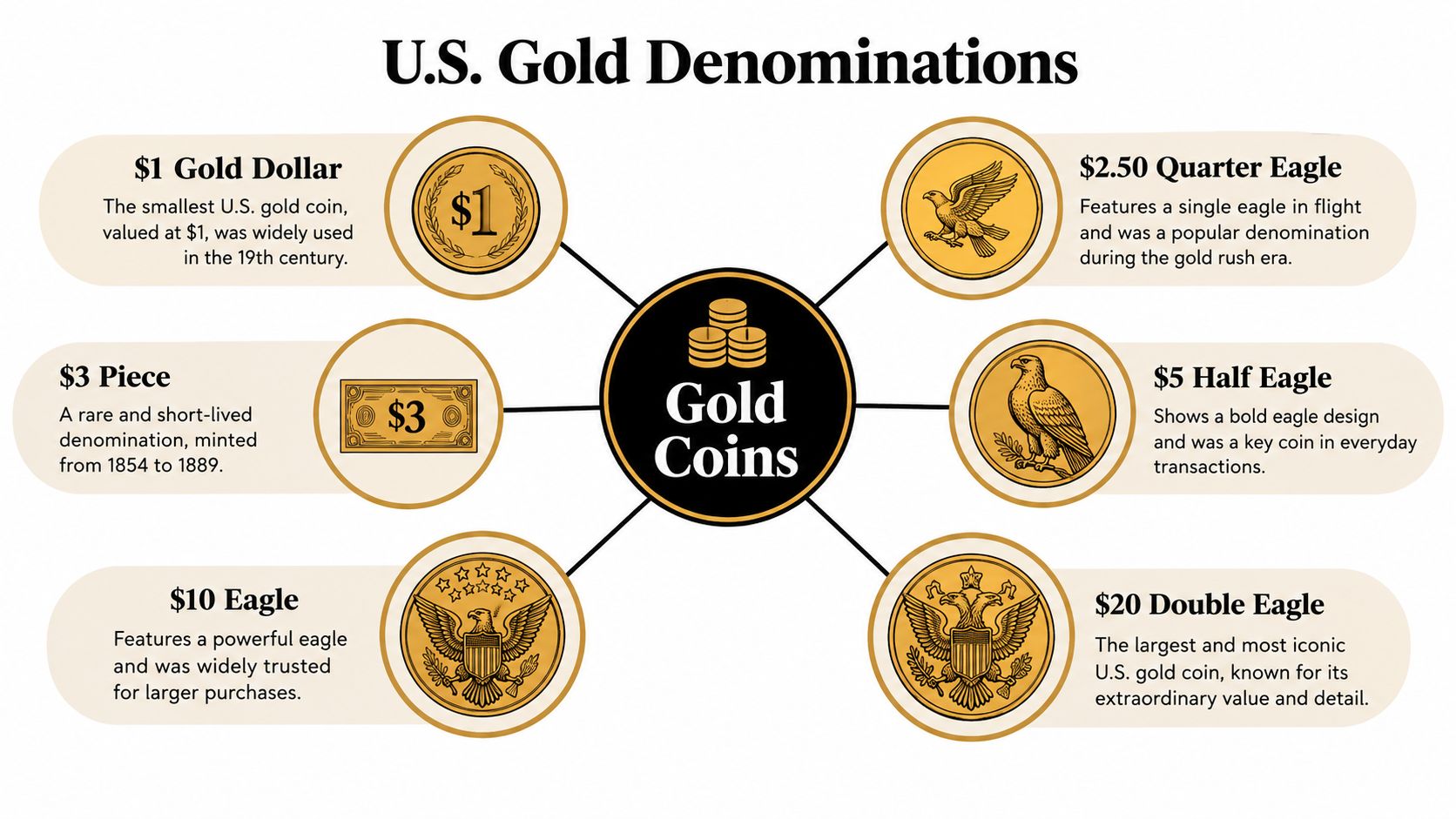
The classic U.S. gold denominations were the dollar, $2.50 quarter eagle, $3 gold piece, $5 half eagle, $10 eagle, and $20 double eagle. The half eagle had a face value of $5 and was made of approximately 90% gold, with the remainder primarily copper and silver (historical overview of the U.S. half eagle). That naming can be counterintuitive: “quarter eagle” means one-quarter of a $10 eagle, so its face value is $2.50.
Compare the coin with the date and denomination in view. A quarter eagle should be identified by its gold denomination and design, while a Morgan or Peace dollar is a larger silver dollar marked “One Dollar.” Don't rely on color alone. A foreign coin, token, jewelry piece, modern commemorative, or fantasy issue might look gold-colored without being a historic U.S. gold coin.
For a closer look at another classic U.S. gold denomination, see this guide to the Liberty $5 gold coin. The important distinction is simple: a quarter eagle has a $2.50 face value, while a U.S. silver dollar has a $1 face value. Those labels point to different metals, coin types, and appraisal methods.
The Five Drivers of Quarter Eagle Value
The query “21 2 dollar gold piece” leaves a basic question: what coin is in hand? Value depends on identifying the exact issue before assessing its date, mint mark, grade, rarity or variety, and gold content. Coins that look similar can bring very different offers once those details are checked. At Carat 24 in Boise, a free XRF scan helps verify the metal as part of the in-person evaluation.
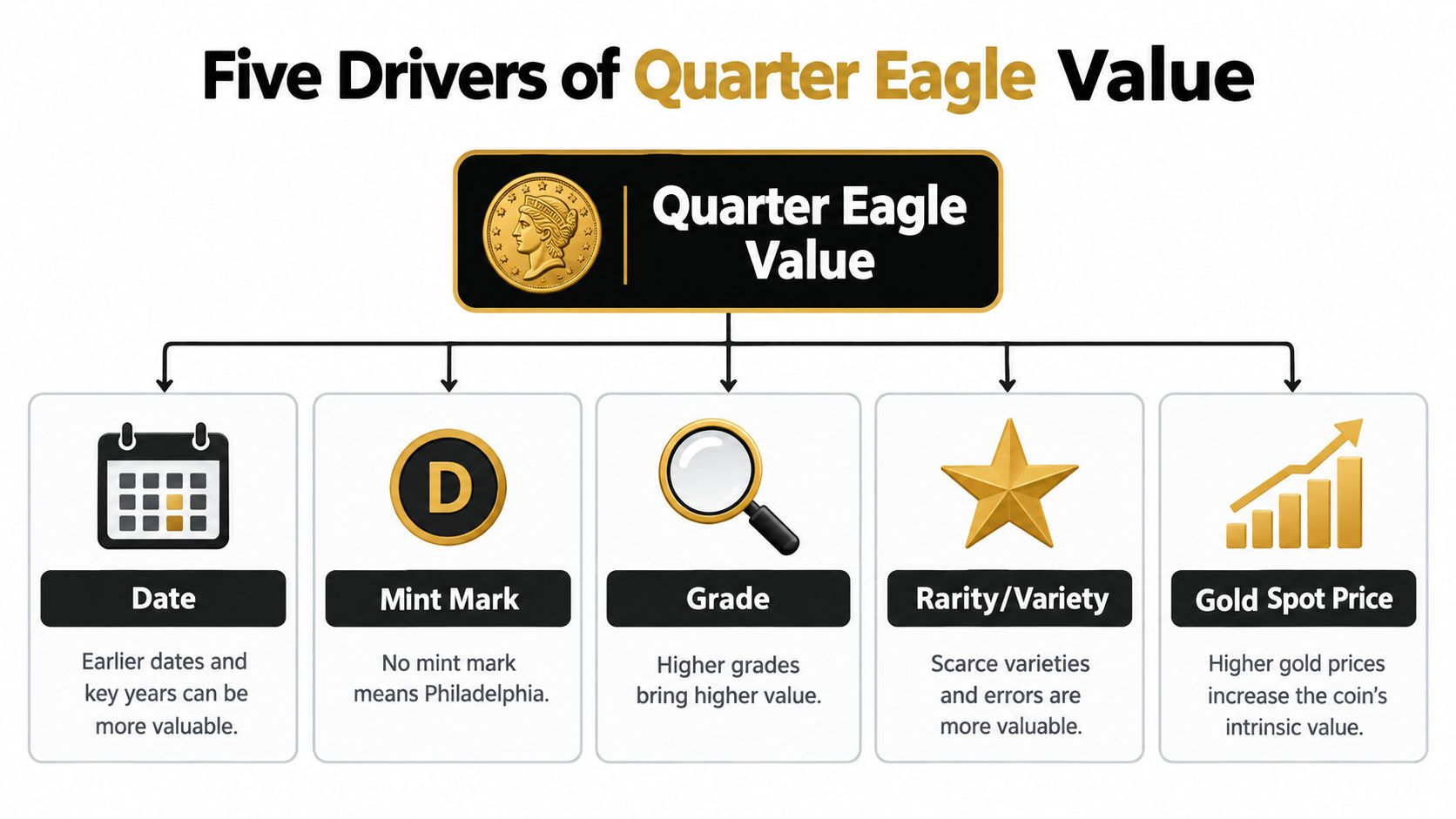
A mint mark is a small letter showing where a coin was struck. Its location varies by issue, so check the specific design rather than assuming a fixed position. Different mints can mean different availability and collector demand. Use the date and mint mark together to identify the issue, and don't guess from a blurry photograph.
Grade describes condition. A worn coin with softened details commands less than the same issue with sharp design features and original luster. Cleaning, scratches, mounting damage, and rough handling can also reduce collector appeal. Bring the coin as it is.
Rarity and variety can affect demand, but only after the coin is identified. PCGS records 44,690,000 Philadelphia, 20,345,000 Denver, and 21,695,000 San Francisco 1921 Morgan dollars, all with the same silver composition and weight (PCGS' 1921 Morgan dollar entry). Those figures concern Morgan dollars, not quarter eagles. They show why mint and production details belong in an appraisal, not why a quarter eagle should be priced like a Morgan dollar.
Finally, gold content sets a metal-value baseline; collector demand may add a numismatic premium. A grading opinion from PCGS or NGC can document condition and authenticity, particularly for a coin that appears unusually well preserved or scarce. For an initial Boise evaluation, have the coin checked in person and don't polish or clean it first.
Bullion Value Versus Numismatic Premium in Real Numbers
A coin's bullion value reflects its precious-metal content. Its numismatic value reflects what collectors may pay for the particular date, mint, condition, and variety. The two figures can diverge sharply, so an appraisal that considers only metal can miss a meaningful collector premium.
| Driver | Bullion Value | Numismatic Premium |
|---|---|---|
| Gold content | Based on the coin's verified gold weight and current metal market | The metal value may act as a baseline, but it doesn't account for collector demand |
| Date and mint | Usually don't change the amount of gold in the coin | Can distinguish a common issue from a scarce one |
| Condition | Doesn't change the gold content | Preservation, wear, cleaning, and damage affect collector interest |
| Rarity or variety | Not reflected in a melt calculation | Verified scarcity and distinctive varieties can increase collector demand |
| Price reference | A metal calculation estimates only the bullion component | Published price guides are reference points, not guaranteed offers |
The 1921 Saint-Gaudens $20 double eagle is a clear warning against assuming face value determines price. The Mint produced 528,500 that year, yet surviving examples are estimated at no more than about 150, a survival rate of roughly 0.03% (CoinWeek's account of 1921 key and semi-key coins). That rarity, not the $20 denomination, explains why the issue attracts collector attention.
That example shouldn't be used as a price estimate for a quarter eagle. It shows the principle: rarity must be verified for the exact coin. PCGS says its published prices are average dealer asking prices for PCGS-graded coins, and should be treated as a guide rather than a guaranteed selling price. Actual offers and completed sales depend on the coin's condition, authenticity, and demand.
For more on the distinction between metal value and collector value, read this overview of numismatic coins. The responsible answer to “What is this worth?” may start with identification and authentication, then move to a comparison with relevant market evidence. A generic gold-price calculation can't do that work.
How to Identify Mint Marks and Read Grade at Home
The phrase “’21 2 dollar gold piece” can point to the wrong coin or even a replica, so confirm what you have before judging its grade. At home, document visible details carefully. Carat 24 in Boise can verify the coin in person, including with a free XRF scan, but a home inspection is a useful start.
- Photograph both sides and the edge. Use even light and keep the coin in focus. Edge images can reveal details or alteration that front-and-back photos miss.
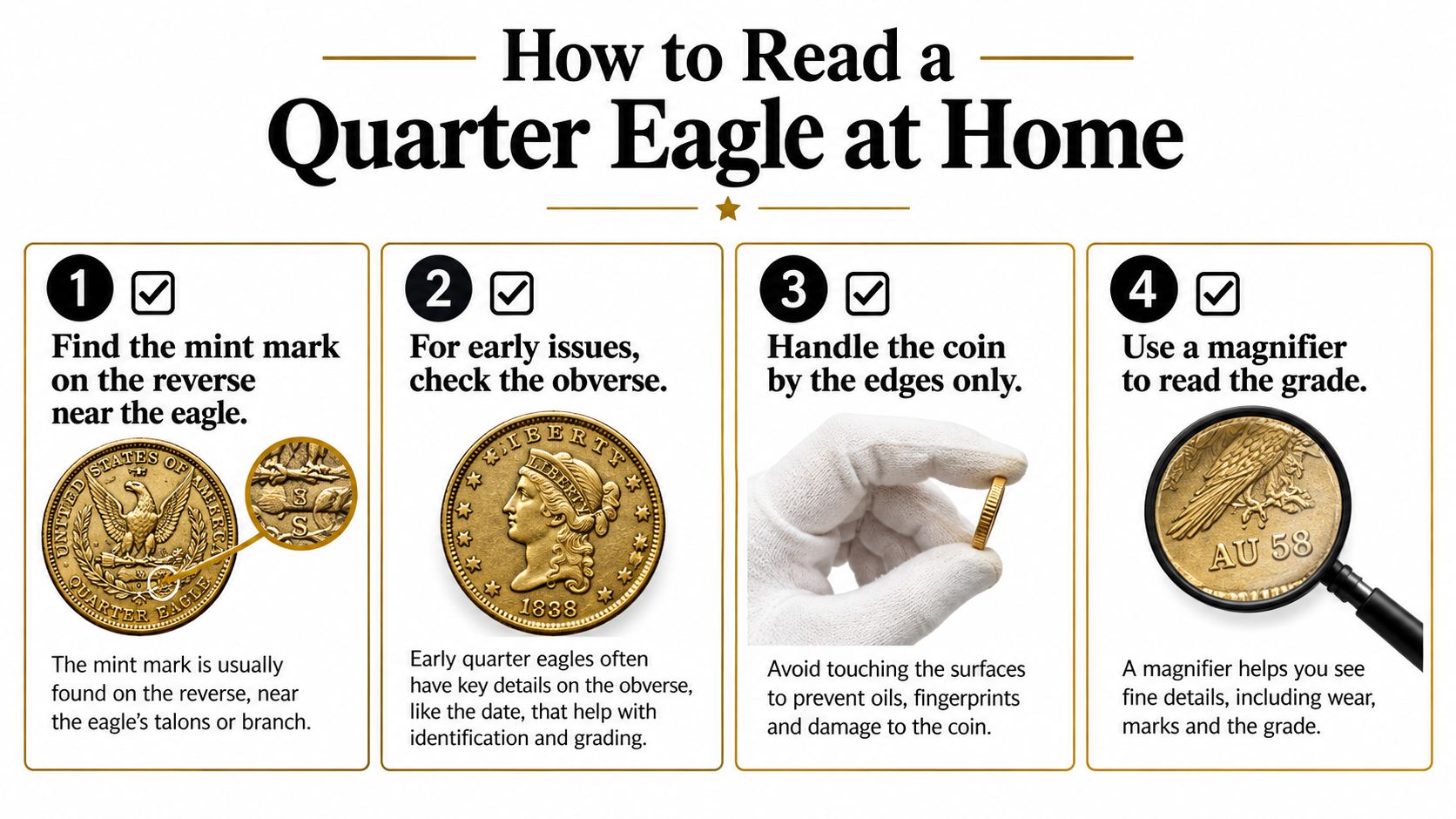
- Look for a mint mark. Its location varies by issue. Check the reverse first on many coins, while some early issues have a mark on the obverse. A 10x loupe helps, but distinguish a mint letter from damage or part of the design.
- Handle only by the edges. Work over a soft surface to reduce the risk of a drop. Fingerprints and scratches can affect the coin's appearance and collector interest.
- Record weight and diameter. Use a scale and measuring tool, and write down the units. A $2.50 Liberty quarter eagle is about 18 mm across and weighs about 4.18 g. Treat those figures as a screening reference, not proof of authenticity.
Describe wear plainly instead of assigning a firm grade. About Good indicates heavy wear, with the main outline still visible. Fine retains clearer design details, though wear is apparent. Extremely Fine shows sharper details with limited wear. Mint State describes an uncirculated coin retaining mint luster; the precise grade still depends on its condition and grading standards.
Keep the date, inscriptions, suspected mint mark, weight, and diameter with your photos of the obverse, reverse, and edge. Don't clean the coin for better pictures. For a broader overview before a local appraisal, read this guide to how to value old coins.
Authentication Pitfalls Every Boise Seller Should Know
A gold-colored coin isn't automatically gold, and a stamp or holder label doesn't prove authenticity. A coin may be plated, altered, mounted in jewelry, or made as a replica. A token or fantasy issue can also resemble a historic coin closely enough to confuse someone who hasn't handled many examples.
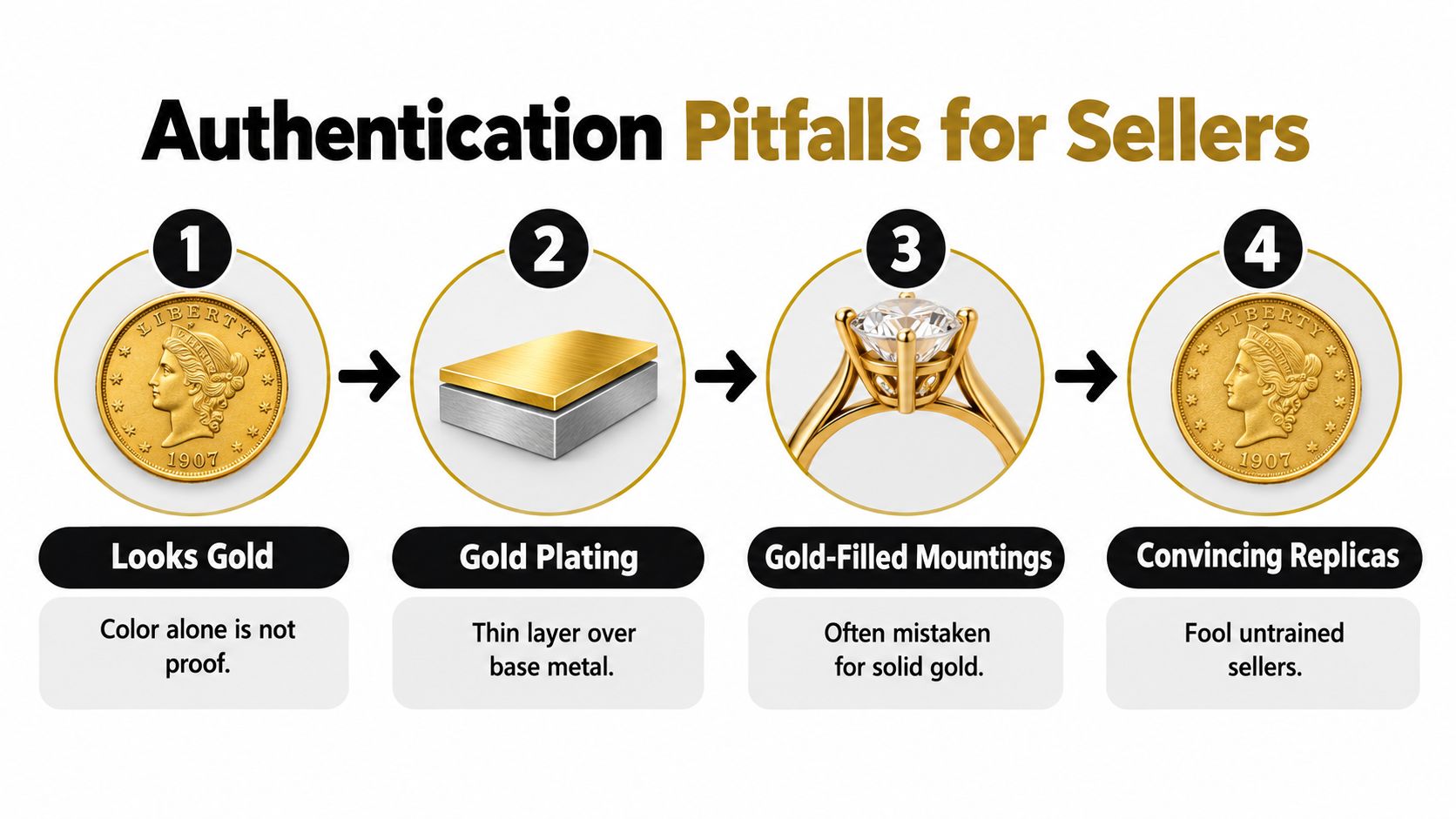
Testing should be part of a broader examination, not a shortcut around it. The FTC explains that karat measures the number of gold parts out of 24: 14K contains 14 parts gold and 10 parts other metal, while 18K contains 18 parts gold and six parts other metal. The FTC also advises buyers to look for a quality mark alongside the name or U.S. registered trademark of the company responsible for that mark (FTC guidance on gold jewelry).
Portable X-ray fluorescence (XRF) can screen an item's metal composition without damaging it. Bruker reports that its portable systems can provide gold concentration and alloy chemistry in approximately 2 to 5 seconds per sample, with accuracy within a few tenths of a percent compared with fire assay (Bruker's precious-metals analysis overview). Carat 24 offers free on-site X-ray scanning and gold testing as part of an evaluation.
There's an important limitation: XRF primarily reads near-surface material. If plating, solder, a coating, or an uneven alloy makes the surface different from the interior, a single reading may not represent the entire object (Fischer's explanation of XRF measurement limitations). A careful buyer may test several areas or use additional verification when construction or surface treatment raises questions.
Carat 24 describes its authentication process as an 8-step review, which combines examination with testing rather than treating a single scan as a final verdict. For a practical look at common warning signs, use this guide to identifying fake gold. The point isn't to assume every unusual coin is counterfeit. It's to verify the object before deciding whether it has bullion value, collector value, or neither.
Getting the Highest Payout in Boise Without the Hassle
If you're selling in Boise, a local appraisal lets you keep the coin in your sight while the buyer identifies and evaluates it. Bring the item to Carat 24 at 3780 W. State St. and ask for a no-obligation review. The process should establish what the piece is, assess its composition and condition, and explain how those findings affect an offer.
Carat 24 provides free XRF scanning and gold testing, as well as hassle-free offers and price matching. Ask how the buyer is treating the coin: as bullion, as a collectible, or as a different type of item. If you have a legitimate competing quote, bring it along and ask whether it can be matched.
Mail-in buyers create a different tradeoff. You ship the coin away before the final evaluation, then wait for the buyer to inspect it and decide whether the offer changes. Selling locally lets you discuss the identification and offer face-to-face, without sending a coin off and hoping the mailed-in price holds.
Before you accept an offer, ask what the buyer identified and how that conclusion affects the price.
Carat 24 also handles gold and diamond jewelry, luxury watches including Rolex, and fine handbags. If you're sorting an estate or bringing in several pieces, ask whether they can be evaluated in the same visit. For a local selling overview, see where to sell gold coins. The highest payout in Boise starts with an accurate identification and a clear comparison, not with the first number someone quotes.
A Boise Seller's Quick Checklist Before You Walk In
Before you visit, gather the details that help an appraiser identify the piece without putting it at risk.
- Photograph it: Take clear pictures of both sides and the edge.
- Record measurements: Write down the weight and diameter, including the units.
- Note visible marks: Copy the date, inscriptions, denomination, and any suspected mint mark.
- Leave it untouched: Don't clean, polish, scrape, or test it with anything abrasive.
- Bring your identification: Have a photo ID ready for the transaction.
- Bring any competing offer: Ask about Carat 24's price-matching policy.
The safest answer to “What is it worth?” starts with “Let's identify it first.” Local verification, free XRF testing, and an opportunity to discuss the offer in person can save the uncertainty of shipping a coin to an online buyer.
Stop by 3780 W. State St. in Boise for a no-obligation appraisal. Bring the coin as you found it, and let its actual identity, metal, and condition guide the conversation.
Carat 24 - Trusted Gold Experts offers free appraisals, on-site XRF scanning and gold testing, hassle-free offers, and price matching for eligible competitor quotes. Visit Carat 24 - Trusted Gold Experts in Boise to have your “$2 gold piece” identified before you decide whether to sell.
