

One partner is on one knee, the ring box is open, and the decision feels wonderfully simple. Then the practical questions arrive: Will the ring need resizing? Can the stone handle daily wear? What happens if the setting breaks, the ring needs insurance, or the owner wants to trade it in years from now?
Diamond engagement ring alternatives can solve the budget, style, and origin questions, but the purchase shouldn't end at the proposal. A ring is also a long-term object that may need repair, documentation, replacement, or resale. The right choice depends on the life you expect it to live, not only on how it looks under a jewelry-store spotlight.
Why More Couples Are Skipping the Traditional Diamond
The person receiving the ring may love the color of a sapphire. The person buying it may want a larger-looking center stone without stretching the budget. A couple may also care about origin and prefer a laboratory-created option over a mined stone. These aren't fringe concerns anymore.
The Knot's Real Weddings Study reported that 52% of U.S. couples married in 2024 selected a lab-grown center stone, compared with 22% who reported using a mined-diamond center stone. The same survey found that lab-grown selection had risen 6 percentage points from the previous year, a sharp change in a category long associated with tradition. The Knot's engagement-ring trend data also shows why buyers should think beyond the proposal moment.
A later study of 10,474 U.S. couples married during 2025 reported that lab-grown center stones represented 61% of engagement-ring purchases, a 239% increase from 2020. The average lab-grown center stone was 1.9 carats, with an average spend of $4,600, illustrating how some buyers are prioritizing visual size while maintaining a defined budget.
Practical rule: Choose the stone with its next ten years in mind. Appearance matters, but so do setting security, paperwork, insurance, and the likely trade-in market.
Skipping a mined diamond changes the future paperwork and valuation path. A lab-grown diamond needs clear origin disclosure. A sapphire needs treatment information. A vintage ring needs an honest assessment of condition and provenance. Before you buy, use a diamond resale value calculator as a conversation starter, not as a promise of what any buyer will eventually pay.
What Actually Counts as an Alternative
“Alternative” can mean three different things, and confusing them creates trouble at trade-in time.
A different material
Moissanite, sapphire, ruby, emerald, morganite, and other colored gemstones are different materials from diamond. They bring different optical effects, durability profiles, treatment considerations, and resale expectations. A plain gold band can also be an alternative if the couple values simplicity over a center stone.
This category gives you the most freedom to personalize the ring. A blue sapphire creates a strong visual identity. Ruby brings saturated color and symbolic meaning. Moissanite offers diamond-like brightness with prominent colored fire. The trade-off is that a future buyer evaluates each material on its own market, rather than comparing it directly with a mined diamond.
A lab-created version of the same material
A lab-grown diamond is still a diamond in chemical composition and visual position, but its origin is different from that of a mined diamond. The Federal Trade Commission says laboratory-created diamonds should be clearly disclosed with terms such as “laboratory-grown” or “laboratory-created.” That disclosure should remain with the ring's paperwork for insurance, repair, and resale.
Buyers who want a deeper explanation of construction, appearance, and purchasing considerations can also review Shapiro Diamonds' guide to lab-grown engagement rings. The important point is simple: lab-grown and mined diamonds shouldn't be described as interchangeable ownership assets merely because they look alike.
A pre-owned or vintage natural ring
A pre-owned or vintage ring may contain a natural diamond or gemstone, but its value also depends on condition, era, design, metal, and documentation. A well-preserved ring with a respected grading report may offer stronger trade-in clarity than a newer ring with missing paperwork. An inherited piece with an undocumented stone may still be beautiful, but its origin and quality need to be established before anyone can assess it fairly.
At a local buying appointment, the category determines the questions. A buyer may test the gold content, inspect the setting, weigh the piece, identify the stone, and review reports or invoices. Read what fine jewelry means before comparing offers, because the metal, craftsmanship, and gemstone can each contribute differently to the ring's value.
What Counts as an Alternative
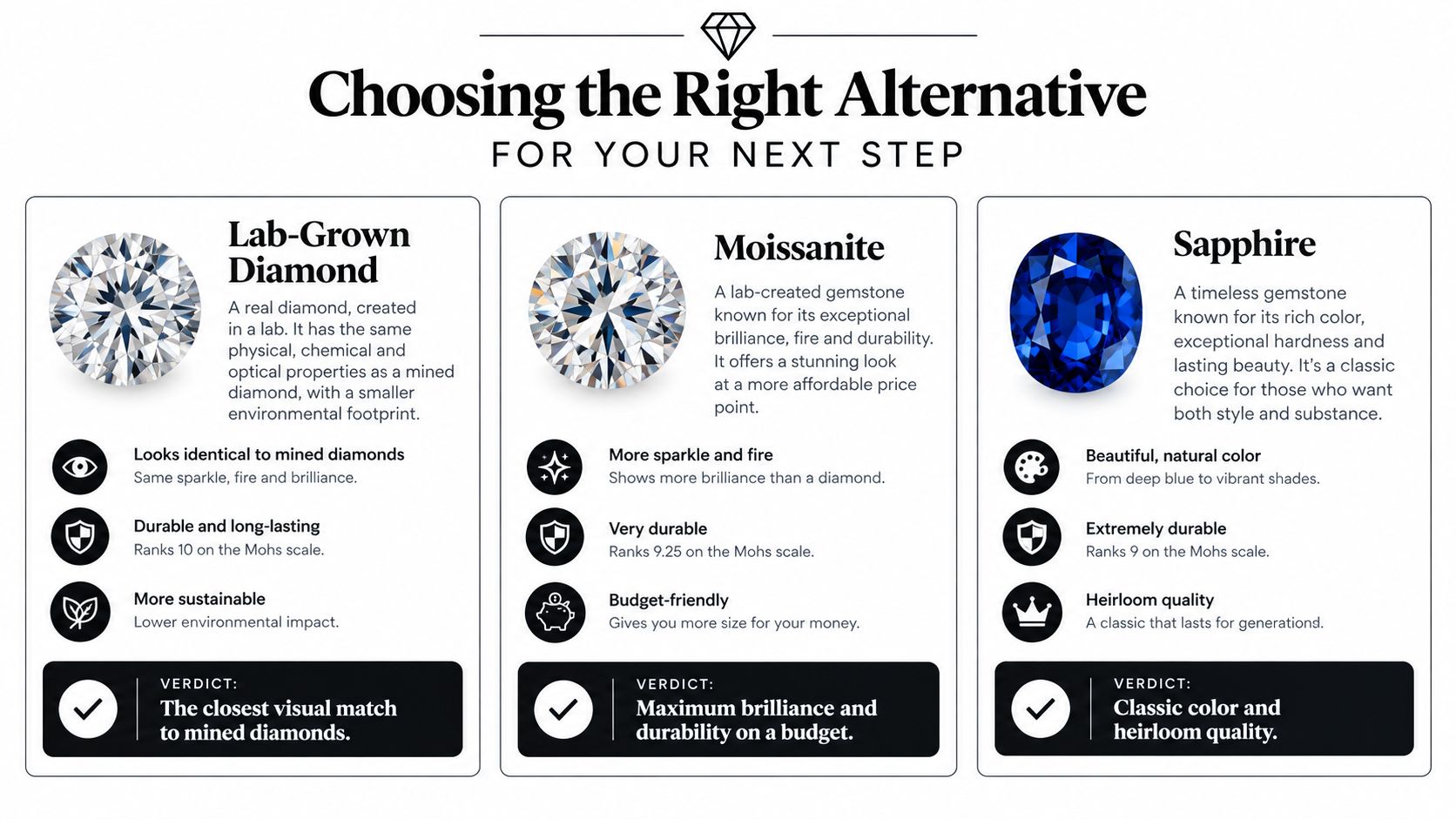
The right alternative starts with the life you expect after the proposal. Choose a lab-grown diamond if you want the closest visual and chemical relationship to a mined diamond. Choose moissanite for bold sparkle and strong scratch resistance. Choose sapphire or ruby if color and personal meaning matter more than a diamond-like look. Choose a vintage or pre-owned ring if design history and the complete piece appeal to you.
The market now includes several serious center-stone choices. The JCK coverage of lab-grown engagement-ring demand cites sapphire and moissanite preferences of 23% and 20% in the referenced Real Weddings Study. That interest matters after purchase, too. A local buyer must be able to identify the stone, evaluate the setting, and explain what future repair, resale, or trade-in may look like.
| Alternative | Cost Position | Daily-Wear Profile | Appearance | Origin and Documentation | Resale and Trade-In |
|---|---|---|---|---|---|
| Lab-grown diamond | Usually positioned below a comparable mined diamond, with price shaped by cut, quality, and paperwork | Diamond-level scratch resistance | Closest match to a mined diamond | Laboratory-created, with clear origin records | Keep the report, invoice, and inscription details. Market treatment differs from mined diamonds |
| Moissanite | Usually selected for a lower entry cost than diamond, though size and quality affect the price | Strong choice for frequent wear | Bright brilliance with noticeable rainbow fire | Commonly laboratory-created | Expect modest resale. Documentation still helps |
| Sapphire | Ranges widely according to color, origin, treatment, and quality | Strong practical choice with a secure setting | Softer sparkle, with color as the main attraction | Natural or lab-created. Treatment information matters | Color, treatment, metal weight, and setting condition shape evaluation |
| Ruby, emerald, and morganite | Wide range based on color, treatment, clarity, and size | Ruby suits frequent wear. Emerald and morganite need more careful handling | Character and color usually outweigh diamond-like fire | Natural or lab-created, with treatments documented | Identity, treatment, condition, and buyer demand carry the most weight |
| Vintage or pre-owned ring | Price reflects the entire ring, not only its center stone | Depends on the stone and setting | Design, age, cut, and condition define the look | Reports or provenance can support natural origin | A complete, documented ring may offer a clearer trade-in discussion |
For a buyer who wants high scratch resistance and dramatic sparkle, moissanite is my first recommendation. GIA places moissanite at approximately 9.25 on the Mohs scale and sapphire at 9 in its guidance on diamond alternatives. Moissanite shows stronger colored-fire flashes. Sapphire looks quieter and less diamond-like, but its color gives the ring a more individual identity. Compare both in daylight, warm indoor light, and direct spot lighting before you commit.
Sapphire has a recognizable engagement-ring history. Princess Diana's blue sapphire ring later became Catherine, Princess of Wales's engagement ring, giving colored sapphire lasting visibility beyond traditional diamond jewelry. For examples of how orange and yellow stones change a ring's personality, browse the Astro West ring collection.
Ruby deserves a separate look if its color or symbolism fits your relationship. A July birthstone can add meaning without making the ring feel conventional. The July ruby guide provides useful context before you choose the setting, stone treatment, and metal.
Before buying, ask what happens if the ring needs resizing. Some settings and gemstone designs offer less flexibility than a simple solitaire. Ask who can repair it, what paperwork will accompany it, and whether a Boise buyer such as Carat 24 would evaluate the complete ring, its metal, and its documentation for a future sale or trade-in. That conversation turns an attractive alternative into a practical long-term choice.
Durability and Daily Wear Essentials
A stone's hardness and toughness aren't the same thing. Hardness measures resistance to scratching. Toughness measures resistance to chipping, cracking, and breaking. A buyer who focuses only on a Mohs number can still choose a vulnerable stone for an active lifestyle.
Moissanite measures approximately 9.25, and sapphire and ruby measure 9 on the Mohs scale. Those stones resist everyday abrasion well, but a sharp impact can still damage an exposed edge. Emerald measures roughly 7.5 to 8, yet its internal structure can make it more vulnerable to fracture, and it is commonly clarity-enhanced with oil or resin. Morganite and zircon measure approximately 7.5 to 8 and can work for daily wear when the owner uses reasonable care.
Match the stone to the hand
| Stone | Mohs Hardness | Toughness | Best Setting | Lifestyle Fit |
|---|---|---|---|---|
| Moissanite | 9.25 | Strong for routine wear, but impacts can still chip an exposed edge | Low-profile bezel or secure prongs | Excellent for frequent wear |
| Sapphire | 9 | Strong practical choice, with protection still recommended | Bezel, halo, or well-maintained prongs | Excellent for active lifestyles |
| Ruby | 9 | Strong for daily use when the stone and setting are sound | Protective prongs or bezel | Excellent for frequent wear |
| Spinel | 8 | Suitable with sensible care | Halo or protective prongs | Good for regular wear |
| Morganite | Approximately 7.5 to 8 | More care required than sapphire or ruby | Bezel or halo | Good for careful daily wear |
| Emerald | Roughly 7.5 to 8 | More vulnerable to fracture and treatment-related care issues | Protective bezel or halo | Better for careful wear |
| Opal or tanzanite | Lower suitability for constant ring wear | Higher damage risk | Protective design, limited exposure | Better as an occasional piece |
A useful rule is 9 and above for an active hand, 7 to 8 with a thoughtful setting, and softer stones for jewelry that sees less impact. That rule isn't a substitute for a gemological inspection, but it helps narrow the field. For emerald, opal, and tanzanite, remove the ring before heavy work, sports, cleaning, or situations involving sudden impact.
The setting is part of the durability decision. A softer center stone with a protective bezel may serve you better than a harder stone held in damaged, exposed prongs.
The first maintenance check should happen before small problems become expensive repairs. Confirm the ring size, inspect prongs, and ask whether the setting can be resized without compromising the design. White gold and platinum also behave differently during repair and maintenance, so review the practical distinctions in this guide to white gold and platinum. A six-month prong check is a sensible early milestone, especially for a ring worn every day.
What Buyers and Sellers Need to Know About Origin and Documentation
Paperwork protects the ring twice. It helps the buyer confirm what they're purchasing, and it gives a future insurer, appraiser, repairer, or buyer a clearer record of what the owner holds.
For natural and lab-grown diamonds, ask what report accompanies the stone and whether the report identifies the stone's origin. GIA, IGI, and GCAL are names buyers may encounter in diamond documentation. A lab-grown diamond should have separate documentation identifying it as laboratory-grown, not a report that leaves the origin ambiguous.
Moissanite paperwork may include documentation from Charles & Colvard or a GRA report. Colored stones can be supported by reports from organizations such as AGL, GIA, or Gübelin. The report doesn't turn every stone into an investment, but it reduces uncertainty about identity, treatment, and quality.
Build a complete ring file
Keep these items together:
- The gemstone report: Save the original document and a digital copy.
- The purchase invoice: It records the description, price, metal, and seller.
- The inscription details: Record any laser inscription or identifying mark.
- Setting-work receipts: Keep records for resizing, prong replacement, repairs, and stone replacement.
- Treatment information: Note whether a colored stone has been oiled, filled, heated, or otherwise treated.
This file matters during an insurance claim because the insurer needs a written description. It matters during resizing because the jeweler needs to know the metal and setting history. It matters during trade-in because an independent buyer can compare the physical ring with the original description.
The FTC also says laboratory-created diamonds should be disclosed with clear language such as “laboratory-grown” or “laboratory-created.” Don't accept a vague description when the origin affects your expectations about future value. For inherited pieces, start with an independent inspection rather than assuming a family story establishes the stone's identity.
Before you buy or sell, review guidance on jewelry authentication near you. The practical question isn't whether a report sounds impressive. It's whether the document identifies the item clearly enough for the next professional to evaluate it.
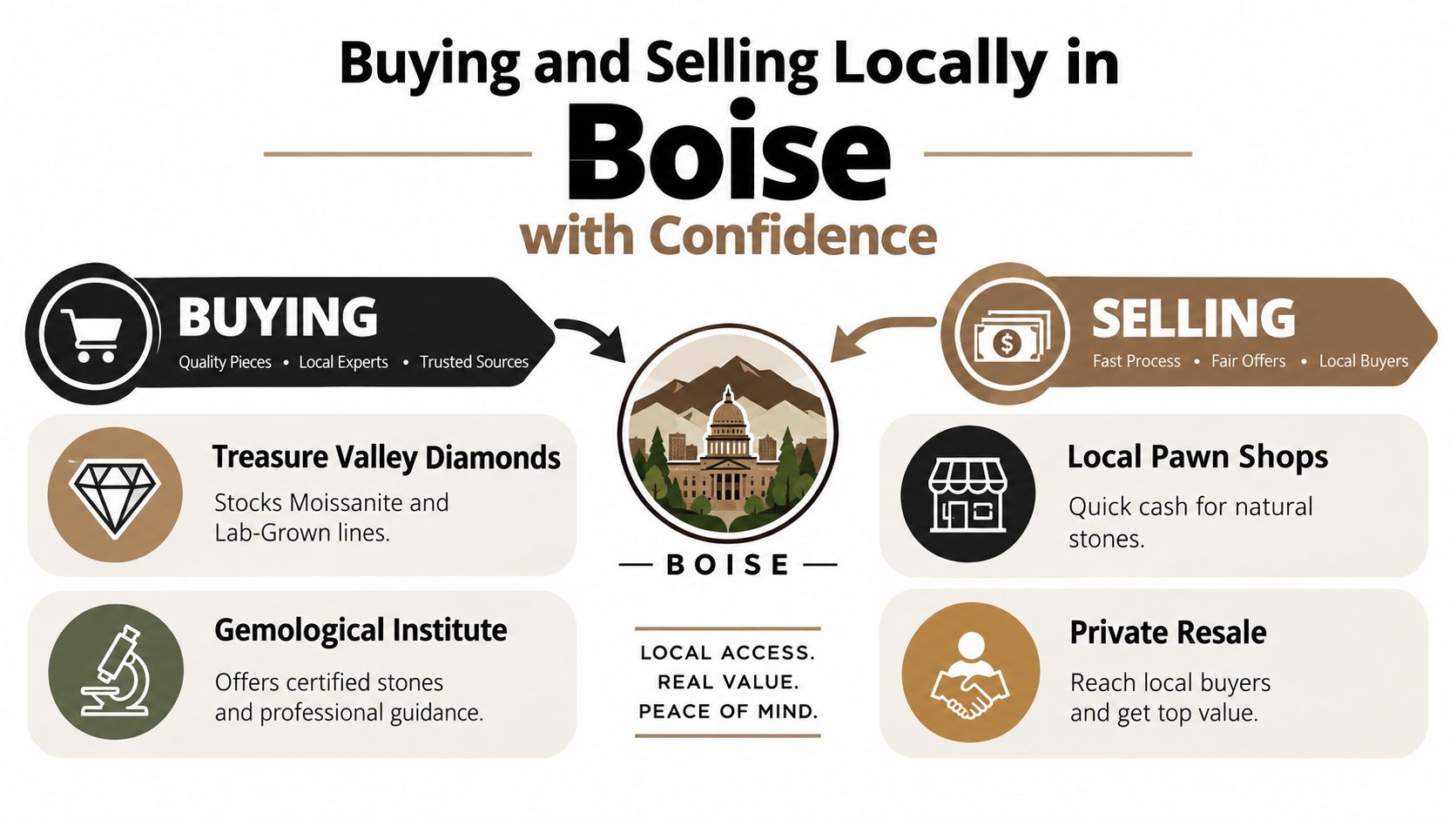
Buying and Selling Locally in Boise with Confidence
A Boise buyer should approach the transaction differently depending on whether they're choosing a ring or trying to sell one.
Buying in the Treasure Valley
Start by visiting local jewelers and asking what they stock. Treasure Valley Diamonds may be a useful place to compare styles, while a jeweler with access to a gemological institute or independent laboratory resources can help explain reports and treatments. Don't buy based on a social-media photograph or a vague “ethical” label.
Ask four questions before paying:
- Origin disclosure: Is the center stone mined, laboratory-grown, natural colored material, or a simulant?
- Return policy: How long do you have to inspect the ring and confirm the fit?
- Prong service: Does the seller provide a lifetime prong check or inspection program?
- Trade-in terms: Can the ring be resized, upgraded, or traded in later, and how is the value calculated?
The Federal Trade Commission recommends comparing quality, price, and service across multiple retailers. For gold, check the karat mark and look for the manufacturer's name or registered trademark near it. The FTC warns consumers not to buy gold jewelry that carries a karat mark without an accompanying trademark. The FTC's jewelry-buying guidance gives buyers a concrete verification habit.
Selling without shipping the ring away
Online shipments create uncertainty that a local appointment can avoid. The package can be lost, the verification process may be opaque, and the final offer may not match the headline estimate. If a seller returns the ring, shipping, insurance, timing, and accountability become part of the transaction.
The FTC recommends investigating unfamiliar sellers, reviewing refund policies, checking reputation, and obtaining written information for claims that influence a purchase. Those safeguards matter when you're deciding whether to mail an engagement ring to an out-of-state buyer or receive a local quote. A local, in-person sale lets you see the testing process and ask questions before accepting an offer.
What a Boise walk-in can look like
Carat 24 offers Gold and Jewelry Buying, including free Xray Scanning and Gold Testing. X-ray fluorescence testing is non-destructive and can identify and measure precious metals including gold, silver, platinum, and palladium, as described by Hitachi High-Tech's precious-metals testing information. Bruker also describes portable analyzers that can provide alloy-composition results quickly, which supports a measured offer rather than an estimate based only on appearance.
At Carat 24, the stated service includes hassle-free offers, a highest payout in Boise position, and price matching on a written competitor offer. The location specified for this walk-in process is 9210 W Fairview Ave, and no appointment is needed. Bring the ring in person, watch the testing, review the offer, and decide without mailing the jewelry across state lines.
The FTC's jewelry guides also recommend comparing simple gold jewelry by gram weight and the current gold price when design and workmanship aren't the primary value drivers. The FTC jewelry guides support requesting an itemized explanation that addresses metal content, weight, quality, value, and price.
Bring government-issued identification, every report and invoice you have, and any repair records. Expect a transparent evaluation and, when the transaction is accepted, cash on the spot. If the ring has sentimental value, you can still request an evaluation without committing to sell.
Choosing the Right Alternative for Your Next Step
The best ring is the one that still makes sense after the proposal excitement settles. Use these verdicts to connect the stone to the action you're most likely to take next.
Lab-grown diamond
Verdict: Choose it when you want the closest visual and chemical match to a mined diamond while making origin disclosure part of the record.
Keep the laboratory-grown report, original invoice, and any inscription details. Insure the ring using accurate documentation, and ask the jeweler how future trade-in or upgrade values are determined. Don't assume a lower purchase price creates the same secondhand demand as a natural diamond. A 2025 consumer survey found that 49% preferred a natural diamond when comparing otherwise identical stones, while 34% had no preference, showing that lower entry cost doesn't automatically create equal perceived value. CNBC's coverage of consumer attitudes toward lab-grown diamonds provides useful context for that distinction.
Moissanite
Verdict: Choose it for maximum brilliance, strong daily-wear performance, and a willingness to accept a different resale conversation.
Its rainbow fire is a feature, not a defect. If you want the softer white sparkle associated with a traditional diamond, moissanite may not satisfy you. If you want visible flashes of color and a durable stone, it earns a place on the shortlist. Select a secure setting, keep the paperwork, and clean it gently with mild soap, water, and a soft brush.
Sapphire
Verdict: Choose it for classic color, personal meaning, and heirloom potential, provided you understand treatments and protect the setting.
Sapphire is a strong recommendation for an active wearer who wants a colored center stone. Ask whether the stone has been treated, request supporting documentation, and choose a setting that protects the edges. The same advice applies to ruby. Emerald and morganite can be beautiful choices, but they demand more careful handling and a more realistic maintenance plan.
Vintage and pre-owned pieces
Verdict: Choose a vintage ring when design, history, and existing craftsmanship matter more than a brand-new stone.
Inspect the shank, prongs, under-gallery, and any previous repairs. Confirm that the ring can be resized before buying it for someone whose finger size may change. A documented vintage natural stone can carry a clearer future story than an undocumented ring, but condition and provenance still control the evaluation.
Keep or sell decision tree
Use this sequence before you pay for a repair or accept an offer:
- Is the center stone certified or otherwise documented? If yes, keep the report with the ring. If no, arrange an identification and condition review before making a value assumption.
- Can the setting be resized safely? If yes, confirm the allowable size range with a jeweler. If no, avoid forcing a change that could weaken the design.
- Is the metal solid and marked correctly? Check the karat mark and manufacturer trademark. If the mark is unclear, request non-destructive metal testing.
- Does the ring fit your actual lifestyle? A fragile stone or exposed setting may justify a redesign, a second ring, or occasional wear.
- Does the current offer reflect the complete ring? Compare the gemstone, setting, metal content, condition, and paperwork rather than focusing only on the original retail price.
Your ownership checklist
- Insurance: Arrange an insurance rider using the stone report, invoice, photographs, and appraisal information.
- Prong checks: Inspect the setting regularly and have worn prongs repaired before the stone becomes loose.
- Cleaning: Follow the stone's care requirements. Avoid harsh chemicals and unsuitable ultrasonic or steam cleaning for treated or fragile gems.
- Resizing: Confirm the metal and setting before resizing. Free XRF testing can help confirm precious-metal content before repair or redesign.
- Trade-in timing: Reassess the ring when your priorities change, when a relationship ends, when an inherited piece arrives, or when the ring no longer fits safely.
- Offer comparison: If you're comparing online buyout offers, bring the written offer to a local buyer and ask whether a price match is available.
Carat 24 can serve as a Boise touchpoint for these next steps, from free XRF testing before a resize to walk-in appraisals for insurance riders and a price-match promise when you compare written online offers. Selling locally also lets you avoid the shipping, insurance, and return uncertainty that comes with sending an engagement ring to an unknown buyer.
For a final decision, watch the visual guide below with one question in mind: which stone will you be happiest to maintain, insure, resize, and own after the proposal photographs are forgotten?
Choose the ring that fits the life you live, not the marketing image someone sold you. If you want a Boise evaluation of a ring, its metal, its documentation, or its next trade-in step, visit Carat 24 - Trusted Gold Experts for free Xray Scanning and Gold Testing, hassle-free offers, and local price matching that can save you the risk of online shipments.
