

You're standing in a Boise jewelry showroom with two trays in front of you. One holds a white-gold pavé ring that catches every overhead light. The other is a 14K yellow-gold solitaire that looks simpler, warmer, and more substantial. Both are beautiful. Neither tells you what you should compromise on.
A diamond engagement ring with a gold band is a budget-and-lifestyle decision before it's a color decision. Choose the gold alloy first, then the diamond, then the setting, and finally the details that affect comfort and maintenance. That order keeps you from spending your diamond budget on metal or choosing a delicate design that doesn't suit the person who'll wear it every day.
What You're Really Choosing When You Pick a Gold Band
The couple in that showroom is making two separate decisions. The first is the band itself, including its gold purity, color, weight, and durability. The second is the center diamond, including its cut, origin, grading, and price.
The band deserves attention first because it's the part that sits against the hand all day. It establishes the color your eye reads as the ring, determines how the piece handles ordinary wear, and sets the amount of money left for the center stone. A richer 18K yellow-gold band may be exactly right for someone who wants saturated color and more precious-metal content. A 14K band may be the smarter choice for someone who works with their hands, exercises regularly, or doesn't want to treat the ring like a museum object.
My buying order: Choose the gold alloy, set the diamond budget, select the center stone, choose the setting, then refine the band details.
That sequence also prevents a common mistake. Buyers fall for a diamond first, then discover that the gold, setting, and labor push the complete ring beyond what they intended to spend. The better approach is to decide what the band must accomplish before you compare stones.
A useful primer on the difference between fine jewelry materials and finished jewelry is this guide to what fine jewelry means. For couples planning wedding details alongside the ring, an engagement registry Australia resource can help organize gifts and preferences, but it shouldn't replace an in-person inspection of the ring itself.
The gold mark inside the shank matters more than a romantic description on a product page. A ring marked 14K or 18K gives you a standardized starting point for understanding composition. From there, you evaluate the diamond, craftsmanship, condition, paperwork, and sentimental value separately.
The right compromise is usually not “buy the biggest diamond.” It's choosing the gold band that fits the wearer's life, then spending the remaining budget on the diamond characteristic the eye will notice most.
Karat, Color, and Cost of Gold Bands
Your gold choice sets the ring's daily durability, color, and share of the budget. Karat is a composition decision, not a quality ranking. The U.S. Federal Trade Commission explains that pure gold is 24 karat, but it is too soft for most everyday jewelry unless mixed with harder metals. Gold content is measured in 24 parts. 18K contains 18 parts pure gold and 6 parts other metals, while 14K contains 14 parts gold and 10 parts other metals. That equals 75% gold in 18K and approximately 58.3% gold in 14K. The FTC's jewelry guidance covers the marking and alloy basics buyers should understand. For a practical explanation, read this guide to how to determine gold purity before comparing rings.
| Factor | 14K | 18K | 24K |
|---|---|---|---|
| Gold content | Approximately 58.3% | 75% | Essentially pure gold |
| Daily durability | Harder alloy, better resistance to bending and surface wear | Softer than 14K, but suitable for daily jewelry with reasonable care | Too soft for most daily-wear engagement bands |
| Color | Softer yellow, with more visible alloy influence | Richer, more saturated yellow | Strongest yellow tone |
| Price per gram | Usually lower because it contains less gold | Usually higher because it contains more gold | Highest gold content, but impractical for an engagement setting |
| Skin-tone fit | Works across skin tones, especially with mixed-metal styling | Warm and traditional, especially flattering on warm undertones | Very intense yellow, rarely chosen for a daily engagement ring |
For an active wearer, 14K is the responsible starting point. Its greater share of harder alloy metals helps the band resist bending and surface wear. That matters for someone who lifts weights, gardens, works in healthcare, handles equipment, or refuses to remove the ring for every household task.
The price difference also affects the diamond budget. A recent Business Insider report on engagement-ring costs and gold prices reported that average engagement-ring prices at one U.S. jeweler rose from $1,633 in 2024 to $2,408 in 2025, while loose-diamond prices fell nearly 40% from 2023 to 2025. The report linked the increase largely to higher gold prices, found that 25% to 30% of shoppers delayed purchases while waiting for prices to decline, and described 14K as the dominant choice because it combines approximately 58.3% gold with a more durable, lower-cost alloy.
Color changes the entire ring
Yellow gold gives a diamond a warm frame and can make a slightly warmer stone look deliberate. White gold creates a cooler, brighter appearance, but rhodium plating eventually wears and may require replacement. Rose gold gets its blush tone from copper in the alloy and suits many skin tones without the traditional yellow-gold look.
Budget and lifestyle should lead this decision, with aesthetics following close behind. Buying locally in Boise also lets you compare color and karat in person, while XRF scanning and direct authentication can provide more confidence than shipping a ring away after an online purchase.
Do not treat “solid gold” as a karat mark. “Solid” means the item is not hollow. It does not state the gold percentage. Look for a quality mark such as 14K or 18K, plus the responsible company's registered trademark or name.
The 4Cs and Lab-Grown vs Natural Diamonds
Once the band has claimed its share of the budget, evaluate the center diamond in plain language.
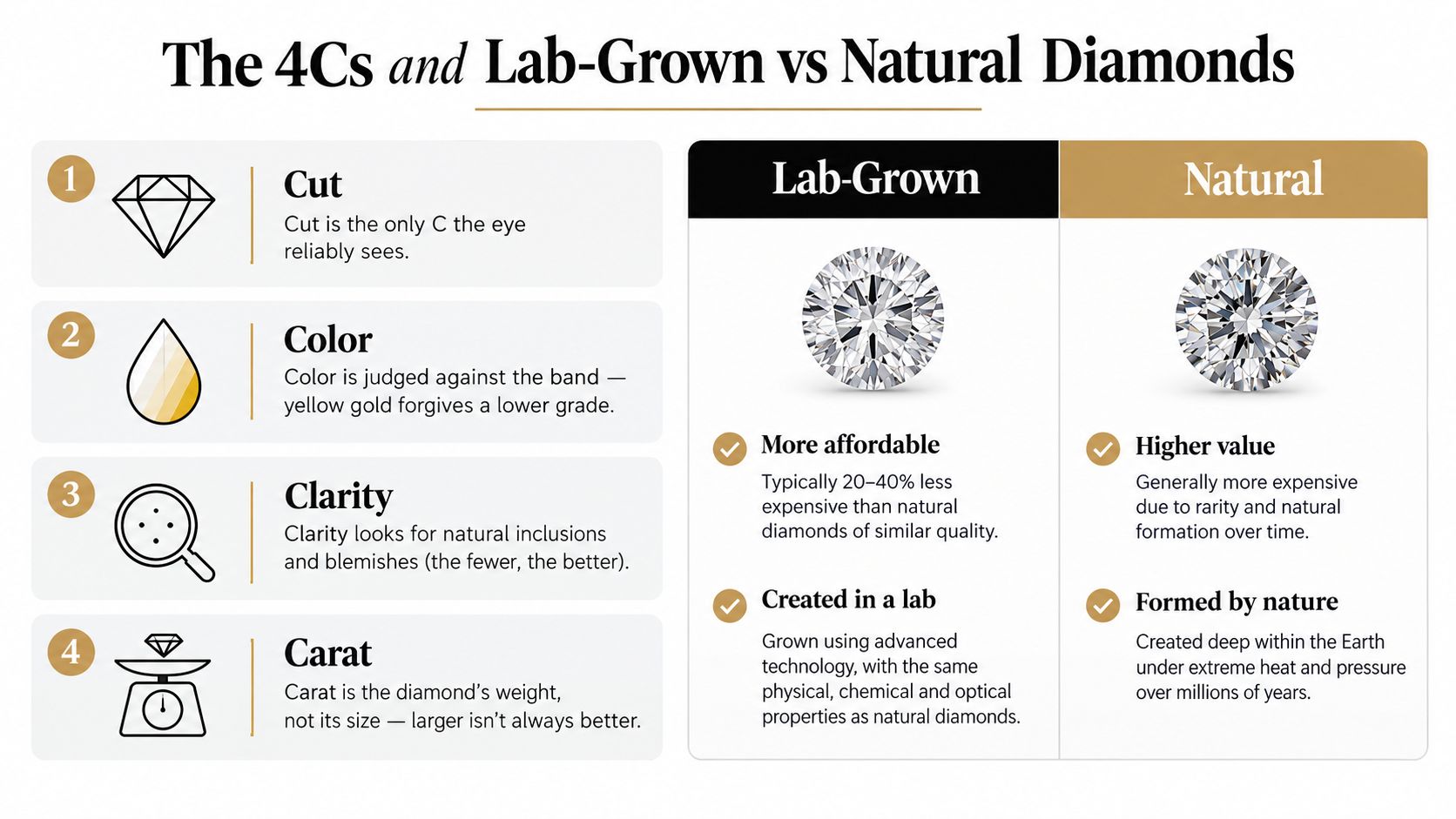
Cut is the first place to spend. Cut controls how effectively the diamond returns light, and it's the characteristic the eye usually notices most quickly. A well-cut diamond can look lively and bright without being the largest stone in the case.
Color depends on the band. A yellow-gold setting can make a lower color grade look comfortably warm because the metal supplies warmth around the stone. The same diamond may appear more noticeably tinted against a very white metal. Don't compare color grades in isolation. Compare the diamond inside the setting you're considering.
Clarity is about what you can see. Inclusions matter if they affect transparency, durability, or the face-up appearance. A grading report provides a map, but your eyes under magnification and in normal viewing light should decide whether a clarity feature matters to you.
Carat is weight, not visual size. Two diamonds with the same carat weight can present differently because shape, cut proportions, and setting affect the face-up appearance. If the budget is tight, protect cut quality before chasing a larger carat number. This diamond clarity and color guide is useful preparation before you compare stones in person.
Decide what the diamond needs to represent
Lab-grown and natural diamonds can both be beautiful, durable center stones, but they answer different buying priorities. A 2025 survey of 2,000 U.S. consumers reported that 74% would accept a lab-grown diamond for an engagement ring, while only 33% preferred one. 37% remained undecided because they lacked information. The survey reporting from Caratx also identified yellow gold as the leading metal preference at 39%, with lab-grown center stones averaging about $4,300 compared with $7,000 for natural-diamond rings in the cited survey.
Choose lab-grown when the priority is a larger or better-cut diamond for the initial budget and long-term resale isn't the central goal. Choose natural when origin, tradition, family succession, or the desire to pass down the stone matters more. A yellow-gold band doesn't answer the provenance question for you. Ask whether the diamond is natural or laboratory-grown, request independent grading, and compare warranties and repair policies.
If you prefer a floral or nature-inspired design, a Get Spliced floral ring guide can provide visual direction. Still, documentation must come before style. Lab-grown resale is currently soft, and complete records matter for either type of diamond.
Settings That Match How You Actually Live
A catalog photograph shows a ring at its most flattering. Your hand will wear it while opening boxes, washing dishes, gripping a steering wheel, pulling on gloves, and reaching into pockets. Choose the setting for those moments.
| Setting | Lifestyle Fit | Stone-Loss Risk | Metal Visibility | Best For |
|---|---|---|---|---|
| Solitaire | Clean, uncomplicated, easy to inspect | Lower than multi-stone designs, though prongs still need checks | High around the shank, minimal around the center | Buyers who want maximum center-stone focus |
| Pavé | Sparkling band with a more decorative look | More small-stone and shared-prong maintenance | Less visible along the decorated portion | Buyers who want continuous sparkle |
| Halo | Makes the center look more prominent from a distance | More surrounding stones and settings to maintain | Moderate, with metal framing the melee | Buyers who want presence without one very large center |
| Bezel | Protective and secure for hands-on routines | Lower exposure to knocks, though inspection remains necessary | High rim around the stone | Parents, healthcare workers, tradespeople, and active wearers |
| Three-stone | Symbolic design with added side-stone presence | Side stones and settings need periodic tightening | Visible between and around the stones | Buyers who want past, present, and future symbolism |
The solitaire remains my practical default when a buyer wants brilliance and straightforward maintenance. Its open design lets light reach the center stone, and the simpler shank is easier to inspect. The drawback is a raised head that can catch on gloves, knitwear, or gym equipment.
Pavé puts small diamonds into the gold band, so the ring sparkles beyond the center. That look costs more in stones and labor, and every additional small setting creates another point that deserves inspection. If a prong fails, a small diamond can loosen or disappear.
A halo surrounds the center with a frame of smaller diamonds. It creates a larger visual footprint from across a room, but the close-set design can trap lotion, soap residue, and grime around the center. Clean it more carefully than a plain solitaire.
For hands-on work, bezel is the serious option. A continuous gold rim protects the diamond's edges and eliminates exposed prongs around the stone. You give up some open brilliance, but you gain protection.
A three-stone ring carries strong symbolism and can add total diamond presence without concentrating the entire budget in one large center. The side stones need periodic tightening, so this isn't a maintenance-free choice.
Sizing, Comfort, and Getting the Fit Right
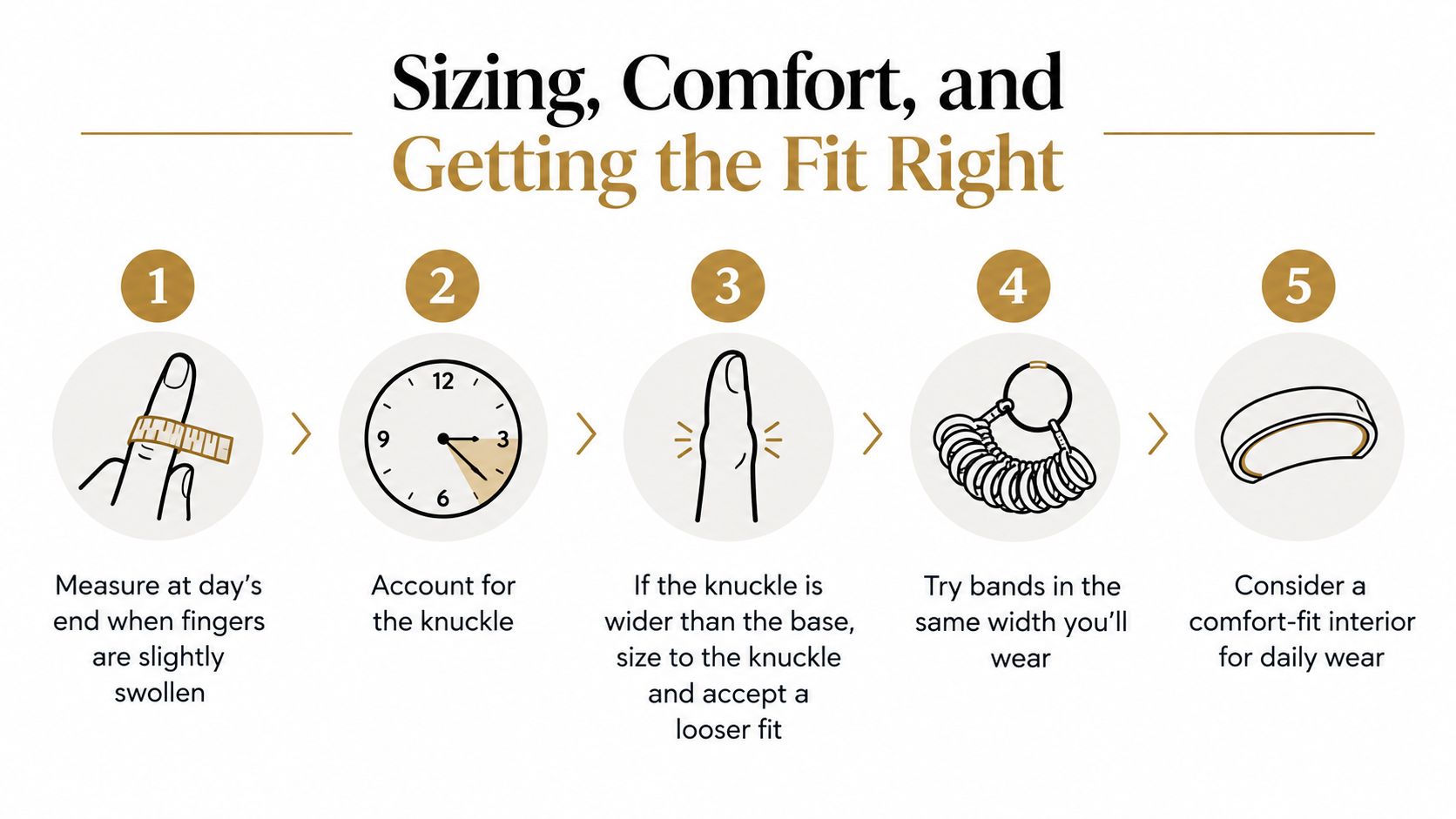
Measure the finger toward the end of the day, when hands are naturally a little fuller. Morning measurements can produce a ring that feels too tight later, while a cold-room measurement can produce the opposite problem.
Pay close attention to the knuckle. If it's noticeably wider than the base of the finger, size to the knuckle and accept a small amount of spinning, or choose a setting and band profile that help keep the center aligned. Try the actual width of band you intend to wear, not just a thin plastic sizer.
Comfort fit or standard fit
A comfort-fit band has a rounded interior that slides over the knuckle more easily and feels gentler during temperature changes. It can use a little more metal because of that interior shape. A standard-fit band feels flatter and can feel slightly smaller, which some wearers prefer because it stays centered.
Plain gold shanks are generally the easiest to resize, often within one full size up or down. Resizing can disturb prong alignment and leave polishing work near the seam, so it isn't a casual adjustment. Eternity bands with diamonds set all the way around can't be resized in the conventional way.
Resizing rule: Get the fit right before finalizing the setting. A ring that needs to be remade is more expensive than a ring that needed careful measuring.
Why Buying Locally in Boise Beats Shipping Your Ring
Online ship-away buyers offer convenience, but the seller carries practical risks while the jewelry is out of sight. You have to package the ring, document its contents, arrange shipment, check the insurance limit, monitor delivery, wait for a remote evaluation, and then wait for payment. Consumer comparisons of online gold-selling services show how widely coverage can vary, with examples of automatic insurance at $1,000, $2,500, or $5,000 per shipment, some services advertising coverage up to $25,000, and others allowing additional insurance for shipments valued as high as $100,000.
That isn't a minor detail when the parcel contains a diamond ring. A headline online offer may look attractive until you account for packing, insurance, shipping, delays, and the possibility that the remote buyer evaluates the ring differently than you expected. A local transaction can remove or reduce those steps and put the inspection and offer in the same room.
What happens across a Boise counter
A local jeweler can examine the band while you watch. Xray Scanning and Gold Testing for free gives you a direct way to discuss the metal rather than relying on an old description or an uncertain stamp. Portable XRF analyzers can provide gold-concentration and full-alloy chemistry data in approximately 2 to 5 seconds per sample, according to Bruker's jewelry analyzer information. Evident Scientific reports practical XRF accuracy for gold of about ±0.4% with a 10-second test using standard calibration, improving to roughly ±0.2% with application-specific calibration and consistent procedures.
XRF is nondestructive. It doesn't require cutting, melting, scratching, or altering the ring. Surface-based readings still require sensible testing protocols and trained interpretation, so ask how the test is performed and explained.
For a purchase, local inspection lets you compare stones in person, examine prong tips under magnification, look at the ring in window light, and discuss whether the documentation matches the piece. An 8-step authentication process can also check the item's identity, condition, setting integrity, provenance information, and supporting certification where applicable. If something needs clarification, you can ask immediately instead of completing a claims form from home.
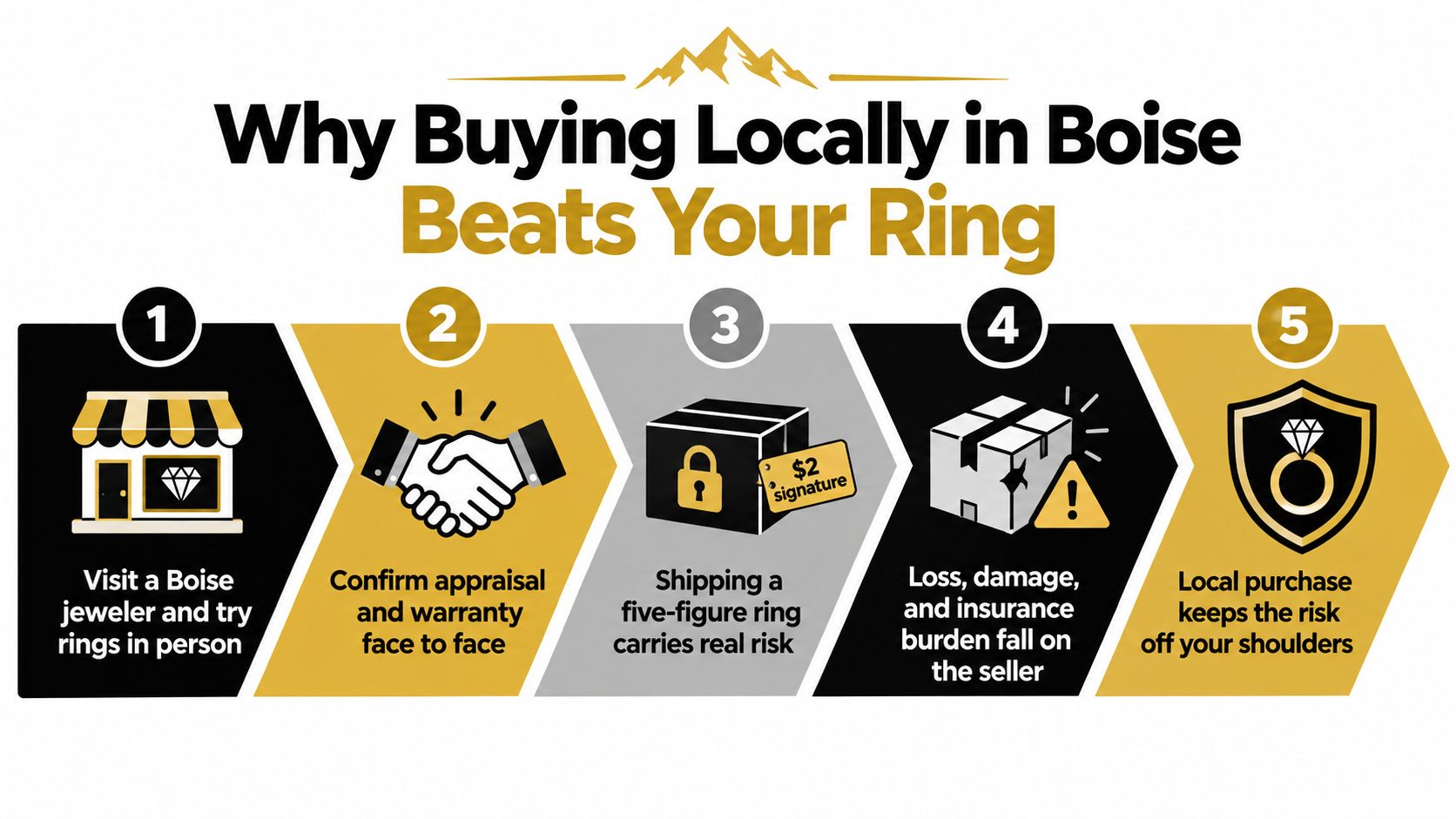
Convenience is useful. For a ring you'll wear for decades, direct inspection is more useful.
Gold and Jewelry Buying should include more than weighing the band. A diamond engagement ring combines gold content, diamond characteristics, design, condition, brand, craftsmanship, and documentation. The highest payout in Boise isn't necessarily the offer with the largest online headline. It's the offer that remains strongest after shipping, insurance, commissions, waiting, and other deductions.
Watch this overview before visiting a buyer, then bring your questions to the counter.
For another practical reference before you shop or sell, review this guide to buying gold and diamonds. Ask for hassle free offers, a clear explanation of what is being valued, and Price Matching based on equivalent specifications. A fair comparison should identify the same karat, weight, diamond characteristics, condition, fees, shipping, insurance, grading, and commissions. FTC jewelry guidance for marketers emphasizes truthful representation of metallic content, size, weight, quality, price, and value.
Care, Cleaning, and Protecting Long-Term Value
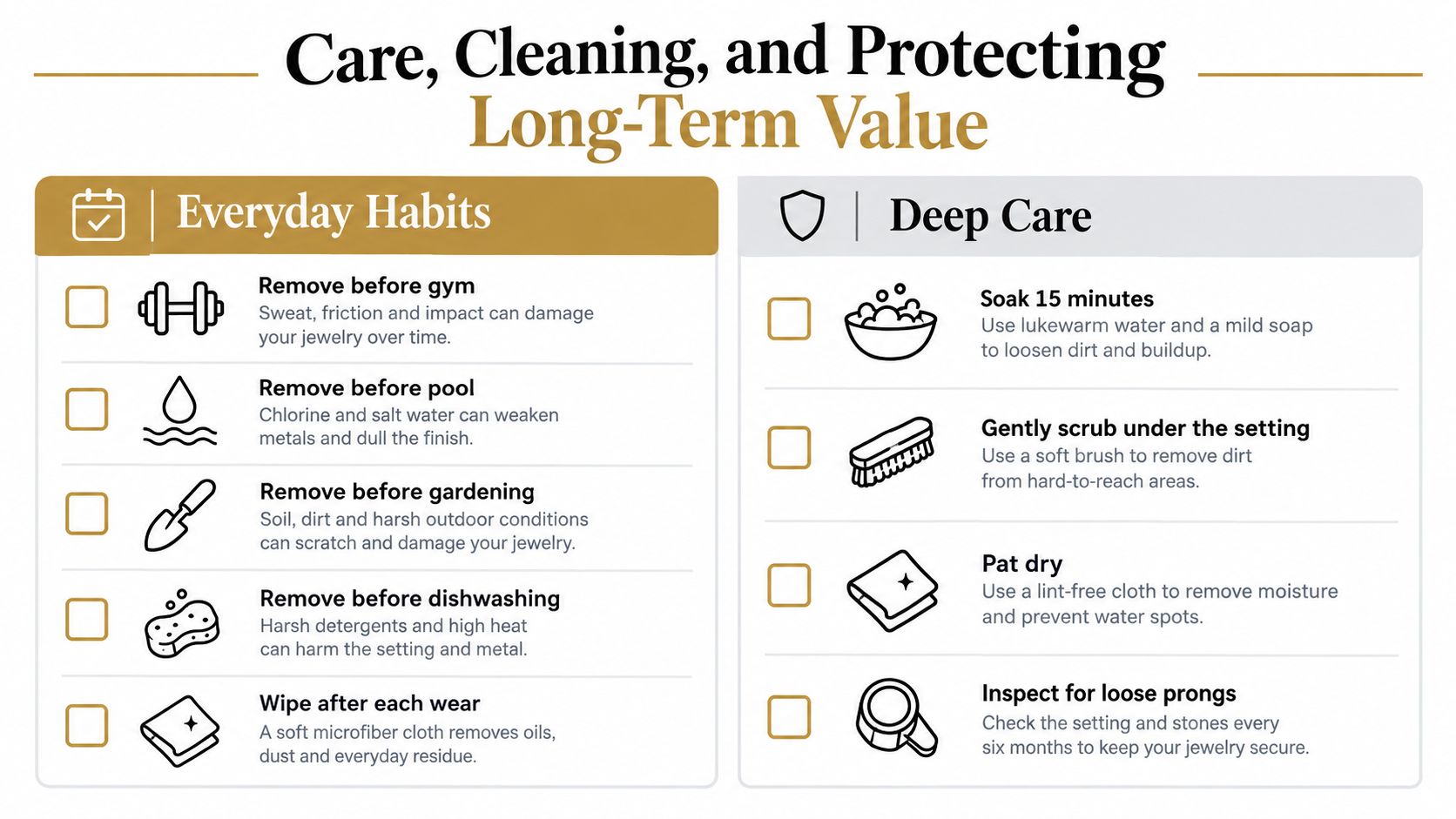
A gold-band diamond engagement ring doesn't need nervous handling. It needs consistent habits. Remove it before the gym, pool, gardening, and dishwashing. Hard knocks, chemicals, dirt, and residue create more trouble than ordinary daily wear.
Wipe the ring with a lint-free cloth after each wear to clear oils from the diamond and setting. Store it flat in a fabric-lined box, away from harder jewelry that can scratch the gold or catch a prong. Don't toss it loose into a drawer with watches, bracelets, and other rings.
A simple home routine
Use lukewarm water, mild dish soap, and a soft brush when the ring needs more than a wipe. Work gently beneath the setting, rinse carefully, and pat dry with a lint-free cloth. Keep the drain closed or use a bowl. Losing a ring to a sink is an avoidable mistake.
The at-home diamond jewelry cleaning guide can help you establish a routine, but home cleaning doesn't replace inspection. Steam cleaning can make a ring look bright while a loose prong remains a structural problem.
Schedule light professional cleaning and a prong check every six months. Have a full inspection annually, especially if the ring has pavé, a halo, side stones, or a raised solitaire head. Ask the jeweler to check the prongs, stone movement, worn contact points, shank thickness, and any prior sizing seam.
Keep one complete documentation folder
Put every important record in one physical or digital folder:
- Sales receipt: Keep the original description, metal karat, diamond details, and price.
- Diamond certification: Save the GIA or IGI report if one applies, and confirm that the report number matches the stone and ring documentation.
- Insurance appraisal: Keep a current appraisal that describes the complete ring, not only the gold weight.
- Photographs: Take dated images before and after repairs, resizing, restoration, or major cleaning.
- Service records: File receipts for prong work, polishing, stone tightening, replating, and other repairs.
Paperwork doesn't turn a ring into an investment, and it doesn't guarantee a particular resale price. It does make the ring easier to identify, insure, appraise, trade, upgrade, or explain to a future buyer. The World Gold Council reported that global gold-jewelry consumption in 2025 fell 18% year over year to 1,542 tonnes, the lowest annual volume in five years, while the value of demand rose 18% to a record US$172 billion. In the United States, second-quarter 2025 consumption fell 7% year over year to 30 tonnes, while demand value rose 30% to US$3 billion. The World Gold Council's 2025 jewelry report shows why gold weight has real commodity relevance, but it also makes clear that a finished ring's value can't be inferred from gold alone.
For an estate ring or inherited piece, separate the recoverable metal value from the diamond, design, condition, brand, and sentimental value. A karat mark and a professional test establish the composition. They don't erase the history of the ring or automatically determine its best use.
Take this checklist to the store
Screenshot this list before you shop:
- Confirm finger size: Measure when the hand is at its largest, typically in the evening, and account for the knuckle.
- Choose the alloy: Decide between 14K and 18K based on daily wear, color preference, and skin tone.
- Set the diamond budget: Establish the remaining amount after the band and setting are chosen.
- Compare the 4Cs: Bring a printed reference, then prioritize cut and visible beauty over a single impressive number.
- Choose practical settings: Narrow the choice to one or two styles that match work, exercise, parenting, and maintenance habits.
- Clarify diamond origin: Ask whether the center is natural or laboratory-grown and request independent grading.
- Request testing: Ask for in-person XRF scanning, gold testing, and the full 8-step authentication process.
- Compare the complete offer: Check whether shipping, insurance, grading, commissions, repairs, and other deductions are included.
- Collect documentation: Get the receipt, certification, appraisal, service terms, and warranty before paying.
The core decision is straightforward. The gold band is a budget-and-lifestyle call. The diamond is a quality-and-certification call. The buying channel is a trust call. A local Boise jeweler can let you watch the gold test, inspect the diamond under magnification, assess the setting, and discuss the offer before you commit. That is the advantage ship-away buyers can't provide.
Visit Carat 24 - Trusted Gold Experts in Boise for gold and diamond jewelry, free Xray Scanning and Gold Testing, hassle free offers, 8-step authentication, and clear Price Matching based on comparable items. Bring your diamond engagement ring with a gold band for an in-person evaluation, and compare a local offer before you send a valuable piece through the mail.
