

You're standing at a jewelry counter comparing two engagement rings. One diamond is lifted on four bright claws, while the other looks set into a smooth metal frame. Both are attractive, but you're wondering which one will survive daily wear, whether the framed diamond is hiding too much stone, and what happens if the ring is inherited, resized, or sold later.
A diamond engagement ring bezel is more than a style choice. It affects protection, cleaning access, repair work, diamond visibility, gold value, and the practical experience of wearing the ring every day. My advice is straightforward: choose a bezel when edge protection and a smooth profile matter more than maximum exposed sparkle, then verify the craftsmanship before you write a check.
What a Bezel Setting Actually Is
A bezel setting holds a diamond with a continuous metal rim. The rim follows the stone's girdle, which is the narrow outer edge around the diamond, and surrounds it rather than touching it at only a few isolated points. A prong setting uses separate claws, commonly four or six, while a full bezel creates a complete perimeter of metal.
Look at the ring from the side. The shank is the part that circles your finger. The shoulders rise from the shank toward the center stone. At the top sits the bezel cup, formed to match the diamond's outline. The setter places the stone into that fitted seat, then burnishes or presses the upper metal edge over the girdle. That folded edge locks the diamond into the setting.
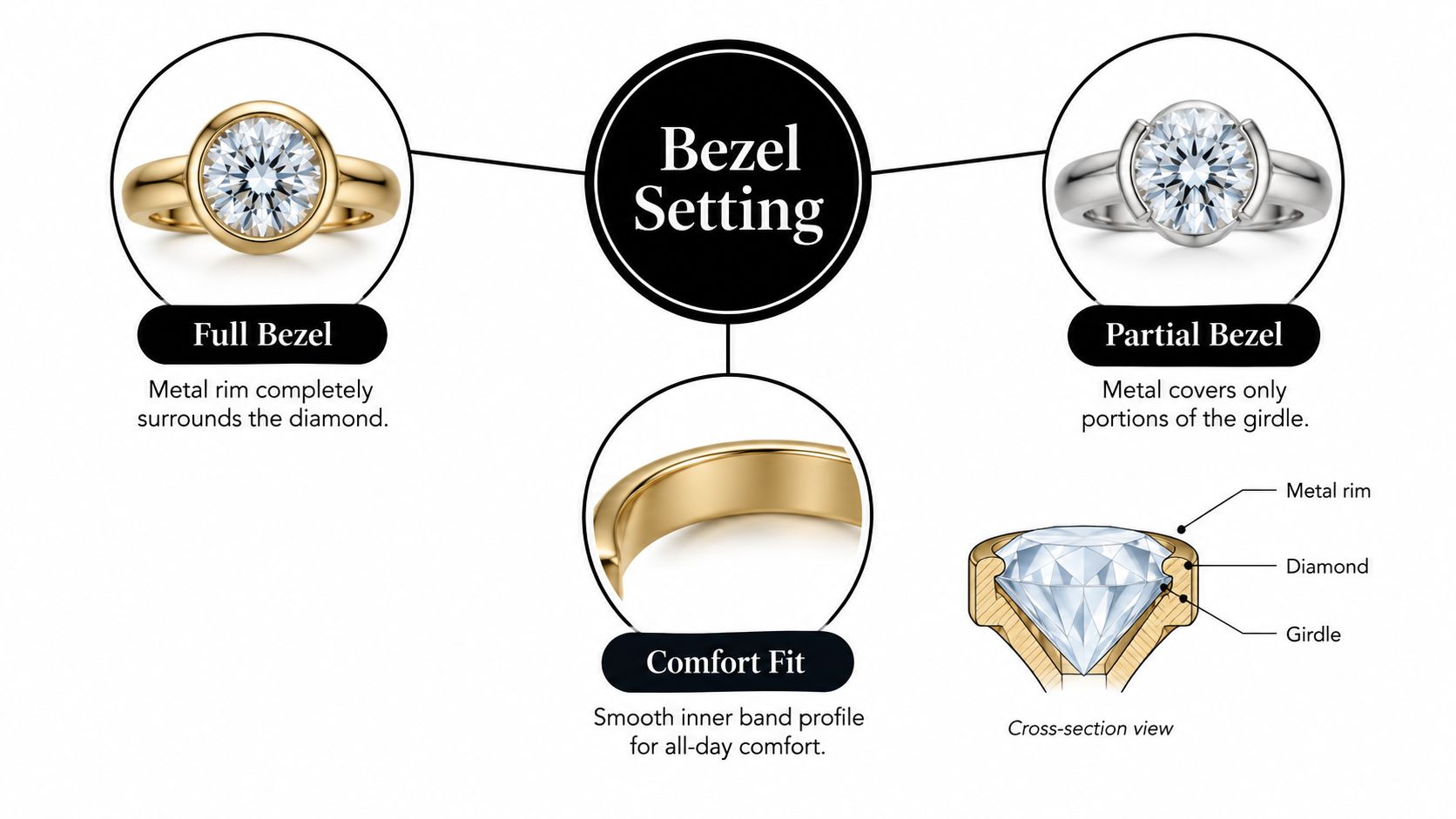
A full bezel surrounds the entire circumference. A partial bezel, sometimes called a half bezel or modified bezel, covers selected areas and leaves more of the diamond's edge visible. A comfort-fit band has a smoothly rounded interior, which can make a low-profile bezel ring easier to wear throughout the day.
Practical rule: If you can trace an unbroken metal outline around the diamond's edge, you're looking at a full bezel.
The method is ancient, not a recent minimalist trend. Historical jewelry evidence places bezel-style mounting as early as approximately 3000 BC, with examples associated with ancient Egyptian, Sumerian, and Roman jewelry, as described in this history of ring settings and mounting styles. Roman goldsmiths also used bezels on signet rings to protect carved designs and provide a smooth surface for pressing an impression into sealing wax.
That history matters because the engineering principle remains recognizable today. Metal encircles the stone's perimeter, creating a protective boundary instead of relying on exposed claws. Modern bezel rings can be sleek, substantial, delicate, vintage-inspired, or entirely contemporary. They aren't costume jewelry and they aren't limited to estate pieces.
When comparing metal choices, remember that the rim's appearance depends on the alloy as well as the design. A buyer comparing white gold and platinum may find this explanation of the difference between white gold and platinum useful before choosing a mounting.
If you're designing a ring rather than buying a finished one, you'll also want the jeweler to separate stone cost, metal cost, setting labor, and margin. A guide to wholesale pricing for jewelry makers can help you understand why two rings with similar-looking diamonds may carry different prices.
Bezel vs Prong Halo and Tension Settings
The right setting depends on what you want the ring to do. A full bezel prioritizes a protected edge and smooth wear. A solitaire prioritizes open views of the diamond. A halo adds surrounding sparkle, while a tension setting makes the metal appear to suspend the stone between the band's sides.
| Setting | How it holds the diamond | Main advantage | Main compromise |
|---|---|---|---|
| Full bezel | Continuous rim around the girdle | Strong edge protection and low snag risk | Covers more of the perimeter |
| Prong solitaire | Four, six, or another limited number of claws | Maximum visible diamond and side exposure | Claws can catch, loosen, or wear |
| Halo | Center stone held within a surrounding diamond frame | Extra visual sparkle and a larger-looking outline | More small stones and setting points to maintain |
| Tension | Band pressure holds the stone between opposing sides | Dramatic, open, modern appearance | Requires precise engineering and has little tolerance for distortion |
A full bezel covers the girdle around the entire circumference. That reduces exposed edge area and removes projecting claw tips that can catch clothing, gloves, hair, or equipment. It also shields vulnerable areas of the diamond, particularly on shapes with sharp corners or points.
Prongs show more of the stone. That openness can help a well-cut diamond look bright and prominent, but the claws need inspection. A bent or worn prong can leave the stone less secure, and a prong that catches on fabric is a daily nuisance. A halo can provide a stronger visual frame and add sparkle around the center stone, but it brings more small settings, more joints, and more surfaces where dirt can collect.
A tension setting is visually striking, but it should be purchased from a jeweler who can explain the engineering and future service plan. The apparent simplicity hides a demanding fit. If the band is altered or distorted, the stone's security can be affected.
The optical trade-off with a bezel is real. The metal collar covers more of the diamond's perimeter than prongs do, so slightly less side light enters and less of the profile is visible. That doesn't automatically make the diamond dull. Cut proportions, symmetry, polish, and accurate bezel alignment still control face-up performance. A thin, even rim can look crisp. A heavy or poorly centered rim can make the diamond appear smaller.
A 2023 retailer survey reported that 68% of jewelers observed zero warranty claims for diamond loss among professionally made bezel-set rings worn by clients in active occupations, compared with 12% for traditional four-prong solitaires under the reported conditions, as reported in this trade coverage of active-lifestyle ring settings. Treat that as a retailer-survey result, not a universal failure rate. Construction quality, maintenance, wear, and customer behavior can all affect the comparison.
This guide to diamond engagement ring alternatives is useful if you're weighing a bezel against other designs. There isn't one universally best mounting. There's only the setting that matches your diamond, hand, occupation, and tolerance for maintenance.
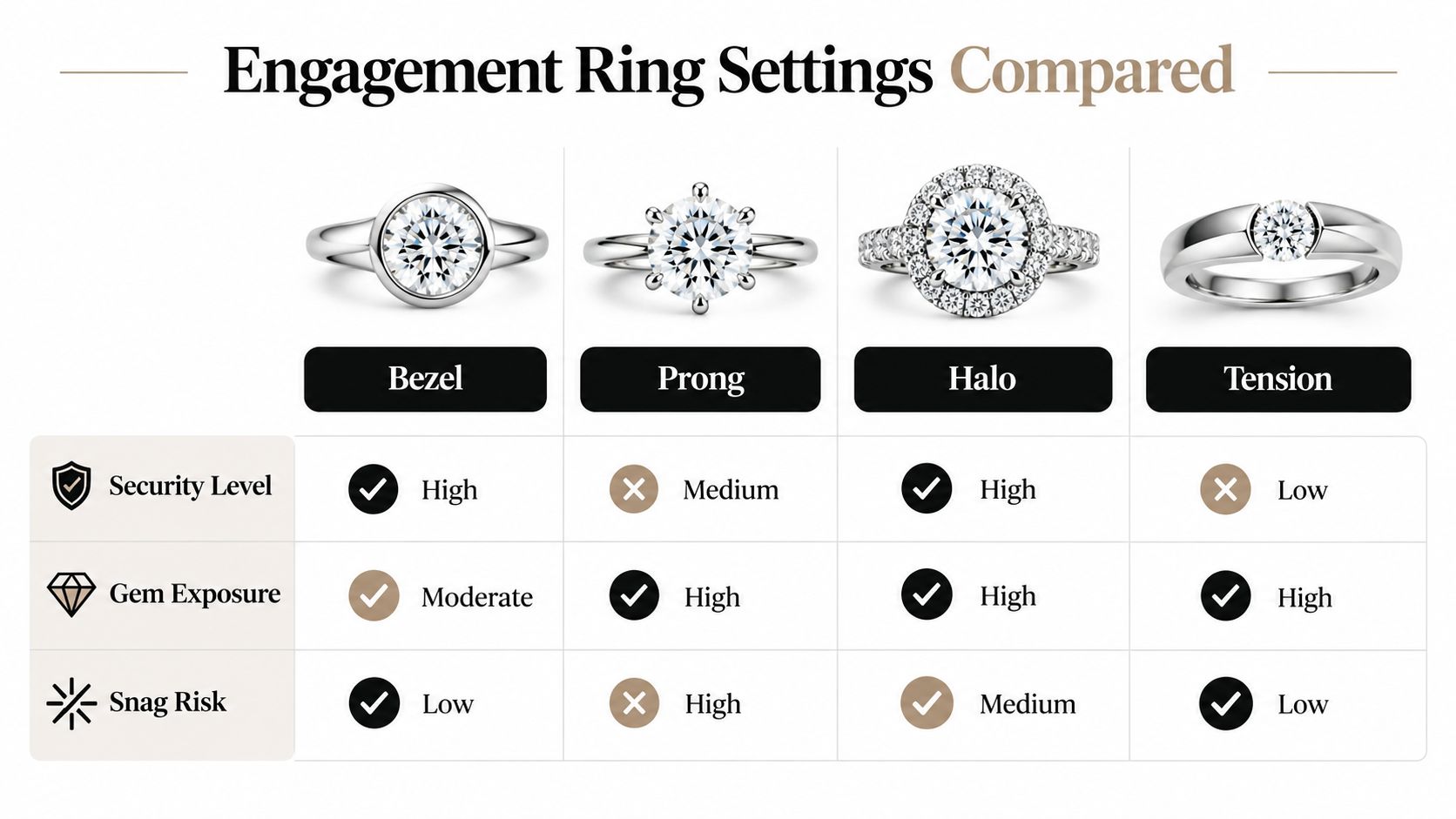
A visual comparison makes the central decision clear. More exposure usually means more openness, while more surrounding metal usually means more edge protection. Choose deliberately rather than assuming sparkle, security, or style exists without a trade-off.
Which Diamond Shapes Work Best in a Bezel
Shape determines whether a bezel looks effortless or overworked. The rim must follow the diamond's outline without covering too much of the crown or creating an uneven border.
Round oval and cushion shapes
Round brilliants are the easiest bezel candidates. Their continuous curve lets a setter form an even rim, and the smooth outline gives the ring a clean, deliberate appearance. An oval works similarly, although the bezel must maintain a balanced curve at the shoulders rather than becoming too broad at the ends.
Cushion cuts also suit bezels well. Their softened corners look intentional inside a metal frame, and the surrounding rim protects those corners without making the setting appear severe. A well-proportioned bezel can emphasize the cushion's outline while keeping the ring low and comfortable.
Emerald cuts have long lines and broad step facets. A precise rectangular or elongated bezel can reinforce that geometry, but the work must be clean. Step cuts reveal alignment errors quickly because their straight edges and corners are easy to inspect.
Pointed and cornered shapes
Princess, Asscher, and marquise diamonds are where I most often see a bezel earn its keep. Their corners or points can be vulnerable to impact when exposed, and a full rim places protective metal around those areas. GIA specifically identifies princess and marquise cuts as shapes for which a full bezel can be especially appropriate, particularly for active wear or frequent glove use, in its guidance on gemstone durability and jewelry design.
A marquise bezel must finish both pointed ends cleanly. A princess bezel needs accurate corners rather than softened, irregular transitions. An Asscher bezel should respect the stone's geometric outline without making the diamond look boxed in.
Pear and heart shapes can look excellent, but they demand a more experienced setter. Their asymmetrical outlines require the metal to follow a changing curve, including a pointed end or cleft. A sloppy fit is obvious, and excess pressure at the point can create a setting problem rather than solving one.
GIA's warning is important: the bezel must be fitted accurately before the stone is secured. Excessive pressure or poor fit can damage the gemstone during setting. Don't accept “the metal will settle into place” as an explanation for a visibly uneven rim.
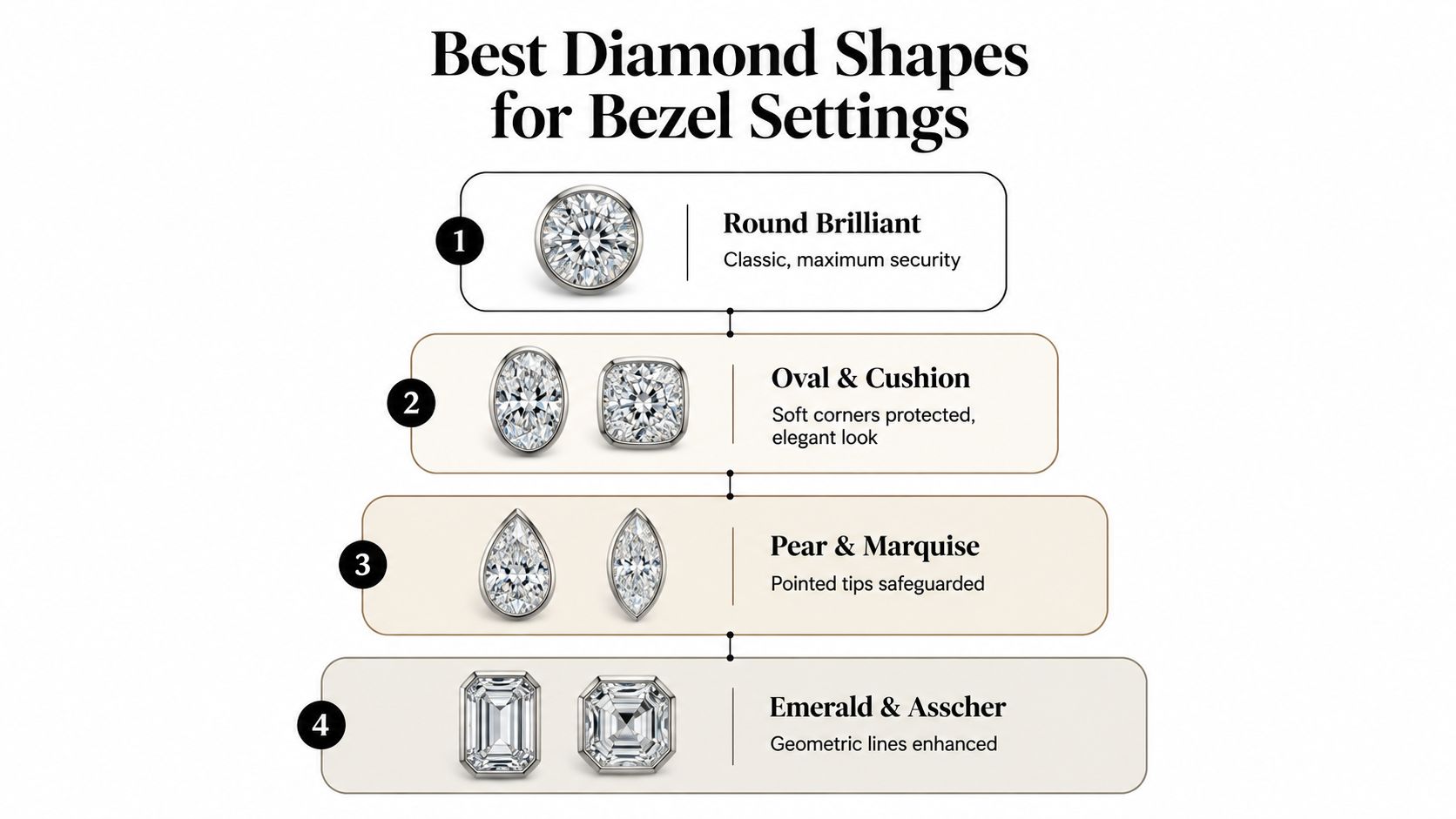
My rule is simple. Round brilliants and step cuts usually look excellent in a bezel when the rim is thin and accurate. Pointed or sharply cornered shapes benefit most from the protection of a full bezel. For pear, heart, and marquise stones, inspect the point coverage closely rather than judging only from the top view.
How It Feels to Live With a Bezel Ring
A ring can make perfect sense on paper and still be wrong for the person wearing it. The best setting is the one that disappears into your routine instead of demanding constant attention.
Consider a nurse who washes her hands repeatedly, pulls on gloves, moves equipment, and works through a long shift. A raised prong can catch on fabric or glove material. A low, smooth bezel removes those projecting claws and gives the diamond's edge a surrounding barrier. For a hairstylist, veterinary technician, or parent handling blankets and car seats, the same smooth profile can make daily wear less irritating.
That doesn't mean a bezel is maintenance-free. Lotion, soap, and fine debris can collect around the rim, and scratches on the exposed metal may be more visible than they are on a textured or prong-heavy design. Still, for someone who works with their hands, I usually recommend a full bezel over a high solitaire if the diamond's visibility trade-off is acceptable.
The inherited ring decision
Now consider someone who inherits a bezel ring from a parent or grandparent. The emotional value may be obvious, but the practical choice isn't always. Before wearing it, remodeling it, or selling it, inspect the rim under magnification and good light.
Check for:
- Rim contact: The metal should remain tight against the diamond's girdle, with no visible gap.
- Thin spots: Repeated wear can reduce the rim's thickness, especially along exposed edges.
- Dents and lifted sections: A dent can change how pressure is distributed around the stone.
- Previous sizing: Look for seams, solder marks, or an uneven shank.
- Stone movement: The diamond shouldn't rock or click when gently tested by a professional.
Keep the measurements straight. The FTC explains that one gemstone carat equals one-fifth of a gram and is divided into 100 points, as stated in its guide to buying diamonds and other gemstones. Carat describes gemstone weight. Karat describes gold purity. A 1.5-carat diamond and a 14-karat gold band are measuring different things.
Before deciding, photograph the ring, record any marks inside the shank, and ask for a written condition assessment. If you're considering home maintenance, use this practical resource on how to clean diamond jewelry at home, but don't scrub a loose stone or damaged bezel before inspection.
Resizing Cleaning and Repair Realities
Resizing a bezel ring isn't the same as sizing a plain band. A bench jeweler cuts and rejoins the shank, but that work can alter the relationship between the band, the bezel cup, and the diamond. A small shift may leave the rim uneven or reduce its contact with the girdle.
Before touching the ring, an experienced jeweler checks the entire structure:
- Existing sizing seams: Prior repairs can weaken or complicate a new cut.
- Shank thickness: A thin or hollow band may not tolerate substantial adjustment.
- Bezel symmetry: The rim must remain centered and evenly shaped.
- Stone security: The setter checks for movement, gaps, dents, and lifted sections.
- Adjustment range: The jeweler determines whether the needed size can be reached without rebuilding the setting.
Most bezel rings can be resized within a modest range when the shank and bezel are sound. A larger change may require the jeweler to remove the diamond, reshape or rebuild the bezel, then reset the stone. Ask exactly how many sizes the jeweler recommends, what the work includes, and what happens if the rim has to be remade. Technical guidance on bezel-set ring resizing and low-profile settings supports treating this as specialist bench work, not routine band sizing.
Ask before approving the job: “If the bezel loses its fit during sizing, will you rebuild the rim and reset the diamond, and is that included in the estimate?”
Cleaning requires the same practical honesty. A bezel can retain lotion and soap beneath the rim more readily than open prongs because access is limited. Start with warm water, mild dish soap, and a soft brush. Work around the outer edge without forcing bristles under a loose section.
An ultrasonic cleaner may be appropriate when the diamond, metal, and setting are in good condition, but a jeweler should inspect the ring first. Skip ultrasonic cleaning if the stone moves, the bezel is cracked, or the piece has an undocumented repair history.
When selling or buying, describe the mounting, metal, condition, and known repairs accurately. The FTC's jewelry guidance for truthful representations is the right standard. A clean-looking ring isn't proof of secure construction, and a polished surface shouldn't conceal thinning or prior work. For broader service planning, review typical jewelry repair costs and considerations before authorizing a repair.
Smart Questions to Ask Before You Buy
Bring questions that force the seller to explain the ring as an object, not just as a pretty photograph. Start with the diamond itself.
Questions about the stone
Ask whether the diamond has a grading report from GIA or another reputable laboratory. Confirm the stated color, clarity, cut information, measurements, and whether the weight is documented or estimated. If the stone is already mounted, ask whether the seller is relying on a prior report or offering an independent evaluation of the ring as it exists today.
Then examine the setting:
- Full or partial: Does metal surround the entire girdle, or only selected portions?
- Rim thickness: Is the edge slim enough to frame the stone without visually overwhelming it?
- Specific fit: Was this bezel made for this exact diamond, or was the stone adapted into an existing mounting?
- Corner protection: Are the points and corners properly covered?
- Cleaning access: Can a jeweler inspect and clean beneath the rim?
Your metal questions matter just as much. Ask for the karat mark, total metal weight, and whether any section is hollow, plated, or filled. A hollow shank may deform more readily than a solid one, while plating can affect how the ring should be valued and maintained.
The FTC states that describing an item as “gold,” or applying a gold-quality designation, can be misleading when an item made throughout from an alloy contains less than 10 karats of gold. The same guidance says gold purity should be accurately disclosed in karats or parts per thousand, as explained in its precious-metal jewelry guidance. A missing or questionable stamp doesn't prove the ring is worthless, but it does mean you should request a separate test.
Questions about the transaction
Ask about returns, resizing, future inspections, loss coverage, and whether you'll receive a written appraisal or detailed sales document. Request a budget breakdown that separates the diamond, metal, labor, design, and any included services. A low price may reflect a thinner rim, lower metal weight, a lower-grade diamond, or limited after-sale support.
Recent trend coverage has identified half bezels as an emerging compromise between full protection and an open profile, according to engagement-ring trend coverage from The Knot. Ask the jeweler to place full and half-bezel versions of a comparable stone side by side. Your eyes will judge the difference more reliably in person than through a website photograph.
Buying and Selling Locally in Boise
A bezel ring deserves an in-person decision because the metal frame changes how the diamond looks from the top, side, and across the hand. In Boise, a local jeweler can measure the finger, check the ring's actual fit, examine the rim under magnification, and let you compare full and partial bezels under showroom lighting. A screen can't show whether the metal edge feels too heavy or whether the stone rocks inside its seat.
The local advantage matters even more when you inherit a ring and don't know what you have. Carat 24 - Trusted Gold Experts uses an 8-step authentication process, with free X-ray scanning and gold testing available as part of its evaluation approach. Energy-dispersive X-ray fluorescence, or XRF, is non-destructive. It can analyze gold alloys and identify gold content and alloying elements without removing material, and a peer-reviewed metallurgy source reports accuracy of about 0.1% under suitable conditions, depending on instrument repeatability and variation within the piece, as described in this research on XRF analysis of gold alloys.
That testing changes the conversation from appearance to evidence. A proper evaluation can consider the diamond, gold karat, metal weight, condition, prior repairs, and market demand separately. It also gives inherited jewelry owners a clearer choice between wearing, consigning, remodeling, or selling.
For buyers, local service means easier resizing discussions, inspections, and follow-up. For sellers, it means hassle-free offers, no uncertainty from shipping a valuable ring, and a chance to ask questions face to face. Price matching can make comparisons more useful, especially when you have more than one written quote.
Selling locally can also avoid the practical headaches of online shipments. You don't have to accept transit risk, wait through a remote inspection, or deal with deductions that may apply when a buyer treats a complete ring as material for refining. A local offer isn't automatically the highest possible offer, but the highest payout in Boise should be your benchmark. Compare the full terms, not just a headline number. This local guide to the best place to sell diamonds can help you prepare before visiting a buyer.
Carat 24 buys gold, silver, bullion, and fine jewelry, including diamond pieces. If you're in Boise and considering a bezel engagement ring, bring it in for a professional look before you clean, resize, remodel, consign, or ship it anywhere.
Carat 24 - Trusted Gold Experts offers free X-ray scanning and gold testing, an 8-step authentication process, hassle-free offers, and price matching for Boise clients evaluating gold and diamond jewelry. Visit Carat 24 - Trusted Gold Experts at 3780 W. State St. for a documented second opinion on your bezel ring and a local offer before you send it away.
