
100 ounces of silver are worth roughly $6,067 to $6,249 at a spot price between $60.67 and $62.49 per troy ounce, before premiums, spreads, or testing adjustments. The amount you receive depends on the bar's purity, authenticity, and where you sell it.
You may be looking at a heavy box from an estate, a 100-ounce bar bought years ago, or a collection that has sat untouched in a Boise closet. The first instinct is usually to search, “What is 100 ounces of silver worth?” That calculation is useful, but it only gives you the metal's theoretical melt value. Your final cash payout depends on the form of the silver and the buyer assessing it.
A large bar can look straightforward, yet sellers still leave money on the table by confusing spot value with a dealer's purchase price. Online mail-in services add shipping, insurance, processing time, and uncertainty. A local, authenticated sale lets you see how the buyer reaches the offer and compare the amount with the live market.
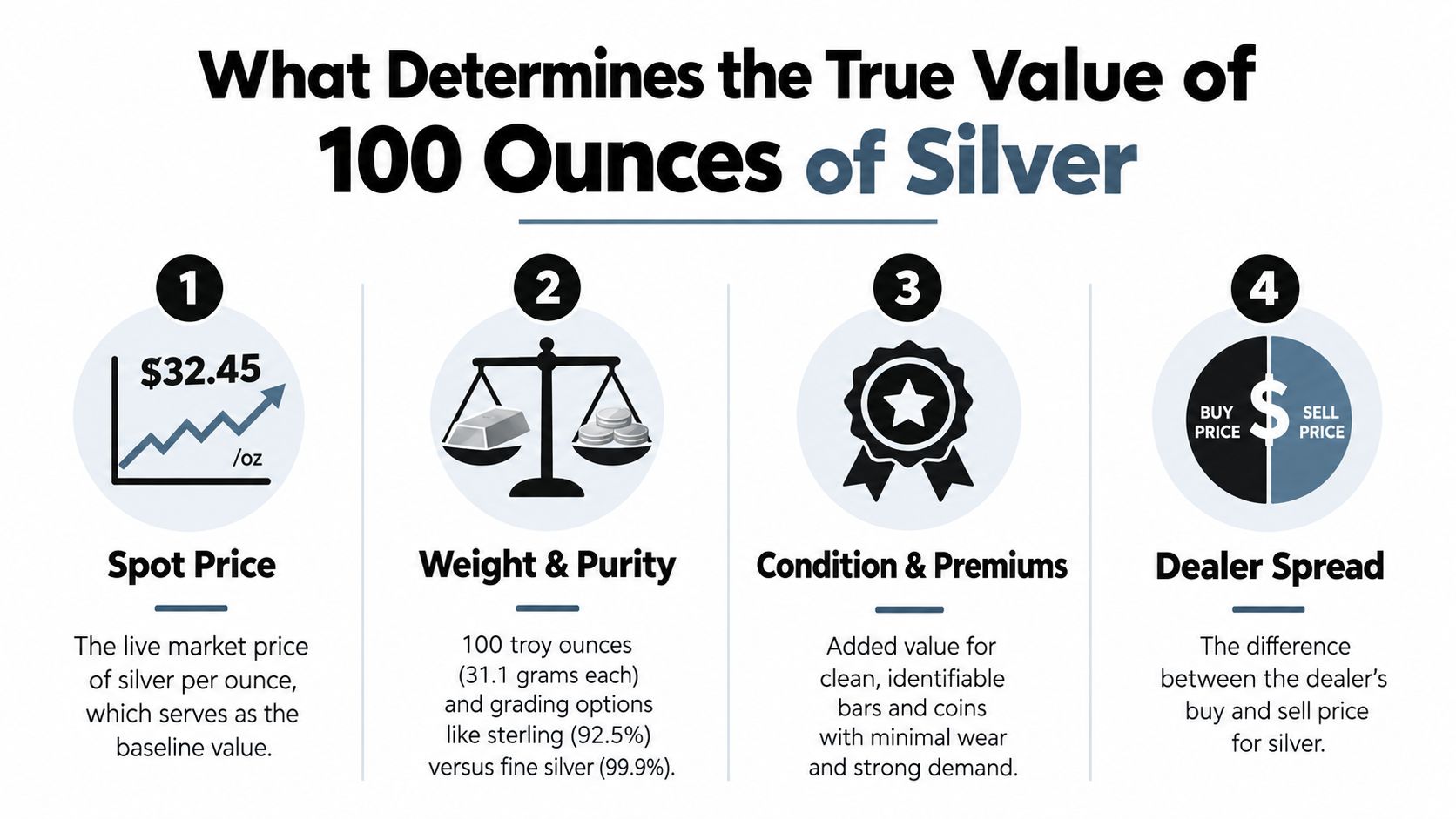
What Determines the True Value of 100 Ounces of Silver
A Boise homeowner may open a safe and find one 100-ounce bar, several silver rounds, or sterling pieces that weigh 100 ounces together. The scale gives you a starting point, not a cash offer. An accurate valuation depends on the item's actual silver weight, fineness, current spot price, authenticity, and the buyer's spread.
The metal calculation is straightforward. Apply the item's purity to its gross weight, then compare the resulting silver content with the current spot market. The stamped weight alone does not establish the amount a buyer will pay.
A .999-fine bar and a .925 sterling lot with the same gross weight contain different amounts of silver. Dealers verify fineness before converting the item into payable ounces, which is why two 100-ounce holdings can produce different melt values. J&M Bullion's explanation of silver purity standards explains how fineness affects a silver valuation.
Spot price is the baseline
Boise buyers use the global silver market as their reference point. Spot pricing changes during trading sessions, while a purchase offer also reflects verification, resale demand, operating costs, and the risk of holding the metal.
A recognizable 100-ounce bar usually has a stronger resale profile than a mixed lot of unmarked pieces. The manufacturer, serial number, assay packaging, condition, and ease of authentication can affect the offer. Those details do not alter the silver inside the item, but they can reduce handling time and buyer risk.
That difference matters when comparing an online mail-in service with a local transaction. Shipping, insurance, processing delays, and the possibility of an unclear adjustment reduce the amount you keep. A Boise shop can inspect and authenticate the silver in person, explain the offer, and give you a clearer path to a higher net payout. Review this guide to the spot price for gold and silver before comparing a live quote with the market.
History shows why timing matters
Silver reached about $49.45 per troy ounce on January 18, 1980, then approached the same level in April 2011 at roughly $49.47 intraday. Those prices valued 100 ounces at approximately $4,945 and $4,947, respectively, according to Reuters' historical silver timeline.
Reuters also records silver falling to about $15 per ounce by the end of 1980, reducing a 100-ounce holding from roughly $5,000 to about $1,500 within that year. A headline peak is not a guaranteed selling price. If you need certainty, compare the current melt estimate with an authenticated local offer rather than waiting for a perfect market call.
Practical rule: Establish the silver content first, then compare the item's market-adjusted value with the net amount a verified Boise buyer will pay.
These physical bullion investment tips cover practical questions about liquidity, storage, authentication, and selling decisions.
Step-by-Step Silver Valuation and Calculation Guide
Start by separating gross weight from Actual Silver Weight, often called ASW. Gross weight describes everything on the scale. ASW estimates how much of that weight is pure silver after the fineness is applied.
Use this formula:
Gross Weight × Purity = Actual Silver Weight
Then apply the market price:
Actual Silver Weight × Spot Price = Raw Melt Value
A 100-ounce bar marked .999 fine therefore contains 99.9 troy ounces of pure silver. A sterling item weighing 100 ounces has .925 fineness, so its pure silver content is substantially lower. The label weight alone can't tell you what the metal is worth.
Work through the market examples
Silver moved above its previous nominal highs in January 2026. One market summary reported an all-time high of approximately $121.62 per ounce on January 29, 2026, which placed 100 ounces at about $12,162 before a dealer spread or other adjustment. That figure was more than double the approximately $4,945 value associated with the 1980 peak. The historical and current figures are documented in Money Metals' silver all-time high summary.
By early October 2026, market readings were back around the low $60s, including approximately $60.84 and $61.42 per ounce. At those prices, 100 ounces represented roughly $6,084 to $6,142. The same holding can therefore move between a five-figure valuation during an exceptional market spike and a mid-four-figure valuation during more ordinary trading conditions.
| Valuation stage | What you calculate | Why it matters |
|---|---|---|
| Gross weight | Everything placed on the scale | It may include base metal or packaging |
| Fineness | The silver percentage, such as .999 or .925 | It determines pure silver content |
| ASW | Gross weight multiplied by fineness | This is the metal basis for valuation |
| Melt value | ASW multiplied by spot price | It gives a market reference before the offer |
Audit the buyer's offer
Ask whether the buyer is valuing the item by gross weight or ASW. Ask what spot price they're using, whether testing has been completed, and whether the quote includes a premium for a recognizable bar. A transparent buyer should be able to explain each adjustment without relying on a vague “that's just our price.”
A 100-ounce bar normally has more efficient fabrication and distribution economics than many small retail pieces. That can make its price sit closer to melt value, while a seller of a small, highly marked-up product may not recover the premium originally paid. The guide to one troy ounce of silver is useful for understanding why product size and format affect the relationship between retail price and resale value.
Don't assume a historic peak is the right target for every sale. If you need liquidity, compare the current verified offer with the current melt value. If you're holding for a future price objective, recognize that silver can move sharply in both directions and that an unrealized market value isn't the same as cash in hand.
Where to Sell Silver in Boise for Maximum Payout
A Boise seller with a 100-ounce bar can lose money without realizing it. An online quote may look competitive, yet shipping, insurance, processing, return handling, and the buyer's spread can reduce the cash that reaches the seller. A local, authenticated sale often produces a stronger net result because the bar stays in the seller's possession until the offer is understood and accepted.
The key comparison is between net payout, control, speed, and risk, and the table below shows how those factors differ.
| Local sale | Online shipment |
|---|---|
| You keep possession during the assessment | You surrender possession before the final offer |
| Testing happens face to face | The buyer evaluates the item remotely or after delivery |
| Payment can be arranged directly after acceptance | Payment depends on the service's process |
| You can compare nearby offers | Returning the item may add time and handling |
| No shipment preparation is required | Packing and insurance become your responsibility |
Online selling shifts more work and uncertainty to the owner. You must package the silver, arrange shipping, purchase suitable insurance, wait for inspection, and decide what to do if the final offer differs from the initial quote. Rejecting that offer can create another delay while the bar is returned. A listing price is not the same as a net payout.
A local transaction gives you more control. You can bring the bar to a physical shop, ask how it will be tested, review the calculation in person, and compare another offer before transferring ownership. You also avoid placing a valuable bar in a shipping chain handled by several parties. For a large bullion piece, those practical differences can make a local shop such as Carat 24 a better route to a higher net payout, even when an online headline quote appears similar.
Local choice exists
Boise has an active local market for precious metals rather than a single buyer. Idaho Gold & Silver says it buys and sells gold, silver, platinum, and rare or common coins, and lists Boise locations. The Boise jewelers and buyer listings show multiple physical businesses and addresses, including 10494 W Overland Rd, 7070 W State St, 6807 W Fairview Ave, and 1008 W Main St.
Those listings give sellers a starting point for comparing location, hours, and service availability. Call before visiting to confirm that the shop evaluates large silver bars and ask what identification or documentation to bring.
The local advantage does not mean every local quote will be higher. It means you can compare offers without adding shipping risk to the transaction. A buyer who tests the bar properly and explains each adjustment gives you a better basis for deciding than an anonymous online form.
For a focused explanation of the practical issues involved, read this guide on where to sell silver bars. To pursue the highest payout in Boise, visit more than one reputable buyer or ask whether a local shop will match a verifiable competing offer.
Preparing Your Silver for Professional Authentication
A seller who ships a 100-ounce bar to an online buyer may receive an attractive headline quote, then lose part of the proceeds to shipping, insurance, platform fees, or a price adjustment after inspection. A local, authenticated sale lets you see the testing, discuss the offer, and leave with a clearer net result. In Boise, that practical control can make a shop such as Carat 24 a stronger choice than selling sight unseen.
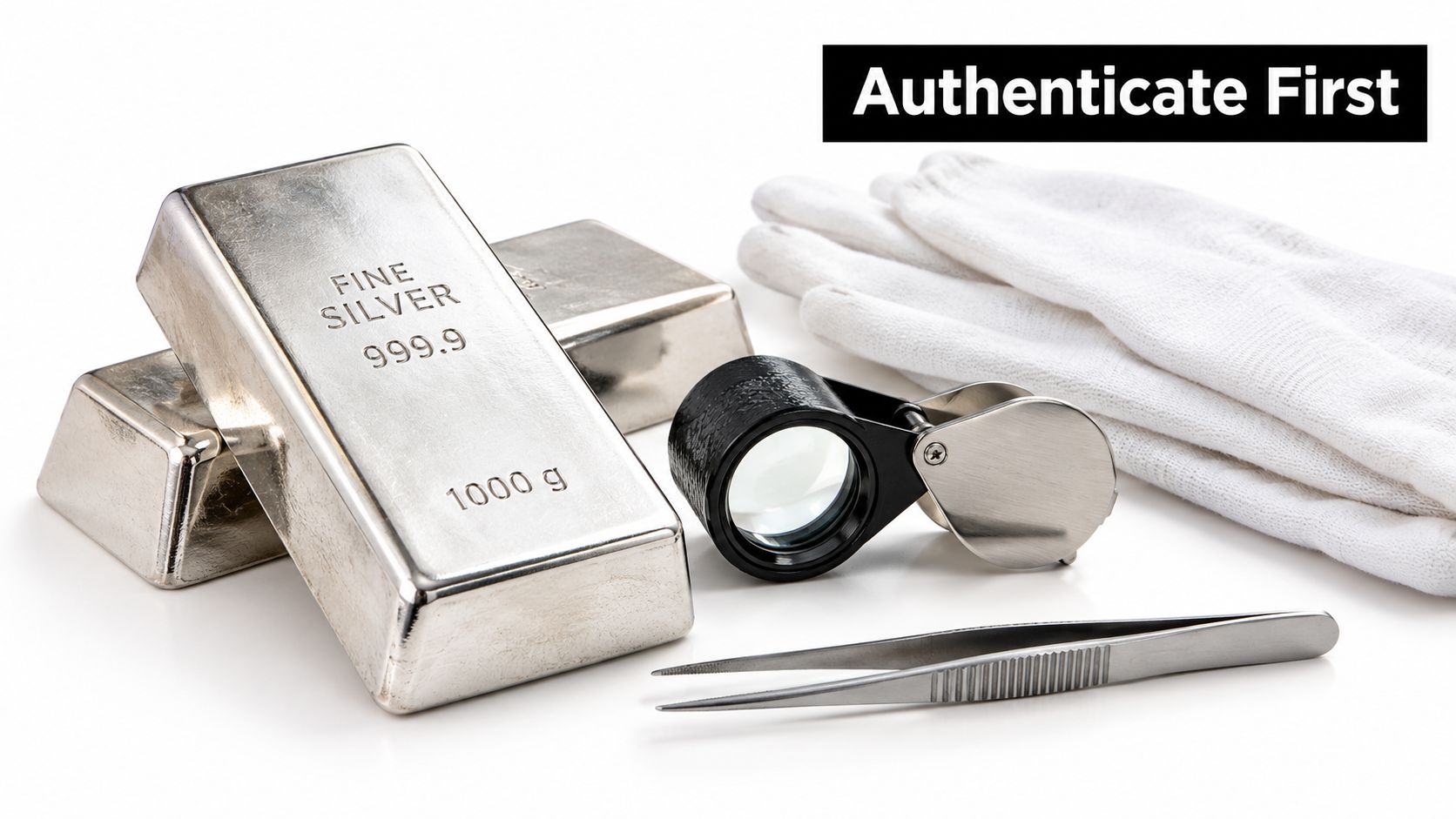
Good preparation protects the bar's identifying details and gives the buyer a clear item to evaluate. Separate bullion from jewelry, sterling flatware, rounds, and miscellaneous pieces. Group items by markings and apparent fineness. Keep assay cards, receipts, certificates, mint packaging, and estate records with the relevant pieces. Documentation does not replace testing, but it can clarify what the buyer is examining.
Follow a clean preparation process
- Leave identifiable surfaces intact. Do not file, scratch, polish, or chemically clean the bar before assessment. Those actions can damage stamps and complicate authentication.
- Record the visible details. Note the stamped weight, fineness, manufacturer, serial number, and assay information. Photograph the bar and its markings before transporting it.
- Transport it securely. Use a discreet container and keep the metal with you. Do not leave it in an unattended vehicle while visiting buyers.
- Keep related pieces together. Bars from one purchase or estate are easier to explain when their records and packaging remain together.
- Request testing before accepting a quote. Ask what method the buyer will use, what it measures, and whether the result covers only the surface or supports a broader evaluation.
Why professional testing protects the offer
X-ray fluorescence, commonly called XRF, directs X-rays at the metal and reads the characteristic fluorescence produced by its elements. The instrument can estimate the composition near the tested surface without cutting or damaging the bar. That makes it useful for checking whether the visible metal aligns with its markings.
A surface reading still has limits. Plating, a localized alloy difference, contamination, or an altered surface can affect what the instrument sees. A careful buyer may test more than one area, inspect weight and dimensions, review the assay, and choose another method when the findings do not agree. Ask whether the result is a surface indication or part of a wider authentication process. Carat 24's silver and gold testing guidance explains how verification fits into an evaluation.
Reliable testing reduces the buyer's uncertainty, which can reduce the adjustment built into an offer. It also gives you a defensible basis for comparing local quotes with an online payout after selling costs. A professional Boise evaluation can therefore produce a higher net result without requiring you to guess at purity or accept a remote adjustment.
Before you sell: Do not judge purity by appearance. Ask the buyer to test the item and explain how the result affects the offer.
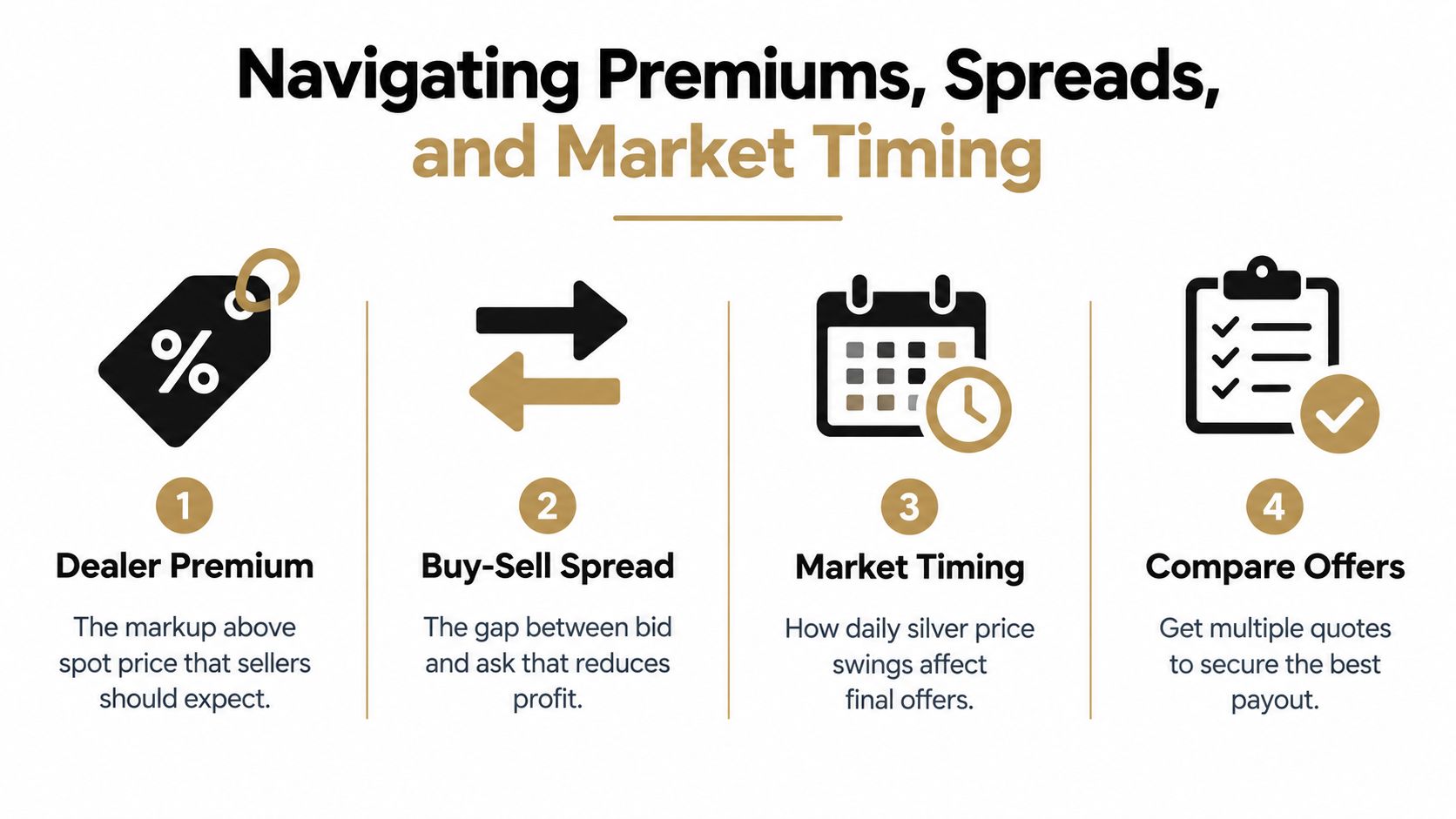
Navigating Premiums, Spreads, and Market Timing
A seller often compares a retail purchase price with a dealer's buyback offer and assumes the difference means someone is undervaluing the silver. Sometimes the offer is weak. Often, the gap reflects fabrication, distribution, testing, operating costs, and the dealer's need to resell the metal at a workable margin.
The form of the silver matters. A 100-ounce bar has fewer production and handling costs per ounce than many one-ounce products, so large bars commonly trade nearer to melt. Small retail products can carry more manufacturing and distribution cost. You shouldn't expect every retail premium to come back when you sell.
Use the current market as your reference
On October 4 and 5, 2026, silver spot readings were approximately $60.67 to $62.49 per troy ounce, producing a raw melt range of about $6,067 to $6,249 for 100 troy ounces before a spread or fabrication adjustment. The live pricing chart from J&M Bullion provides the relevant market reference.
Large 100-ounce bars typically carry a premium of only a few percent above melt, while one-ounce products can carry double-digit markups. That difference is more important to buyers than sellers, because the original retail premium doesn't necessarily transfer into the resale offer.
Match timing to your reason for selling
A seller who needs to settle an estate may value certainty and a clean transaction more than waiting for a possible future peak. A collector who has no immediate need for cash may choose to monitor the market and set a target. Neither approach is automatically correct. The right decision depends on your purpose, liquidity needs, and tolerance for price movement.
The market's recent range illustrates the risk of waiting for a headline number. Silver reached approximately $121.62 per ounce on January 29, 2026, then traded around the low $60s by early October, according to the historical market summary cited earlier. A high theoretical value only helps if you sell while the market is offering it and your specific product is available to a buyer.
Compare the bid, not just the spot price. The amount that matters is the verified cash offer after the buyer accounts for purity, condition, and resale costs.
Get more than one quote when the holding is substantial. Ask each buyer for the spot reference, ASW, testing method, and any deductions. A short conversation can reveal whether one offer reflects the metal fairly or only includes a wider spread.
Why Local Buyers at Carat 24 Deliver Higher Payouts
For a Boise seller, the strongest local transaction combines three things: accurate authentication, a transparent calculation, and a process that doesn't create extra work. That combination is more useful than a flashy online estimate that changes after the item is shipped.
Carat 24 - Trusted Gold Experts operates at 3780 W. State St. Boise Idaho and handles silver, bullion, gold, jewelry, and numismatic collectibles. Its stated process includes an 8-step authentication process, which gives the buyer a structured way to verify what a seller has brought in rather than relying only on a visual inspection.
What a serious local assessment should include
A seller should expect the buyer to identify the item, verify its composition, calculate the actual silver content, and explain the offer. Carat 24 provides Xray Scanning and Gold Testing for free, which helps remove uncertainty around purity and authenticity before the seller decides.
The practical benefits are straightforward:
- Hassle-free offers: You bring the silver to a physical Boise location and discuss the offer directly.
- Price Matching: A verifiable competing offer gives you a basis for asking whether the shop can match it.
- Face-to-face clarity: You can ask why the quoted amount differs from the raw melt value.
- Local convenience: You avoid the packing, insurance, and waiting associated with online shipments.
- Broader buying expertise: Gold and Jewelry Buying can matter when a silver lot includes watches, diamonds, coins, or other precious-metal pieces.
Boise dealers also serve sellers with mixed collections. Independent local listings describe businesses buying and selling gold, silver bullion, rare coins, and pre-owned jewelry, including luxury watches such as Rolex and Omega. Other listings mention bullion, foreign and domestic coins, diamonds, pocketwatches, and dental gold. That broader experience can be useful when an estate or household collection isn't neatly divided into one metal.
Carat 24's guidance on how to sell silver reinforces the practical point: know the spot price, understand the weight and purity, and use authentication to judge the offer. A local shop can't eliminate market volatility, but it can eliminate avoidable confusion.
For sellers focused on the highest payout in Boise, the sensible approach is to bring the bar in for free testing, request a clear calculation, and compare the offer with another reputable local buyer. Save the hassle and sell locally for more than online shipments when the local net amount is stronger after shipping, insurance, time, and risk.
The following video offers another way to understand the type of precious-metals and jewelry service available through a local buyer:
The medium-term outlook also deserves separate attention from the immediate resale decision. The Silver Institute forecasts 2026 silver demand at 1.11 billion ounces, down 2%, with industrial demand expected to decline 3%, while JPMorgan expects solar demand for silver to fall 30%, or about 60 million ounces, compared with 2025. At the same time, the market is described as facing a sixth consecutive annual deficit, and JPMorgan forecasts approximately $63 per ounce in the fourth quarter of 2026 and in 2027 in the cited Silver Institute market report. Those projections support a measured decision, not a promise of a particular future price.
Carat 24 - Trusted Gold Experts offers free Xray Scanning and Gold Testing, transparent hassle-free offers, Price Matching, and local Gold and Jewelry Buying for silver sellers in Boise. Visit Carat 24 - Trusted Gold Experts to have your 100 ounces of silver authenticated, valued, and reviewed in person before you decide.
