
A Boise homeowner opens a safe deposit box, finds a familiar one-ounce gold bar, and searches, “How much is 1 ounce gold bar worth?” The first result shows a live market number. But is that really what the bar will put in your hand after authentication, dealer spreads, and the difference between a retail asking price and a buyback offer?
The short answer is that a standard 1-ounce bar is generally worth close to the current gold spot price before premiums and selling costs. On October 4, 2026, live market trackers showed gold around $4,144 to $4,176.50 per ounce, so a standard bar was worth roughly that range as raw bullion value before dealer premiums, fabrication costs, and buy or sell spreads (Kitco live gold pricing). Your actual Boise payout can be lower or higher depending on purity, brand, condition, verification, and the buyer's current inventory needs.
Why Your 1 Ounce Gold Bar Is Worth More Than the Spot Price
The homeowner with the bar has found the right starting point, but not the final answer. A live ticker tells you what the underlying metal is trading for in a global market. It doesn't automatically tell you what a local buyer will offer after checking the bar, confirming its fineness, and accounting for the cost of reselling it.
That distinction matters because a physical gold bar isn't the same thing as an abstract ounce on a trading screen. It has a refinery, a stated purity, an assay or security package, and a transaction history. A recognized bar with clear markings may move through a dealer's inventory more easily than an unfamiliar or damaged piece, even when both contain approximately the same amount of gold.
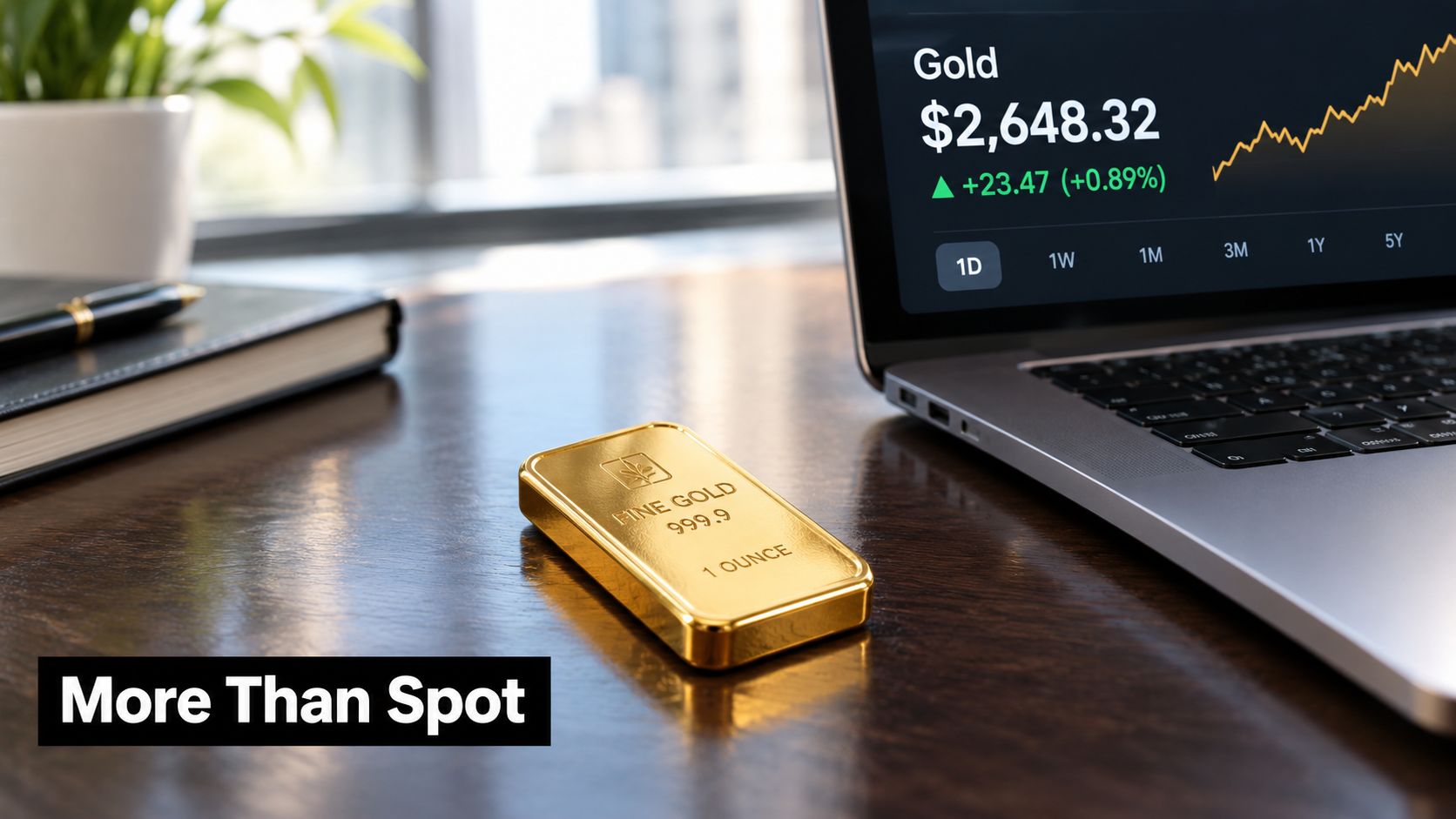
The number on the screen is an anchor
Use this practical equation:
Real-world value = metal value adjusted for purity, plus or minus the product premium, minus the buyer's spread and transaction costs.
For a standard 1-ounce bar, the metal component starts near one troy ounce of gold multiplied by the live spot price. A seller usually doesn't receive the retail premium that another buyer might pay. Instead, the offer reflects the dealer's expected resale price, testing costs, risk, overhead, and margin.
That is why two online pages can display different figures without either page necessarily being fraudulent. One may show spot, another may show a retail ask, and a third may show a dealer's bid. The words spot, ask, and buyback describe different points in the transaction.
Practical rule: If you're selling, ask for the amount you can actually receive today. Don't compare a buyback offer with a retail listing and assume the difference is automatically an unfair deduction.
What can move your payout
A local buyer will generally look at:
- Purity: A bar marked .9999 fine contains a different amount of pure gold than a bar with lower fineness, even if both are labeled as one ounce.
- Recognition: A known refinery, mint, serial number, or intact assay packaging can make verification easier.
- Condition: Scratches or damaged packaging may affect confidence, particularly when the buyer cannot quickly confirm the contents.
- Market liquidity: A dealer with immediate demand for a specific bar may quote differently from one that already has similar inventory.
- Exit method: A local, authenticated sale can avoid shipping fees, insurance complications, waiting periods, and deductions that aren't obvious from an online headline.
Some owners also compare physical bullion with digital ownership before deciding how they want to hold gold. For a plain-language explanation of the distinction, how gold tokenization works provides useful context, although tokenized exposure and a bar in your possession have different ownership, custody, and resale considerations.
The safest interpretation of the October market range is simple: it gives you a reasonable bullion baseline. It doesn't guarantee your final offer. A transparent buyer should explain how the spot reference, purity, testing result, and buyback spread combine into the number you receive.
What the Gold Spot Price Actually Measures
What does the gold spot price tell you about a 1-ounce bar? It gives you the current market reference for one fine troy ounce of gold, not the retail value of a finished bar and not the weight shown by a household scale. Precious-metals markets use troy weight, while kitchen scales commonly use avoirdupois ounces. A standard 1-ounce bullion bar typically contains 31.1034768 grams, the mass associated with one troy ounce.
The London Bullion Market Association identifies the LBMA Gold Price as an internationally recognized benchmark. Dealers, refiners, banks, and bullion platforms use benchmark or live market references, but the number on your screen depends on timing, currency, data feed, and whether it shows a bid, ask, or midpoint. The LBMA explanation of the gold price provides background on how that benchmark developed.
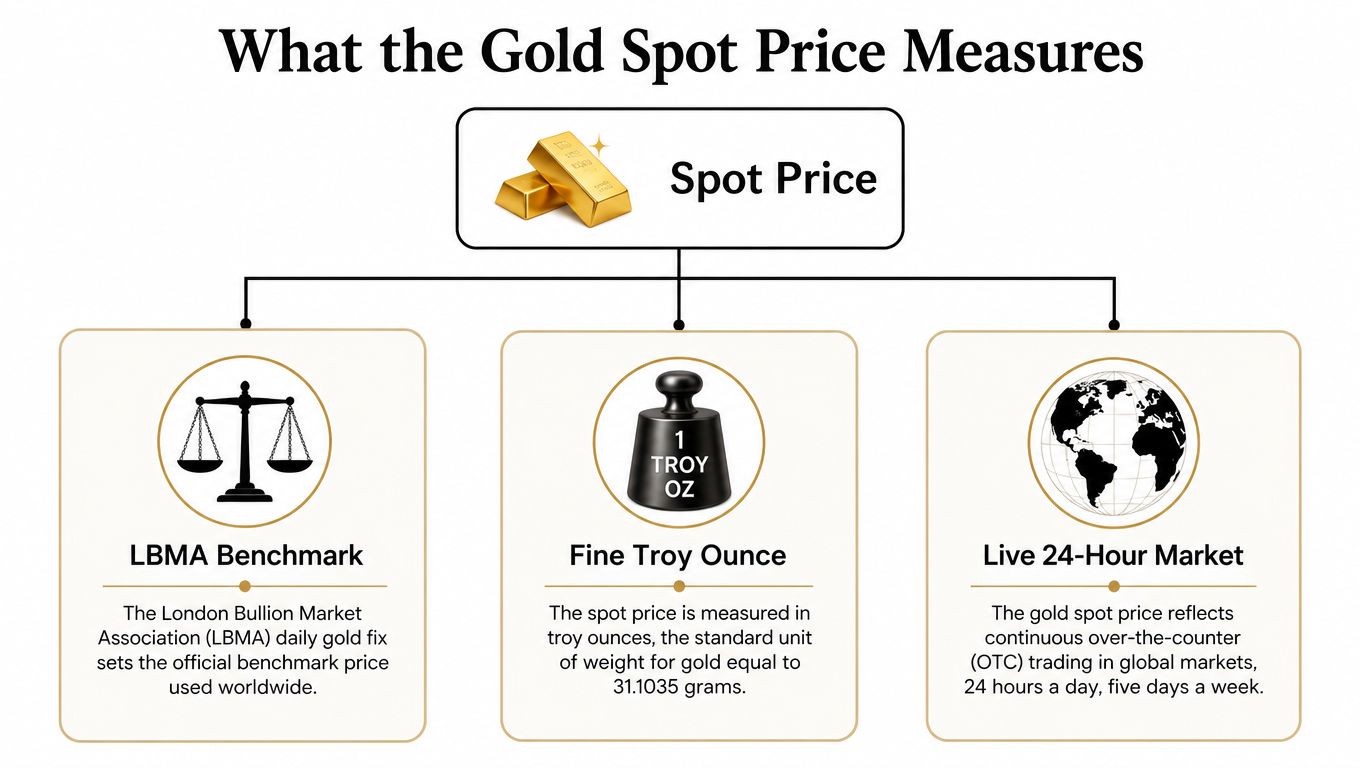
The three measurements behind the quote
Spot pricing has three connected layers:
- Benchmark: The LBMA Gold Price provides a recognized reference for wholesale gold transactions. Its history reaches back to the first London gold price auction on September 12, 1919. The price later shifted from sterling to U.S. dollars on April 1, 1968, as the American market gained influence.
- Weight: The relevant unit is a fine troy ounce. A bar advertised as one ounce should be checked against troy weight, not the ounce printed on a household product or displayed by an uncalibrated kitchen scale.
- Purity: Wholesale gold bars must meet a minimum fineness of 995, while many retail bullion bars exceed that baseline, as explained in the LBMA guide to gold pricing.
A practical Boise check before you compare quotes
Bring a magnet and request a scale check when you visit a local buyer. A 1-ounce bar should weigh 31.1g on a troy-calibrated scale. If your kitchen scale shows 28.3g, you are reading avoirdupois ounces rather than troy ounces. A magnet is only a screening tool, not proof of authenticity, so the buyer should also explain the testing method and any resulting deduction.
Why quoted prices do not always match
A live market changes continuously. One website may refresh more often than another, and one source may display the price a participant will pay while another shows the price a seller is requesting. A dealer's product page may also include a premium before showing the retail price.
Those pages answer different questions. Spot asks for the market reference for the metal. A retail listing shows what a buyer must pay for a physical product. A buyback quote shows what a dealer will pay to take possession, test the bar, and resell it. The gap between those figures is why a bar can be worth more at retail than the cash offer you receive in Boise.
For a seller, ask which figure supports the quote: benchmark spot, retail price, or cash buyback value. Then ask how the dealer's testing result and spread affect your payout. You can review this plain-language guide to what the gold spot price means before requesting offers.
How Dealer Premiums Change Your Real Purchase and Sell Price
A dealer premium is the amount added above the underlying metal value to cover the physical product and the transaction. It can reflect refining, stamping, assay packaging, shipping, inventory financing, authentication, and the dealer's operating margin. It can also change when demand rises or available stock becomes scarce.
A market example illustrates the difference. One-ounce bars were quoted around $4,329.35 against a spot reference near $4,190.35, implying a premium of roughly 3.3% under those conditions (GoldCore one-ounce gold bar pricing guidance). Industry guidance places ordinary one-ounce bar premiums at about 1% to 5% above spot, although the spread can widen when demand is strong or supply is tight.
Buying and selling use opposite sides of the market
If you're buying, you pay the dealer's ask. If you're selling, you receive the dealer's bid or buyback price. The two numbers are not supposed to be identical because the dealer needs room to handle the next transaction.
A branded minted bar with recognized packaging may carry a stronger retail premium than a plain cast bar. That doesn't necessarily mean the gold content is greater. The difference may come from perceived trust, easier resale, fabrication, packaging, and buyer preference. Conversely, a common bar in strong local demand may receive a competitive buyback quote even if its original retail premium was modest.
Use this sequence when comparing offers:
- Identify the reference: Ask which spot price, time, and currency the buyer used.
- Confirm the bar's calculation: Verify the stated weight and fineness rather than relying only on the front label.
- Separate ask from bid: A retail listing shows what a buyer may pay, while a buyback quote shows what you may receive.
- Ask about deductions: Clarify whether testing, shipping, insurance, processing, or payment costs reduce the quoted amount.
- Compare the net result: The highest headline price isn't necessarily the highest payout if it carries additional fees or requires shipment.
Why premiums don't transfer automatically to sellers
Owners often assume that a bar purchased above spot should be sold above spot by the same amount. That isn't how most physical markets work. The original premium paid for fabrication and retail access may not be fully recoverable when the bar returns to a dealer. The buyer may already have inventory, may need to test the piece, or may have to sell it into a wholesale market.
The best way to protect yourself is to compare the live spot reference with the net buyback spread. Ask, “What will I walk away with?” rather than, “What is this bar listed for online?”
A local inspection can make that comparison clearer. You can bring the bar, see how the buyer evaluates it, and decide without committing to a shipment. A guide to how much a bar of gold is worth can help you understand the broader calculation, but only a current offer on your specific bar answers the resale question.
Gold Volatility Explained with Real Historical Context
How can the same one-ounce gold bar have a very different dollar value at different points in history? The bar's weight and fineness stay fixed, while the market's valuation of gold changes with inflation, monetary policy, investor demand, currency conditions, and confidence in other assets.
Early gold markets included long periods of official price controls. Gold was fixed at a low sterling price in the eighteenth century, and that official level remained unchanged for roughly two centuries before London's market pricing began. In the twentieth century, the United States also maintained a fixed official dollar price for decades. Those periods show why a historical price is meaningful only when you understand the monetary system behind it.
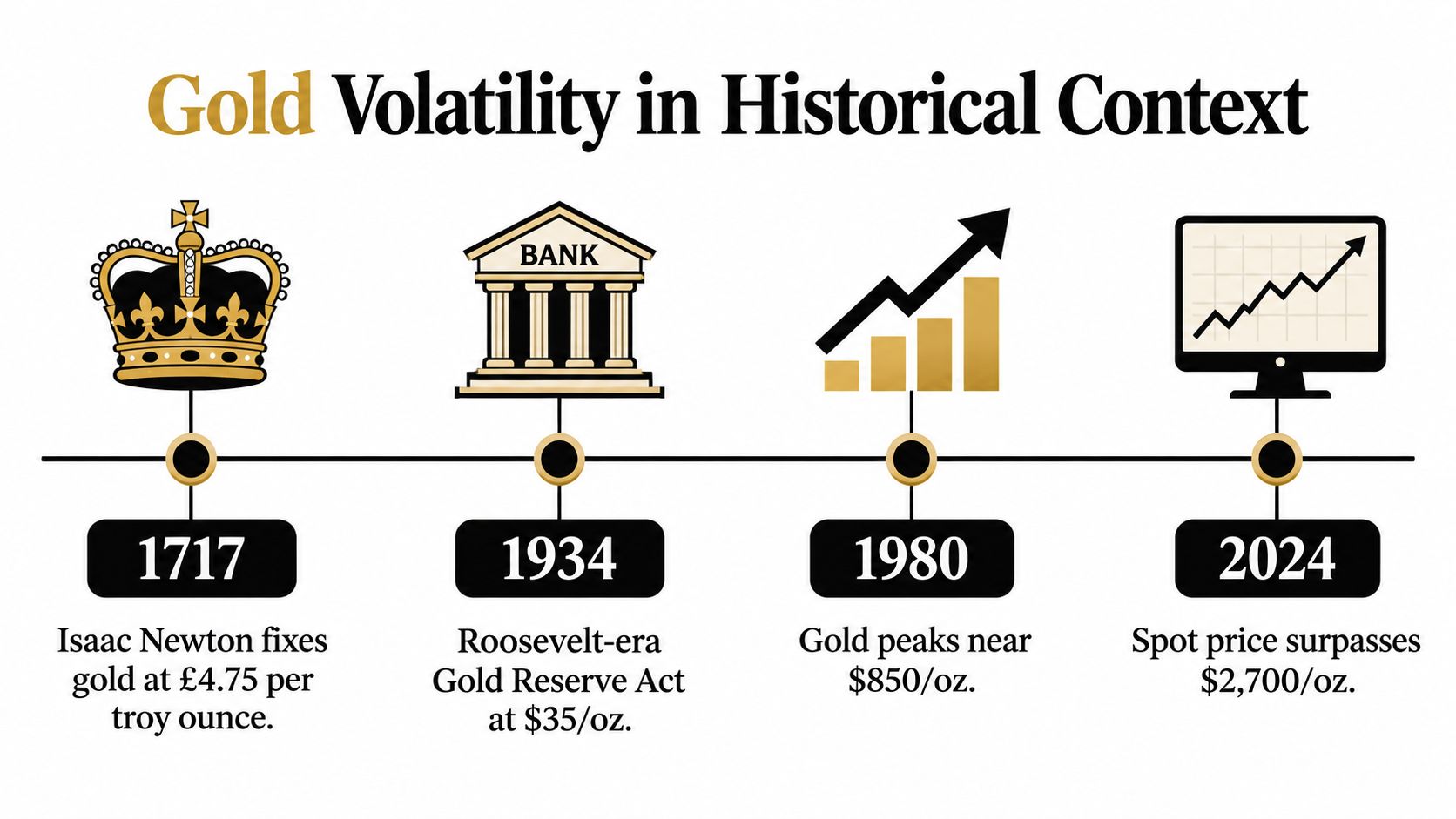
The same ounce across different eras
Modern gold pricing became much more flexible after those fixed-price periods ended. Gold reached a major peak during the inflation crisis of 1980, climbed to another widely watched high after the financial crisis, and later reached a substantially higher record in the 2020s. The exact number depends on the market, time, and source used, so historical highs provide context rather than a guaranteed resale target.
An ounce of gold from the mid-twentieth century did not become heavier as its dollar value rose. Changes in purchasing power, interest-rate policy, currency strength, investor demand, and economic confidence changed what buyers were willing to pay for that ounce.
For a Boise seller, the practical lesson is simple. Waiting for the highest possible price sounds reasonable, but the market identifies its peak only after prices have moved away from it. A transparent local offer, with the dealer's spread and any deductions explained, may produce a better real-world result than a higher theoretical spot price that is difficult to convert into cash.
Execution matters more than a perfect forecast
Historical charts help explain volatility. They do not predict whether tomorrow's bid will beat today's bid, and they cannot account for the premium, testing result, or buyback spread attached to your specific bar.
Separate the market decision from the transaction decision:
- Market decision: Do you want to keep exposure to gold because it still serves a purpose in your finances?
- Transaction decision: Is the current buyer offering a clear, competitive amount for this exact bar after testing, purity verification, and the dealer's spread?
An explanation of what affects gold prices can clarify why quotes change. If you need to pay a bill, settle an estate, simplify a safe, or convert bullion into cash, focus on the net amount and the terms of the offer. A dependable exit process often matters more than a dramatic forecast.
Selling Locally in Boise for the Highest Payout
Mailing a gold bar to an online buyer can look convenient. You package it, insure the shipment, wait for inspection, and accept the final payment after the buyer confirms what arrived. That process may suit some sellers, but it creates practical risks: shipping exposure, delayed payment, unclear deductions, and limited ability to challenge a test result in person.
A Boise counter gives you a different kind of control. You can bring the bar, watch the evaluation, ask how the offer relates to spot, and decide whether the net amount works for you before handing over the item. For people searching for the highest payout in Boise, the comparison should focus on the final offer and the process behind it, not just a search result showing a high retail price.
What a proper local evaluation should include
X-ray fluorescence, or XRF, is a fast, non-destructive method used to identify elemental composition. Testing services describe XRF scans as producing results within seconds, and some offer the scan free to sellers with no obligation to sell (gold testing and XRF guidance).
For a local seller, ask for these safeguards:
- Xray Scanning and Gold Testing for free: Confirm that testing is complimentary and that you aren't required to accept the offer.
- A visible explanation: Ask the evaluator to show the reading or explain the purity result in plain language.
- Hassle free offers: Request a straightforward number without hidden inspection, shipping, or processing charges.
- Price Matching: If another legitimate local buyer has made a written offer, ask whether the buyer will review it and explain any difference.
- A net payout: Confirm the amount you receive, the payment method, and when payment is made.
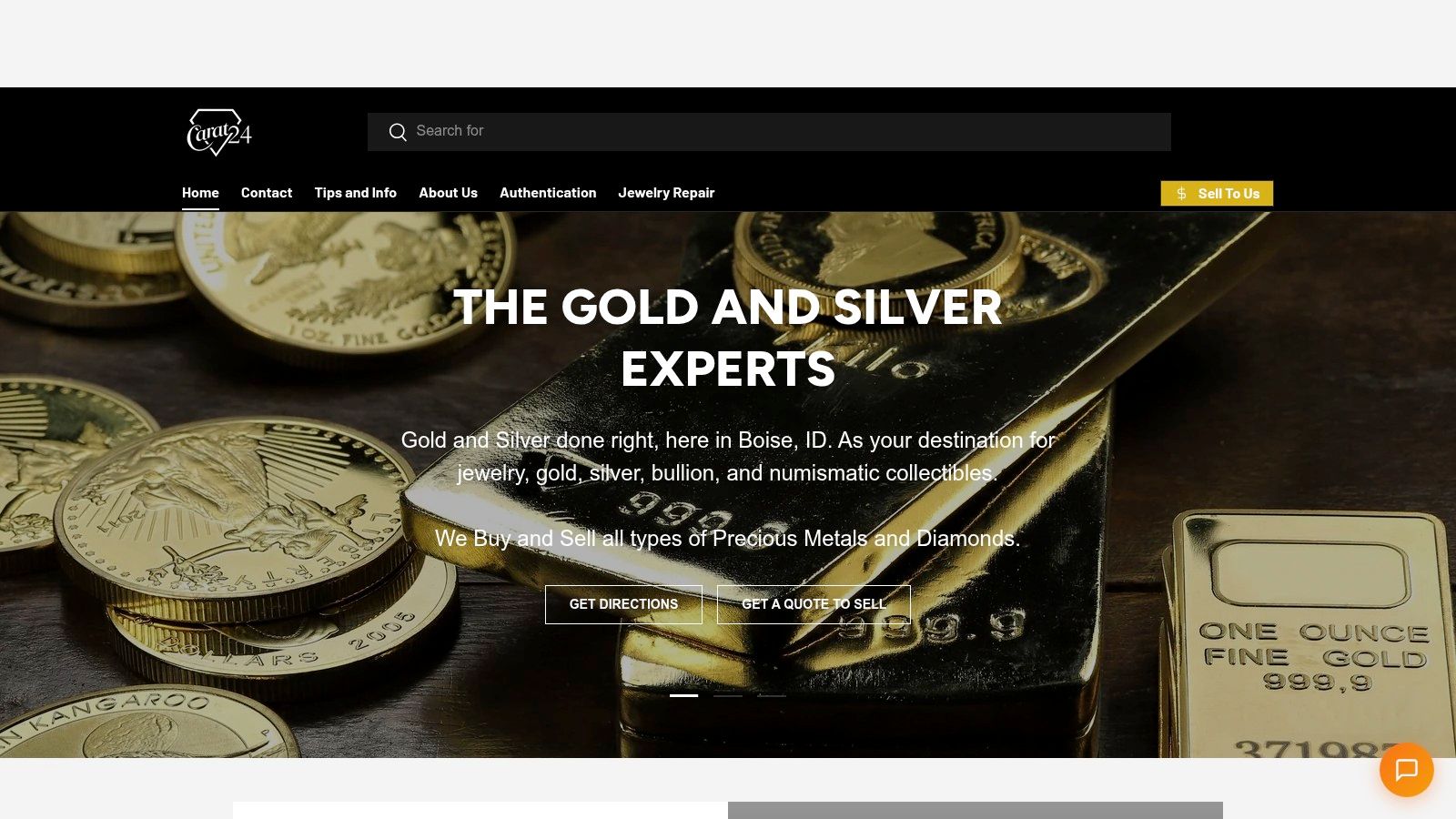
Carat 24 operates at 3780 W. State St. in Boise, Idaho, and its Gold and Jewelry Buying service covers precious metals and related items. The local approach also works well for sellers with estate pieces, jewelry, coins, bullion, or luxury goods who want one conversation instead of several separate shipments.
The business specializes in buying and selling gold, silver, bullion, and numismatic collectibles. That broader experience can be useful when a bar is part of a larger household collection, because the seller can discuss the bullion alongside jewelry or other valuables rather than treating every item as an anonymous melt lot.
Before any transaction, sellers should understand common precious-metals fraud risks, including pressure tactics, unverifiable claims, and offers that hide the actual spread. Kons Law's guidance on precious metals fraud is a useful reference for recognizing warning signs.
A local sale also avoids the hassle of shipping bars across the country. You don't have to buy packaging, arrange insurance, wait for delivery confirmation, or wonder whether the buyer will revise the quote after the package arrives. For Boise residents, the practical comparison is the net amount in hand, the time required, and the confidence created by an in-person test.
Here is a short checklist to take with you:
- Bring the bar and any original assay card or receipt.
- Ask for the current spot reference and the purity result.
- Request the buyback spread in plain numbers.
- Compare the final local payout with the amount an online buyer would pay after shipping and insurance.
- Leave if the offer isn't explained clearly.
A local guide to the best place to sell gold can help you prepare, but the strongest protection is still a transparent inspection and a written or clearly stated net offer.
A quick visual overview can also help you understand how a local evaluation works:
The best exit price isn't always the highest online headline. It is the amount you can verify, accept, and receive without unnecessary risk.
When to Sell Now versus Waiting for a Better Price
Gold sellers often face two competing priorities. They want a fair price today, but they also worry that selling now means missing the next high. That concern is reasonable, especially after a sharp run-up. It becomes less useful when it turns into an attempt to identify the exact peak in advance.
Late-2026 market references illustrate the problem. Gold moved from a record level near $5,405 per ounce in January to about $4,002 per ounce in June, then traded closer to $4,100 per ounce later in the year (World Gold Council mid-year outlook). The same source noted realized volatility above 50% at one point and still above its 20-year average.
Holding can make sense when
Keeping the bar may be reasonable if you don't need the cash, the bar serves a deliberate role in your savings, and you accept that its dollar value can fall as well as rise. Holding also avoids paying a spread today and then paying another spread if you later repurchase physical gold.
That decision should come from your own financial situation, not from a dealer's prediction. Gold is not a guaranteed short-term profit, and a past high doesn't establish a future floor.
Selling can make sense when
A sale becomes more practical when you need liquidity, are settling an estate, want to reduce storage responsibilities, or have received a clearly explained offer close to the current market value. It can also make sense when the bar's paperwork is incomplete and you prefer to convert it while a buyer is willing to handle the authentication process.
Premium data add another layer. In late 2026, widely cited pricing showed one-ounce bars around US$4,154, while premium data showed premiums ranging from roughly 1.05% to 3.67% above spot, with some branded bars around US$151 to US$156 over spot (Kitco physical gold premiums). Those differences show why a retail ask isn't the same as the cash value of your particular bar.
Use a simple decision test:
If you need cash, judge the offer by its net amount, clarity, and speed. If you don't need cash, hold only because you accept the market risk, not because anyone can guarantee the next peak.
Ask whether waiting would change your actual objective. If your aim is to maximize a long-term allocation to gold, selling today may not fit. If your aim is to obtain cash without shipping or hidden deductions, a fair local offer may solve the problem now.
Your Next Step for a Transparent Gold Value Check
The answer to “how much is 1 ounce gold bar worth” has three layers. First, identify the live spot price for a fine troy ounce. Next, confirm the bar's weight and purity. Finally, compare the buyer's net offer after the buyback spread, authentication, and any transaction costs.
For a Boise seller, the process can stay simple:
- Gather the bar, assay card, receipt, and any packaging.
- Request a free, no-obligation evaluation.
- Ask for Xray Scanning and Gold Testing for free, with the result explained in plain language.
- Compare the local offer with any online estimate, remembering that an online retail ask isn't a guaranteed buyback amount.
- Decide based on the amount you can receive and the confidence you have in the transaction.
A broader jewelry evaluation may also be useful if the bar came from an estate or is being sold with rings, necklaces, watches, or other valuables. This guide to appraising jewelry near you can help you organize that visit.
Bring your one-ounce bar to 3780 W. State St. in Boise, Idaho, and ask for a clear offer tied to the current market, verified purity, and the buyer's spread. You don't need to predict gold's next peak to make a well-informed sale. You need a trustworthy test, a transparent calculation, and a payout that makes sense after every deduction.
Carat 24 - Trusted Gold Experts offers free evaluations, complimentary X-ray scanning and gold testing, price matching, and hassle-free offers for Boise sellers comparing the true value of a one-ounce gold bar. Visit Carat 24 - Trusted Gold Experts at 3780 W. State St. to save the hassle of online shipping and receive a clear local offer.
