
The real difference between a proof and an uncirculated coin comes down to how it was made and why. Think of it like this: a proof coin is a specially crafted piece for collectors, struck multiple times to create a flawless, mirror-like finish. An uncirculated coin, on the other hand, is just a regular coin that was pulled from the production line before it ever saw a cash register or a pocket.
Getting this right is the single most important step in figuring out what your collection is actually worth.
Proof vs. Uncirculated: The Core Distinctions
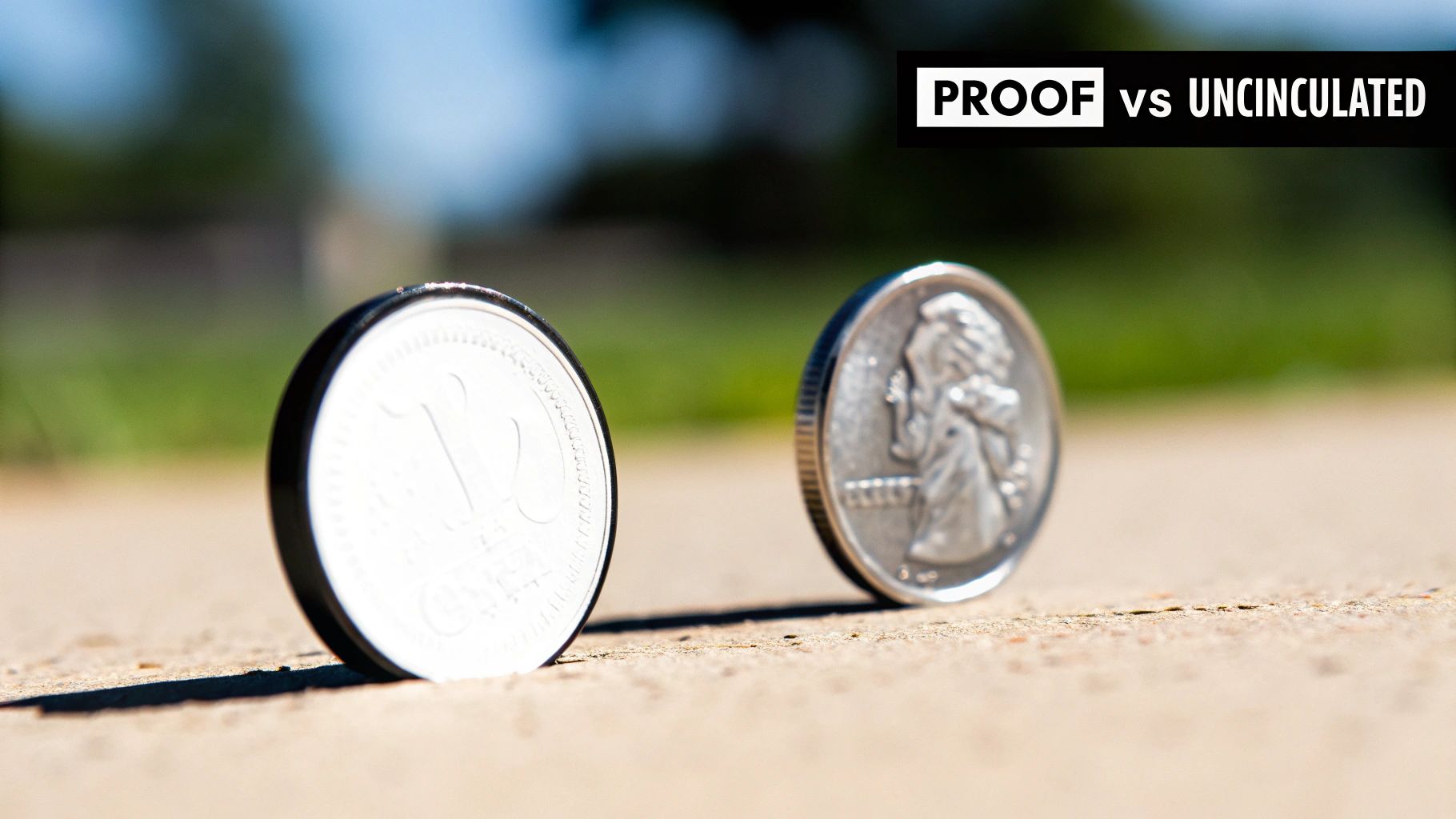
It’s incredibly common for people sorting through a collection to mistake a very shiny, new-looking coin for a valuable proof. But the true distinction isn't about how clean or bright it looks; it's all about the manufacturing process and its original purpose.
A proof coin is the absolute highest quality of coin a mint can produce. It's really a piece of art, made with painstaking care specifically for collectors. The mint uses specially polished dies to strike these coins multiple times, which creates that stunning, sharp contrast you see between the frosted design and the mirror-like background.
An uncirculated coin, sometimes called a Mint State (MS) coin, is simply a standard business-strike coin that never made it into public circulation. While it still has its original shine from the mint, it was only struck once and doesn't have the specialized, high-contrast finish of a true proof.
Quick Comparison: Proof vs. Uncirculated Coins
To make it even clearer, here’s a quick breakdown of the defining features that separate Proof and Uncirculated coins. This should help you spot the key differences right away.
| Characteristic | Proof Coin | Uncirculated Coin |
|---|---|---|
| Manufacturing Method | Struck multiple times with polished dies | Struck once with standard business dies |
| Surface Finish | Mirror-like fields with frosted designs (cameo) | Consistent satin-like mint luster |
| Intended Purpose | Collector's item, not for circulation | Standard currency, saved from circulation |
| Rim Edge | Sharp, squared, and highly defined | Rounded and less defined |
This table is your cheat sheet. The mirror-like fields and sharp rims are dead giveaways for a proof coin.
Knowing these core differences is essential before you even think about getting a valuation. Whether you've inherited an estate or you're a seasoned collector yourself, being able to identify what you have gives you the power to get the best possible offer.
Here at Carat 24, we specialize in Gold and Jewelry Buying, and we can help you understand the real-world value of your collection. We offer free Xray Scanning and Gold Testing to give you a transparent, hassle-free offer, ensuring you get the highest payout right here in Boise. When you understand what numismatic coins are, you can appreciate the value in your hands and avoid the risks of shipping your valuables to an online buyer. Save the hassle and sell locally for more than online shipments.
How Each Coin Type Is Manufactured
The core difference between a proof and an uncirculated coin really boils down to how they're made. One is a high-speed, automated process built for efficiency, while the other is a slow, deliberate art form. Grasping these production differences is the key to understanding why their values can be worlds apart.
Uncirculated coins are the workhorses of the mint, produced for general commerce (though the ones collectors hunt for are saved from ever being spent). They are struck just one time by standard business dies on automated presses that can churn out thousands of coins every hour. This process is all about volume and consistency.
The Meticulous Craft of Proof Coins
Making a proof coin is a completely different animal—a far more hands-on and precise operation. It’s an entirely separate process that values quality over quantity, and the result is as much a piece of art as it is a collectible.
The journey starts with the coin blanks, also known as planchets. These aren't just any blanks; they are specially selected and then burnished, often by hand, until their surfaces are polished to a flawless, mirror-like finish. This first step is absolutely critical for achieving that signature deep background that defines a proof coin.
At the same time, the dies used for striking get their own special treatment. The recessed parts of the die—the areas that will become the coin's background or "fields"—are polished to that same mirror finish. The raised elements that create the actual design, like a president's portrait, are often sandblasted or treated with acid to create a contrasting frosted texture.
This careful preparation is what leads to the classic, eye-catching look of a proof coin.
During the strike, the polished planchet and die work together to create a stunning contrast. The mirror-like fields reflect light brilliantly, while the frosted design elements almost look like they’re floating on the surface. This effect is known as a cameo finish, and it's the hallmark of a high-quality proof.
Striking for Perfection
While an uncirculated coin gets hammered once with incredible pressure, a proof coin is struck at least twice, sometimes more, using lower pressure. This multiple-strike method ensures the metal flows into every last tiny crevice of the die. The result is an incredibly sharp, detailed design with perfectly squared-off rims that you just won't see on a standard coin.
Rarity and market value are what truly set proof coins apart. They often command premiums because of limited production runs, which might only make up 5-20% of a series. This entire labor-intensive process, from hand-polishing dies to multiple strikes, produces superior detail, luster, and that visually stunning frosted-on-mirror contrast.
For those interested in how these factors influence the market, our guide to United States Proof Set Values offers deeper insights. Ultimately, whether you have a meticulously crafted proof or a pristine uncirculated coin, knowing its origin story is vital. When you're ready to sell, this knowledge helps you secure the highest payout, especially when you save the hassle and sell locally in Boise instead of dealing with risky online shipments.
A Collector's Guide to Visual Identification
Learning to spot the difference between a proof and an uncirculated coin with your own eyes is one of the most important skills a collector can develop. While the real differences are baked in during the manufacturing process, the visual evidence is what you'll have to rely on when you're sorting through a new collection.
Knowing what to look for means you can confidently categorize your pieces before ever seeking a professional appraisal. It puts you in the driver's seat.
The most immediate and dramatic giveaway is the coin's finish. A proof coin has a stunning, deep mirror-like background, what we in the business call the field. This surface is so flawless and reflective you can often see your own face staring back at you. This mirror finish is usually contrasted with frosted design elements—like a president's portrait or the lettering—creating a beautiful pop known as a cameo effect.
An uncirculated coin, on the other hand, doesn't have that high-contrast, two-toned look. Instead, you'll see a more uniform, satin-like shine across the entire coin, from the background to the design. This consistent glow is called mint luster. While it can be incredibly brilliant on a high-grade specimen, it will never have the sharp, liquid-mirror background of a true proof.
Examining the Finer Details
Once you've assessed the overall finish, it's time to zoom in on the smaller details that tell the rest of the story. Grabbing a magnifying glass, or a jeweler's loupe if you have one, will help you spot the subtle but critical clues left behind by the minting process.
- Rims and Edges: Proof coins are struck multiple times with immense pressure, forcing the metal into every last crevice of the die. This creates exceptionally sharp, almost knife-like, squared-off rims. Uncirculated coins are struck only once, resulting in softer, more rounded rims.
- Design Relief: Those multiple strikes also make the design on a proof coin incredibly sharp and detailed. The relief—the raised part of the design—will look crisper and more defined than it does on its uncirculated cousin.
- Minor Imperfections: Because uncirculated coins are made for circulation, they're produced in huge batches and dropped into bins together. This process often leaves behind small nicks and scratches known as "bag marks." Proof coins are handled individually like precious jewels, so they should be virtually flawless and free of any contact marks from other coins.
The presence of even minor "bag marks" is an almost certain sign that you're holding an uncirculated coin, not a proof. Proofs are meticulously protected from the second they're struck, so any damage you see happened after it left the mint—it's just damage, not a production characteristic.
Understanding these visual cues is your first step in figuring out what a coin might be worth. Certain years, mint marks, and conditions can make a coin's value skyrocket, and knowing what you have is the only way to spot those hidden gems. You can learn more about how specific dates impact value in our guide to understanding important coin key dates.
Ultimately, identifying your coins correctly is about empowerment. When you walk into a trusted Gold and Jewelry Buying expert with your collection, you’ll have the confidence of knowing exactly what you’re bringing to the table. This knowledge ensures a transparent, fair evaluation and helps you get the highest payout in Boise without ever having to risk shipping your valuables to some faceless online buyer.
Understanding Market Value and Investment Potential
When it comes to the difference between proof and uncirculated coins, what really matters to most collectors and sellers is the bottom line: market value and investment potential. It’s a common belief that proof coins are automatically the better investment because of their special finish and smaller production runs. While they certainly carry a higher price tag straight from the mint, the market doesn't always play by those rules.
Ultimately, rarity and collector demand are what truly drive a coin's long-term value, not just the manufacturing process. For anyone looking to branch out from stocks and bonds, it helps to understand the world of alternative investments. Collectible coins are a perfect example of this, where value is a unique mix of scarcity, historical importance, and physical condition.
When Rarity Trumps Finish
It’s one of the most interesting quirks in numismatics: a standard-issue uncirculated coin can sometimes blow its fancy proof counterpart out of the water. This happens when the mintage of the uncirculated version is incredibly low, making it the rarer and more sought-after coin for serious collectors down the road.
This image gives you a great side-by-side look at the fundamental difference in appearance.
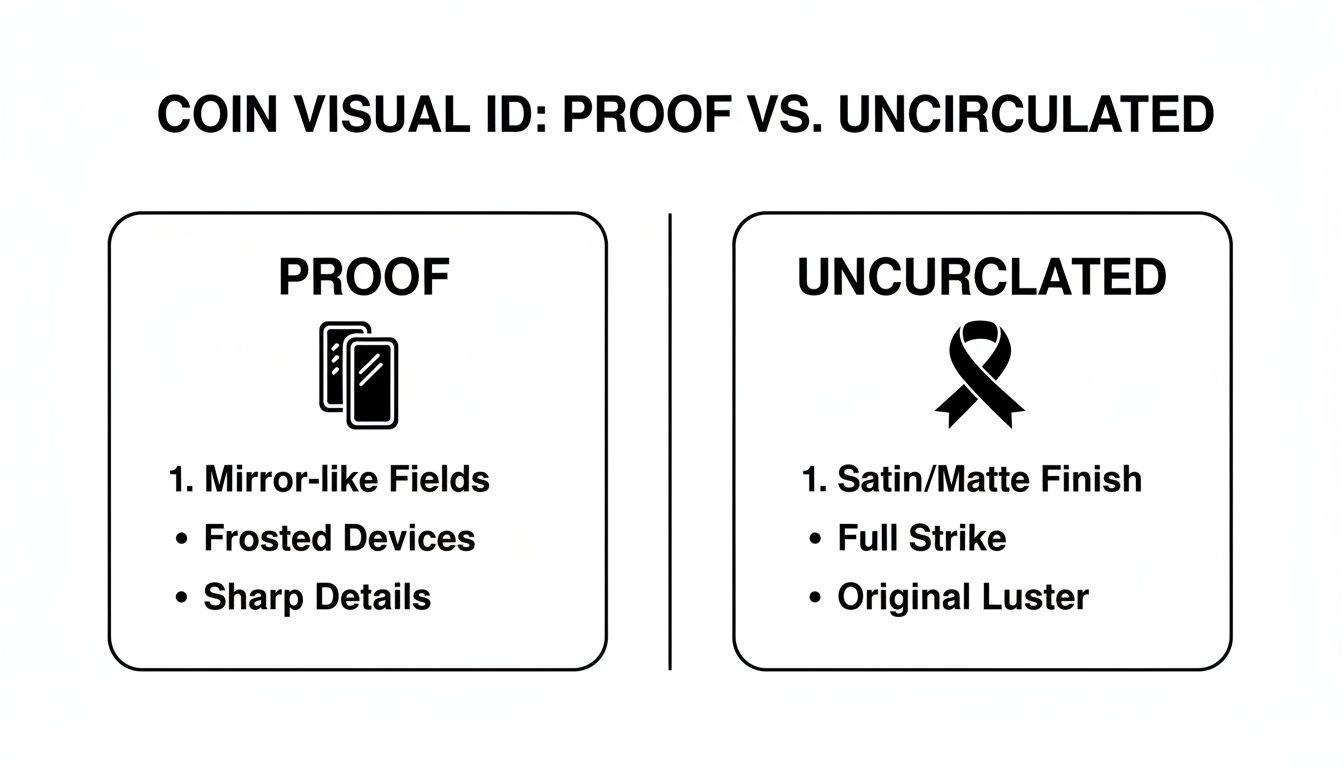
You can clearly see the distinct, mirror-like fields of a proof coin next to the consistent satin luster of an uncirculated one. These finishes are the starting point for their initial pricing.
But let's look at a powerful real-world example of how this plays out. Take the 1951 uncirculated mint set. Only 8,654 were produced across all three mints. Back in 1980, one of these sets was worth about $475. Today? It's valued at $1,825. That’s a nearly 284% increase in 45 years, a performance that left many proof sets from that same period in the dust.
Maximizing Your Payout in Boise
Knowing these subtle details is what makes all the difference when you decide to sell your collection. It’s not just about the weight of the metal; the numismatic value can make a coin worth exponentially more. An expert buyer sees these critical market distinctions immediately.
The key takeaway is that rarity is the ultimate factor. A low-mintage uncirculated coin is often a "sleeper" investment that can appreciate significantly more than a common-date proof coin, even if the proof looks more impressive at first glance.
This is exactly why selling to a trusted local expert is your best move. When you bring your Gold and Jewelry Buying needs to us, you're getting a comprehensive evaluation that looks at both the bullion and collector value. We provide free Xray Scanning and Gold Testing, making hassle-free offers that reflect the true market worth of your items. And with our Price Matching guarantee, you can be confident you’re getting the highest payout in Boise. Save the hassle and sell locally for more than online shipments.
Proper Care and Storage to Preserve Value

It’s one thing to know the difference between a proof and an uncirculated coin, but protecting their condition is where the real value is preserved. One clumsy moment or a bad storage choice can quickly tank a coin’s grade—and its price tag right along with it. Believe it or not, even a single fingerprint can permanently etch itself onto a delicate proof surface over time.
Because of this, both coin types need their own specific approach to care. The stunning, mirror-like fields of a proof coin are incredibly vulnerable to everything from scratches and skin oils to simple environmental exposure. And while uncirculated coins are a bit more robust, they can still pick up dings and contact marks that will knock them down from a high mint state grade.
Storing Proof Coins for Maximum Protection
Here’s the absolute golden rule for storing proof coins: keep them in their original government packaging (OGP). This isn't just any box. It’s usually a hard plastic capsule inside a display case, specifically engineered to shield the coin’s fragile surfaces from the outside world and clumsy hands.
If for some reason you absolutely must handle a proof coin, you need to do it right.
- Always wear soft, lint-free cotton gloves. No exceptions.
- Hold the coin by its edges only. Never, ever touch the face.
- Make sure you’re working over a soft, padded surface. An accidental drop onto a hard table could be a disaster.
Never, and I mean never, try to clean a proof coin. Polishes, chemicals, or even a seemingly soft cloth can create a web of tiny hairline scratches on that mirror finish, absolutely destroying its numismatic value. If a coin needs restoration, that’s a job for a professional.
Preserving Uncirculated Coins
Uncirculated coins might not have the same fragile finish as proofs, but their mint luster is the key to their value. Your main goal here is simple: prevent contact with other coins or any hard surface that could leave a mark.
Archival-safe holders are your best friend. Things like individual flips, tubes, or multi-coin albums made from inert materials are all excellent choices. For more in-depth advice, our guide on how to store silver coins has some great tips that apply to most uncirculated pieces.
At the end of the day, proper storage is your insurance policy. It guarantees your collection stays in premium condition, so when you decide it’s time to sell, that careful preservation helps you get the best possible price. When you bring your collection to our Boise location for your Gold and Jewelry Buying needs, we offer free Xray Scanning and Gold Testing, providing straightforward, hassle-free offers that reflect the true quality of your well-maintained coins. You can save yourself the headache and risk of shipping valuables online by simply selling locally.
Selling Your Coins in Boise for the Highest Payout
You’ve put in the work to understand the crucial differences between your proof and uncirculated coins. Now comes the final, most important step: turning that knowledge into cash. Whether you’ve inherited an estate collection or are cashing in on a personal investment, the buyer you choose will make all the difference in your final payout.
Many people think of online buyers first, but that route is often filled with hidden costs and serious risks. You're looking at potential appraisal fees, the high cost of insured shipping, and the constant worry that your valuable coins might get lost or damaged on their way to a stranger. It's a slow, stressful process that can easily eat into your profits.
The Smarter, Local Choice
There's a much better way to sell right here in Boise. Selling your collection to a local expert removes all the uncertainty and puts you back in the driver's seat. At Carat 24, located at 3780 W. State St., we specialize in Gold and Jewelry Buying, providing a completely transparent and secure experience from the moment you walk in.
Our entire process is designed to be hassle-free. We believe in giving our clients clear information, not a sales pitch. That’s why we offer complimentary, no-obligation evaluations using the best technology available.
- Free Xray Scanning: We use a non-invasive X-ray fluorescence (XRF) scanner to determine the exact metallic makeup of your coins without leaving a single scratch.
- Free Gold Testing: Our specialists will also conduct free Gold Testing to verify the purity and authenticity of each piece, so you know precisely what you have.
The biggest advantage of selling locally is getting fair, immediate payment without the gamble of shipping your assets across the country. You'll get a firm offer on the spot and can walk out with payment in hand, confident you've received the best possible value.
And with our Price Matching policy, we guarantee the highest payout in Boise. We will gladly meet or beat any legitimate, verifiable offer from another dealer. Why go through the delays, costs, and anxiety of sending your precious items to a faceless online company? Save the hassle and sell locally for more than online shipments.
For more tips on choosing the right buyer, be sure to read our complete guide on where to sell gold coins.
Your Questions, Answered
When you're trying to figure out the difference between proof and uncirculated coins, a few key questions always seem to pop up. Let's clear the air on some of the most common ones we hear from collectors and sellers.
Are All Uncirculated Coins in Perfect Condition?
Not at all, and this is a really common misconception. The word "uncirculated" just means one thing: the coin never made it into public circulation for commerce. Think of it this way—it never got spent.
But that doesn't mean it's flawless. These coins are struck at high speeds and tumble into bins together, so they can easily pick up small dings and scratches known as "bag marks" from bumping into each other. A coin's actual condition is defined by its grade, which can range anywhere from MS-60 all the way up to a perfect MS-70.
Can a Proof Coin Also Be Considered Uncirculated?
Technically, yes. By definition, every proof coin is also uncirculated because they're made specifically for collectors and never intended to be spent.
However, calling a proof coin "uncirculated" would be a massive understatement. "Proof" is a much more specific and important classification that points to its special manufacturing process and stunning finish. It's always the more accurate and valuable term to use.
The best way to think about it is this: "uncirculated" describes a coin's history (it hasn't been used), while "proof" describes its artistry (how it was made).
Is a Proof Coin Always More Valuable?
Usually, but not always. Right out of the gate, a proof coin typically has a higher value because of its superior quality, artistic detail, and much smaller mintage numbers.
But the coin market is ultimately driven by two things: rarity and collector demand. A rare, key-date uncirculated coin can absolutely be worth far more than a common-date proof coin from the exact same year. This is precisely why getting a professional evaluation is so important before making any decisions.
If you're thinking about selling your collection, knowing these differences is what gets you the best possible price. Here at our Boise location, we specialize in Gold and Jewelry Buying, and we provide expert evaluations that look at both the numismatic value and the precious metal content.
We offer free Xray Scanning and Gold Testing for straightforward, hassle-free offers, making sure you walk away with the highest payout in Boise. And with our Price Matching guarantee, you can feel confident you're getting a great deal. Save the hassle and sell locally for more than online shipments.
Ready to discover the true value of your collection? Visit Carat 24 - Trusted Gold Experts for a professional, no-obligation appraisal today. https://carat24boise.com
