
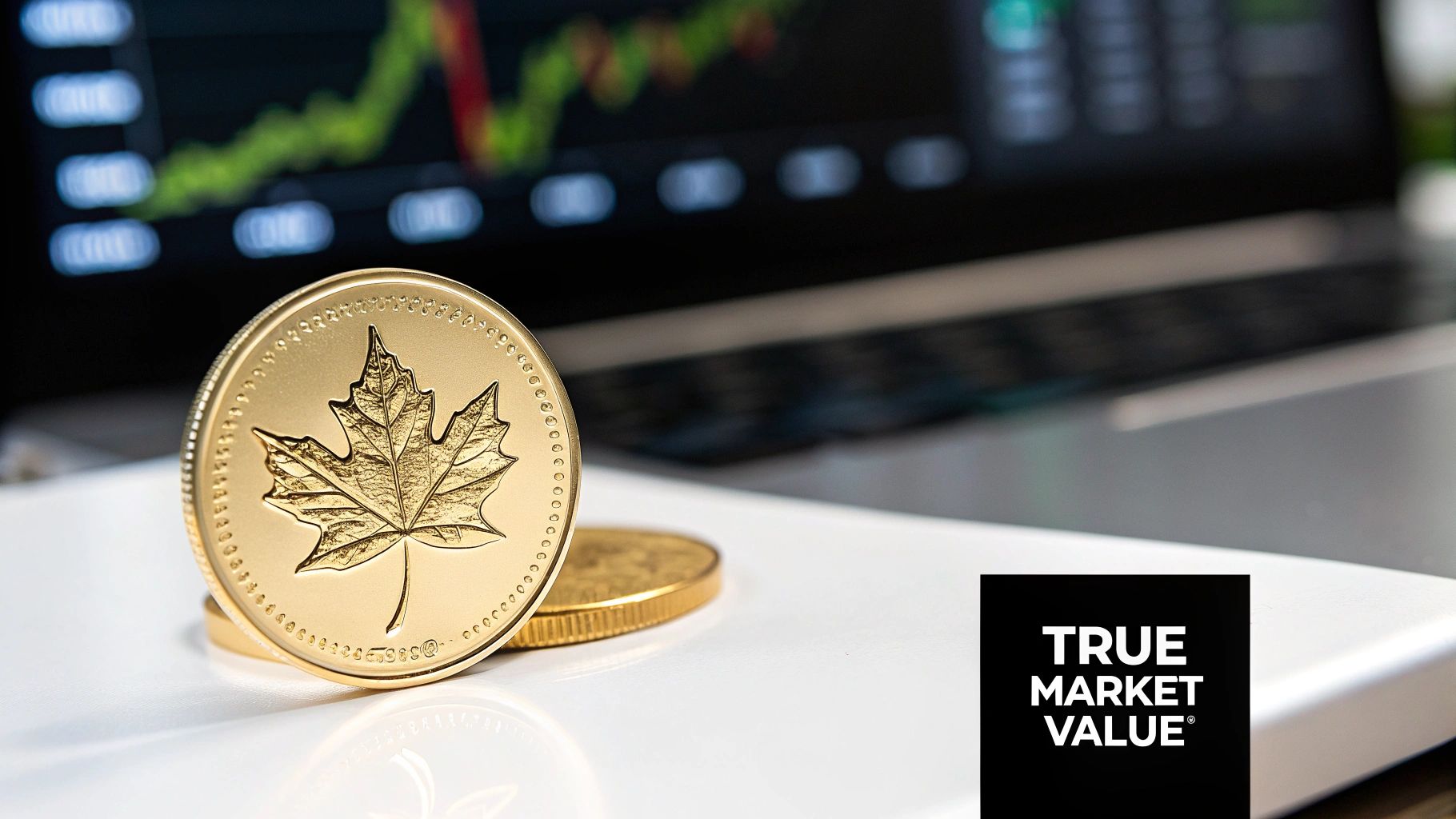
That $50 face value stamped on your Gold Maple Leaf coin? You can pretty much ignore it. It’s a symbolic number, nothing more. The coin’s actual worth is tied to the one troy ounce of .9999 pure gold guaranteed by the Canadian government, making it significantly more valuable.
Its final price comes down to a blend of the live market price for gold, a small premium for minting and distribution, and its physical condition.
What Determines the Value of a Gold Maple Leaf Coin
Think of a Canadian Gold Maple Leaf less like a typical coin and more like a globally recognized, pocket-sized gold bar. Unlike a piece of jewelry where artistic flair and craftsmanship add to the cost, a Maple Leaf's value is almost entirely about its precious metal content.
Whether you're a seasoned investor tracking the market or you've just inherited a coin and want to know what you have, understanding how it's valued is key. It all starts by looking past that stamped face value and digging into what the market really cares about.
Here's a quick rundown of the factors that determine what a buyer will actually pay you:
- Spot Price: This is the live, fluctuating market price for one troy ounce of pure gold. It's the foundation of every calculation.
- Purity: The Gold Maple Leaf's guaranteed .9999 (24-karat) purity is its claim to fame.
- Condition: Scratches, dings, and wear can slightly detract from its value, especially for collectors.
- Authentication: First and foremost, a buyer needs to confirm it's a genuine coin from the Royal Canadian Mint.
To help you see how these pieces fit together, here’s a simple breakdown of the valuation factors and how they impact the final price.
Key Factors Influencing Gold Maple Leaf Value
| Valuation Factor | Description | Impact on Price |
|---|---|---|
| Gold Spot Price | The live market price for one troy ounce of gold, updated by the second. | This is the baseline value of the gold in your coin. |
| Purity (.9999 Fine) | Maple Leafs are 24-karat gold, one of the purest bullion coins available. | The high purity makes it highly desirable and easy to value. |
| Minting Premium | A small fee over spot price to cover the costs of manufacturing and distribution. | You'll see this reflected in the retail price when buying, and a portion is often recovered when selling. |
| Condition & Rarity | The physical state of the coin (e.g., scratches, dents) and its mintage year. | A pristine coin or a rare year can command a higher premium, but most common-date Maples trade based on their gold content. |
| Authentication | Verification that the coin is genuine using tests like X-ray fluorescence (XRF). | A coin that fails authentication has no value beyond a potential counterfeit penalty. |
Ultimately, these are the exact elements a professional gold buyer will evaluate to give you a transparent and fair offer.
A Legacy of Purity
When the Royal Canadian Mint launched the Gold Maple Leaf back in 1979, it was designed to compete directly with other world bullion coins like the Krugerrand. Just three years later, in 1982, they made a game-changing move: they boosted the purity from .999 to an incredible .9999 fine gold.
This decision cemented the Maple Leaf's reputation as the purest gold coin on the market, setting a new global standard that others scrambled to follow. You can read more about its historical impact on gold coin standards over at GoldPrice.org.
When you're ready to sell, these are the exact things a professional Gold and Jewelry Buying expert will look at. For those of us here in Idaho, you can save the hassle and sell locally for more than online shipments. Selling locally is almost always safer and more profitable.
We offer the highest payout in Boise and provide a free, no-obligation evaluation using state-of-the-art Xray Scanning and Gold Testing for free. Our process is transparent and ensures you get fantastic, hassle free offers, backed by our Price Matching guarantee. If you're just starting to explore this, you might find our guide on how to determine what your gold is worth helpful.
Breaking Down the Gold Valuation Formula
Figuring out what your Gold Maple Leaf coin is actually worth isn't complicated once you know the recipe. Think of it as a simple calculation with just three core ingredients. Once you get a handle on these, you can confidently estimate your coin's value at any given moment.
The first and most important ingredient is the spot price of gold. This is the live, minute-by-minute market price for one troy ounce of gold, and it's constantly shifting based on global economic currents. This price is the foundation for the value of the pure gold in your coin. If you're curious about what makes this number jump up and down, we cover it in our guide on what affects gold prices.
Next up is the coin’s guaranteed gold content. Every standard Gold Maple Leaf is minted with exactly one troy ounce of .9999 fine (24-karat) gold. This exceptional purity is a huge part of its worldwide appeal to investors—it makes calculating its raw value incredibly straightforward and easy to verify.
The Role of the Premium
The final piece of the valuation puzzle is what’s known as the premium. This is a small amount added on top of the gold's spot price that covers the cost of minting, distribution, and the dealer's overhead. When you first buy a coin, you pay this premium. When you sell, you typically get a portion of it back.
The coin's raw value is simple: multiply its 1 troy ounce gold content by the current spot price. But investors buying Maple Leafs rarely pay just the spot price. These world-class bullion coins usually command a premium of 4% to 8% over the spot price of gold.
This premium structure isn't arbitrary; it accounts for the real-world costs of manufacturing, secure shipping, and the markup that keeps dealers in business. You can find more details on how Maple Leaf coin premiums are structured on SamuelsonsDiamonds.com.
So, when you put it all together, the formula for market value is crystal clear:
(Current Gold Spot Price x 1 troy ounce) + Premium = Your Coin’s Market Value
For our neighbors here in Boise, the best way to see this formula in action is to bring your coin to a trusted expert for Gold and Jewelry Buying. We take the guesswork out of it by using free, state-of-the-art Xray Scanning and Gold Testing for free to instantly confirm its purity. This process lets us provide the highest payout in Boise, often more than you'd get by shipping it off to an online buyer. And with our Price Matching guarantee, you can save the hassle and sell locally for more than online shipments with total confidence.
How Weight and Special Editions Impact Value
While the iconic one-ounce Gold Maple Leaf is what most people picture, it's far from the only game in town. The coin's design was such a home run that the Royal Canadian Mint wisely decided to expand the series, making gold ownership more accessible for all kinds of budgets. This means the actual weight of your coin is the first thing we look at to figure out its base value.
This wasn't an afterthought, either. The expansion happened pretty quickly after the coin’s 1979 debut. By 1982, the Royal Canadian Mint got the green light to produce fractional sizes, introducing the 1/2 ounce, 1/4 ounce, and 1/10 ounce versions. This move was a game-changer, rocketing the Maple Leaf to global stardom. You can even find details about this on the official LBMA website.
The image below breaks down how these components come together to build a coin's total value, a formula that applies to every size.
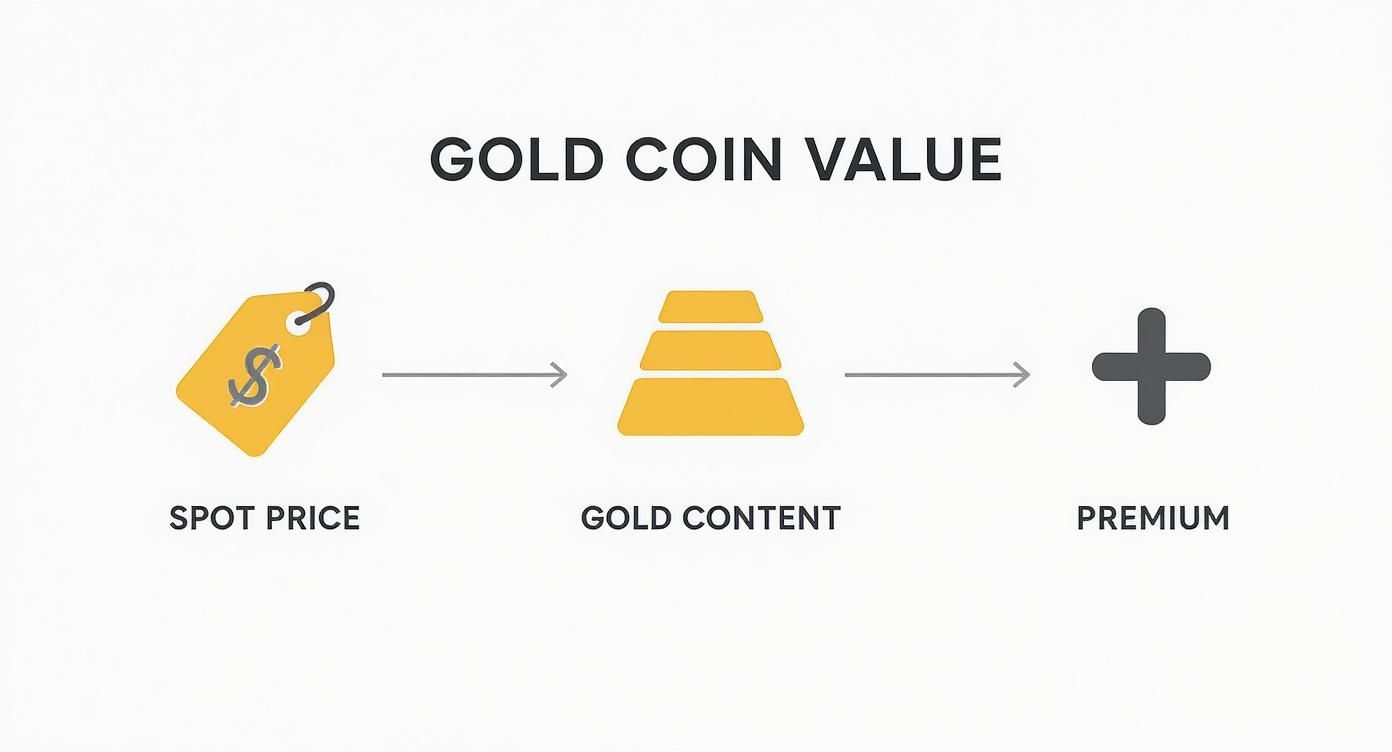
As you can see, the spot price of gold and the coin's actual gold content create the foundation. The premium is then added on top, covering the costs of turning raw gold into a beautiful, finished coin.
Understanding Premiums on Fractional Coins
Here’s something that surprises a lot of people: smaller, fractional coins almost always have a higher premium as a percentage of their gold value.
Think of it like buying a soda. A small 20-ounce bottle costs way more per ounce than a big two-liter bottle. It’s the same principle here. The costs to design, mint, and distribute a tiny 1/10-ounce coin aren't much different from the costs for a full one-ounce coin.
Because those fixed manufacturing costs are spread over a much smaller amount of gold, the premium has to be higher to make it worthwhile for the mint.
- 1 oz Coin: The premium is lowest as a percentage.
- 1/2 oz Coin: The premium percentage creeps up a bit.
- 1/4 oz Coin: You'll notice a higher premium here.
- 1/10 oz Coin: This size carries the highest premium percentage of all.
To give you a clearer picture, here’s a breakdown of how the different sizes and their premiums typically stack up.
Common Gold Maple Leaf Sizes and Typical Premiums
The table below offers a comparative look at the different denominations of the Gold Maple Leaf, their gold content, and how premiums usually vary by size.
| Coin Size (Troy Ounce) | Pure Gold Content (Grams) | Typical Premium Range (%) |
|---|---|---|
| 1 oz | 31.103g | 3% – 5% |
| 1/2 oz | 15.552g | 5% – 7% |
| 1/4 oz | 7.776g | 7% – 9% |
| 1/10 oz | 3.110g | 9% – 15% |
Keep in mind these premium ranges are just typical market estimates; they can shift based on supply, demand, and where you're buying or selling.
The Role of Rarity and Special Editions
Beyond the standard bullion coins you see every day, the Royal Canadian Mint loves to release special editions and commemorative Gold Maple Leafs. These aren't your average Maples. They might have unique finishes, special "privy marks," or incredibly low mintage numbers.
While most Maples trade based on their gold content alone, these rare versions can have a significant numismatic value. This collector-driven value can push their price far beyond what their weight in gold would suggest. Figuring out if you have one of these special issues really takes an expert eye. To see why a professional evaluation is so critical, take a look at our guide on the value of a certified gold coin.
For anyone here in Boise, the absolute best way to know the true value of your Gold Maple Leaf—whether it’s a standard issue or a potential rarity—is to have it professionally appraised. At a trusted Gold and Jewelry Buying center like ours, you get free Xray Scanning and Gold Testing for free to verify its exact weight and purity on the spot. We make hassle-free offers and have a Price Matching guarantee, ensuring you always get the highest payout in Boise. You can save the hassle and sell locally for more than online shipments, getting an immediate, transparent valuation you can trust.
Why Condition and Authenticity Are Crucial
Once you've nailed down the coin's weight and type, two final checks are absolutely essential to lock in the value of a gold maple leaf coin: its physical condition and, most importantly, its authenticity. Think of these as the final gatekeepers that guarantee you get a fair and accurate price.
Now, with a bullion coin like the Maple Leaf, we’re mainly focused on its gold content. So, minor scuffs or small marks from normal handling are pretty much expected and won't really move the needle on its value. But significant damage—we're talking deep scratches, ugly dents, or evidence of a harsh cleaning—can knock the premium down a bit.
Verifying Your Coin Is Genuine
Far more critical than a few minor dings is making sure the coin is real. The gold market, unfortunately, attracts its fair share of counterfeiters. To combat this, the Royal Canadian Mint has packed modern Maple Leafs with advanced security features, like intricate radial lines and a micro-engraved maple leaf you can only see under magnification.
This is where a professional evaluation becomes non-negotiable. Trying to spot a sophisticated fake with the naked eye is a huge gamble, and a mistake could be incredibly costly. If you're curious about what to look for, our guide on how to identify fake gold covers the common red flags.
A reputable Gold and Jewelry Buying expert takes all the guesswork out of the equation. They don't just guess; they use technology to get a definitive answer.
For absolute confidence, nothing beats a non-destructive test. A professional will use an advanced tool like an X-ray fluorescence (XRF) scanner to instantly verify your coin’s .9999 purity and metallic makeup without leaving so much as a fingerprint.
This kind of professional verification protects you from getting low-balled and gives you complete peace of mind. For folks here in Boise, this is a fast and completely free service. We offer complimentary Xray Scanning and Gold Testing for free to confirm your coin's authenticity right on the spot.
This lets us make immediate, hassle-free offers backed by our Price Matching promise. You can save the hassle and sell locally for more than online shipments, knowing you’re getting the highest payout in Boise through a transparent and trusted process.
Selling Your Gold in Boise for the Highest Payout
When you're ready to sell your Gold Maple Leaf, you basically have two choices: ship it off to some faceless online buyer or walk into a trusted local shop. The online route might seem easy at first, but it's packed with risks, delays, and often, hidden fees. Shipping something as valuable as a Gold Maple Leaf means you lose control, waiting days—or even weeks—for an offer, all while hoping it gets there in one piece.
Selling locally right here in Boise is a completely different ballgame. It allows you to save the hassle and sell locally for more than online shipments. You get a transparent, on-the-spot valuation in a secure place where you can watch the whole process unfold. No guesswork, no waiting for a check to arrive in the mail. Just a straightforward, competitive offer and instant payment if you decide to sell.
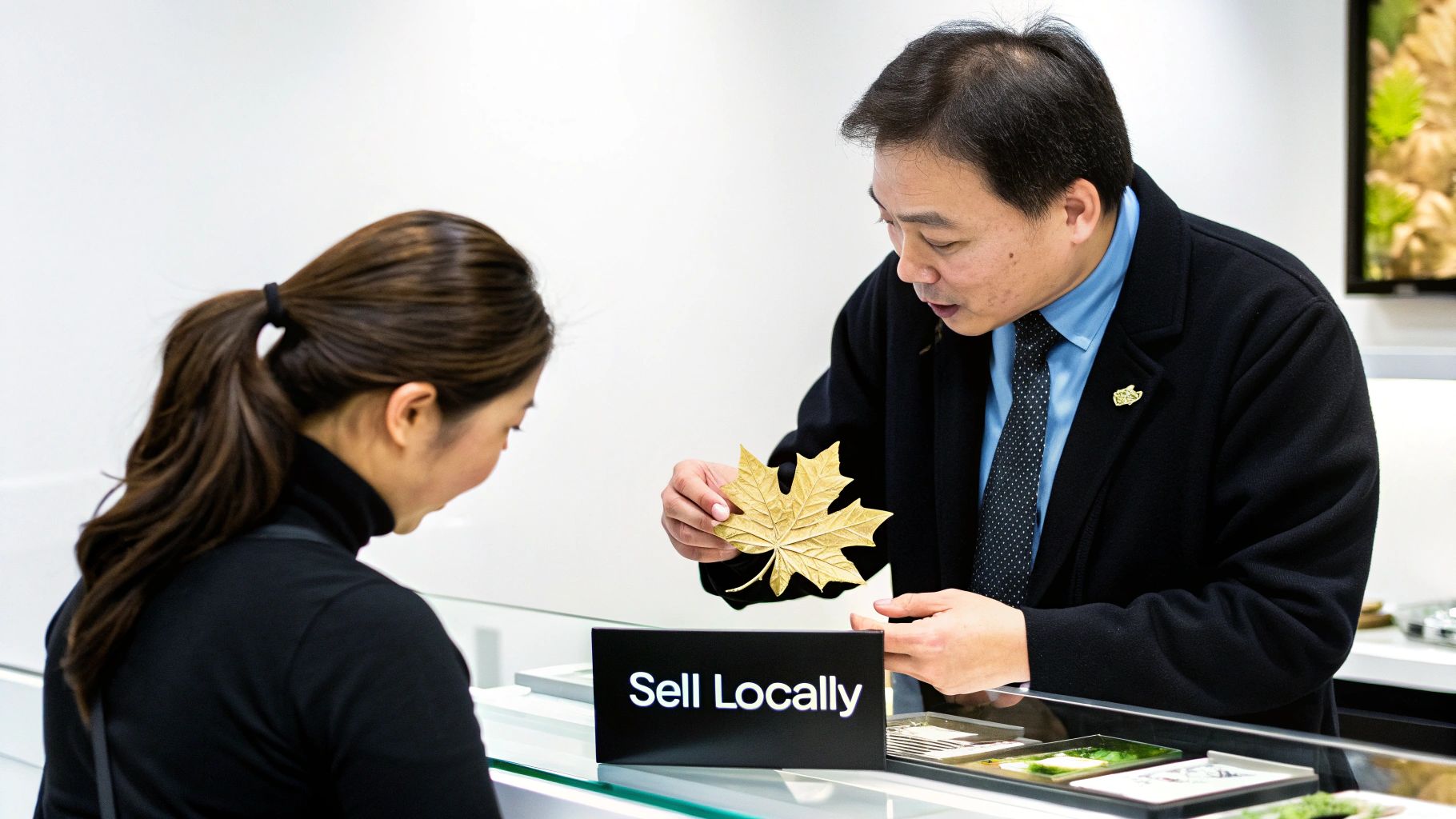
This face-to-face approach doesn't just give you peace of mind; it puts you in a much better position. You can ask questions, really understand how they arrived at their price, and make a decision right then and there, without any pressure.
Why a Local Expert Offers More
Picking the right buyer is everything when it comes to getting the maximum value of your Gold Maple Leaf coin. Reputable local specialists in Gold and Jewelry Buying provide a level of service and security that remote buyers just can't touch. Their entire business is built on community trust and happy, repeat customers, which means being upfront and transparent is their number one priority.
You'll want to find a buyer who uses professional tools and has clear, open policies. For example, free Xray Scanning and Gold Testing for free is the gold standard for verification. This non-invasive tech confirms your coin's .9999 purity in seconds, right in front of you, wiping out any doubt about its authenticity and gold content. This kind of open-book process is how you know you're getting the most accurate appraisal.
The best local buyers stand behind their offers. A firm Price Matching guarantee ensures you are receiving the highest payout in Boise, giving you the confidence that you’re not leaving money on the table.
In the end, selling locally is about more than just convenience. It’s about security, transparency, and walking away with a better price. With hassle-free offers and immediate payment, you leave knowing you made the smartest move. If you're still weighing your options, our detailed guide on where to sell gold coins offers even more insight to help you make the right choice.
What to Expect During a Local Gold Appraisal
Walking into a professional gold buyer shouldn't feel intimidating. If anything, it should feel reassuring. The entire appraisal process for your Gold Maple Leaf coin is built on transparency, giving you a clear, no-pressure look at exactly what your asset is worth.
First, an expert will give the coin a quick visual once-over. They’re looking at its general condition, checking the date, and noting the security features. This initial look helps them identify which series of Maple Leaf they're handling.
The Verification Process
Next comes the most important part: verification. Any reputable buyer specializing in Gold and Jewelry Buying will use a piece of tech called an X-ray fluorescence (XRF) scanner for a free, non-destructive analysis. This is the gold standard for confirming a coin's purity without causing any damage.
In just a few seconds, the XRF scan confirms your coin is .9999 fine gold without leaving so much as a scratch. This scientific proof is the foundation for getting the highest possible value of a Gold Maple Leaf coin.
Honestly, this is one of the biggest reasons to save the hassle and sell locally for more than online shipments. You get to watch the Gold Testing for free, right in front of you. That’s a level of peace of mind that a mail-in service just can't match.
Receiving Your Hassle-Free Offer
Once the weight and purity are locked in, the expert will calculate an offer based on the live market price of gold at that very moment. They'll give you a clear, competitive number right on the spot.
These hassle free offers come with absolutely no pressure to sell. If the number looks good to you, you get paid right then and there. This straightforward approach, often backed by a Price Matching guarantee, is how you know you're getting the highest payout in Boise for your coin. It makes the whole experience both profitable and positive.
Your Top Questions, Answered
When you’re thinking about selling a Gold Maple Leaf, a few questions always come up. Getting straight answers is the first step to feeling confident about the process. Here are some of the most common things we hear from sellers just like you.
Is the $50 Face Value Important?
Not in the slightest. That $50 stamp is purely symbolic, a holdover from when coins had face values related to their spending power. The real story is the coin's one troy ounce of .9999 fine gold. That's what gives the Gold Maple Leaf coin its true value, which is always worlds apart from the number printed on it.
Should I Clean My Coin Before Selling?
Please don't! It’s a common impulse, but cleaning or polishing a bullion coin is one of the worst things you can do. You’ll inevitably create tiny scratches (micro-abrasions) and ruin the original mint luster. This damage can seriously knock down its value, so it’s always best to leave it exactly as is.
Maple Leaf vs. Gold Eagle: What's the Difference?
The biggest distinction boils down to purity. The Canadian Gold Maple Leaf is pure, 24-karat (.9999) gold. The American Gold Eagle, on the other hand, is a 22-karat alloy designed for durability, but it still contains one full troy ounce of pure gold mixed with other metals.
For anyone in the Boise area, you can get these questions answered face-to-face. Just stop by our Gold and Jewelry Buying center. We’ll do a free Xray Scanning and Gold Testing for free to verify your coin's purity right in front of you—no guesswork needed.
We believe in hassle-free offers and providing the highest payout in Boise, and we back that up with a Price Matching guarantee. You can save yourself the trouble and sell locally for more than you’d get with online shipments.
Ready to see what your gold is really worth? Visit Carat 24 - Trusted Gold Experts for a free, no-pressure appraisal today. https://carat24boise.com
