
You are standing at the kitchen table with a shoebox from your mother's dresser, a coin jar from the garage, and a buyer coming tomorrow. Some chains look bright. A few coins feel heavy. Nothing has a receipt. Before anyone names a price, you need a record that shows what each piece is, not a quick glance and a handshake.
Why Item Validation Matters Before You Sell
A validation process is the documented way a buyer or appraiser confirms that an item is what it claims to be, covering metal, karat, origin, condition, and ownership, before money changes hands.
Think of a home inspection. A good inspector does not say the house looks fine. They check the foundation, the wiring, and the roof, then write each finding down so a second person can follow the same path. Jewelry and coins deserve the same habit.
Say a family in Boise clears an estate and finds a box of jewelry with no papers. A plated chain shines like solid gold. A jar of silver coins includes a few pieces that only look right. A missed plated piece can wipe out a large share of the resale money, and an unsupported claim of "real gold" can sink the sale when the next buyer asks for proof.
Gold-filled pieces add another trap. They are not solid, and they are not the same as a thin plate, so care and testing both matter. A clear guide on keeping gold filled chains tarnish-free helps you tell everyday wear from a metal that was never meant to test as solid.
The pages ahead walk through the definition, the stages of a check, the tests used on each kind of item, how to read karat marks, two worked examples, the limits of any check, and the practical next step.
Practical rule: If a finding is not written down, it is not part of the check.
After you read this, you will be able to judge whether a check was thorough enough, and you will know which questions to ask before you sell.
What a Validation Process Actually Proves
A cake that "looks right" is an opinion. A thermometer reading, a scaled weight, and a taste note written against a target bake time is validation. The same split applies when you sell gold.
"Looks like gold" is not validation. "Stamped 14K, trademark present, flat-surface scan shows gold, weight matches the stated figure" is closer, because each part can be checked again.
People who type what is validation process into a search box usually want a yes or a no. The useful answer is narrower. The National Institute of Standards and Technology glossary, drawing on ISO 9000:2015 terminology, defines validation as "confirmation, through the provision of objective evidence, that the requirements for a specific intended use or application have been fulfilled." In plain words, you start with a purpose and with acceptance rules you set before the test, then you collect evidence.
Verification is not the same job
Verification asks whether the test followed the rules. Did the scale get checked, did the scan land on a clean flat spot, did the notes match the photos?
Validation asks whether those results are the right evidence for this decision. A perfect scale reading does not tell you who owns the chain. A clean scan of one clasp does not speak for every link.
The same evidence habit shows up far from a jewelry counter. Collectors who verify original movie posters UK buyers rely on do not stop at a famous image. They compare printing, paper, and provenance so another person can challenge the conclusion.
A credible record names six things:
- The item examined: a description, an identifier, and photos taken before handling.
- The intended use: buying, selling, or refusing a piece, not a vague "check."
- The tests run: which tools, on which spots.
- The results: numbers and observations, not a slogan.
- The limits: surfaces skipped, plating not ruled out, papers missing.
- The decision rule: what would have led you to accept, escalate, or reject.
Validation is a verdict backed by evidence someone else can check.
One test rarely settles a sale. A stamp can be moved. A single scan can miss what sits under a coating. The process has to produce findings a second expert could repeat without calling the first examiner.
The Six Stages of a Validation Process
Each stage below has one job and one kind of evidence. Skip a row and the later conclusion gets thinner.
| Stage | What is checked | Evidence recorded |
|---|---|---|
| 1. Intake and identity | Owner's statement, item description, gross and net weight | Dated photographs, item identifier, weight log |
| 2. Visual and physical inspection | Karat stamps, trademarks, solder seams, wear, signs of re-plating, magnet response | Mark location and type, notes on repairs or wear |
| 3. Weight and dimensions | Weight against stated value; diameter, thickness and edge detail for coins and bars | Measured values against reference specification |
| 4. Instrument testing | Composition of a flat, clean area by X-ray fluorescence after calibration | Scan results, calibration reference, scan location |
| 5. Specialist review | Any disagreement between stages 2 to 4 | Second examiner's findings and decision rule applied |
| 6. Written record | Full chain of findings, limits, and what was not examined | Signed report with assessor, date and item identifiers |
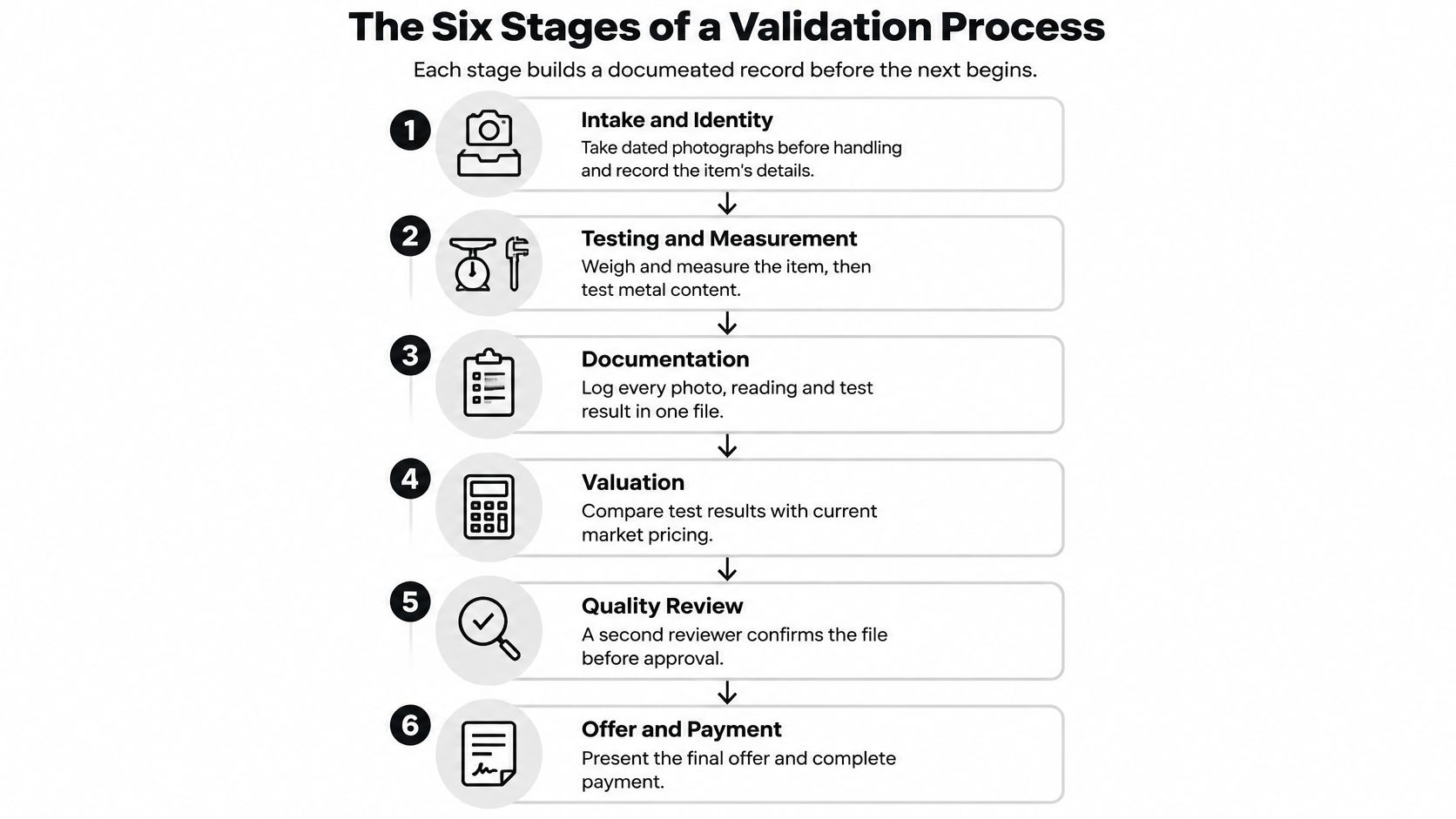
Every item Carat 24 accepts goes through an 8-step authentication process. The six stages here are the seller-facing record: what was seen, measured, tested, reviewed, and written down.
From the tray to the scale
Intake comes first. Dated photos go on file before anyone rubs a clasp or dips a coin. The owner's statement is written as a statement, not as a fact. Gross weight and net weight both go in the log so a later cleaning or stone removal cannot be confused with the piece you brought in.
Visual and physical inspection comes next. You look for karat stamps and trademarks, solder seams, wear that matches the story, and signs of repair or fresh plating. A magnet check rules out obvious magnetic base metals. It does not prove silver or gold. The detailed karat routine sits in the hallmark discussion that follows this stage list, so this stage only records where the mark sits and what it says.
Weight and dimensions come third. Jewelry is compared with the weight the seller stated. Coins and bars are checked for diameter, thickness, and edge detail against the mint or refiner specification. A match supports the ID. It does not finish it.
From the instrument to the file
Instrument testing is stage four. The X-ray fluorescence tester is calibrated before the scan. The reading is taken on a flat, clean area, and the scan location is written down. A number without a location is hard to repeat.
Specialist review is stage five. When the stamp, the weight, and the scan disagree, a second examiner reviews the file. The first result does not win by default.
The written record is stage six. It carries item identifiers, methods, results, what was not examined, the assessor, and the date.
An ambiguous result triggers escalation to that specialist review. It does not trigger a guess.
Checks Used on Metals, Jewelry and Collectibles
Different objects fail in different ways, so the useful check changes with the object. Pair each test with its blind spot before you treat a result as final.
| Item | Check | What it reveals | Limit |
|---|---|---|---|
| Gold jewelry | Karat mark and trademark | Stated fineness and maker | Stamps can be copied or moved to a replacement clasp |
| Gold jewelry | XRF scan on a flat, clean area | Surface alloy composition | Plating may not be detected; convex or relief surfaces read poorly |
| Gold bars and bullion | Weight, dimensions and serial or refiner mark | Match with the stated specification | A well-made fake can match weight and size |
| Silver coins | Magnet test and specific gravity | Rules out magnetic base metals; density near pure silver | Fine counterfeits can pass both tests |
| Silver and gold coins | Diameter, thickness and edge detail | Match with mint specification | Worn or damaged coins are harder to judge |
| Collectibles and luxury goods | Serial checks against certified sources, expert review, third-party tool | Provenance and genuine construction | Papers can be forged; tools are not infallible |
Where an XRF reading goes wrong
X-ray fluorescence reads the surface alloy without melting or filing the piece. Treat the number as a measurement, not as a guarantee that the whole object is genuine.
The Gemological Institute of America paper on gold content methods notes that readings can be unreliable on convex surfaces, unusual finishes, or relief work, and that plating may not be detected. That is why the jewelry row above limits the scan to a flat, clean area, and why a pretty reading on a curved link should be set aside.
The same paper states that accurate quantitative results require calibration against an alloy with similar composition, and that under suitable flat and homogeneous conditions XRF can measure gold content to within 15 parts per thousand. A scan taken before calibration, or on a mixed surface, does not earn that figure.
Our own metal checks follow that caution. A plain walk-through of how a gold and silver tester is used belongs next to the scan, not instead of the written limits.
When the object is not a simple metal
Bars need weight, size, and the serial or refiner mark together. A fake that only matches the scale still fails a careful dimension check, and a fake that matches both still needs the mark checked against the refiner's own record.
Coins need more than "it is not magnetic." Specific gravity compares density with what pure silver should show, and edge reeding compares the piece with mint specs. A worn coin with a polished edge is harder to judge, so the note should say so.
Handbags, watches, and other luxury goods are a different problem. Carat 24's authentication includes examining materials and craftsmanship and verifying serial numbers through certified websites. Each luxury item is authenticated using Entrupy or expert review. Papers can still be forged, so the serial check and the physical exam have to agree.
No single row in the table is enough. A sound process uses at least two checks that rely on different properties, such as a stamp plus a scan, or a weight plus an edge.
How to Read Karat Marks and Hallmarks
You can read a stamp before anyone plugs in a tester. The routine is short, and the order matters.
- Find the karat mark. Look on the clasp, inside the ring band, or on a tag. Write the exact wording, such as 10K, 14K, 18K, 22K, or 24K.
- Look for a trademark beside it. The Federal Trade Commission article on buying precious-metal jewelry says consumers should verify the karat quality mark, which indicates the proportion of pure gold. The FTC also says to check for both a karat mark and a trademark that identifies the seller or manufacturer. If a gold item lacks the trademark alongside the karat mark, the agency says consumers should not buy it.
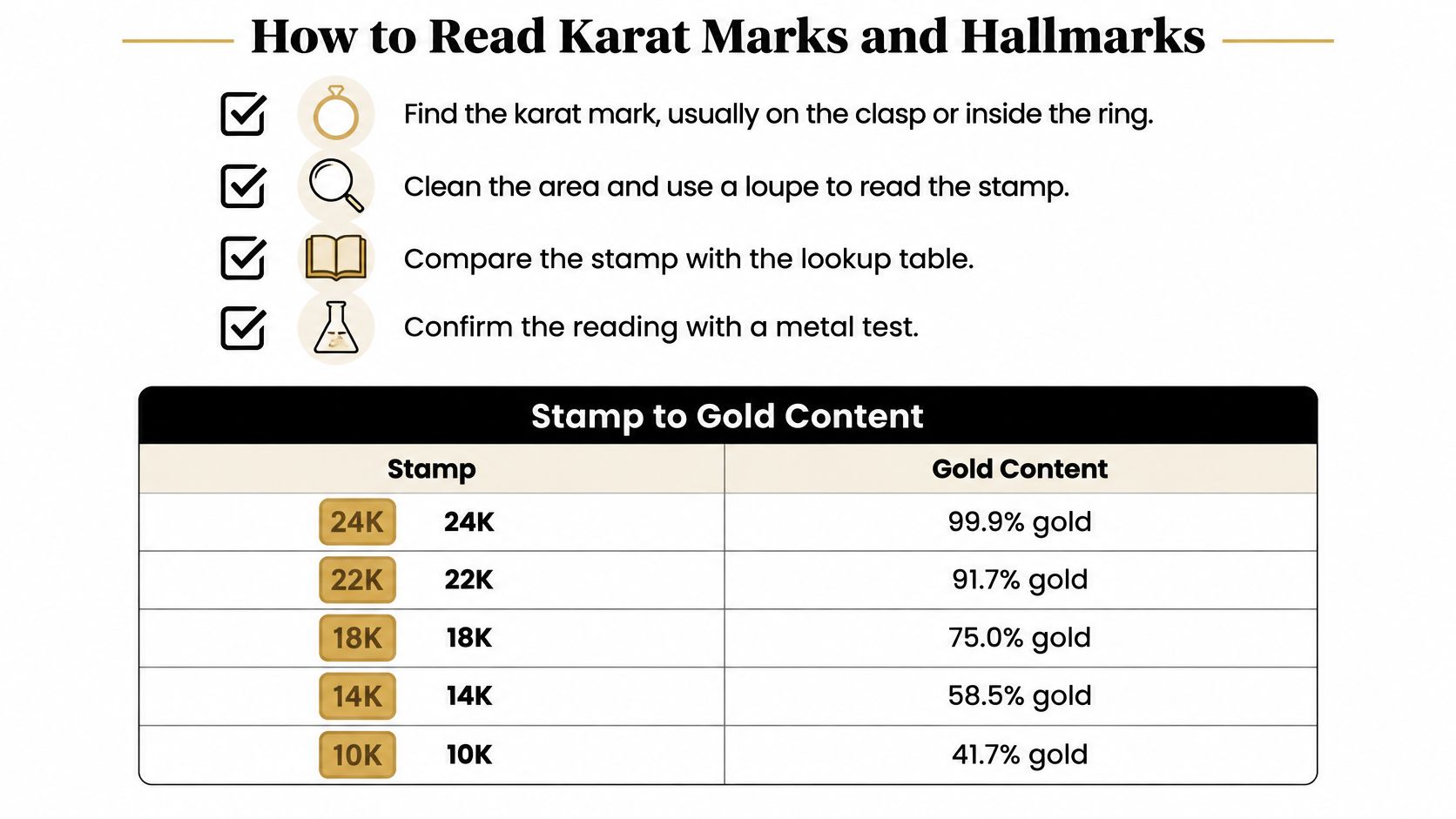
- Compare the stamp with the gold content in the table.
- See whether the stamp sits on a replaceable part. A clasp or jump ring can be swapped onto a different chain. Note that risk.
- Flag a weak stamp. Shallow, uneven, or oddly placed marks deserve a closer test, not a shrug.
- Photograph the mark and record its location and wording before any scan or weighing.
| Karat mark | Gold content |
|---|---|
| 10K | 41.7 percent (10 parts in 24) |
| 18K | 75 percent (18 parts in 24) |
| 24K | 100 percent (pure) |
A mark is a claim
Karat is a fraction of 24. 10K is 10 parts gold in 24, about 41.7 percent. 18K is 18 parts in 24, 75 percent. 24K is the pure end of that scale. The stamp states that claim. It does not measure the metal.
Imported pieces often use marks that do not look like a simple K. A separate note on Chinese gold marks on jewelry is worth reading before you assume an unfamiliar character is meaningless or fake.
The FTC also tells buyers to get refund and return policies in writing before they pay. That paper is part of the transaction record, just as the photo of the stamp is part of the metal record.
The next step after a clear mark is an instrument scan on a valid surface. A confident reading of the stamp, with no test behind it, is still only a claim.
Two Real Examples From Start to Finish
Numbers in these two stories are the figures on the ticket for that piece, not a price list. Watch what gets written down when a test cannot be used.
An inherited chain with no receipt
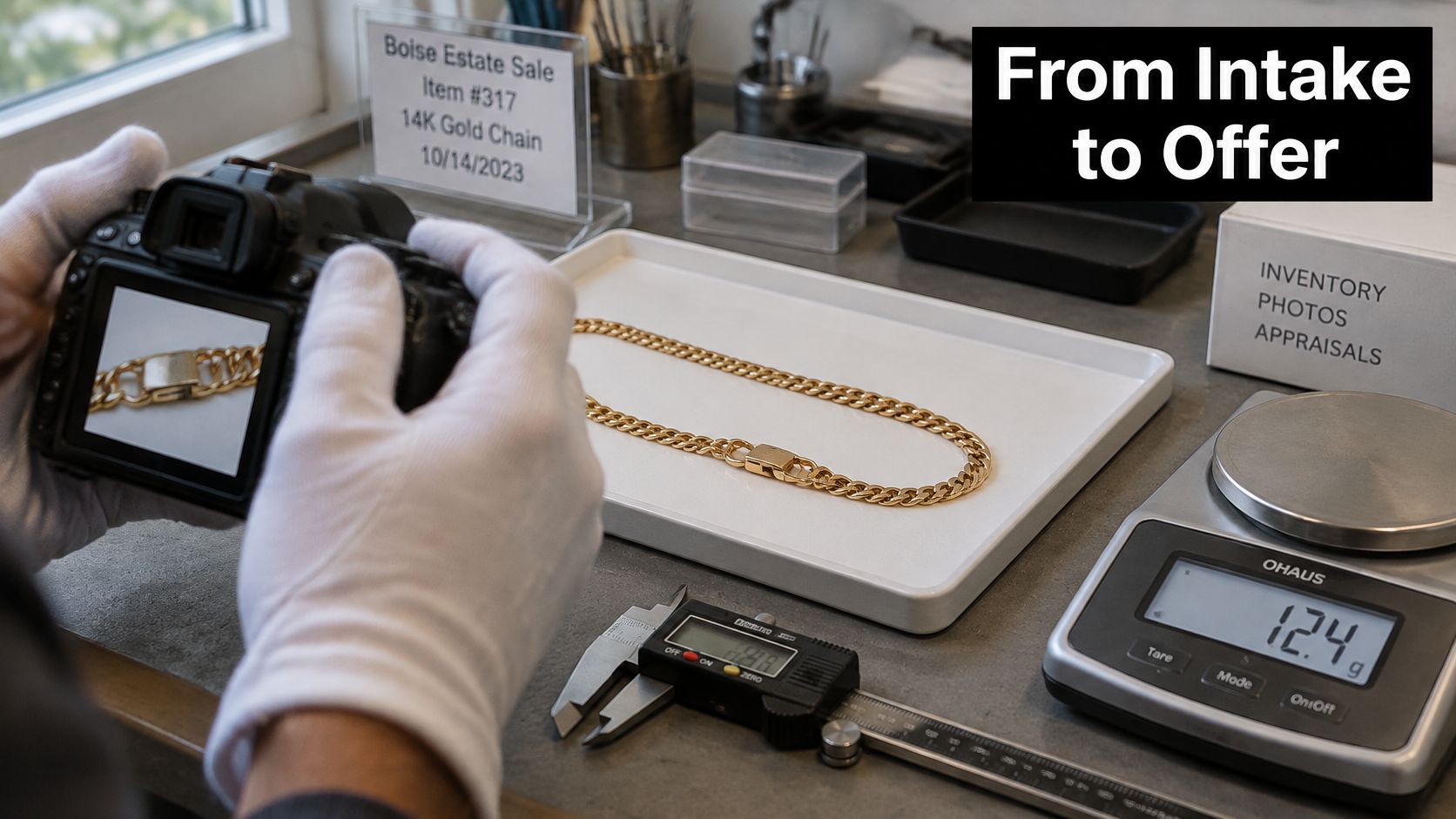
An estate seller in Boise brings a chain described as 14K, weighing 12.4 grams. There is no receipt, so intake starts with photos of the whole chain and of the clasp, plus a weight log.
The visual check finds a 14K stamp and a trademark beside it. A magnet draws no response. An XRF scan on a flat section of the clasp reads as gold. A second pass on a curved link is set aside because that surface is not a valid test point, and the file says the link was not used.
The closing line of the record states what was tested, where it was tested, and what was not examined. The chain is not declared "done" because one link looked pretty.
A worn silver coin from the jar
A coin is offered as one troy ounce of silver and weighs 31.1 grams. The weight matches that claim. The diameter matches the mint specification. The magnet test gives no response.
The coin is worn, and part of the edge has been polished. Those facts go into the record as limits, not as reasons to invent a grade. If you want to see how wear changes what a grader can say, read how a coin grading service treats condition separately from metal content.
The useful result is a clear answer with a documented limit. A confident claim with no photos and no skipped-test note is weaker, even when the coin is genuine.
From the chain, take the habit of naming the test point. From the coin, take the habit of naming the damage. Both habits travel with the item when you sell it.
What Validation Cannot Prove
A lot of people treat validation as a stamp that says real or fake. That belief mixes five different questions into one word, and it leaves estate sellers holding the wrong paper.
A sound check can support conclusions about metal content, karat fineness, weight, dimensions, and plating in the areas that were tested. It does not, by itself, prove lawful ownership, guarantee parts that were never examined, confirm a designer signature without a specialist, or name the best selling price.
The Federal Trade Commission jewelry guides in the Code of Federal Regulations require sellers to represent jewelry's type, quality, quantity, metallic content, weight, origin, price, and value truthfully, and they bar misrepresentation of gold content, karat fineness, and plating. A sloppy "real gold" line is not only weak science. It is a bad sales claim.
Four words estate sellers mix up
- Appraisal: an opinion of value for a stated purpose, such as insurance or a sale.
- Authentication: a judgment about whether the item is genuine as a specific kind of object.
- Assay: a measurement of metal content.
- Valuation: a price estimate tied to market conditions on a given day.
Ask which of the four a document covers, and whether it names what was not examined. If it cannot answer both, it is not ready to travel with the piece.
More tests do not fix an unclear scope. Ten scans of the same clasp, with no note that the links were skipped, do not beat one scan that says "surface composition of the clasp only; no plating analysis." Buyers trust the shorter, honest limit.
The same honesty helps with non-metal goods from the same house. A practical how to authenticate vintage decor checklist shows how photos, marks, and provenance notes work when the object is a lamp or a poster rather than a chain.
Ask for an independent specialist when stages disagree, when a signature or brand claim is the point of the price, or when ownership is disputed. Spotting common fakes is a start, and a guide on how to identify fake gold belongs in that conversation, not as a substitute for the written limits.
Confirm Your Item Before You Sell
Before you sell, bring the pieces to Carat 24 - Trusted Gold Experts in Boise, at 3780 W. State St. Bring the items, any receipts or old appraisals, photos of the marks, and a short note on where each piece came from.
X-ray scanning and gold testing are free. The team runs the checks in the six-stage record and gives you a written account of what was tested and what was not. You can compare that account with a general explanation of how to appraise jewelry so you see where a metal test ends and a value opinion begins.
Gold and jewelry buying here is built around a local offer, including the highest payout in Boise when the file supports the metal. Price matching applies to other offers you already hold, so bring those numbers with you. Hassle-free offers skip the packing, the insurance quote, and the wait for a remote buyer to open the box.
Selling locally can beat an online shipment for simple reasons. You do not pay shipping. You do not pay transit insurance. You do not lose a clasp in a mailer. You do not wait while a buyer you have never met decides the photo was misleading. You watch the test and you leave with the record.
We guarantee the authenticity of all products we sell, and we sell no counterfeit or knock-off products. That promise sits on the same habit you should demand from any buyer, including us: a written record of testing before you accept an offer.
Carat 24 - Trusted Gold Experts checks gold, silver, coins, and luxury pieces in Boise with free X-ray scanning and a written record of what each test can and cannot show. Bring your estate jewelry or coin jar, compare a local offer with the cost and delay of shipping, and ask for the file before you agree to a price. Visit Carat 24 - Trusted Gold Experts to set up that check.
