
If you've ever wondered which half dollars are silver, there's a quick trick: just look at the date. As a simple rule of thumb, any U.S. half dollar dated 1964 or earlier is 90% silver. The coins from 1965 to 1970 are 40% silver. For the most part, anything minted for circulation after 1970 isn't silver, though there are a few special collector's editions out there.
Your Quick Guide to Identifying Silver Half Dollars
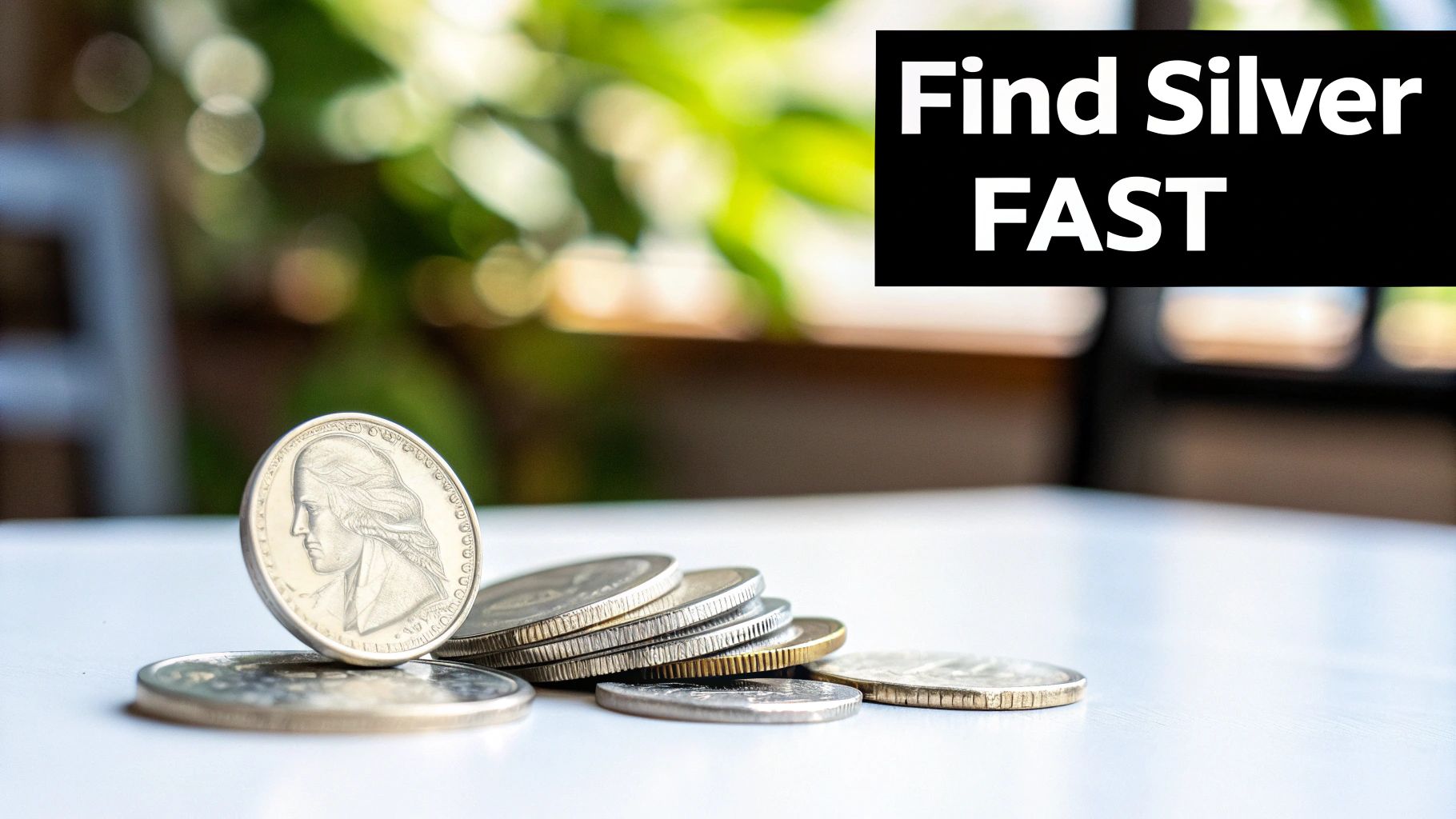
So many of us have old coins rattling around in a jar or tucked away in a drawer, completely unaware of the value they might hold. The secret to unlocking that potential is knowing which ones are made of silver. Thankfully, it's pretty straightforward once you know what to look for, and the date is your biggest clue.
For over 170 years, the United States Mint produced half dollars with a serious amount of precious metal. Every single U.S. half dollar struck from 1794 all the way through 1964 was made of 90% silver. This long history makes them a real treasure trove for both collectors and investors. You'll find a wide range of designs, from the classic Barber and Walking Liberty halves to the more recent Franklin and 1964 Kennedy coins.
Silver Half Dollar Quick Identification Guide
To make sorting through your coins even easier, we've put together a handy cheat sheet. This table breaks down the main types of U.S. half dollars that contain silver.
| Coin Type | Years Minted with Silver | Silver Content |
|---|---|---|
| Barber Half Dollar | 1892–1915 | 90% |
| Walking Liberty Half Dollar | 1916–1947 | 90% |
| Franklin Half Dollar | 1948–1963 | 90% |
| Kennedy Half Dollar | 1964 (Only) | 90% |
| Kennedy Half Dollar | 1965–1970 | 40% |
This information is the perfect starting point for understanding what your collection might be worth. Once you've pulled out the silver coins, the next step is to get them professionally evaluated to make sure you're getting the best possible price. For a closer look at what makes these coins special, check out our guide on identifying valuable coins from 1964 and earlier.
Here at Carat 24 in Boise, we make that process simple. As experts in Gold and Jewelry Buying, we offer free evaluations, using professional tools like Xray Scanning and Gold Testing for free to verify your items accurately right in front of you. You can save the hassle and sell locally for more than online shipments with our hassle-free offers and price matching guarantee.
Exploring the 90% Silver Classics
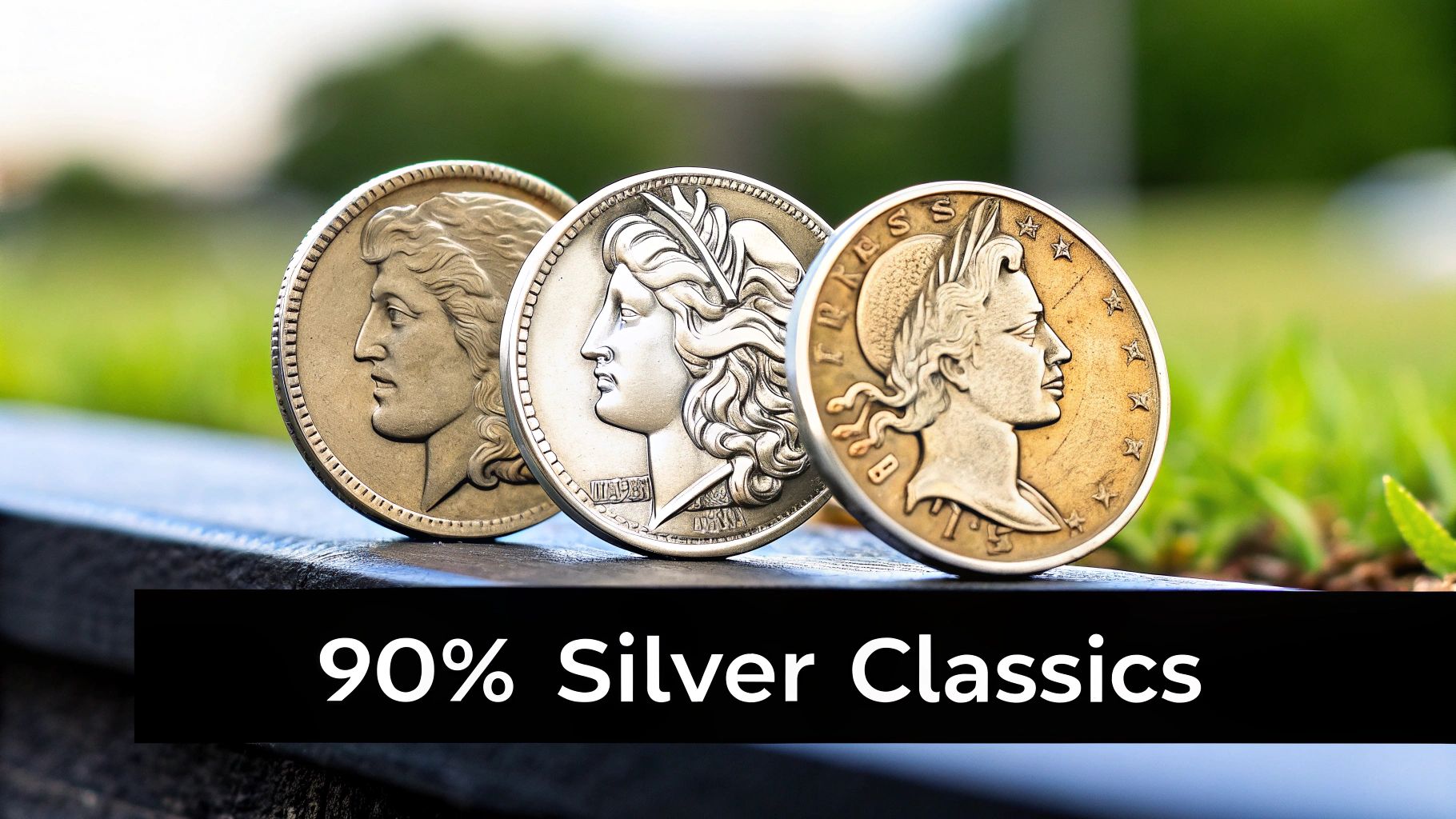
This is where the real history begins. For an incredible stretch of over 170 years, from 1794 all the way to 1964, every half dollar minted by the U.S. was struck from 90% pure silver. When you hold one of these, you’re not just holding a coin; you're holding a genuine piece of American history.
These aren't just lumps of metal. Whether it's a Barber, a Walking Liberty, or a Franklin half dollar, each design tells the story of the era it was minted in. They passed through the hands of generations, serving as everyday currency while being miniature works of art.
The Franklin Half Dollar: An Accessible Classic
The Franklin half dollar, minted from 1948 to 1963, is probably the most common 90% silver coin you'll encounter from this era. They were produced in massive numbers, which is great news for anyone looking to get started. It makes them an affordable and accessible entry point into owning classic American silver.
Each Franklin half dollar contains exactly 0.36169 troy ounces of pure silver. That gives it a solid, tangible value based purely on its precious metal content, making it a favorite for both new collectors and experienced silver stackers.
That said, while most are valued for their silver, some specific dates are worth a closer look from a collector's standpoint.
Remember, every coin has two potential values: its melt value (the price of the raw silver) and its numismatic value (what a collector will pay). Our job is to determine which is higher to get you the best price.
For example, a 1949-S or a 1955 Franklin half dollar can fetch a nice premium over its silver value because fewer were made. This is where a quick glance turns into a professional evaluation—distinguishing a common coin from a more desirable "key date" is what we do.
Beyond the Franklin: The Walking Liberty and Barber Eras
As we step further back in time, the designs become even more iconic. The Walking Liberty half dollar is widely hailed as one of the most beautiful coins ever struck by the U.S. Mint. To learn more about what makes certain dates so valuable, you can read our detailed guide on how much Walking Liberty half dollars are worth.
With these older coins, key dates and mint marks are everything. A common date might just be worth its weight in silver, but a rare one could be worth hundreds, sometimes even thousands, of dollars.
- Barber Half Dollars (1892-1915): Featuring a classic profile of Lady Liberty, these coins are a cornerstone for anyone collecting turn-of-the-century American silver.
- Walking Liberty Half Dollars (1916-1947): Praised for its breathtaking design, this series has several well-known key dates that collectors are always hunting for.
When you bring your collection to us, you're not just getting a quick offer. We provide free, hassle-free offers, often using advanced Xray Scanning to verify your items right in front of you. You can save the hassle and sell locally for more than online shipments. With our price matching guarantee, you can be confident you're getting the highest payout in Boise.
The Kennedy Half Dollar: A Story of Changing Times
The story of the Kennedy half dollar isn’t just about a coin; it’s about a nation in a moment of profound transition. After President John F. Kennedy's tragic assassination, the American public overwhelmingly demanded he be honored on our coinage. The U.S. Mint moved quickly, and the Kennedy half dollar burst onto the scene in 1964.
That first year was a silver stunner. Struck in 90% silver, the 1964 Kennedy was the last of its kind meant for circulation, marking the final chapter in the long history of 90% silver U.S. half dollars. Between the powerful public sentiment and the high silver content, these coins were hoarded almost as fast as they were minted, vanishing from circulation almost immediately. It was a one-year tribute that became the end of an era.
The Shift to 40% Silver-Clad Coins
By 1965, the game had changed. Soaring silver prices forced the U.S. Mint to rethink its strategy. While they needed to reduce the precious metal content in our coins, they weren't quite ready to let go of silver in the half dollar. The solution? The "silver-clad" Kennedy.
From 1965 to 1970, these coins were made with a unique layered composition. The outer layers were 80% silver and 20% copper, bonded to an inner core that was mostly copper with a little silver. This clever sandwich construction resulted in a coin with a total silver content of 40%.
While they don't pack the same punch as their 90% silver predecessor, these 40% silver coins are still highly sought after and contain a significant amount of precious metal. They're a very common find in old family coin jars and are always worth much more than their 50-cent face value.
Key Takeaway: When it comes to Kennedy half dollars, the date is your cheat sheet. 1964 means 90% silver. 1965-1970 means 40% silver. Any Kennedy you find in your pocket from 1971 onward is just copper and nickel (with a few collector-specific exceptions).
The Modern Era and Hidden Silver Gems
In 1971, the U.S. Mint officially removed all silver from circulating Kennedy half dollars, switching to the standard copper-nickel clad composition we still use today. But that wasn't quite the end of the line for the silver Kennedy.
For the dedicated collector, the U.S. Mint began issuing special 90% silver proof sets again starting in 1992. These coins were never intended for your pocket money; they were made specifically for collectors and feature a gorgeous, mirror-like finish. If you happen upon a Kennedy dated after 1991 with a brilliant, highly reflective surface, you might just be holding one of these valuable silver proofs.
Want to dig deeper into specific high-value dates? Check out our complete guide on the value of Kennedy half dollars by year.
Whether you've got a pile of 90% or 40% silver Kennedys, we're here to help you get the highest payout in Boise. At Carat 24, we offer free Xray Scanning and Gold Testing for a no-pressure, transparent evaluation. Save the hassle and sell locally for more than online shipments—we even offer price matching to make sure you're getting the best deal.
How to Confidently Identify Silver Coins at Home
You don't need to be a professional numismatist to start figuring out what you've got. With just a couple of simple tricks, you can confidently sort your half dollars right at the kitchen table, separating the valuable silver from the everyday pocket change.
The easiest, most foolproof check is simply the date. As a hard and fast rule, any U.S. half dollar dated 1964 or earlier is 90% silver. It’s the quickest way to spot the most valuable coins in any pile.
The Revealing Edge Test
For those Kennedy half dollars minted after the 1964 cutoff, the "edge test" is your best friend. This is as simple as turning the coin on its side and looking at the thin rim.
- Solid Silver Stripe: If you see a consistent, solid silver-colored edge with no other metal peeking through, you're holding either a 90% silver (1964) or a 40% silver (1965-1970) coin.
- Copper Stripe: See a distinct copper-colored line sandwiched between two silvery layers? That's a dead giveaway for a modern, non-silver clad coin, minted from 1971 to today.
This simple visual trick instantly tells you if there's any precious metal content. It’s also important to understand the difference between solid silver coins and plated items, like silverplate flatware, which just have a microscopically thin coating of silver and no real melt value.
The Sound Test: A Musician's Trick
Another classic at-home method that collectors have used for generations is the "sound test," sometimes called the "ping test." Gently drop a known silver half dollar onto a hard surface, and then do the same with a modern clad one.
You'll immediately notice the difference. The silver coin rings with a clear, high-pitched "ping" that sustains for a moment. The clad coin, by contrast, makes a dull, lower-pitched thud.
While these home tests are fantastic for a first pass, the only way to be 100% certain about composition and get a true valuation is with a professional eye. To see how the pros do it, you can learn more about our gold and silver testing process.
Here in Boise, we take all the guesswork out of it. Bring your coins to Carat 24 for a totally free, hassle-free offer. We use advanced Xray Scanning and other professional equipment to verify everything right in front of you. You can save the hassle and sell locally for more than online shipments. Plus, with our price matching guarantee, you know you're getting the highest payout in Boise.
Understanding Your Coin's True Worth
Ever wonder why some old half dollars are worth just a few bucks while others can command thousands? It all comes down to understanding two very different kinds of value: melt value and numismatic value. Getting a handle on this difference is the secret to figuring out what your coins are really worth.
Melt value is the most straightforward of the two. It's simply the value of the raw silver inside the coin. For example, a run-of-the-mill 1964 Kennedy half dollar is mostly valued for its 0.36169 troy ounces of pure silver. Its price goes up and down every day with the silver market, just like a silver bar or piece of jewelry.
Beyond Melt Value to Collector Value
Now, numismatic value is where things get interesting. This is the premium a collector is willing to pay for a coin because of its rarity, condition, historical importance, or even a unique minting error.
Think of it this way: a standard brick is worth the price of its clay (its melt value). But a brick salvaged from a famous historic landmark? That's worth a whole lot more to someone who values its story and rarity (its numismatic value).
This quick decision tree can help you with the first steps—figuring out if your half dollar is even silver to begin with.
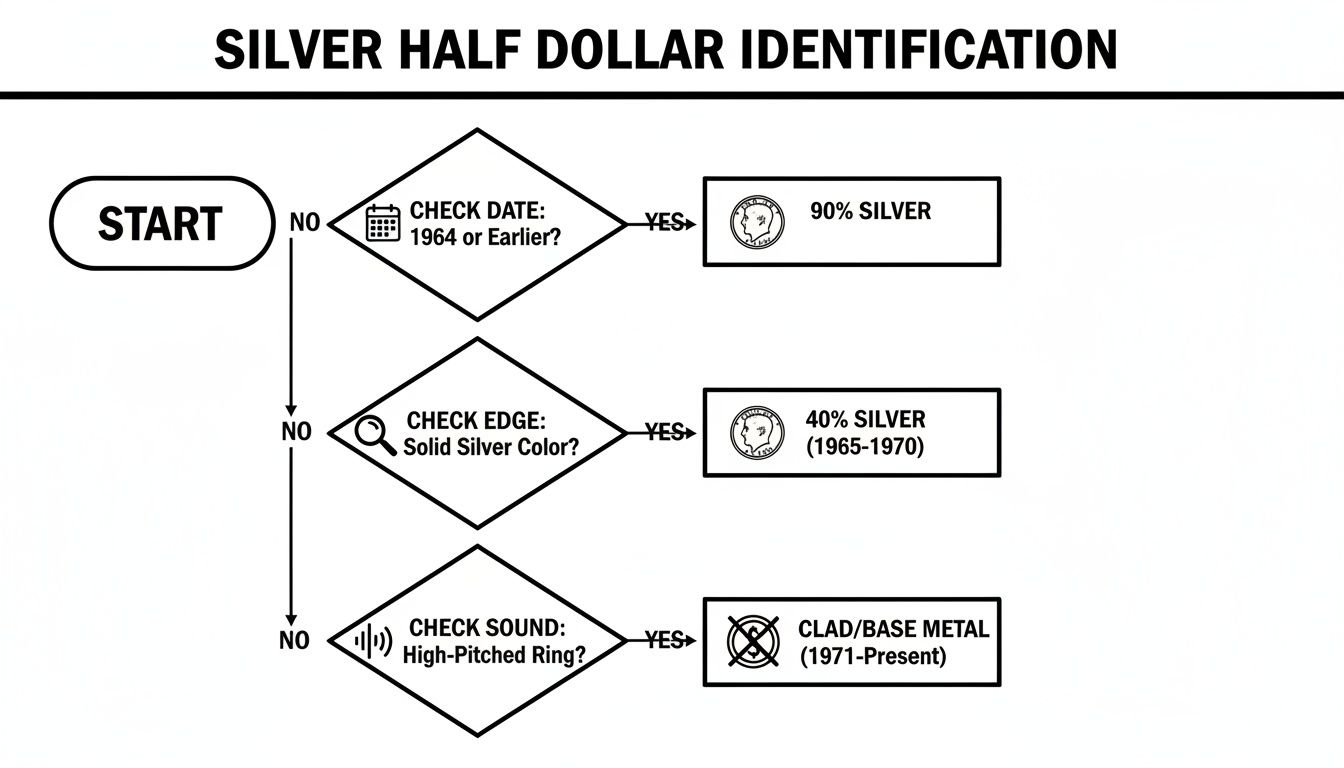
As the flowchart shows, the date is your first big clue, but the coin's physical traits—like the look of its edge or the sound it makes when dropped—are great ways to confirm what you're holding.
A Franklin half dollar in pristine condition from a low-mintage year could be worth hundreds, blowing its basic silver value out of the water. This is precisely why a professional appraisal is so critical. Selling a rare coin for its melt value is like selling a classic car for scrap metal. You’re almost certainly leaving a significant amount of cash on the table.
At Carat 24, we specialize in spotting these hidden gems. We aren't just looking to buy silver; we're committed to finding the numismatic premium in your collection so you get the full value you deserve.
Our experts know how to spot the subtle details—the low mintage numbers, specific mint marks, and rare errors—that create this extra collector value. We provide hassle-free offers and use state-of-the-art Xray Scanning and Gold Testing for free to verify your items' composition right in front of you.
You can save the hassle and sell locally for more than online shipments, ensuring you receive the highest payout in Boise with our price matching guarantee.
Get the Highest Payout for Your Silver in Boise
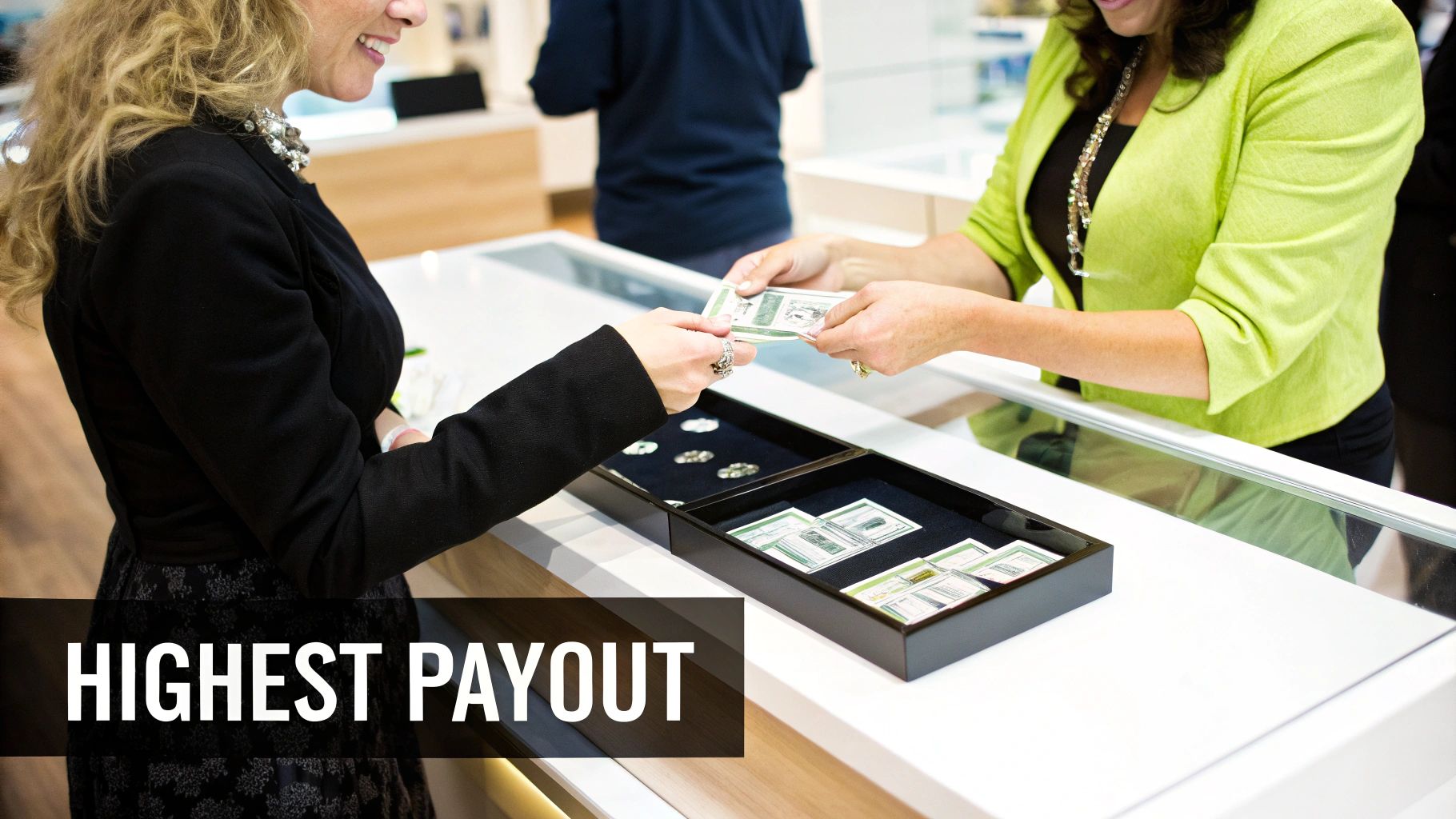
So, you’ve sorted through your change and identified your silver half dollars. What’s the next move? You could go the online mail-in route, but that path is often paved with hidden costs, unnecessary risks, and frustrating delays. You’re left worrying about packing everything securely, paying for insured shipping, and then just waiting for an offer you hope is fair.
There’s a much smarter, safer, and more profitable way. Here in Boise, you can save the hassle and sell locally for more than online shipments. We make sure the process is transparent, secure, and best of all, immediate.
The Advantage of a Local, Trusted Expert
Choosing a local expert like Carat 24 means getting a professional, face-to-face evaluation without any of the mail-in headaches. There are no shipping fees to deduct from your payout, no insurance costs to worry about, and absolutely no waiting. You get a firm, hassle-free offer right on the spot.
Our entire process is built on trust and transparency. We want you to understand exactly what you have and why it’s worth what it is.
- Free, No-Obligation Evaluations: We’ll never charge you for an appraisal. Bring in your silver half dollars, and we’ll assess them with zero pressure to sell.
- Advanced On-the-Spot Verification: We use state-of-the-art Xray Scanning and Gold Testing for free to confirm the precise silver content of your coins, right in front of you.
- Immediate Payouts: If you like our offer, you walk out the door with cash in hand. No waiting for a check to clear or a bank transfer to show up.
We are committed to providing the highest payout in Boise, and we stand by that promise. With our price matching guarantee, you can be confident you’re receiving the best possible value for your precious metals.
This direct, in-person approach completely eliminates the uncertainty. You get to watch the entire evaluation from start to finish and hear a clear explanation of how we arrived at our offer. For a deeper dive into the selling process, check out our complete guide on how to sell silver coins.
What to Expect When You Visit Us
Selling your silver coins should be a simple and empowering experience. When you bring your half dollars to our Boise store, you’ll find a professional and respectful environment waiting for you. Our team will carefully examine each coin, looking not just at its silver melt value but also for any potential numismatic premium that could make it more valuable to a collector.
Forget the risks of sending your valuables through the mail. Stop by for a straightforward, rewarding experience and turn those hidden treasures into immediate cash.
Frequently Asked Questions About Selling Silver Half Dollars
Diving into the world of silver half dollars always brings up a few common questions. We hear them all the time from folks just like you, so let's clear up some of the most frequent points of confusion.
Are 1976 Bicentennial Half Dollars Silver?
This is a big one. While most of the Bicentennial half dollars you'll find in your change jar are just standard copper-nickel, the U.S. Mint did strike a special 40% silver version for collectors.
These weren't meant for everyday use and usually have an "S" mint mark. You'll often find them still sealed in their original government packaging. So, unless it's in a special collector's set, that Bicentennial half dollar is almost certainly not silver.
What Is the Rarest Silver Half Dollar I Could Find?
Everyone dreams of finding that one-in-a-million coin. While stumbling upon a 1916-D Walking Liberty half dollar in an old coffee can is the stuff of legend, it's not impossible. That coin is a "key date," meaning very few were made, which makes it incredibly valuable to collectors.
The takeaway here? Always have older or unusual-looking coins checked out by a professional. You just never know when a hidden treasure might turn up.
Should I Clean My Silver Coins Before Selling Them?
Please, don't do it! We can't stress this enough: do not clean your coins. It might seem like a good idea to make them shiny, but cleaning strips away the natural toning (called patina) that collectors often prize. It also creates tiny, microscopic scratches on the coin's surface.
Cleaning can absolutely tank a coin's numismatic value. Always bring them to us exactly as you found them. We'll know what we're looking at, dust and all.
If you decide to go the online route, using professional product photos for eBay sellers can make your listings stand out. But honestly, you can skip the shipping and fees and often get a better, faster payout by selling locally.
Here at our Boise Gold and Jewelry Buying center, we make it simple. We offer free, instant evaluations with our Xray Scanner and give you a hassle-free offer backed by a price match guarantee. Our goal is to give you the highest payout in Boise.
Ready to discover the true value of your coins and jewelry? Visit us at Carat 24 - Trusted Gold Experts for a free, no-obligation evaluation and get the highest payout, guaranteed. Learn more at https://carat24boise.com.
