

If a band looks old, sparkles softly, and comes with a family story, does that prove it's antique? That's the gap most buyers miss. Antique diamond wedding bands make four separate claims at once, about the stone, the metal, the setting, and the provenance, and each claim needs different evidence. A soft-looking stone doesn't date the mounting, a laboratory report doesn't prove who owned the ring, and age alone doesn't guarantee a premium. When you separate those claims and check them one by one, you can judge what you're buying, what you can safely wear every day, and what a buyer can fairly pay.
Eras and Cuts That Date an Antique Band
How old is this band? Start with the diamond, because cutting technology changed in a clear sequence and each style leaves clues you can see under a loupe.
Say you're handed a low, flat-backed stone that glows rather than flashes. That points you to the earliest style in the sequence. According to the Hallmark Society guide to stones and cuts, rose cuts emerged in the 16th century and used a flat base with a domed, triangular-faceted crown, producing a softer shimmer rather than intense modern brilliance. A rose cut often suggests Georgian or Victorian origins, although the stone could have been reset later.
Move forward and the outline changes. Old mine cuts developed during the 18th century and 19th century, typically with a cushion-shaped outline, high crown, deep pavilion, approximately 58 facets, and a large open culet. Look for a slightly squarish silhouette, a small table on top, and a culet you can see as a circle or point through the table. Those features point to the 18th or 19th century, not to damage.
From Old Mine to Old European
The next step is rounder. Old European cuts became prominent around 1890 and remained widely used through approximately 1930, especially during the late Victorian, Edwardian, and Art Deco periods. You'll still see a high crown and visible culet, but the outline is round rather than cushion-shaped. That combination generally suggests a late-19th- or early-20th-century piece.
A modern round brilliant is your reference point, not your dating evidence. Its proportions are standardized for sharp, uniform sparkle, so an antique stone beside it can look uneven by comparison. That unevenness is often the point. Period stones were shaped with hand tools, so asymmetry, higher crowns, smaller tables, and visible culets are historically characteristic rather than automatic signs of poor workmanship.
Diamond cuts and the eras they date
| Cut | Era | Dating Clue | Look |
|---|---|---|---|
| Rose cut | 16th century onward; Georgian and Victorian | Flat base, domed triangular crown | Soft, low shimmer |
| Old mine cut | 18th and 19th centuries | Cushion outline, high crown, large culet | Broad, uneven flashes |
| Old European cut | About 1890 to 1930 | Round outline, small table, visible culet | Late Victorian, Edwardian and Art Deco look |
| Modern round brilliant | Modern standardized cutting | Standard modern proportions | Sharp, uniform sparkle |
Use the table as a lookup, not a verdict. Identify the cut under a loupe, match it to a row, then check whether the setting style belongs in the same period before you settle on an age. Delicate pierced work, for example, should make sense beside the stone you identified, a connection explored in this guide to antique filigree rings and their construction. If the cut says one era and the mounting says another, you've likely found a reset stone, a later reproduction, or a repair that needs explaining.
Practical rule: Date the stone and the setting separately, then ask whether the two dates agree.
How to Verify Metal, Stones and Hallmarks
Verification works best as a counter sequence you can follow in order. Don't start with price. Start with marks, then metal, then measurements, then construction.
The visual summary below shows the order at a glance before you work through each step.
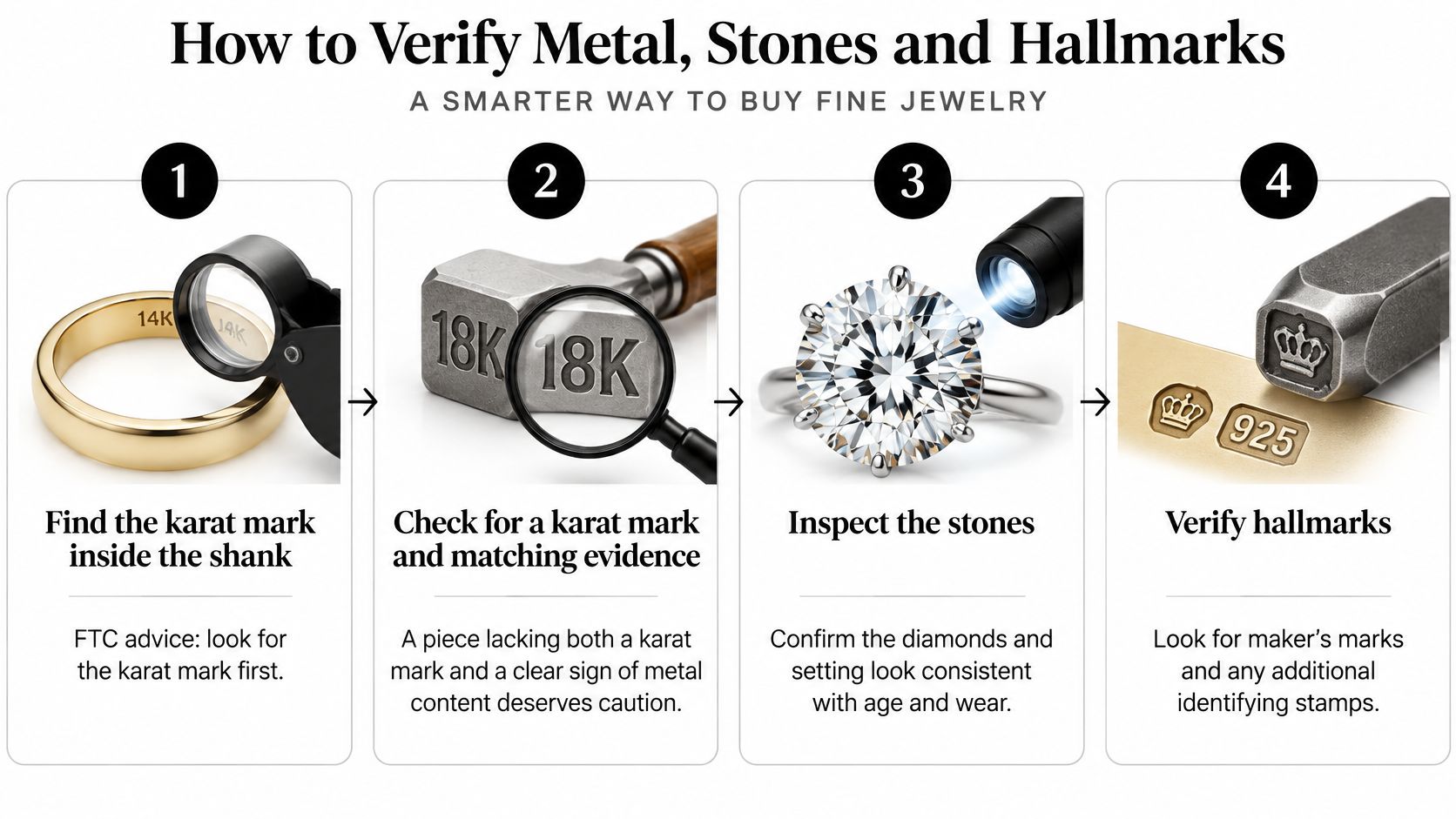
Six Steps at the Counter
- Find the karat mark inside the shank. The Federal Trade Commission Jewelry Guides advise buyers to look for a karat mark showing the proportion of pure gold and warn that a piece lacking both a karat mark and a trademark should not be purchased. The common slip is trusting color alone, since plating can make a base metal look rich.
- Read hallmarks and maker's marks. Photograph every stamp inside the shank, including assay or city symbols, then compare the shapes and lettering with period references. A crisp modern stamp inside a supposedly hand-made Victorian shank is a mismatch worth questioning.
- Test metal at several points. Take readings on the outside of the shank, a worn area, and a concealed spot such as under a prong. One bright surface reading can hide plating, solder from a repair, or an alloy that changes around the band.
- Run a non-destructive X-ray fluorescence scan. GoldSilver guidance on verifying precious metals describes X-ray fluorescence (XRF) testing as a non-destructive method that identifies the elemental composition of a metal surface by measuring characteristic secondary X-rays. Clean the measurement area first and take readings at multiple points, including a worn or concealed area such as a ring shank, because plating, solder, contamination, or uneven composition can mislead a single reading. Treat the scan as screening evidence that depends on calibration, test location, and repeated readings, and record each result.
- Measure the stone, don't just grade its sparkle. Record table percentage, total depth, girdle thickness, culet size, and symmetry. Old cuts weren't made to modern cut-grade formulas, so measured proportions tell you more than a modern label. Note the face-up spread in millimeters as well, since that's the size you'll see.
- Examine construction and wear. Look for hand-finished prongs or bezels, visible solder, softened engraving, and wear that's consistent across the band. Even wear supports an age claim. A heavily worn stone in a pristine, sharp-edged mounting suggests the parts didn't start life together.
Our authentication includes examining materials and craftsmanship and verifying serial numbers through certified websites where a piece carries them. That same habit of checking a claim against an independent record applies when you learn how to appraise jewelry step by step before you buy.
The short video below walks through counter inspection so you can see how marks and settings are checked in practice.
Write down what each step showed. A list that says karat mark present, XRF readings consistent at three points, and culet visible is useful evidence. A note that says antique isn't.
Separating Provenance From Sentiment
Many sellers treat an old-looking cut, a vintage-style mounting, or a diamond report as proof that the whole ring is antique. That assumption is where money gets lost. You're really being asked to accept three different claims, and each one needs different proof.
An antique diamond can sit in a new mounting. An antique setting can hold a replacement stone. A modern ring made in an antique style can copy both the cut and the filigree so closely that photographs won't separate it from an original. Sentiment doesn't resolve those possibilities. Evidence does.
Three claims and the evidence each one needs
| Claim | Evidence That Supports It | What Does Not Prove It | Question to Ask |
|---|---|---|---|
| Antique diamond | Period cut style, measured proportions, lab report on the stone | A cut that only looks old | Do the cut proportions match the era? |
| Antique setting | Hand fabrication, matching wear, period hallmarks | Vintage styling alone | Do the marks and construction match the era? |
| Modern ring in antique style | Modern manufacturing marks, uniform castings | A vintage look or romantic story | Does the metal and build show modern making? |
What a Report Does and Doesn't Prove
A laboratory report grades the stone in front of the lab. It shouldn't be assumed to authenticate the era of the mounting or an uninterrupted ownership history. GIA's explanation of its cut system notes that its standard cut-grading system evaluates defined characteristics for eligible modern round brilliants, while provenance can affect value separately. That distinction matters at resale, because an undocumented historical narrative is harder to substantiate than intrinsic metal and stone value.
Preserve records that connect a specific band to a specific history:
- Prior appraisals and receipts: Keep dated documents that describe measurements and marks.
- Family history and dated photographs: Save names, dates, and photos showing the band being worn.
- Maker's marks and laboratory reports: Photograph stamps and keep reports with the piece.
- Treatment disclosure: Record any repair, reset, or stone replacement in writing.
A recent appraisal by a qualified appraiser who knows period jewelry carries more weight than a seller's description. That context helps when you're deciding what estate jewelry means and how it's classified, since estate means previously owned and doesn't prove age.
Apply a simple test in one conversation. Ask the seller to name the document behind each claim about stone, setting, and ownership. If the answer is only verbal, treat that claim as unproven until evidence appears. Provenance can add value when it's credible, specific, and documented, but age alone doesn't guarantee a return.
What Sets an Antique Band's Value
Value builds in layers. Start with metal, add the stone as measured, adjust for condition, and only then consider documented history.
The Metal Floor
Metal gives you the floor because it's weighable and testable. Multiply the band's weight by the purity-adjusted price for that alloy, and you have a substantiated starting point before anyone debates style or story. That's why a clear karat mark and consistent test readings matter so much to an offer.
Karat purity reference for antique bands
| Metal | Where Seen in Antique Bands | Valuation Note |
|---|---|---|
| 24K gold | Rare in wedding bands | Soft metal, priced on weight and purity |
| 22K gold | Occasional in older European pieces | Priced on weight and purity |
| 18K gold | Common in European antique bands | Strong resale value per gram |
| 10K gold | Less common, often later pieces | Lowest metal value of the gold options |
| Platinum (950) | Common from the early 20th century | Dense, priced by weight |
Don't use the table as a price quote. Use it to understand why two bands with the same gram weight can have different metal floors, and why a dense platinum band can outweigh a similar gold band.
The Stone as Measured
Antique stones need measurement, not modern expectations. The GIA old mine cut diamond guide explains that an old mine cut generally has a cushion-like outline, 58 facets, a small table, high crown, deep pavilion, short lower-half facets, and a prominent culet, while old European cuts are rounder with a high crown, small table, greater total depth, and visible culet. GIA's round-diamond cut system is designed for modern round brilliants, so antique stones are better assessed through measured dimensions, symmetry, polish, transparency, facet pattern, and historical authenticity.
Say two bands each hold a 0.30 carat old mine cut, as a hypothetical comparison. The first has a table near a broader proportion, moderate depth, and a clean girdle, so its face-up spread looks wider on the hand. The second carries more depth below the girdle, so more weight hides where you can't see it and the stone looks smaller from above. Same carat weight, different visible size, different price. Record table percentage, total depth, girdle thickness, culet size, and symmetry, then compare face-up spread with carat weight before you judge either stone. A diamond resale value calculator can help you organize those inputs, but it can't replace measuring the actual stone.
Carat weight tells you what a stone weighs. Spread tells you what a buyer sees.
Condition and Documented History
Condition moves the number next. Worn prongs, chips, a vulnerable girdle, loose stones, and a resize that thinned the shank all lower value because the next owner pays for repair or accepts risk. A verified maker or documented family history can add a premium in specialist channels, while an undocumented narrative usually doesn't. Get a written appraisal that separates metal, stone, condition, and history before you compare offers, so you can see which layer each buyer is paying for.
Caring for an Antique Band Day to Day
Can you wear an antique band every day? Sometimes, but don't decide from romance or age. Decide from the girdle, the setting, and the thickness of the metal.
Antique cuts carry a specific risk. GIA's educational material on diamond cuts notes that old mine cuts commonly feature a small table, large culet, high crown, and girdles that may be very thin in places, which can increase vulnerability to impact damage. Diamonds aren't unbreakable. Chips can occur when a vulnerable girdle or inclusion receives a hard blow, and diamonds can damage one another when stored together.
Make a Wear Decision
- Occasional wear: This suits most antique bands, especially thin-girdled stones in delicate prongs.
- Daily marriage wear: Choose this only when the girdle is protected around the stone, prongs or a bezel-like design are secure, no stones move, and the shank hasn't thinned.
- Hands-on work: Remove the band for lifting, tools, gardening, and gym equipment, where metal strikes metal.
That protection point is practical, not cosmetic. A setting that shields the girdle reduces the chance that a countertop edge becomes a chip. Modern reproductions may use thicker, more durable girdles, so a band that looks antique can be sturdier than an original. Don't assume durability from appearance in either direction.
Inspection, Cleaning, and Resizing
Check prongs and stone security every six months for daily wear and once a year for occasional wear. Catch a lifted prong early and you prevent a lost stone. Store each band in its own soft pouch or separate box compartment so diamonds don't scratch neighboring jewelry.
Clean gently with warm water, mild soap, and a soft brush, then pat dry with a lint-free cloth. Avoid harsh heat and ultrasonic cleaners on fragile settings, loose stones, or fine filigree, since vibration can loosen work that's already worn. For a fuller routine on keeping your diamond ring sparkling, Shapiro Diamonds offers care guidance you can adapt with extra caution for period settings.
Get a jeweler's inspection before any resizing. Resizing can thin metal, disturb stones set around the shank, and weaken original construction or erase marks if the cut is placed badly. If the shank is already thin, prongs are worn, or the girdle sits exposed, ask about moving the stone to a safer setting or reserving the band for occasional wear. Preserving an heirloom sometimes means wearing it less, not forcing it into daily service.
Buying and Selling Locally for the Best Payout
Shipping a band to a distant buyer asks you to trust packaging, transit, and a quote you can't watch being made. Selling in person lets you see the tests, ask questions while the band is on the counter, and leave if the terms don't suit you.
The comparison below sets those choices side by side.
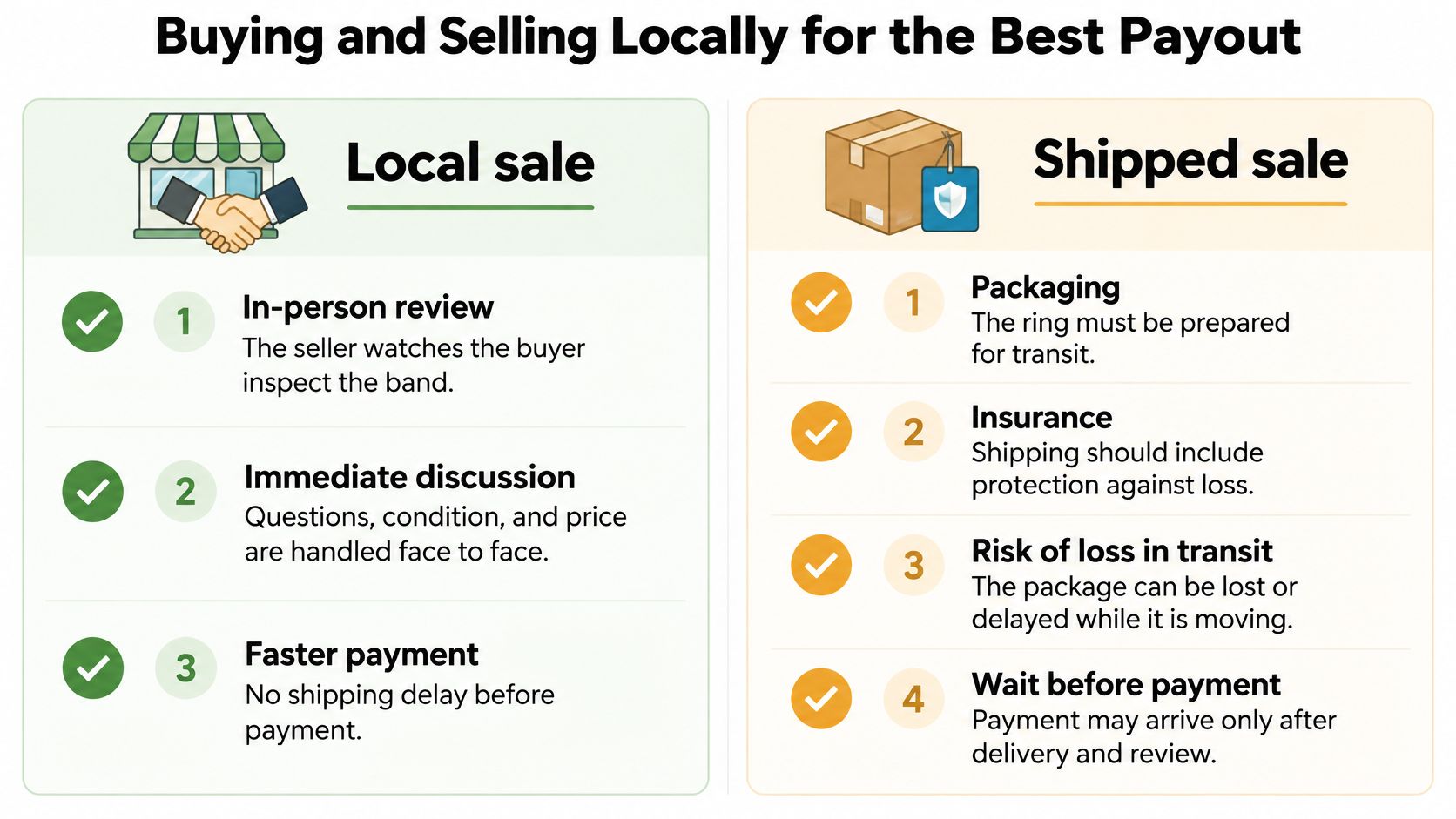
Local Sale Versus Shipped Sale
A shipped sale involves careful packaging, insurance against loss in transit, and a wait before payment while the buyer receives and reviews the piece. You also lose the chance to point out a hallmark, explain a repair, or watch repeated metal readings at worn and concealed points. Save the hassle and sell locally for more than online shipments when an in-person buyer can test the band in front of you and explain deductions line by line.
An in-person review doesn't remove price factors. Items sold to us with significant wear or damage may be offered lower prices or not accepted, and missing paperwork or unclear karat marks also lower confidence. We buy gently used jewelry, and our local team in Boise provides prices and insights on gold, silver, jewelry and diamonds. Buyers should apply the same checks in reverse before paying, including sizing, shank thickness, prong security, and loose stones.
A Seller Checklist You Can Use
- Gather documents: Bring receipts, appraisals, lab reports, and dated photographs.
- Photograph hallmarks: Capture karat and maker's marks before any cleaning or repair.
- Note condition: List chips, loose stones, thinning, and prior resizing.
- Get local quotes: Compare at least three written local offers for Gold and Jewelry Buying.
- Ask about testing: Confirm the buyer offers Xray Scanning and Gold Testing for free and repeated readings.
- Ask about terms: Confirm Price Matching, hassle free offers, and written refund or return terms.
Those safeguards aren't bureaucracy. The FTC guide to buying platinum, gold, and silver jewelry recommends that consumers investigate a seller's reputation, obtain refund and return policies in writing, and understand the jewelry's markings before completing a transaction. A hassle-free offer should still be supported by documentation you can check, not just a quick verbal quote.
Read a written offer line by line. Check the stated metal weight, purity, stone measurements, and every deduction, then compare those lines with your photographs and appraisal. If you're deciding where to sell jewelry locally, favor the counter where testing happens in front of you and questions get specific answers.
As a local option, Carat 24 - Trusted Gold Experts in Boise offers Gold and Jewelry Buying with free X-ray scanning and gold testing, hassle-free offers, price matching, and aims for the highest payout in Boise, with details available through our Boise store. Bring the band in for free testing and leave with an era assessment, a verified metal and stone profile, and a written offer you can compare without obligation. That's the practical advantage of separating stone, metal, setting, and provenance in person rather than shipping the whole story away in a box.
Bring your antique diamond wedding band in for free X-ray scanning and gold testing, and we'll separate the stone, metal, setting, and provenance claims in front of you before making a hassle-free written offer with price matching. Visit Carat 24 - Trusted Gold Experts to plan your Boise visit and compare your payout with confidence.
