

Your mother's jewelry box is on the kitchen table, tipped out onto a towel. A wedding band worn thin at the back, a chain with a broken clasp, a ring with a stone nobody has ever had checked, and a watch with a name you can't quite read. You need a number, and you'd rather not put the whole thing in a padded envelope and wait three weeks to find out.
That box is harder to price than it looks. Two buyers can examine the same ring and hand you offers that differ by several hundred dollars, and the gap is almost never about the gold price that morning. It's about how each offer was built: what got weighed, what got tested, what got waved through, and which definition of value the buyer started from.
The market behind that box is bigger than most families expect. Bain & Company estimated the global secondhand luxury market reached approximately €50 billion in 2025, with watches and jewelry making up roughly 83% of it, according to National Jeweler's coverage of the Bain figures. You're not selling into a flea market. You're selling into an established resale economy, and the offer you get depends on which door you walk through.
Which Estate Jewelry Buyer Fits Your Piece
Most estate jewelry buyers you'll meet fall into six categories, and each one sets its price a different way. The table below is the one I'd want an executor to read before picking up the phone, because the channel decides the range of offers long before the piece does.
| Buyer type | How the offer is set | Best for | Main risk |
|---|---|---|---|
| Local independent gold and jewelry buyer | Metal weight, karat, stones and design review, often same day | Gold, silver and mixed pieces needing quick cash | Offers vary between shops, so compare two |
| Pawn shop | Loan-style pricing, usually the lowest offer | Small, low-value items needing fast money | Lowest offers for fine jewelry |
| Online mail-in buyer | Offer after photos or a shipped inspection | Sellers with no local buyer nearby | Shipping risk, delays and less control |
| Auction house | Pre-sale estimate, then final price minus commission | Signed, branded or rare pieces | Commission costs and unsold lots |
| Estate liquidator | Bulk offer for the whole household's contents | Full estate cleanouts with little time | Single pieces often underpaid |
| Independent appraiser | Fee-based written valuation with no purchase | Insurance records and dividing items among heirs | An appraisal is not a guaranteed sale price |
The pattern is hard to miss. The further a piece travels from the person testing it, the more room opens up between what it's worth and what you're paid. A pawn shop prices for a loan it half expects you to redeem. A liquidator prices an entire house at once and has to leave margin for the pieces nobody wants. An auction house earns on the hammer price and hands you nothing if the lot stalls.
Match the channel to the piece
Everyday gold, the broken chains and single earrings and class rings, belongs with a local buyer who tests it while you stand there and pays on the spot. Signed or branded pieces deserve a specialist or an auction estimate, because the name on the mark can outweigh the metal many times over. Sentimental pieces should be appraised before anyone sells them, so the family ends up discussing facts rather than feelings.
Buyers and sellers want the same things, and the survey numbers say so. In a 2025 survey of 7,800 resale-engaged Vestiaire Collective community members, 70% valued authentication when buying and 67% when selling, while 68% of buyers and 64% of sellers valued detailed product specifications, according to Do Amore's pre-owned luxury market statistics. A buyer who won't document purity, stone identity and condition is out of step with the market they're reselling into.
Before you choose a channel, answer three questions carefully:
- What is the piece likely worth? A rough range is enough to spot a lowball offer.
- How fast do you need the cash? Speed costs money at auction and in mail-in sales.
- Does anyone else need a say? An heir, an attorney or a sibling can stall a sale after the fact.
How to Vet a Buyer Before You Hand Over Jewelry
Gold and jewelry buying rewards the seller who asks questions before the scale comes out, not after. Once a ring is in someone else's tray, your bargaining power shrinks to whatever the receipt says.
The checklist below is what I'd want confirmed within the first ten minutes of a visit.
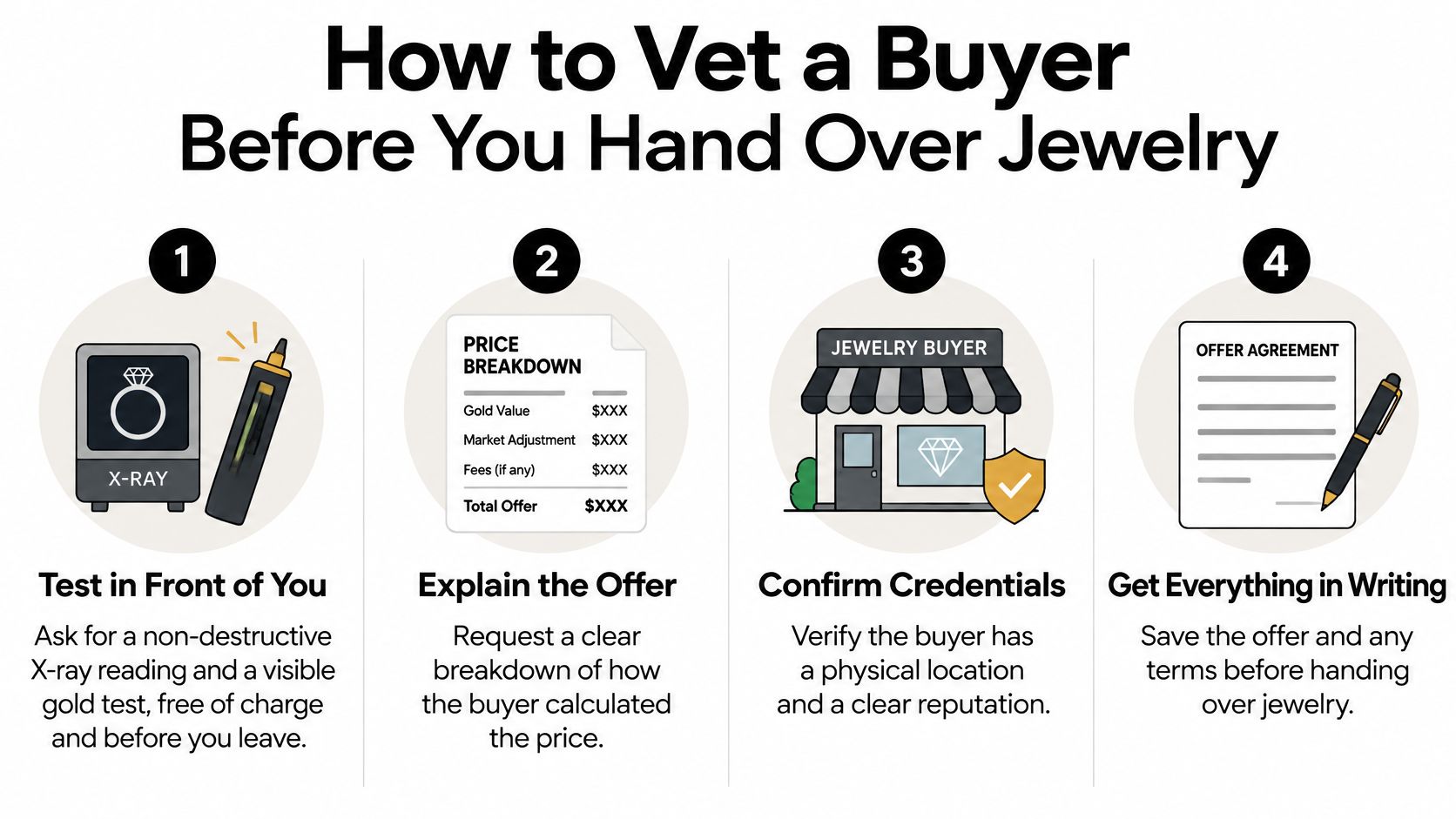
- Testing happens in front of you. Ask for a non-destructive X-ray reading and a visible gold test, free, with no obligation to sell. A buyer who disappears into a back room and returns with a figure is asking you to trust arithmetic you never saw. Reading up on how reputable gold buyers work before the appointment makes the questions easier to ask.
- The offer is written and itemized. Metal weight, karat, stones, and every deduction should appear on paper. A verbal number can't be compared against anything, including the next buyer's number.
- The method gets explained, and the piece is tested in more than one spot. Edges, clasps and the back of a brooch are where base metal and plating show up. One clean reading on the top face proves less than sellers assume.
- There's a stated price-matching policy. If a shop will match a competing written offer, you can shop the box without moving it twice. If there's no such policy, ask why.
- The karat mark has a trademark beside it. The FTC states that a gold karat mark identifies how much pure gold an item contains and recommends looking for the maker's registered trademark near that mark; where a gold item carries a karat mark but no accompanying trademark, consumers are advised not to buy it, per the FTC's guidance on buying platinum, gold and silver jewelry. The same guidance notes that "solid gold" means the item is not hollow.
- There's a clear hold or return policy. Families often need one night to talk. A buyer who won't hold an offer overnight is telling you something about how the number was built.
Four behaviors end the conversation for me: pressure to decide today, a refusal to weigh the piece in front of you, a cash offer with no receipt, and a business with no physical address. A good buyer looks like a workshop rather than a cubby. Clean counter, calibrated scale, loupe on the table, and an explanation before the first number.
How Buyers Test Gold and Gems Without Damage
A karat stamp is a claim, not a measurement. Everything a careful buyer does after reading the stamp exists to confirm or contradict it without harming the piece.
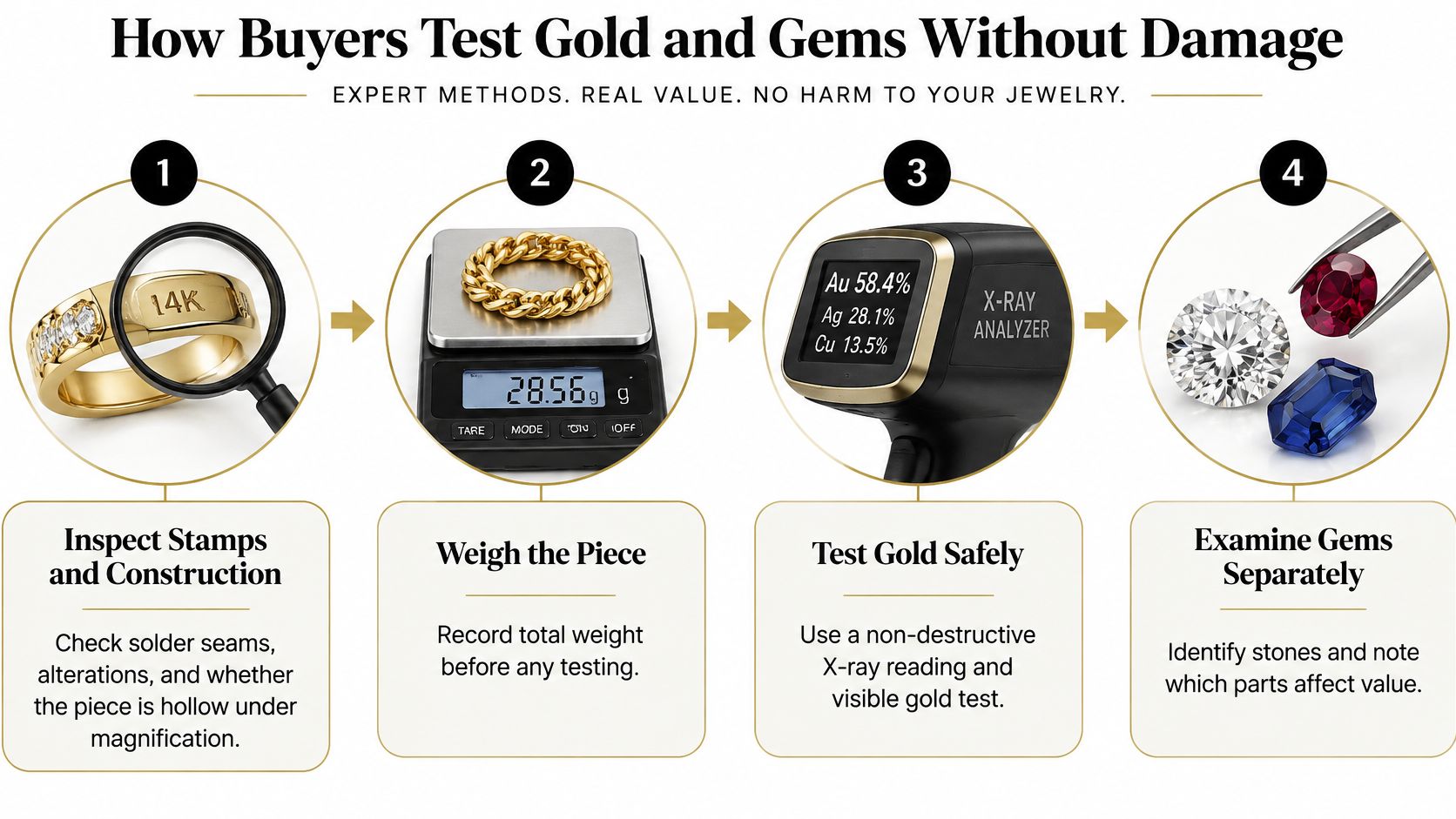
- Inspect stamps and construction under magnification. Look for solder seams, replaced settings, hallmarks that don't match the period, and whether the piece is hollow. A worn shank and a rebuilt shank look different under ten power.
- Weigh the piece and write the number down. Gross weight includes stones, solder and non-precious parts. It's a starting figure, never an offer.
- Run an X-ray fluorescence scan on a flat, clean area. The Gemological Institute of America explains that XRF measures characteristic secondary X-rays emitted by elements in a sample, and under suitable conditions, such as a flat homogeneous test piece calibrated to a comparable alloy, its reported gold-content accuracy can be within 15 parts per thousand, according to GIA's methods for determining gold content. Handheld units read gold, silver and platinum, and they help flag plating.
- Test several surfaces, because plating lies. GIA's lab notes describe a precisely gold-plated 10-karat alloy reading as 14-karat or 18-karat when the plating goes undetected, and note that thick plating and electroforming may not show up on XRF alone, per GIA's Summer 2025 lab notes on gold-plated gold. Edges, clasp tongues and the underside of a setting are where the truth usually sits.
- Order a confirmatory assay when the reading lands near a cutoff or the piece is high value. Assaying is slower and may be destructive, which is exactly why it belongs on the pieces where a small percentage swing moves real money.
- Identify the stones separately, then verify the paperwork. Natural, laboratory-created, treated or imitation changes the offer entirely. Record the report number and date, check any laser inscription against the stone in the tray, and call the issuing laboratory rather than trusting a photocopy.
Practical rule: never let a single spot reading settle a high-value piece. Scan the flat areas, then the edges, then ask the buyer what they do when the numbers disagree.
A handheld gold and silver tester gives you the same reading the buyer sees, which turns the offer from an announcement into a conversation. That is the whole point of a free X-ray scan: you can look at the number before anyone asks you to accept it.
| Test | What it reveals | Limit |
|---|---|---|
| Stamp and construction check | Karat mark, maker trademark, hollow or solid build | A stamp alone does not prove composition |
| XRF X-ray scan | Gold content in seconds without damage | Plating and uneven surfaces can distort the result |
| Multi-surface testing | Plating or base metal on edges, clasps and back | Takes more time than a single spot test |
| Confirmatory assay | Exact fineness for high-value pieces | Slower and more costly; may be destructive |
| Gemological lab report | Natural, lab-created, treated or simulated stones | Must be verified directly with the issuing lab |
Why Offers Differ From Appraisals and Resale Value
The same estate ring can carry three defensible numbers before lunch: replacement cost for insurance, wholesale value for a dealer, melt value for the metal. Only one of them is the cash figure on the counter.
Sellers get hurt when they compare an offer against the wrong column.
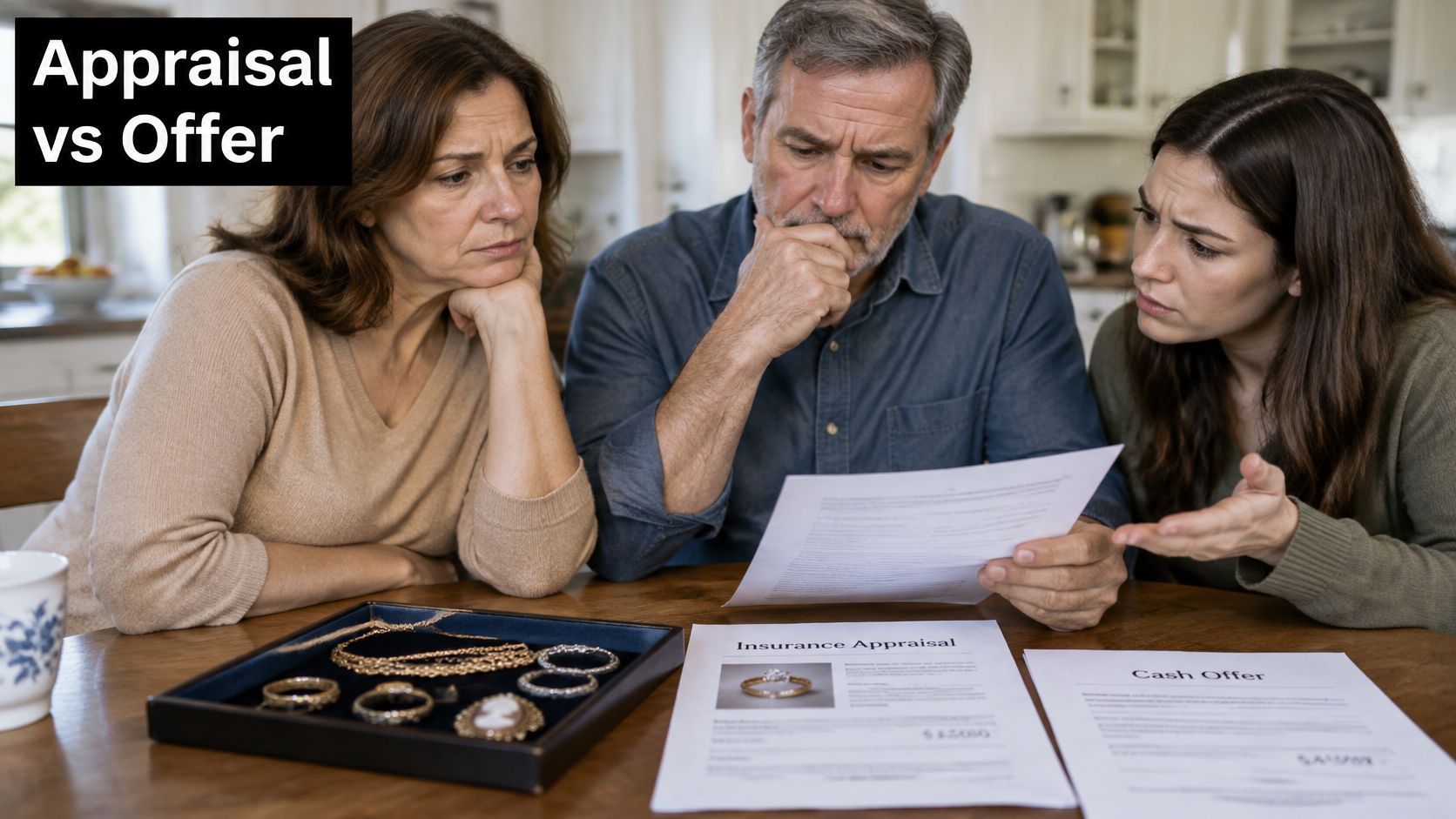
Five valuation terms get used in the same conversation, and they answer five different questions.
| Valuation term | What it measures | Use it to answer |
|---|---|---|
| Melt value | Metal content only, by weight and purity | What the raw metal is worth |
| Wholesale value | What a dealer pays to resell the piece | What a buyer could recover quickly |
| Retail replacement value | Cost to buy a comparable piece new | What insurance would need to replace it |
| Auction estimate | Pre-sale price range before commission | What a sale could bring, before fees and with no certainty |
| Expected resale price | What the buyer expects to earn after selling | Whether the offer leaves room for a margin |
Deductions explain most of the distance between those numbers. Testing costs money. Refurbishing costs money, whether that means rebuilding prongs, restringing pearls or recutting a chipped stone. The buyer carries a margin for risk, and the piece may sit in a case for months before the right customer walks in. None of that is hidden if you ask for it line by line.
Market averages do not price one item. Demand can concentrate in particular eras, brands and designs, a point behind Rapaport's analysis of jewelry from the past; an unsigned brooch still gets valued on its own metal, condition, workmanship, documentation and likely time to sell.
The same piece can lose a large share of value when the offer is built from melt while the paperwork supports resale, or when vague "handling" costs replace named deductions. I would treat that gap as a pricing problem, then ask which line items created it.
Ask before you sign: which valuation is this offer based on, and what deductions explain the difference between it and the last number I was quoted?
"Estate" and "vintage" describe age and ownership history. They do not multiply value by themselves. When two offers sit far apart, paying a fee for an independent jewelry appraisal is often cheaper than guessing which buyer was closer to the truth.
Dividing Inherited Jewelry Before Anything Is Sold
The argument usually starts before the sale, not after it. Someone mentions selling a ring at Thanksgiving, and a sibling who never heard about it feels ambushed. That is an information problem, and it has a paper solution.
The gap shows up in the research. Recent North American research found that 68% of affluent respondents plan to pass collections to heirs, yet 36% worry about whether their legacy will continue, while a separate 2025 U.S. survey found 59% intend to leave possessions to family and only about half have discussed final wishes with loved ones, according to Chubb's 2025 Wealth Survey.
- Photograph and describe every piece with its marks, dimensions and any known history. Do this before anything moves.
- Give relatives a claim window. Set a deadline for sentimental pieces and honor it before selling anything.
- Appraise the highest-value pieces independently and record the valuation date for probate and insurance files.
- Balance unequal values with cash, swaps or agreed shares, and write the agreement down while everyone is still speaking.
- Sell what remains through a buyer who gives an itemized, written offer.
Executors should also confirm legal authority to sell by reading the will or the court appointment, and note which heirs consented to each sale. Where an estate is being administered, understanding what assets subject to probate in Texas covers gives a useful comparison point for how personal property is handled and distributed.
The highest immediate offer isn't always the best outcome. For a piece with real family meaning, documenting its history and giving relatives a defined chance to claim it can preserve more value, financial and emotional, than treating it as anonymous scrap.
That is also where a redesign conversation earns its place. An inherited stone reset into something the next generation will wear keeps the value inside the family rather than converting it into cash at a discount. A heirloom jewelry redesign is often the cheapest way to keep a piece in use.
Negotiate a Fair Local Offer in Boise
Two buyers can examine the same estate ring on the same afternoon and hand you offers far apart, and the gap rarely comes from the gold itself. It comes from how the offer was built: which weight was used, which price benchmark was applied, and which deductions were taken before the number reached you. Learning to read that construction is what negotiation is.
Selling locally removes three costs at once: shipping, transit insurance, and the weeks spent waiting for a marketplace buyer to commit. It also keeps the piece in the room while it's being tested, so you can question each line of the offer instead of accepting or refusing a number that arrived by email.
The local market is readable. Carat 24's team in Boise provides prices and insights on gold, silver, jewelry and diamonds, so a seller can check a local figure against the current spot price of gold and silver before deciding anything.
Sort the box before you shop it. Everyday gold, branded or signed pieces, and sentimental pieces are three separate conversations with three different price logics. Photograph each item and note any karat mark and maker's trademark, because those two details drive the first question any buyer asks.
- Collect two or three written offers on the same day. Offers taken against the same metal price are the only fair comparison, and collecting them shows whether a low number reflects a bad offer or just a different method.
- Ask how the weight was calculated. A figure built from gross weight alone counts stones, solder, non-precious components and hollow construction as if they were gold. The FTC's jewelry guides for businesses and consumers set the precision expected in stated weights: a stated weight of 0.50 carat is generally expected to fall between 0.495 and 0.504 carat under the FTC's two-decimal convention.
- Ask which valuation the offer uses and what each deduction covers. Melt value, resale value and a flat percentage of spot produce three different numbers for the same piece, and a buyer who can't say which one applies is asking you to negotiate blind.
- Bring the strongest competing written offer back to the table. A buyer who knows a second figure exists has a reason to explain the gap between them, and that explanation is often more useful than the number itself.
- Walk away when the buyer won't itemize, or when the only explanation for a gap is urgency.
Carat 24, at 3780 W. State St., Boise, Idaho, buys gently used jewelry, gold and silver. Bring the sorted groups in for an itemized offer, compare it against one other written offer from the same day, and accept only when every weight, deduction and valuation term makes sense to you. Set the sentimental pieces aside for a family decision before any of this starts. I'd take a lower itemized offer over a higher unexplained one every time, because the itemized one can be checked and the unexplained one can't.
A good local offer is one you can explain to a relative, line by line, without guessing at any part of it.
If you're holding a box of inherited or unworn jewelry and want a straight answer before you commit, Carat 24 - Trusted Gold Experts buys gently used jewelry, gold and silver at 3780 W. State St. in Boise. Ask for an itemized written offer you can take home and think over. Visit Carat 24 - Trusted Gold Experts to plan your visit.
