

You open your late mother's jewelry box and find a brooch wrapped in tissue. You remember her wearing it, but you don't know whether the stones are valuable, whether the metal is gold, or whether that tiny stamp on the back means anything. Before you polish it, pin it to a coat, or accept an offer, you want a clear answer to a simple question: what do you have?
Good decisions about vintage jewelry for women start with separating what a piece means to you from what its construction, materials, and condition can prove. You don't need to become a collector. You need a careful sequence for examining the piece without damaging it or confusing family history with market value.
Why Vintage Jewelry Matters Beyond Fashion
That inherited brooch presents several equally reasonable choices. You might wear it, preserve it for someone in the family, or sell it to fund something you'll use more often. None of those choices requires you to dismiss its emotional importance.
Personal meaning, responsible ownership, and realistic exit value are separate questions. A modestly priced locket can deserve careful preservation because it holds a photograph. A valuable bracelet can still be uncomfortable enough that selling it makes sense.
The starting point is the piece itself, before cleaning or alteration.
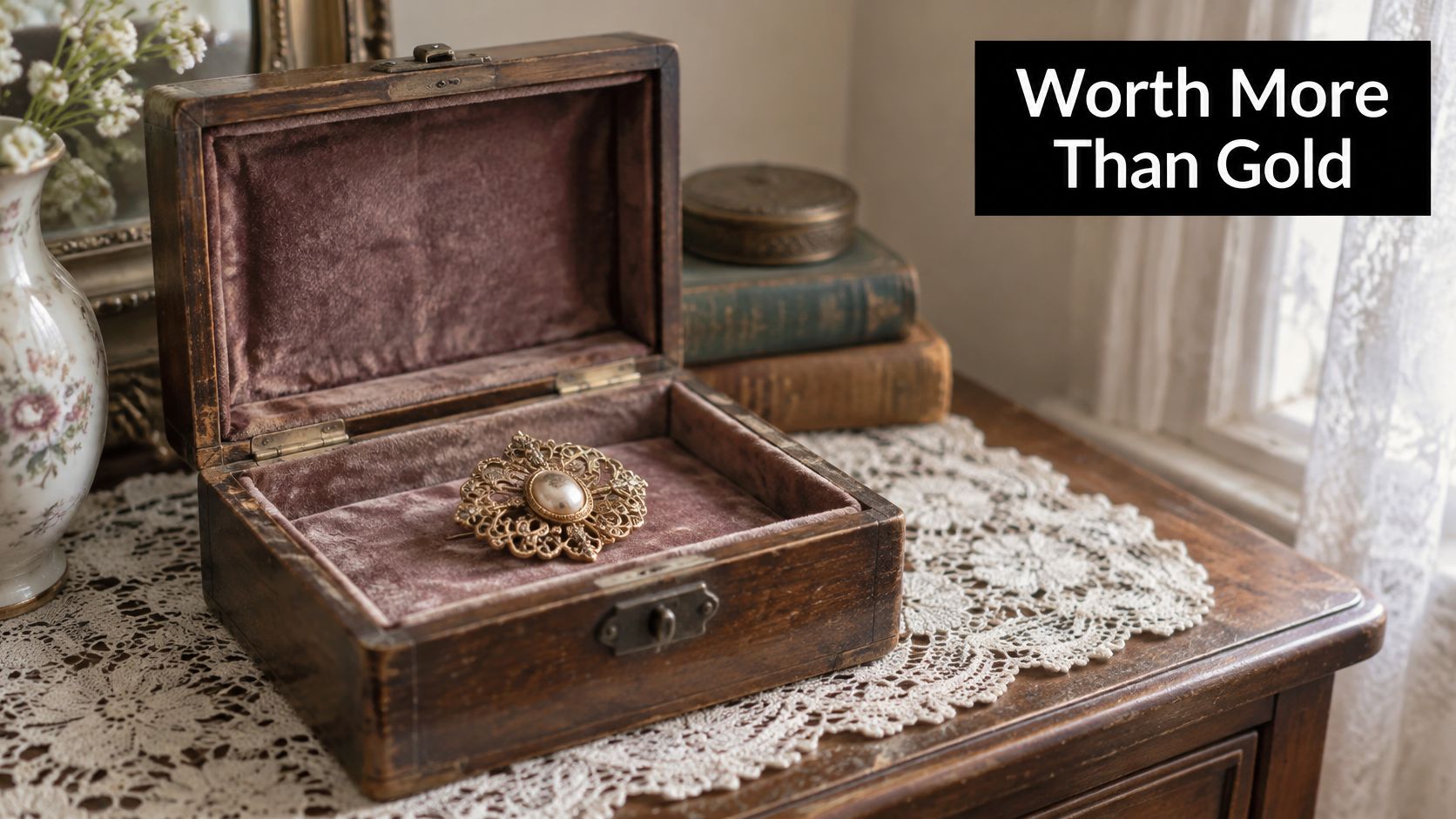
Understand the trade's vocabulary
In common trade usage, vintage generally means roughly twenty to one hundred years old, while antique means more than a century old. Estate jewelry means previously owned, so an estate ring needn't be old.
These descriptions answer different questions. Estate describes ownership history; vintage and antique describe age. None independently proves quality.
Think of jewelry like a well-kept family recipe card. Age adds character, but the quality of the ingredients still matters. With jewelry, those ingredients include metal, stones, craftsmanship, condition, and documented history.
Recognize the market without assuming a windfall
According to Rapaport's coverage of estate jewelry, worldwide retail sales of estate and antique jewelry were estimated at approximately $4.4 billion in 2023, about 1% of the broader jewelry market, with faster growth than the overall category and North America leading regional sales.
That establishes a real resale audience, not a guaranteed price for your brooch. Retail market totals aren't individual purchase offers, and a dealer must still assess the specific piece.
- For an inherited piece, preserve its history alongside the object.
- For a purchase, compare construction and condition rather than relying on an appealing era label.
- For a collection, JewelryBuyDirect's tips for buying vintage jewelry wholesale offer useful context for comparing grouped purchases rather than judging everything by appearance.
A sound decision leaves you able to name a likely era, interpret the marks, verify the metal, arrange appropriate care, and choose whether to wear, keep, or sell.
Vintage Jewelry Styles and Eras to Recognize
| Era | Dates | Defining look | Signature materials | Typical pieces |
|---|---|---|---|---|
| Victorian | 1837–1901 | Sentimental, ornate, naturalistic motifs | Gold, seed pearls, garnets, hair work | Lockets, mourning brooches |
| Edwardian | 1901–1915 | Light, lacy, garland-inspired designs | Platinum, diamonds, pearls | Bar pins, delicate rings |
| Art Deco | 1920s–early 1930s | Geometric symmetry, strong contrast | Platinum, onyx, sapphires, diamonds | Bracelets, clips, cocktail rings |
| Art Moderne | Late 1930s–1940s | Bold geometry, large gemstones | Yellow gold, large colored stones | Statement brooches, cuffs |
| Bold mid-century | 1930s–1950s | Dramatic, large-scale statement pieces | Gold, rhinestones, cultured pearls | Cocktail rings, collar necklaces, brooches |
| Mod and enamel | 1960s–1970s | Bright enamel, chunky forms | Gold-tone metals, enamel, acrylic | Chunky necklaces, enamel pendants |
Design is a first clue, not a date certificate. Use these categories to describe what you see before deciding when the piece was made.
The checklist below provides prompts for looking beyond the front of a piece.
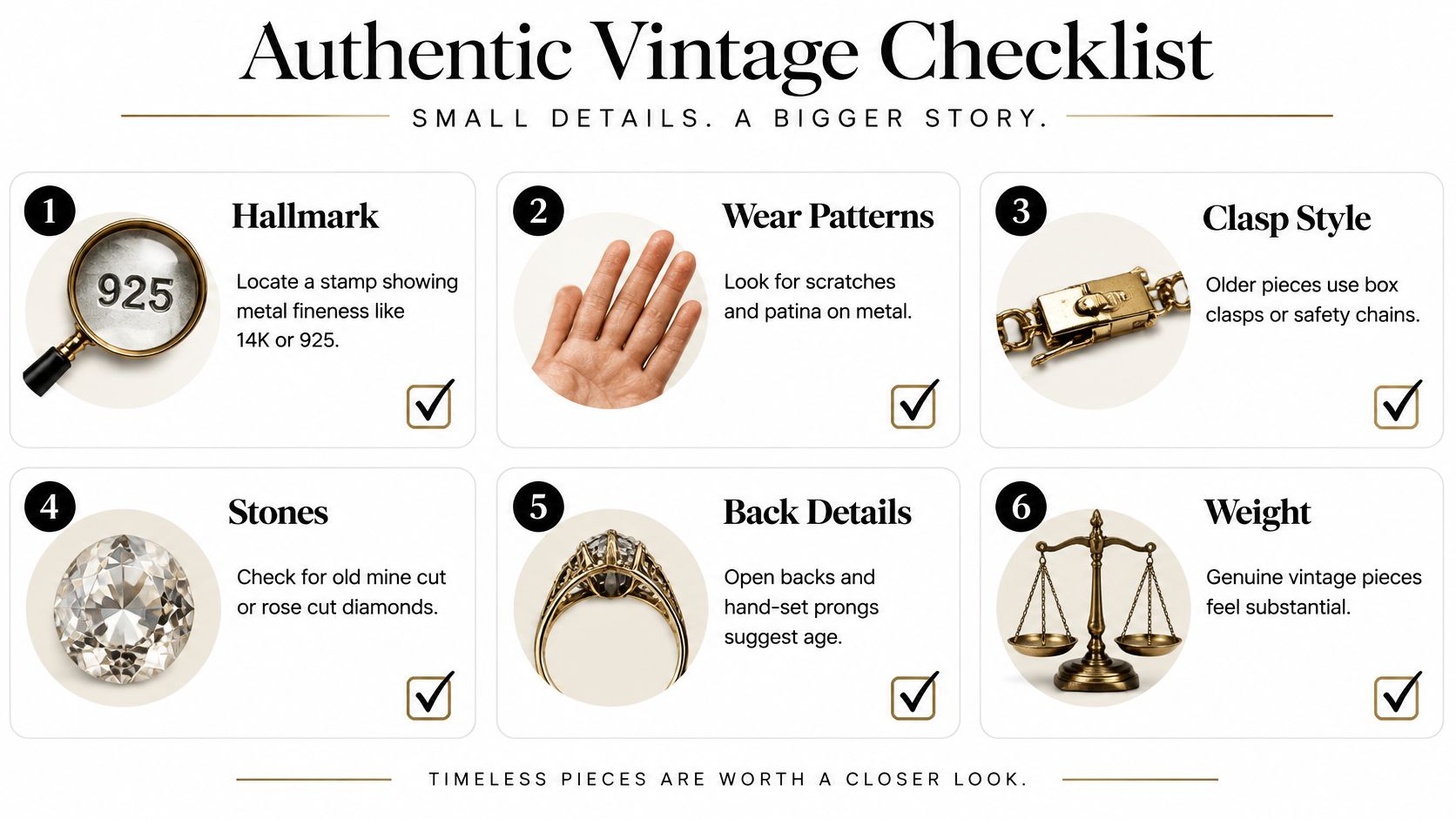
Treat visual clues as questions rather than verdicts. Weight, wear, stone cuts, and clasp types can all be reproduced or changed, and delicate original jewelry may be surprisingly light.
From sentimental detail to geometric contrast
Victorian jewelry often asks you to look closely. A locket, flower motif, or woven-hair compartment may carry a private message rather than make a large visual statement. Don't remove an unfamiliar insert before identifying it.
Edwardian pieces tend toward a more airy effect. Where a Victorian brooch may look richly worked and enclosed, an Edwardian-style ring often resembles lace in metal. The pierced construction discussed in our guide to antique filigree rings helps distinguish decorative openness from missing or damaged metal.
Art Deco replaces flowing ornament with organized geometry. The Magazine Antiques' account of jewelry's democratization describes the geometric symmetry of the 1920s and early 1930s, the bold Art Moderne jewelry of the late 1930s and early 1940s, and dramatic 1930s–1950s pieces associated with collectors including Joan Crawford.
A dark onyx panel beside bright diamonds suggests a different design intention from a soft garland of pearls. That contrast is useful even before anyone identifies the stones.
From sculptural gold to playful color
Art Moderne jewelry usually has a fuller, more sculptural presence than the flatter, orderly look associated with Art Deco. Look for broad curves, generous mountings, and a prominent central stone.
Bold mid-century jewelry overlaps with that period rather than following it in a perfectly tidy sequence. A collar necklace or dramatic brooch may emphasize scale and theatrical effect, whether its materials are precious or costume.
Mod and enamel pieces shift attention toward color and simplified shapes. A chunky acrylic necklace shouldn't be dismissed because it lacks precious metal; its appeal belongs to a different collecting category.
A modern jewelled brooch for Scottish wedding attire from Kilts4Less illustrates why ornamental form and ceremonial use don't establish age. A newly made accessory can use a historically familiar motif.
For a moving-image companion to examining jewelry, the video below offers another viewing format.
A style period identifies when a design was fashionable, not necessarily when your example was manufactured. Later reproductions can borrow from every era in the table.
How to Tell Authentic Vintage Pieces
A hallmark works a little like a passport stamp. It matters, but you still need the photograph, name, and other details to agree. A mark that looks convincing in isolation doesn't authenticate an entire piece.
The Hallmark Society's guide to dating antique jewelry explains that a hallmark concerns metal fineness, not automatic proof of age, maker, workmanship, or value; it also notes that the United States historically lacked a centralized assay-office system, so many American marks represent the maker's claim.
Build a chain of evidence
Use a jeweler's loupe, a bright desk light, and your phone camera. Work over a soft cloth so a dropped piece doesn't strike a hard surface.
- Record the mark exactly. Photograph its lettering, position, outline, and nearby symbols. Don't rewrite an unclear character into the number you expect to see.
- Compare it with the construction. Examine the clasp, hinge, solder joints, stone settings, and gemstone cuts. You're looking for agreement between the marked component and the rest of the object.
- Investigate mismatches. A modern-looking stamp on a hand-fabricated mounting may indicate a replacement part or later alteration. It's a reason to ask more questions, not immediately declare a fake.
- Look for supporting identifiers. Maker's marks, patent references, and design details can help narrow an attribution. A brand-like symbol needs comparison with a reliable reference, not a resemblance found in an online listing.
- Allow for missing marks. Resizing, polishing, and wear can remove them, and hallmarking wasn't universal. An unmarked ring deserves examination rather than automatic rejection.
- Describe separate components separately. An inherited ring might combine an older mounting, a replacement stone, and a later shank. Authenticity isn't always an all-or-nothing judgment.
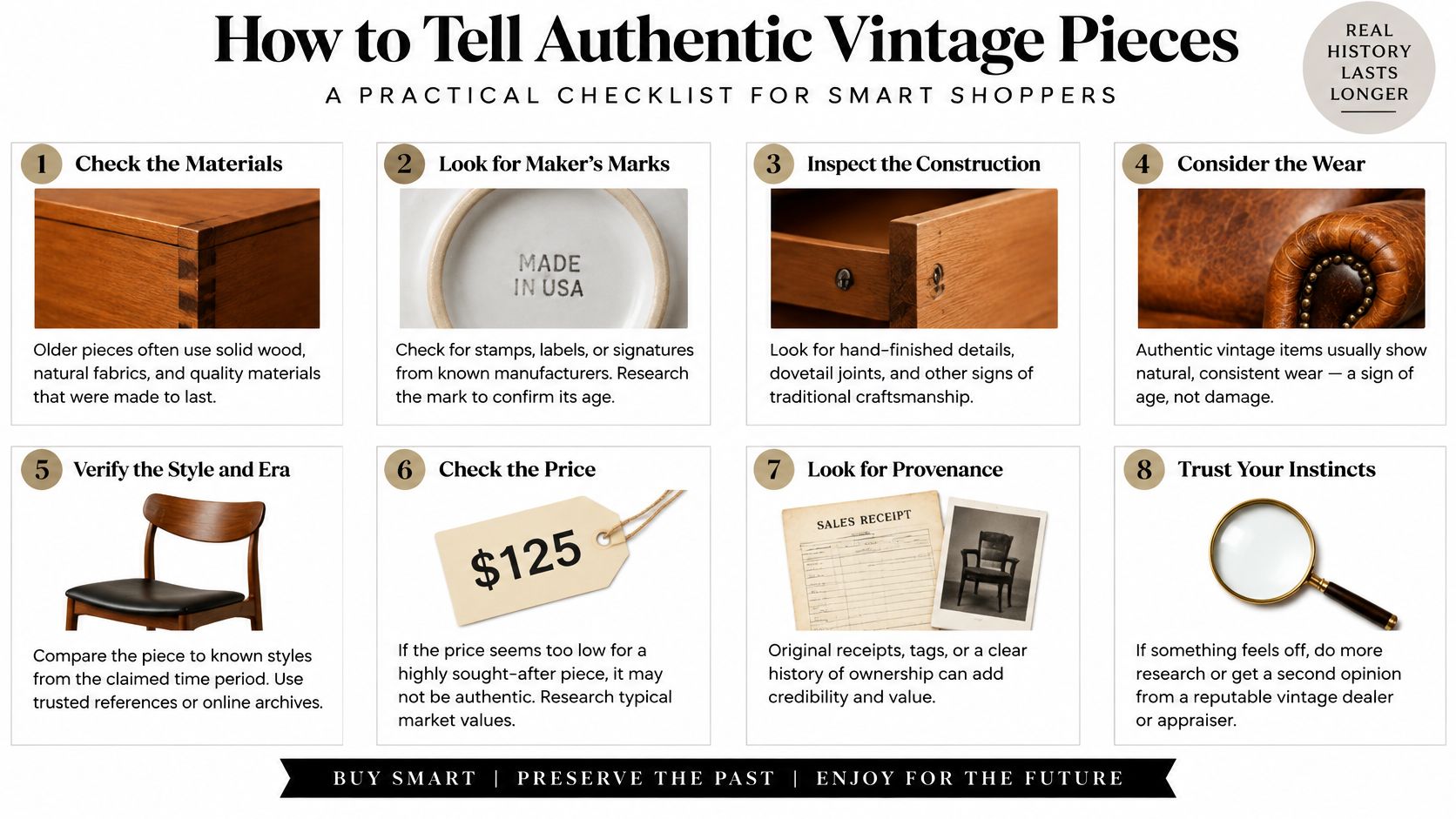
Keep the following visual checklist beside your notes, but let the physical evidence determine the conclusion.
Separate the metal description from the age claim
Solid gold describes gold alloy throughout the relevant component. It doesn't mean pure gold, and it doesn't mean the item can't be hollow.
Gold-filled jewelry has a bonded gold layer over a base metal. Gold-plated jewelry has a surface coating. Both can look convincing from the front, especially where wear is limited.
Examine high-contact areas such as chain links, clasp edges, and the backs of pendants. A different-colored metal showing through can suggest a layered construction, but color alone isn't a complete identification. Our guide to telling real gold from fake gives additional context for separating visual clues from reliable conclusions.
Practical rule: A loupe can reveal a problem or support an attribution. It can't independently establish the composition of metal hidden beneath the surface.
Independent testing becomes useful when the stamp is unclear, the construction appears inconsistent, or meaningful money depends on the result. Gemstone identification may require separate examination, too. A metal test doesn't establish whether a stone is natural, treated, or original to its setting.
Write observations as observations: a yellow-metal brooch with an indistinct mark is a more honest starting description than an antique gold brooch whose age and composition haven't been established.
Gold Testing Methods and What the Results Mean
| Method | Accuracy | Non-destructive | Typical time | Best use |
|---|---|---|---|---|
| XRF, energy-dispersive | Instrument-based estimate affected by surface and calibration | Yes | Rapid instrument reading | Fast screening of gold alloys; investigate plating separately |
| Fire assay | High-precision reference analysis | No, the submitted sample is consumed | Laboratory processing rather than an immediate counter result | High-value reference testing of a representative sample |
| Acid testing | Comparative karat screening, not a precise percentage assay | No, sampling can leave a small scratch | Minutes | Quick check; less reliable on plated or layered items |
A gold test is an evaluation, not an unquestionable number. The best method depends on what you need to establish and whether sampling would compromise the jewelry.
What XRF can tell you
X-ray fluorescence, usually shortened to XRF, identifies elements by measuring their response to X-ray excitation. In plain language, the instrument reads the composition near the tested surface without requiring the operator to cut or melt the piece.
Thermo Fisher's comparison of XRF and chemical assay describes readings in roughly 5–30 seconds and typical jewelry accuracy around 0.2%–0.5% compared with assay under ordinary conditions, while identifying surface and sample limitations.
That makes XRF useful for checking an apparent gold alloy and identifying other alloying elements. It doesn't make every reading representative of every part of a bracelet.
Plating, chemical surface treatments, dirt, curved surfaces, and uneven composition can interfere. A replacement clasp may also have a different composition from the chain attached to it. The operator's choice of test location therefore matters.
When another method is appropriate
Fire assay consumes the submitted sample. That can make sense for a representative sample from a bulk settlement, but it's a very different proposition for a brooch you want to preserve intact. Testing a detached sample also requires confidence that it represents the material being valued.
Acid testing compares a sample's reaction with testing solutions. A jeweler commonly rubs metal onto a touchstone, although exposing material beneath a coating may require a more intrusive scratch. Don't experiment with household acids on an heirloom.
Use these questions before authorizing testing:
- Coverage: Does the result describe the tested spot, a component, or a representative sample of the whole item?
- Construction: Could plating, hollow sections, solder, or mixed components require additional examination?
- Consent: Will the proposed method leave a mark, remove material, or change the piece?
Our explanation of how to test gold purity can help you prepare those questions before an appointment.
If a result conflicts with the hallmark, don't immediately choose whichever answer produces the higher value. Have the operator repeat the measurement at appropriate locations, check the instrument setup, and consider a second method before deciding. A disagreement is a reason to investigate, not a valuation conclusion.
Caring for Vintage Pieces Without Damage
One damaging habit is cleaning an older piece exactly as you'd clean modern everyday jewelry. A bright surface doesn't tell you whether the setting beneath it is secure.
| Item | Safe routine | Avoid |
|---|---|---|
| Solid gold with stable stones | Soft brush, lukewarm water, mild dish soap, pat dry, once stone compatibility is confirmed | Harsh chemicals, abrasive polish |
| Old prong or bezel settings | Gentle wipe only; inspect prong tips under a loupe | Ultrasonic or steam cleaning without expert confirmation |
| Pearls, opals and porous stones | Lightly damp cloth; store flat in a soft pouch | Ultrasonic, steam, chemicals, long soaks |
| Plated or gold-filled costume | Dry soft cloth after wear | Polishing that can wear through the surface gold layer |
The word stable matters. If you don't know the stone, treatment, adhesive, or repair history, start with a dry, soft cloth and arrange an examination before wet cleaning.
Inspect before you clean
Prongs grip a stone at individual points, while a bezel surrounds its edge. The Antique Jewellers guide to remodeling a family ring explains why worn settings, repair heat, and the choice between restoration and remodeling require care, including professional confirmation before ultrasonic or steam cleaning.
Follow a preservation-first routine:
- Examine the holding points. Look at prong tips, bezel edges, the gallery beneath the stone, and clasps under magnification. Stop wearing a piece if a stone moves or a catch won't close reliably.
- Document its current condition. Photograph the front, back, marks, and damaged areas before work begins. Save the written repair description with those images.
- Discuss heat before structural work. A specialist should determine whether heat-sensitive stones can be removed before soldering. If removal isn't practical, the repair requires suitable protective procedures.
- Approve a defined scope. Distinguish tightening a setting from replacing it, and cleaning from polishing away metal. Don't assume those operations are interchangeable.
Preserve detail rather than chasing newness
Minimum intervention means doing what's necessary for safety and preservation without unnecessary alteration. A sympathetic repair can retain engraving, surface character, and recognizable construction that aggressive remodeling might erase.
Ask what will be removed, replaced, or permanently changed before approving a restoration.
That doesn't mean every old repair must remain untouched. It means the decision should be deliberate and documented, especially when family history or collector interest matters.
Store pieces separately in soft pouches or lined compartments, with chains laid so they won't knot around fragile pendants. Keep brooch pins closed and avoid placing heavy bracelets on top of filigree. Our guide to storing gold jewelry offers practical ways to organize pieces without creating new wear.
Styling Vintage Jewelry for Everyday Wear
A vintage brooch pinned to a plain black wool coat can change the whole outfit. The coat provides a quiet background; the brooch supplies texture, color, and a personal connection. You don't need matching earrings or a period costume to make it work.
Start by choosing the piece you want to notice first. If that's a dramatic necklace, let your earrings stay discreet. If it's a small locket, give it enough open space that it doesn't disappear among competing chains.
Let the outfit support the jewelry
- Choose an anchor. Wear a mid-century statement necklace over a plain crew-neck knit. The simple neckline keeps its shape visible.
- Balance the era. Geometric Art Deco earrings work with a sleek bob or an updo for evening, without requiring a historically styled dress.
- Match the scale. A small Victorian locket on a fine chain suits daily wear, while a substantial brooch needs fabric that can support its weight.
A lapel is usually an easier place for a brooch than a delicate blouse. On a scarf or cardigan, test the fabric's strength and make sure the pin won't pull, sag, or snag.
An uneven neckline can make jewelry placement less obvious. Cashmere Boutique's asymmetrical sweater tips for every body type offer useful clothing context when deciding whether a pendant complements the neckline or competes with it.
Make comfort part of the decision
For women in later life, a beautiful clasp that's difficult to operate may turn an otherwise wearable piece into something that stays in a drawer. Favor secure, manageable catches, comfortable earring backs, and weight you can tolerate without strain.
Try a new-to-you piece for a short outing before committing to a full day. Check for pulling at the neckline, pressure behind the ears, and skin irritation where an alloy or worn plated surface touches you.
Wearability test: If you keep adjusting a piece, it needs a different placement, a suitable repair, or a different occasion.
Build a small rotation of comfortable favorites and reserve more delicate or demanding pieces for occasions. Jewelry can remain part of everyday life without requiring every heirloom to serve as an everyday accessory.
Gold and Jewelry Buying in Boise Without Surprises
A sound buying or selling decision balances personal meaning, responsible ownership, and realistic exit value. You might keep a ring because you love it, buy a wearable replacement for a fragile heirloom, or sell jewelry that no longer fits your life. The financial assessment should support that choice rather than dictate it.
Interest in older jewelry doesn't remove the need for discipline. Rapaport's discussion of jewelry from the past reports that 47% of luxury consumers consider resale value when making new luxury purchases and that searches for vintage engagement rings rose 198% in 2025.
Those findings describe consumer interest rather than guaranteed appreciation. A fashionable decade can attract attention while an individual piece remains difficult to resell because of condition, an ambitious asking price, or a narrow audience.
Identify what kind of value you're evaluating
Different categories need different questions. Don't evaluate a signed bracelet, an unsigned gold chain, and a rhinestone brooch as though buyers want the same thing from each.
| Category | Durability and repairability questions | Documentation priorities | Likely resale audience |
|---|---|---|---|
| Signed designer jewelry | Will repair preserve the maker's construction and finish? | Signature, provenance, original paperwork, alteration history | Brand-focused buyers and collectors |
| High-karat gold | Is the construction suitable for the intended wear? | Verified composition, weight, component details | Precious-metal buyers and jewelry buyers |
| Antique diamonds | Are stone edges and settings secure? | Stone identification, condition, available grading documentation | Buyers seeking older cuts and period character |
| Costume jewelry | Are plating, enamel, glue, and replacement parts sound? | Maker attribution, originality, condition photographs | Costume-jewelry collectors and style-led buyers |
| Period-specific pieces | Can damage be repaired without losing defining details? | Evidence supporting date, construction, and restoration history | Buyers interested in a particular era |
A signature doesn't remove the need to inspect condition. Likewise, a lack of precious metal doesn't mean a costume piece should automatically be treated as scrap.
Separate material value from collectible value. Weight and verified purity matter greatly to a metal-based offer. Design, maker, originality, and buyer demand can matter more when a piece is being purchased for resale intact.
Build a buying decision around evidence
Start with documentation. Request a written description that distinguishes confirmed facts from an attribution or estimate, and retain photographs of marks and condition.
Next, check what has changed. Replacement stones, rebuilt settings, shortened chains, or converted brooches may affect desirability. A conversion might improve wearability while making the piece less attractive to a collector seeking original construction.
Then ask whether the claimed rarity is meaningful. Something can be old and still be common, or unusual because it has been altered rather than because few examples were made.
Finally, compare the asking price with the right alternatives. A precious-metal item needs a weight-and-purity assessment, but a collectible should also be compared with similar pieces. A seller's advertised price doesn't prove that another buyer paid it.
Our guide to buying gold and diamonds provides additional context for distinguishing the material assessment from the finished-jewelry purchase.
Confirm the testing terms before accepting a number
For an in-person evaluation, establish which components will be examined and how the findings will be recorded. A hollow bangle, layered item, or unusually shaped mounting may need a different approach from a plain ring.
Evident's technical guidance on gold testing explains that instrument calibration, measurement conditions, geometry, and surface condition affect XRF results, while fire assay can reach approximately 0.02% accuracy as a reference method for high-value bulk settlements.
Precision alone doesn't determine the right choice for an heirloom. You also need an appropriate sampling plan and clear consent for any invasive procedure.
Keep valuation purposes distinct, too. An insurance replacement assessment concerns replacing an item, while a purchase offer concerns what a buyer will pay under current conditions. A large difference between those figures isn't, by itself, evidence of dishonesty.
Compare local offers on net proceeds and clear terms
At Carat 24, 3780 W. State St., Boise, Idaho, the local team buys gently used jewelry and provides prices and insights on gold, silver, jewelry, and diamonds. An individual offer still depends on what the piece's materials, condition, and resale potential support, so treat any single figure as one data point among several.
Bring competing written terms when comparing offers. Check that each buyer assessed the same item, used the same verified composition, and explained whether the offer treats the jewelry as an intact piece or primarily as metal.
Selling locally can spare you the shipping, insurance, handling, and return costs that reduce what a remote offer pays. Compare the amount you'll receive after those costs on either side, and consider whether you're comfortable releasing an heirloom before its final evaluation.
For repair customers, our in-store drop-off and pickup are available for added security. If you choose shipping for repair, tracked and insured shipping is required, and we're not responsible for jewelry lost or damaged during shipping. Don't confuse insurance arrangements with a guarantee that the business assumes transit risk.
Before leaving home, follow a straightforward sequence:
- Gather documents and photographs. Include receipts, previous appraisals, stone reports, repair records, and family information, clearly distinguishing documented history from recollection.
- Have the piece evaluated in person. Ask which checks will be performed, and keep your questions focused on composition, component differences, condition, and the basis of the evaluation.
- Compare the written offer with your own assessment. Consider verified weight and purity alongside era, maker, originality, and whether you'd regret parting with the piece.
You're allowed to pause. A transparent evaluation should leave you understanding both what the jewelry is and why an offer takes the form it does.
Bring your inherited brooch, vintage ring, or unworn jewelry to Carat 24 - Trusted Gold Experts at 3780 W. State St. in Boise. We'll help you understand the evaluation and the options in front of you so you can make a considered decision about keeping, repairing, or selling your piece.
