
You open the jewelry box after a funeral, a move, or a long-overdue closet clean, and a gold locket is sitting on the chains. It may still hold a photograph, a braid of hair, or only a faint date inside the lid. You want a straight answer: is it solid gold, what does the stamp mean, and would selling it throw away something the family should keep?
Those are three different questions. A karat stamp doesn't prove the piece is solid, authentic, or still sound at the hinge. Sentimental value and melt value are separate numbers. Mixing them up is how families either underprice an heirloom or turn down a fair offer on a worn plated piece.
This guide covers how a gold locket is built, how karats and marks work, what you can check at home, how to separate family value from gold value, how to care for the piece, and how a local sale in Boise runs.
Solid, Plated and Filled Gold Lockets Compared
Every price and care question starts with how the gold locket was made. Think of four branches on one family tree: solid gold, gold-filled, gold-plated, and vermeil. They can look alike in a box. They don't hold the same gold, and they don't wear the same way.
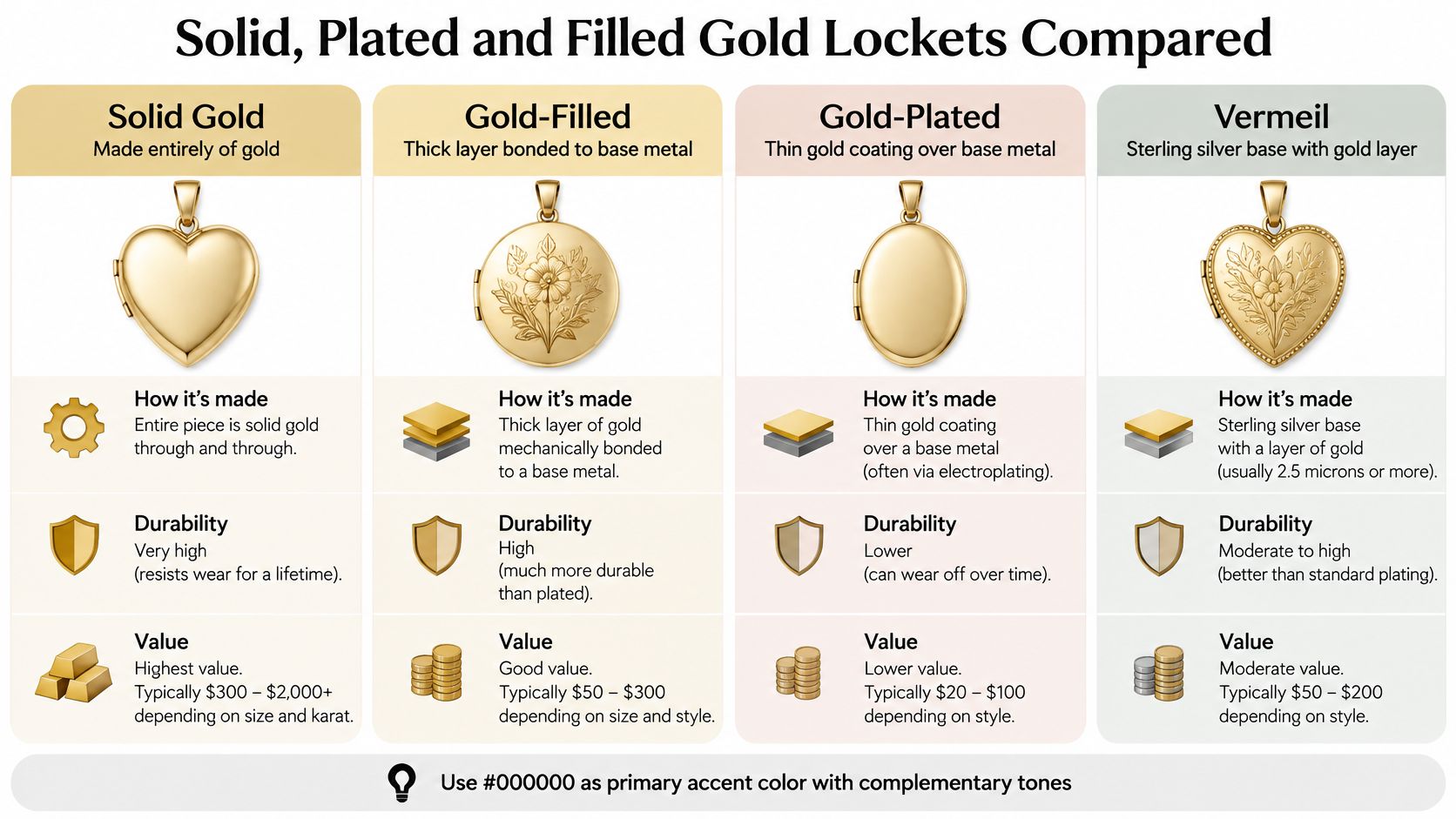
| Type | How It Is Made | Gold Content | Wear and Resale Value |
|---|---|---|---|
| Solid gold | Gold alloy throughout the entire piece | Stamped 10K to 24K; 14K holds 58.3% gold | Keeps color through wear; resale tracks gold weight and karat |
| Gold-filled | Thick gold layer bonded to a base metal | Gold layer at least 5% of total weight (US standard) | Layer can wear through over years; resale sits below solid gold of the same weight |
| Gold-plated | Thin electroplated gold layer over base metal | Gold layer only microns thick | Rubs off within months to a few years; resale is low |
| Vermeil | Sterling silver base with a gold layer | Gold of at least 10K, about 2.5 microns thick or more | Gold layer wears and silver tarnishes; resale is low to moderate |
Solid gold is gold alloy all the way through. Scratch a 14K locket and the color stays gold, because there's no base metal waiting underneath. Gold-filled bonds a much thicker gold layer to a cheaper core. Under the US standard that layer has to be at least 5% of the piece's total weight, which is why it outlasts plating by years of ordinary wear. The difference between gold-filled and solid gold is mostly that bonded layer versus gold through the whole shell.
Gold-plated is a different object. Electroplating leaves a film only microns thick. Daily contact with skin, collars, and a chain can rub that film off within months. Vermeil starts with sterling silver and adds a gold layer of at least 10K, about 2.5 microns or thicker. Once that layer wears, the silver base tarnishes, and the resale sits in a low to moderate range rather than tracking bullion.
Why the old examples still matter
Lockets aren't a Victorian invention. The Metropolitan Museum of Art records a probably French gold-and-enamel locket dated approximately 1620–1640, about 1 9/16 inches (4 centimeters) high, with rock crystal over the keepsake. That places a documented gold locket more than 380 years in the past. Crystal let the owner see a portrait, relic, or lock of hair while the cover protected it. Age, enamel, crystal, and provenance can move the price far past melt.
Practical rule: Check the hinge edge and any bright worn spot, then match what you see to one row of the table before you talk price.
Karats and Hallmarks Decoded
For a gold locket worn most days, 14K is the practical benchmark. It holds real gold and still stands up to a hinge, a bail, and a clasp that move every time you open the piece.
Karat is a share of gold, not a quality grade in the school sense. 24K is pure and generally too soft for most jewelry. Alloy metals such as copper, silver, zinc, nickel, or palladium add hardness. A 14K locket contains approximately 58.3% gold by weight. 18K contains 75.0% gold, with richer color and more intrinsic gold, and it's comparatively softer. Those figures come from the MJSA jewelry metals charts. A genuine 14K or 18K mark names the nominal alloy. It doesn't prove a thin hinge, solder joint, or clasp is still structurally sound.
| Karat | Gold by Weight | Gold in a 10-Gram Piece | Durability and Best Use |
|---|---|---|---|
| 10K | 41.7% | 4.17 g | Hardest and most durable; practical for rugged everyday wear |
| 14K | 58.3% | 5.83 g | Balanced hardness and gold content; the practical benchmark for lockets |
| 18K | 75.0% | 7.50 g | Richer color and more gold, but softer; better for heirlooms worn less often |
| 22K | 91.7% | 9.17 g | Soft and prone to denting; uncommon in lockets |
| 24K | 100% | 10.00 g | Too soft for most jewelry; rare in lockets |
Higher karat means more gold and a warmer color. It also means a softer shell. Hinges, bails, and clasps on an 18K or 22K locket dent and stretch sooner than the same parts in 14K. Save 18K for an heirloom you wear on quieter days. Use 14K when the locket rides a chain every week.
What the stamp can and can't prove
A stamp that only says "14K" or "18K" is not enough. The Federal Trade Commission advises buyers to look for a karat mark together with the responsible company's registered trademark. A karat mark without that trademark is a warning sign. UK-style hallmarks go further: an assay office tests the metal against a stated purity and strikes its own marks. A maker's stamp in a small American locket is not the same evidence.
Vintage marks hide. Look inside the bail, on the clasp, and on the back plate, not only on the front. A worn or partial stamp still deserves a photo. It just doesn't settle the alloy by itself.
Before you decide what the piece is, read four things:
- Karat number: 10K, 14K, 18K, or another fraction of 24.
- Maker or trademark: letters or a symbol next to the karat, not the karat alone.
- Construction words: "GF," "gold filled," "GP," "plated," or "vermeil" change the whole table row.
- Stress points: a sound mark with a cracked hinge is still a repair, not a clean resale.
How to Authenticate a Gold Locket Step by Step
Home checks build a record. They don't prove what the metal is. Photograph the piece before you clean it, bend anything, or pop the photo out.
The sequence
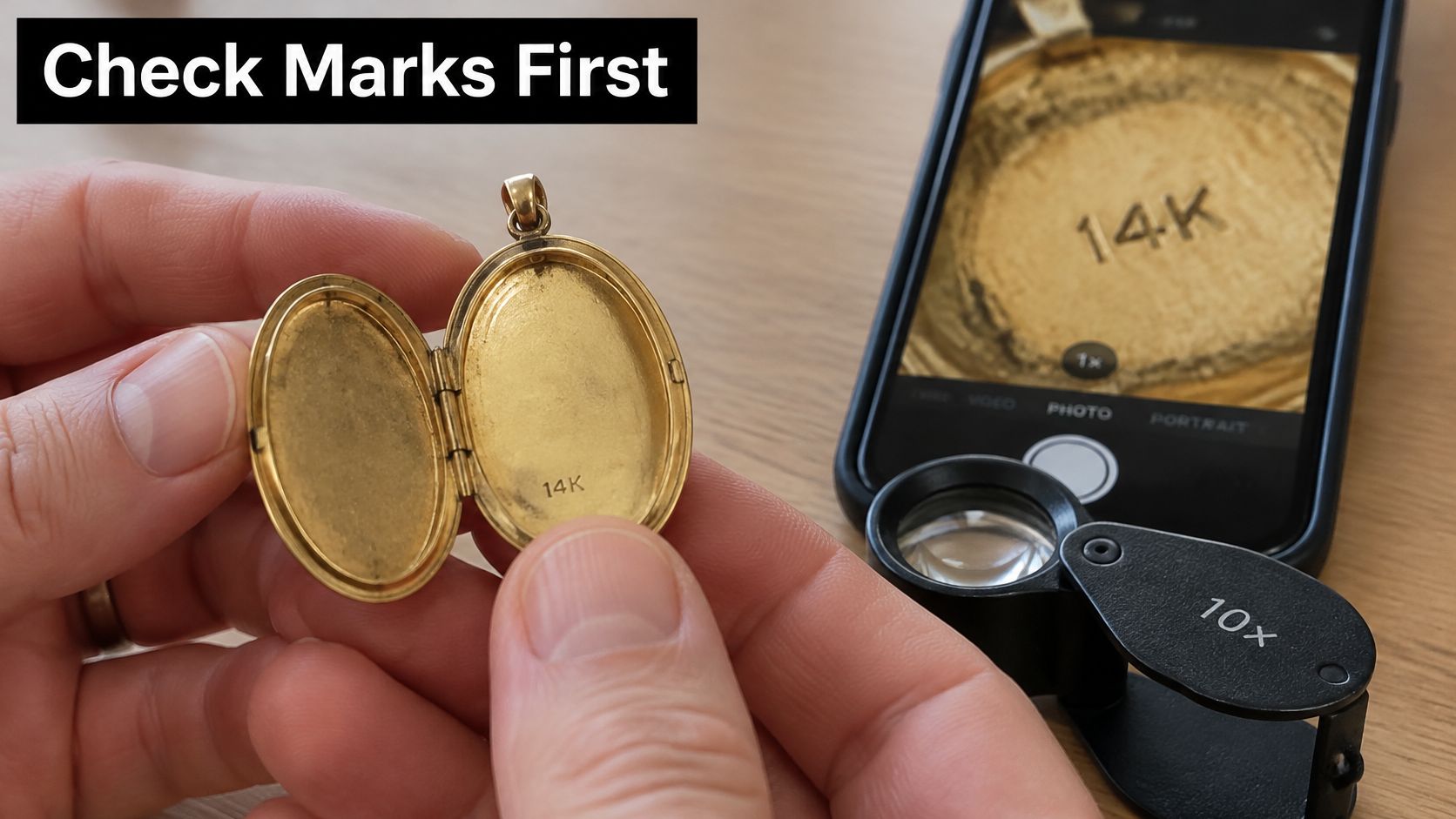
- Photograph every mark. Use a loupe or a phone macro lens, with the stamp filling the frame. You want a record before further handling rubs a weak impression flatter.
- Pair the karat mark with a trademark. A number by itself is a warning sign, because counterfeit stamps are easy to strike into soft metal.
- Inspect the hinge, bail, and clasp. Thinning, cracks, or lumpy solder can mean a heavy old repair or a poorly made copy. Those spots carry the weight of the lid and the chain.
- Read the worn edges. Brass or copper showing through points to plating or a base-metal core. Solid alloy stays the same color in the scratch.
- Match stamp and wear to the karat grades. A piece stamped 22K that looks battered at every corner fits a soft alloy. A "24K" locket with a snappy steel-like clasp does not.
- Book an X-ray scan. The Gemological Institute of America reports that handheld X-ray fluorescence instruments are built for gold, silver, and platinum in offices or in the field, and that quantitative XRF is widely used to verify content and detect plating. It reads characteristic X-rays from the tested surface, so plating, coatings, or filled construction can still need more tests.
- Ask for a formal lab test when marks conflict. Missing, altered, or contradictory marks are past what a screening visit should settle.
Magnification and photographs document marks. They can't prove alloy composition. A free screening is a screening result, not a formal certificate. If you want a plain walk-through of purity checks before you book anything, read how to test gold purity.
A short video on reading small jewelry marks is worth watching once, then going back to your own photos with the loupe.
Bring the photos, not just the locket. A tester who never sees the worn edge can miss a filled back that the beam didn't hit.
Valuing and Passing Down a Sentimental Locket
Price a gold locket twice, on purpose. One number is gold you could recover. The other is what a collector, insurer, or relative would pay to keep the object whole.
Melt arithmetic
Record gross weight in grams, the karat mark, and the dimensions. Note whether glass, enamel, stones, photo inserts, or steel mechanisms are inside that weight. They add grams and add no gold. Jewelry Science puts the conversion plainly: a 10.0-gram 14K locket contains about 5.83 grams of gold before refining losses, and a 10.0-gram 18K locket contains about 7.50 grams. Higher-fineness panels are more malleable, so thin 18K or 22K shells dent more readily than comparable 14K panels.
Multiply recoverable grams by the day's gold price, then subtract refining costs and the buyer's margin. A fair written offer shows that math line by line. Our page on what your gold is worth is the right place to see how weight and fineness turn into a number you can compare.
Market and family value
Maker, design, age, engraving, original inserts, condition, and provenance sit on the other side of the ledger. A seventeenth-century French locket with enamel and crystal is a historical object, not a scrap lot. Christie's reported that a rare jewelled and champlevé enamel gold pendant locket by Fabergé sold for US$60,480 in 2025. That price is a reminder of the ceiling, not a quote for a family piece. A 14K locket that still holds its original photograph and inscription is worth more to a collector, and to your family, than to a refiner.
Styling is part of keeping it wearable. A 16 to 18-inch chain sits at the collarbone. A 24-inch chain suits layering. A heavier locket needs a sturdier chain so the bail doesn't stretch. Before the next wear, check whether the lid closes evenly, whether the hinge has lateral play, whether the bail is thinning, and whether the clasp still has spring tension.
Keep, gift, repair, insure, or sell
Photograph the front and the back. Write down inscriptions and dates. Leave original inserts in place. Get an independent written assessment before anyone resizes, polishes, or lifts an image out. Polishing can erase engraving. Removing a photo can erase the reason the locket exists.
If the locket is meant to stay in the family, name it. A short clause is enough, and a guide to protecting your legacy through a will from Coto & Waddington, Attorneys at Law, shows the kinds of personal property instructions families use.
Say a grandmother's locket still holds a child's photograph. You leave the photograph where it is, replace only the tired chain, and pass the locket to a granddaughter with the photos and the written note. Sell or insure only after that record exists. The keep-or-sell choice is easier once melt math and family math are on two separate lines.
Caring for and Restoring a Locket
Restoration should keep the gold locket and its history. Photograph it first. Don't force a stuck lid, and don't pry a hinge pin with pliers from a kitchen drawer.
| Symptom | Likely Cause | Safe Fix |
|---|---|---|
| Lid will not close evenly | Bent hinge pin or misaligned hinge | Have a jeweler realign the hinge; do not force the lid |
| Hinge has side-to-side play | Worn hinge pin or stretched hinge | Professional hinge repair or pin replacement |
| Clasp loses grip or spring tension | Weakened spring or worn clasp | Replace the spring or clasp at a jeweler |
| Dull, grimy finish | Skin oils, cosmetics and everyday dirt | Warm water, mild soap and a soft brush; avoid ultrasonic cleaning on stones and enamel |
| Fogged or damp photo insert | Moisture trapped under the glass | Dry storage; professional reseal of the back |
| Thinning bail | Fatigue from a heavy chain or repeated stress | Replace the bail or chain before the next wear |
| Worn gold plating | Normal wear over time | Replating by a jeweler; polishing cannot restore it |
Cleaning without stripping the story
Warm water, a drop of mild soap, and a soft brush are safe for most solid gold lockets. Rinse and dry with a lint-free cloth, including the hinge gap, so moisture doesn't sit on a photo. Ultrasonic cleaners and harsh dips can craze enamel, etch crystal, and loosen pearls or stones. If the interior glass looks fogged, don't bake the locket on a radiator. Dry storage and a jeweler's reseal of the back are the fix.
Parts you shouldn't bend yourself
Hinge and clasp work belongs with a qualified jeweler. A bent pin or a weak spring can snap under pressure and scar the lid. A thinning bail is a stress warning, not a cosmetic nick. Check it before the next wear, and replace the bail or the chain rather than hoping the loop holds.
Worn plating can't be brought back by polishing. Polishing only removes more gold. Replating restores color and changes the original finish, which matters if a collector is paying for age. Resizing and chain swaps are further alterations. They can make a piece wearable and still lower collector value, so document the "before" state.
Between wears, keep the locket closed, away from perfume, and in a dry compartment of its own. How to store gold jewelry covers the simple habits that prevent the next fogged photo and the next stretched bail.
What to Bring and How the 8-Step Sale Works at Carat 24
An inherited locket can arrive with a chain, an old appraisal and a photograph worth more to the family than the gold. Keep those parts of its story together, but distinguish what you want assessed from what you intend to sell.
Carat 24 buys gently used jewelry, and its Boise team provides prices and insights on gold, silver, jewelry and diamonds. Bring the locket as it is, without fresh polishing that could obscure wear or soften engraving.
What to bring
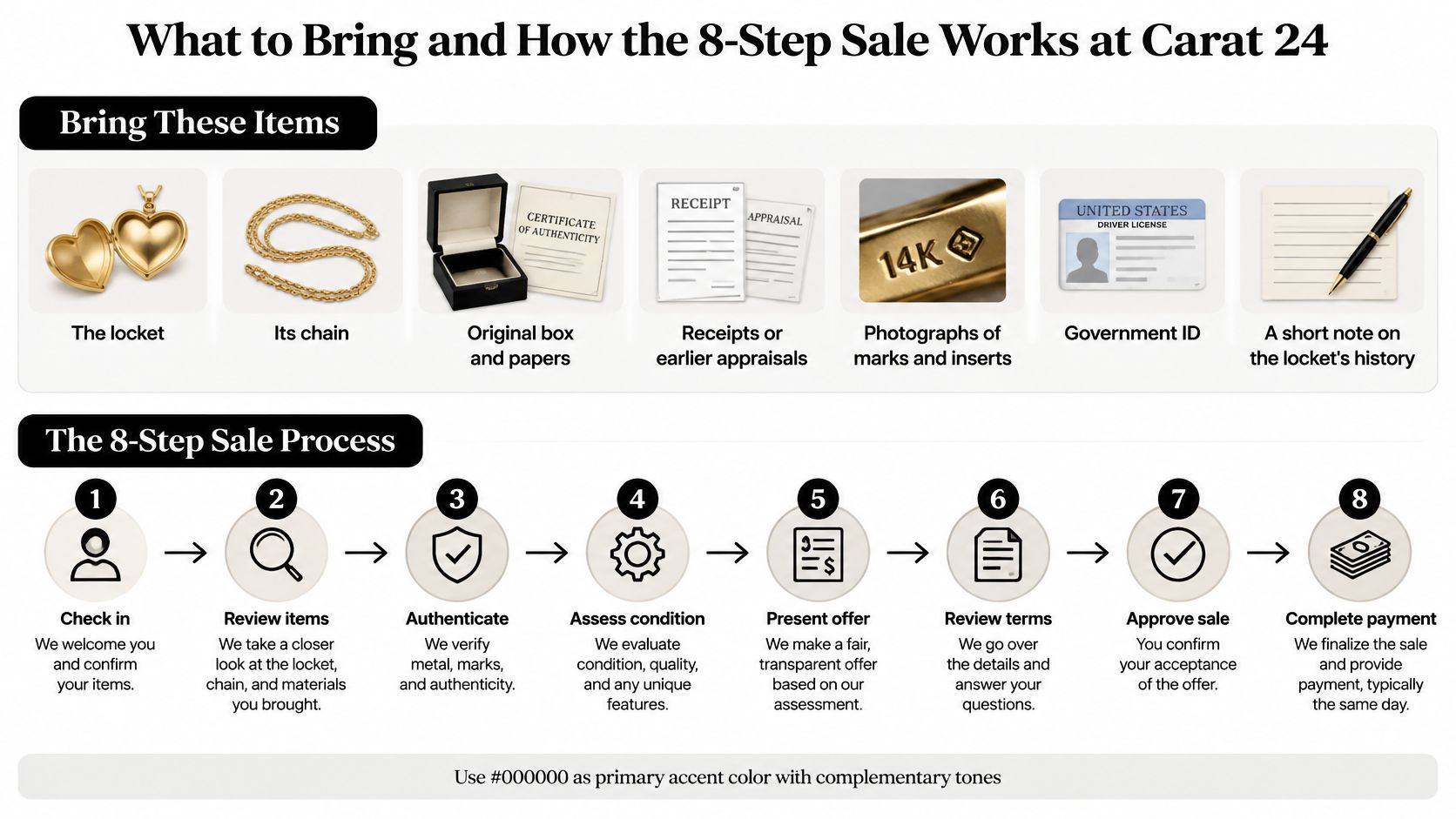
- The locket and its chain. Have both available for inspection, even if you plan to keep one.
- Any original box, papers, receipts or earlier appraisals. These provide background for the assessment.
- Photographs of marks and inserts, plus a short history. Identify any sentimental contents you want to retain.
- Government-issued identification. Ask the team what identification and sale paperwork are needed before your visit.
The eight steps
Use this sequence to organize the assessment and your decision:
- Identify the item and seller. Confirm which pieces you are offering, including whether the chain is part of the proposed sale.
- Review the construction. Ask about the marks, hinge, clasp and worn areas. A karat stamp cannot establish whether the locket is structurally sound.
- Discuss the testing method. Ask what the proposed test measures and whether it could leave a mark before authorizing it.
- Clarify uncertain results. If a reading conflicts with the stamp or visible wear, ask how that difference can be investigated.
- Separate total weight from gold weight. Have the chain and locket identified separately, and ask how non-gold parts are accounted for.
- Understand the offer calculation. Ask which gold content, weight and market price support the amount offered.
- Compare on the same basis. When considering another offer, check that it covers the same pieces and uses comparable weight and purity assumptions.
- Review the sale paperwork. Make sure it identifies the pieces you intend to sell and the agreed amount before accepting.
Why the stamp isn't the offer
A hallmark is a starting clue, like a label on a box. The contents and construction still need examination.
The Gemological Institute of America's comparison of gold-testing methods examined density, touchstone and chemical-reactivity testing, electronic testing, and X-ray fluorescence. Each method has limits. An assessment needs to reconcile the test results with the locket's construction rather than treating one reading as the whole answer.
Melt value concerns the gold present. Family meaning belongs in a separate part of the decision, and an old appraisal does not by itself establish today's purchase offer.
Before accepting, ask to see the weight and karat used in the calculation. Keep the sentimental decision separate from the arithmetic.
Sell Your Gold Locket Locally in Boise
Shipping an inherited locket to an online buyer means packing it securely and waiting for the piece to arrive before you can discuss an offer. A local visit lets you bring the locket and ask questions in person.
Carat 24's Boise team provides prices and insights on gold, silver, jewelry, and diamonds, and buys gently used jewelry. For a locket, the offer depends on verified gold content, weight, condition, and the market that day. Ask for those details in writing before deciding. Learn more about selling gold locally in Boise.
A test result has limits. The GIA's lab notes on gold-plated gold explain that plating can affect XRF readings: a gold layer over lower-karat material may produce a higher reading, while some plated or electroformed pieces can evade XRF alone. A karat stamp or a single test cannot establish that a locket is solid gold, genuine, or structurally sound. Ask what the result shows and what it cannot prove.
Call Carat 24 at (208) 314-9995 or email info@goldsilveridaho.com to ask about a visit. The store is at 3780 W. State St., Boise, Idaho. Bring the locket and any notes about its history, then review the written offer before accepting.
Carat 24 buys and sells gold, silver, bullion, coins, and other precious metals. Selling locally gives you a chance to discuss the locket's metal value while keeping its sentimental value separate. Visit Carat 24 - Trusted Gold Experts for information about the business.
