
Most of the advice about buying a Rolex watch circles one sentence: get the box and papers. That advice is comfortable, easy to repeat, and incomplete. A box proves someone kept a box. Papers prove a card was printed. Neither tells you whether the movement inside the case is the one Rolex built, whether the serial has been reported stolen, or whether the bracelet was swapped for a gold-plated copy.
The second most common line is "buy the seller, not the watch." True as far as it goes, and useless on its own, because it hands you nothing to check. A seller is only as good as the documents they'll sign and the inspection they'll let you commission.
What protects your money is a sequence. Understand what each channel guarantees you, verify five separate things about the specific watch (authenticity, provenance, originality, condition and legal ownership), test the movement, price the metal, and add up the true all-in cost before you compare two offers.
Where to Buy a Rolex and What Each Channel Guarantees
The standard advice sounds bulletproof: buy from an authorized dealer and you cannot go wrong. It works if you can get an allocation. It also dodges the central question, because a warranty, a return window and a promise of authenticity are three different documents covering three different problems, and each channel hands you a different combination.
Five separate things decide whether a Rolex is a good buy: authenticity, provenance, originality, condition and legal ownership. The gaps between what a channel guarantees and what the specific watch needs are where bad deals live. Popular references draw the heaviest demand, and counterfeiters chase the same models. Morgan Stanley and LuxeConsult estimated that Rolex generated about CHF 10.5 billion in turnover in 2024, roughly 32% of total Swiss watch industry market value, with Rolex, Patek Philippe, Audemars Piguet and Richard Mille together controlling approximately 47% of the market (Monochrome Watches on the Morgan Stanley top 50 watch brands report). One brand carrying a third of an industry's turnover concentrates the part swaps, misdescribed watches and outright fakes on it.
Rolex buying channels compared
| Channel | Guarantee | Authentication | Price position | Main risk |
|---|---|---|---|---|
| Authorized retailer (new) | Five-year guarantee | Brand-backed | Retail list price | Limited availability on popular models |
| Rolex Certified Pre-Owned | Two-year international guarantee | Certified and serviced by Rolex | Premium over independent pre-owned | Higher cost for the brand-backed assurance |
| Independent pre-owned dealer | Dealer's written policy | Dealer and third-party inspection | Market-based | Quality varies by dealer; get the policy in writing |
| Private sale | None unless stated in writing | Buyer's responsibility | Often lower asking price | No recourse if the watch is fake or stolen |
| Auction | Usually sold as-is | Limited and varies by house | Hammer price plus buyer premium | Few returns once the hammer falls |
Read that table by your goal, not by the price column. If you want the brand's own warranty and don't want to argue with anyone later, an authorized retailer is the only path to a new watch with the full five-year guarantee, and you pay for it in waiting time rather than money. If you want brand-backed assurance without the wait, certified pre-owned gives you a watch Rolex itself inspected and serviced, at a premium over what an independent dealer charges for a comparable piece. You're buying paperwork and a two-year international guarantee, not a rarer watch.
If price decides it, an independent dealer is the normal answer, provided the inspection and return terms land on the invoice. A private sale can beat every channel on asking price and is also the only route where all the risk stays with you. Auctions sit at the far end: the hammer price is not the price, because the buyer premium gets added on top and return rights are usually minimal.
One caution applies across every row. A guarantee covers what it says it covers, which is usually narrower than buyers assume. A five-year warranty guarantees the watch will run, not that a pre-owned piece still wears its original dial. A dealer's authenticity promise covers whether the watch is real, not whether a bezel was swapped before it reached the case. Genuine watch, wrong watch: that is the gap worth pricing.
Ask any seller three questions before money moves. Who inspected the watch, and what did they test? You want a name and a method, not "our in-house team." What is the written return window, and in what condition must the watch come back? What happens if a third-party authentication fails? Get each answer in writing, on the invoice or in an email, before anything changes hands. Dealers ask the same questions in reverse when they buy, and a second-hand watch shop's intake checklist shows the standard a careful seller already works to.
Buyers who total the all-in cost first tend to leave room for the rest of the wardrobe, and budget-friendly menswear shopping picks keep that side of the budget under control.
Verify Authenticity Beyond the Box and Papers
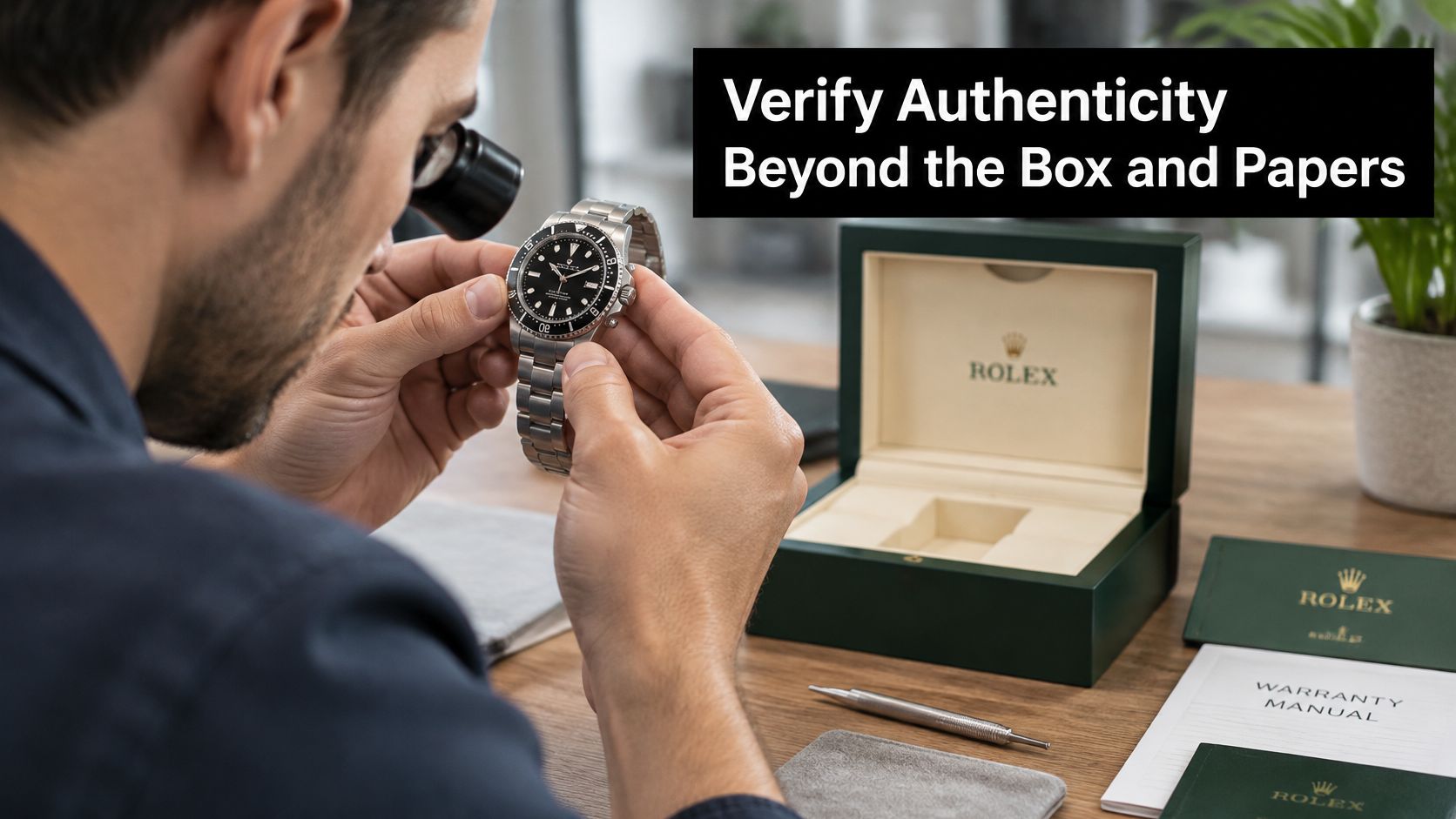
The most repeated line in Rolex buying advice, that box and papers make a watch safe, is the one that fails most often. Authentication is a physical inspection of parts, because paperwork alone proves nothing about the watch in front of you.
U.S. Customs and Border Protection reported a $2.5 million seizure of counterfeit Rolex watches in Louisville in 2025 (CBP Louisville seizure release), and authentication services screening submissions for secondary-market platforms turn away a steady share of the Rolex watches sent to them. That rejection pile gets misread constantly. A rejection can mean a counterfeit, a stolen watch, undisclosed modifications, counterfeit components, incorrect parts, or a condition that does not match the listing.
That distinction is the whole point of this check. A pre-owned Rolex has to pass five separate tests, and each one can fail on its own. Authenticity asks whether the watch is a real Rolex at all. Originality asks whether the dial, hands, bezel and crystal are the ones it left the factory with. Provenance asks who serviced it and when. Condition asks how much metal polishing has removed and whether a refinished dial is hiding under a clean crystal. Legal ownership asks whether the watch is free to be sold to you at all. A watch can pass the first test and fail any of the other four, which is how a genuine Rolex becomes a poor purchase: all genuine Rolex parts in some cases, none of them what you thought you were buying.
Run the checks in this order.
- Match the serial and reference to the case, papers and movement. The number stamped between the lugs and the number on the warranty card should belong to the same watch. A re-engraved case, a mismatched card, or a serial that "isn't visible right now" ends the conversation.
- Examine the movement and components for non-original parts. A watchmaker looks at the movement finish, the rotor markings, the dial feet, the hands and the crystal. Aftermarket diamonds, swapped dials and refinished cases are the usual finds.
- Request dated service records and repair invoices. A watch described as recently serviced should have a document with a date and a workshop on it. Undated claims price like an unserviced watch, because that is what they are.
- Screen the serial against stolen-watch records. This protects you as much as the original owner, since a stolen watch can be recovered from you later.
- Get an independent expert opinion before paying. Independent means someone whose fee does not depend on the sale completing.
An inspection in motion shows why a loupe and a timing machine catch things a photo set never will.
Rolex states plainly that only its official channels can provide brand-backed authentication, and its guarantee excludes watches materially modified with non-genuine Rolex parts. Read that twice before you accept "it's been checked by a jeweler" from a private seller.
Walk-away rule: if any of the five steps fails, or the seller won't produce the documents, there's no discount large enough to make the deal sensible.
Our guide to a Rolex serial number lookup explains which numbers sit where on which era of case, so you can confirm the first step yourself in a parking lot.
Movement, Accuracy and Power Reserve Checks
A model name tells you almost nothing about how a specific watch runs. The movement inside does. Rolex's Superlative Chronometer standard requires finished, fully cased watches to hold minus 2 to plus 2 seconds per day, tighter than the COSC movement-level tolerance of minus 4 to plus 6 seconds per day (Rolex newsroom on the Oyster Perpetual). COSC tests movements for 15 days and nights across positions and temperatures, then Rolex retests after casing under a protocol built to mimic real wearing.
Treat that standard as the factory baseline for a new watch. The watch in front of you has lived a life since then: magnetization, a knock against a doorframe, aging lubricant, a regulator nudged during an unauthorized service. Each one shifts the rate. So request a timekeeping report, or pay an independent watchmaker for one, measured across several positions and at different power-reserve levels. One flattering number on a timing machine proves very little.
What a timing report should actually show
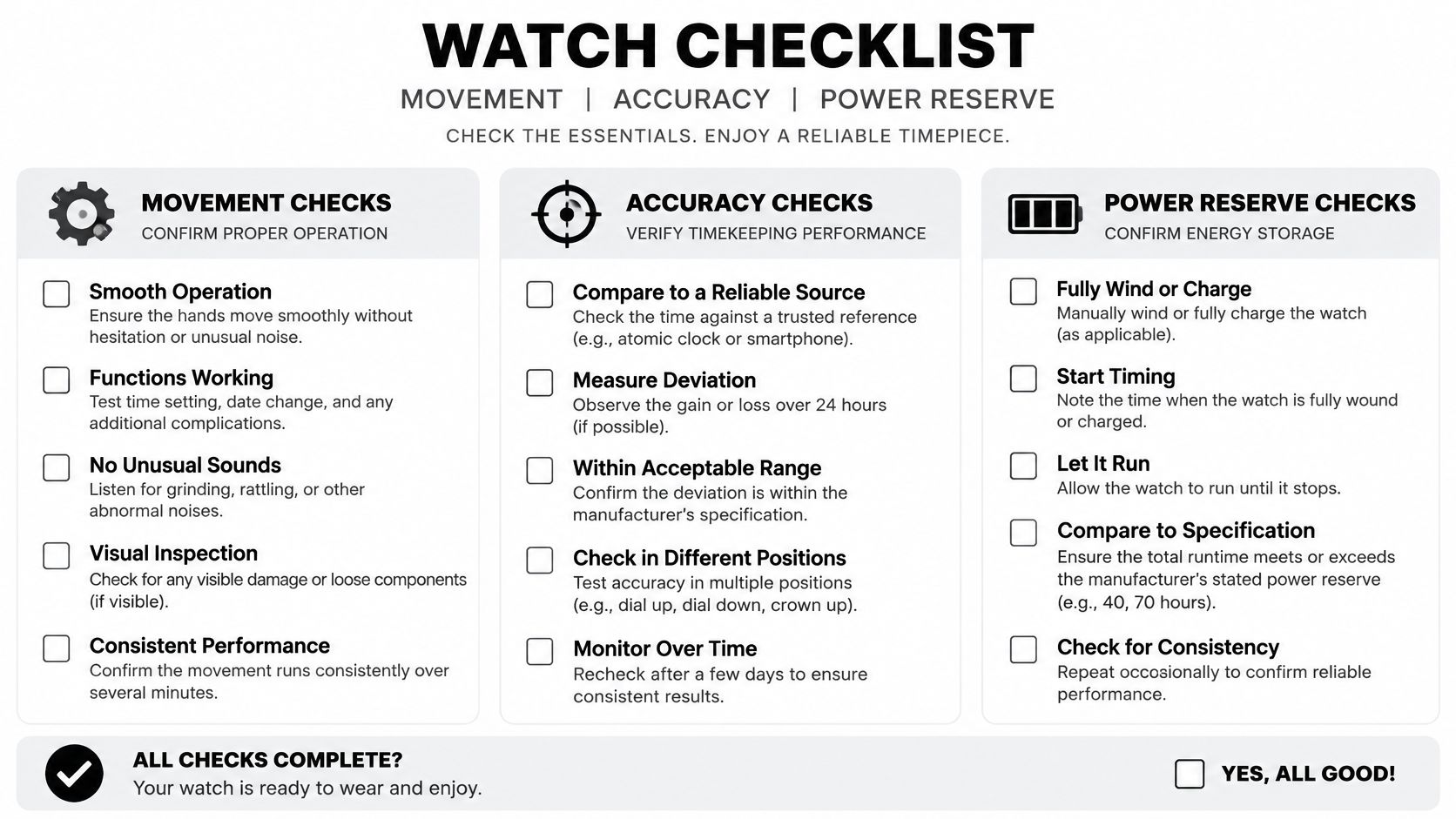
Ask for rate deviation, amplitude and beat error together, at full wind and again after several hours of running. Amplitude that sags sharply as the mainspring unwinds points to worn parts or a tired lubricant film. A wide spread between positions suggests the watch needs regulation or has taken a hit. Winding feel counts too, since a gritty crown or a rotor that drags shows up on the bench before it shows up on the machine.
A genuine Rolex can still fail every one of these checks. Authenticity tells you the watch is real; the bench report tells you whether it is healthy. Sellers blur that distinction constantly, and it is exactly where bad deals hide.
Power reserve tells you how you'll live with it
Larger Rolex calibres typically run around 70 hours on a full wind; the Day-Date's 3255 carries a reserve in that range (Rolex Day-Date reference page). Smaller calibres generally sit closer to 55 hours. In practice, 70 hours survives a weekend off the wrist, while 55 hours often falls short and leaves you resetting the date on Monday morning.
The calibre sits inside the case, and neither case size nor collection name identifies it. Confirm it with a watchmaker or in the service record before you compare two watches on price.
Testing reserve is simple and worth insisting on. Wind the movement fully, record the start time, and check whether it approaches the stated duration while still holding acceptable amplitude and rate. A short reserve points to poor winding efficiency, a worn mainspring, friction or overdue maintenance. Don't let anyone wave it off as "normal for its age."
Condition checks before you pay
| Check | How to test it | Red flag |
|---|---|---|
| Serial and reference | Compare the serial with the case, papers and model records | Mismatch or re-engraved case |
| Movement accuracy | Timing report across several positions | Readings far outside the stated range |
| Power reserve | Fully wind, record the start time and time the run to stop | Reserve well short of the stated duration |
| Calibre | Confirm the calibre with a watchmaker or service record | Calibre differs from the listing |
| Crystal and bezel | Inspect under magnification for replacements | Non-original or mismatched parts |
| Service history | Request dated service records | No record on a watch that claims recent service |
Practical rule: the printed certification in the box describes the watch on the day it left the factory. Bench numbers describe the watch you're about to buy.
Gold Rolex Karat and Case Metal Explained
Karat marks are a pricing language few buyers ever learn to read. The Federal Trade Commission explains that "gold" used alone means 24-karat gold, while lower-karat jewelry mixes gold with other metals, so 14-karat jewelry contains 14 parts gold and 10 parts base metal (FTC guide to buying platinum, gold and silver jewelry). That ratio determines the price of a gold case: the extra weight over a steel equivalent is mostly paid-for metal.
Gold karat, gold content and use
| Karat | Gold content | Other metals | Use in watches |
|---|---|---|---|
| 24K | 100% | None | Too soft for watch cases |
| 18K | 75% | 25% alloy | Common in Rolex gold models |
| 14K | 58.3% | 41.7% alloy | Not used for Rolex cases |
| 9K | 37.5% | 62.5% alloy | Not used for Rolex cases |
Rolex gold cases are commonly 18-karat, which is 75% gold, so the metal value is a real component of the asking price and not a rounding error. Three checks follow from that.
Check that the karat stamps on the case, clasp and bracelet agree with each other and with the paperwork. Check whether the case is solid gold, plated or gold-filled, since plated pieces carry a fraction of the gold the stamp seems to promise. And ask, plainly, whether the metal was tested or assumed.
Then ask the harder question. Metal can be authentic and the watch can still be wrong: a genuine gold case that was never factory metal for that reference, or a bracelet swapped in from another watch, passes a purity test and fails the buyer anyway. Authenticity tells you the gold is real. Originality tells you it belongs. Keep the two questions separate, because a yes on one says nothing about the other.
Gold content also sets melt value, which is why a heavily polished case should be judged by weight and purity as well as by the name on the dial. A worn gold bracelet loses grams, and grams are money. The same logic applies to any precious-metal purchase, and this explainer on how to invest in gold covers how metal pricing works before you treat a gold Rolex as jewelry with a movement inside.
Before you accept a seller's karat claim, confirm the reference as well, since the Rolex reference number guide tells you which metals that model was offered in at the factory. A reference that was never offered in white gold, yet is being sold as white gold, is worth catching before you pay.
Calculating the All-In Cost of Your Rolex
A fair sticker can still become an expensive watch once the missing costs are added. Secondary Rolex prices move model by model: one reference can command a premium for immediate delivery while another sits unsold. Treat brand heat as weather around the deal, then run the arithmetic on the exact watch in front of you.
Authenticity is only the first gate. A genuine Rolex can still be a poor purchase if the dial was replaced, the case lost metal to polishing, the papers belong to another reference, or the seller cannot show clean ownership. Provenance, originality, condition and legal title each change what the watch is worth and how long it may take to resell.
Say you pay 20% above retail for a steel sports model because you want it this month. The market now has to rise about 20% before you break even on resale, before the dealer spread and the months it takes to find a buyer. Pay a 45% premium on a hyped reference and the required rise climbs accordingly. That does not make buying wrong. It makes the premium a cost you should name out loud.
The honest version: you're buying a watch you want to wear. Any resale value is a bonus that arrives with conditions, timing and a dealer's margin attached.
Frame the purchase by goal. Wearing it daily means insurance and servicing dominate, and the premium matters less because you spread it over years of use. Collecting means originality and completeness dominate, since a replacement part can cost more in value than it saves. Estate planning means documented provenance and a realistic resale value rather than a retail sticker. Resale means liquidity and spread dominate, and the model you can sell in a week beats the model that lists higher.
All-in cost worksheet
| Cost line | What to record | Effect on break-even |
|---|---|---|
| Purchase price | Amount paid to the seller | Sets the baseline |
| Dealer premium | Price paid minus current retail | Market must rise by this share before you break even |
| Taxes and fees | Total charged at checkout | Adds directly to cost |
| Servicing | Expected service bill | Recurring cost of ownership |
| Insurance and storage | Annual premium and storage fees | Recurring cost |
| Currency conversion | Exchange fee and rate spread | Affects cross-border purchases |
| Dealer spread on resale | Gap between buy and sell quotes | Reduces net resale value |
| Time to sale | Expected months to sell | Adds holding cost |
Fill the worksheet before you compare two offers. Price the specific reference against at least three current listings and request a written quote from each seller, then confirm the written return terms before money moves, including required packaging and paperwork. Match the guarantee to the channel instead of assuming every route protects the same costs. If you want a starting number for the resale side, this breakdown of what your Rolex is worth shows which factors move the figure most.
Choosing a Trusted Local Seller in Boise and Closing the Deal
Buying locally removes a problem you can't insure away: the parcel. A watch shipped across the country sits in a depot, gets scanned by strangers, and if it arrives with a swapped bracelet you're filing a claim instead of negotiating. Handling the watch across a counter, with the seller in front of you and the loupe in your hand, is a shorter path to a fair number. That's the honest case for buying face to face instead of trusting an online quote issued before anyone has seen the movement.
The criteria that separate a shop from a counter
Write these down and hold every local seller to them. The authentication process is described out loud, step by step, in detail instead of being summarized as "we check it." The watch is tested in front of you, so you see the reading and the verdict together. The offer is explained line by line, with the metal value, the movement condition and the model's demand separated. The return policy is in writing, including the condition the watch must come back in. A shop that resists any of these is telling you something useful.
At Carat 24, each of those tests has a concrete answer. Every luxury item is authenticated through Entrupy or expert review before it's listed for resale, every piece is guaranteed 100% authentic, and a certificate of authenticity is available on request. Luxury items carry a 30-day return window, with one firm requirement: the watch must come back in its original condition with all packaging and paperwork, so keep every box and document that arrives with the purchase.
X-ray screening and what it does and doesn't prove
X-ray fluorescence gives you a fast, non-destructive read on metal content. Independent instrument guidance states that XRF does not damage the tested item, that commercial precious-metal analyzers can return gold concentration and alloy-chemistry results in roughly 2 to 5 seconds per sample, and that results can come within a few tenths of a percentage point of fire assay under suitable conditions (Helmut Fischer precious-metal analysis FAQ). The limit is depth: XRF reads near-surface material, so plated, layered or compositionally inconsistent pieces need further confirmation.
That makes an XRF scan the right first move on a gold Rolex, a gold chain or an inherited bracelet. It settles the karat question in seconds without a file touching the metal. It does not replace the movement inspection, and it doesn't tell you whether the dial is original. A genuine gold case can still hide a replacement dial, so treat the scan as one line of evidence, not the whole file.
What to bring and how the offer works
Bring the watch, the papers, the service records and any authentication documents you already hold. On the buying side, Carat 24 purchases gold, silver, jewelry and fine watches, and the local team in Boise provides prices and insights on gold, silver, jewelry and diamonds. If a purchase includes authenticity certificates such as an Entrupy report, those documents must be delivered with the item, so confirm they're in hand before you leave the counter.
Test any offer instead of trusting it. Get a written quote from Carat 24 and two other buyers, line them up side by side, and compare the number after fees instead of the headline figure. Bring everything to 3780 W. State St., Boise, and ask to watch each check as it happens. If a purchase is shipped to you instead, choose a delivery option that requires a signature, since a luxury watch left on a doorstep is a claim waiting to happen.
Vintage references need a slightly different conversation, since dial originality and case sharpness carry more weight than the model's current catalog position. Our notes on vintage Rolex watch dealers cover what changes when the watch is older than the buyer. Then close the deal on one condition: the serial check, the timing report, the completed cost worksheet, the metal test result and the written return policy are all on file, and the price is confirmed in writing before anything changes hands. If one of those is missing, you haven't finished buying a Rolex watch. You've started hoping.
Carat 24 - Trusted Gold Experts buys gold, silver, jewelry and fine watches, and every luxury piece is authenticated before it reaches a shelf. If you're buying a Rolex watch in Boise, bring the watch, the papers and your completed worksheet to 3780 W. State St. and walk through the checks with the team. Start at Carat 24 - Trusted Gold Experts to see what's in the case before you make the drive.
