
Stack's Bowers Galleries reported $275.6 million in total auction prices realized during 2024, according to PCGS's report on the auction house's results. That's a useful starting point for understanding collectible coins: value comes from actual buying decisions, not just age, a shiny surface, or a price written on an old envelope.
For a Boise family sorting an inherited collection, the useful question isn't just what a coin might be worth. It's what makes that particular coin desirable, how confidently you can identify it, and what you could realistically receive after selling costs. A certified grade is not a price, and a high retail number is not the check.
Why Age Alone Does Not Price a Coin
A coin's age can tell you when it was made, but not what a buyer will pay. PCGS's auction database records more than seven million significant coin lots sold from 1997 through 2026, with reported totals that include final bids and buyer's premiums. Completed sales offer a firmer reference than an asking price, which shows what a seller hopes to receive.
Numismatic value depends on the specific coin: its identity, rarity, condition, demand, and metal content. Face value names the denomination. Age gives a date. Neither is a price.
Two silver dimes can share a date and metal content yet attract different interest. A worn example may be common, while one with unusually strong detail and luster may merit closer examination. That difference is like comparing two books with the same title: the edition and condition affect what collectors want.
Buying rule: Pay for an identified coin and supported condition, not for the story that old automatically means expensive.
The exact issue matters
A date and mint mark can set one coin apart from another. The 1893-S Morgan dollar is a well-known example of a scarce issue, but its reputation does not price every Morgan dollar. Even for the same issue, grade, originality, eye appeal, and sale timing can change what a buyer offers.
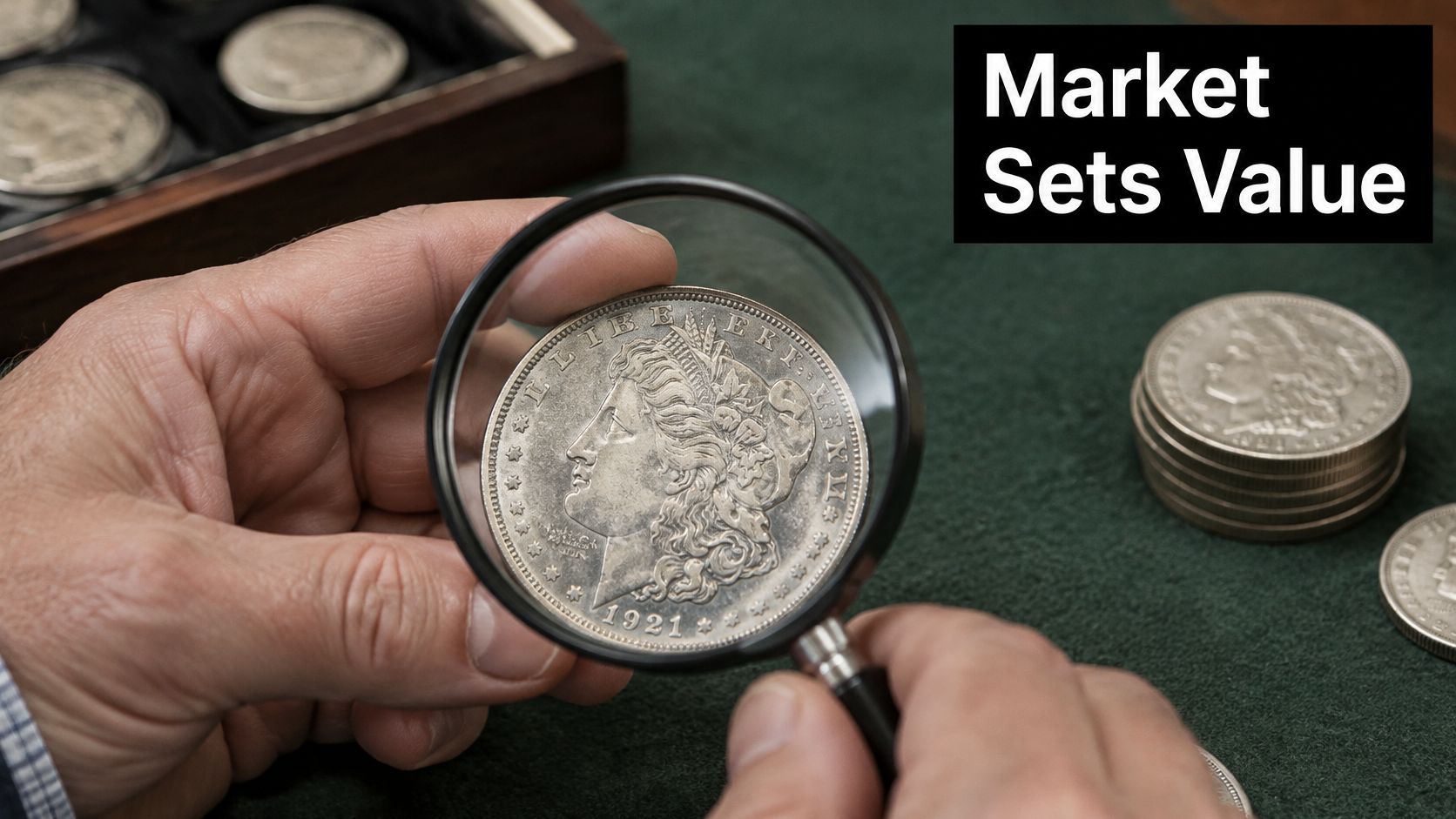
Separate ordinary coins from potential Morgan dollar key dates, then investigate the exact issue rather than assuming age or resemblance establishes value. A magnifier helps you record what is on the coin, not just what it seems to resemble in an online listing.
The Five Drivers and the Sheldon Grade Ladder
Use these drivers together. A coin can have attractive metal content but little collector demand, or modest metal content and an exceptional premium because collectors struggle to find its exact issue in comparable condition.
What moves numismatic coins value
| Driver | What it measures | How it moves price | Signal to look for |
|---|---|---|---|
| Rarity | Survivors of that date, mint mark, and variety | A thin population raises collector competition | An issue with many worn survivors but very few high-grade examples |
| Condition | Wear, marks, luster, strike, and damage | Better surfaces can multiply price on scarce dates | Strong original surfaces compared with marked, worn, or impaired examples |
| Grading | Sheldon numerical grade or a Details designation | A normal number supports comparisons; Details requires problem-specific pricing | Whether the holder reports a straight grade or identifies an impairment |
| Demand | Active collector and dealer bidding | Strong buyer participation supports premiums; weak demand compresses them | Completed transactions and competing bids for the exact issue |
| Precious metal | Weight, fineness, and spot price | Provides a metal-value reference for common coins, not the premium on keys | Ordinary circulated silver trading near its bullion market level |
The distinction between condition and grading is important. Condition is the physical state of the coin. Grading is a professional assessment of that state under a defined standard.
Neither replaces identification. Before judging preservation, establish the denomination, date, mint mark, and variety. A beautiful example of a common issue isn't automatically comparable to a rare issue that looks similar.
Read the grade as a staircase
The PCGS grading standards describe the Sheldon 1–70 scale and explain that business-strike coins graded MS-60 through MS-70 have no circulation wear, although an MS-60 coin can be heavily marked and an MS-70 coin is fully struck and visually free of meaningful marks.
Mint State does not mean untouched. A coin can avoid circulation yet acquire contact marks from handling or storage with other coins. Another example may have fewer marks but weaker detail from the original strike.
Think of grade as a staircase, not a ruler. Each step describes a different preservation level, but collectors don't necessarily pay the same additional amount to move up each step. On a scarce date, the next grade may leave very few comparable coins available.
PCGS's explanation of grading notes that Sheldon originally designed a grade of 70 to represent 70 times the value of a grade-1 coin. That historical design is not a formula for today's selling prices.
A modern valuation needs evidence for the particular issue. Don't multiply a lower-grade price by the label number, and don't assume an uncertified coin qualifies for the grade whose price looks most appealing.
Eye appeal and Details change the comparison
Technical preservation isn't everything a buyer notices. Attractive luster, color, and contrast can make a coin more desirable than another example with a similar technical assessment.
PCGS's eye-appeal guidance explains that negative eye appeal or unattractive toning can reduce the effective grade by as much as one point, while severe toning may cost up to two points or lead to a no-grade designation for environmental damage. Color alone therefore isn't proof of either exceptional value or a problem.
A Details designation needs a different reading. It may describe the remaining wear while also identifying cleaning, scratches, or another impairment. The designation doesn't make the coin worthless, but normal numerical-grade price comparisons may no longer fit.
Don't pay the problem-free price for a problem coin simply because its remaining detail looks sharp.
For example, a cleaned coin may show clear lettering and strong facial features, yet lack the original surface quality collectors seek. Trying to restore brightness can remove precisely what supports the collectible premium.
Document before handling
Use a magnifying glass and a steady light, then make an inventory before deciding whether professional submission makes economic sense. Our explanation of a coin grading service can help you understand what that process is meant to establish.
- Record identity first. Copy the denomination, date, mint mark, and any suspected variety without upgrading a guess into a confirmed attribution.
- Photograph the surfaces. Capture the high points, open fields, rims, lettering, and both sides under consistent lighting.
- Show luster accurately. Take an additional angled photograph if needed, rather than editing brightness until the surface looks different.
- Record problems openly. Note visible scratches, deposits, unusual discoloration, or possible cleaning. Keep packaging and purchase paperwork with the inventory.
Handle loose coins by their edges over a soft, clean surface. Keep certified coins in their holders, and don't rub a fingerprint or spot to see whether it comes off.
Precious-metal value remains useful, but it's a starting reference rather than a guaranteed dealer payment. A buyer still has transaction costs, and a collectible premium still needs support. Metal sets the basement, grade and rarity set the stairs.
What One Morgan Dollar Reveals About Grade
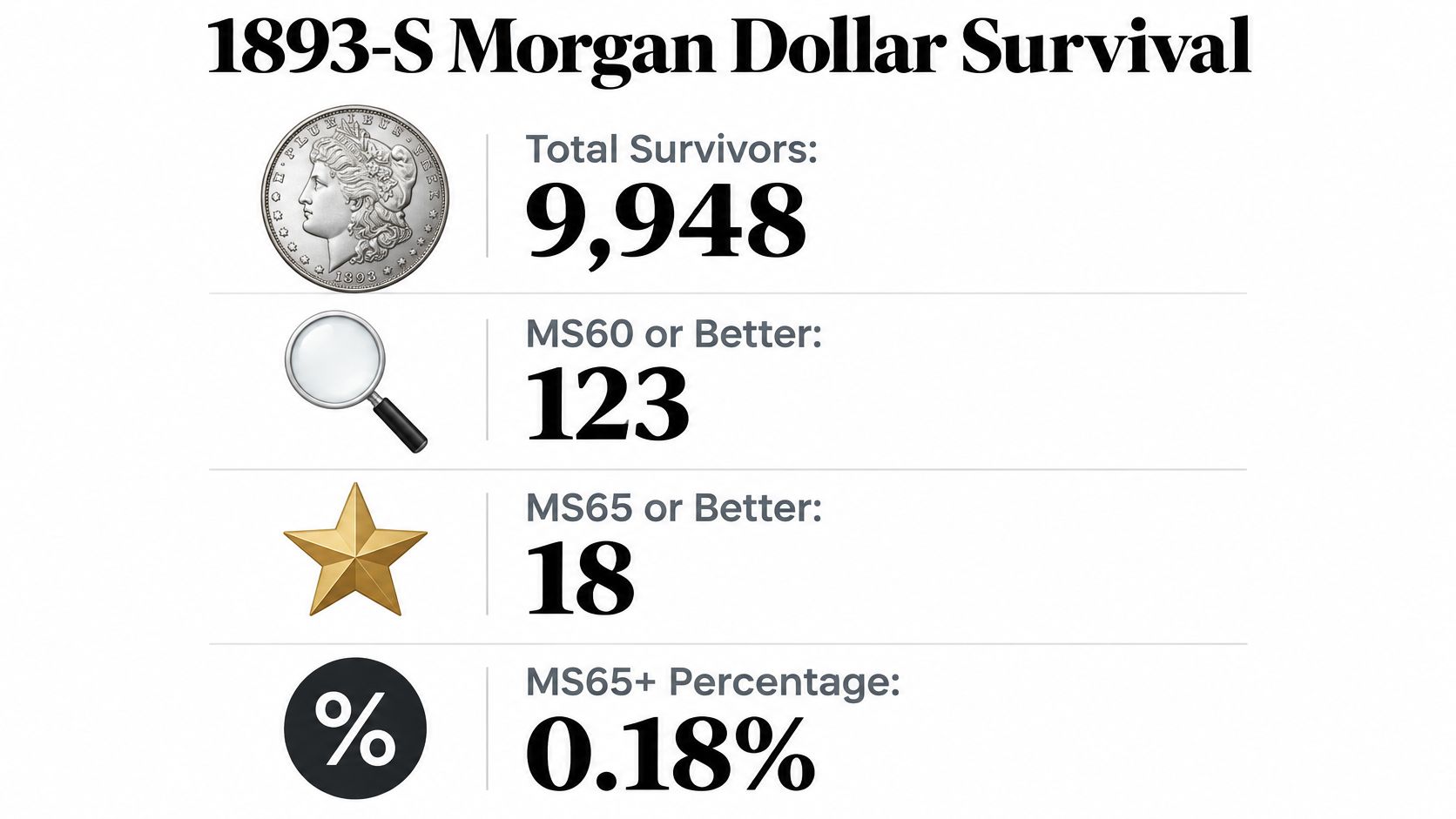
A single grade point can matter more than a coin's silver when it separates a common example from a scarce condition rarity. The 1893-S Morgan dollar shows how strongly preservation can affect collector demand. The figures below come from PCGS CoinFacts for the 1893-S Morgan dollar.
1893-S Morgan dollar population and sales
| Measure | Figure |
|---|---|
| Estimated survivors, all grades | 9,948 |
| Survivors at MS60 or better | 123 |
| Survivors at MS65 or better | 18 |
| MS65-or-better share of survivors | About 0.18% |
| MS65 sale at Sotheby's, May 21, 2018 | $735,000 |
| MS67 sale, 2021 | $2,086,875 |
| 2021 sale compared with 2018 sale | About 2.84 times |
The high-grade share is calculated by dividing the estimated 18 survivors at MS65 or better by the estimated 9,948 survivors overall. The narrowing is like a stadium with broad lower stands and only a few seats in the top rows.
What the sales prove, and what they don't
The two auction coins shared a date and mint issue, but the higher-grade specimen also had notable collection history. That means the price gap cannot be credited to grade alone.
The comparison shows how buyers may value different examples of the same issue. It does not isolate the effect of one grade point. On a scarce date, a single point can move a coin into a much smaller population, but the premium needs support from comparable sales.
The same principle applies to graded cards. A condition label helps organize comparisons, while the item's scarcity and relevant transactions still matter. See what drives graded card prices for a related example.
For a visual reference alongside the written comparison, this video is available.
A population count needs interpretation
PCGS's population-report guidance explains that its report counts coins submitted to and certified by PCGS, not every surviving coin. A coin submitted more than once may be counted again, while coins never submitted are absent from the report.
Treat certification counts and estimated total survival as different measures. A low holder count alone does not prove that an issue is rare.
An ordinary Morgan dollar belongs in a different comparison group from this San Francisco key. For worn or impaired examples, compare against cull Morgan dollars, not a trophy-auction headline. The useful outcome is a defensible selling range, not the largest number associated with the design.
Melt Retail and the Check You Actually Get
A coin's advertised retail price is not the same as the cash a seller receives. Separate three figures: intrinsic melt, retail replacement, and net liquidation. Each answers a different question.
The Federal Trade Commission's materials on precious coins and bullion warn that historic or collectible coins can be sold with markups as high as 100% to 300% over prevailing market prices. That range applies to some collectible-coin sales, not every dealer or coin.
Three figures for one coin
| Figure | What it answers | Where it usually sits | Use it when |
|---|---|---|---|
| Intrinsic melt | Metal value if the coin were treated as bullion | A metal-value reference for common gold or silver, not a guaranteed offer | The piece is worn, common, or damaged |
| Retail replacement | Price to buy a comparable coin from a dealer | Above the dealer's acquisition cost; some collectibles carry substantial markups | Insuring, replacing, or interpreting an asking price |
| Net liquidation | Money the seller may actually receive | Below the gross sale amount after applicable spreads and selling costs | Deciding whether to sell now |
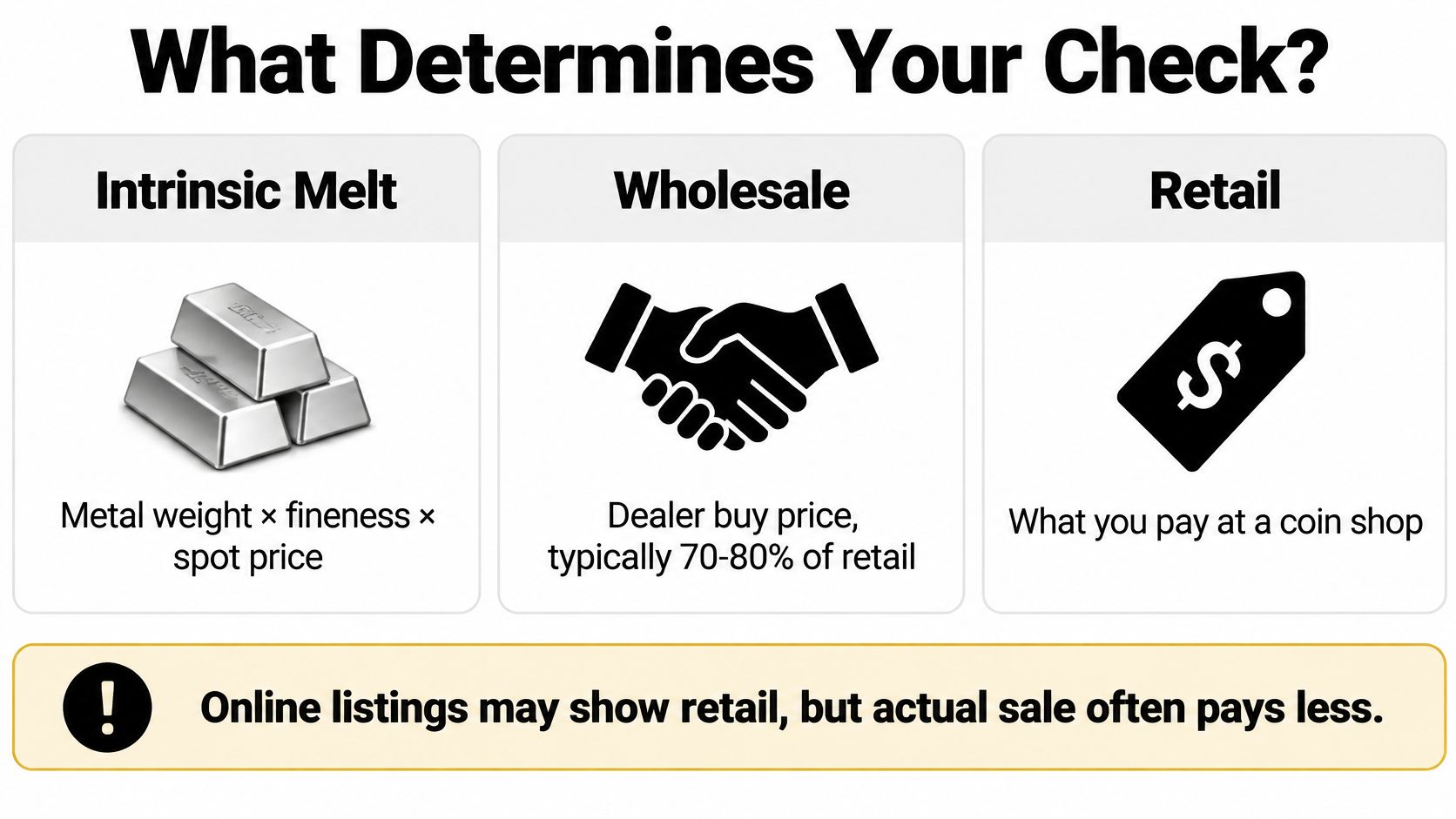
For melt, multiply gross metal weight × fineness × spot price per unit, with weight and spot price expressed in matching units. Fineness accounts for the proportion of precious metal in that gross weight. If you already have the coin's fine-metal weight, use fine-metal weight × spot price instead. The spot price for gold and silver is a reference for the metal value, separate from any collector premium.
The visual below distinguishes the pricing layers. Wholesale percentages vary by dealer and market conditions, so they are not fixed payout rates.
Follow the money through the transaction
A widow inherits a certified coin and sees a dealer advertising a comparable example. She expects to receive the advertised price because the coin in her hand appears to match.
The buyer still has to authenticate the coin, pay for it, find another customer, and account for resale risk. A lower offer is not automatically dishonest. Compare it with relevant transactions and competing bids.
Check which costs apply to the sale route:
- Dealer spread. In a direct purchase, the buyer's resale margin is generally reflected in the offer rather than billed separately.
- Auction costs. Seller commissions reduce proceeds. A buyer's premium paid when acquiring a coin is an acquisition cost, not money guaranteed back.
- Preparation costs. Grading and authentication may help, but might cost more than the value they add.
- Delivery costs. Shipping and insurance reduce what you keep from a distant transaction.
Selling rule: Compare the money you'll keep, not the biggest number printed beside the coin.
The FTC identifies false grading claims, counterfeit certification documents, exaggerated values, and misleading buyback promises as warning signs. Pressure to act immediately or a guaranteed return deserves a pause before you sign.
When a Price Guide Is Not an Offer
A slab label is an identification and condition starting point. Turning it into a selling range requires matching it to the right transactions, then checking what buyers will pay.
The PCGS Price Guide applies only to PCGS-graded coins and reports average dealer asking prices compiled from advertisements, fixed-price lists, auctions, and coin-show activity; PCGS also advises sellers to contact at least three dealers before completing a transaction. Individual examples can sell above or below guide figures because of surface color, eye appeal, and other characteristics.
Turn the label into a usable range
- Read the complete holder. Record the certification number, grading service, numerical grade, and any Proof, cameo, or other designation. Verify that the certification record describes the coin you're examining.
- Match the issue exactly. Check the date, mint mark, denomination, and variety against the guide entry. A nearby line with a similar description isn't an acceptable substitute.
- Use population as context. Ask whether the count describes certified submissions or an estimate of surviving coins. Don't treat a small entry as a completed valuation.
- Compare several completed transactions. Favor recent sales with clear photographs and the same issue, grade, and designation. Note whether reported auction totals include buyer's premiums before comparing them.
- Estimate proceeds for the chosen route. Request the applicable charges and subtract them from a plausible gross sale amount. Don't subtract a dealer spread again if it's already embedded in a direct cash offer.
- Collect competing written bids. Give buyers the same inventory and make clear whether each offer covers individual pieces or the entire group. Keep the terms beside the amount.
Exact identification matters in every collectible marketplace. Wine Labs' explanation of canonical wine identities across marketplaces provides a useful comparison: meaningful price analysis starts by ensuring that differently worded listings refer to the same underlying item.
Resolve mismatches before accepting a price
An altered date or counterfeit mint mark can eliminate the premium you thought you owned. Cleaning and scratches can also make an apparently close comparison unsuitable, so request an independent examination when the value is material or the identification is disputed.
A price index is a guide, not the value of the individual coin. If your estimate depends on ignoring a visible problem, choosing an unmatched sale, or assuming an upgrade, it isn't yet a reliable selling range.
Use a written inventory and the practical checks in how to sell collectible coins to keep the decision grounded. You don't need the most optimistic estimate. You need an explanation you can verify.
Gold and Jewelry Buying in Boise Before You Ship
Start locally when it gives you a clear inspection and a meaningful comparison. Gold and Jewelry Buying often involves mixed estates, so keep collectible coins separate from scrap jewelry until someone has assessed their possible collector premiums.
Don't clean, polish, or dip coins before the visit. PCGS's selling guidance warns that cleaning can damage value and recommends comparing dealer offers. Photograph both sides, record any safely obtainable weight, and keep holders, receipts, and handwritten collection notes together.
Test the terms as carefully as the metal
Bring the same items to each buyer and request an itemized written offer. Ask how much reflects metal content and how much reflects a coin's grade, rarity, or collector demand.
- Free testing. Ask whether X-ray scanning and gold testing are free, whether any conditions apply, and whether testing requires agreement to sell. Free testing at Carat 24 isn't established here, so confirm before authorizing it.
- Price matching. Ask whether the buyer will match a written competitor offer and obtain the policy in writing.
- Hassle-free offers. Look for clear terms, understandable calculations, and time to consider the decision, rather than relying on the phrase alone.
- Highest payout in Boise. Treat that claim as something to test through comparable net offers, not as a verified promise.
At Carat 24, we buy and sell gold, silver, bullion, coins, and other precious metals. Our Boise team provides prices and insights on gold, silver, jewelry, and diamonds; our authentication includes examining materials and craftsmanship and verifying applicable serial numbers through certified websites.
Compare like-for-like jewelry offers
The FTC's gemstone and jewelry guidance supports accurate descriptions of material characteristics and recommends asking about diamond origin and equipment used to distinguish natural from laboratory-created stones. Request explanations of karat, weight, stone identification, and the basis of the offer.
Save the shipping hassle and sell locally for more only when the local net offer wins. A distant buyer may still be worth considering, but compare postage, insurance, return terms, and exposure to loss or damage before sending anything.
Keep control of the timetable. A clear local offer can be useful without being the best offer, and a larger online quote can disappoint once its conditions are applied.
Carat 24 - Trusted Gold Experts offers buying and selling of coins and precious metals, with a Boise team that can help you understand your items before making a selling decision. Bring your coins, holders, and collection paperwork to Carat 24 - Trusted Gold Experts, and ask for an explanation of authenticity, condition, metal content, and any collectible premium so you can compare the offer confidently.
