

The ring sits in a drawer because nobody in the family can agree on what it is. It's white metal, cool in the hand, with a stepped shoulder and a row of small diamonds set so closely the metal barely shows between them. The inside of the shank carries a stamp you need a jeweler's loupe to read, and a great-aunt's note calls it Art Deco.
Maybe you're the one holding it. You want to know whether it's a genuine 1920s piece, what it's worth, and whether the flat offer from an online buyer is fair or fast.
Calling a ring Art Deco is a question of evidence, not style. A stamp, a signature, a geometric outline and a row of old-cut diamonds each tell you something, and none of them settles it alone. What settles it is a layered check: marks, construction, motifs, stones and repair history, all read together before anyone polishes or resizes the piece.
That's the walk-through ahead, one layer at a time.
Defining Features of an Art Deco Platinum Ring
The dates come first. The Gemological Institute of America's history of Art Deco jewelry places these rings mainly in the 1920s and 1930s, and identifies the movement's defining milestone as the 1925 Exposition Internationale des Arts Décoratifs et Industriels Modernes in Paris. That exhibition gave the style its name and its visual grammar: geometric structure, symmetry, clean forms, and hard contrast between white metal and vivid gemstone colour. Smithsonian material cited in the same history dates the period to roughly 1920 to 1935.
The look broke sharply with what came before it. Edwardian and Art Nouveau jewelers worked in flowing, organic lines, with garlands, bows and botanical scrollwork. Art Deco makers went the opposite direction: straight edges, repeated angles, balanced axes. Platinum made that possible. It combined high strength with malleability, so a maker could build thin, durable settings that held diamonds with as little visible metal as the design allowed. The Metropolitan Museum of Art's account of the period emphasises dense concentrations of gemstones set in platinum rather than gold, and the resulting surfaces sparkle across the whole ring instead of sitting in one heavy mount.
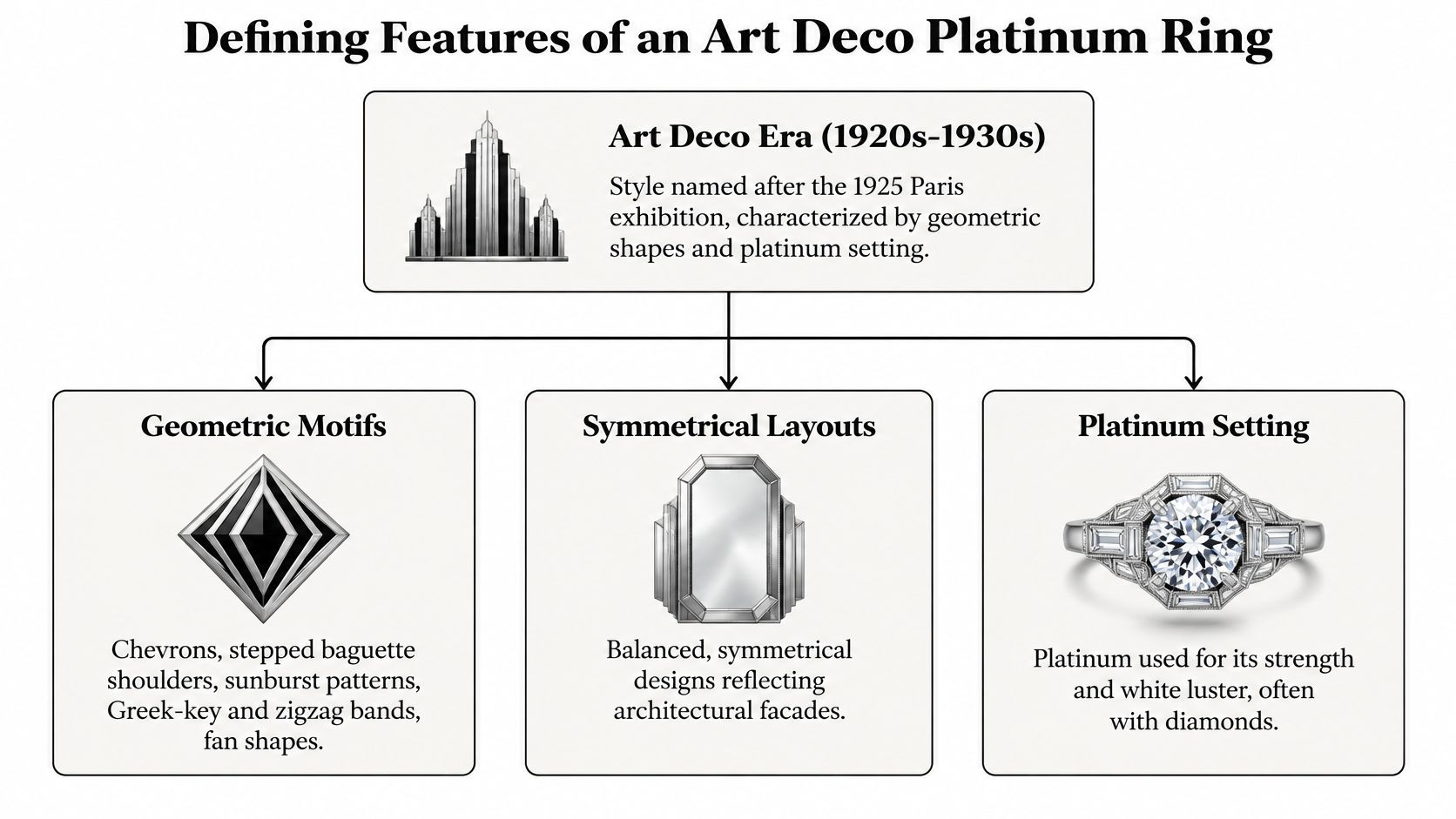
Hold a candidate ring against this baseline before you go further.
| Feature | What to Look For | Why It Matters |
|---|---|---|
| Geometric layout | Straight lines, stepped shoulders, rectangular or circular outlines | Marks the break from Art Nouveau curves |
| Symmetry | Mirror-image balance across the head and shank | Reflects the period's ordered design |
| Platinum body | Cool white metal with no yellow cast | Platinum became the preferred metal for fine Art Deco jewelry |
| Dense stone setting | Many small diamonds set close together | Puts the sparkle on the stones rather than the metal |
| Bold colour contrast | Onyx, jade, sapphire or emerald against white metal | Reflects the period's stronger palette |
| Hand-finished detail | Milgrain edges, pierced galleries and fine prongs | Shows the craftsmanship of the period |
Treat those features the way a baker treats ingredients. Flour on its own proves nothing, and neither does one stepped shoulder on an otherwise ordinary band. The combination is what points to an authentic piece, and a ring showing three or more of them at once earns the closer inspection that follows.
Later revival pieces share much of this vocabulary, so the table is a filter, not a verdict. If the metal itself is the part you're unsure about, this comparison of white gold and platinum covers the colour, weight and wear differences that separate them in the hand.
Reading Platinum Marks and Authenticating the Ring
Start with a 10x loupe and the inside of the shank, before any cleaning, polishing or resizing touches the ring. Buffing thins stamps, and cutting a shank can erase them outright, so every check below happens on the ring exactly as it sits.
Platinum fineness runs on a parts-per-thousand scale, and the CIBJO precious metals guidance.pdf) recognises 850, 900 and 950 as platinum fineness levels. Under the Federal Trade Commission's Jewelry Guides, a ring marked "Platinum" should contain at least 95% platinum, with the remainder made up of alloy metals such as ruthenium, iridium, palladium or cobalt, which affect hardness, workability, repair behaviour and weight.
| Mark | Platinum Content | What It Tells You |
|---|---|---|
| 850 | 85% platinum | Lower declared fineness with a heavier alloy share |
| 900 | 90% platinum | Recognized international fineness level |
| 950 | About 95% platinum | The fineness you'll meet most often on platinum jewelry |
| Pt950 | About 95% platinum | Same fineness as 950, with the platinum symbol |
| Plat or Platinum | At least 95% platinum under US consumer-labeling guidance | Declares the metal but not the exact fineness |
Where a stamp stops being proof
A hallmark records what the maker declared. Whether the metal matches that declaration is a separate question, and it sits behind every valuation conversation worth having. Those same FTC guides require sellers to represent a piece's metal type, grade, quality, quantity, metallic content, weight and value truthfully, so a listing that says only "platinum" should prompt you to ask for the fineness in writing.
A maker's signature is a separate layer, and a weaker one. Signatures get faked, added later or stamped onto assembled pieces. A famous name on its own settles nothing, and an unsigned ring can still carry collectible workmanship.
Run the check in this order and score each layer separately:
- Fineness mark. Confirms the metal family and the declared purity.
- Maker's mark. Records a name, not a guarantee.
- Hand-finishing. Look for tool marks, the slight asymmetry you'd expect from hand work and crisp interior edges.
- Setting construction. The next section gives you the detailed inspection sequence.
- Stone cutting style. Old European and single cuts sit alongside calibrated colour stones; modern brilliants often don't.
- Repair and replacement evidence. Solder seams, mismatched metal, stones of the wrong cut or colour for the mount.
Red flags worth naming: machine-uniform stone sizing on a hand-built ring, a finish that looks factory-new on a century-old piece, a gallery rebuilt in a different alloy, and stones that sit proud of their settings because they were replaced with the wrong proportions.
Each layer on its own is a hint. A crisp 950 stamp beside a later solder seam tells a mixed story, while a faint stamp beside period hand-finishing and matching old-cut stones points the other way. Plenty of platinum rings with geometric styling were made well after 1935, so the label needs the layers behind it.
Testing has limits too. Fire assay remains the most accurate and legally recognised method for determining precious metal concentration, but it destroys the item because the metal must be melted, as this comparison of portable XRF with fire assay explains. For a high-value ring, ask an independent appraiser for laboratory testing before an estate negotiation or an insurance filing, and get the result in writing.
Geometric Motifs and Symmetrical Layouts
A platinum band with a sunburst head, calibrated sapphires and a stepped shoulder can announce its period before you ever reach for a loupe. The steps in the metal line up with the rows of stones, and the chevron on the shank points straight at the centre stone. Nothing on that ring is decorative for its own sake, and that is the test to apply to every Art Deco piece, because a stamp or signature only ever confirms one layer. Motif is another layer, and it has to agree with the first.
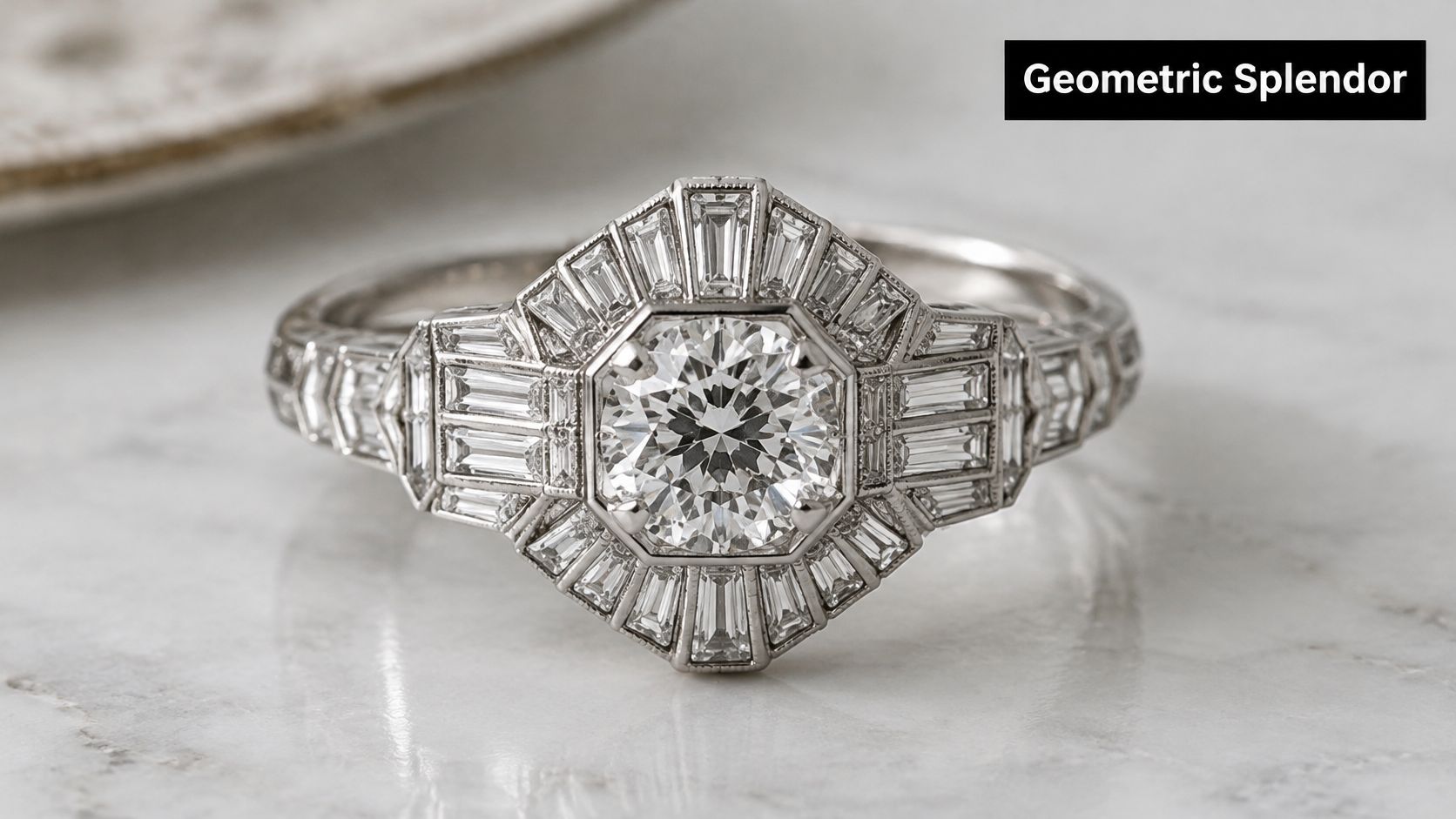
Where an Edwardian jeweler thought in garlands and ribbons, a 1920s designer worked in elevations and setbacks, so the ring reads the same way from every angle. Learn where each motif lives and you can date a design at a glance:
- Chevrons repeat along the shoulders and shank, meeting at a point that lines up with the centre stone.
- Stepped baguette shoulders build the side profile in tiers, the way a 1920s skyscraper steps back as it rises.
- Sunburst patterns radiate from the head across the front, so the setting itself looks lit from the centre.
- Greek key and zigzag bands wrap the shank as engraved or pierced borders.
- Fan shapes flank the head, and rectangular plaque heads frame a stone group inside a flat panel.
The Metropolitan Museum of Art traces Near and Far Eastern sources in Art Deco design, and on a ring that influence surfaces as stylised geometry: a stepped bracket, a repeating key, an abstracted fan. You will not find literal lotus petals or scrollwork rendered nature-first. For the opposite end of the design spectrum, the Get Spliced floral ring guide shows how organic flower motifs follow a curved, petal-led logic, and holding that contrast in mind sharpens your eye for the straight-edged discipline Deco demands.
Turn the ring over and watch how the back is finished.
On a period piece the pattern is cut, pierced or engraved into the metal and integrated with the structure. On a later imitation it is often an applied strip soldered onto a plain band, which shows as a seam under the motif and a slight step at its edge. Symmetry should also hold when you rotate the ring in your fingers, with the head, shoulders and shank balanced on a single axis.
Do this read before any cleaning or resizing. Polish softens engraved borders and can blur the seam of an applied strip, and a resize cut straight through a Greek key band erases the evidence you need. By the end of this pass you can answer one question: which motifs appear on this ring, and do they share a single design logic?
Craftsmanship in Settings, Milgrain and Galleries
Platinum's mechanical behaviour explains why period rings look the way they do. The GIA's study of Art Deco jewelry credits platinum's strength, tarnish resistance and malleability for its place as the preferred material of the period: it held diamonds securely with very little visible metal while supporting precise, intricate outlines. That's where thin geometric rails, fine prongs, pierced galleries and millegrain borders come from, and why the stones appear to float.
Milgrain is the row of tiny metal beads, from the French for "a thousand grains", that frames a stone or edges a band. Each bead is raised by hand with a beading tool and then refined, so the evenness of the row is a signature of the maker's skill. Decades of wear soften those beads, and a heavy polish can flatten them into a blur that no jeweler can rebuild exactly.
Bring magnification and work through five checks:
- Prongs. Each one should be continuous and sit square over its stone. A prong worn thin over decades is honest wear; a prong that's been re-tipped crudely shows as a blob of metal and a colour mismatch.
- Milgrain beads. Look for flattening, gaps or replacement. Worn beads tell you how the ring has lived, and crude polishing is the usual culprit.
- Gallery joints. Solder seams, pitting or fatigue cracks underneath the head point to past repairs. Ask what was repaired, not whether.
- Resizing evidence. A join inside the shank, a changed profile or a thinned band at the back all suggest the ring was sized, sometimes more than once.
- Stone seating. Every stone should sit level and be held firmly. A stone sitting high or tilted was probably set later by someone working without the original mount in mind.
A repair doesn't ruin a ring, but a badly executed one lowers its appeal to a collector. Picture a ring where a resized shank left a visible seam on the inside and the new section is a slightly different white, so the join catches the light. The metal content is unchanged and the ring still wears well, yet it now reads as a working piece rather than an intact period example.
Practical rule: value the ring as metal plus engineered structure. Weight alone tells you what the platinum is worth and nothing about whether the setting will survive another twenty years of wear.
If delicate openwork is the feature you love most, this look at antique filigree rings shows how pierced metalwork was built and where it typically fails.
Gemstones Common in Period Platinum Rings
Diamonds set the standard, because they're what the period's dense settings were designed around. Old European and old mine cuts dominate the centre, with smaller single-cut accents packed close together so the whole surface throws light. Those older cuts have a smaller table, a taller crown and often a visible culet, and that facet pattern is one of the quickest ways to tell a period stone from a modern brilliant dropped into an old mount.
Colour stones were cut to order for the geometry. Calibré means gauged to size, and calibrated sapphires, rubies and emeralds were shaped to fit an exact slot in a border or channel, which is why replacing one is harder than replacing a round accent.
| Stone | Typical Cut or Form | What to Check |
|---|---|---|
| Diamond | Old European, old mine and single-cut accents | Old-cut facet pattern and whether the stone is original |
| Calibré sapphire or ruby | Step-cut or baguette, sized to fit the setting | Fit to the setting; loose or replaced stones lower value |
| Emerald | Rectangular step-cut | Fissures, oiling or resin filling; check for replacement |
| Onyx | Flat-cut or opaque cabochon | Even black colour; dyed or glass substitutes |
| Jade | Cabochon or carved form | Natural versus dyed or treated stone |
| Early paste or glass | Foil-backed or fused stones | Original paste elements add value; avoid harsh cleaning |
Opaque stones did a specific job in this palette. Black onyx and green jade gave the hard contrast against white metal that the style wanted, and period makers mixed them freely with diamonds. A circa-1930 platinum ring set with jade, onyx and diamonds appears in a Tokyo Metropolitan Teien Art Museum exhibition record, as documented in this Art Deco jewelry history, which shows how far the combination travelled across markets.
Treatments and substitutions are where money changes hands. Dyed jade, resin-filled emeralds and glass or early paste elements all turn up in genuine period pieces, and paste in particular is a period feature in its own right rather than a defect. It also damages easily, so it's the last thing that should meet a polishing wheel.
Replaced stones cut in a different style or colour from the original pull value down, while documented original stones push it up. Recording each stone's type, cut and colour on an appraisal gives you something to compare later, and this diamond clarity and colour guide explains the grading terms an appraiser will use.
What Drives the Value of an Art Deco Platinum Ring
Two prices sit inside every one of these rings, and they move independently. The first is the metal: platinum is worth its content whatever the design, and confirmed weight and fineness anchor the floor. The second is the period premium, which lives or dies on condition and originality. Each layer you checked earlier (marks, construction, motifs, stones, repair history) feeds one of those two numbers, which is why the ring should be assessed before any work is done on it.
Here are the factors in the order they usually shift a number:
- Metal weight and fineness. Check it against the stamp, and for a high-value piece, get independent laboratory testing in writing before relying on the fineness.
- Setting integrity. Intact prongs, sound galleries, no crude re-tipping.
- Milgrain condition. Crisp beads support value. A collector's primer on Art Deco jewelry notes that original milgrain is nearly impossible to restore precisely, so flattened beads permanently cost the ring something.
- Stone originality. Documented original diamonds and calibrated colour stones add; replacements of the wrong cut or colour subtract.
- Repair and resize history. A visible solder seam or mismatched metal lowers collectible appeal even when the ring is structurally fine.
- Documentation. Receipts, earlier appraisals and family history support the attribution, and reporting on what makes Art Deco jewelry valuable singles out missing stones and replaced original features as the factors that cut what a piece brings. If the ring came down through the family, this guide to what counts as estate jewelry explains how inherited pieces are classified before a sale.
- Market demand. WPIC's May 2025 market update forecast 8% growth in North American platinum jewelry demand for 2025, a projection that supports the metal side of the equation rather than the period side.
Put two rings side by side to see how far apart those forces pull. Both carry a 950 stamp and weigh within a gram of each other. One has crisp milgrain, its original calibrated sapphires and a shank that has never been cut. The other was sized twice, lost a border stone to a round replacement and has beads polished almost smooth. The metal is nearly identical. The offers won't be, because one ring still carries its period premium and the other sold it off, one repair at a time.
Protect Value and Get a Local Appraisal in Boise
A platinum stamp only means something if the metal and workmanship around it are still original. The well-meant steps before an assessment are the ones that cost the most, because a polish, a cleaning or a resize erases the very evidence an appraiser reads. Follow this sequence first.
- Photograph it properly. Top, both sides, the inside of the shank and every stamp, in daylight, before anything else happens.
- Don't polish it. A buffer flattens milgrain and rounds off the crisp edges that prove hand finishing.
- Skip the ultrasonic cleaner. Fragile calibrated stones and early paste elements can loosen or cloud. Warm water with a soft brush on the metal only is the safe route.
- Don't resize before an appraisal. Sizing removes original shank detail and can change the profile a collector is looking for.
- Gather the paper trail. Boxes, receipts, earlier appraisals and family history all support the attribution, and a written record of condition and value is what insurers expect too, which is the discipline behind TLC Moving & Storage's documentation guide.
- Write down every repair and replacement. A short honest list beats a surprise during negotiation, and it is also the basis for getting a jewelry appraisal that holds up.
Once the ring is documented, testing can happen without touching it. X-ray fluorescence gives a rapid, nondestructive read on gold, platinum and silver, producing alloy-concentration data in approximately 2 to 5 seconds per sample with accuracy within a few tenths of a percentage point of fire-assay results, and the item is never melted or altered, so your ring keeps its condition throughout, as Bruker's precious metals analysis overview explains.
That layered read is what settles the question. Our local team in Boise provides prices and insights on gold, silver, jewelry and diamonds, and we buy gently used jewelry. Authentication here goes beyond a glance at a hallmark: each luxury item is verified through Entrupy or expert review, with materials and craftsmanship examined and serial numbers checked through certified websites before anything is agreed.
Selling locally also removes a practical risk. Online gold-buying services commonly cap shipment insurance below a parcel's full value, with reviewed coverage limits ranging from $1,000 to $25,000 and at least one service requiring sellers to buy extra insurance above $2,500. Packing a ring into a box under those terms is a gamble a face-to-face visit avoids.
If the assessment turns up a loose stone or a worn prong, jewelry repair is available with a free estimate before work begins and a 30-day workmanship warranty on the finished job.
Bring the photographed, unpolished ring in before you clean it, resize it or list it anywhere.
Carat 24 - Trusted Gold Experts buys gently used jewelry of exactly this kind, and the Boise team will read the marks, examine the materials and craftsmanship, and tell you what the stones, workmanship and condition are worth before you commit to anything. Come in person to 3780 W. State St. and skip the shipping risk that comes with mailing a piece this delicate. Visit Carat 24 - Trusted Gold Experts to see how a face-to-face offer works.
