
The most repeated tip in gold bars vs gold coins is simple: buy coins because they are easier to sell. That advice treats every sale as a one-ounce trip to a retail counter, and it skips what you keep. A familiar coin can be the right tool for a small sale. A recognized bar can put more fine gold in the same budget and cost less to sell when the buyer wants that whole piece. The useful test is net proceeds after premium, dealer spread, testing, shipping, insurance, and tax, not which product looks simpler on a shelf.
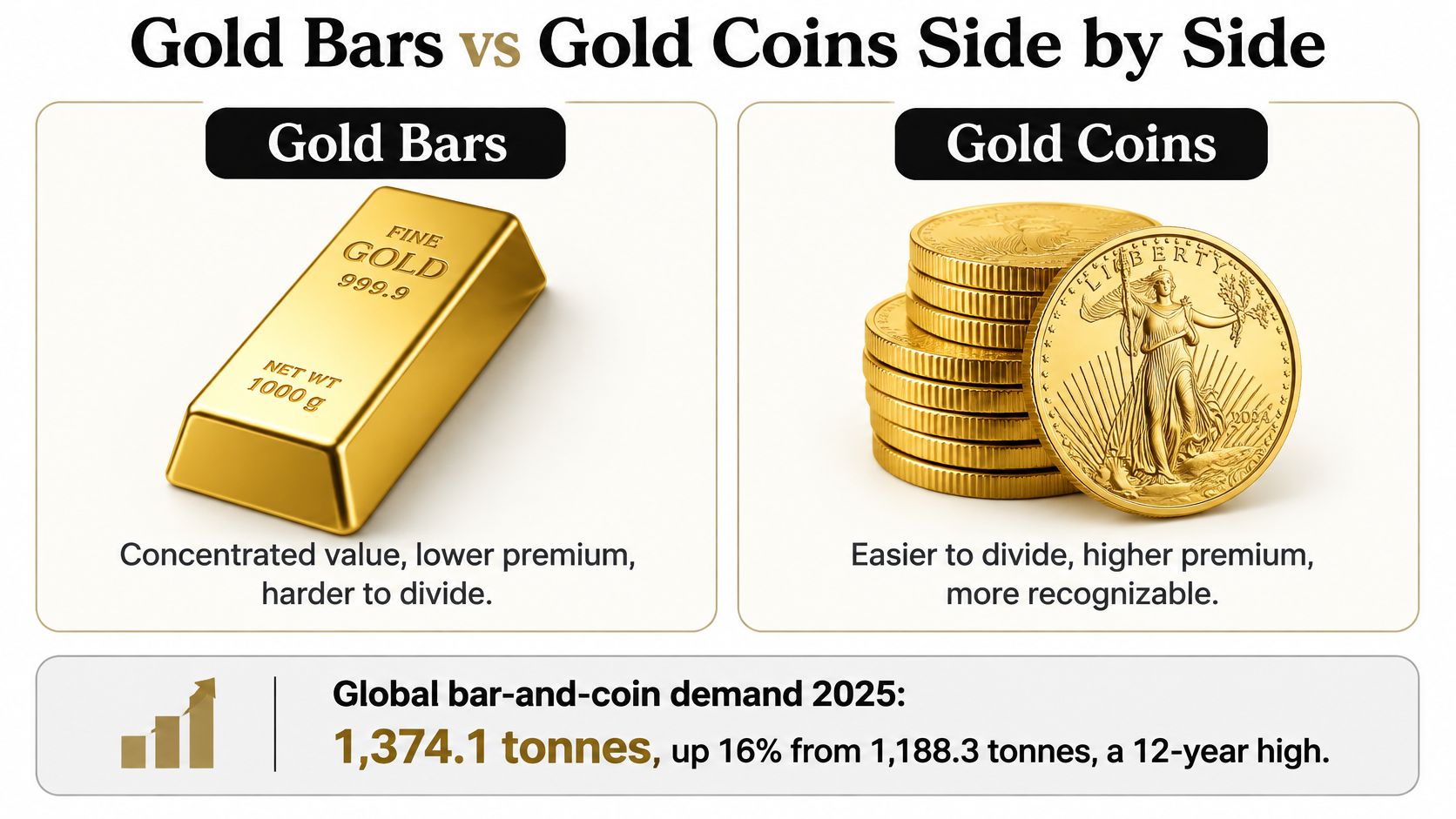
Gold Bars vs Gold Coins Side by Side
Coins are not the easier product in every market. In 2025, worldwide bar-and-coin demand reached 1,374.1 metric tonnes, a 16% increase from 1,188.3 tonnes in 2024 and the highest level in 12 years, with purchases worth about US$154 billion, according to the World Gold Council's full-year Gold Demand Trends. Bars accounted for 1,068.2 tonnes, up 24% year over year, against about 305.9 tonnes for coins and medals. Bars were roughly 77.7% of combined demand, more than three times coin-and-medal volume.
Larger recognized bars usually buy more fine gold per dollar. Familiar one-ounce coins fit smaller units and partial sales. China's bar-and-coin demand rose 28% to 431.7 tonnes, and India's rose 17% to 280.4 tonnes, so the bar-heavy year was not a local quirk.
What changes the price you pay
| Decision point | Gold bars | Gold coins |
|---|---|---|
| Premium over spot | Usually lower on larger bars; very small bars can be expensive per ounce | Often higher because of minting, design, and distribution |
| Purity the buyer should quote | Stated fineness; Good Delivery minimum 995 parts per thousand | Legal-tender coins can be 22k alloy while still stating exact fine gold, as the Eagle does |
| Common sizes | 1 oz, 10 oz, 100 g, kilo; wholesale Good Delivery about 350-430 oz | 1/10 oz, 1/4 oz, 1/2 oz, and 1 oz |
| Divisibility | Poor if one large bar is the whole position | Strong; one coin can be sold without melting the rest |
| Storage and insurance | Fewer pieces and more value in each piece | More pieces, easier to split, more items to track |
| Main authenticity cues | Refiner, weight, fineness, serial number, assay card | Sovereign design, weight, diameter, edge, and stated fine content |
| Best first fit | A larger allocation where fabrication cost per ounce matters | Partial sales, gifts, and widely recognized bullion units |
A cell is not a live quote. Premiums move with size, mint, purity, and supply, and a tiny bar can cost more per ounce than a common coin. Check fine weight, then run the net-proceeds test, before you buy or sell. A written local offer, including Gold and Jewelry Buying, can beat a mailed shipment once postage and cover come off the check.
Fine Gold Weight Inside Bars and Coins
Price talk starts with the wrong unit if you weigh the whole piece, read the face value, or judge the shine. The unit that matters is fine troy ounces of gold.
The United States Mint one-ounce American Eagle contains exactly 1.000 troy ounce of fine gold. The complete coin weighs 1.0909 troy ounces, or 33.931 grams, because it is 91.67% gold, 3% silver, and the balance copper. It is 22-karat, not 24-karat, and it still delivers that stated ounce. It carries a US$50 face value, measures 32.70 millimeters (1.287 inches), and has a reeded edge. That fifty dollars is legal tender, not the gold value. Our note on the gold content of U.S. coins walks through the same split for other issues.
Coin specs next to a wholesale bar
| Product | Fine gold | Gross size | Purity | Do not treat as gold value |
|---|---|---|---|---|
| American Eagle gold coin | 1.000 troy ounce | 1.0909 troy oz or 33.931 g; 32.70 mm diameter | 91.67% gold, 22-karat, plus silver and copper | US$50 face value |
| LBMA Good Delivery bar | About 400 troy ounces | Wholesale bar, not a household stack | At least 99.5% fineness | A single headline spot price with no assay or serial check |
Retail investment bars are judged on stated fine weight, purity, refiner, serial number, and assay. Buyers do not look for a government face value. Large wholesale bars under the London Good Delivery framework are commonly associated with about 400 troy ounces and at least 99.5% fineness. Those bars settle between recognized participants in the London wholesale market. Ordinary coins do not.
Practical rule: Compare fine-gold weight, not total product weight, face value, or how heavy the piece feels in your hand.
A heavier Eagle is not more gold than a one-ounce 24-karat bar. Both can hold one fine ounce, and the coin's extra mass is silver and copper. A bar near 400 ounces is efficient metal and a poor household unit, because value, storage, insurance, and assay needs sit in one piece.
Premiums and the Real Cost per Ounce
Premium is the amount you pay above spot for a specific item. Two stickers next to spot do not tell you the cost of getting in and getting out.
Add the purchase premium to the discount you expect on resale, then add shipping, insurance, and any assay. Larger bars spread fabrication across more ounces, so more of the check buys metal. Sovereign coins carry minting and distribution costs that often stay in the premium. Very small bars can erase the bar advantage and cost more per ounce than a common one-ounce coin. If you are still mapping the quote, start with what the gold spot price is and then ask for the premium on the exact piece.
Costs that change what you keep
| Cost component | How to measure it | Why it matters |
|---|---|---|
| Purchase premium | Price paid above spot, per fine troy ounce | Sets the cost of entry for bars and coins |
| Expected resale discount | Dealer bid below spot on the day of sale, per fine ounce | Decides what the sale returns |
| Shipping and insurance | Carrier cost plus the declared-value cover you actually buy | A mailed sale can shrink a small lot |
| Assay or verification | Paid testing or documentation fee | Needed for secondary-market bars |
| Tax | Gain on sale, treatment confirmed with a tax adviser | Can differ by product and account type |
The LBMA Good Delivery specification requires 350 to 430 fine troy ounces, about 10.9 to 13.4 kg, and minimum fineness of 995 parts per thousand. Weight is recorded in 0.025 troy-ounce steps, rounded down. Qualifying bars can settle in the London over-the-counter market with less repeated testing between recognized participants. Coins do not qualify for that channel. A bar in that range is not a household checkout, and its value, storage, insurance, and assay support sit in one asset.
One sale or several
Say you expect to sell the whole position at once to a dealer. The lower-premium larger bar usually wins, because you are not paying minting costs on every ounce and you are not splitting the lot. Say you expect to sell a few ounces at a time. Several recognized one-ounce coins can win even after a higher purchase premium, because the unsold ounces stay intact and you do not have to find a buyer for a 10-ounce or kilo piece.
U.S. bar-and-coin demand fell 25.2%, from 77.5 tonnes in 2024 to 58.0 tonnes in 2025, per the World Gold Council's U.S. figures. A quieter national bid can widen spreads even when the global market is busy. Ask for the premium per fine ounce on the exact item, not a blended store average.
When Coins Are Easier to Sell Than Bars
Coins are not automatically more liquid than bars. The gold price can be easy to trade while your particular bar or coin is not.
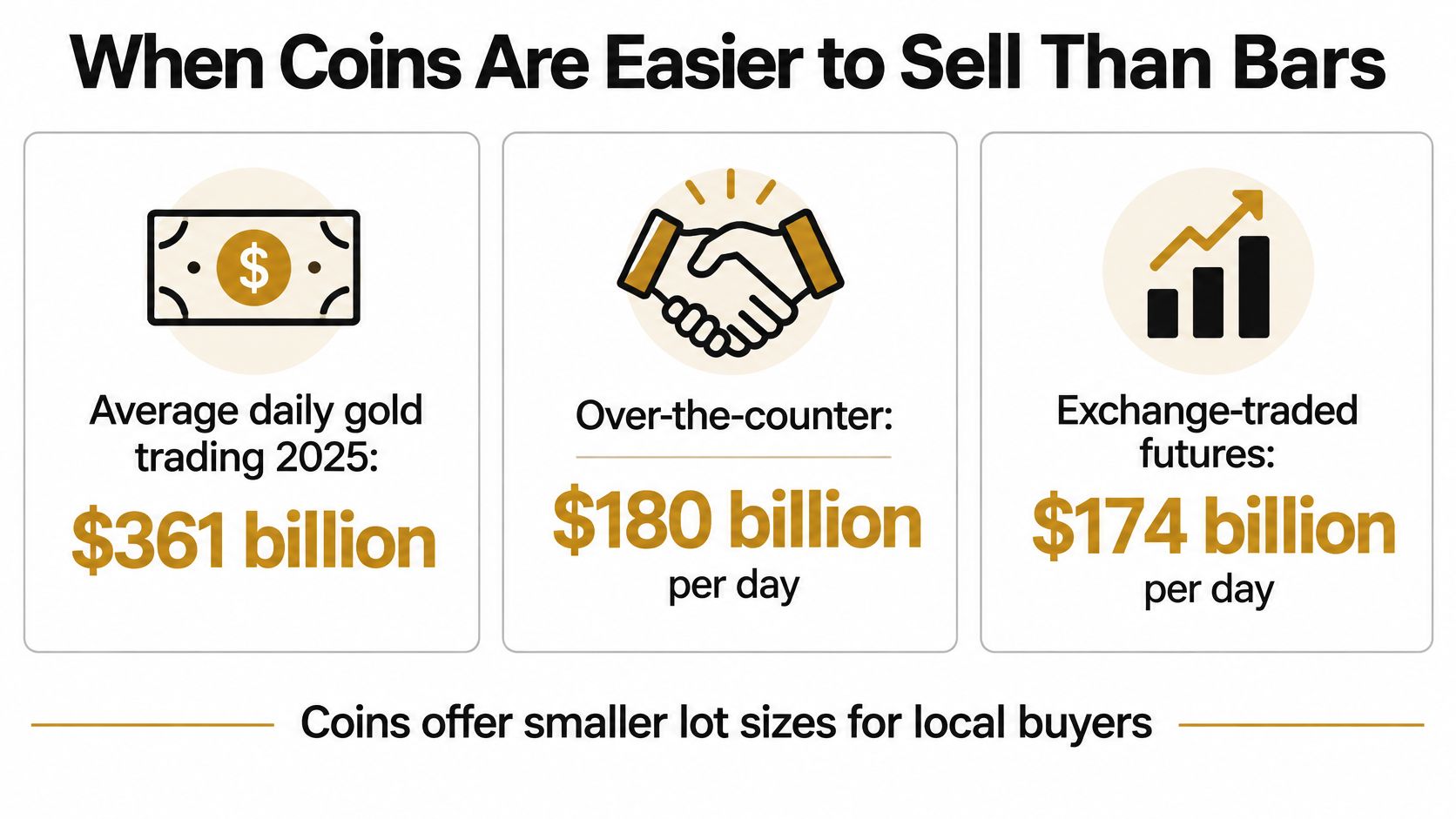
The overall market is deep. Average 2025 trading volume was about $361 billion a day, including about $180 billion in over-the-counter trading and $174 billion in exchange-traded futures, as summarized in this capital-gains overview of precious metals. That volume supports the price. It does not guarantee a tight bid on a damaged coin or an obscure bar in Boise.
Official-coin demand fell 15% to 170.5 tonnes in 2025, while bar demand rose, according to the World Gold Council's 2025 investment release. That split undercuts the idea that coins always have the stronger bid.
Where the coin still wins
A recognized one-ounce Eagle, Maple, or Britannia can be identified and sold one piece at a time. You do not melt the rest of the stack. A 10-ounce or kilo bar may need a buyer who wants that exact size, or you accept a wider spread. If you are choosing a counter, this guide to where to sell gold coins is the retail side of that choice.
Numismatic premiums are a separate trap. A collectible price paid on the way in is often not recovered when the piece sells for melt. Investment precious metals are generally treated as collectibles for federal capital-gains purposes, and long-term gains can face a maximum 28% rate, though exceptions and IRA rules can apply to particular coins and structures. Confirm treatment with a tax adviser before you model the sale.
Coins are more liquid for small, incremental retail sales. Bars are more efficient when the sale matches the bar size and the product is widely recognized.
Run the same net-proceeds math on one ounce versus a whole bar: purchase premium, bid, assay, shipping, insurance, and tax. The format that looks busy in a display case can still return less once those lines are filled in.
Storage Risks and How Gold Gets Tested
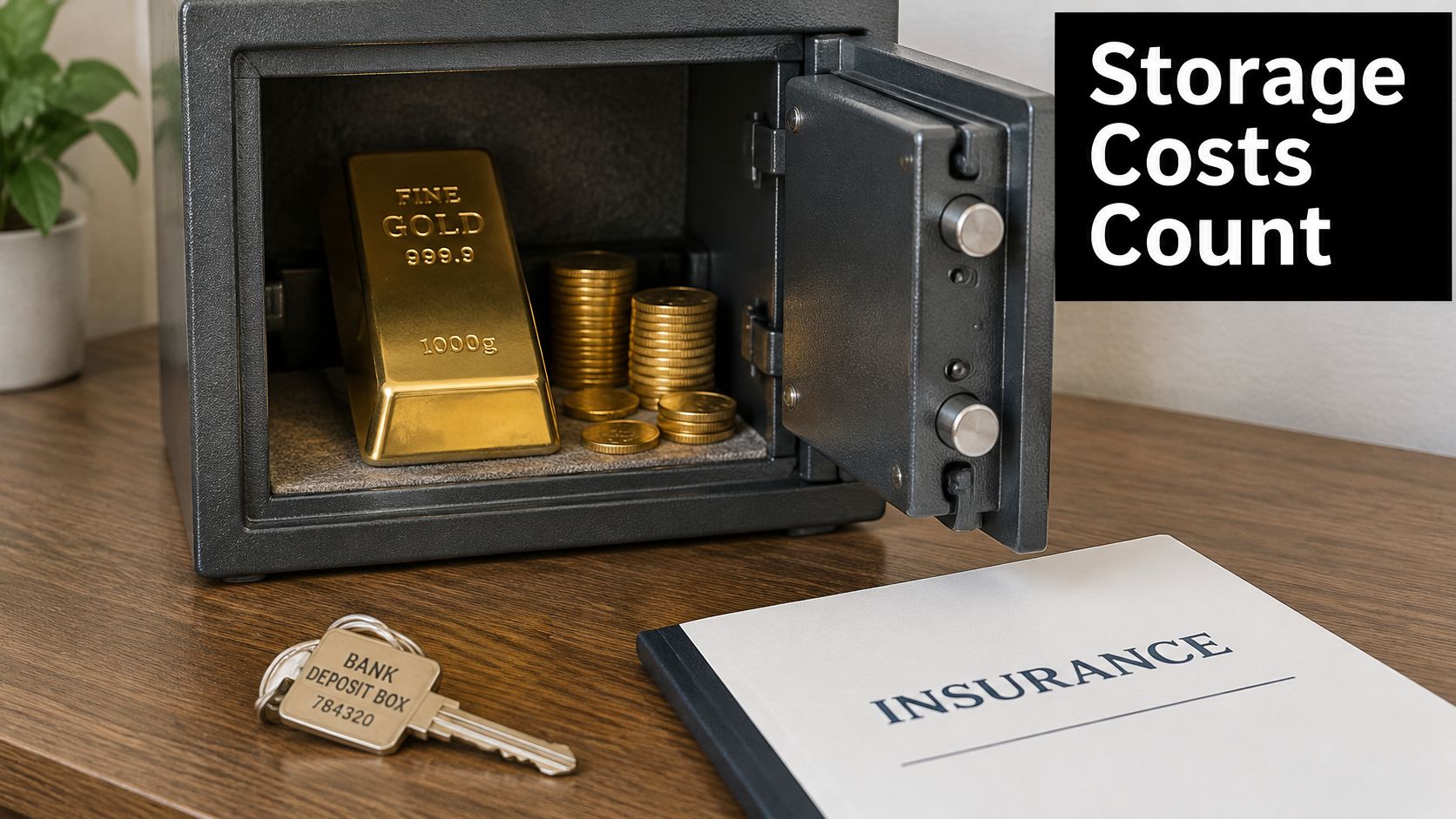
Storage is a cost, not a footnote. A large bar concentrates value, so a home safe, a bank box, and insurance all sit inside the return. Several coins are easier to divide and easier to misplace or scratch.
Keep the paperwork with the metal
- Bars: Keep the assay card, mint or refiner packaging, and serial number with the bar. A missing card often means a wider bid or a paid test.
- Coins: Do not clean them. Scratches and polish can cut a resale bid even when the fine gold is unchanged.
- Either format: Photograph serials and packaging before you move the pieces, and insure the amount you could not replace from cash on hand.
The FTC's jewelry buying guidance says gold jewelry should carry a karat-quality mark and the responsible maker's trademark, and it advises you not to buy a piece that lacks both. Get refund and return terms in writing. The FTC Jewelry Guides also expect truthful statements of type, quality, metallic content, weight, price, and value. That is the standard for hassle free offers: karat or fineness, weight, the market basis, and how the number was built, not a lump sum with no math.
What an X-ray reading can and cannot do
The Gemological Institute of America reports that X-ray fluorescence can measure gold content to within 15 parts per thousand when the item is flat and homogeneous and the instrument is calibrated to a similar alloy. XRF reads a surface. Shape, mixed alloys, or plating can mislead it, so a professional evaluation may combine scanning with other methods. For bullion, add weight, dimensions, magnetism, and assay paperwork rather than trusting one screen. A plain walk-through of how to test gold purity covers those checks before you accept a number.
Carat 24 offers an Authentication service, and our Boise counter does Gold and Jewelry Buying with Xray Scanning and Gold Testing for free. Compare that written result with any mailed offer before you ship.
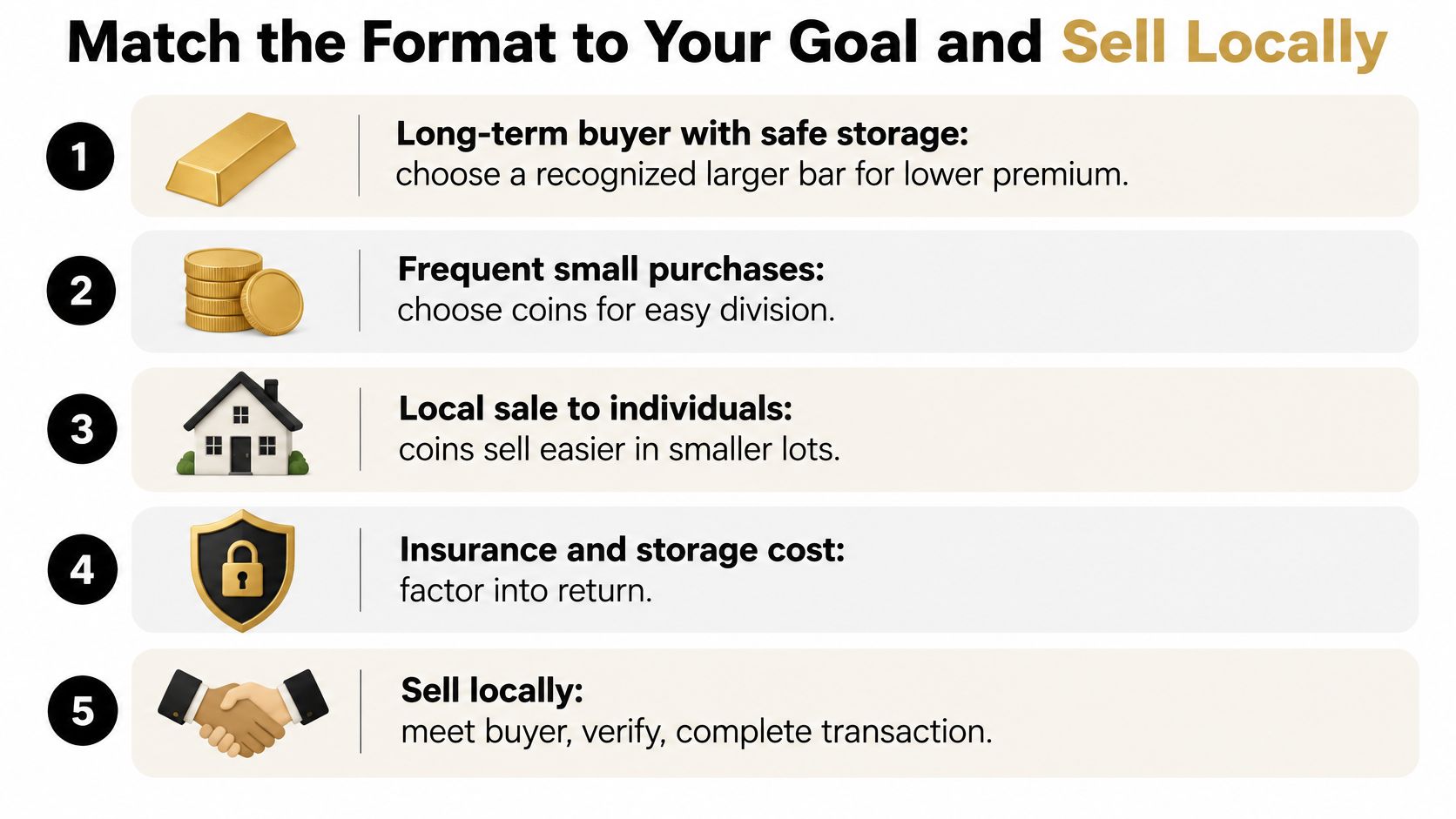
Match the Format to Your Goal and Sell Locally
Pick the format that matches the size of the future sale. Five common situations, one pick each:
Someone placing several thousand dollars for the long haul, who can store and insure one piece, usually does better with a recognized larger bar. Less money goes to fabrication.
Someone who may need an ounce or two for an emergency should buy one-ounce sovereign coins, not a kilo that must be sold whole.
A gift or a first purchase is usually a familiar coin. The unit is small, and a buyer can recognize the design without a lab.
A mixed estate of jewelry and coins should be valued by component. Bullion, worn karat jewelry, and numismatic pieces each get a different bid. We buy and sell gold, silver, bullion, coins, and other precious metals, and we also buy gently used jewelry, so those pieces do not have to share one blended number.
An investor chasing a collectible date or a proof finish is no longer making a bullion comparison. Pay the collector premium only if you expect a collector to pay it back.
The private-mint middle case
Gold and silver rounds sold on our site are privately minted and are not legal tender. If a round is not legal tender, do not assume a coin collector's bid. Price it like bullion: fine weight, fineness, and the spread, not a sovereign design. Physical metal is also only one sleeve of a wider plan. Readers building a broader mix can diversify beyond listed Australian markets with Wealth Collective's alternative-investment overview, then come back to the bar-or-coin choice for the ounces they want to hold.
Local net versus a mailed offer
Save the hassle and sell locally for more than online shipments. In Boise, compare the written local offer with the online net after caps and insurance. One reviewed service insures USPS shipments only up to $1,000, while another offers FedEx coverage up to $5,000 unless you buy more, according to Top Consumer Reviews. Reviewed Price Matching programs can require written proof of a competing offer and may cap the matched amount at 90% of that day's gold market price. If you want the highest payout in Boise, put both offers on the same fine ounces and subtract what the mailer will not cover.
Ask us for Gold and Jewelry Buying, free X-ray scanning and gold testing, a hassle-free offer showing karat or fineness, weight, and market basis, and price matching against a real competing quote. The steps for how to sell gold bullion line up with that counter visit. Reach Carat 24 at (208) 314-9995 or info@goldsilveridaho.com, or come to 3780 W. State St. in Boise.
Carat 24 - Trusted Gold Experts buys and sells gold bars, gold coins, silver, and jewelry in Boise, and we price pieces from fine weight, fineness, and a written market basis rather than a single lump sum. Bring the bar, the coins, or the mixed estate and we will test them in person, including free X-ray scanning, so you can compare a local offer with a mailed shipment before you pay for insurance. Visit Carat 24 - Trusted Gold Experts to start with the format that matches the sale you expect to make.
