

You've opened a jewelry box and found a broken chain, rings you no longer wear, and a few inherited pieces you're not sure how to value. You'd like to turn some of them into money, but handing everything across a counter without understanding the offer doesn't feel right.
To sell gold locally in Boise, treat the visit as a documented transaction, not a hunt for the biggest advertised payout. Know what you're bringing, understand how the buyer evaluates it, and keep enough paperwork to explain what you sold and what you received.
Estimate Your Local Gold Payout Before You Go
Start with this formula: estimated fine-gold weight × current benchmark price × the buyer's disclosed payout percentage, minus itemized deductions. Use a benchmark price expressed in the same weight unit as your estimate. Otherwise, even correct arithmetic can produce a misleading answer.
Fine-gold weight means the gold itself, not the weight of the entire piece. The following table uses rounded working shares for estimating, not a guarantee that a stamped item will test at exactly that purity.
Fine gold content by karat mark
| Karat mark | Fine gold share | Fine gold in a 10 g item |
|---|---|---|
| 10K | 41.7% | 4.17 g |
| 14K | 58.3% | 5.83 g |
| 18K | 75.0% | 7.50 g |
| 22K | 91.7% | 9.17 g |
| 24K | 99.9% | 9.99 g |
For a hypothetical 10-gram 14K ring, applying the table's rounded share gives about 5.83 grams of fine gold, provided the full weight is the stated alloy. A stone-set ring requires a different starting weight.
Gross weight can include gemstones, spring mechanisms, non-gold findings, and components with different purity. Don't subtract every clasp or solder joint automatically, because some contain gold. Instead, flag uncertain components and have the buyer explain what they exclude.
Separate the market reference from the offer
The benchmark isn't a promise of payment. A buyer's payout accounts for its purchasing margin and any disclosed processing deductions; our explanation of the spot price of gold and silver helps distinguish that reference from a retail purchase offer.
Ask whether the piece is being priced for melt value or as something that can be resold intact. A maker's name, collectible coin, antique setting, or valuable gemstone may justify a separate evaluation rather than immediate scrap pricing.
Local recycling is an established market: the U.S. Geological Survey estimated that approximately 90 metric tons of new and old gold scrap were recycled in the United States in 2024, equal to about 45% of reported domestic gold consumption. That context doesn't establish your payout, but it explains why even broken jewelry can have recoverable value.
Set your floor: Divide the minimum total payment you'd accept by your estimated fine-gold grams. Write that minimum payout per gram on your worksheet before leaving home.
Prepare and Verify Your Gold Step by Step
Preparation isn't about making old jewelry look new. It's about giving yourself a reliable record of what you brought and helping the evaluator distinguish ordinary scrap from pieces that deserve closer attention.
Use this visual checklist to organize the appointment.
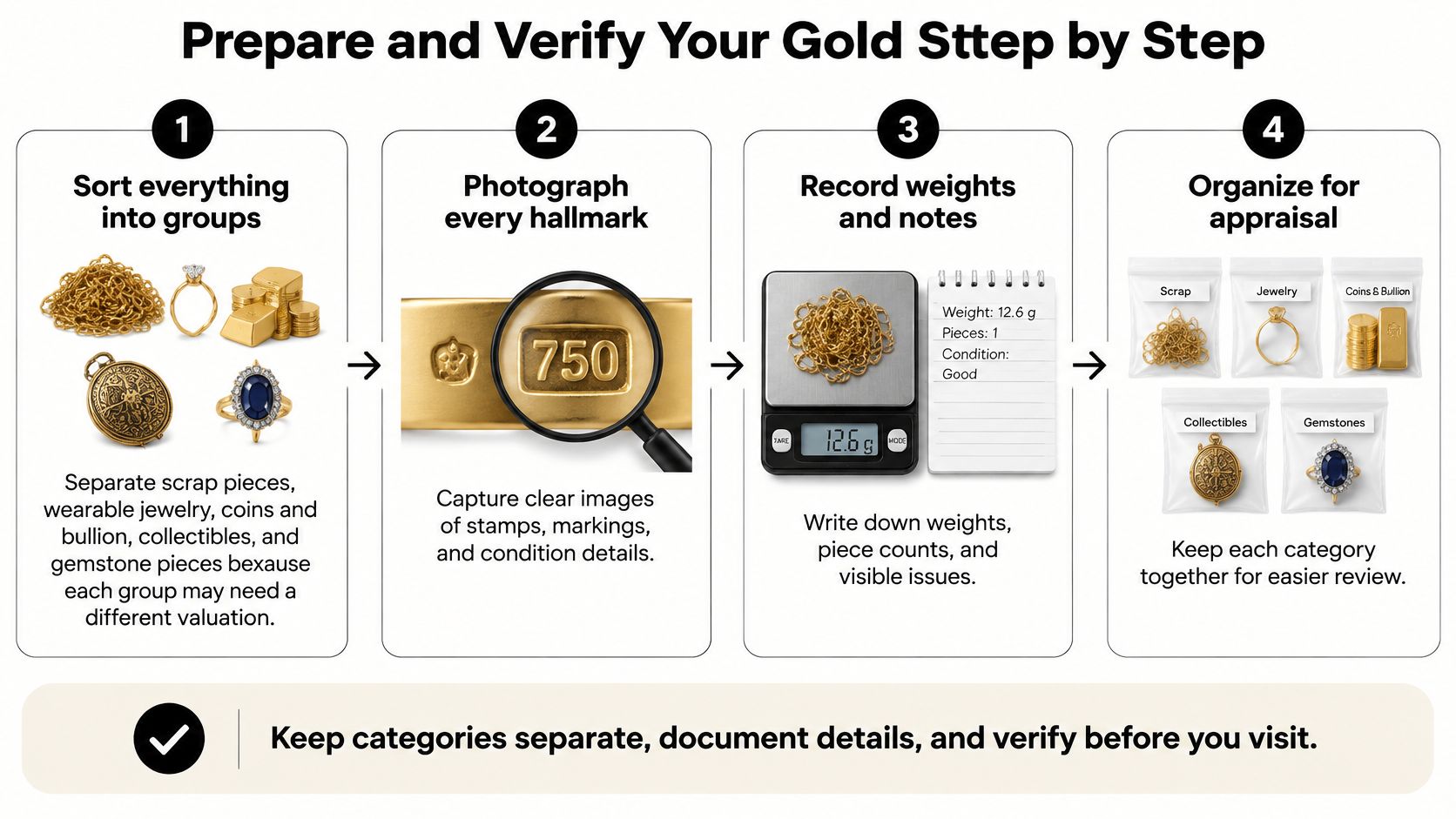
Build an item-by-item inventory
- Sort by valuation category. Separate broken scrap, wearable jewelry, coins and bullion, potential collectibles, and gemstone pieces. A mixed bag makes it easier to overlook a coin premium or a signed piece that shouldn't be priced solely for metal.
- Photograph identifying details. Capture each item, its hallmark, maker mark, stones, clasp, and visible damage before anyone handles it. Use a plain background and keep the photographs clear enough to match each object to your inventory.
- Record marks without treating them as proof. The Federal Trade Commission's jewelry guidance explains that a karat quality mark identifies gold proportion and recommends checking for a trademark alongside it. If neither is visible, write purity unverified, rather than guessing from color.
- Weigh pieces individually. Use a digital jewelry scale readable to 0.01 gram and record the displayed gross weight, while treating the home measurement as preliminary. Check that the scale is set to grams, not another unit, and don't combine different marked purities into a single weight.
- Leave the condition alone. Don't polish, dip, resize, or dismantle pieces before evaluation. Alterations can change collectible condition, remove useful surface evidence, or make it harder to establish what you originally owned.
- Identify stones and mixed components. Note pearls, gemstones, steel springs, watch movements, and anything else that isn't plainly the same gold alloy. Don't pry stones out yourself, and don't authorize removal without understanding how the stones will be identified and returned.
- Date and duplicate the inventory. Give each item a description, visible mark, gross weight, photograph filename, and condition note. For an estate, have another family member confirm the list and keep a separate copy.
Make uncertainty visible
A useful entry might describe a yellow-metal ring with a visible karat stamp, a clear center stone, a bent setting, and a matching photograph. That's more helpful than calling it a gold diamond ring when neither the metal nor the stone has been confirmed.
Put loose items in separate labeled bags or compartments. Keep coin packaging, grading documents, and original boxes with the relevant pieces rather than mixing them into the scrap group.
At the counter, your preparation sheet should have one line per item, with unknowns clearly identified. The buyer should be evaluating those unknowns, not guessing which piece belongs to which photograph or family record.
Test Purity Without Damaging Your Gold
Gold testing methods and their limits
| Method | How it works | Main limitation | Best use |
|---|---|---|---|
| Touchstone with acid | Streak on stone, compared with reference needles and acids | Judgment dependent; removes a tiny sample | Quick screening of plain pieces |
| Capacitive testing | Measures the metal's electrical response | Less reliable on plated or layered items | Fast first-pass check |
| X-ray fluorescence (XRF) | Nondestructive elemental scan | Surface-focused reading that needs calibration | Higher-value or disputed pieces |
| Hydrostatic weighing | Compares weight in air and water | Least suitable in GIA's comparison | Rarely the right standalone choice |
The distinction is between screening and confirmation. A quick check can help sort a mixed group, but it shouldn't settle every disagreement about a valuable item.
The Gemological Institute of America's touchstone guidance describes a relatively nondestructive method using an unobtrusive sample, reference needles, and acid reactions observed after roughly 20 to 40 seconds; its comparative findings also identify limitations in touchstone, capacitive, and XRF testing, with hydrostatic weighing the least suitable. No single convenient test deserves unquestioning trust.
What the results actually tell you
With touchstone testing, the evaluator rubs an inconspicuous area against a testing stone and compares the streak's response with known references. The acid goes on the streak, not casually across your finished jewelry. Because a small amount of metal is removed, relatively nondestructive doesn't mean completely untouched.
Capacitive testing offers a quick electrical reading, but contact quality and layered construction can complicate interpretation. A result that conflicts with the hallmark or the item's construction should prompt another method, not an argument about which number looks preferable.
XRF identifies elements in the scanned area without taking a conventional sample. Its weakness is that the scanned surface may not represent the whole object, particularly where plating, repairs, or different components are involved.
Hydrostatic weighing estimates composition through density. Hollow construction, stones, and trapped air make that approach especially awkward for jewelry, so a quote based only on weighing an item in water deserves questions.
Protect the piece while resolving doubt
A hallmark is a starting clue, not a substitute for examination. For an expensive, unusual, or disputed piece, request an independent assay or an XRF confirmation suited to the item. Ask whether any proposed assay requires cutting, drilling, or another alteration before consenting.
At Carat 24, we offer Xray Scanning and Gold Testing for free, allowing you to compare our reading with a second evaluation without paying for our initial test. Our guide to determining gold purity provides additional context for interpreting the result.
Don't authorize melting, filing, or stone removal merely to receive a preliminary offer. Agree on the testing method and any alteration first.
Request a written record showing the tested karat, evaluated weight, and method used. A verbal statement that something tested as gold isn't enough to explain a pricing disagreement later.
Vet a Local Buyer and Spot Red Flags
An older seller clearing a family estate may have only one chance to safeguard both the valuables and the paperwork. A nearby address alone does not establish trust. Before visiting, verify the buyer's business name and permanent location, review complaint history, and check applicable licensing requirements. Read the privacy policy and written terms. Ask whether an offer is binding, when it expires, and whether an evaluation obligates you to sell.
An appointment should give you time to consider your options, not push you into a decision.

The Commodity Futures Trading Commission's precious-metals fraud guidance cautions that retail precious-metal dealers are generally not regulated by state or federal authorities. It advises avoiding traveling dealers who operate from hotel rooms, cars, homes, or temporary meeting places. A polished advertisement is not independent proof that a business is trustworthy.
Check conduct as well as credentials
- Temporary premises: Be wary if a buyer has no independently verifiable permanent location or cannot explain where transaction records are kept.
- Immediate surrender: Leave if someone demands your gold before explaining the offer or discourages you from taking time to decide.
- Protect-your-savings requests: Don't buy gold, transfer money, or hand over valuables because a caller says it will secure your accounts.
- Official impersonation: Check government-related claims using contact information you find independently, not a number supplied by the caller.
- Unexplained deductions: Stop if the buyer will not explain how the offer was calculated or what charges apply.
Use the same questions for every candidate, and record each answer so you can compare how clearly buyers explain their terms. The templates for checking provider reliability can help organize those notes.
This video provides additional context for evaluating a local buyer.
Give yourself permission to leave
Older sellers and estate heirs can reduce pressure by booking an appointment, bringing a trusted companion, and deciding beforehand not to accept an offer in haste. For estate property, confirm who has authority to sell before arranging a visit. Keep your notes and any paperwork provided, so you have a record of who assessed the items and what terms were discussed.
Carat 24's local team in Boise provides prices and insights on gold, silver, jewelry, and diamonds. Its storefront is at 3780 W. State St. Evaluate the business by the same standards you apply to any buyer. The guide to reputable gold buyers can help you prepare questions. Clear explanations and a verifiable location matter more than convenience alone.
Compare Offers and Negotiate the Payout
Compare net payout per gram of fine gold, not just the largest total written on a slip. Divide the final payment by the fine-gold weight the buyer has accepted. If buyers disagree about that weight, resolve the difference before deciding which offer is better.
Collect three written offers on the same day where practical. Ask each buyer to record the benchmark and timestamp used, then request refreshed quotes against a common reference if the market moved between visits. Don't try to adjust an old offer yourself without knowing how that buyer calculates it.
Make the quotes comparable
| Quote detail | What you need explained |
|---|---|
| Gross weight | Which items were included |
| Excluded materials | What was removed from the calculation and why |
| Purity | Tested karat and conversion to fine-gold weight |
| Valuation basis | Melt purchase, intact resale, bullion, or collectible value |
| Deductions | Every fee or adjustment before payment |
| Net settlement | What you receive and by what payment method |
The Federal Trade Commission's precious-metal jewelry guidance recommends personal recommendations, checking a business name alongside complaint or review searches, and obtaining return or refund policies in writing. Apply that same preference for written clarity to the offer itself.
Stay present during weighing and testing. If items must leave your sight for further examination, require an itemized custody record and an explanation of what will happen before agreeing.
When searching, use Gold and Jewelry Buying as a category, then check whether each business evaluates your type of property. A jewelry buyer, bullion dealer, and collectible specialist may recognize different sources of value. Per-gram comparisons work for the metal portion, but shouldn't erase a separate gemstone or collectible premium.
Use a competing offer without accepting pressure
For bullion, record the refiner or mint, stated fineness, assay packaging, and serial details where present. Don't apply a wholesale bar standard indiscriminately to ordinary retail coins and bars, and don't remove protective packaging just to make comparison easier.
Carat 24 presents its highest payout in Boise positioning as a claim you should test with your own written comparisons, not accept as a guarantee. We advertise Price Matching: bring a higher competing written offer and ask us to match it before you sign. Confirm that both offers cover the same items, valuation basis, and net payment.
Walk-away rule: Decline any quote you can't explain line by line, even if its headline total looks attractive.
An offer can be competitive without being right for your timing or your attachment to the piece. Our discussion of whether to sell gold now can help you separate the decision to sell from the negotiation over price.
Local Sale Versus Shipping Gold Online
Local sale compared with mailing gold
| Factor | Selling in person locally | Shipping by mail |
|---|---|---|
| Insurance cover | No parcel insurance needed for counter settlement | Eligible domestic coverage available; declared-value fees apply |
| Proof required | Itemized written sale receipt | Proof of value and insurance retained by shipper |
| Claim window | No postal claim involved | Postal filing deadlines apply |
| Payout basis for claims | Sale payment agreed directly | Actual value at mailing, capped by purchased coverage |
| Excluded losses | Postal exclusions don't apply | Consequential losses and certain packaging or fragility losses excluded |
| Time to payment | Same visit if evaluation and payment terms allow | After delivery, evaluation, acceptance, and payment processing |
The USPS insurance and extra-services guide states that eligible domestic mailpieces can have coverage up to $5,000, with fees based on declared value, and that loss or damage claims generally must be filed within 60 days of mailing. Keep proof of value and proof of insurance; a tracking receipt alone doesn't establish what the contents were worth.
The USPS insurance receipt terms explain that claims reflect actual value at mailing, limited by the insurance purchased, and exclude consequential losses and certain improperly packaged or overly fragile articles. Buying coverage doesn't guarantee recovery of your anticipated sale proceeds.
Compare the money you actually keep
Mailing adds packing, insurance, tracking, and waiting to the transaction. Before shipping, establish who pays return postage, whether rejection of an offer triggers charges, and when the buyer considers the price fixed.
Our Hassle free offers approach in Boise lets you discuss the evaluation face to face and avoid the parcel stage. A local buyer can test, quote, and complete payment during a visit when the items and settlement terms permit.
Save the hassle and sell locally for more than online shipments is a goal to verify through net offers, not a universal promise. Compare the local payment with the online payment after shipping, insurance, and other deductions; our guide to selling gold jewelry online helps frame that comparison.
Shipping can still make sense when a specialist is far away or a dealer has already priced a clearly identified bulk lot. Use the route that gives you the strongest documented net result.
Document Every Sale Before You Sign
A clear sale file helps explain what you sold, what you received, and how the item came into your possession. Keep purchase receipts, appraisals, inheritance papers, and the signed sale receipt together. Each serves a different purpose: an appraisal records an evaluation, a purchase receipt supports acquisition cost, and a sale receipt documents the transaction.
Before transferring ownership, organize the records:
- Gather acquisition records. Match purchase receipts and appraisals to the items being sold.
- Add estate documents. Keep probate papers, inheritance records, and relevant valuation evidence for inherited jewelry.
- Keep the settlement record. Request a signed receipt listing the items, karat, weight, deductions, net payment, and payment method.
Separate dealer reporting from your tax obligations
Will the buyer report the sale? The IRS correction to precious-metals Form 1099-B instructions explains that some sales may not be reportable on that form, depending on product form or quantity. That does not automatically exempt a sale from tax, and the instructions do not establish one reporting threshold for every gold item.
Do I still report it? In general, taxable gain is calculated using sale proceeds and applicable adjusted cost basis. Long-term gains on collectibles can face a higher federal rate than other long-term gains. A tax professional can confirm the rate that applies to your situation.
What if the jewelry was inherited? An old family purchase price or current insurance appraisal may not establish the correct inherited basis. Ask a tax professional to review the estate records and relevant valuation date.
What records should I keep? Retain your inventory, photographs, purchase or inheritance documents, and final receipt. Holding period, basis, item classification, and jurisdiction can affect the result, so get individualized tax advice.
Finish with a complete record
The highest cash offer may not produce the highest after-tax proceeds. Resolve ownership and basis questions rather than assuming missing paperwork means there is nothing to report.
Carat 24 buys and sells gold, silver, bullion, coins, and other precious metals. Call (208) 314-9995 or email info@goldsilveridaho.com with preparation questions. After the sale, file the signed receipt with your other records.
