

You're clearing a jewelry box, settling an estate, or looking at a ring you don't wear anymore, and you've got an old appraisal in the drawer that says it's worth far more than anyone's offering. That gap is where most sellers get frustrated. Trading diamonds for cash isn't about what a piece cost new or what insurance would pay to replace it. It's about what a trade buyer can verify today, resell, and pay for on the spot.
What Cash Buyers Pay Compared with Retail Prices
A direct cash sale for ordinary used diamond jewelry often returns roughly 20%-60% of the original purchase price. That sounds harsh until you separate what's in a retail price. Store margin, taxes, branding, and overhead helped the first seller, but a cash buyer can't recover them. You're selling a stone and a setting back into the trade, not selling the shopping experience.
Old paperwork can mislead you further because markets move. A Rapaport report on pawning diamond jewelry cited an industry report stating natural-diamond values fell 26% from 2023 to early 2025 and lab-grown diamond prices declined 74% between 2020 and 2025. A lab-grown stone can look excellent and still face steep price compression. Its precious-metal setting may hold separate value, while the stone is priced differently from a natural stone with similar 4Cs.
Four numbers that are not the same thing
| Value basis | What it measures | What it means for a cash offer |
|---|---|---|
| Original retail receipt | What you paid, including store margin, taxes and branding | Resale guidance often cites roughly 20%-60% of this amount. It's a guide, not a guaranteed offer |
| Insurance replacement appraisal | Cost to buy an equivalent piece at retail today | Usually well above what a cash buyer pays. Use it as context only |
| Current fair-market value | Price a trade buyer would pay for the stone today | Closest to a realistic cash offer, if the stone is graded |
| Immediate cash offer | Price after testing, resale and handling costs | Lowest number, paid on the spot |
The same logic applies to metal. If you're comparing a setting's worth, this breakdown of silver melt value versus finished ring prices shows why raw material and retail price diverge. For an early estimate before a visit, try a diamond resale value calculator, then treat any replacement figure on paper as background, not an offer.
Documents and ID to Bring to a Cash Sale
Put everything in one folder before anyone weighs the piece. Good paper doesn't invent value, but it removes uncertainty, and uncertainty lowers first offers.
Use this checklist to gather what a buyer will ask for first.
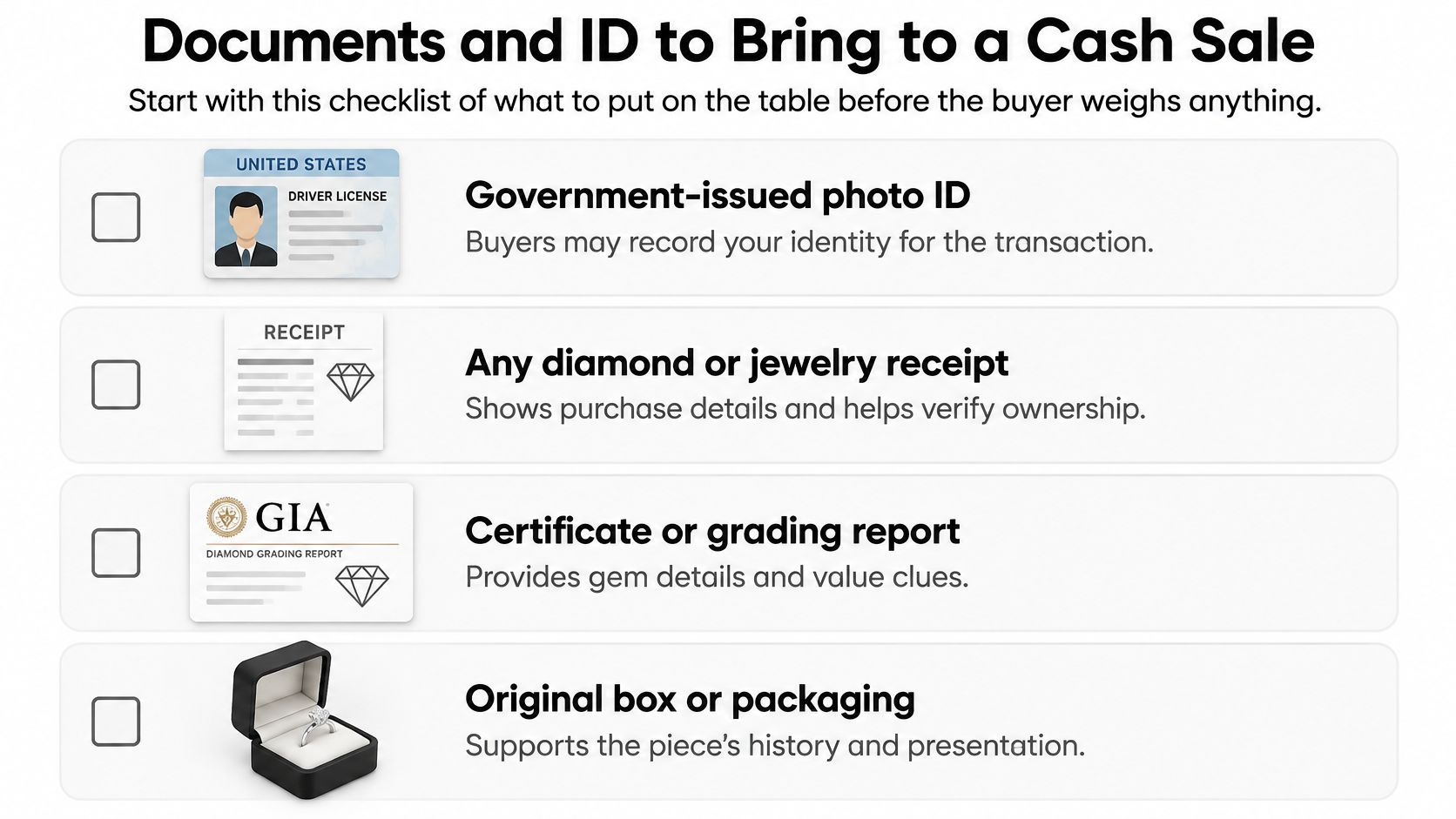
- Government-issued photo ID: Buyers may record your identity for the transaction.
- Grading report and report number: Bring the GIA or other lab report and note any laser inscription on the girdle.
- Purchase receipt or box papers: These support ownership, purchase details, and the piece's history.
- Insurance or appraisal document: Label it clearly as replacement value so nobody mistakes it for a cash price.
- Estate paperwork if inherited: Bring probate papers or an estate letter showing you have the right to sell.
- Hallmarks and maker's marks: Photograph markings on the setting and bring the notes with you.
A grading report describes characteristics. It doesn't assign a dollar value.
That distinction matters. As Diamond Banc explains about selling a ring to a jewelry store, the Gemological Institute of America provides technical information but does not assign a dollar value, while an appraisal estimates value for a defined purpose and date. A missing report doesn't make a diamond worthless, but it can increase uncertainty and verification costs. Buying a new appraisal just to sell may not improve the offer either, because a buyer needs current quality data and market comparables.
This short video walks through what to expect when you bring documents to a counter.
Say a Boise seller inherits a 1990s ring with a 2008 insurance appraisal. She'll get a cleaner comparison if she also finds the original receipt and identifies the setting's maker's mark, because the buyer can separate stone, metal, and history instead of pricing unknowns.
How to Prepare Your Piece for an Honest Appraisal
A prepared piece gets tested faster and compared more fairly. I'd do this routine at home before visiting any buyer for diamonds for cash, and I'd keep it simple.
This graphic sums up the photographing and weighing steps.
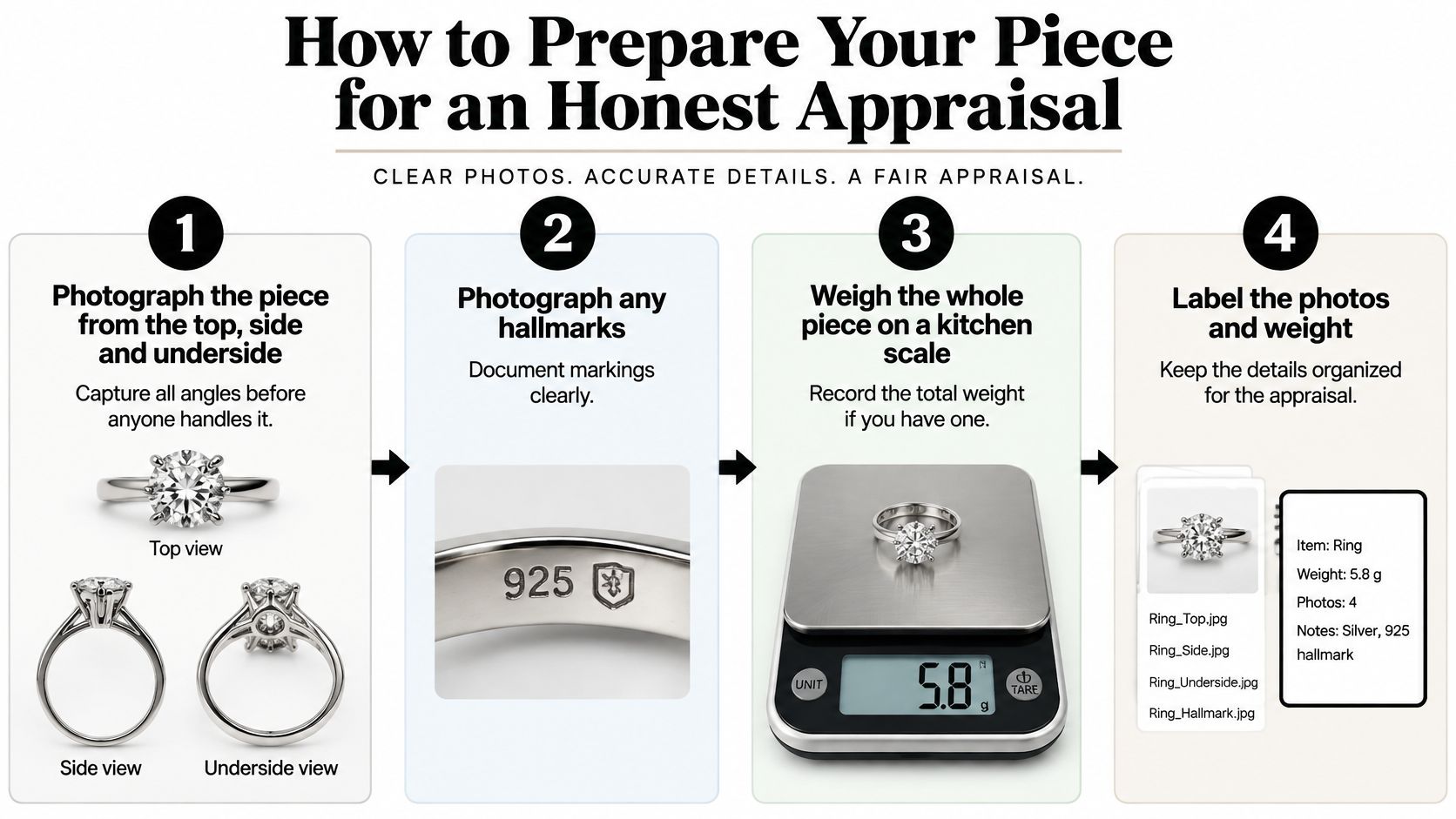
- Photograph every angle. Take top, side, and underside photos before anyone handles it. Add close-ups of hallmarks. These photos protect you if a prong is loose or a stone shifts later.
- Weigh the whole piece if you can. A kitchen scale is fine for a rough total. Label it total weight including metal and setting, never diamond weight. Quoting a full ring's weight as carat weight is the most common slip at the counter.
- Match the report to the stone. Write down the report number and find the laser inscription if there is one. If the number doesn't match the stone you're holding, say so upfront.
- List repairs and changes. Note a past resize, a re-tipped prong, or a replaced stone. Buyers will spot bench work under magnification, and disclosure keeps the conversation honest.
- Keep cleaning light. Wipe the piece with a soft cloth and stop there. Harsh chemicals can hide coatings and make the first inspection harder to read.
- Separate loose stones. Put each loose stone in its own small bag. Keep a setting with the ring it came from. Don't carry a loose diamond in a pocket or loose in a purse.
- Write a one-page description. List the item, total weight, documents you hold, and known repairs. Hand it over with the folder.
What ready looks like
You've got photos, a labeled total weight, matching paperwork, and a clean enough stone for the buyer to see inclusions clearly. If you want more detail on the process, read this guide on how to get jewelry appraised. That preparation won't force a higher price, but it'll keep a good stone from being discounted for avoidable doubts.
4Cs, Weight and Certification
Buyers grade the stone, not the story around the ring. Start with the carat-weight trap. A ring's total weight includes gold or platinum, side stones, and the setting. Only a loose stone on a calibrated scale gives true carat weight. If a buyer quotes from mounted weight alone, ask what portion is diamond.
Identity comes before value. Verify whether the stone is natural, laboratory-grown, or treated, confirm any laser inscription, and compare shape, measurements, and plot features against the report. According to GIA guidance on grading the diamond 4Cs, GIA grading uses multiple independent graders, 10× magnification for clarity assessment, masterstones for color comparison, and computerized cut metrics validated through more than 70,000 human observations across nearly 2,300 diamonds. Those grades are comparative technical classifications, not direct predictions of resale proceeds.
| Factor | What the buyer checks | How it affects the offer |
|---|---|---|
| Carat weight | Loose stone weighed on a calibrated scale | Larger stones raise the base price. Mounted total weight is not all diamond |
| Color | Compared with masterstones on the report | Stronger color grades usually support steadier offers |
| Clarity | Inclusions viewed at 10x magnification | Visible inclusions lower the offer |
| Cut and proportions | Face-up appearance and light performance | Excellent cut does not guarantee a cash premium |
| Fluorescence | Reaction under long-wave UV, recorded on the report | Can shift the offer depending on demand. Record it, don't label it |
| Report and inscription | Laser inscription matched to report number | A missing report adds verification cost |
| Treatments and origin | Coatings, fracture filling, natural or lab-grown status | Undisclosed treatment or unclear origin can lower or void an offer |
Details sellers often miss
Fluorescence isn't automatically good or bad. It's the diamond's reaction under long-wave ultraviolet light, and it belongs on the written offer exactly as recorded. Cut affects face-up appearance and light performance, but a strong grade won't rescue weak demand for a shape or size. For a sense of how inclusions change character, look at an Astro West salt and pepper diamond, where visible inclusions are part of the look rather than a hidden flaw.
Smaller stones need a different path. GIA's explanation of how it grades diamonds notes the standard report threshold for loose natural D-to-Z diamonds is 0.15 carat or more, so a small stone may have no full report. Our local team in Boise provides prices and insights on gold, silver, jewelry and diamonds, and this diamond clarity and color guide helps you read grades before you visit. Ask for every factor above in writing.
Scams and Red Flags That Cost Sellers Money
The two losses sellers describe most are simple. They accepted a verbal-only quote they couldn't compare, or they let a buyer price the piece by total ring weight. Both mistakes hide the basis of the offer.
| Red flag | Why it matters | What to do |
|---|---|---|
| Offer given only verbally | No itemized basis to compare against other offers | Ask for the offer in writing with weights and grades |
| Pressure to sell today | Rushes past testing and second quotes | Get at least two independent quotes before signing |
| Origin claimed without a report | Natural or lab-grown status is unverified | Check the report and the laser inscription |
| Price based on total ring weight | Total weight includes metal and setting | Ask for the stone-only weight |
| Refusal to test or remove the stone | The stone cannot be verified in its setting | Request removal or independent testing, or walk away |
| Fee required before any offer | Appraisal may be used to inflate the figure | Ask whether an appraisal is needed for a cash offer |
| Stone does not match its report | Possible swap or simulant | Compare measurements against the report before handing over the piece |
Origin claims deserve direct questions. Federal Trade Commission guidance on buying gemstones and diamonds advises diamond buyers to ask about a stone's origin and whether testing equipment distinguishes natural diamonds from laboratory-created gems. That standard supports hassle free offers that identify what's being purchased.
For broader consumer protection steps, Gini Help's scam protection is a useful starting point before you share personal or payment details. You can also review basic checks in this guide on how to tell if diamonds are real.
Practical rule: If a buyer won't itemize weights, grades, and deductions in writing, don't sign.
Sell at an established shop with posted hours and a verifiable address, not in a parking lot. Ask for payment at the counter or by a traceable method, plus a receipt listing the business name, address, item, weights, and amount paid. Don't accept a check for more than the agreed amount, and don't refund a third party. A legitimate buyer won't object to a second quote.
Tax, Estate and Paperwork Considerations
Before price, confirm who has the right to sell. If you inherited the piece, ask which papers the buyer accepts, such as probate documents, a letter of authority from the executor, or a signed estate letter naming you as seller. One heir shouldn't sign for the whole group without agreement.
Splits and records
- Agree the split in writing first: If several heirs share proceeds, decide percentages before the visit.
- Keep the full file: Save the original purchase receipt if you have it, any appraisal labeled as replacement value, the itemized cash offer, and the final signed receipt with the sale price.
- Use the estate name when needed: If an estate liquidator is involved, ask for the offer in the estate name and file the final record with estate paperwork.
Taxes on jewelry sales generally depend on your cost basis and the price you receive compared with the value when you acquired or inherited the piece. Get advice from a qualified tax professional for your situation rather than relying on a selling guide. Clean records make that conversation short, and they protect executors if another heir asks questions later.
Free Testing, Offers and Next Steps in Boise
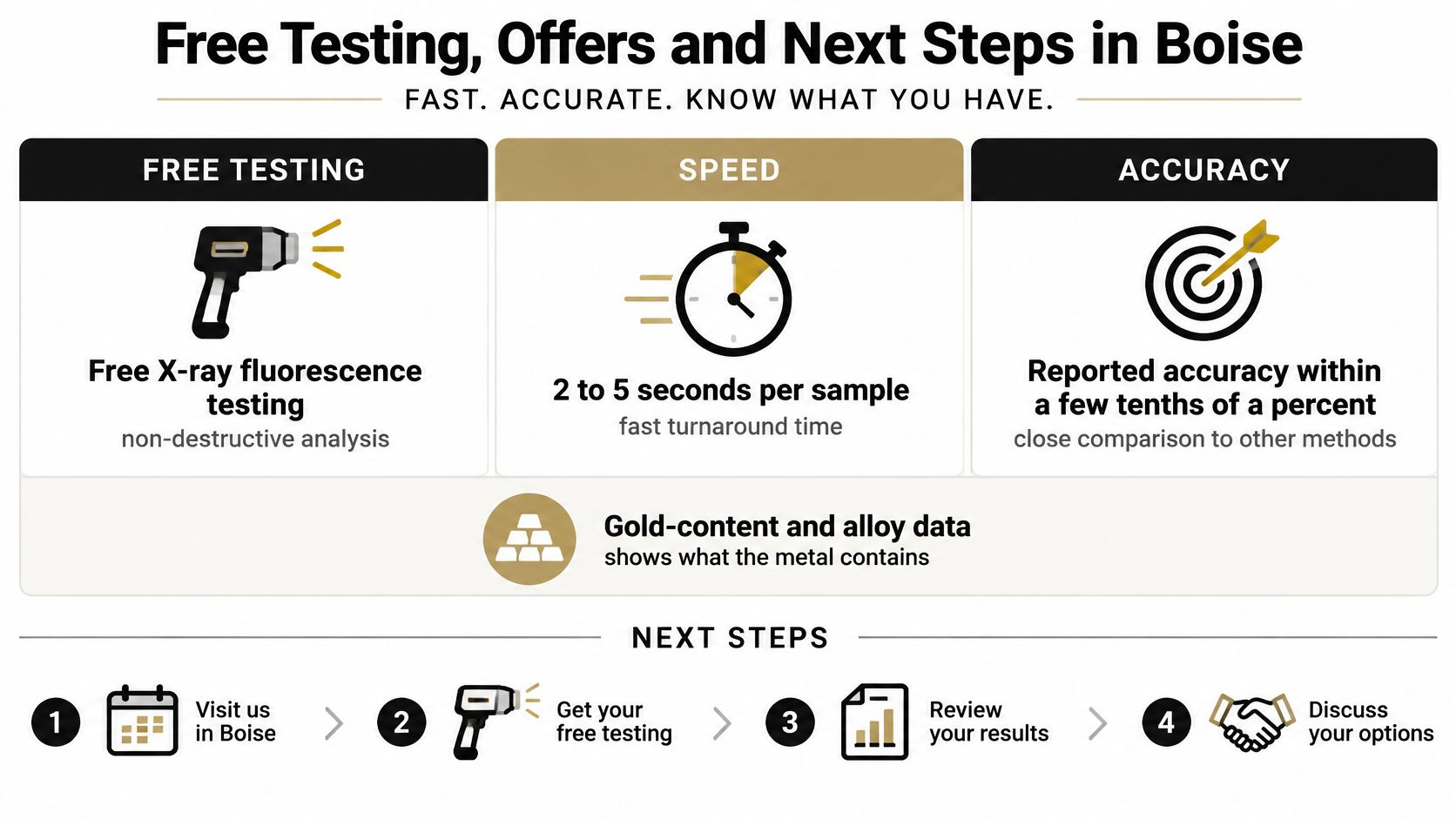
For the metal setting, testing is fast and shouldn't damage the piece. Bruker's overview of precious metal analysis describes X-ray fluorescence testing that produces gold-concentration and alloy-chemistry data in approximately 2–5 seconds per sample, with reported accuracy within a few tenths of a percent compared with fire assay. Because the method reads near-surface layers, a careful buyer also checks for plating or mixed construction instead of trusting a hallmark alone.
This infographic shows the free testing process and timing.
At Carat 24, we offer Gold and Jewelry Buying with Xray Scanning and Gold Testing for free, so a gold setting is valued alongside the stone. We buy gently used jewelry, and you can ask about Price Matching against a written competing quote and whether we're giving you the highest payout in Boise on that itemized basis. Check any highest-payout claim against a dated, independent price comparison.
| Factor | Local buyer in Boise | Online shipment |
|---|---|---|
| Testing | Free X-ray scanning and gold testing in person | Testing after shipment, on the buyer's timeline |
| Packaging and insurance | Not needed for a visit | Packaging, shipment and insurance required |
| Payment timing | Immediate offer possible on the spot | Wait for the buyer to receive and verify the item |
| Price check | Compare a written local quote and ask for price matching | Compare after shipping, with the buyer's return terms applying |
Save the hassle and sell locally for more than online shipments after you count shipping, insurance, and waiting, but compare written offers rather than assuming geography guarantees more. For details, see our page on a free jewelry appraisal.
- Gather your documents in one folder.
- Photograph and weigh the piece.
- Visit us or call (208) 314-9995. You can also email info@goldsilveridaho.com.
- Ask for the offer in writing, with stone-only and complete-jewelry figures and any deductions.
- Compare it with at least one other written quote before you hand over the piece.
Bring your folder, photos, and piece to Carat 24 in Boise for free X-ray scanning and gold testing, an itemized written offer for your diamond and setting, and a clear answer on price matching against a competing written quote. We'll test gently used jewelry in person so you can decide without shipping anything away. Visit Carat 24 - Trusted Gold Experts or call (208) 314-9995 to start your diamonds for cash sale today.
