

You're holding a ring box from a parent's estate, a gold chain that has been in the family for decades, or a watch with no paperwork. You want a straightforward answer, but the first number you hear may not mean what you think it means. A free jewelry appraisal can identify what you own and what a buyer may offer, but only if you ask what kind of value the number represents.
In Boise, the practical starting point is an in-person evaluation that documents the metal, gemstones, condition, and testing basis. If you're considering a sale, look for Gold and Jewelry Buying, Xray Scanning and Gold Testing for free, Hassle free offers, and Price Matching. A local visit can also save the hassle and sell locally for more than online shipments, because you can compare the actual net offer without mailing valuables away.
What a Free Jewelry Appraisal Really Tells You
A free jewelry appraisal usually gives you an informed evaluation, not an automatically insurance-ready document. The evaluator may identify the metal, inspect gemstones, assess condition, and explain what the item may bring in a particular market. That information is useful, but the figure means little until the purpose is clear.
Ask this first:
What is this appraisal valuing my jewelry for?
The same ring can have different figures depending on whether the purpose is:
- Insurance replacement value: What it may cost to replace a comparable item through a retail market.
- Fair-market value: A figure used to support estate distribution or another transfer between interested parties.
- Liquidation value: What the item may bring when speed matters.
- Scrap or melt value: The value of recoverable precious metal, without giving full credit to design, craftsmanship, brand, or gemstones.
- Resale value: What a buyer may realistically pay for the complete piece in the secondary market.
GIA states that insurance requires an appraisal, while a grading report records characteristics such as a diamond's quality but does not itself assign a monetary value. GIA also describes resale proceeds as materially below insurance replacement figures. Read GIA's explanation of diamond buying and appraisal distinctions before treating a large replacement figure as a likely cash offer.
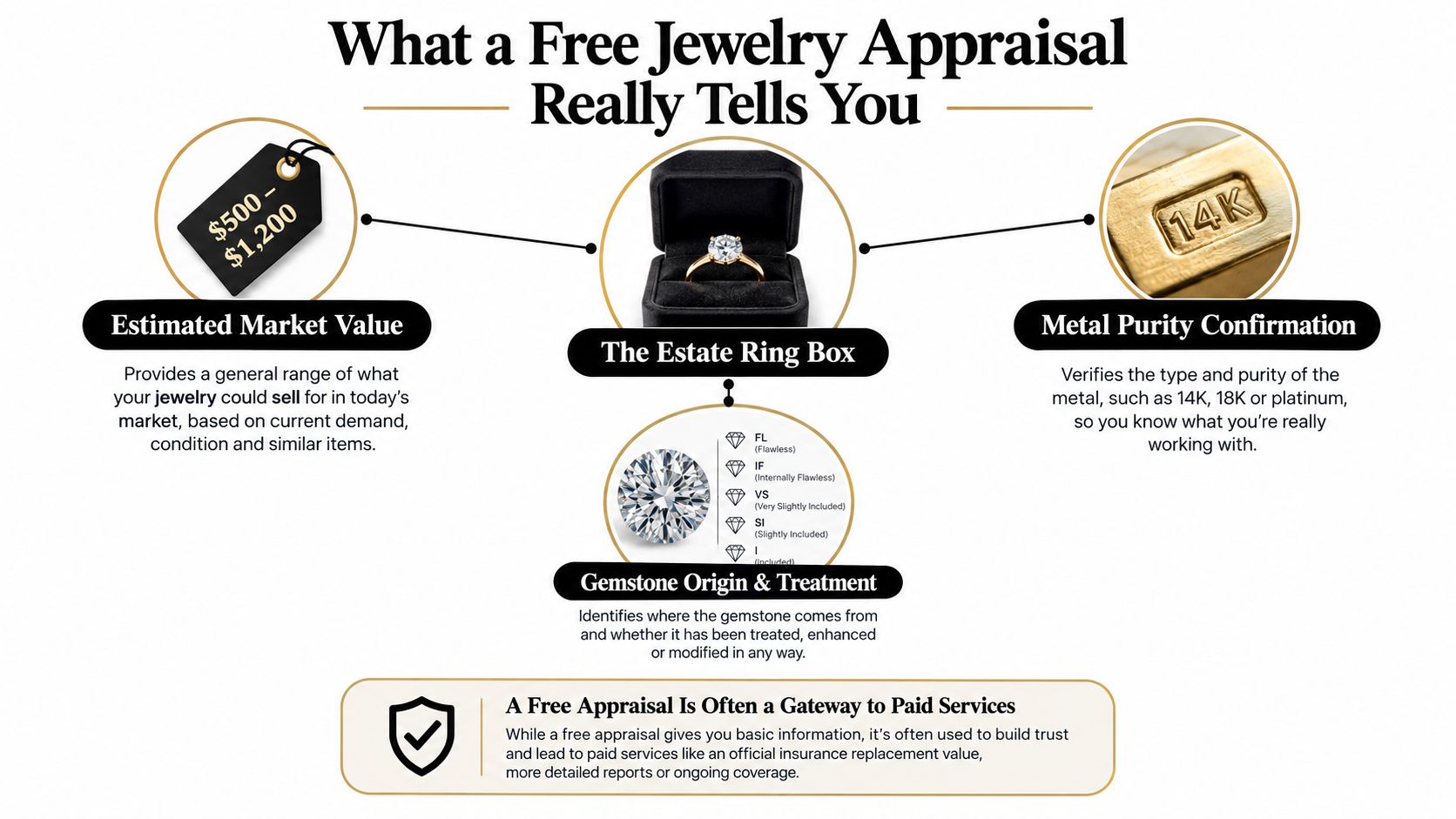
Evaluation is not the same as grading
A gemstone grading report describes a stone. It may address characteristics such as color, clarity, measurements, and other identification details. A monetary valuation must go further by considering the complete piece, including the setting, metal, condition, workmanship, brand, and intended market.
That distinction matters when someone says, “The diamond is certified, so the ring is worth this amount.” The report may support identification and quality, but it doesn't establish what an insurer would pay to replace the ring or what a local buyer will offer today.
If you're comparing jewelry with other collectibles, the same purpose-first thinking applies. Someone researching a trading card may estimate a card's PSA 10 value by separating condition, authentication, and market demand. Jewelry requires the same discipline, with added attention to metal composition and gemstone treatments.
A useful local reference is this guide to how to appraise jewelry. Use it to prepare questions, then insist that any written conclusion states whether it addresses a sale, insurance, estate distribution, or melt value.
Preparing Your Jewelry and Documents Before You Go
Preparation prevents a rushed evaluation and reduces the chance that useful context gets lost. Gather every piece connected to the question, including broken chains, single earrings, loose stones, watches, and matching sets. Don't throw away an item because it looks damaged or ordinary. A missing clasp, maker's mark, or detached stone can affect identification.
Bring a folder with:
- Original receipts: They may help establish purchase history and item identity.
- Prior appraisals: Earlier descriptions can reveal changes, repairs, or differences in stated purpose.
- Gemstone certificates: A GIA or other laboratory document can provide useful stone information.
- Warranty cards and branded packaging: These may support brand or authenticity questions.
- Reference photos: A photograph showing the piece being worn can help connect it to an owner or family history.
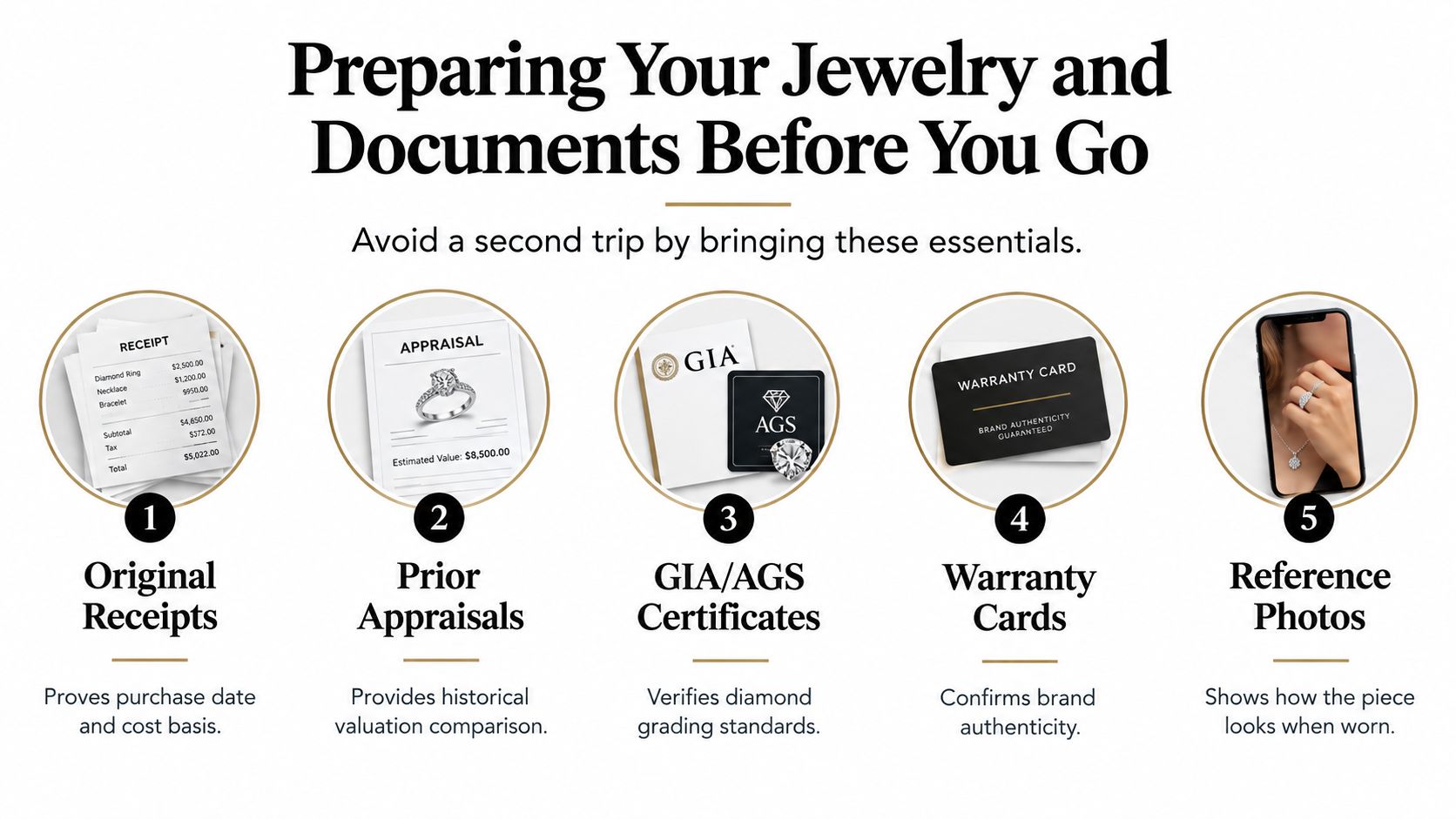
Read the marks, but don't trust them blindly
Look inside rings, near clasps, on bracelet links, and on watch cases for marks such as 14K or 18K. The FTC explains that a karat mark identifies the proportion of pure gold. 14K contains 14 parts gold and 10 parts other metal, while a higher karat mark indicates a greater gold proportion. The FTC also recommends checking for a trademark or company name near the karat mark, because that trademark identifies the party standing behind the metal-content claim. See the FTC's consumer guidance on buying platinum, gold, and silver jewelry.
A stamp is a clue, not conclusive proof. Older jewelry may have worn marks, altered components, or inaccurate markings. Unmarked pieces can still contain valuable metal, and plated items can look convincing. Bring the item for testing rather than relying on a phone photograph or a magnifying glass at the kitchen table.
Inherited jewelry also carries a family and legal context. If several heirs need to decide whether to keep, divide, or sell pieces, this resource on dividing heirloom jewelry in an estate can help frame the conversation.
Use a simple kitchen-table checklist
Before leaving home, place each item in a separate pouch or small box. Keep matching earrings and sets together, label anything with a known owner, and write down what you want the evaluation to answer.
Check that you've packed:
- The jewelry itself, including damaged or unmarked pieces.
- Paperwork and certificates, even if the documents are old.
- Family notes or photographs, especially for inherited items.
- Your purpose, written in plain language, such as “cash sale” or “estate division.”
- Your questions, including how the metal was tested and what the offer includes.
For a practical explanation of how to test gold purity, focus on the testing method rather than trying to perform an at-home acid test. Home testing can damage jewelry and still leave you without a defensible valuation.
What Happens During the Appraisal Itself
A credible evaluation follows a sequence. The evaluator first photographs or describes the complete item, then records its weight, dimensions, hallmarks, construction, and condition. After that, the metal and each significant gemstone should be considered separately.
You should be able to watch the process and understand what each test answers. A ring with a diamond, for example, has at least two appraisal questions: what metal is present in the setting, and what can be established about the stone. A total weight on its own doesn't answer either question.
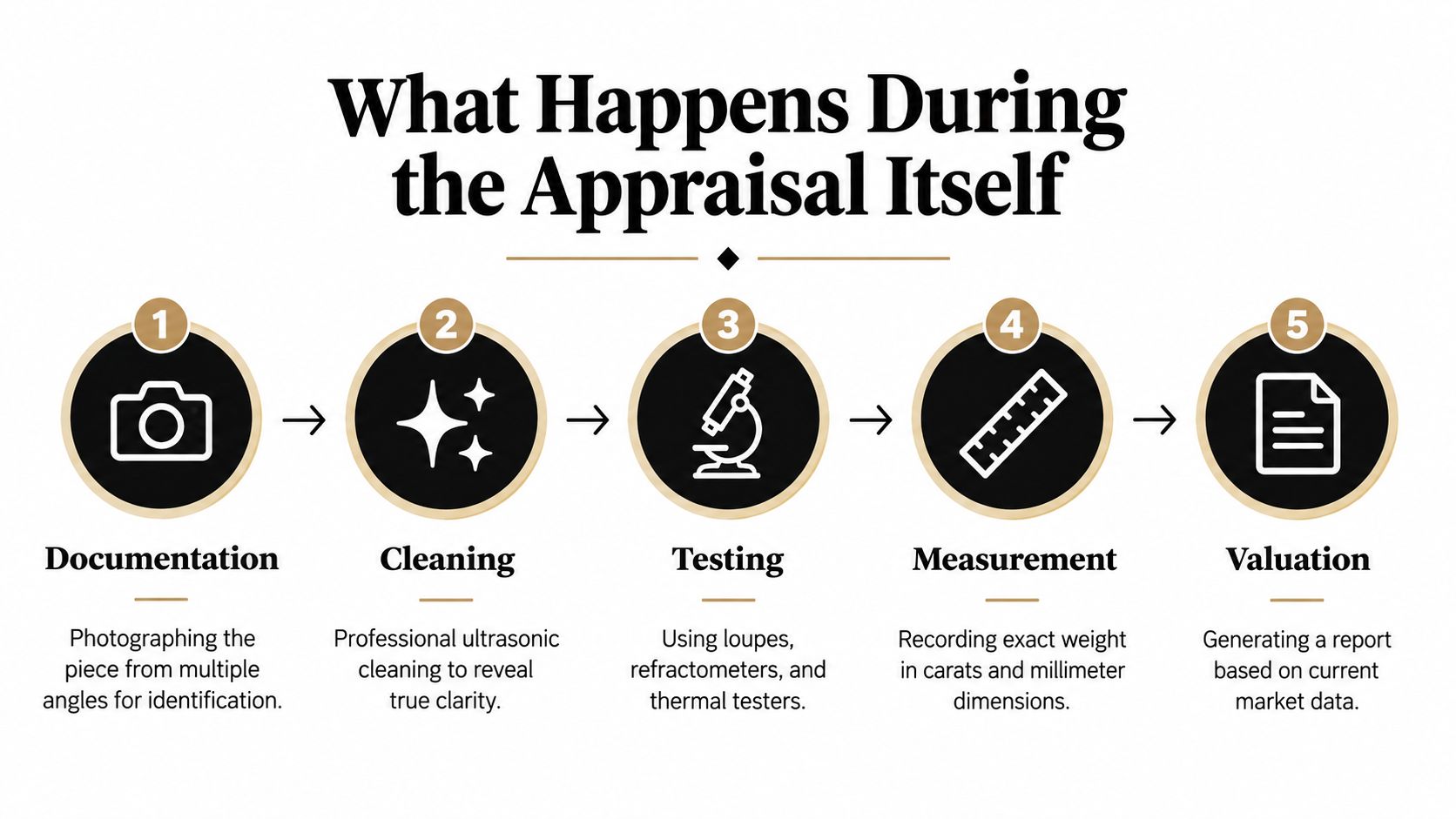
XRF gives a fast surface reading
X-ray fluorescence, or XRF, can identify elements present on the tested surface and report their proportions within seconds without visibly marking the jewelry. That makes it a useful first screening tool for gold, silver, and mixed-metal pieces.
XRF has limits. Coated, plated, curved, dirty, or very small items may produce results that don't represent the bulk composition. The FTC explains that difficult pieces may need additional testing, such as exposing an internal surface or using another gold-testing procedure. A responsible evaluator treats XRF as part of the examination, not as permission to skip judgment.
At Carat 24 in Boise, Xray Scanning and Gold Testing are offered free during an in-person evaluation. That gives a seller a chance to understand composition before deciding whether to accept an offer, with no need to ship the jewelry out of state.
The evaluation should also separate a mounted piece from its stones when practical. Weighing the entire ring and calling the result “gold weight” can overstate the metal content. A careful evaluator records what was measured and explains any limitations.
Gemstones need more than a glance
For gemstones, a technical workflow may include optical measurement, volume and specific-gravity calculations, a refractometer, polariscope, dichroscope, and handheld spectroscope. GIA describes specific gravity of approximately 3.52 as an initial consistency check for a stone presumed to be diamond, followed by additional screening to determine whether it is natural or laboratory-grown. This figure and testing context are discussed in GIA's gemstone analysis guidance.
A trustworthy evaluator should document whether a stone appears natural, laboratory-grown, or man-made, and should disclose detectable treatments such as heating, clarity enhancement, dyeing, or impregnation. A single test shouldn't carry the entire conclusion, especially when a stone is valuable or disputed.
Watch for a written or clearly explained result that identifies the metal, stones, condition, testing limitations, and valuation purpose. If the evaluator can't explain what the number includes, you don't yet have a useful appraisal.
Questions to Ask and Credentials to Verify
A free evaluation should feel transparent. Before you leave, you should know what was tested, what was assumed, and what the final figure represents. Don't accept a polished number without an itemized explanation.
Ask these questions directly:
- What is the valuation purpose? Is this for resale, insurance replacement, estate distribution, liquidation, or melt value?
- Which tests were performed? Ask whether the evaluator used XRF, visual inspection, gemstone instruments, or another method.
- What does the itemized description show? Look for metal content, weight, hallmarks, stone identity, measurements, condition, and photographs where appropriate.
- Are treatments disclosed? Ask whether the stones were checked for heating, clarity enhancement, dyeing, impregnation, or other detectable treatment.
- What market supports the figure? The conclusion should distinguish retail replacement, wholesale, secondary-market, and scrap economics.
The FTC's Jewelry Guides have existed in some form since 1918, creating a long-running consumer-protection framework for truthful descriptions of precious metals, gemstones, treatments, and value-related claims. Amendments effective April 10, 2001 required disclosure of gemstone treatments that are not permanent, require special care, or significantly affect value, including laser drilling of diamonds. The FTC's history of the Jewelry Guides and their treatment-disclosure requirements is worth reviewing if an evaluator makes broad claims about a stone.
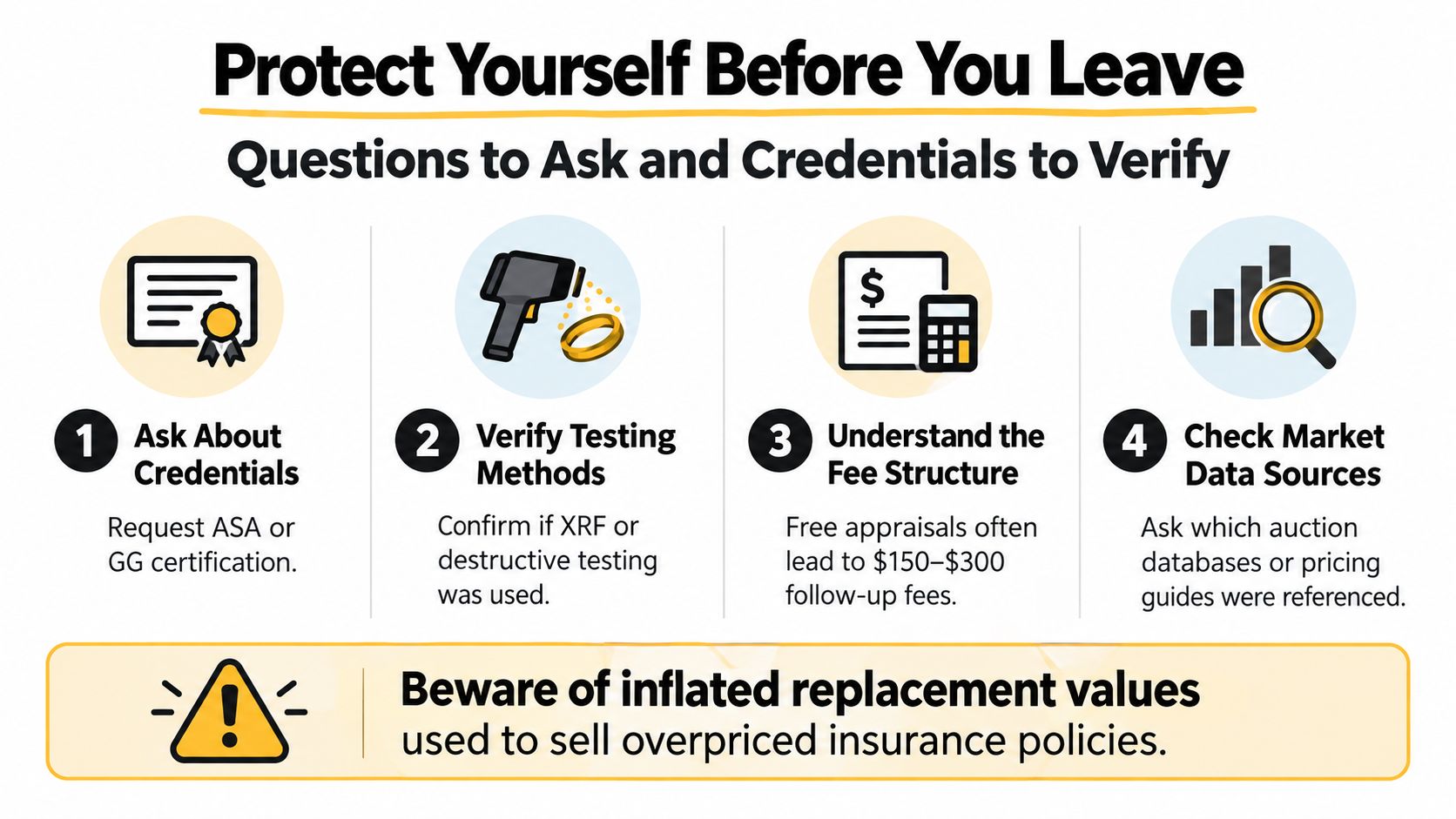
Red flags deserve a pause
Be cautious when someone claims a stone's origin without supporting analytical evidence. GIA reports origin only when the evidence supports an opinion, and it may report origin as inconclusive. An unsupported “natural” assertion, a single-test conclusion, or a karat stamp treated as final proof should trigger further questions.
A gemstone identification report also isn't a cash offer. GIA's explanation of how to read a GIA identification report makes the distinction clear. Identification establishes what a laboratory can support. Valuation adds the setting, condition, market, purpose, and buyer economics.
Practical rule: If the evaluator won't state the purpose, testing limits, and offer basis, don't treat the number as reliable enough for an estate decision or sale.
For valuable or disputed stones, use an independent laboratory rather than relying on an unsupported verbal claim. You can also review this guide to jewelry authentication near you before choosing where to take an unusual piece.
Free Appraisals and Local Selling Versus Mail-In Buyers
Mail-in gold services follow a predictable path. You request a prepaid kit or shipping label, send the jewelry away, wait for an appraisal, and then accept or reject the offer. A consumer comparison describes examples with appraisal results within 24 hours, insured packages up to $1,000, and price-match terms that can exclude offers more than 90% above that day's gold-market value. Review the government-published consumer information on mail-in gold selling before comparing offers.
The headline price isn't the whole transaction. Consider shipping risk, insurance limits, time without the jewelry, return shipping, unclear deductions, and the possibility that a buyer values only the metal. A Boise walk-in lets you keep possession until you understand the testing and offer.
| Factor | Local Buyer in Boise | Mail-In Online Buyer |
|---|---|---|
| Testing | You can ask questions while the item is examined in person. | The item leaves your possession before the assessment. |
| Speed | You receive an evaluation and can decide during the visit. | You ship, wait for the assessment, then review the offer. |
| Shipping risk | No outbound shipment is required. | Insurance and package limits may apply. |
| Offer comparison | You can compare written terms and ask for price matching. | Price-match conditions may contain exclusions. |
| Return process | You leave with the jewelry if you decline. | Declining may require return shipping and additional waiting. |
| Best fit | Sellers who want transparency and a direct conversation. | Sellers who prioritize remote convenience over immediate control. |
A free evaluation from a buyer isn't independent by definition. The buyer is assessing what the business can pay, so ask whether the offer reflects complete jewelry value, gemstone value, metal value, or a combination. Get deductions and terms in writing, then compare the final net amount rather than the most flattering estimate.
Carat 24 offers a local option for selling gold in Boise, with in-person evaluation and a direct conversation about the offer. The practical advantage is control. You can see the process, ask why the figure changed, and decide without packaging valuables for a cross-country shipment.
Your Next Steps After the Appraisal
The right next move depends on why you requested the appraisal.
For insurance, keep the written description, photographs, test information, gemstone details, and stated replacement purpose together. A grading report alone isn't a monetary appraisal, and a resale offer isn't an insurance replacement conclusion. If the evaluator can't state the purpose, ask for clarification before giving the document to an insurer.
For an estate, request itemized metal and stone data, photographs, condition notes, assumptions, and a clear valuation purpose. That record helps heirs compare the same information instead of arguing from memory. It also separates a fair-market or estate figure from a cash liquidation offer.
For an immediate sale, compare the actual offer terms. Ask whether the buyer is paying for the finished jewelry, the gemstones, the precious metal, or only recoverable melt value. Keep any item you aren't ready to sell separate from the pieces you approve.
Carat 24, at 3780 W. State St. in Boise, buys gold and jewelry directly and provides free X-ray scanning and gold testing. The business also presents hassle-free, no-pressure offers and offers price matching, giving local sellers a way to pursue the highest payout in Boise without shipping valuables across the country or accepting an online buyer's first number.
Use this simple action plan:
- Sort the pieces: Keep sets, documents, and damaged items together.
- State your purpose: Say whether you need resale, insurance, estate, liquidation, or melt information.
- Watch the testing: Ask what the results prove and what they don't prove.
- Compare net offers: Include shipping, insurance, waiting, deductions, and return costs.
- Decide deliberately: Keep, insure, divide, or sell only after the documentation makes sense.
An informed seller doesn't need to chase the biggest-looking appraisal figure. The better outcome comes from matching the valuation to the goal, verifying the testing, and comparing a transparent local offer with the actual cost of alternatives. For a quick way to organize potential sale values, use this gold jewelry cash calculator before your visit.
Carat 24 - Trusted Gold Experts offers free in-person jewelry evaluations, including Xray Scanning and Gold Testing for free, with hassle-free offers and Price Matching for Boise sellers. Visit Carat 24 - Trusted Gold Experts to bring in your jewelry, understand what it contains, and compare a local offer without the hassle of online shipments.
