

Two Boise neighbors can invest the same amount in precious metals and make completely different decisions. One may want a steadier store of wealth and a straightforward way to sell later. The other may accept larger price swings in exchange for more exposure to industrial growth. So, is the best investment silver or gold determined by the latest price chart, or by the job you need the metal to perform?
The answer depends on your purpose, the way demand supports each metal, and what happens when you eventually sell. A quoted market price is only one part of the result. Premiums, authentication, storage, dealer spreads, and local resale liquidity can influence whether a physical purchase preserves purchasing power.
Why This Comparison Matters More Than Price Charts
Consider two residents in Boise with the same amount available for precious metals. The first is approaching retirement and wants an asset that can sit steadily in a broader portfolio, diversify investments, and remain relatively easy to liquidate. The second has a longer time horizon, accepts sharper drawdowns, and wants exposure to manufacturing and technology demand.
The first person may lean toward gold. The second may choose silver, or use silver as a smaller satellite holding alongside another asset. Neither decision is automatically correct for everyone. The important point is that they aren't solving the same financial problem.
Gold has a longer-established record as a strategic investment and monetary asset. Silver has a stronger connection to industrial activity, including electronics, solar technology, and equipment. Those different sources of demand affect how each metal responds to economic stress, investor confidence, and manufacturing conditions. A person buying silver because it feels affordable may be taking on more cyclical risk than expected. A person buying gold solely because it feels safer may overlook premiums or an unsuitable investment vehicle.
For Boise households, the exit plan deserves attention before the purchase. Physical metal must be stored, protected, authenticated, and sold through a buyer who can explain how weight, purity, spot pricing, and premiums affect the offer. Reading about gold as a hedge against inflation can help frame the monetary role, but it doesn't replace a personal decision about liquidity and risk.
Practical rule: Choose the metal by the outcome you need, then choose the product by the way you expect to buy, hold, and sell it.
| Characteristic | Gold | Silver |
|---|---|---|
| Primary portfolio role | Defensive core holding and monetary asset | Industrial growth exposure and precious-metals satellite |
| Main demand sources | Central banks, jewelry, technology, and investment | Electronics, solar technology, industrial equipment, jewelry, and investment |
| Typical behavior | Generally more defensive and less volatile | More economically sensitive and more volatile |
| Best fit | Wealth preservation, diversification, and liquidity | Investors willing to accept larger swings for cyclical upside |
| Physical challenge | Higher value density and authentication | More units, storage considerations, premiums, and resale planning |
Gold vs Silver by Purpose and Behavior
Gold and silver aren't just cheaper and more expensive versions of the same investment. They occupy different roles.
Gold's long record is central to its appeal. After the United States ended dollar convertibility into gold in 1971, gold prices rose by approximately 8% per year in U.S. dollar terms over the following more-than-half-century period, according to World Gold Council analysis of gold's return characteristics. That annualized performance was comparable with equities and higher than bonds over the same period. Gold's demand also comes from several sources, including central banks, jewelry, technology, and investment, rather than one economic use.
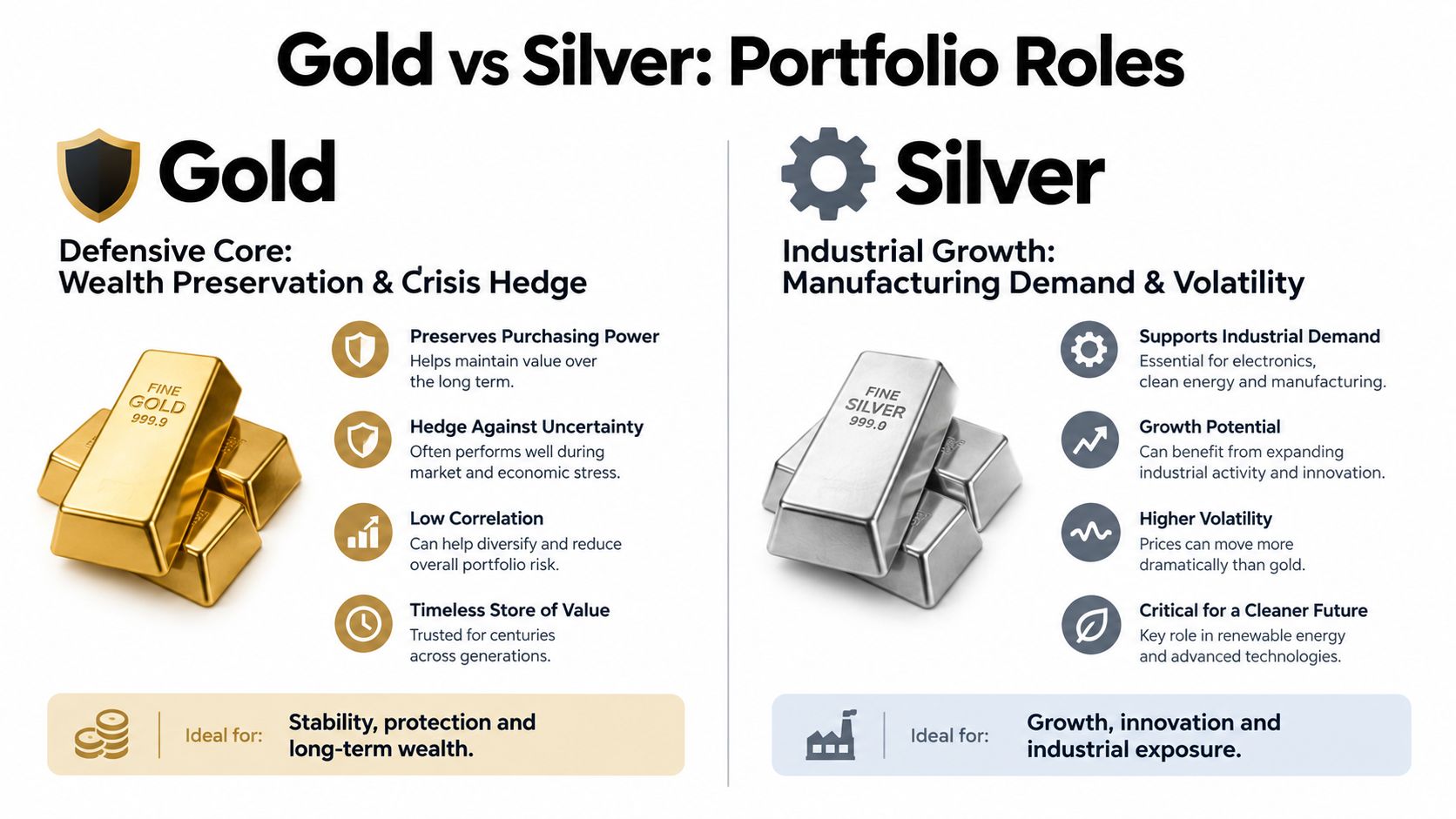
Gold as the core and silver as the satellite
In a portfolio study covering December 31, 2005, through December 31, 2025, a hypothetical portfolio with 5% gold produced an annualized return of 7.0%, compared with 6.7% without gold. Annualized volatility declined from 9.9% to 9.6%, and maximum drawdown improved from -34.9% to -32.7%, according to the same World Gold Council analysis. Over the 10-year period, the portfolio with 5% gold returned 8.4% annually, compared with 8.0% without gold, while volatility fell from 9.5% to 9.1%.
Those figures don't promise that gold will outperform in every future period. They show why investors often treat it as a defensive core holding when preservation and diversification matter.
Silver has a different engine. Its industrial use connects its price to manufacturing cycles, technology demand, and economic expansion. That connection can create greater upside sensitivity, but it can also make silver less consistent as a crisis hedge. A study summarized by the Royal Mint and World Gold Council characterizes silver as materially more volatile than gold and bonds, and finds that silver underperforms gold as a safe-haven asset.
| Characteristic | Gold | Silver |
|---|---|---|
| Portfolio purpose | Stability, diversification, and wealth preservation | Cyclical upside and industrial exposure |
| Demand logic | Monetary, investment, jewelry, and technology demand | Industrial, investment, jewelry, and technology demand |
| Risk profile | Historically lower volatility than most individual commodities and major benchmarks | Higher volatility and stronger sensitivity to economic conditions |
| Practical role | Foundation for investors prioritizing stability | Smaller complementary position for investors with a larger risk budget |
For a deeper introduction to the physical metal, what silver bullion is helps clarify the difference between investment-grade bullion and items whose value also depends on design or collectibility.
What Demand Tells You About Each Metal
Could the kind of demand behind a metal matter more than its latest price move? For a physical investor, the useful questions are who is buying, why they are buying, and how easily that demand may weaken when prices rise. Demand composition shapes the investment thesis, while premiums, authentication, and resale conditions shape the result you keep.
Gold's recent demand pattern supports its monetary role. In 2025, global gold investment demand rose 84% to a record 2,175 tonnes, while total demand exceeded 5,000 tonnes. The increase included 801 tonnes of ETF inflows and a 16% rise in bar-and-coin demand, according to Reuters' report on World Gold Council demand data. Investors, exchange-traded funds, central banks, and households may all buy gold for reserves, diversification, or wealth protection. That range of buyers can support liquidity when a Boise owner wants to sell recognized bullion.
Silver has a more mixed demand engine. Global silver demand reached approximately 1.16 billion troy ounces in 2024, a 3% decline from the previous year, according to the Silver Institute's supply and demand analysis. Electronics, solar technology, industrial equipment, jewelry, and physical investment all consume silver. A factory slowdown can therefore affect silver differently from a period when investors seek monetary protection. For a longer view, see historical silver prices over 100 years.
Why a deficit isn't a complete investment thesis
Industry projections indicate that silver could remain in deficit for a sixth consecutive year in 2026, with total supply forecast at approximately 1.05 billion ounces and physical investment expected to rise 20% to 227 million ounces. Industrial fabrication was forecast at roughly 650 million ounces. These figures suggest demand may exceed newly available supply, but they do not guarantee a profit for someone buying coins or small bars.
Price responses can pull in opposite directions. Higher prices may attract investment buyers while encouraging manufacturers to reduce silver use through substitution or thrifting, meaning less silver in each product. Jewelry buyers may postpone purchases or choose alternatives. Reuters' coverage of the 2026 silver projection describes this tension, including projected industrial fabrication of about 650 million ounces and projected jewelry demand of 178 million ounces, a 9% decline.
For a Boise buyer, a deficit matters only alongside transaction friction. Dealer premiums, bid-ask spreads, storage, product recognition, and local resale conditions influence the result after costs. A wholesale shortage does not remove those costs at the retail counter, and unfamiliar pieces may require more testing before a dealer can make an offer.
Investment Vehicles and How to Choose Between Them
The metal is only half the decision. The vehicle determines how directly you own it, how easily you can trade it, and what practical work falls on you.
Physical bullion provides direct possession. Recognized coins, bars, and rounds can suit someone who values tangible ownership, but the buyer must account for premiums, secure storage, insurance, and authentication. A physical investor should keep receipts, product details, and a clear record of purchase cost.
Exchange-traded funds offer market exposure without placing coins or bars in a home safe. They can be convenient for investors who value trading access and don't need direct possession. Their structure, fees, tax treatment, and exposure rules deserve review before purchase.
Mining stocks add another layer of risk. A mining company depends not only on the metal's price but also on operating costs, management decisions, financing, production, and the jurisdiction where it works. A strong gold market doesn't guarantee that every mining share will perform well.
Match the vehicle to the exit
Start with your time horizon. Someone who may need to raise cash quickly should prioritize an exit route they understand. Recognized coins and exchange-traded products can offer practical liquidity, while unusual rounds, obscure bars, and collectible pieces may require a more specialized buyer.
Next, estimate transaction friction. The purchase premium and the eventual selling spread can matter as much as the spot price movement. For physical silver, the number of pieces and the space required to store them can become meaningful practical considerations. For gold, value is concentrated into a smaller physical footprint, but authentication and product selection still matter.
A simple checklist helps:
- Define ownership: Decide whether direct possession matters or whether market exposure is sufficient.
- Set the horizon: Separate money intended for long-term preservation from money that may be needed sooner.
- Plan the sale: Identify a reputable local buyer before committing to a product.
- Review taxes: Personal circumstances vary, so use qualified advice alongside practical money guidance when evaluating the wider financial decision.
Investors considering silver can also review how to invest in silver, especially before choosing between physical products, funds, and mining companies. The best vehicle isn't necessarily attached to the metal with the strongest recent narrative. It's the one whose costs and exit process fit your actual plan.
Authentication, Fair Pricing, and Selling Locally in Boise
A metal investment becomes real money only when a buyer can verify it and explain the offer. That matters with bullion, estate jewelry, inherited pieces, and coins whose value may include craftsmanship or collectibility.
X-ray fluorescence testing can provide a rapid, nondestructive estimate of gold content. The Gemological Institute of America explains that results are more reliable on flat, homogeneous surfaces when the instrument is calibrated to a standard with a similar shape, finish, and composition. Convex surfaces, unusual finishes, and relief work can produce unreliable results. In one cited test using a Seiko instrument, 80% of results were within 3 parts per thousand of assayed values.
That makes a free scan useful as a screening and valuation aid, not an automatic substitute for laboratory-level certainty.
What a transparent offer should show
For gold jewelry, the Federal Trade Commission explains that a karat mark expresses the share of pure gold in a 24-part alloy. 18K contains 18 parts gold and 6 parts other metals, while 14K contains 14 parts gold and 10 parts other metals. The FTC also advises buyers to look for a manufacturer or seller name, symbol, or U.S.-registered trademark near the karat mark. If the quality mark lacks an identifying trademark, choosing another piece is safer. These details appear in the FTC's guidance on buying platinum, gold, and silver jewelry.
For simple gold jewelry without unusual design or workmanship, the FTC recommends comparing gram weight with the current gold price. A clear offer should distinguish:
- Metal content: Weight and karat purity, translated into fine-gold content.
- Market basis: The spot price or other pricing reference used.
- Added value: Craftsmanship, gemstones, branding, rarity, or collectibility.
- Transaction outcome: The amount the buyer will pay and any conditions attached.
Carat 24 - Trusted Gold Experts in Boise offers free X-ray scanning and gold testing, hassle-free offers, and price matching for qualifying transactions. Selling locally can save the hassle of online shipments and may provide more than online shipping offers by allowing you to discuss the item, testing, and valuation in person. Before selling an estate or a collection, readers may also benefit from understanding capital gains taxes and discussing personal tax questions with a qualified professional. For local authentication considerations, jewelry authentication near me offers another useful starting point.
Real Investor Scenarios That Make the Choice Clear
A retiree in Boise may care less about an exciting price move than about preserving purchasing power and having a clean selling process. For that person, gold generally fits the foundational role more naturally than silver, particularly through recognizable physical products or a regulated fund. The decision still requires attention to fees, taxes, storage, and the rest of the household's financial plan.

A younger investor with a longer horizon may tolerate silver's larger swings. Silver can provide exposure to industrial demand and cyclical upside, but that investor should treat it as a position requiring a larger risk budget, not as a replacement for every defensive asset. The question isn't whether silver can rise more quickly. It's whether the investor can hold through periods when manufacturing demand and sentiment weaken.
An estate with mixed items
An estate sale often contains several different kinds of value:
- Plain gold jewelry: Weight and karat purity may provide the starting point, with design and condition considered separately.
- Luxury jewelry: Brand, workmanship, stones, condition, and documentation can matter beyond melt value.
- Bullion: Recognition, purity, condition, and the current market basis influence the offer.
- Numismatic coins: Rarity and collector demand may matter more than metal content alone.
Selling everything as scrap can overlook added value. On the other hand, assuming every inherited coin is rare can lead to unrealistic expectations. A local evaluation that tests composition and explains the pricing categories gives the owner a stronger basis for deciding what to sell, what to retain, and where to request another opinion.
A buyer seeking higher potential upside may prefer silver, but should compare the expected metal movement with premiums and resale conditions. Someone seeking a compact, liquid store of value may prefer gold. Both investors need an exit plan before purchase, because the best investment silver or gold choice can change when the physical product carries a high premium or limited local demand.
How to Decide and Move Forward Confidently
Use four questions before committing money:
- What job should the metal perform? If the priority is wealth preservation and portfolio diversification, gold is generally the stronger foundation. If the priority includes industrial-cycle exposure and greater upside sensitivity, silver may complement that foundation.
- How much volatility can you accept? Silver's behavior demands more patience and a larger tolerance for drawdowns. Gold is generally better suited to a defensive allocation.
- Which vehicle fits your life? Compare physical bullion, recognized coins, exchange-traded products, and mining shares by storage, fees, control, and liquidity.
- How will you sell? Confirm how the item will be authenticated, how the offer will be calculated, and whether a local buyer can explain the result clearly.
Boise investors don't need to make the decision from a chart alone. Free testing, transparent weight and purity calculations, price matching, and an in-person offer can help reduce uncertainty before a sale. The strongest approach is deliberate: define the purpose, buy a suitable product, preserve documentation, and know the exit route.
Gold is usually the more defensive core. Silver can be a useful satellite for someone prepared for industrial and price-cycle risk. Neither metal is universally superior, and neither should be chosen solely because a recent headline sounds compelling.
Carat 24 - Trusted Gold Experts offers gold and jewelry buying, silver and bullion transactions, free X-ray scanning and gold testing, hassle-free offers, and price matching in Boise. Visit Carat 24 - Trusted Gold Experts to discuss authentication, fair pricing, and whether selling locally makes sense for your precious-metals plans.
