

The popular advice to sell a diamond ring for a fixed percentage of its original price is a poor place to start. It ignores what you own, what buyers can verify, and whether the quoted amount is money you'll keep. A high insurance appraisal can make a reasonable cash offer look disappointing because those figures measure different things.
If you're asking, “How much can I sell my diamond ring for?” the useful answer is a written offer for the diamond and setting, based on their documented characteristics and current resale demand. For a Boise seller, the practical job is to assemble the paperwork, understand how buyers price each component, and compare equivalent offers before handing over the ring.
Four Numbers That Decide What Your Ring Sells For
A high appraisal isn't a cash price. Most sellers arrive with one number in mind, but a ring sale involves four distinct values. Confusing them is the main reason negotiations start badly.
Your original receipt records a past retail transaction. An insurance appraisal estimates replacement cost, including retail design, labor, overhead, and margin. Neither tells a buyer what they can recover by reselling the ring today.
Four values in a ring sale and what each one measures
| Figure | What It Measures | Who Uses It | Relationship to Cash Offer |
|---|---|---|---|
| Original retail price | What you paid at the store | Receipts and warranty claims | Starting point only, not a resale value |
| Insurance replacement value | Cost to buy the same ring new at retail | Insurers and claim settlements | Usually the highest figure |
| Current comparable retail price | Asking prices for similar stones now | Retailers and online listings | Above what a dealer will offer |
| Realistic net proceeds | Cash after buyer margin, checks and fees | Dealers, auctions and private buyers | The number to plan around |
Say your appraisal lists $6,000, purely as a hypothetical example. A substantially lower purchase offer doesn't, by itself, establish that the buyer is undervaluing the ring. You need to know which stone characteristics they used, what they credited for the mounting, and which costs or deductions they included.
Find the cash-market evidence
A grading report solves a different problem from an appraisal. GIA explains that its reports document dimensions, quality, and identifying characteristics, rather than stating monetary value. The buyer still has to decide what that particular diamond can sell for.
Completed sales are more useful than optimistic asking prices, provided the items match. If you're checking marketplace comparables, SellerAI's explanation of how to analyze exported eBay sales data can help organize sold listings. Exclude rings with different origins, grading standards, stone sizes, or designer provenance rather than averaging unrelated jewelry together.
The diamond and mounting may also have separate buyers. A dealer might want the center stone for another ring while valuing the setting primarily for its precious metal. Attractive workmanship adds money only when someone expects to resell it as jewelry.
Practical rule: Compare the amount you'll receive, not the largest number printed anywhere in the paperwork.
Start with this short sequence:
- Pull the appraisal and identify what kind of value it describes.
- Record the grading details from the laboratory report rather than relying on the receipt's description.
- Request two written offers in the same category, complete ring against complete ring, with deductions disclosed.
Certificates and Lab-Grown Origin That Change Your Price
Confirm origin before discussing price. Natural and laboratory-grown diamonds belong to different resale markets, even when they look similar across a jewelry counter. A buyer needs to establish which market applies before selecting comparable stones.
The inspection should connect the ring in front of the buyer with its paperwork.
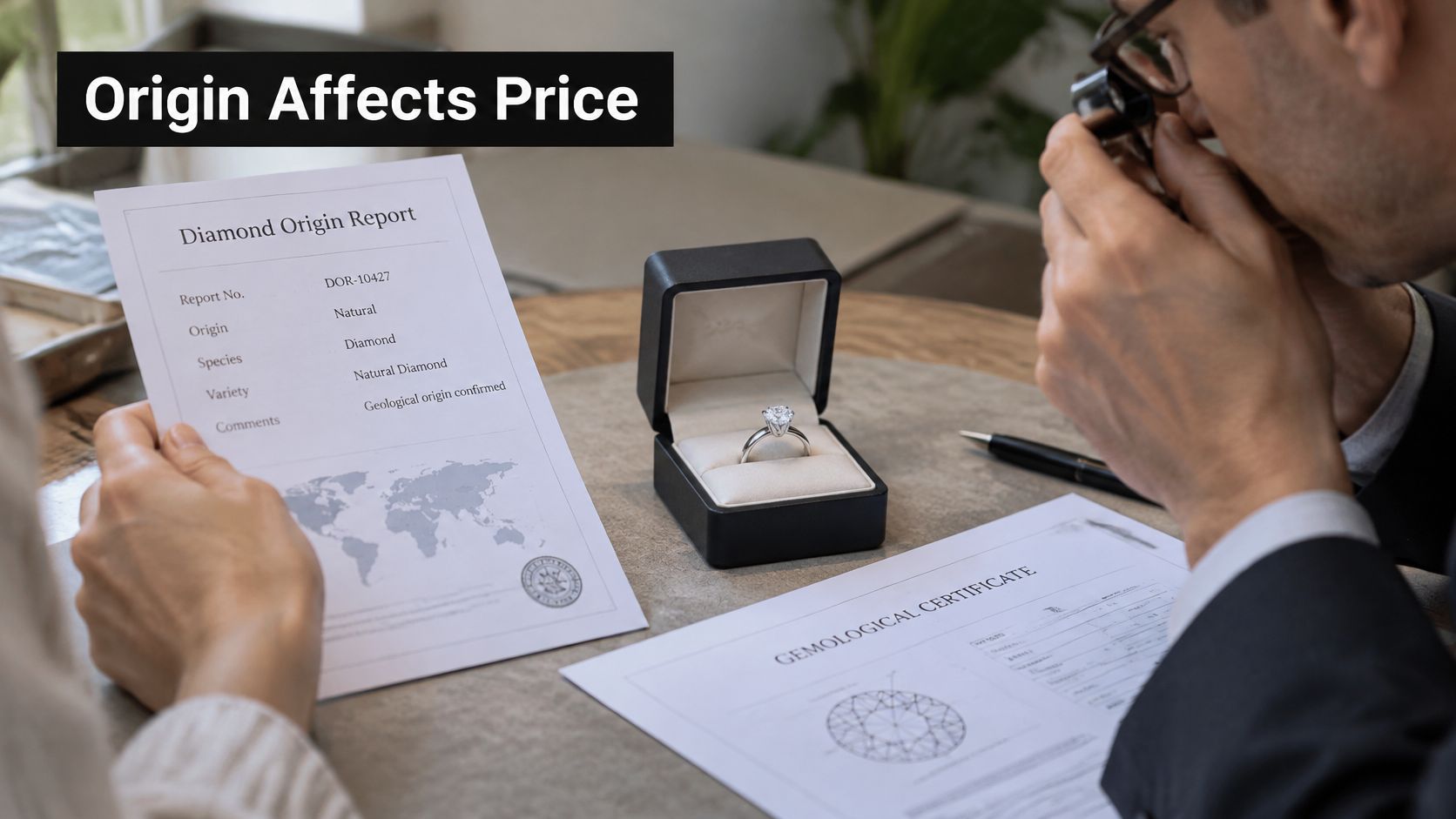
For a dated market comparison, the September 2026 Caratlytics index reported median listed prices of approximately $2,335 per carat for natural diamonds versus $443 for laboratory-grown stones, with natural prices about 51% below their 2021 average. Those are listed-price measures, not cash offers for your ring.
Natural origin therefore doesn't guarantee a strong return. Laboratory-grown stones face a different problem: manufacturers can expand replacement supply, and falling new-stone prices can leave an older receipt far removed from what a buyer will pay.
Bring evidence, not just a description
Gather the documents that let the evaluator identify the stone and assess uncertainty:
- Laboratory report: Bring the original GIA or other laboratory document, including the report number.
- Purchase receipt: Keep any description of origin, mounting, designer, and included stones.
- Treatment disclosures: Include paperwork identifying fracture filling, laser treatment, or other modifications.
- Service history: Bring records of resizing, replacement stones, repairs, and previous inspections.
GIA's guide to reading a diamond report describes its natural-diamond grading report for loose diamonds weighing 0.15 carats or more, including quality characteristics, proportions, and treatment information when detected. Laboratory-service charges are separate from the ring's value, so don't assume paying for new documentation will automatically increase your proceeds by more than its cost.
Without a report, a buyer may need additional testing or may make a conservative provisional offer. Ask whether the evaluation is final before comparing it with an offer based on verified grading.
Use the video as a visual companion while reviewing the ring and its documentation.
Shape also belongs in your records. For an elongated stone, our guide to marquise diamond engagement rings provides useful shape context, but appearance alone won't establish origin or grade. Write down natural or laboratory-grown, laboratory name, report number, and shape before asking anyone to commit to a price.
The Four Cs and Setting That Set Your Offer
Start with the center diamond, because it often accounts for most of a conventional diamond ring's offer. Buyers need its carat weight, color, clarity, and cut, then adjust for factors that affect saleability and condition.
The FTC's gemstone buying guidance identifies these core grading criteria and explains that treatments such as fracture filling or lasering can reduce value and should be disclosed. A description such as large, bright diamond isn't enough to select meaningful comparables.
What the grading terms mean at the counter
GIA's explanation of the diamond grading system describes carat weight recorded to the nearest hundredth on a standard report, with one carat equal to 0.2 grams; its D-to-Z color scale, Flawless-to-Included clarity scale assessed under 10× magnification, and Excellent-to-Poor cut grades for standard round brilliant diamonds in the D-to-Z range establish the distinctions buyers examine.
Those categories affect an offer differently:
- Carat weight: Weight isn't the same as visible size. Measurements and proportions help explain why stones of similar weight can look different face-up.
- Color: Within the normal color range, increasingly noticeable yellow or brown generally reduces desirability when other characteristics are comparable. Don't apply that shortcut to a stone represented as a fancy-color diamond.
- Clarity: The location and character of an inclusion matter alongside the grade. A feature beneath a prong presents a different practical concern from a conspicuous feature under the center of the table.
- Cut: Buyers examine how the stone handles light, not only whether its outline is round, oval, or pear. Shape and cut quality aren't interchangeable terms.
Our diamond clarity and color guide can help you interpret those report fields before your evaluation. Don't guess a grade from photographs, particularly pictures taken under warm household lighting.
Why matching weights don't produce matching offers
Consider a hypothetical pair of one-carat diamonds. One has verified natural origin, strong cut quality, and no disclosed treatment; the other has weaker proportions, a visible inclusion, and fracture filling. Matching their weights doesn't make them comparable merchandise.
Buyers also check fluorescence, polish, symmetry, chips, abrasions, and repair needs. Fluorescence isn't an automatic deduction in every stone; ask how it affects the buyer's assessment of that diamond. A chip, meanwhile, can change both saleability and the work needed before resale.
The mounting needs a separate assessment. Gold or platinum can be valued by verified weight and purity, while design or brand value requires evidence that the buyer can resell the intact piece at a premium.
A beautiful setting doesn't guarantee a design premium. Ask whether the offer treats it as wearable jewelry or recoverable metal.
Make a worksheet with these fields:
- Stone identity: Origin, shape, laboratory, report number, and measurements.
- Quality: Carat, color, clarity, cut, fluorescence, polish, and symmetry.
- Disclosures: Treatments, chips, replaced stones, or uncertain history.
- Mounting: Metal, karat or fineness, estimated metal weight, and condition.
Work Out the Gold Payout in Your Setting
The mounting's gold content is usually easier to check than the diamond's resale price. Begin with the karat mark, then verify the metal and establish a weight that excludes stones.
Gold content by karat
| Karat | Gold Parts of 24 | Other Metals |
|---|---|---|
| 24K | 24, or 100% gold | 0 parts |
| 22K | 22, or approximately 91.7% gold | 2 parts |
| 18K | 18, or 75% gold | 6 parts |
| 14K | 14, or approximately 58.3% gold | 10 parts |
| 10K | 10, or approximately 41.7% gold | 14 parts |
The table calculates gold shares from the karat system described in the FTC's precious-metal jewelry guidance, which identifies 14-karat gold as 14 parts gold and 10 parts other metal, and 24-karat gold as pure gold. The same guidance recommends looking for the responsible company's trademark or name near the karat mark.
Calculate metal value before the buyer's deduction
- Establish mounting weight in grams. Have a jeweler remove the stone if removal is appropriate and authorized, then weigh the empty mounting on a gram scale. Don't dismantle a saleable ring yourself merely to run this calculation.
- Check the stamp and verify purity. Record the karat mark and maker's mark. A stamp is useful evidence, not a substitute for testing.
- Calculate fine-gold weight. Multiply mounting grams by the gold fraction corresponding to its karat.
- Apply the gold price and payout percentage. Multiply fine-gold grams by the current fine-gold price per gram, then apply the buyer's stated purchasing percentage.
This visual summarizes the calculation, including the need to exclude gemstone weight.
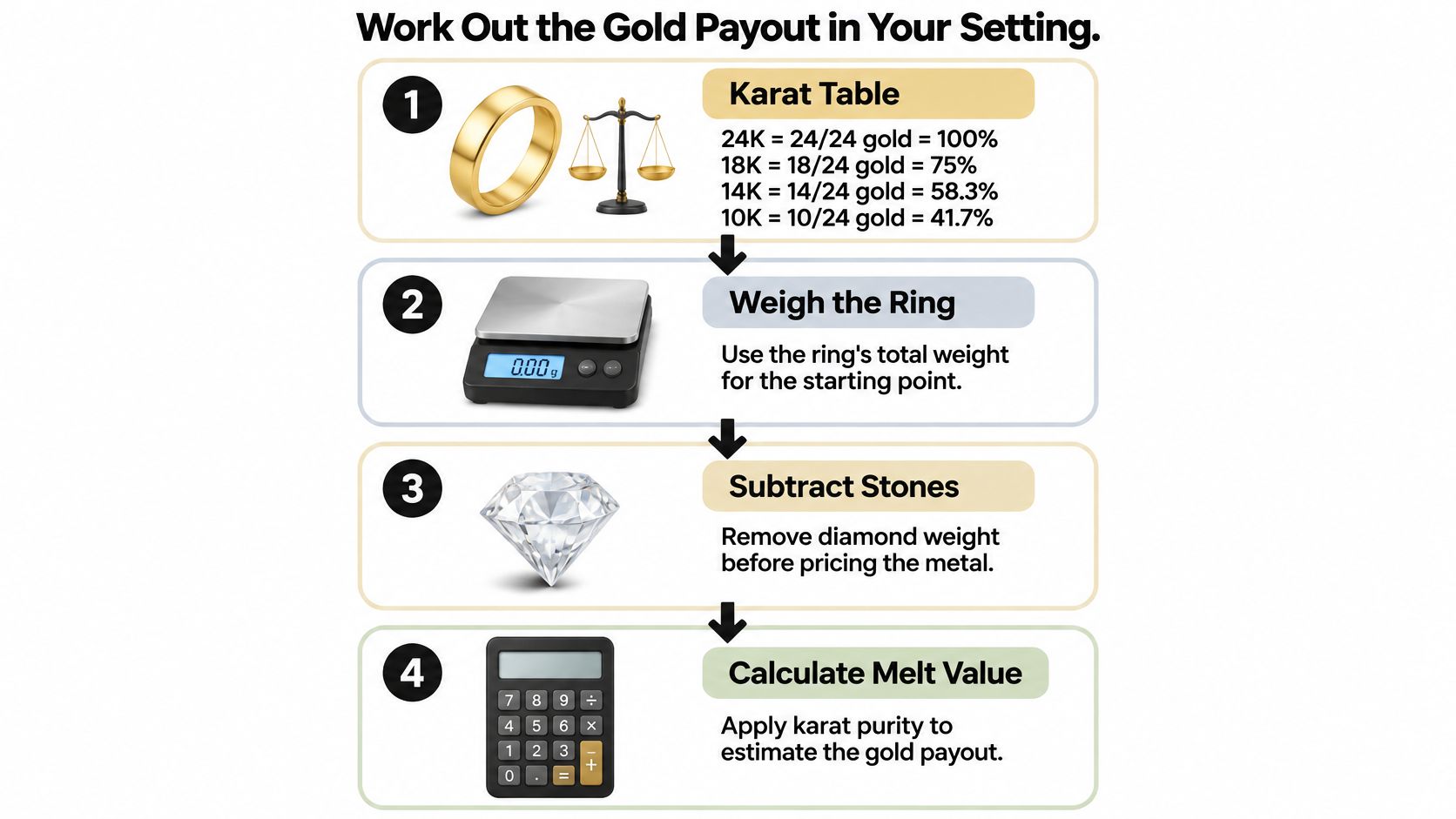
For a hypothetical 4-gram, 14-karat mounting, multiplying 4 × 0.583 gives approximately 2.33 grams of fine gold. Its theoretical metal value is that fine-gold weight multiplied by the current price per gram, before the buyer's deduction. The stones must already be excluded from that mounting weight.
Our explanation of what gold spot price means helps distinguish the market reference price from an actual jewelry-buying payout. Don't multiply the entire ring's weight by the pure-gold price.
The FTC recommends comparing gram weight with the current gold price for simple gold jewelry. Treat this calculation as a metal-value benchmark, not a guaranteed minimum offer. Any premium for intact design, brand, or craftsmanship should be identified separately.
Where to Sell Your Ring Locally and What Each Route Pays
Choose a selling route by net cash, effort, and risk, not the largest advertised valuation. A buyer paying immediately takes on resale work. A private seller keeps that work and its uncertainty.
Selling routes compared for a diamond ring
| Channel | Typical Cash Offer | Time to Cash | Effort and Risk |
|---|---|---|---|
| Local jewelry buyer | Strong for gold and in-person gemstone offers | Same day when evaluation and purchase are completed | Low; stone and metal checked on the spot |
| Pawn shop | Often lowest for diamonds; potentially fair for gold weight | Same day if an outright purchase is agreed | Low; diamond value may be heavily discounted |
| Auction or consignment | Can be high for rare stones, minus commission | Weeks to months | High; fees and unsold risk |
| Private sale | Highest possible if the seller finds the right buyer | Weeks to months | High; verification, safety, and payment risk |
| Online shipment | Based on remote evaluation; shipping and fees reduce proceeds | Days to weeks | High; insurance and transit risk |
These are planning expectations, not promised payment schedules or a universal ranking. A specialist buyer can outbid a general buyer for the right stone, regardless of channel.
Match the route to the ring
A local jewelry buyer can inspect the diamond and mounting together and explain the offer while you are present. That makes local evaluation a sensible first move for an ordinary wearable ring.
A pawn shop may prioritize recoverable metal or readily saleable inventory, leaving less credit for diamond quality. Make sure you are discussing an outright sale rather than a loan secured by the ring.
Auction or consignment deserves consideration for unusual stones or collectible jewelry with supporting documentation. Ask about commission, reserve terms, withdrawal charges, and what happens if the item does not sell before treating an estimate as expected proceeds.
A private sale can eliminate a dealer's purchasing margin, but you become responsible for descriptions, buyer verification, secure meetings, payment, and disputes. With an online shipment, also examine insured-value limits, packaging instructions, return charges, and the right to decline the final offer.
Compare a firm local purchase offer with the online amount you would keep after every deduction, not with an initial estimate.
Use testing to make the local offer checkable
Many jewelers use X-ray fluorescence as a non-destructive surface screen for metal composition. Plating, coatings, dirt, curved surfaces, and small components can still require additional testing.
Ask for the tested purity and assessed metal weight to appear on the offer. An X-ray metal scan does not establish a diamond's origin or quality, so the gemstone assessment still needs its own explanation.
Our guide to the best place to sell diamonds helps frame that buyer comparison. Selling locally removes shipping and transit exposure. It can also leave you with more than an online shipment once deductions are counted. It is not an automatic payout guarantee, which is why the written net comparison matters.
Prepare Your Ring and Get a Written Boise Offer
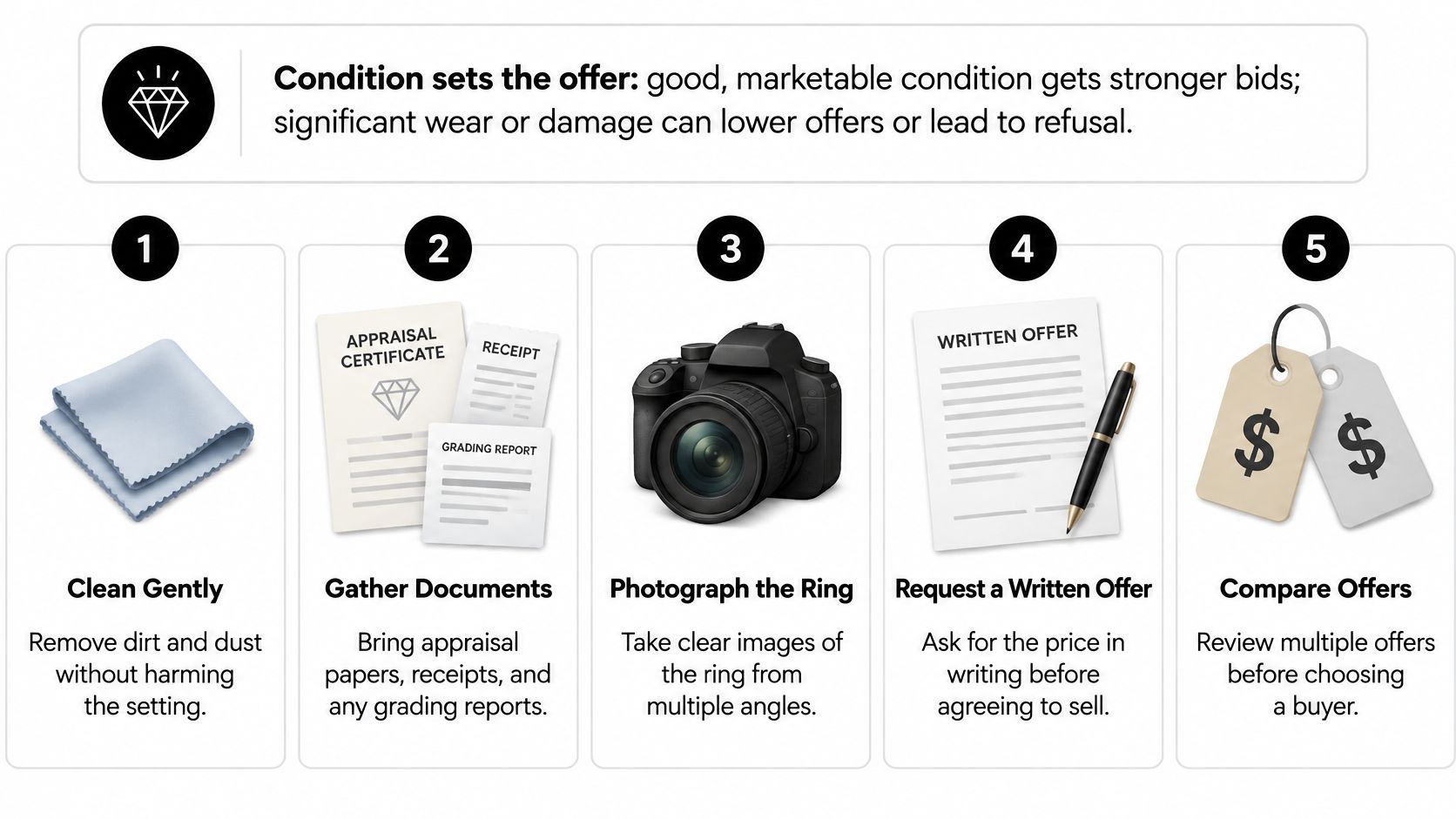
Preparation that pays is documentation and an as-is evaluation, not a polish. Carat 24 prices the items it buys on good, marketable condition, and significant wear or damage can lower an offer or mean the ring is not accepted at all. Bring it as it is and let the paperwork do the arguing.
Build a useful counter packet
- Gather the records. Bring the laboratory report, receipt, appraisal, original box and papers if you have them, plus any service records. Keep the originals together and carry copies in your own file.
- Inventory the stones. Record each stone's position and approximate size, and keep documented weights separate from estimates. Put the quality fields, treatment information, metal karat and known mounting weight on one page.
- Clean gently and photograph it. Wipe the mounting with a soft cloth. If the stone's treatment or the setting's security is uncertain, skip ultrasonic cleaning, steam, chemicals and vigorous brushing.
- Set your minimum acceptable proceeds. Decide the number before you discuss a sale, and stay willing to revise it when the facts at the counter differ from your assumptions.
- Visit locally before mailing the ring. Keep physical control of the item while you establish one firm comparison point.
The checklist keeps preparation short. What sits on the counter matters more than how the ring looks in the box.
For inherited or jointly held jewelry, establish your authority to sell before seeking payment. If you're organizing property during a separation, Bryan Fagan's financial inventory guide from Law Office of Bryan Fagan, PLLC offers a framework for organizing financial records, although its Texas family-law context isn't Idaho legal advice.
Don't pay for polishing, resizing or repairs just to improve presentation. A buyer may prefer the existing condition or plan to replace the mounting, and repair spending often does not come back through the offer. Our guide to getting jewelry appraised helps you choose documentation that fits your purpose instead of commissioning paperwork you don't need.
Turn the evaluation into a comparable offer
Carat 24 buys gently used jewelry through its buyback program, and its local Boise team provides prices and insights on gold, silver, jewelry and diamonds. That is the offer you want in writing. A usable one separates the stone from the setting and the gold payout from the diamond figure. If the number arrives as a single total, ask for the split before you compare it with anything.
Bring any competing written offer to the same appointment so the comparison covers the same item and the same sale terms.
Ask the evaluator to document:
- Scope: whether the amount covers the diamond, setting, side stones or the complete ring.
- Basis: the stone specifications, tested metal purity, assessed weight and condition deductions.
- Final proceeds: the amount payable to you, any remaining conditions, and whether further testing could change it.
Treat any "highest payout in Boise" claim as something to test against comparable written offers rather than a reason to skip comparison. A local sale wins on net proceeds when the written figure beats the shipped alternative after packaging, insurance and return charges, and it removes transit exposure from the transaction.
Finish by comparing two or three written offers for the same category of sale. Choose the buyer whose final amount, explanation and transaction terms hold up, not the one who reads the appraisal number most generously.
Bring your ring, grading report, appraisal and any competing written offer to Carat 24 - Trusted Gold Experts at 3780 W. State St. in Boise. Ask for a written breakdown of the stone and setting, with condition deductions shown, before you decide whether to sell.
