

You've cleared a parent's dresser or opened a safety deposit box, and now there's a velvet box on your kitchen table. Inside are rings you don't wear, a bracelet with a broken clasp, maybe a watch, and no receipts for any of it. You don't want to guess, and you don't want to mail family pieces to a stranger and hope for a fair number back.
That's the moment many sellers search for estate jewelry buyers near me. The smart move isn't chasing the biggest headline payout. It's comparing the true net after shipping, insurance, testing charges, consignment cuts, and transit risk, then choosing the buyer who'll show you the weight, karat, and math in writing.
Find Estate Jewelry Buyers Near You and Compare Options
Start with a local counter. For a mixed estate lot, a good local buyer lets you watch the scale and the test, ask for a re-test on the spot, and keep the pieces in your hands until you agree on a number. A Boise search turns up walk-in jewelry shops, pawn counters, coin and bullion dealers, estate specialists, mail-in buyers, and auction houses. The useful ones explain their gold and jewelry buying process before anything changes hands.
The city-level figure that matters for planning comes from U.S. Census Bureau QuickFacts, which reports that 16.2% of Boise city residents were age 65 or older. That is the household pattern that often puts inherited rings, chains and watches on the table.
If the estate also involves a trust or an out-of-state probate matter, a practical guide for grieving families can help you sequence the legal steps while you sort tangible assets like jewelry.
Sale Channels Compared for Estate Jewelry
| Channel | Payout timing | Cost and risk | Best for |
|---|---|---|---|
| Local walk-in buyer | Paid at the same visit | No shipping, no insurance, re-test on the spot | Mixed lots and quick decisions |
| Mail-in online buyer | Days after the package arrives | Insured shipping, transit risk, remote grading | Pieces with no local buyer nearby |
| Consignment shop | Only after each item sells | Commission taken and an open-ended wait | Designer or collectible pieces with strong demand |
| Estate auction house | After the auction closes, often weeks later | Seller fees and reserve risk | Rare or high-value pieces |
Compare net, not headline. A mail-in quote can look stronger until you subtract tracked, insured shipping and the cost of a second opinion. Say a remote offer comes in $30 above your local quote. If shipping and a re-test together cost more than $30, the local net wins. Consignment can produce a higher retail price, but the commission and the wait come out of your proceeds. Auction adds seller fees and reserve risk, and the check arrives after the sale closes.
Carat 24 in Boise is a local option for this work. It buys gently used jewelry, and its local team provides prices and insights on gold, silver, jewelry and diamonds. If you're comparing local jewelers in Boise for estate help, bring the whole collection to the first visit so the lot gets priced together rather than guessed piece by piece over the phone.
Vet a Buyer Before You Hand Over a Ring
The most common red flag is a fast verbal number with nothing behind it. No weight, no karat, no gold price, no breakdown. That isn't an offer you can compare. It's a number you're being asked to trust.
Start with the mark itself. The Federal Trade Commission guidance on buying platinum, gold and silver jewelry explains that 14K jewelry contains 14 parts gold and 10 parts other metal, and advises consumers to look for a company name or registered trademark near the karat mark. Gold with no identifying trademark next to the stamp deserves extra scrutiny, not a quick sale.
Red Flags at the Counter
- No written offer: The buyer won't itemize each piece, weight, and karat on paper.
- Scale out of sight: You can't see the reading, or pieces get weighed as one mixed pile.
- Pressure to decide today: The price supposedly expires if you walk out to think.
- Unnamed testing method: The buyer won't say how purity was checked or let you watch.
- Cash with no receipt: There's no record of what was bought, from whom, or for how much.
- No pricing basis: The buyer won't say whether the offer follows gold weight and karat, stones, or resale value.
Reading about how reputable gold buyers operate before you go will help you spot these gaps faster, but the counter test is simpler. Ask five questions and listen for direct answers.
Five Questions to Ask
- How do you test each piece, and can I watch?
- Is the offer per gram of pure gold, and which gold price do you use?
- Does the offer include stones or designer value, or metal only?
- What fees come off the top?
- How long does the offer hold?
A good buyer answers all five in writing without hesitation. A buyer who answers in a hurry has told you something.
Before any sale, ask for the paperwork. You want a written record of each piece's metal content, gemstone identity, treatments, origin, weight, and any value claim made during the evaluation. Keep receipts, original boxes, repair records, and lab reports together with your item list, since that bundle supports the description if questions come up later between heirs.
Don't hand over a ring for testing in a back room you can't see. A careful buyer tests in front of you, returns every piece if you decline, and doesn't treat a pause for a second quote as an insult. That patience is part of the service, especially when several family members need to agree before anything is sold.
Test and Authenticate Pieces Before the Offer
Authentication is a sequence, and the order carries the weight. Read the stamp first, weigh the piece second, scan it third. Skip a step and you can price plating as solid gold or count stone weight as metal. That mistake comes out of your net, not the buyer's margin.
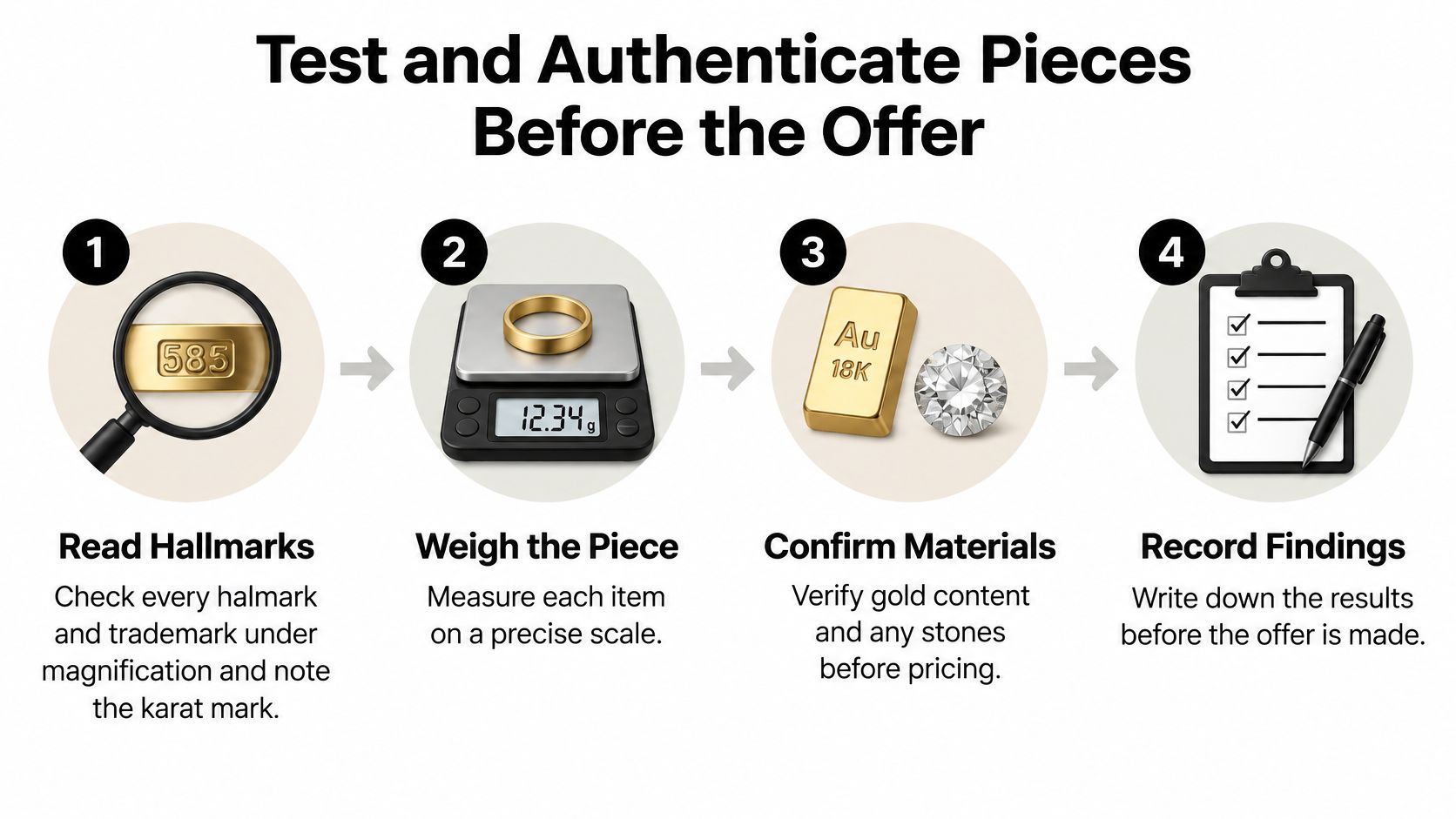
The Verification Sequence
- Read every hallmark and trademark under magnification. Note the karat mark, maker's mark, and any country or fineness stamps. The common slip is reading a worn stamp at arm's length and recording the wrong karat.
- Weigh each piece on a calibrated scale. Record gross weight with stones still set, piece by piece. Weighing a stone-set ring as if all the weight were gold overstates metal value, so the ticket should say gross weight clearly.
- Run the X-ray scan. This checks for fillings, heavy plating, and hidden layers that a surface test can miss. It's especially useful on thick chains, hollow earrings, and pieces that feel lighter or heavier than they look.
- Test fineness on the metal area only. Stones and settings stay protected while the metal reading is taken. Testing a plated clasp and calling the whole piece gold is the classic error here.
- Separate detachable parts and test them alone. Pendants, clasps, earring backs, and watch buckles can be different metals from the main piece. A mixed-metal assembly gives a misleading single reading.
- Match any lab report to the stone. Measurements and inscriptions on the report should line up with the stone in front of you. A report for a different stone adds no value, however impressive the paperwork looks.
- Write the results on the ticket before a number is named. Karat, weight, test method, and stone notes go down first. Pricing comes after, so you can check the math against the findings.
Testing cost is the line sellers forget to ask about. If a buyer charges for assay or appraisal, that charge comes off the offer, and on a light 10K piece the recoverable metal is already small at 41.7% of gross weight. Ask whether the number quoted is before or after testing, and watch the scan happen where you can see it.
The same arithmetic decides whether a local sale beats shipping. Ship a ring to a distant buyer and you pay for insured transit, you wait, and you give up the chance to set a second local quote beside the first. If the parcel disappears, you are the one chasing the claim. A counter you can watch, with the readings written down in front of you, is worth more than a headline payout you cannot check.
If you want a clearer picture of what should happen at that counter, these notes on jewelry authentication near you walk through the steps in order. Carat 24 offers an Authentication service, and its local Boise team provides prices and insights on gold, silver, jewelry and diamonds, so you can ask for each reading to be explained before you agree to anything.
Karat Marks and Their Gold Content
| Karat mark | What it means for the offer |
|---|---|
| 10K | 41.7% gold. Lowest common purity, so test the stamp against the metal reading |
| 14K | 58.3% gold. Common in US jewelry, and a company trademark should sit next to the mark |
| 18K | 75% gold. Common in fine and European pieces, worth confirming rather than assuming |
| 22K | 91.7% gold. High purity, softer metal, seen more in coins and some traditional jewelry |
| 24K | 100% gold. Pure gold, rarely in jewelry, mostly bullion and coins |
What a passing test proves: The metal checks out. It doesn't establish the maker, gemstone origin, treatment history, or collectible value.
Stop and get independent laboratory review when tests conflict, a hallmark looks altered, or a luxury watch serial doesn't match its reference. A careful buyer will tell you that plainly instead of forcing a price on a piece that needs more work. Get the karat, the test method and the findings on paper, because that page is what you hold against the next offer, whether it comes from a counter across town or a consignment deal that settles weeks later after fees and insurance come off.
How Estate Jewelry Pricing Really Works
Two buyers can put the same 10 g bracelet on the scale, read the same 14K stamp, and still write offers that don't match. The difference usually starts with the math, not the mood of the buyer.
For simple gold, the calculation is plain. The FTC tips on comparing simple gold jewelry prices recommend comparing by gram weight and the current gold price. That gives you a checkable formula instead of a mystery number.
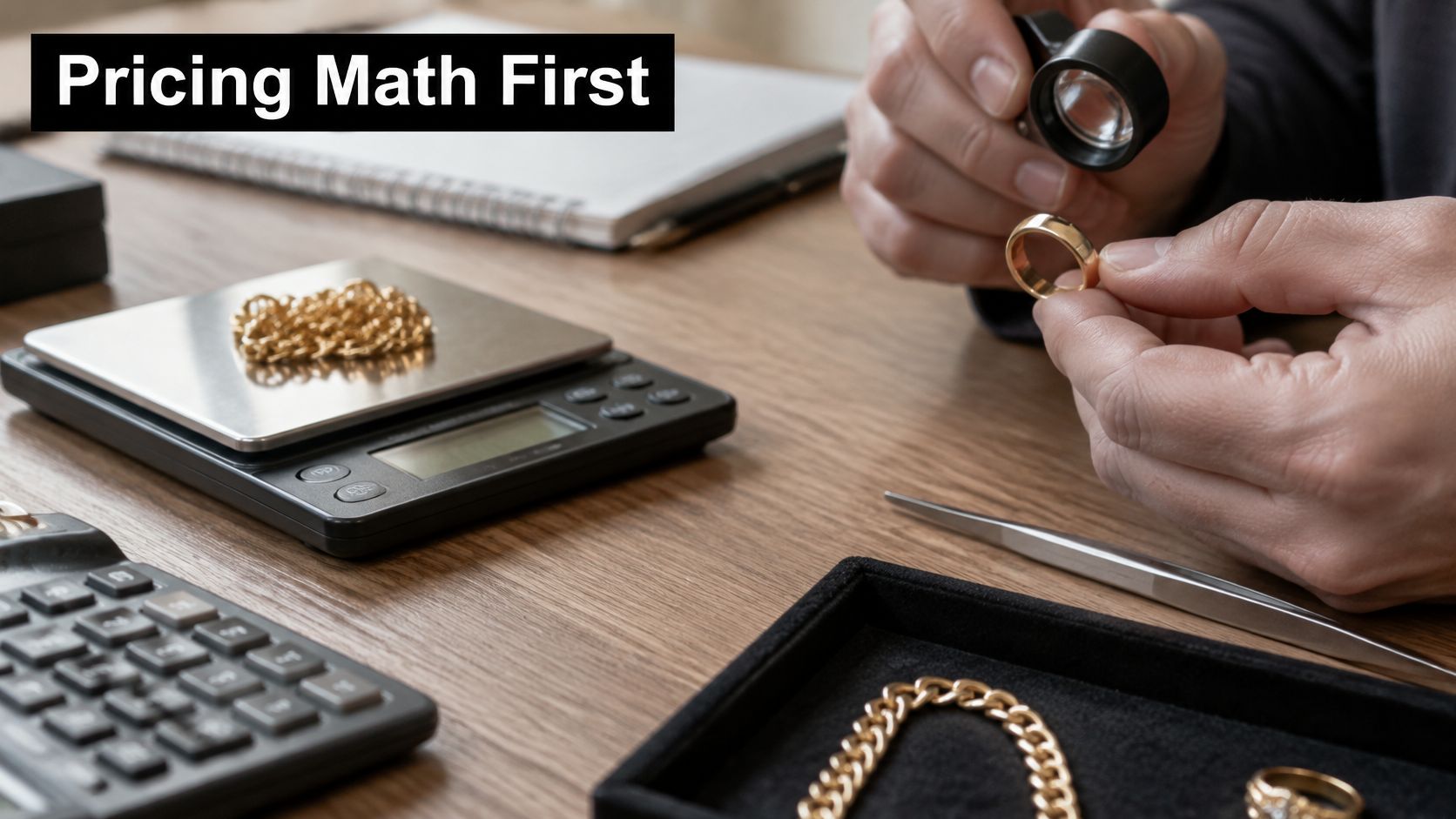
Pure gold weight equals gross weight times karat divided by 24. Multiply that pure weight by the current gold price, then subtract the buyer's refining or handling margin. A local buyer should show the full calculation on the ticket so each piece can be checked against the same gold price, which is the core idea behind how to price jewelry by weight and karat.
Worked Pure Gold Content for Four Common Pieces
| Piece | Gross weight | Karat | Pure gold content |
|---|---|---|---|
| Chain | 5 g | 10K | 2.08 g |
| Bracelet | 10 g | 14K | 5.83 g |
| Ring | 8 g | 18K | 6.00 g |
| Earring pair | 4 g | 22K | 3.67 g |
Say two buyers both weigh the 10 g bracelet correctly. One prices it as 14K and the other treats it as 10K. The pure gold figure drops from 5.83 g to 4.17 g before price is applied. At the same gold price, the second offer starts about 28% lower on metal alone. That's why the karat on the ticket matters as much as the payout. A stamp is not proof. Read the mark, then test the metal.
The formula gives gross melt value. Net is what remains after the buyer's margin and any testing charge, plus shipping and insurance if the piece travels, or a consignment cut if it sits in a case and only pays when it sells. A mail quote can look higher per gram and still pay less once insured postage, testing, and transit risk come out. A local cash offer with no postage and no commission has fewer deductions, but only if the buyer shows the deduction line.
The video below shows an in-store evaluation so you can see the weighing and inspection steps in context.
Where the offer departs from scrap value is where estates get interesting. Designer names, original boxes and papers, collectible models, antique settings, and gemstones with their own value can push a piece above melt. A brand-name piece may fetch more through resale than as metal, so ask for the melt figure and the resale estimate separately. Carat 24 offers a Buyback Program for people who want to sell their luxury items, which suits pieces that should be judged as luxury assets first.
Practical rule: If a buyer quotes only gold value for a designer piece, ask for the resale estimate in writing before accepting.
An insurance appraisal won't settle this. Replacement value answers what it costs to remake a piece, not what a buyer will pay today. Treat it as documentation, not as a cash benchmark.
If the estate also includes electronics, the same like-for-like rule applies when you get a fair laptop selling price.
Compare Written Offers and Sell This Week
Two offers on the same ring can differ by a hundred dollars before anyone mentions fees. The way to tell which one is real is to rebuild both on identical inputs: same pieces, same weights, same karats, same gold-price date. Then subtract everything the deal costs you to close.
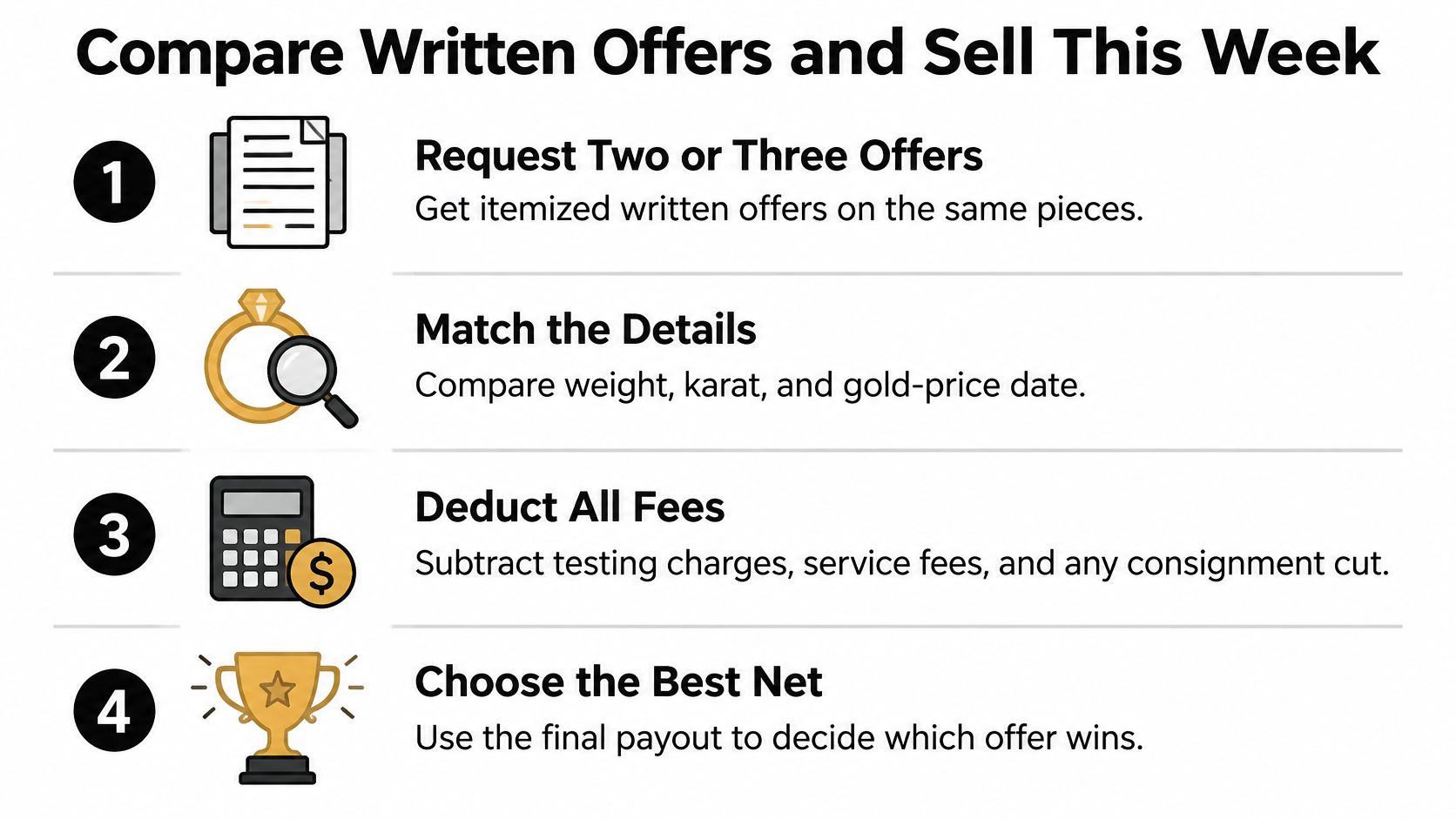
A comparison is only honest when every column is filled in. For each quote, get the buyer to state in writing the gold-price basis, the karat and weight used for each piece, the spread taken off melt, and how long the offer holds. An offer that lapses in a day, or that shifts when the gold price ticks down, is a different offer than one held for a week. The hold period belongs on the paper, not in conversation.
Worked backwards, the local advantage gets easy to see. Suppose a mail-in house quotes $40 more on the same lot. Insured, tracked postage both ways eats most of that gap, and you carry the transit risk until their scale confirms the weight. If remote grading calls one piece 10K instead of 14K, that is a second cut you cannot argue at a counter, because the piece is not in front of you. A consignment quote loses its commission and pays only if and when the piece sells, sometimes months later. A local written offer paid the same visit carries none of those deductions, which is why the net frequently beats a higher headline number from farther away.
Steps for the First Visit
- Gather the pieces, boxes and papers. Don't remove stones, polish aggressively, or throw away certificates and service records before evaluation.
- Write a one-page list of each item. Note approximate weight and karat mark where you can read them, and photograph hallmarks and any damage.
- Bring the whole box to Carat 24 at 3780 W. State St. in Boise. The shop buys and sells gold, silver, bullion, coins and other precious metals, so a mixed estate with coins alongside jewelry gets handled in one trip. The local team provides prices and insights on gold, silver, jewelry and diamonds, item by item.
- Get the weight, the karat call and the price basis on paper for each piece. Every item should have its own line, even small ones. If you want to know which questions an appraisal answers and which it doesn't before you sell, read what a free jewelry appraisal covers and keep that document separate from the cash offer.
- Compare the net against one other local quote. Same pieces, same day if you can, so the gold price hasn't moved between visits.
- Sign only once the item list and total match. Read the ticket against the pieces on the counter before anything leaves your hands.
The hassle-free part is real. No packing, no shipping labels, no insurance claim forms, and no transit loss to argue about. You watch the scale, you keep custody until you sign, and you leave with payment and a receipt that lists what was sold.
One caution before you sign. Decide whether you might want a piece back, because returns must come in original condition with all packaging and paperwork, and any market loss in metal value comes off the refund. If one item carries family meaning, set it aside at home first rather than negotiating with yourself at the counter.
Bring the broken chains and single earrings too. Sorting scrap from resale pieces is faster with everything on the table, and small items priced as part of a lot are less likely to be overlooked or undervalued on their own. Where a piece carries a designer name with its box and papers, ask for the resale estimate separately from the melt figure so you can see which number the buyer is paying.
If a piece you are keeping needs attention, Carat 24 offers jewelry repair with a free estimate before work begins, a standard turnaround of 5-7 business days, and in-store drop-off and pickup if you would rather not ship. Prices vary with the complexity of the repair, so put that estimate in writing alongside your selling paperwork. Plan the trip through Carat 24 - Trusted Gold Experts and sell locally without shipping costs or transit risk.
