

Gold demand reached a record 5,002 metric tons in 2025, including over-the-counter trading, according to the World Gold Council. But record demand doesn't tell you what a buyer will pay for your necklace, inherited ring, or bullion. If you're asking, “Should I sell gold now?” the useful answer starts with what you'll keep per gram after costs and potential taxes, not the price flashing across a financial-news screen.
Sell Now or Hold by Your Situation
A strong gold market does not make every sale worthwhile. Selling can make sense when proceeds meet a real cash need, reduce an oversized investment position, or turn unwanted jewelry into useful funds. Holding may be wiser if you have not established the item's value or would regret losing it.
The World Gold Council's full-year 2025 demand report reported 53 new all-time highs in the LBMA afternoon gold price during 2025 and a full-year average of $3,431 per ounce, up 44% from 2024. Those figures put a past purchase in context, but they do not establish today's offer or predict the next price move. Your decision should turn on what you will keep per gram after fees and any applicable taxes, not on the headline price alone.
Sell-now verdict by seller situation
| Seller situation | Sell now? | Why |
|---|---|---|
| Cash needed within weeks | Usually yes | An acceptable offer can meet the need without relying on a later forced sale |
| Holding far above target allocation | Partly | Trim toward the target; deciding where to reinvest is a separate choice |
| Inherited jewelry, no sentimental value | Usually yes, after appraisal | Document the basis and obtain an appraisal before accepting an offer |
| Family heirloom or designer piece | Hold until appraised | Brand, craftsmanship, or rarity may add value beyond the metal |
| Recent purchase with a small gain | No rush | Fees can reduce a modest gain; compare offers first |
| Only one offer so far | Wait | Get two or three written offers and compare the net price per gram |
These are decision rules, not price forecasts. Someone covering an essential bill faces a different choice from an investor rebalancing a portfolio. Neither needs to identify the market peak; each needs to compare the likely net proceeds with the problem the sale is meant to solve.
If tax collection pressure is driving the sale, review your options before disposing of an irreplaceable item. Omni Tax Help explains how to appeal an IRS levy, though an appeal does not guarantee a particular outcome.
Decision rule: Choose the option that addresses your financial need at an acceptable net payout, rather than one that depends on correctly predicting gold prices.
Start with the row closest to your situation, then check whether written offers support that choice. A favorable market alone does not establish that a particular offer is favorable.
What Gold Prices Do and Do Not Tell You
Think of spot gold as a car's published book value and your jewelry offer as a dealer's trade-in quotation. The benchmark matters, but the buyer is pricing your particular item, not purchasing an abstract market quotation.
Gold also isn't a simple inflation gauge. Inflation expectations and real interest rates can influence investors' willingness to hold it, while institutional purchases contribute another source of demand. The World Gold Council's demand analysis provides context for those competing influences, but none supplies a dependable sell signal for an individual owner.
Separate the metal market from the jewelry market
Annual gold-jewelry consumption fell to 1,542 metric tons in 2025, a five-year low, according to the World Gold Council's jewelry report. That distinction matters: strong overall gold demand doesn't establish equally strong demand for a particular bracelet or ring.
Bullion offers can be benchmarked primarily against metal value. Finished jewelry requires another question: will someone pay for the craftsmanship, brand, gemstones, or design? Weaker jewelry demand alone doesn't prove that a particular buyer's discount is justified.
For more context, review what affects gold prices, then separate your market opinion from your household decision. Selling part can let you recover an original investment or restore a target allocation while retaining exposure. You don't have to choose between selling everything and holding everything.
How to Confirm Karat and Authenticity
Before requesting a quote, establish what you're offering. A photograph of a yellow-metal chain isn't enough to determine its recoverable gold content, and a stamp is a starting point rather than conclusive proof.
Run an at-home identification checklist
- Find the karat mark. Use a jeweler's loupe or your phone's magnifier to inspect the clasp, inner band, or back of the piece. Photograph the mark before taking the item anywhere.
- Look for the maker's identification. The Federal Trade Commission's jewelry guidance explains that karat expresses gold parts out of 24 and advises buyers to look for the responsible company's name or registered trademark alongside the mark.
- Read the complete description. Don't treat wording about plating as equivalent to a solid-gold claim. The FTC's published jewelry-guidance document describes an alloy of at least 10-karat fineness using the correct designation immediately before “Gold,” such as “14 Karat Gold.”
- Record the weight. Use a digital jewelry scale, select grams, and weigh each item separately. Treat that as a preliminary gross weight, not a confirmed gold-only weight.
- Note distinguishing features. Record stones, signatures, damage, repairs, mixed-metal components, and original packaging.
- Keep documents together. Put receipts, certificates, repair invoices, and photographs in the same folder.
Karat marks and gold content
The percentages below are arithmetic conversions of the parts-out-of-24 definition; rounded percentages aren't independent test results.
| Karat mark | Gold parts out of 24 | Gold content | Other metal parts |
|---|---|---|---|
| 24K | 24 | 100% | 0 |
| 18K | 18 | 75% | 6 |
| 14K | 14 | About 58.33% | 10 |
| 10K | 10 | About 41.67% | 14 |
The important distinction is gross item weight versus gold-bearing metal weight. A stone-set ring includes material that shouldn't automatically be multiplied by its stamped purity. Ask the buyer to explain any deduction rather than guessing the stone weight yourself.
Don't file, scratch, or apply testing chemicals to a potentially valuable heirloom at home. Preserve the piece until someone qualified can assess whether an invasive test is appropriate.
A guide to determining gold purity can help you interpret what you're seeing. Professional verification still matters, especially when the mark is worn, the construction is mixed, or the item's history is unknown.
Calculate Your Net Proceeds Before Accepting an Offer
The largest offer isn't necessarily the largest amount you'll keep. Use a worksheet that distinguishes the buyer's quotation, selling expenses, taxable gain, and estimated after-tax cash.
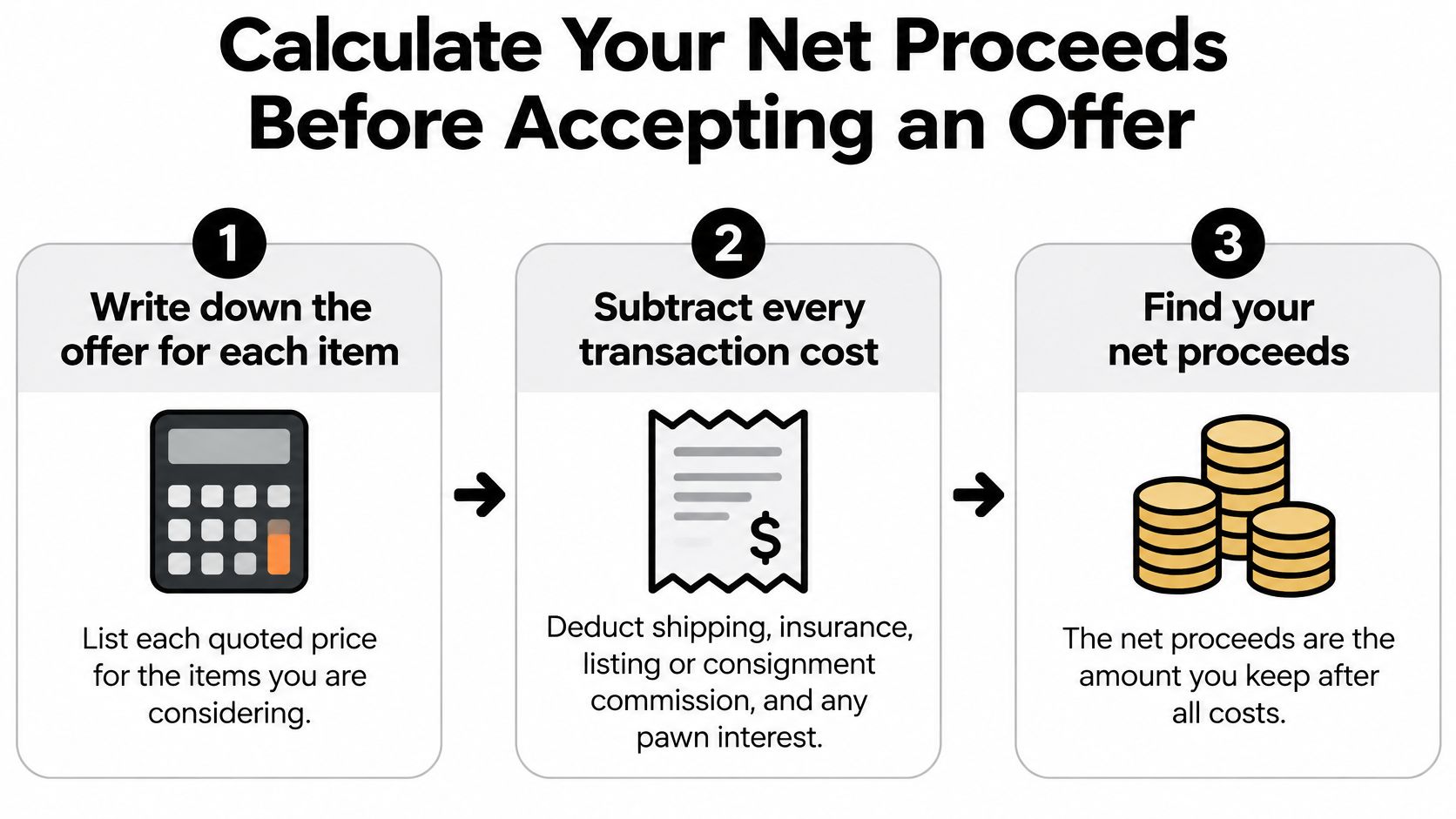
This visual summarizes the first part of that calculation.
Build an item-by-item worksheet
- Write down each offer. Request the item's tested karat, payable metal weight, quotation time, and total payment in writing. Keep separate items separate so a bundled offer doesn't conceal an unfavorable valuation.
- Subtract transaction costs. Include applicable shipping, insurance, listing charges, consignment commission, and any pawn-related borrowing costs. Don't deduct an expense again if the written offer already includes it.
- Calculate pure-gold content. Multiply confirmed gold-bearing weight in grams by karat divided by twenty-four. Exclude stones and non-gold components before using this formula.
- Calculate both per-gram figures. Divide proceeds after selling costs by payable alloy grams, then by pure-gold grams. Compare a pure-gold-per-gram payout with a spot quotation expressed in the same unit.
- Establish documented basis. Gather purchase receipts, estate records, relevant appraisals, and improvement records. An inherited item's basis may differ from what the deceased originally paid, so don't substitute family recollection for a documented calculation.
- Estimate the tax effect. The IRS explains capital-gain reporting for assets including metals and jewelry, with gain generally determined from proceeds minus basis and long-term treatment generally applying after more than one year. Ask a tax professional how personal-use status, inheritance, losses, and applicable tax treatment affect your result.
- Check intact resale value. Obtain an independent appraisal for a signed, collectible, or historically significant piece before accepting scrap pricing. High purity alone doesn't establish collectible value.
A hypothetical calculation
Suppose a buyer offers $900 for a 20 g, 14K item with no stones or other excluded components, and shipping costs $25. In this illustrative example, proceeds before tax are $875, or $43.75 per gram of alloy; calculated pure-gold content is about 11.67 g, producing a payout of approximately $75 per pure-gold gram.
Those are example inputs, not market quotes. Your after-tax result still requires your actual basis and tax circumstances.
Use the gold-jewelry cash calculator guide to organize comparable quotes.
Keep the accounting straight: Basis helps determine taxable gain. It isn't another cash expense to subtract from the check you'll receive.
Choosing Between Local, Pawn, Online, Auction and Consignment
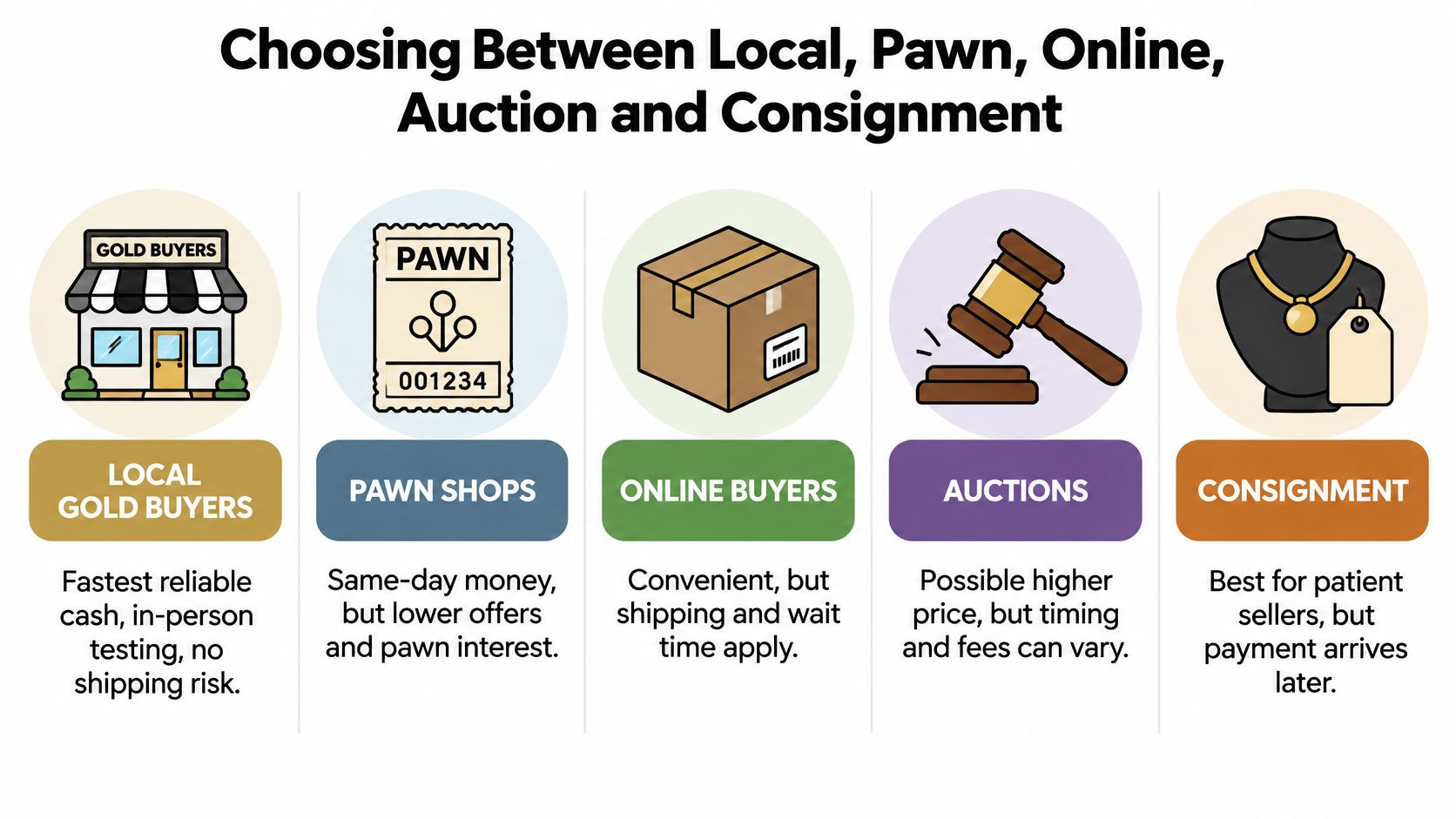
Choose a selling channel by comparing net payout, payment certainty, timing, and item type. A route suited to a broken chain may be poorly suited to a signed estate bracelet.
The following comparison describes general transaction patterns, not guaranteed provider terms. Confirm payment timing, deductions, cancellation rights, and return arrangements before handing over or shipping anything.
Selling options compared
| Option | Speed | Typical payout | Fees and hassle | Best fit |
|---|---|---|---|---|
| Local gold buyer | Same-day payment may be available | Gold-content valuation minus buyer margin, or an intact-item offer | In-person testing; confirm deductions | Cash needed promptly |
| Pawn shop | Same-day sale or loan may be available | Compare the purchase offer separately from any loan amount | Interest and redemption terms apply when borrowing | Short-term cash you can repay |
| Online buyer | Payment follows shipping, receipt, and acceptance | Use the final accepted quote, not an advertised estimate | Shipping, insurance, return terms, and potential disputes | Items with clear weight and purity |
| Auction | Scheduled sale and settlement process | Determined by bidding and any reserve | Seller commission and possible listing or other charges | Rare or collectible pieces |
| Consignment | Payment follows a completed sale | Final selling price minus agreed deductions | Commission, custody terms, and potentially extended waiting | Branded items needing a resale audience |
A pawn loan and an outright sale aren't interchangeable. With a loan, you're evaluating repayment obligations and the consequences of not redeeming the item, not choosing the largest cash offer. Review the difference between pawning and selling before signing either agreement.
Match the route to the asset
For ordinary scrap jewelry, ask whether the buyer explains the payable weight and purity clearly. For rare coins, designer jewelry, and collectible watches, ask whether the selling channel reaches buyers who value the complete object.
An auction's possible upside isn't a guaranteed payout. Ask what happens if bidding fails to reach the reserve, whether unsold charges apply, and when cleared proceeds become available. With consignment, establish who carries insurance and whether you can withdraw the item.
Compare a firm purchase offer with another firm purchase offer. Don't treat an auction estimate or hoped-for retail price as cash already available.
Local selling removes the need to send the item away for evaluation. Online selling may still produce a better net result, but only if its accepted price compensates for all applicable costs and conditions. Fast cash generally favors a direct buyer; unusual pieces may justify a specialist resale channel.
Getting the Best Local Offer in Boise and Your Next Steps
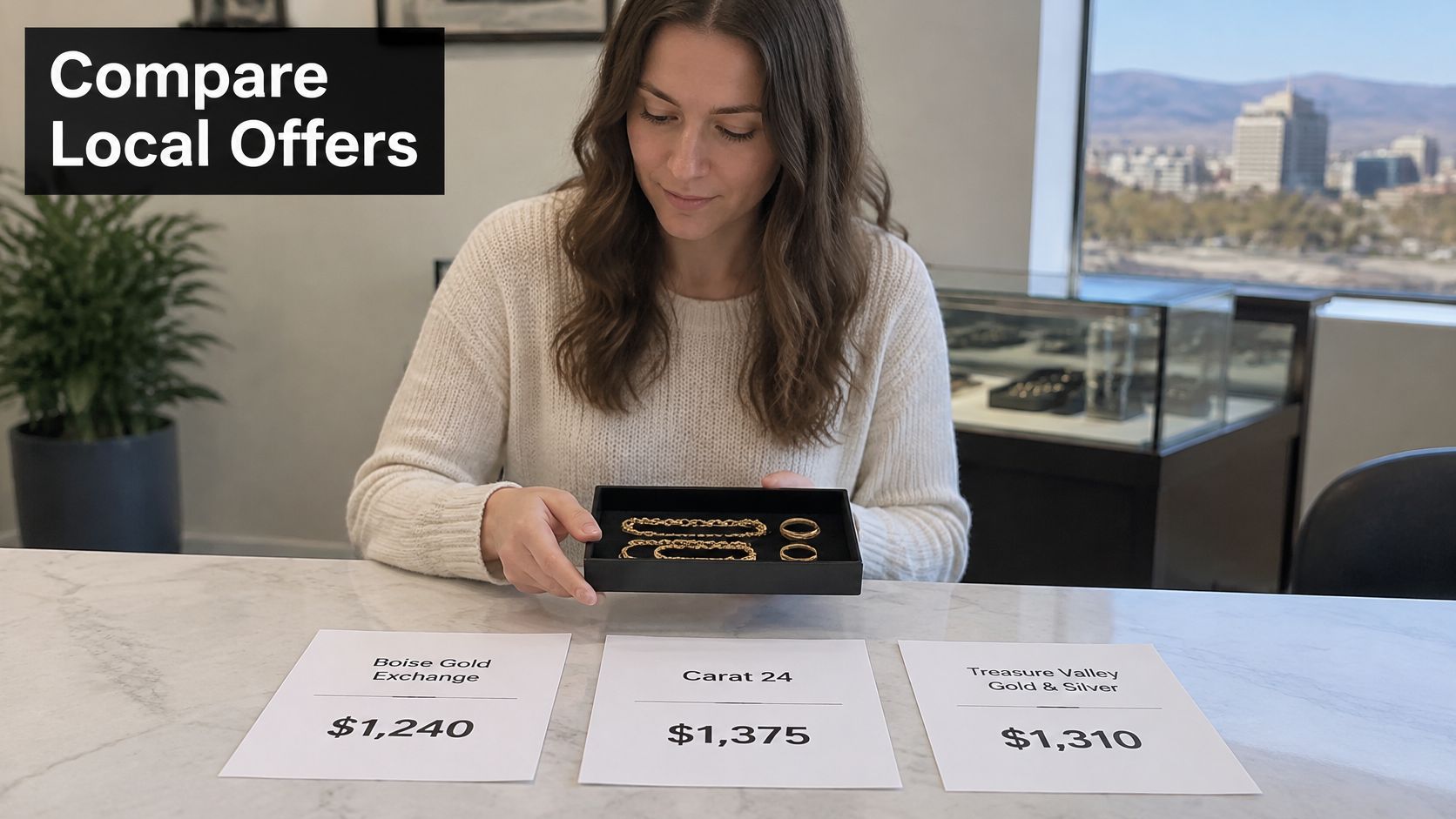
A local offer is only comparable when each buyer evaluates the same items and states the deductions clearly. Carat 24 is one Boise option for selling jewelry, bullion, and estate items. Compare its written evaluation with other offers, then decide based on the amount you would receive.
Bring the same items and records to each appointment.
Ask for terms in writing
Ask every buyer, including Carat 24, to state whether testing has a charge, whether price matching is available, and how the offer and any deductions are calculated. Confirm what each policy covers before relying on it.
Use this checklist at the shop:
- Request an itemized quotation. It should identify karat, payable weight, total offer, deductions, and the resulting price per gram.
- Ask about price matching. If available, get the qualifying offer requirements and any exclusions in writing.
- Ask whether testing costs anything. Confirm whether a charge applies if you decline the offer.
- Clarify custody and consent. Before testing, ask whether a method could mark, cut, remove stones from, or otherwise alter your property.
- Compare the payment you would receive. Base the decision on the stated amount, not a promotional claim or an estimate from photographs.
A guide to local gold and silver dealers can help you prepare questions. Ask each shop directly for its current terms.
Understand what scanning can establish
X-ray fluorescence, or XRF, analyzes elemental composition without cutting jewelry. However, a technical submission in the FTC's jewelry-guides record explains that XRF cannot reliably determine exact low-karat gold-plating thickness over materials such as sterling silver. Both the coating and the underlying material can affect the reading.
Screening can still inform an evaluation, but a surface-sensitive result may not establish an unusual item's full construction. Ask how the evaluator handles suspected plating, hollow construction, or inconsistent readings.
The same technical record describes cross-sectional SEM/EDS examination, which requires destructive preparation. For a potentially collectible piece, consider a specialist assessment before authorizing more invasive testing.
This video offers another format for considering the selling process.
Make a limited, deliberate sale
Before your appointment, sort your property into bullion, ordinary jewelry, heirlooms, and collectibles. Keep estate documents and repair invoices with the relevant items, and set aside anything you are unwilling to sell.
Write down the cash amount you need or the allocation you are trying to restore. Sell only the portion that serves that objective, and choose a review date for anything you retain.
A local sale avoids shipping and arranging transit insurance. To compare it with an online offer, subtract applicable costs from the online buyer's accepted payment, then compare that net amount with the local written offer.
Decide based on the verified item, net payout, documented basis, and estimated taxes. A headline gold price alone does not show what you will keep after deductions and taxes.
Visit Carat 24 - Trusted Gold Experts to discuss selling gold, silver, bullion, or jewelry and request a written evaluation. Bring relevant receipts and estate records, ask about testing charges and price-matching terms, and compare the net payout with competing offers before deciding.
