
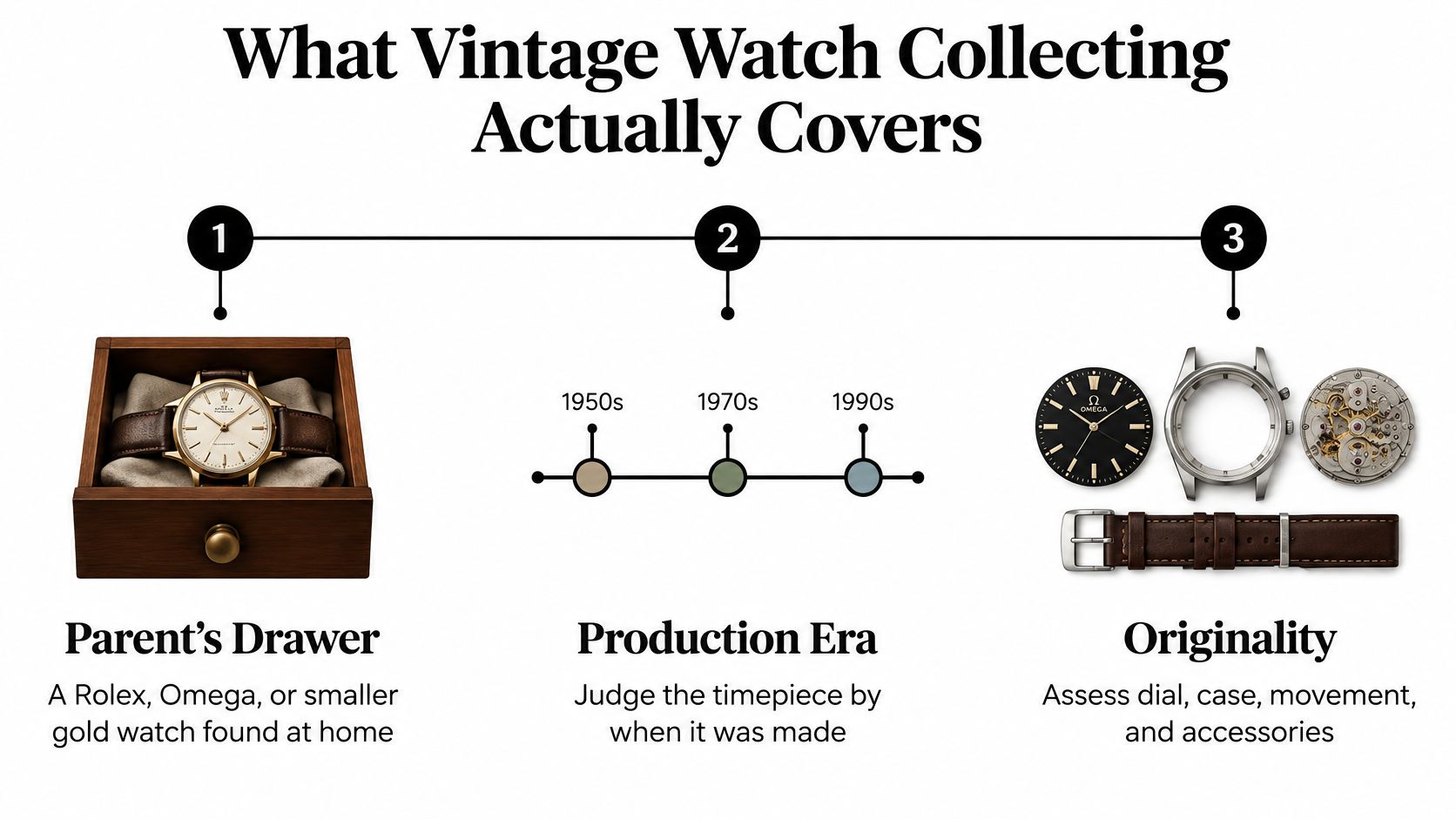
The watch on the kitchen table is probably a Rolex, an Omega, or a smaller gold piece from a parent's drawer. It may run, or it may sit silent, and the papers are gone. You don't need a brand speech yet. You need a way to judge the object in front of you: when it was made, what movement it uses, whether the parts still match that period, and what it will cost to keep, or to sell, over the next decade.
What Vintage Watch Collecting Actually Covers
A gold pocket watch and a slim wristwatch may both come from the same family drawer, but they belong to different collecting eras. Vintage watch collecting starts by placing the watch in its period, then looking at its movement and design. Era gives the watch context; a famous name alone does not.
Swiss watchmaking has roots in mid-16th-century Geneva. The Swiss watchmaking industry's history also describes the disruption of the 1970s and 1980s, when inexpensive battery-powered quartz watches and strong Japanese competition challenged mechanical makers. Many watches collectors seek were made just before, during, or after that shift. Swiss exports later climbed from just over CHF 4 billion in 1986 to more than CHF 20 billion by 2015, a reminder that the industry changed along with the technology.
Five eras you can point at
Use five broad eras to orient yourself. Like reading a map before choosing a route, this gives you a starting point: compare the movement, case size, and dial with the period's design.
- Pocket watches. Look at the case hallmarks, winding method, and movement. A thick gold hunter watch from a grandfather's vest belongs here. For more context, see this guide to good pocket watches.
- Early wristwatches. Smaller cases, lugs, and dials designed for the wrist mark a different kind of watch from a pocket piece. Small gold dress watches can be easy to overlook, even though they have a clear place in a collection.
- Pre-crisis mechanicals. These watches use manual or early automatic movements and often have sharp case lines. Their designs belong to the period before quartz competition reshaped the market.
- Quartz-crisis survivors. Mechanical watches from this period were made while quartz was gaining ground. Some kept conservative designs; others show a mechanical line's response to the shift.
- Neo-vintage, from the 1970s into the early 2000s. Quartz and mechanical watches appeared side by side, with designs that include integrated bracelets and smaller sports cases. Consider how the design relates to the quartz era, not just whether the logo is familiar.
Pick the job before the logo
Choose an era and a purpose before narrowing by brand. A dress watch should sit comfortably under a cuff; a daily wearer needs a case and bracelet suited to regular use.
For example, a 34 mm gold Omega from the late 1960s fits the pre-crisis dress-watch category. Its case size, movement, and period design help explain what kind of watch it is. Then judge the specific example on its condition and parts: authentic, original, and historically correct describe different things, and the distinction affects what a buyer is paying for.
Authentic Original or Historically Correct
Heirs skip the question that sets the price. A real brand name is not an untouched collector watch. The practical split, spelled out in guidance on buying a vintage watch without getting burned, is that a watch can be genuine and still hold later service parts, while mismatched case and movement serial ranges can signal swapped components.
| Category | What it means | Effect on collector value |
|---|---|---|
| Authentic | Genuine maker's watch that may contain later service parts | Proves it is not counterfeit; does not by itself earn a premium |
| Original | Dial, hands, bezel, case finish, and related visible parts still match production | Usually the configuration buyers pay up for |
| Historically correct | Replacements fit the era and reference but may not be this watch's first parts | Middle ground when the swap is disclosed |
| Serviced non-original | Later dial, hands, relume, or a refinished case | Can be reliable to wear and is priced below an original example |
A genuine watch is not the same thing as an original watch.
Authentic means the maker built it, even if a later crown, crystal, dial, hands, or bezel went on during service. That rules out a counterfeit. It does not, by itself, earn a premium.
Original means the dial, hands, bezel, and case finish still match how that reference left production. That's the configuration buyers usually pay up for.
Historically correct means a replacement fits the era and the reference, but it may not be this serial's first part. Disclosed, it's a middle price. Hidden, it's a problem.
Serviced non-original means a later dial, a relume, a polished case, or mismatched hands. The watch can be honest and wearable. It prices below an original example of the same reference.
Manufacturer service can lower originality without creating a counterfeit. A service center that fits a current hand set so the watch tells time has not built a fake. It has changed what a collector is willing to pay.
The paperwork test
Run this before anyone quotes a number. A Rolex reference number guide helps on one brand's codes. The same six checks apply to Omega, Cartier, and a no-name gold dress watch.
- Photograph the movement and the case, inside and out.
- Check that the reference and the serial sit in a compatible range.
- Gather whatever service history exists, even a single invoice.
- List every part someone says was replaced.
- Note refinishing or reluming in plain words.
- Say whether each replacement is period-correct for that reference.
Label it before you price it
Take a 1970s gold dress watch with a later reprint dial. It keeps time. The case may even be right. The reprint dial still drops the collector premium, because the face is no longer the one that left the factory. That's a serviced non-original watch, not an original one and not a counterfeit.
Write one row from the table on a card and tape it to the pouch. “Worth a lot because it's a Rolex” is not a label. “Authentic, serviced, later dial” is. Only then is a price conversation useful.
How to Start a Focused Collection
A first year of vintage watch collecting works better as one trail on a map than as a trophy case of logos. One reference family, one wrist, one era you already chose.
A sequence you can finish this month
- Set a cash ceiling you can lose sleep over. Often that is one watch, not three. If a missed payment would wreck the month, the ceiling is too high. Write the number down before you open a listing.
- Keep the era you already picked, and add one wrist size. Smaller cases and women's references are a real collecting lane, not a courtesy shelf. A 31 mm gold Cartier that fits a 60-year-old wrist in Boise is a collection, not a compromise.
- Learn one brand's reference system before you add a second brand. Rolex, Omega, and Cartier are common starts because parts and completed sales are easier to find than on an obscure caliber. Use something like a list of most collectible Rolex watches only as a map of references, not as a shopping order.
- Buy the best originality you can wear. Skip the rarest name that still fits the budget if the dial is a reprint and the case is round from polishing. A plain, original Omega you will strap on beats a “rare” project you cannot explain.
- Keep a one-page log. Reference, serial, seller, price, and what was disclosed as replaced. Six months later you will not remember the phone call. The log will.
Where neo-vintage fits
When classic steel sports watches sit past the ceiling, neo-vintage references from the 1970s through the early 2000s are a workable on-ramp. You still pick one family. A single Omega Seamaster line, or one Cartier Tank size, beats a drawer of unrelated logos bought because each one was “a deal.”
What a full set actually proves
A box and period papers raise confidence only when they match the reference and the serial. Unrelated booklets, a later outer box, or a photocopy with another watch's number do not. Papers are evidence about this object, not a costume.
If you can't explain why this reference fits your era and your wrist, don't buy it yet.
That's the starter rule. Say it out loud at the counter. If the sentence doesn't come, put the watch back and spend the month on the reference chart instead.
The Authentication and Valuation Checklist
Price follows an exam, not a vibe. The vintage watch authentication guide from Watch Express treats originality as a system: reference, caliber, dial, hands, case, crown, bezel, bracelet, and any restoration. A watch that runs can still be the wrong configuration.
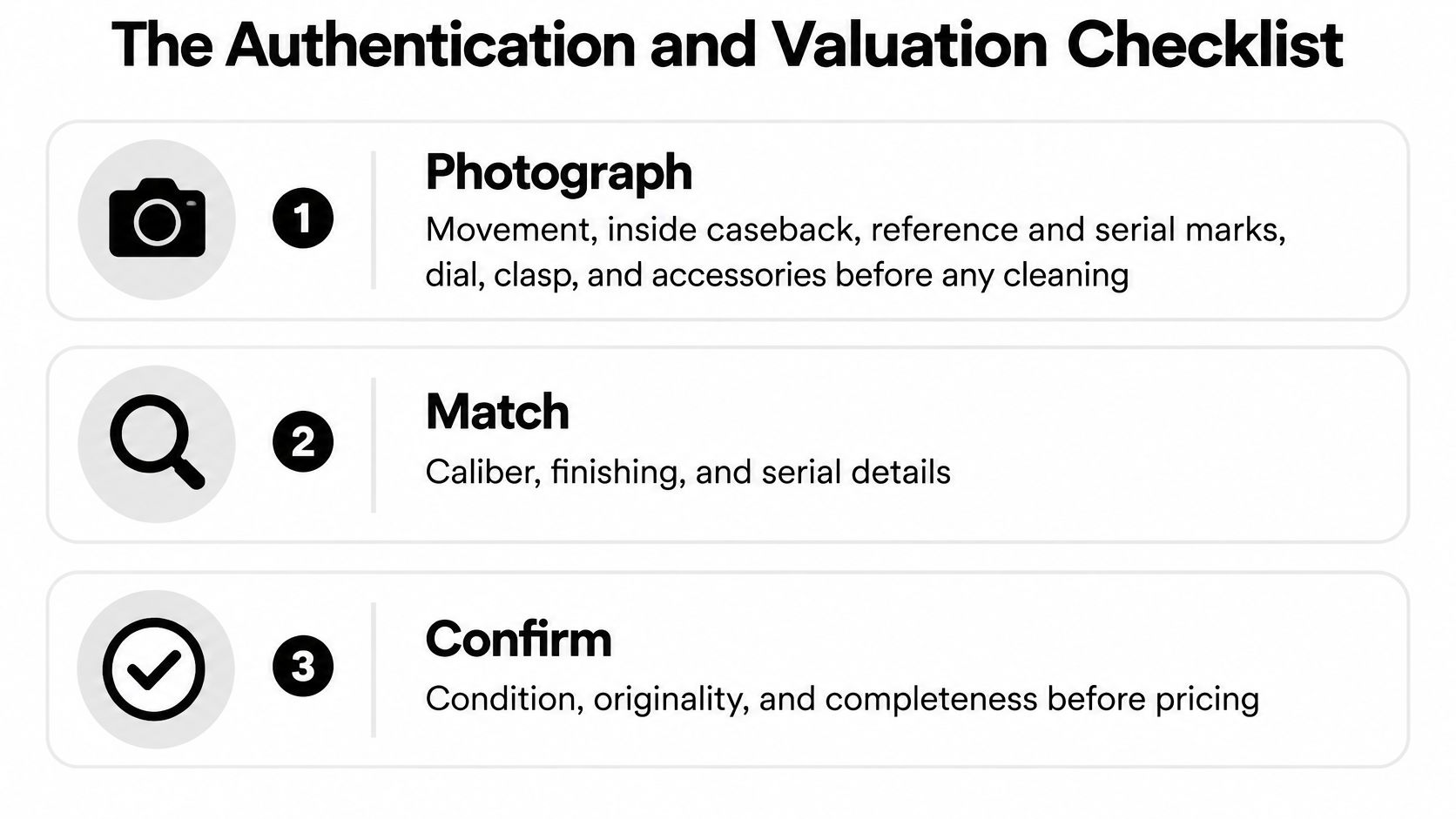
Bench routine before anyone cleans it
Do this in order. Cleaning first destroys the evidence you're trying to read. A separate walkthrough of watch authentication pairs well with the photos, but the photos come first.
- Photograph before cleaning. Movement, inside caseback, reference and serial marks, dial, clasp, and accessories. Use daylight and a plain background. These frames are your record if a later polish or a lost hand becomes a dispute.
- Match the movement to the period. Caliber, finishing, and where the serial sits should agree with how that reference was made. A pretty rotor in the wrong caliber is not a small miss.
- Read the outside as a set. Dial typography, lume aging, hand shape, crown, bezel, and bracelet reference. A period-correct replacement dial may be easier to read and still cut collector demand. Ordinary internal wear parts from the maker are usually judged more kindly than a new face.
- Judge the case by its edges. Sharp lug edges, intact chamfers, and even factory brushing are the clues. Repeated polishing removes metal and rounds the transitions the factory cut.
- Leave the surfaces alone. Don't chemically brighten a dial or refinish the case. That work is irreversible, and it erases the aging a buyer uses to believe the watch.
- Split the invoice. A qualified watchmaker's bill should separate visible parts replaced from ordinary wear parts. “Serviced” on one line hides a new dial. Itemized lines do not.
Price against finished sales, not averages
Subdial's notes on vintage market dynamics point to completed sales of the same reference over a 12 to 24 month window, sorted by condition, originality, accessories, and papers. Add buyer's premium and applicable tax to a hammer price. The result is an all-in cost, not a headline.
An original manufacturer warranty card or period papers outweigh a generic service slip or a photocopy. Provenance helps when it ties this serial to a reference range, an ownership line, or a documented service. A box plus unrelated letters does not.
| Tier | What you typically see | How to use it in pricing |
|---|---|---|
| Project | Not running, heavy damage, or important parts missing | Compare only with other projects; do not use driver prices |
| Driver | Runs, with polish, wear, or some service parts | Everyday-wear band, below original show examples |
| Show | Strong originality and light wear | Premium when dial, hands, bezel, and case finish still match |
| Concours | Unpolished, original visible parts, strong documentation | Top of the 12 to 24 month set for that reference |
The common mistake is pricing a polished project against an unpolished original and calling the gap “negotiation room.” It isn't. It's two different watches that share a reference number.
Before you talk money, write one tier and one comparable range on the same card as the category label. “Driver, and the finished sales I can match sit here.” That's the number you negotiate from.
Care Service and Long Term Ownership Cost
A watch can look complete in a display case and still be hard to keep running. Over the next 10 to 20 years, ask whether a watchmaker familiar with its caliber can source seals, a crystal, and movement parts. Timeless Ticks' vintage buying guide frames serviceability as a practical buying question, not an afterthought.
A scarce reference can become an expensive paperweight if its caliber is unsupported. That risk can be greater with less familiar watches, smaller-diameter pieces, and neo-vintage models from the 1970s to the early 2000s than with references many local watchmakers already know. Interest in pre-owned women's watches has been rising, including vintage Cartier, Rolex, and Omega. Demand alone is no reason to buy a watch that is difficult to service.
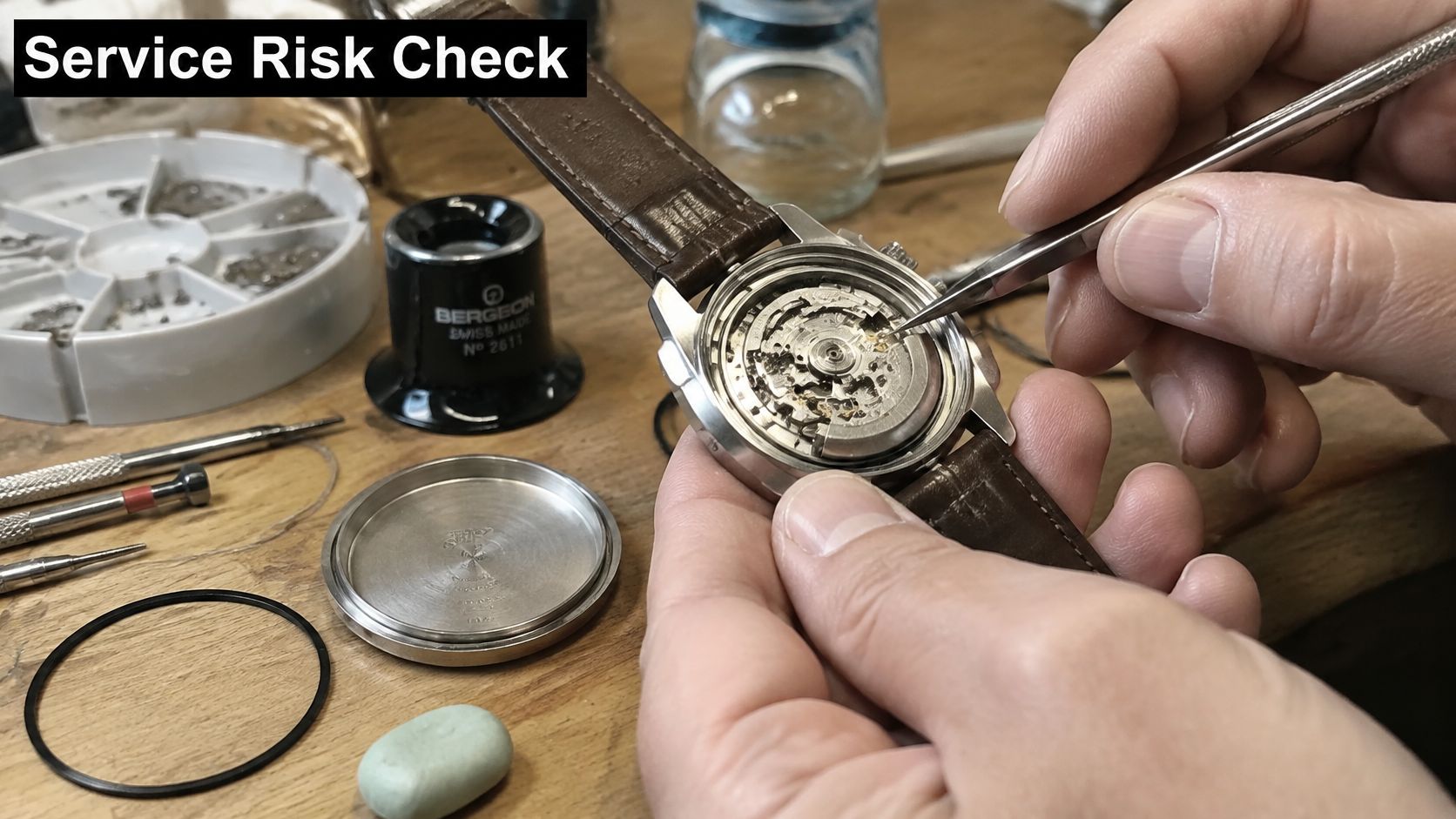
What ownership actually costs
Separate the purchase price from the cost of keeping the watch usable. You do not need an exact dollar estimate before you buy, but you do need to identify likely jobs and who can do them.
- Periodic overhaul: Gaskets, oils, and timing need attention. Ask about service before treating a low purchase price as a bargain.
- Water resistance: Many vintage cases cannot promise safe swimming. A watch's past use as a diver does not establish its current water resistance.
- Parts scarcity: A specific crystal or bracelet end link may take longer to find than movement service takes to arrange.
- Shipping to a specialist: If local watchmakers will not work on the caliber, include postage and insurance in the ownership cost.
- Insurance: Check whether a household policy can cover the watch, and keep photos that match the piece you own.
- Resale after a non-original repair: Mismatched hands or a polished case can change how buyers judge originality and condition, affecting the price tier.
Daily care is not valuation
Keep the watch away from magnets and hard knocks. Wipe it dry, then store it somewhere stable, away from a hot car or damp bathroom. Avoid polishing a collectible case for shine. Removing metal can soften the edges of the lugs and alter the case's original shape.
The cheapest purchase can carry the highest long-term cost. A less rare watch with serviceable parts may be easier to wear and resell than a “rare” example with an obsolete caliber. Authenticity, originality, and historical correctness are separate qualities; serviceability determines whether you can keep enjoying the watch over time.
Before paying, ask the seller who can service the caliber and which visible parts a repair might replace. A clear answer helps you judge whether the watch is a practical purchase, not just an appealing object.
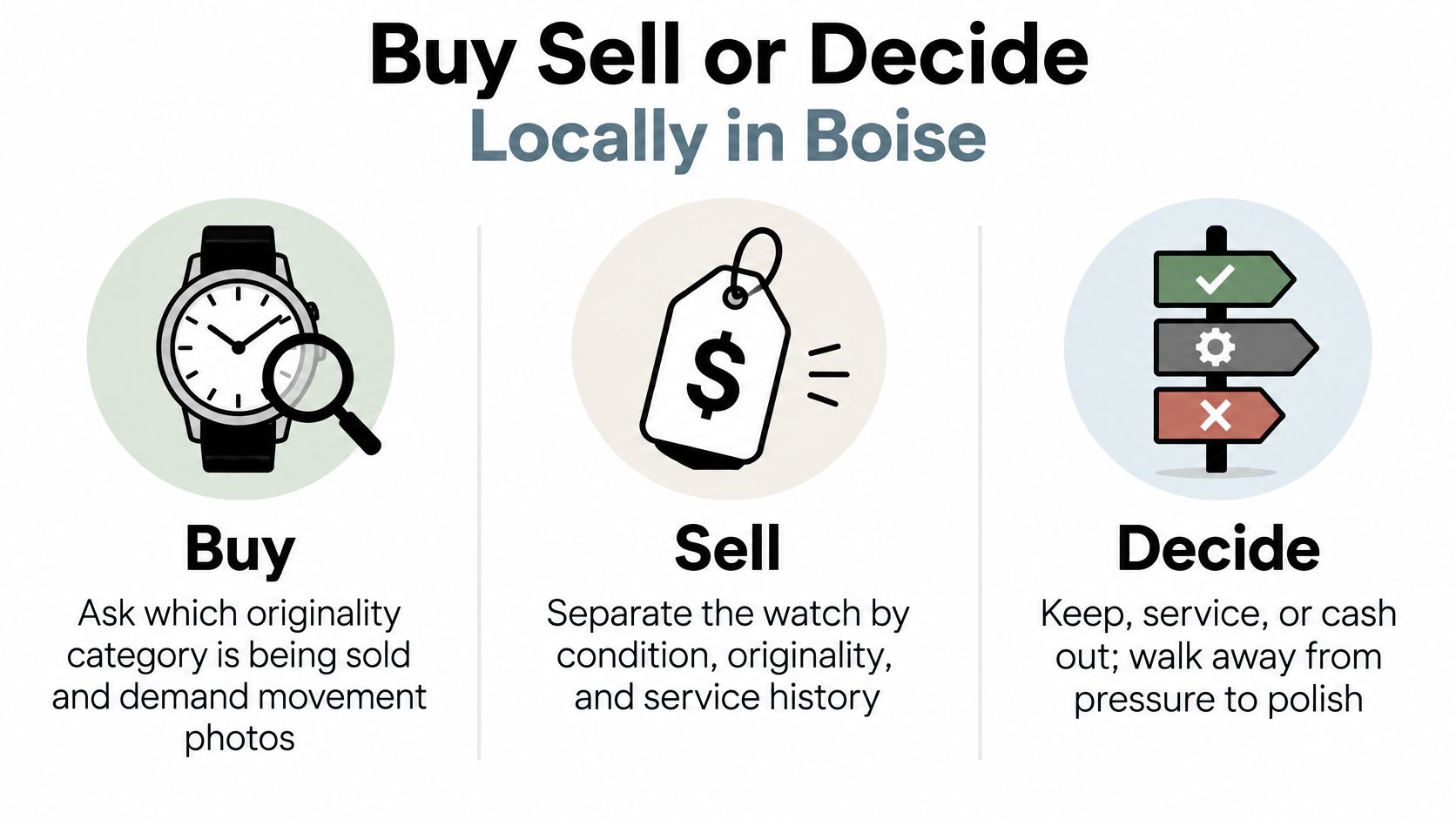
Buy Sell or Decide Locally in Boise
Buying and selling are different jobs. Mix them and you'll polish a watch you meant to keep, or you'll ship a gold bracelet for a headline that shrinks after fees.
Buying without a polish pitch
Ask which originality category is being sold, and ask it in those words. Demand movement photos before you travel across town. Walk away from pressure to polish “so it looks new.” New edges on a 1968 case are damage, not a favor.
For gold and jewelry buying, appearance is a weak test. The FTC jewelry guides require truthful claims about metallic content, quality, weight, size, origin, price, and value, and they point buyers toward a karat-quality mark because the karat number shows how much pure gold is in the alloy. Free X-ray scanning and gold testing beat a color guess on a worn clasp or a faded stamp. A hassle-free in-person offer still has to show how weight, purity, brand, and condition produced the figure.
What you actually keep
Online selling is a stack of chores. Hostinger's jewelry-selling walkthrough lists listings, buyer questions, payment, packaging, and tracked, insured shipping with signature confirmation for valuable jewelry. Platform fees vary. A local counter removes the listing and the shipment. It doesn't remove the need to compare offers.
LitCommerce's fee comparison cites eBay Jewelry & Watches at 15% on sales up to $5,000 per item and 9% on the portion above $5,000, before ads, payment processing, shipping, or insurance. A local offer can beat an online headline once those costs come off. Compare nets. Price matching is a store policy, not a legal right, so the comparable has to be defined. No public source names a single highest payout in Boise. If that's the number you want, collect more than one written quote on the same watch, with the same disclosed parts.
| Route | Costs and effort | How to judge the offer |
|---|---|---|
| Online marketplace | About 15% eBay fee to $5,000 and 9% above that, plus possible ads, payment, shipping, and insurance | Subtract fees from the sale price before comparing |
| Shipped private sale | Listing, questions, packaging, tracked insured signature shipping | Headline price is not cash in hand |
| Local Boise counter | No platform fee and no shipment; in-person identity, weight, purity, brand, and condition | Compare the quoted net with online net, not with a listing price |
| Price-match request | Policy only; the comparable quote must be defined | Match like-for-like nets, not unrelated asking prices |
Say a finished online sale would show $4,000. Fifteen percent is $600 before postage and insurance, so the wire is already under $3,400, and shipping sits on top of that. A local quote of $3,500 with no fee and no box to mail is the higher net, even though the online number looked bigger on the screen. That's the comparison. Save the hassle and sell locally when the in-person figure, after you subtract nothing for a platform, beats what you'd clear on a shipment.
Carat 24 at 3780 W. State St., Boise, buys and sells gold, silver, bullion, numismatics, and luxury watches including Rolex. The counter uses an eight-step authentication process and offers free X-ray scanning, gold testing, and a hassle-free in-person offer. Bring a competing written quote if you want a price-match conversation, and treat that quote as a like-for-like net. A shop that only buys scrap gold is a different appointment from one that will also read a watch reference. Luxury watch buyers near me is a useful filter for which counters look at the movement.
Three forks, then one choice
The mistakes that wreck the net are specific. Polishing before photos. Pricing a project against concours. Treating a brand name as originality. Buying an unserviceable caliber because the logo is familiar. Comparing an asking price before fees.
- Keep it when the watch is original enough for your purpose, wearable, and serviceable on a caliber someone local or shippable already knows. Log the reference, the serial, and the service date.
- Service it first when the caliber is known and the only barrier is an overhaul. Budget that visit before you decide the watch is “not worth keeping.”
- Sell locally when you want cash, when the piece is gold jewelry, when it's an incomplete estate watch, or when it's refinished and you won't wear it. Bring the photos, any papers, and one competing quote. For an estate with several gold chains and one tired wristwatch, split the lots: metal by karat and weight, the watch by reference and condition, so neither offer hides inside the other.
That's the decision. Not “is it a famous name,” but keep, service, or cash, judged on originality, the next 10 to 20 years of parts, and the dollars that arrive.
Carat 24 - Trusted Gold Experts buys and sells gold, silver, and luxury watches in Boise, with free X-ray scanning and gold testing on the piece you bring in. If a drawer watch or a gold bracelet needs a straight local number, compare that in-person net with what you'd clear after online fees and shipping. Visit Carat 24 - Trusted Gold Experts at 3780 W. State St. with the watch, any papers, and a competing quote.
