

A handbag sold for €8.6 million, approximately $10 million including fees, at Sotheby's Paris on July 10, 2025, setting the auction record for any handbag, according to CNN's report on Jane Birkin's original Hermès bag. That result makes luxury handbags sound like financial assets. But the bag's documented history and celebrity ownership make it an exceptional collectible, not a sensible benchmark for the bag in your closet.
For everyday buyers and Boise estate sellers, the useful question is narrower: What will someone pay for this exact model, in this condition, after selling costs? Start with the house, identify the bag, and compare realistic proceeds with a local offer before deciding whether to buy, keep, consign, or sell.
Luxury Handbag Brands at a Glance
Industry estimates put the worldwide luxury handbag market at approximately $27.08 billion in 2025, with a projected value of $38.13 billion by 2031, according to Mordor Intelligence's luxury handbag market analysis.
Luxury handbag brands by heritage, signature, and price tier
| Brand | Signature style | Typical resale behavior |
|---|---|---|
| Hermès | Birkin and Kelly | Scarce styles hold value; resale outcomes differ by model and size |
| Chanel | Quilted flap with turn-lock | Strong demand, uneven by size and color |
| Louis Vuitton | Speedy, Neverfull, monogram canvas | High liquidity; coated canvas often easier to sell locally |
| Gucci | Jackie, horsebit, Dionysus, GG canvas | Fashion-cycle sensitive; trend and age move the offer |
| Prada | Saffiano and nylon totes | Usually durable use value rather than trophy appreciation |
The visual comparison provides a quick way to recognize each house's design language.
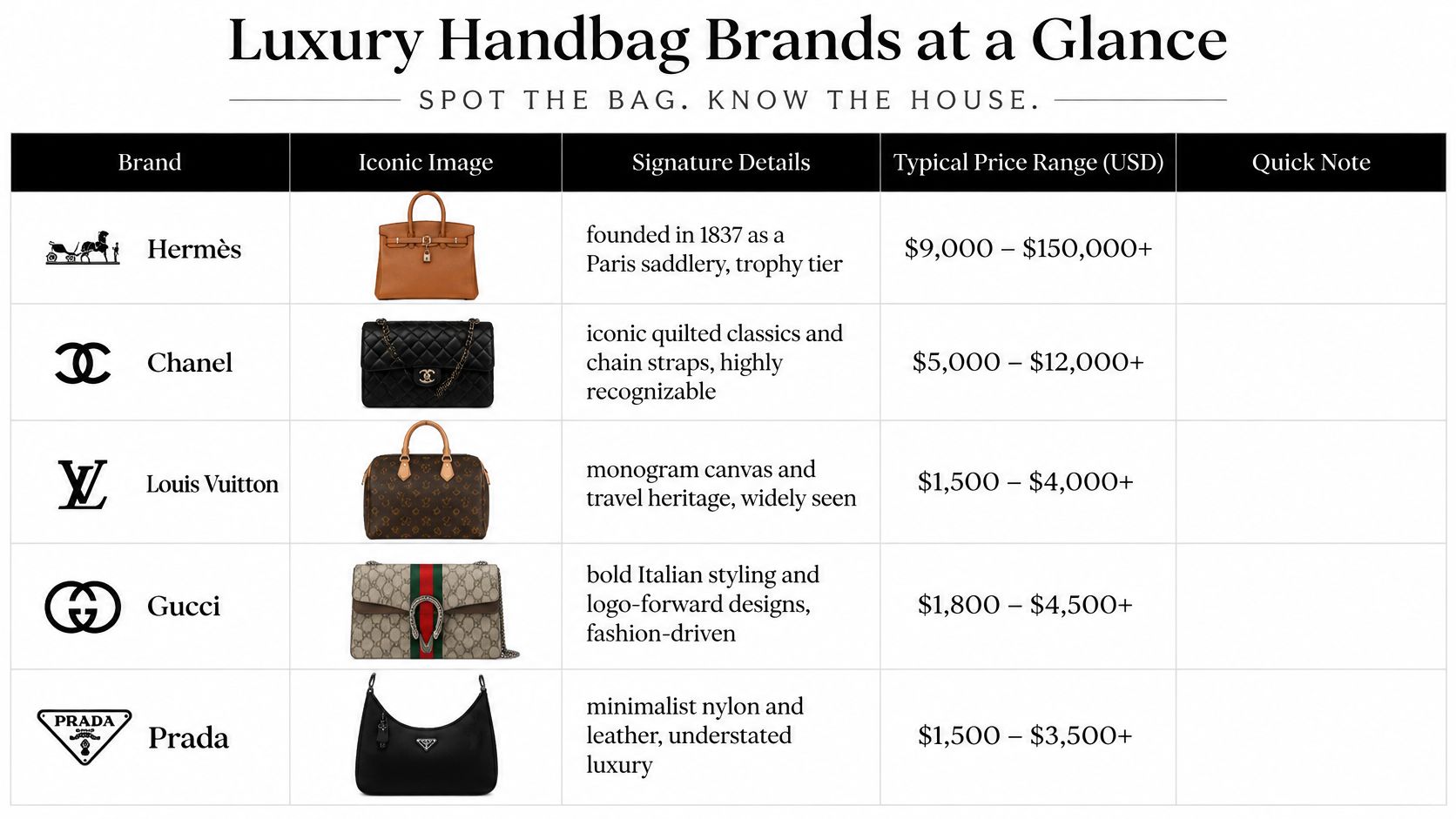
Read the House Before the Price Tag
Hermès, founded in 1837 as a Paris saddlery, occupies the trophy tier. The Birkin and Kelly are its essential reference points, but restricted boutique access doesn't make every example equally collectible. A buyer still needs to distinguish the model, size, construction, leather, and condition.
Chanel is the quilted-flap house, from Gabrielle Chanel's 2.55 to the Classic Flap with its recognizable turn-lock. Chain straps and quilting help identify the family, not the final value. Don't treat every black quilted Chanel as an interchangeable product.
Louis Vuitton, a trunk maker from 1854, belongs in the liquidity conversation. Buyers recognize Speedy and Neverfull shapes, along with monogram and Damier canvas. Liquidity means finding an interested buyer may be easier, not that the buyer will reimburse the original purchase price.
Gucci, founded in Florence in 1921, is more exposed to fashion cycles. Jackie, horsebit, Dionysus, and GG canvas describe different buyer interests. An older design might appeal to a collector, while another seasonal style needs a more conservative asking price.
Prada, founded in Milan in 1913, offers a useful counterpoint through saffiano leather and nylon totes. A practical bag can justify ownership through regular use even when it doesn't produce a resale gain.
Turn Recognition Into a Useful Comparison
Read each row as a starting point, not an appraisal. Heritage explains recognition, the signature style gives you search terms, and the price tier helps decide how demanding your financial test should be.
For example, searching only for a used Louis Vuitton bag mixes unrelated products. Search the model, dimensions, material, strap configuration, and condition instead. Separate asking prices from completed sales whenever the selling platform makes that distinction available.
Think of a handbag like a collectible coin. The retail tag is its face value in this analogy, but a later buyer argues about the house, exact issue, material, preservation, and paperwork. The logo gets attention; those details determine whether the offer makes sense.
Bags That Keep Value Versus Expensive Purchases
Handbags make up 40% of surveyed consumers' secondhand wardrobes, while 41% of sellers resell to recover residual value, according to BCG and Vestiaire Collective's secondhand-market findings. Those figures describe participation and seller motives, not investment returns. Recovering some of a purchase price after use is different from making a profit.
Handbag resale outcomes versus a typical resale
| Example | Reported result | What drove it |
|---|---|---|
| Hermès bags | Resale varies by model | Scarcity, size, and construction can shape buyer interest |
| Kelly Mini II | Collectible appeal varies by example | Small size and scarcity |
| Birkin Sellier | Collectible appeal varies by example | Construction and model demand |
| Original Birkin prototype | €8.6 million, about $10 million, July 10, 2025 | Documented origin and celebrity use, 1985-1994 |
| Typical seller motive | 41% resell to recover residual value | Use and recovery, not guaranteed profit |
A strong result for one bag does not predict the price of another from the same house. A resale percentage also does not show what the seller keeps after fees, shipping, or other selling costs.
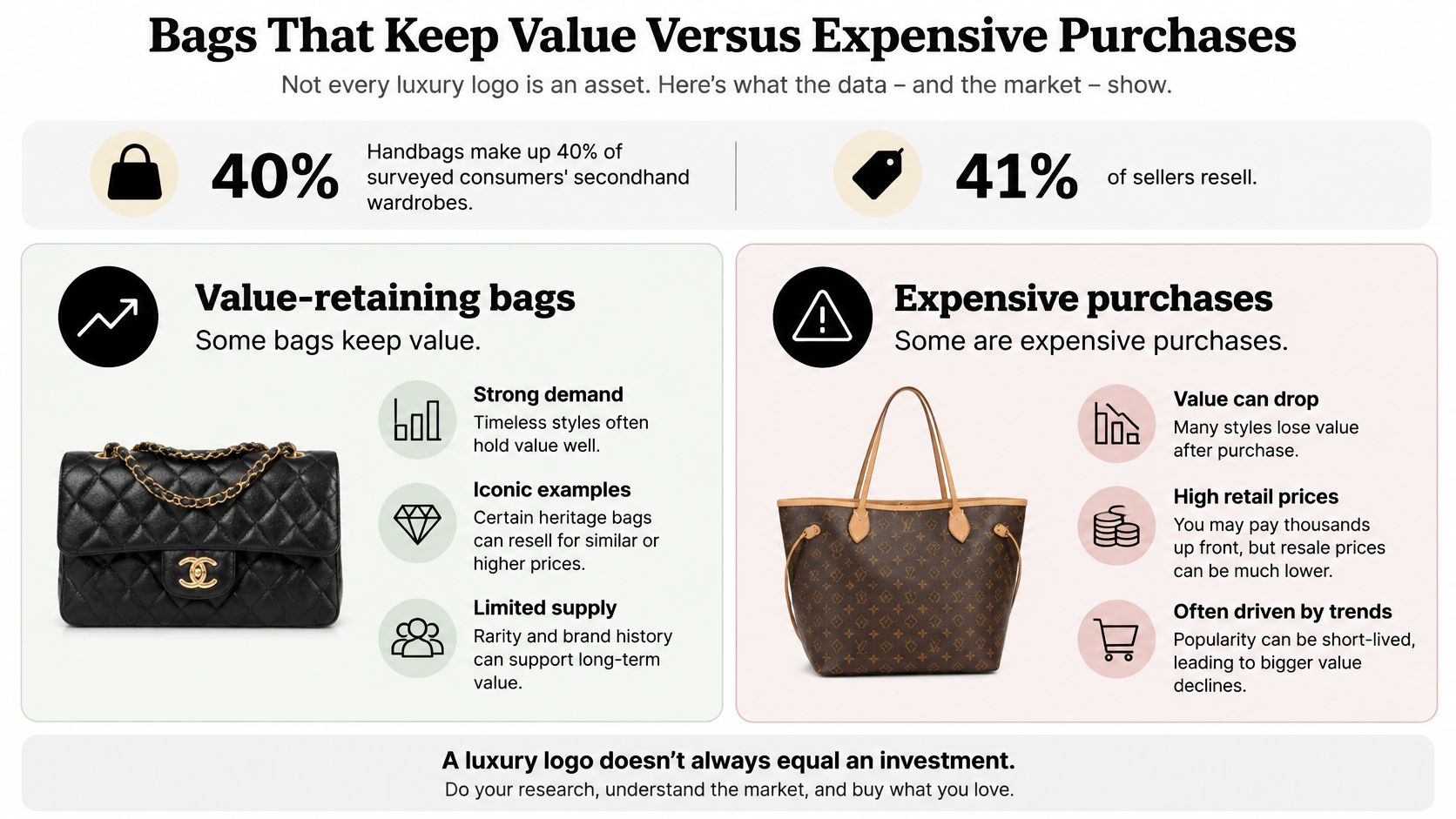
Why the Original Birkin Is an Outlier
The Birkin story began with a 1981 Air France conversation between Jane Birkin and Jean-Louis Dumas, then Hermès's artistic director. Birkin needed a larger carryall, and the pair reportedly sketched one on an airsickness bag. Hermès completed the prototype in 1985, and Birkin used the original through 1994.
The prototype's documented connection to the design's creation sets it apart from an ordinary production bag. Its auction result reflects that provenance, not a likely resale outcome for every Birkin.
Investment test: Compare what you paid with what you can actually receive, not with the highest asking price you can find.
Count the Whole Ownership Cost
Record the original price, a defensible current resale range, size, color, condition, repair history, and accompanying box or cards. Then estimate the net after selling costs. A high asking price is not the same as money in your hand.
A clean, scarce Kelly might clear its purchase price. A worn seasonal Gucci or common Prada tote may have delivered excellent service while remaining a poor financial investment. Use the brand row to identify the house, then judge the exact model and condition. For a Boise sale, compare that estimated net with a local counter quote for the bag and any gold you might sell in the same visit. This guide to selling a designer handbag can help organize the preparation.
For an estate, don't divide the original retail total among heirs and call that present value. Create a model-specific inventory and compare items using a consistent selling method. A bag's brand is a starting point, not its price.
How to Authenticate a Pre-Owned Luxury Handbag
About one-third of American luxury consumers bought or sold through a resale platform in 2025, according to Business Insider's examination of luxury resale. Buyers and sellers need more than confidence in a familiar logo.
Original packaging can support a transaction, but a box doesn't prove the bag inside it is genuine. Equally, a missing receipt doesn't automatically disqualify an authentic bag. The inspection must account for repairs, replaced components, and gaps in ownership records.
Use this visual checklist as an orientation, not a substitute for model-specific examination.
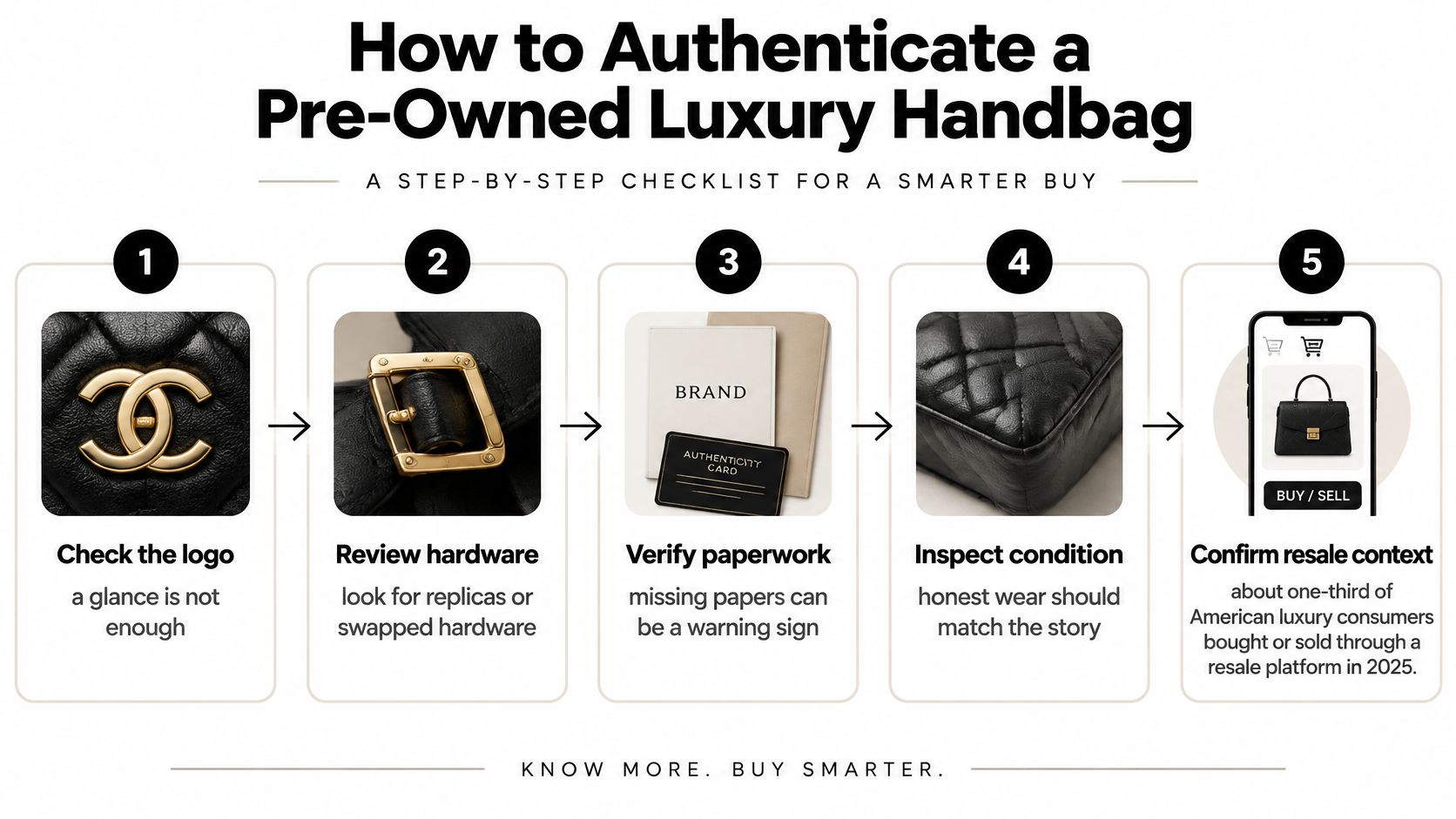
Follow a Documented Inspection
- Name the exact bag. Establish model, size, and material before judging details. Otherwise, you might compare a legitimate variation with the wrong reference.
- Inspect model-specific construction. Compare leather or canvas, edge paint, stitching, and hardware with appropriate examples. Heavy hardware and even stitching alone don't establish authenticity.
- Read identifiers in context. Evaluate date codes, chips, serial information, or heat stamps against the relevant model-year reference. Don't apply one era's format to another.
- Compare the ownership records. Check receipts, boutique stickers, and the seller's account for consistency. Record gaps instead of inventing an explanation.
- Identify replaced components. Photograph straps, feet, pulls, and zippers that appear different. A replacement may reflect legitimate repair, but it still needs disclosure.
- Create a condition record. Photograph corners, handles, lining, and hardware in even light. Avoid filters that conceal discoloration or surface damage.
- Write the conclusion and its basis. Use pass, fail, or needs review, supported by observations. An unresolved detail should prompt specialist review rather than a confident guess.
Keep Evidence Separate From Assumptions
Counterfeit awareness also matters elsewhere in a luxury estate. If fragrances are included, the perfume authenticity tips from Gotham Fragrances provide a separate product-specific resource. Perfume checks shouldn't be transferred to handbags, just as handbag rules shouldn't be treated as universal authentication tests.
For a visual companion to the inspection process, consider the following video.
Authenticity reduces fraud risk; it doesn't set the price. An authentic bag can still have limited buyer demand, incomplete accessories, or expensive damage. Keep the authenticity determination separate from the valuation so neither buyer nor seller mistakes a genuine-item finding for a financial guarantee.
Condition Details That Change a Resale Offer
Full-grain leather retains the hide's outer grain and can develop patina while preserving strength. Top-grain leather is lightly corrected and remains durable, while bonded leather and heavily coated weak substrates are more vulnerable to peeling and cracking, as explained in Main Street Collective's leather construction guide.
Those categories help explain service life, but they aren't enough to price a used handbag. Inspect what remains functional today, not merely what the material was called when new.
Examine the Parts That Carry the Load
Use clean hands, good daylight, and a soft surface. Don't apply cleaner or conditioner before documenting the bag, because treatment can alter the appearance of wear.
- Identify the surface. Record the exact leather, coated canvas, nylon, or other textile when known. Don't guess from texture alone.
- Check handle attachments. Look for stretched holes, loose stitching, splitting, and distortion where the handle joins the body.
- Inspect folded edges gently. A brittle coating may show cracks during normal movement. Never force an old fold open.
- Follow the seams. Note unraveling, uneven repairs, worn thread, and separated edge finishing.
- Operate the closure normally. Test zipper alignment and fastening without overfilling or pulling harder than ordinary use requires.
Corner abrasion, stretched handles, glazing cracks, odor, interior staining, tarnish, and lining separation each create a practical objection. Some require restoration; others affect which buyers will consider the bag. Prior repairs need assessment too, especially if they changed color, shape, or original components.
A famous model with structural damage can be a less useful purchase than a plainer bag in sound condition.
Material Alone Doesn't Predict Resale
A designer-bag resale analysis hosted by Brown University found a statistically significant leather-versus-non-leather price difference, with a t-statistic of -9.386 and p-value of 8.37e-20, and leather had the lower average resale price in that sample. That doesn't establish that canvas is universally superior. It shows why paying a premium for material alone is unsafe.
Judge brand demand, exact model and size, color, condition, accessories, provenance, and likely selling time together. Net realizable value means expected proceeds minus authentication, cleaning, repair, platform, shipping, and negotiation costs.
Photograph every wear point before requesting an offer. Clear disclosure lets buyers distinguish cosmetic aging from structural trouble and makes any condition deduction easier to discuss.
How Gold and Jewelry Offers Are Tested
A karat mark gives a first clue to a piece's gold content. The Federal Trade Commission's jewelry guidance advises checking the mark and says representations of metallic content, weight, quality, price, and value must be truthful. A stamp is a starting point; ask how the buyer confirms the metal and calculates the offer.
Understand What the Instrument Measures
X-ray fluorescence, or XRF, analyzes elemental composition without cutting into an item. Results typically arrive within 3 to 30 seconds, and modern instruments can closely match fire-assay results for standard 9K-to-22K jewelry, according to VRXRF's gold-analyzer guide.
XRF reads the surface and near-surface layer. Thick plating or cladding can hide a different core, so a buyer may use complementary specific-gravity or ultrasonic testing when a piece raises questions. Metal testing also does not authenticate a stone. For green-stone jewelry, a guide to distinguishing real jade from imitations explains a separate part of the assessment.
Ask for a Written Offer Breakdown
A written breakdown makes the calculation easier to follow. Ask the local buyer to state the test method, weight, purity, and deductions, then check each item against the offer.
- Record the weight and mark. Note the grams and visible karat marking.
- Confirm purity by testing. Ask how unexpected results or mixed components affect the assessment.
- Name the valuation method. Ask how the current gold price relates to the offer.
- List deductions. Separate any stone-removal, repair, or other charges.
- Clarify transaction terms. Ask about applicable refund, return, and final-sale terms before accepting.
The FTC's comparison-shopping advice for simple gold jewelry emphasizes gram weight, current gold price, and refund or return policies. Designer workmanship, stones, and collectible interest may add value beyond the metal content, so compare the complete written offer rather than judging it by a gold rate alone.
Sell in Boise or Ship the Bag Online
A local sale, a shipped marketplace listing, and consignment place different demands on the seller. Compare the expected proceeds after fees and the time and handling each route requires.
| Path | Speed | Typical cost or friction | Best when |
|---|---|---|---|
| Buy locally | Same day when available | Inspect the bag before paying; ask about the return policy | You want to examine condition in person |
| Consign | Weeks or longer | Commission and waiting for a buyer | The model is scarce and you can wait |
| Ship to an online marketplace | Listing plus transit | A marketplace fee, plus insurance, tracking, and signature costs | A national buyer pool may offset the fees |
| Sell locally in Boise | Same visit when accepted | No shipment; compare the full net with the online quote | You also have gold or jewelry to sell |
One jewelry-marketplace example charges a 15% referral fee on the total sale price, including shipping, according to LitCommerce's online jewelry-selling guide. That rate is not a universal handbag fee. Check the platform's terms for the relevant category before estimating proceeds.
Other possible charges include listing, payment processing, promotion, or final-value fees. A valuable shipment may also require tracking, insurance, and a signature. If a parcel is disputed, payment can be delayed while the claim is addressed.
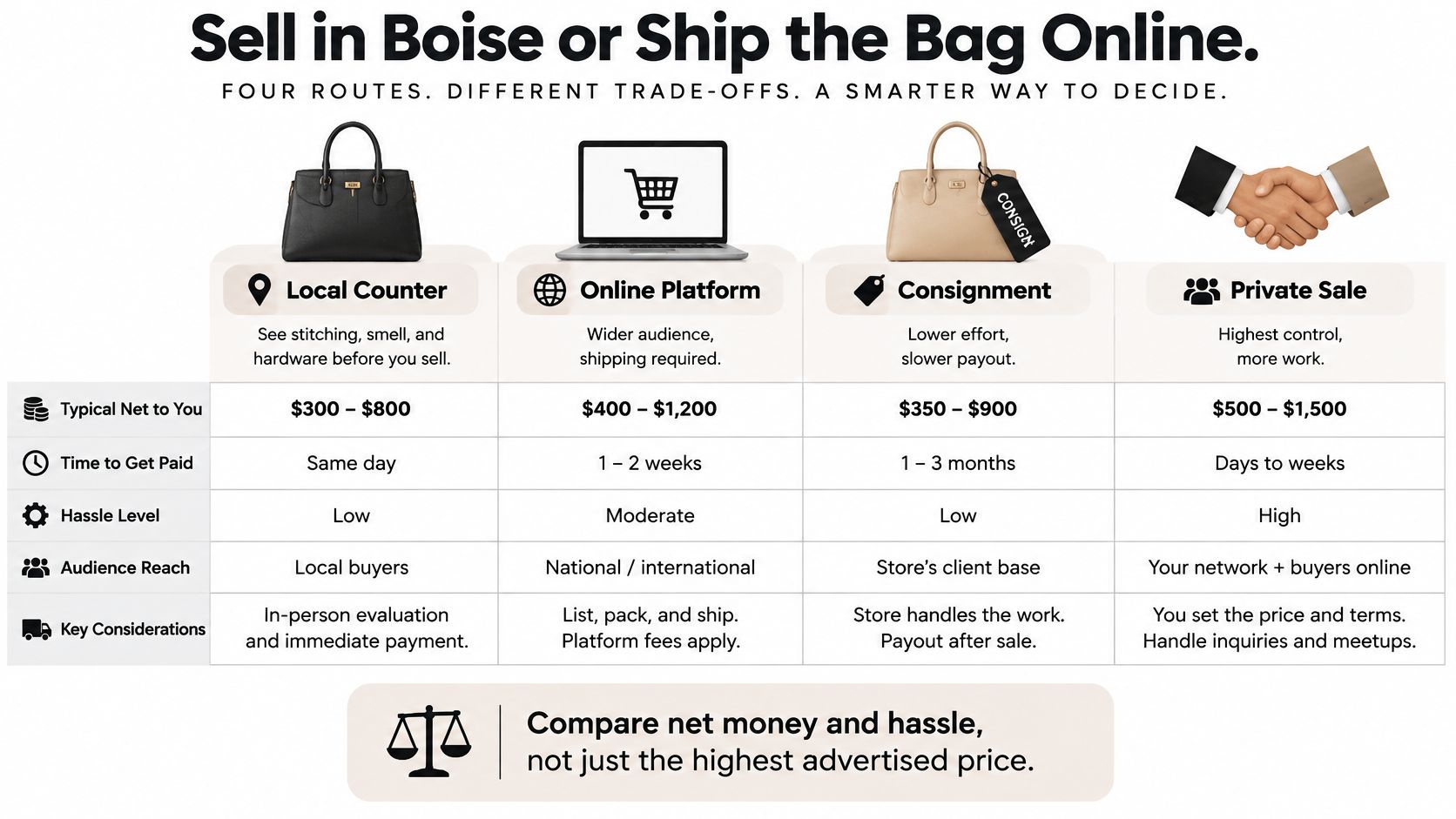
Choose the Route That Fits the Bag
Buying locally lets you examine stitching, smell the interior, and operate the hardware before paying. Ask about the return window and exclusions; terms can differ between pre-owned items.
Consignment can suit a seller willing to wait for a buyer. Before leaving the bag, check the commission schedule, who can approve markdowns, withdrawal terms, and payment timing.
An online marketplace may work if access to more buyers is likely to make up for its costs. Private selling gives you more control over the asking price, while leaving you to manage inquiries, payment safety, and disputes.
Put the Boise Quote Beside the Shipped Quote
Carat 24 buys luxury handbags, gold, and jewelry at 3780 W. State St. in Boise. A local counter offer can be compared with the expected proceeds from shipping the bag.
For a Louis Vuitton piece, this guide to where to sell your Louis Vuitton bag can help frame the comparison. Bring an outside quote with its fees and shipping obligations, rather than comparing a local offer with another seller's asking price.
Decision rule: Compare the local offer with the shipped net after fees, insurance, and other costs. Choose based on the proceeds and the handling each option requires.
Get a Local Offer on Your Bag and Gold
A brand name alone does not determine a handbag's resale value. Bring the bag and any supporting documents to a local buyer, then compare the offer with what you would keep after online selling and shipping costs.
Prepare for One Useful Visit
Bring the handbag and any dust bag, box, receipt, detachable strap, keys, or other original accessories you still have. You can also bring gold or diamond jewelry for assessment during the same visit.
Use this checklist to keep the comparison clear:
- For the handbag: Ask how the model and condition affect the offer, and whether missing accessories change the amount.
- For the jewelry: Ask how it is assessed and what deductions affect the offer.
- For comparison: Bring an outside quote that lists fees and shipping obligations.
- For your decision: Write down the local offer and expected online proceeds side by side.
If you are comparing an outright sale with another type of transaction, this guide to a pawn shop for handbags can help you frame questions before agreeing to terms.
Bring the items and documents together to 3780 W. State St. in Boise. A clear comparison helps you judge the local offer against the amount you would keep from another selling route.
Carat 24 - Trusted Gold Experts buys luxury handbags, gold, and jewelry. Bring your bag, accessories, jewelry, and complete outside quote to Carat 24 - Trusted Gold Experts to compare the local offer with your expected proceeds after shipping and selling fees.
