
A troy ounce of fine gold weighs 31.1035 grams. The troy ounce gold price is the U.S.-dollar benchmark for that amount of pure metal, the reference behind headlines and dealer quotes.
The benchmark works like a wholesale price tag: useful for orientation, separate from the cash that reaches your hand. A buyer tests the karat to establish gold content, weighs only the payable portion, subtracts a dealer spread, and may deduct shipping or other selling costs. What remains is the net payout.
A record quote can make a jewelry box look richer than the offers it produces. Whether you are selling a broken bracelet, sorting an estate, or comparing a Boise counter offer with a mail-in advertisement, separate fine-gold value from the cash offered for your piece.
What the Troy Ounce Gold Price Measures
A troy ounce weighs 31.1034768 grams, roughly a tenth more than the 28.3495-gram avoirdupois ounce on a kitchen scale. That gap catches sellers who weigh a chain on the "oz" setting: a 10-ounce reading equals about 9.11 troy ounces. Weigh in grams, then convert.
The benchmark quote describes a wholesale market, and its terms explain why your jewelry will never match it directly. The London Bullion Market Association's precious-metal benchmark guide describes a U.S.-dollar price per fine troy ounce for unallocated gold delivered in London, with eligible metal at least 995 parts per thousand, or 99.5% fine, auctioned at 10:30 a.m. and 3:00 p.m. London time each business day. The guide dates the official gold benchmark to 1919 and the current electronic auction to March 20, 2015. A price formed in that market works like a wholesale lumber quote: a reliable yardstick for material value, even though a single board at the local yard always costs something different.
Convert the weight before calculating value
Troy ounce conversions at an example spot price
The arithmetic below applies an example price of $4,506.29 per fine troy ounce, an illustration rather than a live quote or a purchase offer. Values assume fine gold and are rounded.
| Measure | Grams | Troy ounces | Example fine-gold value |
|---|---|---|---|
| 1 troy ounce | 31.1034768 | 1 | $4,506.29 |
| 1 gram | 1 | 0.0321507 | $144.88 |
| 1 pennyweight | 1.55517384 | 0.05 | $225.31 |
| 1 avoirdupois ounce | 28.3495 | 0.911458 | $4,107.29 |
| 1 kilogram | 1,000 | 32.1507 | $144,880.59 |
A pennyweight is one-twentieth of a troy ounce. One buyer may quote per gram while the next quotes per pennyweight, and the two numbers can describe the same valuation in different clothing. Ask which unit an offer uses before comparing it with another buyer's figure.
The guide to what a troy ounce means can help you recognize the units that appear on bullion listings and buying receipts. For your own worksheet, grams are usually the simplest starting point, because they keep jewelry weight separate from fine-gold content.
Practical rule: Write the current quote, its time, and its unit beside your calculation. A correct conversion attached to an old price still produces an outdated estimate.
Don't multiply the total weight of a jewelry collection by the fine-gold gram value. A bracelet's scale weight can include alloy metals, stones, and other non-gold components that no buyer will pay for at gold rates.
A record troy ounce quote is a benchmark, and the distance between it and a seller's check is measurable. Tested purity, payable weight, assay results, product premiums, refining costs, and the dealer's spread each take a slice, and what remains after shipping and other selling costs is the amount that reaches your hand.
Melt Value From Karat Weight and Spot
Melt value estimates the value of the gold contained in an item before a buyer's deduction. Start with the metal weight eligible for valuation, not the gross weight of everything attached to the piece.
Use this formula:
Fine troy ounces = payable metal weight in grams ÷ 31.1035 × karat ÷ 24
Then calculate:
Estimated melt value = fine troy ounces × the selected gold price
“Payable” needs careful handling. Fine-gold content is the result of the purity calculation, while the amount the dealer pays may include a further deduction. Ask the buyer to distinguish those figures rather than using the same word for both.
The Federal Trade Commission's jewelry-buying guidance explains that 24K is pure gold, 18K contains 18 parts gold and 6 parts other metal, and 14K contains 14 parts gold and 10 parts other metal. It also advises buyers to look for a manufacturer's name or U.S.-registered trademark near the karat mark and not buy a piece lacking that identifying mark.
Read karat as a fraction
Karat share and value of 10 grams at the example spot
These are calculated illustrations using the dated benchmark, not offers.
| Karat | Gold fraction | Example melt value of 10 grams |
|---|---|---|
| 24K | 100 percent | About $1,449 |
| 18K | 75 percent | About $1,087 |
| 14K | 58.33 percent | About $845 |
| 10K | 41.67 percent | About $604 |
For a hypothetical 10-gram 18K chain, multiply the weight by its gold fraction before applying the fine-gold price. That gives 7.5 grams of fine gold, with an illustrative melt value of about $1,087 at the example benchmark. A buyer's cash offer is a separate calculation.
A 22K item follows the same arithmetic: its stated karat represents approximately 91.7% gold. You don't need a separate pricing method for every stamp.
Remove what isn't gold
Stones, enamel, and steel components don't become gold because they're attached to a gold setting. A buyer should explain whether those components were removed, separately weighed, or accounted for through an estimated deduction.
Plated and gold-filled articles require different treatment from solid-karat jewelry. Their markings describe construction, and applying a solid-gold fraction to their entire weight can badly overstate recoverable metal.
Use gold-purity testing guidance to understand why a stamp is a starting clue rather than a settlement. Finally, keep melt value separate from collectible value. A signed jewel or desirable coin may deserve a different kind of evaluation.
Spot Price Versus a Dealer Cash Offer
How different quotes sit against spot
| Quote or offer | Versus spot | What changes the gap |
|---|---|---|
| LBMA Gold Price | The benchmark itself | London auction, 99.5 percent fine or better |
| Bullion dealer buyback | Slightly under spot | Spread, bar size, brand recognition |
| New coin or small bar retail | Over spot | Fabrication premium and retail demand |
| Scrap jewelry buy | Under fine-gold spot | Karat, stones, refining, assay |
| Online mail-in payout | Headline minus costs | Shipping, insurance, fees, payment wait |
The table describes common pricing relationships, not guaranteed terms. A desirable collectible can trade differently from ordinary bullion, and an unusual transaction deserves an item-specific explanation.
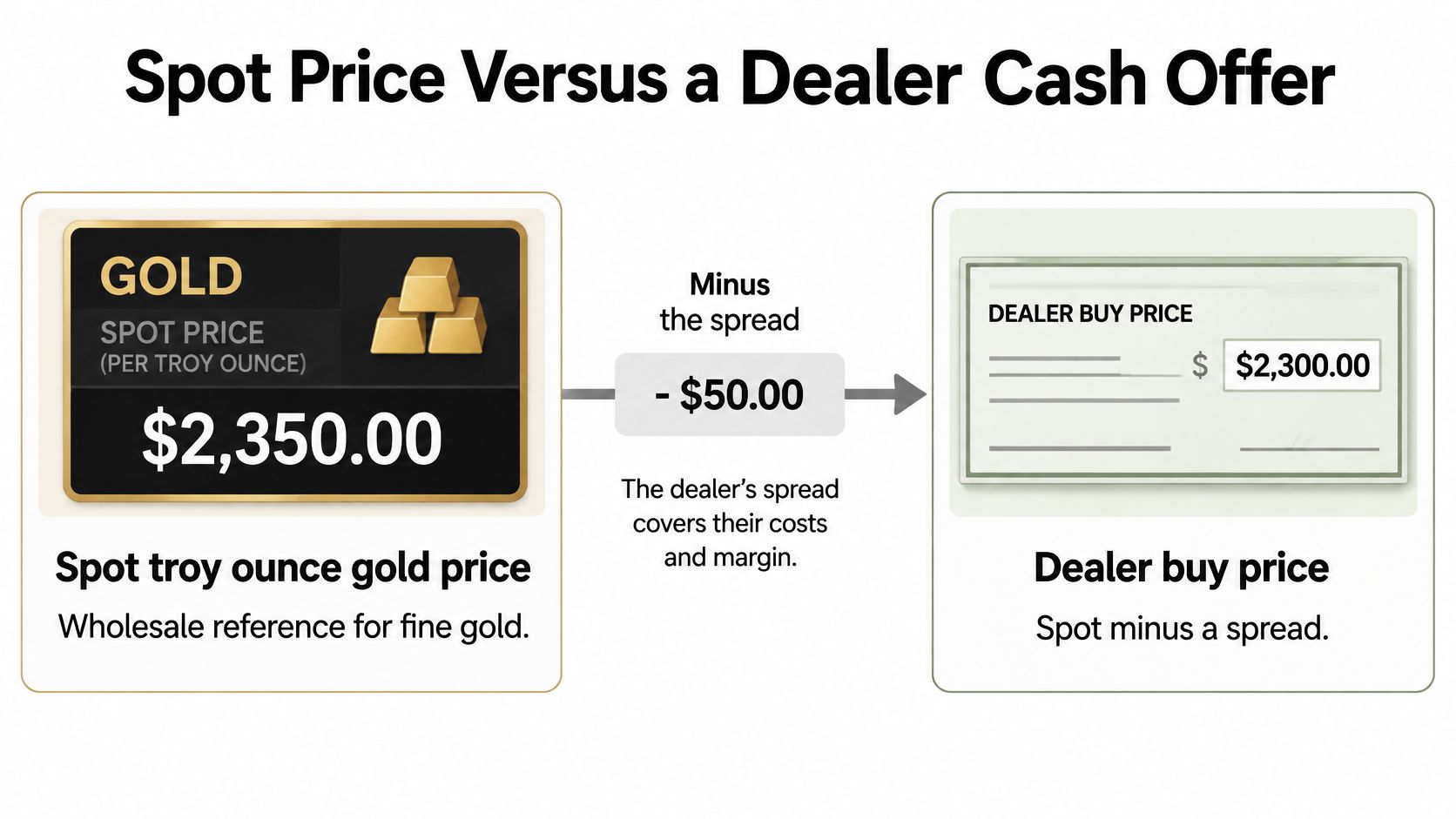
The price-board number and the check answer different questions. Spot describes a market reference for fine gold. A dealer buy price describes what a particular business will pay to acquire your item under its terms.
This illustration shows the basic difference between those figures.
Understand which side of the transaction you're seeing
A bullion buyback reflects what the dealer can resell or process and the margin needed to handle the purchase. Recognizable bars and popular coins can be simpler to evaluate than unfamiliar pieces, although recognition alone doesn't guarantee a particular payout.
A retail coin listing answers the opposite question: what a customer pays to buy. Its premium may cover fabrication, distribution, and demand for that product. Comparing that retail listing directly with an offer for your used jewelry mixes two different transactions.
Scrap jewelry requires another adjustment. The buyer is evaluating tested metal content rather than paying the fine-gold quote against the item's full scale weight. Ask whether any processing deductions are already included in the offered percentage or will appear separately.
A high advertised rate isn't necessarily a high settlement. Compare the amount you can actually keep under the complete offer terms.
Ask for the figures behind the check
A transparent offer should identify:
- Reference price: Which gold quote did the buyer use, and when?
- Tested purity: What composition did the buyer find?
- Payable weight: What weight remains after non-gold material is excluded?
- Payment basis: What share of calculated melt value is being paid, with what additional deductions?
Price Matching should compare like with like. A written, item-specific net offer is more useful than a screenshot advertising payment “up to” an unspecified rate.
For mailed transactions, also ask when the price becomes binding and what happens if you reject the final assessment. The return terms can matter as much as the opening advertisement.
Forces That Move the Daily Gold Quote
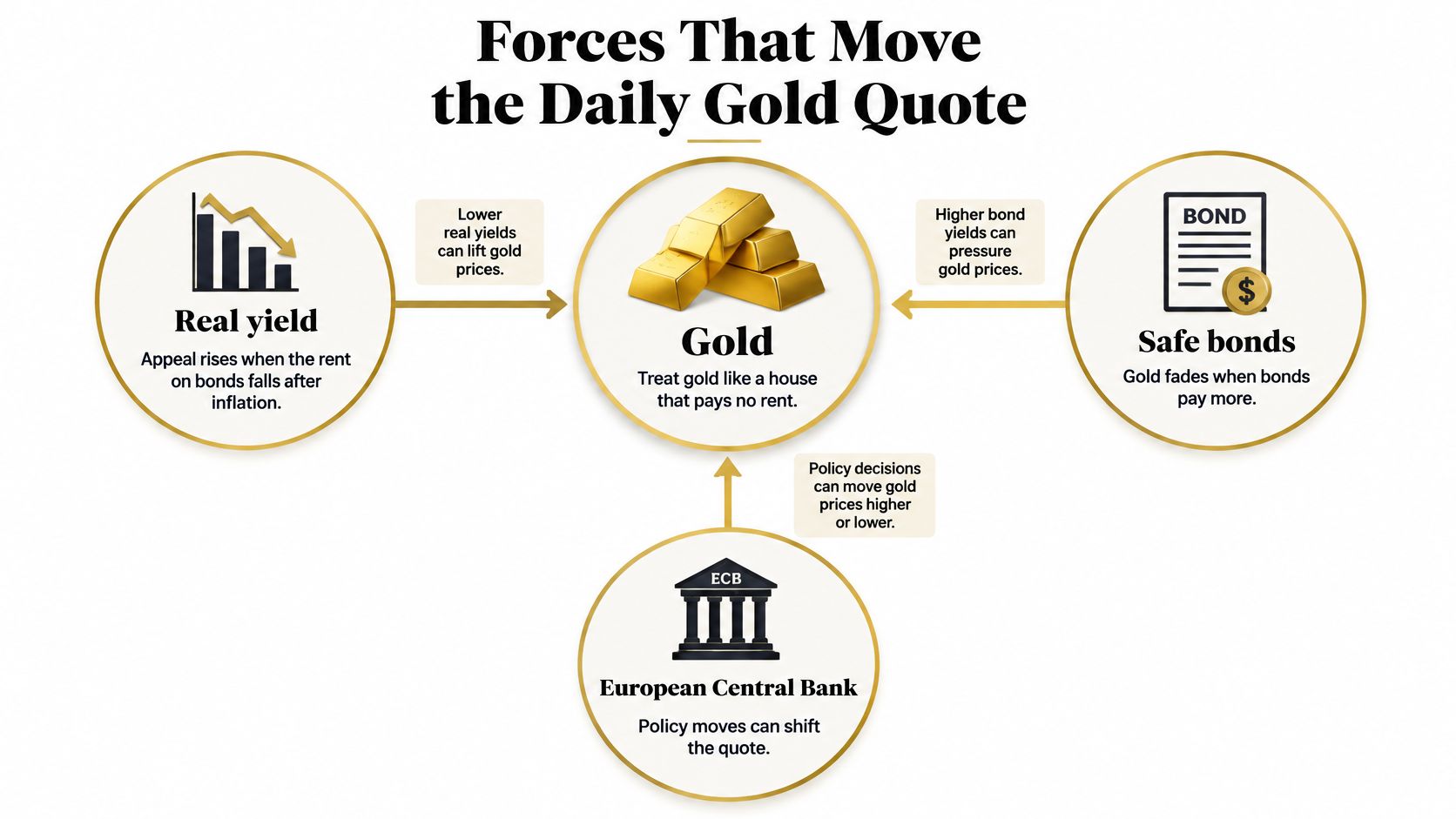
Think of gold as a house that pays no rent. You might still want to own it, but its appeal changes when another asset provides more income without requiring you to give up comparable security.
Gold produces no interest or dividends. That makes opportunity cost, the return you forgo elsewhere, important when investors decide how much to hold.
The diagram highlights the relationship between income-producing alternatives and gold.
Why yields matter without explaining everything
The European Central Bank's analysis of gold-price drivers identifies real yields, nominal interest rates, inflation expectations, and geopolitical risk as important influences, noting a negative relationship between gold prices and real yields from 2008 through early 2022 that weakened after Russia's invasion of Ukraine.
A real yield is a bond's return after accounting for inflation. When inflation-adjusted Treasury yields rise, investors may find those securities more attractive relative to gold. When real yields fall, the income sacrificed by holding gold becomes less compelling.
That relationship isn't a mechanical trading rule. Investors may buy gold because they're worried about geopolitical disruption, even while another financial indicator would ordinarily point toward lower demand.
Currency movements also affect comparisons. A dollar-denominated increase needn't translate into the same increase for someone measuring wealth in another currency. For a Boise seller paid in dollars, the relevant starting quote is the dollar price, not a foreign-currency headline.
This video offers another way to consider the market context behind changing quotations.
Keep market changes separate from item changes
The practical question isn't whether you can predict every policy announcement. It's whether the offer uses a timely price and correctly evaluates what you own. A broader explanation of what affects gold prices can help you interpret a moving quote without treating every news story as a selling instruction.
A rising screen price does not mean:
- Higher purity: Your ring hasn't gained gold content.
- A guaranteed continuation: An afternoon increase doesn't establish tomorrow's direction.
- Less need for verification: A favorable market doesn't replace testing or an itemized offer.
You can understand why a quote moves without needing to forecast its next move. That's enough to make a more informed selling decision.
Why a Record Quote Is Not a Sell Signal
The World Bank recorded an April 2024 monthly gold price of $2,331.45 per troy ounce. A later, higher reference still doesn't tell you whether selling a particular possession is the right decision.
The World Gold Council's demand summary reports that 2025 recycling rose only 3% to 1,404 tonnes despite a 67% increase in the U.S.-dollar gold price, alongside 863 tonnes of central-bank purchases and total demand including over-the-counter activity above 5,000 tonnes. Its Q2 2026 figures place the LBMA average at $4,506.29, 37% above Q2 2025, while recycling fell 6% year over year.
High prices don't eliminate reversals
The historical cycles below are documented in the World Gold Council's historical perspective on gold bear markets. They're nominal U.S.-dollar moves, not inflation-adjusted purchasing-power comparisons.
Major nominal gold moves per troy ounce
| Period | Direction | Approximate level |
|---|---|---|
| August 1971 to November 1974 | Up 353 percent | About $184 |
| November 1974 to August 1976 | Down 43 percent | $104 |
| August 1976 to September 1980 | Up 541 percent | Toward the 1980 peak |
| September 1980 to June 1982 | Down 52 percent | $667 to $318 |
| August 1999 to August 2011 | Up 612 percent | About $1,814 |
| August 2011 to December 2015 | Down 42 percent | About $1,060 |
| April 2024 monthly average | World Bank print | $2,331.45 |
| Q2 2026 LBMA average | 37 percent above Q2 2025 | $4,506.29 |
A high quote can coexist with reluctant sellers. People may need cash, expect another increase, dislike transaction friction, or value the object more than its metal.
Your choices are practical:
- Sell now: Appropriate when the net proceeds meet a real cash need.
- Appraise first: Sensible when a coin, signature, brand, or unusual design could add value.
- Separate the categories: Evaluate ordinary scrap apart from collectible or sentimental pieces.
For help weighing whether to sell gold now, start with your purpose and the actual offer. A record quotation isn't a personal deadline.
Sell Locally for a Higher Net Payout
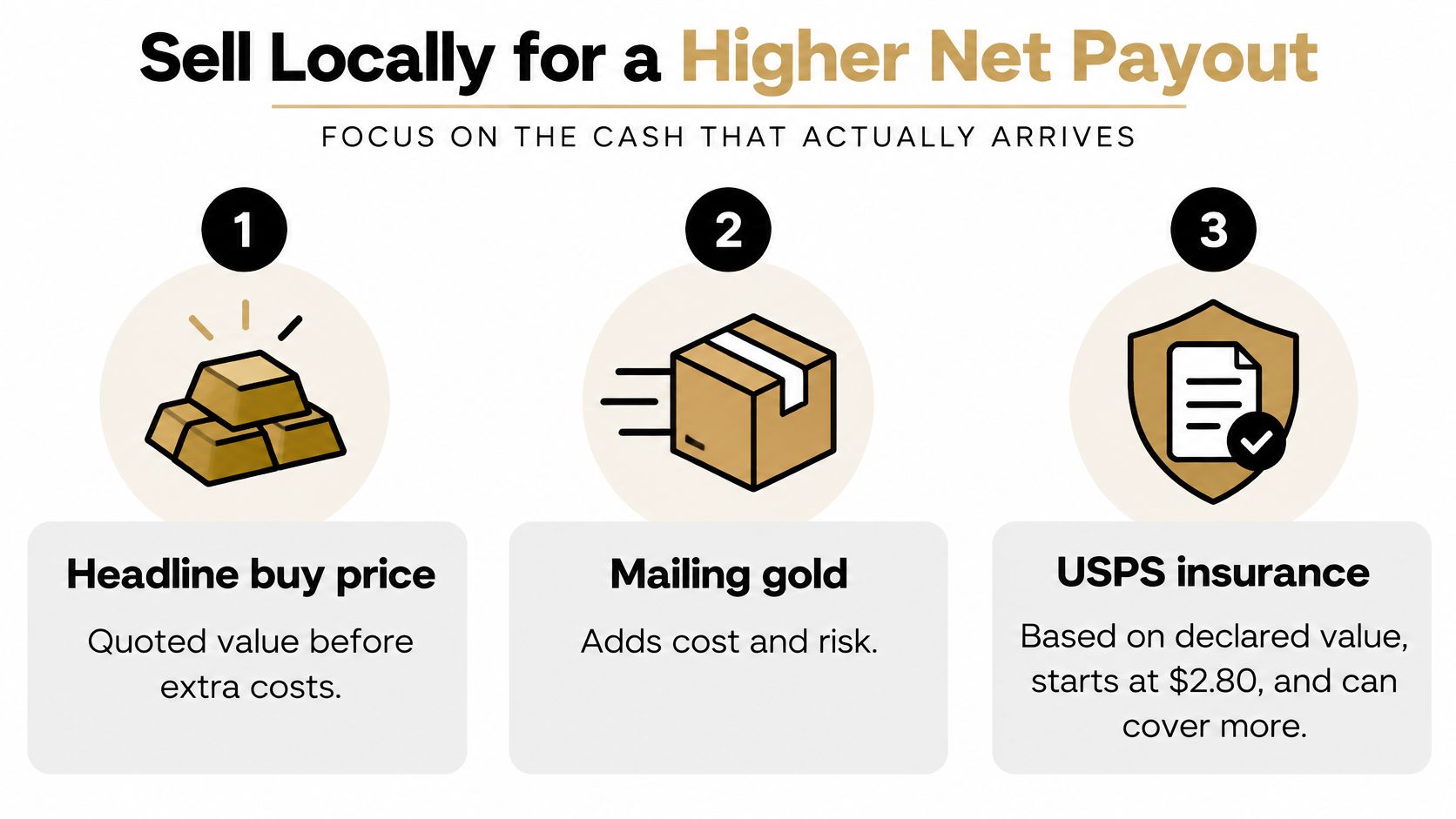
A mailed offer can look generous until the shipping math reaches your settlement. Packaging, postage, insurance suited to the value, and time spent resolving a dispute all come out of the same pot as the gold itself. The advertised quote works like a sticker price: the number that matters is what survives the trip to your bank account.
The USPS insurance and extra-services guide lists declared-value insurance starting at $2.80 with coverage up to $5,000, while USPS Ground Advantage includes only up to $100 of insurance in its basic price. Check eligibility, exclusions, and the coverage appropriate to your shipment rather than assuming the standard parcel price protects its full value.
This comparison keeps attention on the amount that reaches you.
Watch the testing and understand its limits
Local Gold and Jewelry Buying puts the scale and the tester in front of you, so you can discuss the item before deciding whether to part with it. Before you agree to sell, the evaluator should explain which testing method was used and what the result means for your metal content.
The Federal Trade Commission's Jewelry Guides call for truthful representations of metallic content, karat fineness, weight, and value. Testing supports that transparency, yet an X-ray reading still needs informed interpretation: a surface result alone may not establish the construction of a plated or otherwise unusual object.
Ask what method was used and whether further checks are needed. An evaluator should explain uncertainty rather than turn a single instrument reading into an unsupported guarantee.
Compare the settlement: A local offer is financially better only when its net exceeds the amount you would retain from the mailed transaction.
Use a written comparison
When choosing among local precious-metal dealers, ask for an item-specific offer rather than relying on a general rate advertisement. Keep the comparison simple:
- Local transaction: The amount offered after disclosed deductions.
- Mail-in transaction: The final payment after postage, insurance, fees, and other charges.
- Rejected offer: Any return cost, deadline, or condition that affects your ability to get the item back.
Before accepting, ask how long the offer stays open, whether you can decline it without charge, and whether a second test would change the number. Price matching is useful when both buyers have evaluated the same property on comparable terms.
Seeking the highest payout in Boise is a comparison exercise an advertisement alone cannot settle. Convenience has value, though it should never substitute for checking the arithmetic on a written net figure.
Choose Melt Appraisal or a Local Offer
A broken chain and a signed brooch can share a jewelry box without sharing a pricing path. One may be worth little more than its gold content, while the other can carry design, maker, or collector value that a scrap calculation would miss.
For ordinary jewelry without separate designer, stone, or collector value, tested metal content is the yardstick. You do not need to call a market peak; you need an offer that fits the item, is explained clearly, and compares well with the other routes available to you.
Match the decision to the item
| Item type | Useful next step |
|---|---|
| Broken, ordinary karat jewelry | Obtain a tested-weight melt-based offer |
| Dated coin with a mint mark | Check numismatic value before accepting scrap treatment |
| Signed or branded jewelry | Request evaluation of the complete piece |
| Luxury watch | Consider model, authenticity, condition, and completeness |
| Mixed estate jewelry | Sort potential collectibles separately from ordinary scrap |
Leave potential collectibles uncleaned and unpolished until they are evaluated. Original surfaces, patina, stamps, and small identifying marks can help an evaluator read the piece, while aggressive cleaning can remove evidence or raise new questions.
For an estate, keep receipts, boxes, certificates, appraisals, and family notes together. Those materials may help identify what an object is, even when they do not prove what it will sell for today.
Make the counter conversation specific
Bring the items, a photo ID, and any written competing offer. Ask the evaluator to connect the quote to the exact piece on the counter rather than to a broad advertisement.
Useful questions include:
- What was excluded? Ask how stones, clasps, solder, and non-gold components were treated.
- What remains uncertain? Clarify whether construction, plating, or authenticity needs another check.
- What am I accepting? Confirm the final payment and whether acceptance authorizes alteration or refining.
Ask for the local net in writing and keep the transaction record. Sell only the pieces whose metal, collector, or sentimental value you no longer want to hold; you can accept an offer for damaged jewelry and still take the heirloom home.
Bring your jewelry, bullion, or estate pieces to Carat 24 - Trusted Gold Experts at 3780 W. State St., Boise, where the team can authenticate them and prepare a written local offer tied to tested content and payable weight, so you can compare the cash you will keep rather than the troy ounce gold price on a screen.
