

You've found a pre-owned designer bag that looks right, feels substantial, and comes with a convincing story. Perhaps you're holding it at an estate sale, considering a private purchase, or deciding whether to sell a bag that's been in your closet for years. Before money changes hands, you need answers to separate questions: Is the bag genuine, and does the seller have the authority to sell it?
Designer handbag authentication addresses the first question. Purchase records, seller verification, and ownership documents address the second. A useful home inspection keeps those tasks separate, records the evidence, and stops short of claiming certainty where a specialist's examination is needed.
What to Inspect on Any Designer Handbag
The bag arrives with a dust bag, an authenticity card, and a seller who insists it came from a boutique. Those extras deserve examination, but they shouldn't determine your conclusion. Start with the bag itself and ask whether its materials, construction, markings, and claimed production period agree.
The uncertainty is real. In a nationally representative survey of 1,000 U.S. consumers conducted in 2022 for Business of Fashion Insights, 25% of luxury shoppers believed they'd previously purchased a fake luxury accessory or were uncertain whether they had.
Read the components together
Use this comparison as a screening guide, not a universal manufacturing specification. Genuine embossed leather can have a deliberately uniform grain, coated canvas isn't supposed to feel like untreated leather, and some legitimate patterns terminate at seams. The correct reference is the same model, material, and production era, not another bag bearing the same brand.
Handbag components: genuine signs and red flags
| Component | What a genuine bag usually shows | Red flag |
|---|---|---|
| Materials and leather | Consistent grain appropriate to the leather, natural variation where expected, smooth edge finish | Plastic-looking surface, uniform stamped grain where natural grain is expected, strong chemical smell |
| Stitching | Even stitch length and spacing, clean thread ends, consistent colour | Uneven or crooked stitches, loose thread, mismatched thread colour |
| Logo or monogram | Pattern alignment consistent with the model, clean printing or embossing, correct proportions | Unexpected pattern breaks at seams, blurry edges, wrong spacing or scale |
| Hardware | Weight appropriate to the component, crisp engraving, consistent plating finish | Unexpectedly light weight, soft or uneven engraving, plating that flakes or looks too bright |
| Lining and interior | Neat stitching, correct labels and fabric for the model | Glue residue, loose or wrong-font labels, mismatched lining fabric |
| Date code or serial | Format and placement matching the brand's system for that era | Wrong-era format, unreadable stamp requiring investigation, code on the wrong surface |
| Edges and finishing | Smooth, even paint or edge finishing with defined corners | Rough or bubbled edges, misplaced paint, uneven corners |
| Packaging and accessories | Dust bag, box, or card consistent with the model and era | Generic packaging, poor printing, accessories that don't match the bag |
Run your inspection into less visible areas: underneath zipper pulls, inside pockets, behind strap attachments, and along the base. Compare thread colour between exposed and protected seams, allowing for fading and repairs rather than assuming every difference proves counterfeiting.
For additional examples to guide your questions, consult OneTrendyCloset bag authentication insights. Use online guides to identify details worth examining, not to substitute for model-specific evidence.
Practical rule: Photograph before judging. Capture every side, the interior, and each identifier so you can compare the evidence without relying on memory.
Documenting Provenance and Ownership
A genuine handbag can still have an unclear ownership history. An authentication certificate generally addresses what the bag is, not whether the current seller owns it or has permission to sell it. The Salars provenance and authentication guide distinguishes physical authentication from lawful provenance and clear title. Keep those questions separate: convincing construction does not establish a seller's right to transfer the bag.
A receipt connects a purchase to a transaction, but it does not automatically connect today's seller to that purchase. Missing paperwork does not prove wrongdoing; it does leave a gap that the seller should be able to explain through other credible records.
Build an ownership file
Gather records that show who acquired the bag, how it changed hands, and who can authorize the current sale.
- Purchase record: Request the original receipt, order confirmation, or another identifiable transaction record.
- Seller identity: Verify the seller's full name and identification, and handle personal information securely.
- Previous transfers: Ask for resale receipts, gift records, or a clear explanation of earlier ownership.
- Import documentation: Request relevant records if the transaction history involves importation.
- Estate authority: Ask for documents showing that the executor or heir has authority to sell.
If an estate bag has a receipt in someone else's name, establish the connection between that purchaser, the estate, and the person conducting the sale. A name mismatch alone is not proof of fraud, but an unexplained mismatch leaves ownership unresolved. Ask for records that bridge the gap before proceeding.
A dust bag and a seller's story may accompany a genuine item, but neither documents the ownership trail. Request a written transaction record identifying both the seller and the bag before committing. For a local sale, the guide to where to sell a Louis Vuitton bag can help organize the selling process.
Preserve the chain of custody
Keep a dated log of who handled the bag, where each inspection took place, and which photographs were taken. Record identifying wear, repairs, and included accessories. These details help distinguish the inspected item from another similar bag if questions arise later.
When a seller points to a website or a certificate issuer, find that issuer's contact details independently through its official site or a public directory rather than relying on a message the seller supplied. You can also assess online claims with Maxijournal as a separate resource for evaluating claims found online.
Pause the deal if you cannot verify the seller, the documents describe a different model, or someone pressures you to skip records. Authentication can support a conclusion about the bag's identity; it cannot, by itself, establish lawful ownership or authority to sell.
Step-by-Step Inspection and Home Test Limits
A home inspection can flag contradictions, but it cannot certify a bag or establish the seller's right to sell it. Keep those questions separate: physical features help identify the item, while ownership records address the transaction. Set the bag on a clean, dry surface under bright, even lighting. Have a phone camera, a soft cloth, and a 10x loupe ready. Avoid solvents, abrasive cleaners, heat, and scratch tests, which can damage the bag or erase evidence.
Use this visual guide to structure a preliminary check.
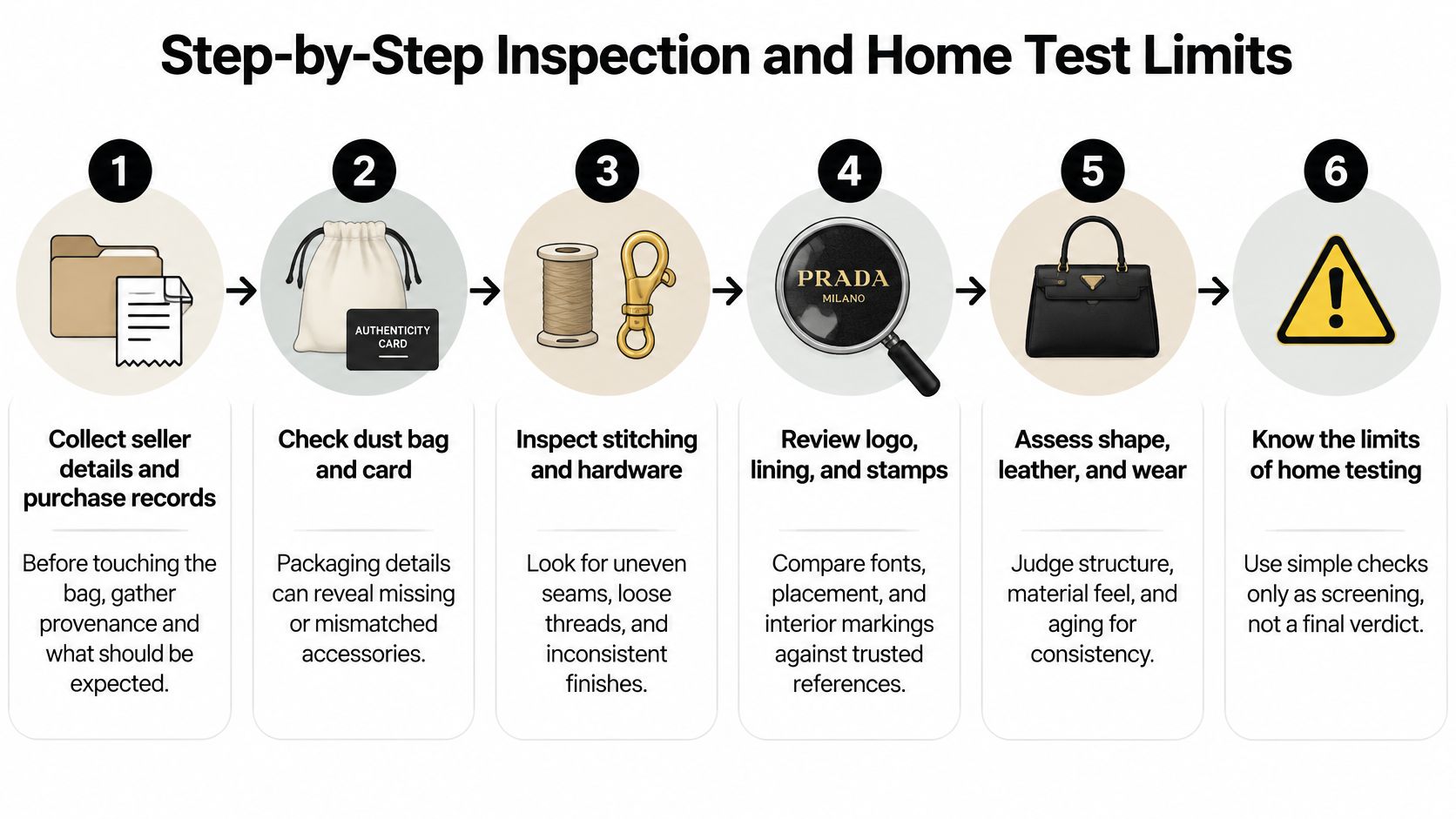
Follow a repeatable routine
- Collect the context first. Gather the seller's details, purchase records, dust bag, and any card before handling the item. The claimed history gives you a basis for judging whether the bag and its accessories fit together.
- Identify the exact model, era, and size. Confirm the material and configuration as well. Hardware, markings, and construction can vary between versions, so a reference for the wrong model can mislead.
- Inspect construction under magnification. Check stitch spacing, glazing, edge paint, handle attachments, and corner reinforcement. Look for consistency across the bag rather than treating one attractive seam as proof.
- Examine the hardware. Check the finish, engraving, clasp operation, zipper markings, and weight in your hand. Inspect undersides and backs, not only the visible faces.
- Compare with verified references. Use photographs of authenticated examples from the same model and production period. A matching logo does not resolve a contradiction elsewhere, such as an interior detail that differs.
- Check identifiers last. Compare date codes, serial elements, or embedded technology with the physical findings. Treat identifiers as supporting evidence, not as a reason to overlook conflicting construction.
The Virginia Commonwealth University anti-counterfeit handbag poster discusses microscopy and combining independent identification technologies rather than relying on a removable identifier alone. A loupe helps screen visible details, but it cannot replace specialist material imaging.
If two or more features contradict each other, stop and seek another opinion. A skipped model check, an inspection limited to the front, or a conclusion based on one imperfect stitch can all produce a weak result. A receipt may support a transaction history, but it does not settle conflicting physical evidence.
Understand what home tests actually establish
Home tests and their limits
| Home test | What it can suggest | Where it falls short |
|---|---|---|
| Visual symmetry and stitch count with a loupe | Obvious construction errors or inconsistent stitching | Genuine production can vary, and good copies may match stitch counts |
| Hardware weight and feel | Components that feel clearly lightweight or poorly finished | Repairs may use different hardware; weight alone is inconclusive |
| Smell and glue residue | Strong chemical odour or visible interior glue | Genuine bags may smell neutral, and some fakes are clean |
| Date-code lookup against references | A format or era inconsistent with the model | Codes can be copied, and references may be incomplete |
| Authenticity card or chip | An accessory or identifier inconsistent with the model and era | Cards and chips can be transferred, removed, or copied |
| UV light on adhesives and edges | Unexpected adhesive or finishing patterns | Repairs and restoration can produce similar effects |
| Magnet test on hardware | Attraction where a verified component should be non-magnetic | Alloy and plating differences prevent a universal pass-or-fail rule |
Technology results also need context. A 2025 Dataintelo market analysis reports 97.3% AI accuracy versus 85% for human authenticators, while 42% of consumers prefer combined AI and human verification for purchases above $5,000. These figures do not establish the reliability of a particular app or determine whether the bag in your hands is genuine.
A digital product passport can record origin and repair information, but its record must correspond to the physical item. Verify the issuing system independently and compare its information with the bag rather than treating a digital record as conclusive.
Use the video as a demonstration aid, not an authentication verdict.
An uncertain result is not proof of counterfeiting, because a bag that cannot be identified is not necessarily fake, so record unresolved findings in writing and avoid cleaning away evidence. If you are considering a pawn shop for handbags, keep those findings with your records and seek a second opinion before relying on a home check.
Brand-Specific Red Flags to Check First
Louis Vuitton deserves careful model-era comparison. In 2024, it accounted for 32.76% of luxury-goods submissions to Entrupy and was described as the report's most frequently counterfeited brand by FashionUnited. That submission share isn't the proportion of Louis Vuitton bags that are counterfeit.
Goyard also warrants close attention: 18.4% of Goyard St. Louis Totes submitted to Entrupy in 2024 were identified as fakes, according to AlchemPro's report. For a St. Louis, examine the chevron print and coating alongside the bag's overall construction.
Start with the house's construction conventions
First checks and common red flags by brand
| Brand | Check first | Common red flag |
|---|---|---|
| Louis Vuitton | Monogram alignment across seams and date-code format for the model's era | Unexpected pattern breaks, wrong-era date code, or incorrect code format |
| Goyard | Chevron pattern alignment and canvas coating | Pattern continuity inconsistent with the model; glossy or stiff, plastic-looking coating |
| Chanel | Quilting symmetry, chain and hardware weight | Uneven quilting diamonds, unexpectedly lightweight chain, mismatched hardware finish |
| Prada | Triangle logo attachment, stitching where applicable, and nylon texture | Glued or uneven triangle where inconsistent with the model; unnatural nylon sheen or texture |
| Hermès | Saddle stitching where expected and edge finishing | Machine-like stitching inconsistent with the expected technique, uneven edge paint |
| Other designer brands | Model-specific photographs from a trusted source | Unexpected pattern or logo breaks and no matching reference for the claimed model and year |
These are starting points, not universal rejection rules. A Louis Vuitton pattern can legitimately be interrupted by a seam or component. What matters is whether the interruption agrees with the construction of that particular model.
For Chanel, place the bag upright and examine the quilting across the flap, body, and pocket where the design calls for continuity. Then inspect the chain's finish and leather interweaving, if present, rather than relying on the front clasp alone.
With Prada, first establish which material and logo configuration belong to the model. With Hermès, don't equate hand stitching with sloppy stitching or machine-like regularity with automatic proof of a fake. Examine stitch angle, tension, edge work, and the surrounding construction together.
A red flag gives you a reason to ask a better question. It doesn't, by itself, supply the answer.
Use current, verified reference photographs of the correct historical version, not merely the newest product listing. The overview of luxury handbag brands can help identify the house and style before you seek a narrower comparison.
A perfect logo on a bag with implausible hardware and inconsistent seams still warrants a second opinion. Brand familiarity should sharpen your examination, not shorten it.
Buying and Selling Checklist
At the point of purchase or intake, use a written checklist instead of making a decision while the seller waits. Separate observations from conclusions: a replaced clasp is an observation; counterfeit is a conclusion requiring further evidence.
Keep this checklist with the transaction photographs.
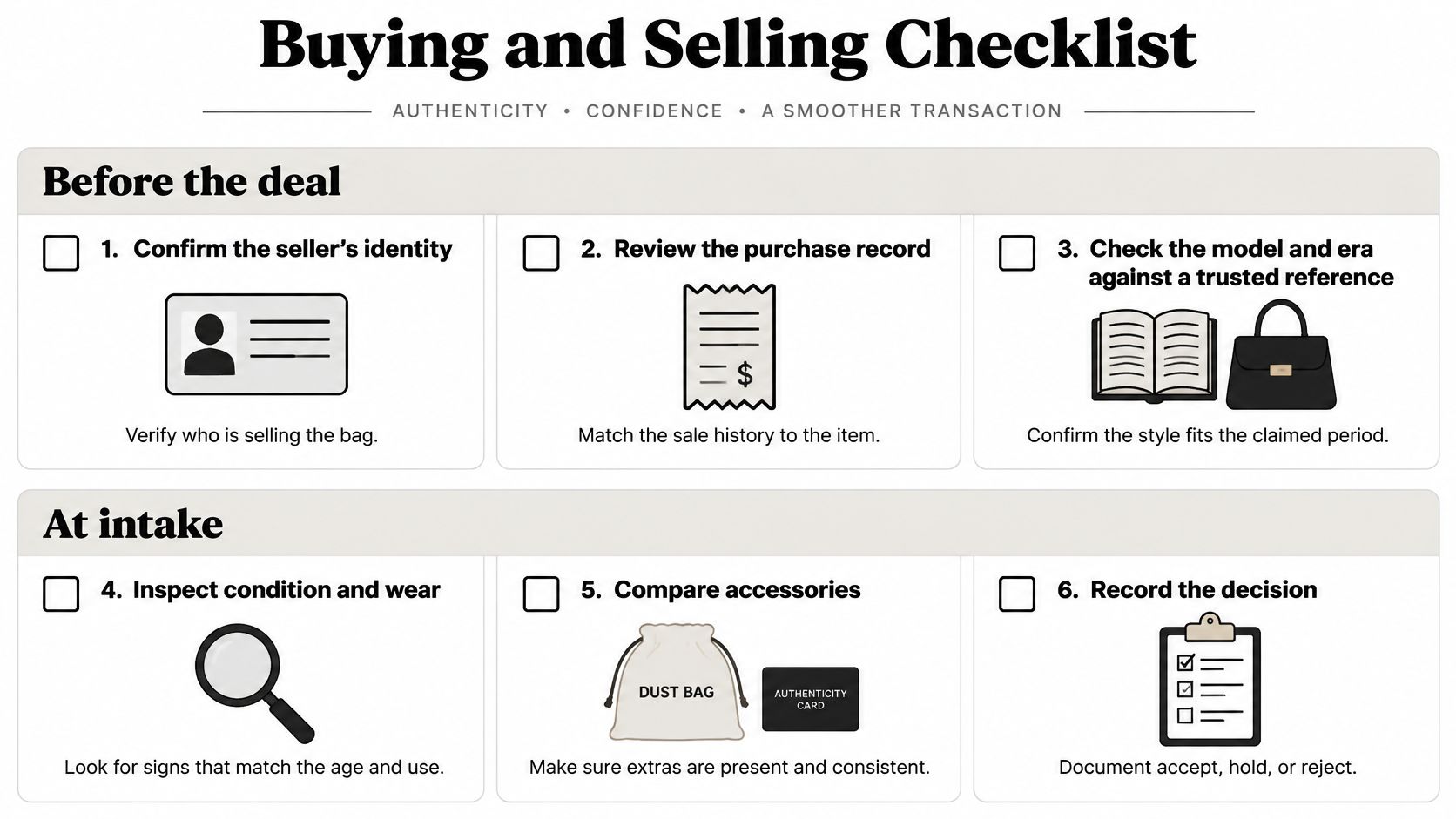
Before the deal
- Verify identity: Confirm who is selling the bag.
- Review the record: Match the purchase history to the item presented.
- Establish the version: Check the model, material, size, and era against a trusted reference.
- Agree on recourse: Obtain the return or refund policy in writing.
During inspection
- Photograph the exterior: Capture the front, back, sides, base, handles, and corners.
- Record the interior: Include pockets, lining, labels, and identifier areas.
- Document details: Take sharp photographs of hardware, seams, stamps, and accessories.
- Note contradictions: Describe each discrepancy without immediately assigning a verdict.
- Disclose alterations: Identify known repairs, recolouring, replacement parts, and restoration.
Before pricing or making an offer
- Grade confidence: Mark the preliminary assessment high, medium, or low.
- Hold unresolved pieces: Keep contradictory items separate from stock represented as authentic.
- Seek review: Obtain an independent opinion when the value or uncertainty justifies it.
- Write the decision: Record accept, hold, or decline with the evidence supporting that choice.
Sellers should keep the receipt, dust bag, and any card together while describing condition accurately. Buyers should request an itemized receipt that identifies the bag and records the seller's representations, rather than accepting a vague description.
For help preparing the sale itself, consult how to sell designer handbags. A useful decision record explains why you proceeded, including what remained uncertain and how that uncertainty was resolved.
Get a Professional Check Before You Buy or Sell
A professional review is useful when a handbag represents a significant purchase, an inspection turns up conflicting evidence, or you need a documented opinion. For resale models from brands such as Louis Vuitton and Goyard, choose someone familiar with the production details of those bags.
Ask what the review covers, how the examiner compares the bag with relevant references, and how uncertain findings are reported. Written findings should identify the item examined and explain the basis for the conclusion. Authentication answers what the bag is; it does not establish whether the seller has the legal right to sell it. Treat physical evidence, provenance documents, and the seller's authority as separate questions.
What a local examination adds
Carat 24 in Boise assesses luxury handbags alongside fine jewelry, gold, silver, and bullion. Its handbag authentication service offers local buyers and sellers an opportunity to discuss a bag in person instead of relying only on listing photographs.
Bring any previous opinion, including an inconclusive one. Ask the reviewer to separate authenticity findings from condition observations and valuation. Ownership records matter too, but they answer a different question from whether the bag is genuine.
Before accepting an offer: Request the assessment notes and purchase offer separately. Knowing what the item is and deciding what you will accept are distinct decisions.
Gold and Jewelry Buying during the same visit
Carat 24 also buys and sells precious metals and jewelry. Any discussion of metal testing applies to jewelry, not to a handbag's leather, canvas, or construction. Bruker's precious-metals testing guidance describes X-ray fluorescence as a method used to assess precious-metal composition.
For gold jewelry, check for a karat-quality mark and the accompanying company name or registered trademark. The FTC's jewelry-buying guidance cautions buyers about gold jewelry with a karat mark but no accompanying trademark. Ask for clear terms before agreeing to a sale. The FTC Jewelry Guides address truthful representations of jewelry content, quality, weight, price, and value.
A local transaction may avoid packing and shipping, but it does not guarantee a better offer. Compare the terms and net offers, and review the buyer's reputation, policies, and receipt details before completing a transaction. The FTC's jewelry-shopping guidance covers those practical checks.
Bring the handbag, receipt, dust bag, any card, and ownership documents to Carat 24 - Trusted Gold Experts for an in-person assessment. Request the authentication notes and any offer in writing before deciding.
